

Key Takeaways
Pick a dream that makes you grin, even if the odds feel ridiculous
Choose for desire, not certainty. Neill invites readers to select one project they would love to bring into the world, even if they think success is unlikely. The project should produce a real-world result, not merely a feeling or a promise to improve oneself. It should also be worth spending time on even if the outcome disappoints. His rule of thumb is that the goal should feel almost laughably ambitious, with hard work alone unlikely to guarantee it.
Make the dream playable. A project can begin as a fanciful possibility, then grow through testing and commitment. Before choosing, ask whether the goal is an end in itself or just a route to something else. Commit simply: Neill compares it to booking a passage before knowing every detail of the journey. A 90-day frame supplies a useful game, not a guarantee or a deadline imposed by nature.
The useful move is to separate ambition from prediction. A goal can be worth pursuing because it reveals what someone cares about, even when the outcome is uncertain. That is different from insisting that desire makes the result likely. The book's emphasis on one project also guards against a familiar failure of attention: spreading effort across many attractive plans until none receives enough sustained work. The 90-day frame is best treated as a container for experimentation, not a test of personal worth.
Start before you know the route; creation reveals its next step
Expect a messy middle. Neill describes creation as a movement from an unformed possibility into a finished thing. It often begins with playful exploration, or “mucking about,” such as sketching, drafting, or talking through an idea without demanding a polished result. Then comes sustained work, sometimes followed by absorbed creative flow, and finally the act of releasing the work into the world.
Do not mistake effort for failure. The middle can feel less magical than the initial inspiration. Neill recalls how Victor Hugo reportedly made writing unavoidable by having himself shut in with his materials until he had produced pages. The point is not to copy that extreme tactic, but to recognize that an idea does not become a book, product, or business simply because it arrived. Begin with a small action, keep working, and decide when the creation is ready to leave your hands.
This account joins two often-separated pictures of creativity: inspiration as discovery, and craft as repetition. The first explains why beginning can feel surprising; the second explains why completed work usually requires ordinary labor. That combination is more credible than either romantic extreme, the genius who never practices or the technician who expects procedure alone to generate novelty. The reminder to release a project also matters: endless polishing can disguise fear of evaluation. Still, completion standards should fit the work. A private sketch and a safety-critical product cannot share the same threshold.
Treat feelings as weather, not a verdict on your ability
Notice the mind's role. Neill's inside-out understanding says that people experience life through thought, rather than receiving feelings directly from events. He explains this through three principles: Mind, the intelligence or vitality behind life; Consciousness, the capacity to be aware; and Thought, the creative process that gives experience its momentary form. These terms are the author's spiritual model of how experience works, not a project-management checklist.
Use feelings without obeying them. In Neill's train-station analogy, thoughts are like trains carrying a person toward different emotional destinations. Distress is a cue to notice the thinking currently shaping experience, not automatic proof that the project is doomed or that the person lacks ability. The practical implication is to allow moods to shift and keep attention on the task. Neill's example of golfers argues that performance need not wait for a perfect emotional state.
The model can reduce a costly habit: treating a temporary mood as a forecast. It has an affinity with psychological approaches that encourage people to notice thoughts without fusing their identity to them. That can create room to act while anxious or discouraged. The boundary is important, though. Feelings sometimes carry useful information about fatigue, danger, conflict, or unmet needs. A low mood should not automatically dictate withdrawal, but neither should it be dismissed as meaningless. The strongest application is to question emotional certainty while still checking the facts.
Measure commitment by showing up, not by feeling confident
Give direction, then locate yourself. Neill calls inner knowing an “Inner GPS,” a metaphor for guidance that becomes useful when a person can name both a destination and their actual present position. He recommends describing the destination clearly, then recording observable facts about current progress rather than judging the project by whether it feels promising.
Take the next available step. His two-part creation formula is to begin moving toward the desired result, then respond to what appears along the way. When Neill wanted a pedestrian crossing near his London home, he did not know how to secure one. He contacted a local representative, learned that a feasibility study required 1,000 signatures, and began gathering them. A café owner offered to host the petition. The process took more than two years, but it began with an action rather than a complete plan.
This is a practical account of adaptive planning. A clear destination helps orient effort, while attention to current conditions prevents a plan from becoming a fantasy that ignores new information. In that sense, the GPS image is less about supernatural certainty than feedback: act, observe, update. The crossing story illustrates how small steps can recruit other people and resources. It also highlights a limit of the book's framing: some goals depend on political, financial, or institutional constraints that persistence alone cannot remove. Responsiveness helps navigate constraints, but does not erase them.
Make work more productive by engaging fully, not merely staying busy
Track reward, not motion. Neill defines productivity as the return received for effort, rather than the amount of activity performed. A crowded calendar, constant email, and long hours can create the appearance of progress without producing much of value. He argues that engagement and enjoyment can improve the quality of attention, making work feel less like a forced march and allowing fresh ideas to surface.
Use the engagement loop. Neill describes enjoyment and involvement as reinforcing one another: interest draws attention into the task, and fuller participation can make the task more interesting. His story about neuroscientist Candace Pert shows this in action. Instead of resenting her repeated delays in writing a book foreword, he made playful offers that helped keep the exchange warm and eventually got the foreword in time. The lesson is not to enjoy every chore on command, but to bring curiosity and full attention where possible.
The distinction between busyness and output is especially relevant in work built around communication, where activity is easy to count and value is harder to see. The proposed enjoyment-engagement loop also resembles the conditions often associated with deep concentration: a task holds attention, and attention makes the task more absorbing. Yet enjoyment is not a universal prerequisite for useful work. Caregiving, maintenance, and difficult administrative tasks may remain unpleasant. The practical question is whether the task can be redesigned, shared, or connected to a purpose, rather than whether every worker can simply choose to like it.
Treat failure as feedback, then return to the experiment
Separate learning from self-judgment. Neill argues that people often avoid trying because they interpret mistakes as evidence about their character. Yet learning unfamiliar skills requires repeated attempts that do not work. He offers a framework called the Four Quadrants of Creation, organized around two questions: how much a person wants the result, and how much competence they currently have. Low desire and low skill may signal an irrelevant area; high skill but low desire can produce success that feels empty; high desire with low skill marks a learning curve; high desire and skill can support mastery.
Let thinking settle. An aerospace team faced a demand to halve production time on a military project, from 18 months to nine. After weeks of fruitless problem-solving, the leader announced they would stop. Engineers returned with fresh ideas, and the project was completed on time and within budget. A pause can create room for insight, but it does not replace skill-building or action.
This takeaway gives failure a diagnostic role without glorifying it. The commitment-and-competence grid helps distinguish a skill gap from a goal that was never genuinely wanted, which can prevent needless self-blame. The engineering story also suggests that cognitive pressure can narrow a team's search, while rest may widen it. However, a breakthrough after stopping is memorable partly because it is unusual; pauses do not guarantee insight. A sound practice is to alternate deliberate effort with recovery, then test new ideas against evidence rather than treating an intuitive answer as automatically correct.
Build momentum through repeated requests, not perfect plans
Give the project a flywheel. Neill uses the flywheel image for momentum: early effort may produce little visible movement, but repeated pushes can make continued progress easier. One exercise asks participants to take and track 100 actions toward their project. An action can be small, and it counts even if it does not work.
Ask other people to participate. Neill also recommends “massive action,” which he illustrates as making specific requests that could move a project forward. A nonprofit leader in his example made more than 100 requests in a week and received positive responses to over half; within three months, the organization had tripled its prior year's fundraising. For evaluation, he contrasts project-specific Key Performance Indicators, such as calls or revenue, with Universal Performance Indicators, or UPIs: inspiration, engagement, and lightness. These internal measures can reveal whether the process remains alive, though they do not replace outcome data.
The flywheel idea captures a real coordination effect: repeated outreach creates more chances for information, introductions, and collaboration than private planning can. Tracking actions also makes progress visible before a lagging result appears. Pairing that record with external indicators and internal ones is a useful safeguard, since neither tells the whole story alone. The caution is that high activity can become its own vanity metric. One hundred requests matter only if they are relevant, respectful, and connected to a worthwhile result. Volume should create learning and access, not pressure people into saying yes.
Own your 51 percent, and let uncertainty keep the route open
Take responsibility without pretending to control everything. Neill borrows a “51 percent” estimate from sports-marketing executive Bill Goldstein, who felt he had a slight edge in shaping outcomes, but not total control. The figure is a metaphor for active participation amid uncertainty, not a measured probability. The project depends on effort, skill, other people, changing conditions, and chance.
Stop treating the imagined future as a fact. Neill tells of a restaurant owner who felt trapped because he believed the business could not survive without him. Once he questioned that prediction, he could consider leaving without assuming the business was doomed. The book's counsel is to act toward a desired future while staying open to outcomes that cannot be forecast. That includes taking calculated risks: assess what is actually at stake, distinguish it from imagined embarrassment or catastrophe, and look for ways to limit the downside.
The 51 percent image offers a healthier alternative to both control fantasies and helplessness. It encourages initiative while acknowledging that outcomes are co-produced by conditions beyond any one person's influence. This resembles decision-making under uncertainty, where robust actions are preferable to confidence in a single forecast. The metaphor should not be mistaken for a literal probability or a universal guarantee that effort gives someone the upper hand. Unequal resources and structural barriers matter. Its value is psychological and practical: take responsibility for the part that is yours, without claiming ownership of the whole system.
Finish in focused sprints, then recover instead of grinding forever
Match effort to the season. Near the end of the 90-day program, Neill offers three routes: sprint toward the original finish line, expand the project or its timeframe, or stop forcing the original target and follow the energy created by the work. None is presented as morally superior. The right choice depends on what the project needs and whether the creator still wants to pursue it.
Pair intensity with recovery. A sprint can make focused effort possible because the finish line is visible, but it is not a sustainable way to live indefinitely. Neill recommends building rest into the schedule and adjusting the balance as needed. At the end, he asks readers to review what they did, what now exists that did not exist before, what role they played, and what surprised them. The project is both a result to assess and a chance to learn how creation works.
The three routes make the program more flexible than a rigid promise to hit a target at any cost. They also distinguish persistence from stubbornness: continuing, extending, or changing course can each be a considered response rather than a verdict on character. The sprint model adds an important recovery principle, since short bursts of intensity can be useful while chronic urgency degrades judgment and health. Still, a deadline can create distortions, especially when others bear the cost of the sprint. Reviewing both the result and its consequences keeps ambition accountable.
Analysis
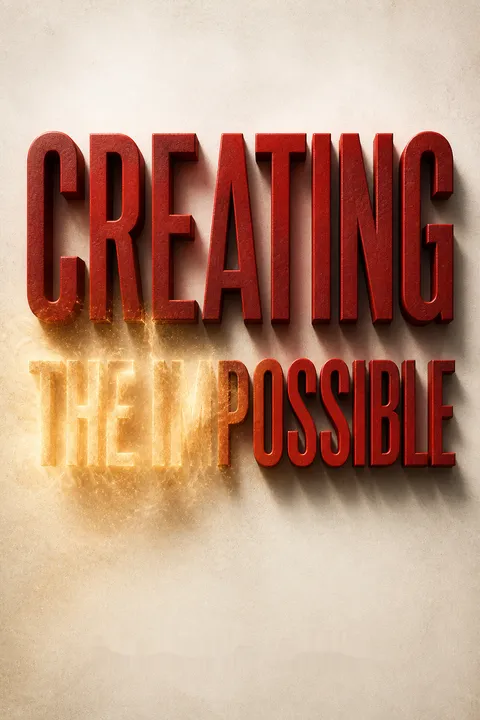
Creating the Impossible is a hybrid of spiritual psychology, coaching narrative, and a 90-day action program. Its central proposition is that people often mistake their current thinking for a fixed picture of reality, then wait for confidence, certainty, or a perfect plan before acting. The counterproposal is deliberately simple: choose a deeply desired project, begin, notice what emerges, and respond. Stories of a pedestrian crossing, an aerospace team, and a fundraising campaign give the approach a human scale and a practical edge.
The book's most durable contribution is not a claim that thought alone changes external facts. It is the behavioral permission to work without treating discomfort as a stop signal, and the tactical insistence that a project becomes real through repeated contact with the world. The distinction between busyness and reward, the use of factual progress measures, and the permission to pause or revise a goal all help translate inspiration into practice. Its 90-day structure supplies useful friction against indefinite daydreaming while remaining flexible enough to avoid turning the calendar into a moral test. The main conceptual tension lies in the inside-out claim that experience is wholly generated within the mind. As a description of perception, it can help loosen rigid interpretations. As a general account of hardship, it risks minimizing material conditions, illness, discrimination, or other people's conduct. A reader can preserve the useful insight without accepting the metaphysical claim literally: emotions and interpretations are mediated by thought, while external events and constraints remain real and consequential.
The book relies chiefly on anecdotes and coaching observations rather than controlled comparisons, so its dramatic examples establish possibility, not typical odds. Its strongest practical use is therefore experimental: take one ambitious but meaningful aim, track actions and results, protect recovery, and revise from evidence. The approach works best when openness to surprise complements, rather than replaces, planning, expertise, and attention to real-world risk.
Review Summary
Creating the Impossible receives mostly positive reviews, with readers praising its ability to inspire creativity and change perspectives. Many found it helpful for achieving goals and understanding the creative process. Some readers particularly appreciated the book's day-by-day approach and its emphasis on tapping into deeper wisdom. However, a few critics found it lacking substance or difficult to engage with. Overall, readers who connected with the book's message reported significant personal growth and success in their creative endeavors.
People Also Read




Glossary
inside-out understanding
Experience shaped through thoughtNeill's account of how people experience life: feelings and perceptions arise through thought, rather than being direct copies of external circumstances. The idea is intended to help readers see that current interpretations and moods can change, so they need not dictate whether someone acts. It is also a spiritual framework, not simply a claim about ordinary cognitive processes.
Three Principles
Mind, awareness, and thoughtThe three spiritual principles Neill attributes to Syd Banks. Mind refers to the intelligence or life force behind existence, Consciousness to the capacity for awareness, and Thought to the creative force that gives experience its content. Neill presents them as foundational elements of human experience, while acknowledging that the terms only approximate what they describe.
impossible project
An ambitious 90-day creationA personally meaningful result that feels unlikely or beyond the person's current sense of what is possible. In Neill's program, participants choose one project they want to bring into the world, engage with it over roughly 90 days, and track what they do and what emerges. The label is meant to stretch expectations, not guarantee completion.
Inner GPS
Intuitive guidance toward a goalNeill's metaphor for an inner capacity to sense a useful next step, especially when a project has no established route. The metaphor requires a clear destination and an honest reading of the person's current position. Rather than calculating every turn in advance, the creator acts on what seems appropriate and updates as new information appears.
effortless productivity
More reward per effortNeill's term for producing valuable results without assuming that greater output requires proportionally greater strain. It does not mean avoiding work. The approach emphasizes the quality of attention, genuine engagement, and enjoyment, while recognizing that sustained creative work still requires time and effort.
Universal Performance Indicators
Internal measures of project healthNeill's proposed measures for assessing progress across different kinds of projects. Unlike project-specific Key Performance Indicators, which track observable outputs such as revenue or calls, UPIs focus on subjective conditions he considers broadly relevant: inspiration, engagement, and lightness. They supplement external measures rather than establish whether a project has achieved its concrete goals.
Four Quadrants of Creation
Desire and skill combinedA framework that maps commitment, or how much someone wants an outcome, against competence, or their current ability to achieve it. Low levels of both may indicate an irrelevant area; skill without desire can yield incidental success; desire without skill creates a learning curve; and high levels of both support mastery. The framework helps identify whether a stalled effort needs clearer desire or skill development.
About the Author




Download PDF
Download EPUB
.epub digital book format is ideal for reading ebooks on phones, tablets, and e-readers.








