

Key Takeaways
Begin writing poetry before you feel qualified to call yourself a poet
Poetry is a practice. Fry treats poetry as an ordinary creative pursuit, not a gift reserved for the naturally brilliant or professionally published. Like painting, cooking, or playing music, it can provide pleasure even when nobody else sees the result. The book’s invitation is practical: English speakers already possess the basic material, language, and can learn how to shape it.
It is never too late. Fry points to Thomas Hardy, who began publishing poetry close to age sixty, and argues that beginning late is no reason to stay silent. The goal is not to win prizes. It is to find out what happens when a person tries.
What's striking is the book's reframing of artistic legitimacy: participation does not depend on public recognition. That idea makes creativity less like a career ladder and more like a form of play or skilled leisure. It also challenges the familiar belief that talent must announce itself early. The invitation has a useful limit, though: access to language is not the same as equal access to time, education, or encouragement. The book's emphasis on teachable craft helps address one barrier, but its deeper gift is permission to begin without demanding proof of future achievement.
Learn form as a tool for freedom, not a test of genius
Constraints create choices. Fry argues that metre, rhyme, and stanza patterns give a poem resistance to work against. A painter's canvas and a composer's musical structure do not prevent invention. Likewise, a poet can push a form, adapt it, or eventually devise a new one after learning how existing forms behave.
Start with the rules. Fry contrasts free verse with tightly patterned writing, but his practical point is broader than a preference for tradition: freedom without technique can leave a beginner with no useful way to revise. He recommends learning established forms as an apprenticeship, not a promise that every poem must obey convention.
The comparison to music and visual art clarifies why a constraint can be generative: it narrows the field of choices enough for deliberate decisions to become visible. In design, a fixed page size or limited palette can produce coherence rather than sameness. Still, constraints are not automatically liberating. A form can become a crutch, and free verse can be highly disciplined. The strongest version of Fry's case is that knowledge expands options. It does not require loyalty to any single aesthetic.
Listen for English stress before counting poetic beats
Speech supplies the rhythm. English gives some syllables more emphasis than others. Metre is the arrangement of those stresses into a recurring pattern, and a foot is a small rhythmic unit within that pattern. An iamb moves from a lighter syllable to a stronger one. Five iambs make iambic pentameter, the five-beat line that became central to English verse.
Hear it in context. The line has ten syllables in its most regular form, but the rhythm matters more than a mechanical count. Fry traces its long use from Chaucer through Shakespeare and Milton to later poets. He asks beginners to tap, speak, and mark lines so the pattern becomes audible rather than merely theoretical.
This method makes prosody embodied knowledge. A reader can feel a line's pulse before knowing its name, much as a listener can recognize a waltz without reading musical notation. That is a powerful teaching sequence because it begins with perception and adds terminology afterward. The account also wisely treats metre as a pattern of expectation, not a metronome that every word must obey. A technical scan is useful for noticing choices, but a living voice remains the final test of whether the rhythm works.
Use pauses and run-ons to make metre sound human
The line can bend. Enjambment occurs when a sentence runs beyond the end of a verse line. A caesura is a pause within a line. Both let a poet vary pace and emphasis while keeping the larger metrical pattern in place. Fry also shows how poets may alter an expected foot or add a light final syllable without destroying the line's underlying rhythm.
Form can act drama. In Shakespeare's Winter's Tale, a jealous king speaks in broken, stop-start phrases, while the sonnet promising lasting love proceeds with greater composure. The contrast shows that metre is not just decoration. Its regularity, interruptions, and pauses can make a speaker's state of mind audible.
The comparison between the king's fractured speech and the sonnet's steadier movement offers a compact lesson in form as characterization. The same principle applies beyond poetry: a pause in conversation can signal uncertainty, while an uninterrupted sentence can suggest confidence or urgency. The risk is over-reading every variation as intentional symbolism. A poet's choices matter, but not every irregularity carries a secret message. Scansion is most useful when it sharpens listening, not when it replaces it.
Make rhyme carry meaning, not merely satisfy expectation
Sound shapes thought. Rhyme can connect words and ideas, but it can also force a poet toward stale phrases or awkward syntax. Fry makes this danger vivid through William McGonagall's poem about the collapse of the Tay Bridge. Its weak rhymes drag the language into strained expressions and make the poem feel as if it is collapsing with the bridge.
A better fit matters. Alfred Tennyson's poem about the failed Charge of the Light Brigade uses a small group of recurring sounds to reinforce the charge's force and the event's grim irony. Fry also explains that rhyme need not be exact. Assonance repeats vowel sounds, while consonance repeats consonants, giving poets subtler ways to link lines.
Rhyme acts like a prediction: once a sound appears, the reader anticipates its return. That expectation can create pleasure, emphasis, or comic surprise, but it can also expose a weak word choice. This makes rhyme a useful diagnostic tool. If a line only works because a forced ending arrives, the sound pattern may be controlling the thought rather than serving it. The book's caution is not to avoid familiar rhymes at all costs. A natural, conventional rhyme can be stronger than an attention-seeking novelty.
Choose stanza shapes that suit the poem's movement
Stanzas organize attention. A stanza is a group of lines that functions like a room in a poem: it can hold one thought, create a pause, or set up a contrast with the next group. A quatrain has four lines; other stanza shapes use different counts or rhyme patterns. In terza rima, a rhyme links one three-line stanza to the next, creating a sense of forward motion.
Architecture changes emphasis. Chaucer's rhyme royal uses seven-line stanzas, while the eight-line ottava rima often supports narrative and comic turns. These are not just labels to memorize. Their patterns affect how long an idea can develop and where a reader expects closure.
The room analogy makes stanza form easy to apply: a break is a decision about pacing and grouping, not a typographic afterthought. Similar choices shape essays, music, and even the timing of a speech. A recurring stanza pattern can help readers navigate complexity, while a changed pattern can mark a shift in mood or argument. Yet a poem does not need a traditional blueprint to be coherent. The useful question is whether the grouping creates an experience the continuous page would not.
Let strict forms force fresh choices from familiar thoughts
Repetition can evolve. A villanelle returns to two key lines throughout its stanzas, so their meaning can shift as the surrounding poem changes. Dylan Thomas used the form for a poem about resisting death. A sestina takes six end-words and rearranges them through six stanzas, then gathers them into a short closing section. Elizabeth Bishop used this pattern to braid household detail, memory, and grief.
A sonnet makes room for argument. Its fourteen lines often turn from one perspective toward another. In Shakespeare's sonnets, that turn can make a private debate feel like a staged encounter between opposing thoughts. The forms are demanding, but their rules give a writer something definite to solve.
These forms behave like creative algorithms: repetition and rearrangement make a writer revisit material from new angles. That can reveal meanings that a looser draft would not produce. It also explains why formal poetry need not sound antique. A contemporary speaker can occupy an old pattern without adopting an old voice. The challenge is to keep the device from becoming the whole point. Technical ingenuity earns its place when the pattern intensifies the poem's thought or feeling, not simply when it proves the writer can follow instructions.
Make abstract ideas visible by turning them into concrete action
Poetry can embody an idea. Fry recounts how the young John Keats was struck by a phrase in Spenser that made a whale seem to push through the sea. The phrase mattered because it transformed a description into a vivid physical event. A poem can make an abstraction tangible in a similar way.
Words can stage what they describe. In Ted Hughes's poem about Wilfred Owen's photographs, an Irish parliamentarian calls for the navy's cat-o'-nine-tails to be brought into the chamber. The real whip is passed around, making the debate about punishment immediate and physical. The gesture turns an argument into an experience the politicians must confront.
The examples point to a central strength of art: it can move an idea from description into perception. A policy argument may remain remote until an object, gesture, or image makes its consequences hard to evade. This is not the same as claiming that vivid language proves an argument true. Concrete representation can persuade as well as clarify, so readers should distinguish emotional force from evidence. At its best, poetic embodiment heightens attention without pretending to settle every question.
Choose each word for its sound, history, and associations
Diction is material. Diction means a poet's choice of words. Fry urges writers to notice not only what a word means, but how it sounds, where it comes from, and what it suggests. Words for a smell, for instance, may share a basic definition while ranging from pleasant to repellent. Their connotations change the feeling of a sentence.
Listen beyond the dictionary. The poet should pay attention to stress, syllable length, alliteration, internal rhyme, and the physical difficulty or ease of saying a phrase. Fry recommends keeping a notebook, collecting language from daily life, and reading drafts aloud. A line may be technically correct yet fail because its words do not sound or feel right together.
This attention resembles material practice in sculpture or cooking: ingredients are not interchangeable simply because they perform a similar function. It also supports a useful revision habit. Instead of asking only whether a sentence communicates, a writer can ask what its sounds and associations make the reader experience. There is a boundary to this approach. Obsessing over every syllable can turn revision into paralysis, and semantic clarity still matters. Sensuous language works best when sound and meaning sharpen each other.
Practice aloud, revise patiently, and judge the poem honestly
Build skill through repetition. Fry's exercises treat metre and form like musical scales: short, repeated attempts develop a feel for the pattern before a writer tries to produce polished work. He recommends a notebook and writing by hand, reading poems slowly, and saying verse aloud whenever possible. Meaning need not be solved immediately; rhythm and sound deserve attention too.
Keep pleasure and standards together. Early exercises are practice, not proof of talent. But Fry also warns against laziness, imitation, and emotion left shapeless on the page. Read widely, listen to drafts, revise, and ask whether the poem gives a reader a reason to stay with it. Enjoyment matters, but it does not excuse carelessness.
The book's pedagogy joins deliberate practice with permission to make imperfect work. That pairing is more effective than either perfectionism or unstructured self-expression: repetition builds competence, while low-stakes experiments make experimentation possible. Reading aloud adds immediate feedback that silent rereading can miss. The caution is that craft cannot guarantee originality or emotional truth. Exercises build options, not outcomes. A writer still has to decide which rules serve the poem, which should be altered, and when a technically elegant line is simply not worth keeping.
Analysis
The book's central argument is not that formal poetry is superior to free verse. It is that poetry becomes less mysterious when its techniques are made available to ordinary writers. Fry turns prosody into a learnable craft: first hear the stress patterns already present in English, then try them, mark them, and notice how formal choices alter tone. This sequence matters. Technical language can intimidate, but it can also give a beginner names for distinctions the ear already detects. The exercises make that vocabulary practical rather than ornamental.
The book's strongest insight is that form carries meaning. A pause can make a line hesitate; a rhyme can bind ideas or expose a strained choice; a repeated refrain can change its force as its context changes. This is a more persuasive case for learning form than mere reverence for tradition. The poems discussed are not museum pieces. Their structures are working parts, available for examination and adaptation.
Fry sometimes sharpens his defense of form by caricaturing unstructured writing as lazy or empty. That polemic is less convincing than his teaching. Free verse also demands selection, rhythm, and revision, even when its patterns are not named in advance. Conversely, strict form can become a technical stunt. Neither method guarantees a poem worth reading. The useful distinction is between deliberate and accidental choices, not between traditional and modern categories.
The book also understands poetry as both private pleasure and public language. A person need not publish to benefit from writing, yet poetic diction can make an abstraction newly palpable to others. This range, from notebook exercise to carefully shaped public poem, gives the book its unusual generosity. It teaches readers to take poetry seriously without insisting that they take themselves too seriously. The result is an invitation to practice, notice, and keep revising, with pleasure as a motive and craft as a means.
Review Summary
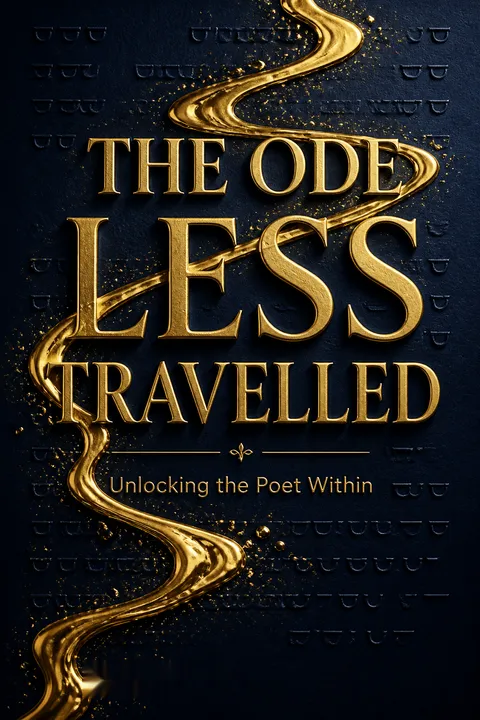
Readers broadly praise The Ode Less Travelled as an entertaining, accessible, and informative guide to poetic forms, metre, and rhyme, delivered with characteristic wit and warmth. Many appreciate Fry's passion, self-deprecating humour, and practical exercises, though some find the exercises demanding. Common criticisms include Fry's perceived bias against free verse, occasional pomposity, and repetitiveness. The audiobook format receives particular praise for bringing the material to life. Most recommend it to aspiring poets and poetry lovers alike, regardless of experience level.
People Also Read


Glossary
Prosody
The craft of versificationProsody is the study and practice of how verse is made, including metre, rhythm, rhyme, and stanza structure. Fry presents it as a practical craft rather than an academic barrier. Learning its terms helps a writer notice how a poem's sounds and patterns work, and gives the writer more deliberate choices.
Metre
Organized poetic rhythmMetre is the regular pattern of stresses and unstressed syllables that organizes a line of poetry. Fry compares it to a recurring pulse. In English verse, a line's metrical pattern can be varied through pauses, run-ons, or substitutions while remaining perceptible as an underlying structure.
Iambic pentameter
Five rising rhythmic feetIambic pentameter is a line organized into five iambs. An iamb moves from an unstressed syllable to a stressed syllable, so the line commonly has ten syllables and five main beats. Fry presents it as the most widely used English poetic metre, prominent from Chaucer and Shakespeare through many later poets.
Enjambment
A sentence running across linesEnjambment occurs when a sentence or thought continues beyond the end of a verse line instead of stopping there. It can create forward momentum, suspense, or a mismatch between metrical structure and grammatical sense. The line break remains meaningful even when the sentence runs on.
Caesura
A pause within a lineA caesura is a pause or break inside a line of poetry, often suggested by punctuation or the natural movement of speech. It can divide a line into contrasting parts, slow its pace, or create emphasis. Its placement affects how a reader hears the metre and meaning together.
Accentual-syllabic verse
Verse measured by stress and syllablesAccentual-syllabic verse organizes lines by both the number of syllables and the arrangement of stressed and unstressed beats. Iambic pentameter is a familiar example. Fry contrasts this system with accentual verse, which counts stresses, and syllabic verse, which counts syllables without fixing a stress pattern.
Sprung rhythm
Verse organized around stressesSprung rhythm is Gerard Manley Hopkins's term for verse in which the number of stressed beats is regular while the number of unstressed syllables can vary. Hopkins used it alongside strong alliteration and compressed language. The effect can sound more forceful and less evenly paced than conventional accentual-syllabic metre.
Villanelle
A poem with recurring refrain linesA villanelle is a closed poetic form built from five three-line stanzas and a final four-line stanza. Two lines introduced at the start recur alternately as refrains, then appear together at the close. The repeated lines can acquire changed or intensified meanings through their shifting contexts.
Sestina
A poem cycling six end-wordsA sestina is a closed form made from six six-line stanzas and a short concluding section. Instead of relying on rhyme, it repeats the same six words at line endings in a prescribed order that shifts from stanza to stanza. The pattern makes repeated words gather new associations as the poem develops.
About the Author
Other books by Stephen Fry


Download PDF
Download EPUB
.epub digital book format is ideal for reading ebooks on phones, tablets, and e-readers.








