

Key Takeaways
Treat craft as the rendezvous that lets inspiration arrive
Talent is not the whole instrument. Oliver distinguishes the mysterious impulse that gives a poem its life from the learnable craft that shapes it into language. She imagines the two as partners who must keep their appointments: steady, serious time at the desk gives the inward source a reason to appear. Exercises in sound, line, and form do not manufacture inspiration. They give a writer more ways to meet it.
Aim beyond easy milestones. Publication, praise, and workshop activity can help sustain effort, but they are not the same as writing memorably. Oliver's standard is demanding: technique should let an experience travel farther than a writer's first, familiar habits can carry it.
What's striking is the refusal to choose between inspiration and discipline. The image of an appointment makes creative practice relational: attention is not a machine that produces ideas on command, but a condition that makes ideas more likely to be welcomed and developed. This resembles studio education, where repeated exercises expand a maker's available choices without prescribing the final work. The limit is that a strict schedule cannot guarantee artistic arrival, especially amid illness, care work, or economic pressure. Its value is less as a promise of output than as a way to protect the possibility of serious attention.
Read across centuries, then imitate before claiming originality
Let poems teach technique. Oliver considers wide, attentive reading essential, even more valuable than a workshop when a writer must choose. The past is not a museum of obsolete styles: its poems can still speak to present concerns, while contemporary work grows from what came before. Reading only the newest writing risks mistaking what is fashionable for what is new.
Borrow to discover choices. Imitation, in Oliver's account, is an exercise in learning how a poem works, not a license to pass off another poet's work as one's own. A writer might test a spare lyric, an expansive sequence, or a sharply observed poem in another poet's manner. Moving among models helps prevent one early, accidental style from hardening into a rut. Personal style emerges through practice and difference, not by avoiding influence.
Imitation is a useful antidote to the myth that originality must appear fully formed. In music and visual art, copying a masterwork can reveal decisions that admiration alone conceals: proportion, pacing, emphasis, and control. Writing exercises make those decisions tangible. The important distinction is between imitation as temporary study and imitation as a finished identity. A writer who studies only one influential voice may absorb its mannerisms more readily than its underlying principles. Rotating models, as Oliver recommends, makes influence a broad education rather than a single attachment.
Choose sounds for their physical force, not meaning alone
Sound carries sensation. Oliver argues that word choice involves more than definition and association. Some consonants stop the breath sharply; others flow or hiss. Vowels, repeated initial sounds, and recurring vowel sounds can give a passage softness, speed, weight, or tension. Alliteration repeats opening sounds, assonance repeats vowel sounds within nearby words, and onomatopoeia uses a word whose sound evokes what it describes.
Listen to the movement. In her reading of Robert Frost's poem about a traveler pausing beside snowy woods, quieter, flowing sounds help establish a hushed mood. Harder consonants become more prominent as the speaker turns toward a decision. The point is not that Frost mechanically counted sounds. A poet develops an ear through reading, practice, and revision, so sound and meaning can reinforce each other without conscious calculation.
This account connects poetry to embodied language: words are not only symbols interpreted by the mind, but events produced by breath, tongue, and ear. Phonetic patterns can make a line feel smooth or abrupt before a reader has fully analyzed its sense. Oliver's close reading demonstrates how sound can shape a poem's emotional trajectory. The caution is that sound symbolism is suggestive, not universal. A consonant does not carry one fixed emotional meaning across every word, speaker, or language. Its force depends on context, rhythm, and the reader's habits of hearing.
Use line length and breaks to choreograph a reader's breath
Every line sets a pace. In metrical poetry, scansion means dividing a line into rhythmic feet and syllable stresses to identify its pattern. Oliver explains how shorter lines can feel quick or tense, while longer ones can suggest abundance or expansive power. She treats iambic pentameter, a five-foot pattern, as a familiar English measure partly because it often fits a spoken breath. These effects are tendencies, not automatic meanings.
Breaks create pressure. A caesura is a pause inside a line; enjambment carries a grammatical phrase across the line ending. Each choice affects emphasis and speed. In free verse, where no fixed meter dictates the line, the writer still has to decide where a phrase turns. A break can make a word newly important, delay completion, or invite the reader to pause and absorb a thought.
Lineation is a form of temporal design. A reader cannot take in a poem all at once, so the writer controls when information arrives and where attention briefly rests. This resembles editing in film: a cut does not merely divide material, it changes how the next moment is perceived. Oliver's breath-based account is especially useful because it links abstract meter to the body. Still, breath capacity and speech rhythm vary among readers, so a line's effect is not perfectly predictable. The craft lies in shaping expectations, not issuing commands to every reader.
Give free verse a pattern the reader can feel
Freedom still needs order. Free verse is not simply prose broken into short rows. Without a fixed meter or rhyme scheme, the poem must establish its own design through such choices as sound, repetition, line length, syntax, stanza breaks, and image. Readers sense the design as an expectation that the poem develops and answers, even when the pattern is not mathematically regular.
Notice how the page moves. Oliver uses William Carlos Williams's brief poem centered on a red wheelbarrow to show how line breaks can unfold an ordinary scene in stages. Its divided phrases keep the reader alert to what is being seen and how the image takes shape. Stanzas also affect pace: a pause between sections can slow a poem, while a sentence carried across the gap can create momentum. Form is made from many interacting decisions.
Oliver's account offers a strong corrective to the idea that formal freedom means absence of form. Readers are pattern-seeking, and an irregular poem can be compelling when its repetitions and disruptions feel purposeful. The page itself becomes part of the reading experience, not decoration added after composition. The useful challenge is to ask whether a pattern is perceptible without being predictable. A poem can be too shapeless to hold attention, but an overly obvious design can make every turn feel prearranged. The most responsive forms balance recognition with surprise.
Let the poem's speaker become more than the writer's biography
Word choice makes a voice. Diction means the words a poem selects; tone is the overall effect those choices create; persona is the speaking presence the poem presents. Oliver warns against stale poetic language and against coldly informational phrasing that reports facts without creating an experience. Plain, conversational language can be artful when its words are precise and its tone is deliberate.
Make room for another life. Keats called a poet's capacity to remain open to uncertainty and to enter perspectives beyond the self negative capability. Oliver connects this idea to a speaker who need not be a transparent portrait of the author. Lucille Clifton's poem about being handed an inherited history shows how a personal voice can also carry shared cultural experience. The speaker's reality comes from the poem's construction, not simply from autobiography.
The distinction between author and speaker matters ethically as well as technically. It allows a poem to dramatize perspectives without claiming that every utterance is a confession, while negative capability describes imaginative receptivity rather than certainty or mastery. This connects to theories of perspective-taking, where understanding another position requires tolerating incomplete knowledge. Such openness is not a substitute for listening to people whose experiences differ from the writer's. A crafted voice can broaden empathy, but it can also overreach. The poem's authority depends on how carefully its language earns the perspective it presents.
Make an image particular enough to become an experience
Give the reader something to see. Oliver uses the word texture for the sensory particulars that make a poem feel inhabited. A general category such as fruit gives little to imagine; a specific object in a particular condition gives the mind a scene to enter. Imagery represents one thing through another, as a simile does through an explicit comparison or a metaphor through an implied one.
Observe before embellishing. Elizabeth Bishop's poem about a caught fish lingers over its skin, eyes, gills, and the fishing lines lodged in its jaw. Those details make the encounter more than a statement about catching and releasing an animal. Oliver also cautions that images can crowd one another. Too many vivid comparisons may jolt the reader repeatedly without allowing the poem's movement or meaning to develop.
Sensory detail gives abstract thought a foothold. This is compatible with embodied theories of cognition, which emphasize that understanding is often grounded in imagined or remembered perception. Bishop's close observation also shows that detail can carry judgment indirectly: the reader sees the fish's history before being told what to feel about it. Oliver's warning about excess is essential because vividness can become a performance in its own right. The test is not whether an image dazzles, but whether it deepens the reader's experience of the poem's subject.
Revise for a stranger, cutting truth that burdens the poem
Separate the poem from its origin. A draft may begin in a real event, but it is not required to reproduce that event faithfully. The writer knows private context that a reader cannot see, and may include accurate details that do not help the poem. Revision asks whether the work supplies enough information to stand on its own, and whether any passage distracts from its movement.
Remove weight, not life. Oliver says she often revises a poem through roughly forty to fifty drafts. The number signals persistence, not a universal quota. She warns that a poem can be packed with attractive lines and comparisons yet lose its forward motion. Imagery and detail earn their place when they contribute to the poem's unfolding, rather than merely displaying the writer's cleverness. Sometimes the most useful revision is to abandon a piece that cannot be made to work.
The imagined distant reader is a practical tool for countering the author's knowledge advantage. It forces a draft to communicate through what is actually on the page, rather than through memories the writer silently supplies. This resembles user testing in design: an artifact must function for someone who was not present at its creation. Yet revision should not become endless polishing toward an imagined universal audience. The stranger is most useful as a check on clarity and excess, not as a demand to erase eccentricity or make every poem easily accessible.
Use workshops to learn technique, not to win approval
Shared language improves critique. A workshop can teach writers to discuss rhythm, sound, imagery, and structure specifically, rather than relying on vague praise or dislike. Several readers may notice problems or strengths that a writer cannot see alone. Oliver also values exercises that ask everyone to explore the same technique, giving participants a chance to move beyond habitual ways of writing.
Protect the difficult experiment. Groups can reward work that is familiar and discourage an ambitious poem that is still rough. Oliver argues that criticism should explain how a choice works, not simply pronounce a verdict. The workshop is most useful when members support one another while remaining loyal to the poem's aims. Its purpose is to expand a writer's options and perception, not to make every draft pleasing to the room.
A good workshop combines psychological safety with intellectual friction. Safety allows a writer to expose unfinished work; friction keeps encouragement from becoming empty reassurance. This resembles effective peer learning in other fields, where shared vocabulary makes feedback more actionable and less personal. The danger Oliver identifies is real: group taste can masquerade as objective craft judgment. A useful critique therefore distinguishes a reader's response from a technical diagnosis, and asks what the poem appears to be attempting before recommending changes.
Protect solitude when a poem enters concentrated work
Some work needs uninterrupted attention. Oliver distinguishes the social value of workshops from the solitude required to compose a poem. As a poem forms, thought, feeling, and craft are intertwined; an interruption can break the line of attention that made the emerging work possible. She invokes the familiar account of Samuel Taylor Coleridge losing the thread of his imagined poem after a visitor interrupted him, using it to illustrate how fragile a creative state can feel.
Choose the right setting. Discussion may help a writer identify problems and possibilities, but it cannot replace the quiet needed to follow them through. Solitude here is not a claim that collaboration has no value. It is a condition for certain phases of work, when a writer must stay with an unfolding poem rather than explain or defend it to other people.
The idea anticipates contemporary accounts of deep work: complex tasks often require protection from frequent shifts of attention. Oliver adds an artistic dimension by treating composition as an emotional process, not merely a sequence of reasoning steps. Still, solitude should be understood as a need for sustained attention, not as a romantic requirement to work alone in ideal conditions. Many writers create amid noise, shared homes, or limited time. The practical principle is to defend whatever uninterrupted interval is possible, rather than measure seriousness by the amount of isolation available.
Feed poetic attention with books, work, and the living world
A poem depends on a way of seeing. Oliver urges writers to nourish the sensibility that makes poems possible, not only to practice writing. Reading, history, art, philosophy, honest labor, and close attention to people and animals all provide material for thought and feeling. Her own methods include walking slowly and carrying a notebook, but she treats these as personal discoveries rather than universal rules.
Find a workable ritual. Some writers may think more clearly after a walk; another activity may create the necessary opening. The task is to notice what helps attention settle and to build a life that leaves room for it. Oliver especially emphasizes contact with the natural world because it supplies the images and shared experiences that much poetry uses. The point is not to imitate her routine, but to become more observant wherever life is lived.
This is a poetics of attention, linking literary practice to habits of perception. A notebook does not create observations; it helps preserve them long enough to become material. The connection to ecological literacy is particularly useful: readers and writers who learn to notice local plants, weather, and animals gain access to more than ready-made symbols. The qualification is important in an urbanized, digitally mediated life. Nature need not be treated as the only legitimate subject. Oliver's deeper claim is that poetry requires close encounter with particulars, wherever those particulars are found.
Analysis
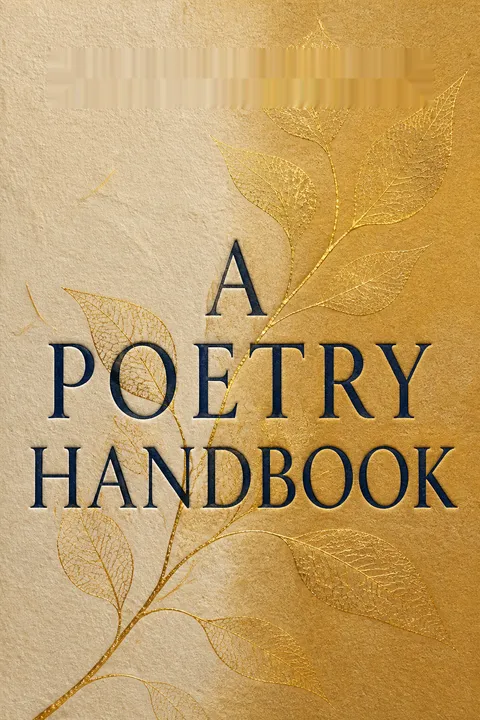
A Poetry Handbook makes a case for craft without pretending that craft can explain the whole poem. Its central tension is productive: the poem must be deliberately made, yet its deepest force cannot be manufactured by following instructions. Oliver resolves this not by ranking inspiration above technique, but by presenting technique as an enlarged capacity to respond when inspiration appears. The handbook's practical subjects, including sound, meter, line breaks, imagery, and revision, all serve that larger relationship between attention and form.
The book is also a pedagogy of perception. Its examples ask readers to hear consonants, feel a line's pace, notice where a phrase turns, and observe the minute features of an animal or landscape. These are not ornamental skills. They train a writer to recognize that language changes the experience it describes. The poem becomes a crafted encounter between a particular subject and a reader who was not present at its origin.
Oliver's account of poetic form is especially durable because it treats free verse as designed rather than ruleless. That insight applies beyond poetry: apparent spontaneity often rests on practiced choices that have become invisible. Her advocacy of imitation, workshops, and revision likewise counters the idea that originality is a solitary gift. At the same time, she guards the solitary phase of composition, where a writer follows a fragile sequence of thought and feeling.
Some prescriptions are best read as strong artistic convictions, not universal laws. Natural imagery is vital to Oliver's own account, but poetry can also draw its particulars from cities, machines, and mediated life. Solitude and long revision are valuable conditions for many writers, but access to them varies. The handbook's most transferable principle is therefore not a single lifestyle or style. It is the demand to make conscious choices, observe closely, and test whether every choice helps the poem become a complete experience for another mind.
Review Summary
A Poetry Handbook is widely praised as an accessible, concise guide to poetry for both readers and writers, earning an overall rating of 4.23/5. Readers appreciate Oliver's clear explanations of poetic elements like meter, sound, imagery, and form, and her compelling argument that even free verse requires deliberate craft. Many wish the book were longer or deeper, and some experienced poets find it too basic. Her chapters on revision and the creative process are frequently highlighted as standouts, with her closing quote about poems being "fires for the cold" resonating deeply with many readers.
People Also Read
Glossary
Negative capability
Openness to uncertaintyA term coined by John Keats for the capacity to remain with uncertainty, mystery, and doubt without forcing a quick explanation. Oliver uses it to describe a poet's ability to enter perspectives beyond the self, including those of other people or even nonhuman life. It is a receptive imaginative stance, not a guarantee of knowledge or empathy.
Scansion
Mapping a line's meterThe process of dividing a metrical line into feet and identifying its pattern of light and heavy stresses. Scansion helps a reader or writer describe how a line moves, such as through repeated iambs or another rhythmic arrangement. It is a way to examine a poem's audible structure, not a requirement that every line follow a perfectly regular beat.
Caesura
Pause within a lineA deliberate pause inside a line of poetry, usually created by punctuation or a strong break in syntax. A caesura can slow a line, interrupt its rhythm, or emphasize a shift in thought. Because the pause occurs within the line rather than at its end, it works against the line's ongoing movement and can make a moment feel especially charged.
Enjambment
Phrase continues across linesThe continuation of a grammatical or logical phrase beyond the end of a poetic line. Enjambment can hurry a reader forward, delay the completion of an idea, or make the line ending create temporary uncertainty. Its effects depend on how the phrase is divided and what information arrives in the next line.
Texture
Sensory detail in a poemOliver's term for the concrete particulars that make a poem's imagined world vivid and inhabitable. Texture may include a subject's appearance, physical setting, or sensory qualities. It gives readers an experience rather than only an abstract statement. Too little can leave a poem thin, while excessive detail can interrupt its movement.
Persona
The poem's speaking presenceThe voice or agent presented as speaking in a poem, distinct from passages of direct dialogue and not necessarily identical to the poet. Thinking in terms of persona lets writers shape a speaker's knowledge, tone, and perspective. It also reminds readers that a poem's first-person voice is a crafted presence, not automatic evidence of autobiography.
Syllabic verse
Verse patterned by syllable countA form of poetry organized by a repeated number of syllables in each corresponding line, rather than by a fixed pattern of stresses. In Oliver's example, each stanza repeats the same syllable counts from line to line. Stress and word choice may vary, creating a regular structure with rhythmic variation.
Free verse
Verse without fixed meterPoetry that does not follow a fixed metrical pattern or prescribed rhyme scheme. Oliver stresses that free verse still requires design. Repetition, sound, syntax, line length, stanza breaks, and patterns of expectation can give a poem coherence. The form frees the writer from inherited rules but does not remove the need for deliberate structure.
Poetic diction
Stale conventional poetic languageOliver's term for language and imagery whose freshness and credibility have worn away through overuse. Such expressions point toward a subject without making it vivid or newly felt, so readers may respond by habit rather than imagination. The problem is not elevated language itself, but language that no longer creates a living experience.
Download PDF
Download EPUB
.epub digital book format is ideal for reading ebooks on phones, tablets, and e-readers.








