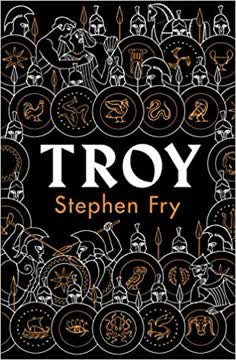
Key Takeaways
1. Troy's Cursed Foundations: Divine Gifts and Mortal Treachery
To understand Troy’s end we must understand her beginning.
Ancient lineage. Troy, or Ilium, was a glittering kingdom, protected by gods like Ares and Aphrodite, founded by Dardanus, a son of Zeus. His descendant, King Ilus, established the city, which received the Palladium—a wooden statue of Pallas Athena that fell from the sky—as a symbol and assurance of its divine status and enduring prosperity. This sacred totem was believed to guarantee the city's survival as long as it remained unmolested.
Seeds of doom. However, King Laomedon, Ilus's son, betrayed the gods Apollo and Poseidon by refusing payment for building Troy's magnificent walls. In revenge, Apollo sent a plague and Poseidon a sea monster, demanding the sacrifice of Laomedon's daughter, Hesione. This act of mortal treachery set a precedent for future divine wrath and demonstrated the perilous consequences of offending the Olympians.
Intertwined curses. Meanwhile, the Greek royal houses were also entangled in curses, notably the house of Tantalus and Pelops, whose actions led to a cascade of doom. These early events, marked by both divine favor and human deceit, laid the groundwork for the epic conflict to come, demonstrating that actions have profound, long-lasting consequences that ripple through generations.
2. Priam's Rise: From Ruin to Resplendent City
So it was that, from that day on, Podarces led his people and directed the rebuilding of their ruined city.
Heracles' intervention. When Hesione was chained to a rock for sacrifice, Heracles arrived, offering to save her and clear the sea monster in exchange for divine horses. Laomedon, true to form, reneged on his promise, leading Heracles to sack Troy, killing the king and all his sons except the youngest, Podarces. This brutal act left Troy in ruins, but also set the stage for its rebirth.
Podarces becomes Priam. Hesione, in an act of love, ransomed Podarces with a golden veil, leading him to be renamed Priam, "the One Who Was Bought." Despite his youth, Priam displayed remarkable leadership, rebuilding Troy into a city grander and richer than ever before. His acumen in trade and statecraft, coupled with the land's fertility, made Troy the "Jewel of the Aegean."
A dark prophecy. Priam's queen, Hecuba, had a vivid dream of giving birth to a torch that would burn Troy to the ground. The seer Aesacus prophesied that her unborn son would cause the city's complete destruction. Despite their love, Priam and Hecuba ordered the baby's death, but the herdsman Agelaus, unable to kill the child, left him on Mount Ida, where he was nursed by a she-bear and eventually named Paris.
3. The Apple of Discord: A Beauty Contest Ignites a War
Without a moment’s thought Paris pushed the apple into Aphrodite’s hands.
Divine wedding. The wedding of Peleus and the sea nymph Thetis, parents of Achilles, was a grand affair attended by all gods except Eris, the goddess of strife. Uninvited, Eris threw a golden apple inscribed "To the Fairest" among Hera, Athena, and Aphrodite, sparking a furious dispute. Zeus, unwilling to choose, appointed the mortal Paris as judge.
Paris's fateful choice. Paris, now a handsome herdsman on Mount Ida, was visited by Hermes, who presented the goddesses' offers:
- Hera promised power and sovereignty over all kingdoms.
- Athena offered wisdom, mastery of war and peace, and eternal fame.
- Aphrodite promised the love of Helen, the most beautiful woman in the world.
Without hesitation, Paris chose Aphrodite, setting in motion the events that would lead to Troy's downfall.
Helen's abduction. Paris, now recognized as a Trojan prince, convinced Priam to let him lead an embassy to Sparta, ostensibly to retrieve his aunt Hesione. His true aim, however, was Helen. With Menelaus and Helen's brothers conveniently absent, Paris abducted Helen, along with much Spartan treasure, bringing her back to Troy. Cassandra's dire warnings of destruction were ignored amidst the city's joyous welcome.
4. The Greek Alliance: Oaths, Sacrifices, and Achilles' Fury
The whole Peloponnese will froth with blood!
The oath fulfilled. Menelaus, enraged by Helen's abduction, rallied his brother Agamemnon, King of Mycenae, to call upon all the Greek kings and princes who had sworn an oath to defend Helen's marriage. This unprecedented alliance, known as the Achaeans, assembled a vast fleet at Aulis, ready to sail for Troy. Odysseus, who had devised the oath, initially feigned madness to avoid the war but was exposed by Palamedes.
Iphigenia's sacrifice. The fleet was becalmed by Artemis, angered by Agamemnon's killing of a sacred stag. The seer Calchas declared that only the sacrifice of Agamemnon's eldest daughter, Iphigenia, would appease the goddess. Lured to Aulis under the false pretense of marrying Achilles, Iphigenia willingly offered herself, but was seemingly spared by Artemis, who replaced her with a stag, and sent a favorable wind.
Achilles' rage. Achilles, the greatest Greek warrior, was furious at Agamemnon for using his name in the deception and later for seizing his war prize, Briseis. In a fit of rage, Achilles withdrew his Myrmidons from battle, vowing not to fight until the Greeks were pushed to the brink of defeat. This personal feud between the two greatest Greek leaders would have devastating consequences for the Achaean army.
5. Nine Years of Stalemate: Raids, Rivalries, and Patroclus's Fate
For nine years the Trojan War was more plunder than thunder.
Entrenched conflict. The initial Greek assault on Troy failed, leading to a nine-year stalemate. Troy's formidable walls and strategic location made it unassailable, while the Greeks, unable to breach the city, established a permanent encampment. The war devolved into a series of raids on surrounding cities and towns, with Achilles and his Myrmidons proving particularly ruthless in their pillaging.
Internal strife. During this period, internal conflicts plagued both sides. Odysseus, never forgetting Palamedes' exposure of his feigned madness, orchestrated Palamedes' execution for treason. On the Trojan side, Priam's youngest son, Troilus, was sacrilegiously killed by Achilles in Apollo's temple, further fueling divine enmity against the Greek hero.
Patroclus's sacrifice. As the war dragged on, the Trojans, led by Hector, pushed the Greeks back to their ships, threatening to burn the fleet. Desperate, Patroclus, Achilles' beloved friend and lover, pleaded to fight in Achilles' armor to rally the Greeks. Achilles reluctantly agreed, but warned him not to pursue the Trojans to the city walls. Patroclus, however, ignored the warning, achieving a glorious aristeia before being killed by Apollo, Euphorbus, and finally, Hector.
6. Achilles' Vengeance: Glory, Brutality, and a Hero's Fall
I have sworn not to eat or drink until my Patroclus’s death is avenged and Hector lies bleeding in the dust.
Inconsolable grief. The news of Patroclus's death plunged Achilles into inconsolable grief and a burning desire for vengeance. His mother, Thetis, warned him that Hector's death would immediately precede his own, but Achilles embraced this fate. Hephaestus forged him new, magnificent armor, including the famous Shield of Achilles, depicting all human life.
Achilles' rampage. Re-entering battle, Achilles unleashed an unparalleled fury, slaughtering Trojans indiscriminately and driving them back to the Scamander River, which boiled with the bodies of the dead. He even fought the river god Scamander himself, who was only subdued by Hephaestus's fire. Achilles' rampage was a pitiless orgy of blood, a testament to his grief and rage.
Duel with Hector. Finally, Achilles confronted Hector outside the Scaean Gate. Despite Priam and Hecuba's pleas for Hector to retreat, he stood his ground. After a desperate chase around the city walls, Achilles, knowing his old armor intimately, found a vulnerable spot in Hector's neck and killed him. He then brutally dragged Hector's body behind his chariot around Troy's walls for twelve days, a profound dishonor that shocked even the gods.
7. The Trojan Horse: Cunning Deception and the City's Doom
Sometimes what the gods write man must rewrite.
Ransom and truce. Zeus, appalled by Achilles' desecration of Hector's body, commanded him to return it. Priam, laden with treasure, bravely entered the Greek camp, appealing to Achilles' empathy for his own aging father. Achilles, moved, agreed to a twelve-day truce for Hector's funeral, marking a brief moment of shared humanity amidst the war.
Odysseus's cunning. With Achilles dead (slain by Paris with Apollo's aid, an arrow to his vulnerable heel), and the war still at a stalemate, Odysseus devised a plan: the construction of a giant wooden horse. This horse, built by Epeius, would conceal thirty elite Greek warriors, while the rest of the fleet would pretend to sail home, leaving the horse as a supposed offering to Athena.
Sinon's deception. Sinon, a Greek left behind, convinced the Trojans that he was a victim of Odysseus and that the horse was a gift meant to appease Athena for the theft of the Palladium. He claimed it was too large to enter Troy, ensuring the Trojans would dismantle their walls to bring it in. Laocoön, a Trojan priest, warned against the horse, but he and his sons were devoured by sea serpents, interpreted by the Trojans as divine punishment for doubting Sinon.
8. The Sack of Troy: Unspeakable Atrocities and Lingering Curses
There is little one can say to mitigate the horror of what happened that night in Troy, or to excuse the bestial savagery with which the storming Achaeans torched the city and slaughtered its inhabitants.
The city falls. Convinced by Sinon and the omen of Laocoön's death, the Trojans breached their walls and dragged the wooden horse into the city, celebrating their perceived victory with drunken revelry. Under cover of night, Sinon lit a beacon, signaling the returning Greek fleet. The warriors emerged from the horse, opened the city gates, and unleashed a brutal, merciless assault on the unsuspecting Trojans.
Royal family's fate. The Trojan royal family met a tragic end. Priam, old and frail, was brutally slain by Neoptolemus at the altar of Zeus. Hector's infant son, Astyanax, was thrown from the city walls, and his wife Andromache taken as a prize. Cassandra, who had prophesied the doom, was raped by Aias in Athena's temple and taken as a slave by Agamemnon, foretelling his own death at Clytemnestra's hands.
Aeneas's escape. Amidst the carnage, Aeneas, guided by divine will, escaped with his aged father Anchises, his son Ascanius, and the Palladium, destined to found a new civilization in Italy. While most Greeks indulged in horrific atrocities, Acamas and Demophon rescued their grandmother Aethra, and Antenor's family was spared for his past kindness. The gods, witnessing the unspeakable violence, condemned the Greeks' profanities, ensuring their difficult journeys home and further divine retribution.
Last updated:
Review Summary
Troy receives high praise from readers for Stephen Fry's engaging retelling of the Trojan War. Many appreciate his accessible writing style, wit, and ability to bring the complex mythology to life. Readers enjoy Fry's narration in the audiobook version. Some found the extensive cast of characters challenging to follow, but overall the book is commended for its comprehensive coverage of the Troy legend, from its origins to its fall. Fry's footnotes and historical context are also highlighted as valuable additions.
Stephen Fry's Great Mythology Series
Similar Books





About the Author
Other books by Stephen Fry
Download PDF
Download EPUB
.epub digital book format is ideal for reading ebooks on phones, tablets, and e-readers.





