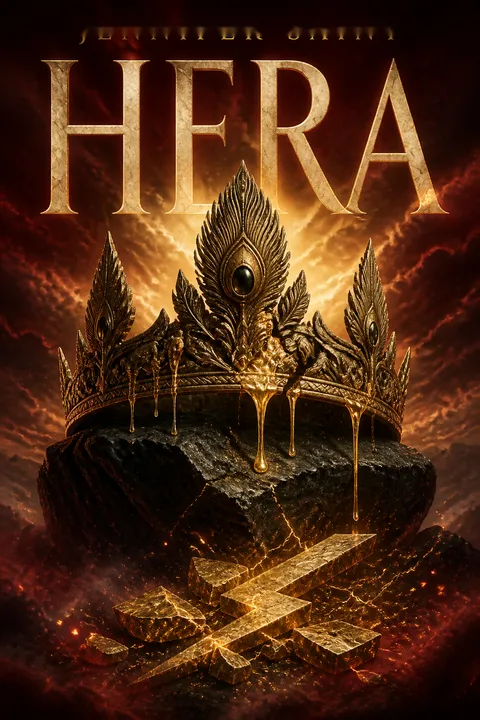


Plot Summary
Prologue
Hera crosses a battlefield where the Titans lie broken and the ground is slick with immortal blood. She fought beside the monstrous Hecatoncheires and Cyclopes, whose strength she admired even when the other gods recoiled from them. Above, Zeus hurls lightning at their father Cronus; below, Hera binds the defeated and mourns the wounds her war has carved into Gaia.
The Titans’ reign ends, and the Olympians take power. Their victory promises a new order, but the blood-soaked field already holds the question that will follow Hera through the ages: can rulers who overthrow tyranny avoid becoming tyrants themselves?
The opening gives Hera both a warrior’s authority and a conscience. She can kill without hesitation, yet she kneels to honor Gaia and registers the suffering left by victory. Her admiration for the rejected monsters also establishes a moral contrast: she notices strength where the Olympians see ugliness. The new regime begins in triumph, but Hera’s awareness of the cost makes the promise of a clean break from the Titans feel precarious. The prologue frames power not as an abstract right, but as a relationship to those made to bear its consequences.
Oaths on the Styx
After the war, Hera watches the scarred battlefield soften into grass and the Olympians settle into their new palace. Zeus seats his siblings on golden thrones and summons the surviving Titans to swear loyalty on the waters of Styx. The oath also binds their descendants, turning peace into a system of control.
Hera is pleased by the order they have won and keeps watch over the Titans’ duties, certain that careful oversight will prevent another uprising. The siblings feast together, replaying their victory, while Zeus’s growing confidence goes largely unquestioned. To Hera, their shared rule seems unlike Cronus’s tyranny: authority is divided among family, and the world’s rhythms continue without interruption.
Hera’s first political instinct is vigilance. She believes order can prevent the violence she remembers, and she mistakes enforced loyalty for lasting consent. The oath on Styx is a practical safeguard, but it also reveals that the Olympians inherit the Titans’ fear of replacement. Hera’s confidence in shared rule rests on a family bond that will soon prove less durable than the chains securing their enemies. Her attention to the defeated makes her perceptive, but not yet critical of the new rulers’ methods.
Ixion Enters Olympus
Zeus becomes fascinated by mortals, first dismissing their weakness and then inviting the violent king Ixion into Olympus. Hera distrusts the guest, whose greed turns to a predatory fixation on her. Zeus tests that desire by asking the cloud-nymph Nephele to form an illusion of Hera.
Ixion enters Hera’s chamber and assaults the phantom, believing he has conquered a goddess; the Olympians then expose him and Zeus binds him to a burning wheel. Hera cannot dismiss the scene as a joke. She fears other mortals will imitate Ixion, so Zeus floods the earth and wipes out his first human race. The world greens again, but Zeus’s appetite for remaking it remains.
Ixion’s visit places divine privilege and mortal brutality side by side. Hera sees his violence clearly, yet Zeus turns the threat into entertainment and punishment rather than confronting the power that made the encounter possible. The phantom lets the gods test a mortal without risking Hera, but it also makes her body an instrument in their spectacle. The flood restores the landscape while erasing the people who lived there. Hera reads that erasure as a return to safety, not as another ruler exercising unchecked power.
The Empty Share
As Zeus plans a new human race with Prometheus, he gathers the gods and Titans at the Styx to divide the world. Poseidon draws the sea, Hades the Underworld, and Zeus the heavens. Metis oversees the lots, which Hera believes were arranged to ensure Zeus’s victory. Gaia restrains Hera when she tries to object, and Zeus grants Hestia the hearth, Demeter the harvest, and Aphrodite desire.
He gives Hera no domain at all. Later, he offers her the position of queen beside him if she will marry him. Hera refuses, insisting that their victory was meant to bring shared rule, not replace Cronus with another solitary king. Her sisters will not join a rebellion, leaving her isolated.
The drawing of lots converts a family’s shared victory into a hierarchy, and Hera’s exclusion exposes how little her sacrifice protects her political claim. Gaia’s restraint is difficult for Hera to accept, but it forces her to see that open resistance could make her another target of a succession struggle. Her sisters’ choices complicate any simple alliance of women: each protects a distinct source of influence, while Hera still equates power with a throne. Zeus’s marriage offer appears affectionate, yet it is also a way to absorb a rival he cannot safely ignore.
The Sky Takes Metis
After Hera discovers Zeus and Metis are lovers, Hestia warns that their brothers are repeating Cronus’s habits of rule. Hera refuses to believe Zeus will become their father. Then a prophecy predicts that Metis will bear a child stronger than its father. Zeus becomes the sky itself and consumes Metis, removing the threat before it can be born.
Horrified, Hera flees to Oceanus. Zeus follows, disguises himself as an injured cuckoo, and uses her compassion to get close before attacking her on the shore. Hera freezes in terror, then decides that fleeing has left her exposed. She returns to Olympus and accepts marriage, believing a public place beside Zeus will give her leverage and keep her from being discarded.
The repeated pattern of fathers fearing their children makes Zeus’s transformation more than a private betrayal: it shows the new regime reproducing the old one. Hera’s attack leaves her with shame as well as rage, and she interprets the shame through the language of political failure. Her decision to marry is therefore neither simple consent nor simple surrender. She tries to turn a coerced position into a platform from which she can act, but the bargain requires her to conceal what happened and to keep confusing survival with control.
A Crown of Marriage
Zeus makes Hera goddess of marriage, a role that sounds honorable but leaves the heavens and its power in his hands. When Hera listens to mortal prayers, women ask for gentle husbands, safe births, and relief from cruelty. Their dependence unsettles her, since she cannot promise the happiness they seek.
Her sons offer no political answer: Ares takes his war-throne but leaves Olympus for a fortress among mortals, while Hephaestus’s gift for metalwork wins him little respect from his mother or the other gods. Hephaestus’s devotion to Athena ends when she rejects him. Hera sees that neither son can deliver the alliance she hoped for, and her assigned authority begins to feel like a gilded enclosure.
Marriage gives Hera a public title while narrowing the terms under which she is allowed to matter. The women’s prayers reveal that her domain is not a symbol but a daily archive of vulnerability, and her inability to answer them mirrors her own constrained position. Her sons become extensions of her political hopes, so their separate desires feel to her like failures of loyalty. The section traces how powerlessness can distort care: Hera recognizes suffering, yet she remains tempted to treat children and worshippers as resources for a struggle they did not choose.
A Monster Made Hers
After witnessing Zeus pursue Asteria, who escapes by becoming a quail and then a floating island, Hera’s buried anger wakes something in the earth. Gaia answers by placing a new life within her, created from Hera alone. Hera gives birth in a remote cave to Typhon, a serpent-bodied, fire-breathing creature, then entrusts him to Ekhidna, a hidden monster-goddess who lives beneath the earth.
Typhon grows there and fathers a brood of hybrid beasts, including the Hydra, Cerberus, and the Nemean Lion. Hera visits them secretly, finding a tenderness she never managed with her other children. Hestia agrees to support Hera’s plan to overthrow Zeus, though Ekhidna distrusts the Olympians and warns that monsters have their own reasons to fight.
Typhon embodies the difference between a child conceived as an ally and a child loved as an individual. Hera begins by imagining him as an answer to Zeus, but her visits reveal a form of attachment that is not reducible to politics. Ekhidna’s suspicion challenges Hera’s assumption that shared enemies produce shared aims. The monsters are not simply weapons for a goddess’s rebellion; they have their own history of exclusion and their own need for safety. Hera’s attempt to build a different order begins with the same danger of instrumentalizing others that marked the old one.
Typhon’s Premature War
Before Hera finishes planning, Typhon launches an attack on Olympus alone. He rains fire onto the palace and batters the gods with burning rock. Ares shields Aphrodite, while Athena directs the defense, but Zeus arrives with his thunderbolt and strikes Typhon down. Hera’s attempt to reach Athena is stopped, and Zeus sees enough to suspect her betrayal.
He chains Hera to a cliff. Hephaestus secretly brings her nectar and frees her, but Zeus catches them and hurls his son into Mount Etna, where Hephaestus must survive without help. Zeus later confirms Typhon is buried beneath the volcano. Hera returns to Olympus outwardly subdued, while the gods rebuild and distrust her.
Typhon’s strength cannot compensate for the absence of coordination, and his solitary assault turns Hera’s carefully imagined rebellion into a disaster for the very beings she hoped to protect. Zeus’s victory also lets him define the event publicly as proof of his right to rule. Hephaestus’s rescue exposes a different kind of courage, rooted in familial attachment rather than a bid for status. Hera accepts his help, then obeys Zeus’s demand that she leave him behind. That choice becomes a moral debt she cannot erase by calling herself the victim.
The Bloom Beneath Etna
Hera searches Etna’s poisoned slopes and finds flowers growing from the venom in Typhon’s blood. She presses their sap into a small vial, a weapon she can hide while appearing obedient. She bears two daughters, Hebe and Eileithyia, hoping that more children will strengthen her place at court, but Zeus gives neither a throne: Hebe serves the gods, and Eileithyia oversees childbirth.
When Hera learns that Zeus has fathered a child with the Titaness Leto, she orders Eileithyia to prevent the birth on land or sea. Iris spreads the warning, leaving Leto without sanctuary. Hera’s strategy is defeated when Leto reaches Delos, the floating form of her sister Asteria, and gives birth to Apollo and Artemis.
The vial marks Hera’s turn from direct rebellion to patient retaliation. It is a material memory of Typhon, but also a temptation to treat every future conflict as an opportunity to poison rather than negotiate. Her daughters receive useful roles but not the authority she wants for them, repeating the distinction between being honored and being empowered. In the Leto episode, Hera uses her own daughter’s childbirth authority to punish another mother. Asteria’s refuge succeeds where Hera’s rules fail, showing that care and solidarity can create possibilities that formal power cannot anticipate.
The Gods’ Scandal
Hera silences the nymph Echo after discovering she has distracted Hera while Zeus pursues another lover. Later, disguised as Semele’s nurse, Hera persuades the pregnant mortal to demand that Zeus reveal his full divine form. Bound by an oath, Zeus appears in his radiance, and Semele burns to death.
He saves their unborn son by carrying him within his body until the child can be born again as Dionysus. Hera later slips Typhon’s venom into Dionysus’s wine, driving him into madness and keeping him away from Olympus. She also delays the birth of Zeus’s promised heir so Eurystheus receives the kingship instead of Heracles, but two snakes sent to kill the infant are strangled in his fists.
Hera’s punishments increasingly land on the people nearest to Zeus rather than on Zeus himself. She calls this defense of her marriage and position, but each action creates fresh suffering without changing the arrangement that enables his conduct. Semele’s death is particularly revealing: Hera exploits Zeus’s oath, yet the mortal woman pays the price for a trap set by the gods. Heracles’s survival then turns an attempted private revenge into the beginning of a public legend, teaching Hera that harming a rival can amplify his reputation.
A Mother Stops the World
When Demeter’s daughter Kore disappears, the harvest goddess searches until Helios reveals that Hades seized her and carried her to the Underworld. Demeter withdraws into a cave and stops nourishing the earth; crops fail, and famine spreads. Hera urges Zeus to command her back, but he cannot risk making the land barren beyond repair.
Athena proposes a compromise: Kore, now called Persephone, will spend part of each year with Hades and return to Demeter for the rest. Demeter accepts, restoring growth while keeping the winter as an expression of grief. Hera watches her sister accomplish through maternal refusal what Hera could not win through rebellion, and she resents that Zeus must negotiate with Demeter rather than simply command her.
Demeter’s grief becomes political force because the world depends on what she withholds. Hera has long understood power as authority over territories and councils; Demeter demonstrates that care itself can be leverage when others rely on it. The compromise does not undo Persephone’s abduction, and its recurring winter preserves the cost rather than resolving it. Hera recognizes the effectiveness of her sister’s resistance but cannot fully celebrate it, partly because Demeter once refused to join Hera’s own challenge. Personal resentment prevents Hera from seeing that the two sisters have been forced into different strategies by the same unequal order.
Heracles and the Monsters
After Semele’s death, Zeus brings their son Dionysus back to life as a god. Hera later poisons his wine, and the resulting madness drives him away from Olympus. She also sends Lyssa to unleash Heracles’s violence; in his frenzy, he kills his wife and children. Apollo directs him to serve King Eurystheus, whose tasks include killing the Nemean Lion and the Hydra, both children of Typhon and Ekhidna.
Hera is forbidden to intervene and watches Heracles turn the monsters into trophies. She then chooses Jason as her own champion and sends him after the Golden Fleece. His Argonaut crew includes Heracles, Atalanta, and sons of several gods, making their voyage a shared spectacle that briefly draws the rival Olympians together.
Hera’s revenge on Heracles produces tragedy, but it does not restore the lives destroyed or diminish the hero’s fame. The monsters’ deaths make her conflict with Zeus painfully concrete: the beings she once loved become evidence of a mortal’s greatness. Choosing Jason redirects her competitive energy into patronage rather than direct attack, and the Argonauts give the gods a common interest without resolving their rivalries. Hera discovers an influence she had not valued before: she can draw others together by creating a story they all want to follow.
The Throne Becomes a Trap
After returning to Olympus, Hephaestus presents Hera with an exquisite throne that secretly clamps her wrists and ankles in place. He refuses to release her until she acknowledges that she persuaded him to free her from Zeus, then abandoned him to be thrown into Etna.
Zeus cannot break the device, and Hephaestus ignores his summons. Dionysus brings the blacksmith back with wine and conversation; Hephaestus frees Hera only after she swears by Styx not to retaliate.
Zeus then orders Hera to arrange a marriage between Aphrodite and Hephaestus. He also commands her to wed the sea-nymph Thetis to the mortal Peleus. Seeking a new champion, Hera sends Jason on the quest for the Golden Fleece, drawing gods and heroes into a rare shared enterprise.
The throne is a brilliant reversal: Hephaestus uses the gifts and labor that Olympus undervalued to make its queen physically dependent on him. Hera has relied on persuasion when she lacked force, but now her son recognizes the same tactic and refuses to be used without a price. Her oath limits revenge, though it cannot repair their relationship. The forced marriages show that Hera’s office gives her responsibility without freedom to reject Zeus’s commands. Patronizing Jason offers a different, more constructive source of influence, but it still begins as an effort to outmaneuver her husband.
Giants at Olympus
The earth-born giants attack Olympus, and Hera insists she had no part in their uprising. Athena accepts her help, so Hera descends with a spear and fights alongside the Olympians. Heracles saves her when a giant pins her to the ground, then she turns and kills another giant herself. After the battle, Zeus promises Heracles immortality and marriage to Hebe.
Hera recognizes that every attempt to destroy him has made his legend stronger, so she stops treating him as a rival and warns him that Olympus will remain under her rule. The change marks a shift in her loyalties: she has fought Gaia’s children to defend the gods, and can no longer pretend she stands outside the order she once hoped to replace.
The battle forces Hera into an allegiance she can no longer explain away as temporary. She fights for Olympus, and Heracles, the object of her hostility, saves her life. The experience complicates her belief that resisting Zeus necessarily means defending the excluded. Her decision to stop testing Heracles is pragmatic, but it also reflects a more difficult recognition: she has helped make him powerful by repeatedly defining him as an opponent. Her identity begins to change not through victory, but through the collapse of the old categories she used to understand herself.
Troy Commands the Gods
Zeus proposes a war against Troy, and the gods choose sides. Hera supports the Greeks, angered that the conflict centers on Helen, another daughter of Zeus, and on a story that disguises the pursuit of wealth and fame. In the tenth year, Achilles refuses to fight after Agamemnon takes Briseis. Thetis persuades Zeus to aid her son, weakening the Greeks despite his earlier promise.
Hera and Athena prepare to intervene, but Zeus threatens to destroy their chariot. They stand down, then continue to influence the war in other ways. Hera directs Hephaestus to save Achilles from the river Scamander. Troy eventually falls, leaving gods and mortals changed by a decade of shared attention to grief, strategy, and loss.
The Trojan War makes divine politics inseparable from human suffering. Hera’s anger at the story used to justify the invasion is partly moral and partly personal, yet the carnage draws her into a scale of loss she had not previously allowed herself to experience. Zeus’s threat restrains her, but it does not erase her capacity to act indirectly. Her intervention to save Achilles signals a change in what she values: even while she remains a strategist, she is increasingly responsive to the lives caught inside the conflict.
Hestia Leaves the Hearth
After Troy falls, Hestia tells Hera that the gods have become dependent on mortal belief and that she intends to leave Olympus for the human homes warmed by her fire. Hera rejects the warning until Hestia departs and the central hearth goes cold. Demeter also vanishes, crops fail, and the remaining gods drift away as famine reduces the offerings reaching Olympus.
Hera visits Hephaestus in his volcanic forge and finds him content among the Cyclopes, useful and respected in a way he never was at court. She lets him remain. When she returns to Olympus, only Zeus is still clinging to his throne, surrounded by silent mechanical servants and a palace losing its life.
Hestia’s departure makes absence visible: Olympus is not sustained by architecture or divine rank, but by relationships and practices that the gods have taken for granted. Hephaestus’s forge offers Hera a model of belonging based on contribution rather than status. She can finally recognize his contentment without demanding that he serve her plans. Zeus’s deserted palace contrasts with the active communities below, and the change undermines the assumption that divine authority can survive without reciprocal attention.
The Thunderbolt Goes Quiet
As mortal populations recover, Hera’s strength returns, but Olympus does not. She finds Athena in Athens, where the goddess explains that immortals must adapt to human life rather than expect their old regime to return. Hera then sees that Zeus has petrified on his throne, his body fused to the palace. His thunderbolt lies beyond his reach.
Hera takes it, but does not strike him. At Oceanus, she feels Gaia reshaping the world and sees that the old boundaries have disappeared. The weapon that once founded and defended Zeus’s dynasty has become dull. Hera lowers it into the stream until its power fades, then lets it go. She refuses to inherit Zeus’s rule merely because she can.
Hera’s choice not to kill Zeus is more consequential than another victory would be. The thunderbolt could make her the next ruler in the same structure, but she recognizes that inheriting its authority would also inherit its limits. Athena’s presence helps Hera understand adaptation as survival, not defeat. At Oceanus, the changing earth offers a scale of time larger than dynastic succession. By surrendering the weapon, Hera gives up the clearest instrument of command and opens the possibility of an identity not organized around opposition to Zeus.
A Life Beyond Olympus
Athena directs Hera toward Athens’s temples, libraries, and theatre, where mortals keep reshaping the gods through stories. Hera attends a play and is moved by the audience’s shared response. She follows its playwright home, speaks with him through the night, and chooses a mortal intimacy that is hers rather than Zeus’s. Before leaving, she returns to Olympus.
Zeus remains a stone figure in a crumbling palace, and Hera departs without the thunderbolt. She imagines the other gods living on in human crafts, battles, homes, and festivals. The stories may preserve Hera as queen, wife, and avenger, but she no longer has to obey those versions. She walks into a changing world without a throne, choosing her own future.
The ending does not grant Hera a restored kingdom; it releases her from the need to measure freedom by possession of one. The theatre gives her a new understanding of human beings: they are not merely worshippers or pawns, but makers of meaning who can revise the gods through art. Her mortal intimacy matters because it is chosen, not because it erases the past. By leaving the palace and the thunderbolt, Hera accepts that stories will outlast any single version of her, while claiming the right to live beyond the role those stories assign.
Analysis
The novel retells divine history from the position of the woman who is usually reduced to a jealous wife. It does not simply reverse that judgment. Hera is injured by Zeus’s coercion and exclusion, but she also directs her anger toward women and children with less power than she has. Her attempts to punish Zeus’s lovers, control her sons, and turn Typhon into an instrument of rebellion show how easily resistance can reproduce the logic it opposes. The book’s strongest challenge is therefore not whether Hera is justified in hating Zeus, but what she does with that justified anger.
Motherhood provides the story’s central test. Hera’s children are repeatedly imagined as political answers: heirs, allies, or threats to Zeus. Typhon is the most intimate exception, yet even he is raised within a plan that assumes his strength will serve Hera’s cause. Her failure to protect Hephaestus, and her later recognition of his life in the forge, expose the cost of treating love as a resource. Demeter’s refusal to nourish the earth offers another model of power, one rooted in care that can be withdrawn, while Hestia’s hearth shows how ordinary acts of welcome sustain a community more durably than a throne.
The gradual dependence of the gods on mortal worship shifts the scale of the story. Human beings begin as Zeus’s experiment and end as makers of the gods’ continuing meaning through theatre, ritual, philosophy, and memory. Hera’s encounter with the playwright does not erase her past or make her innocent. It gives her a way to live beyond the identity imposed on her by marriage and myth. Her final freedom is not a new kingdom, but the recognition that she can change even when the stories about her endure.
Review Summary
Hera receives mixed reviews, with praise for Saint's lyrical writing and feminist retelling of Greek mythology. Many readers appreciate the complex portrayal of Hera, humanizing her without excusing her actions. Some find the pacing slow and the character development lacking. Critics note the book's accessibility for mythology newcomers while still engaging long-time fans. The ending is frequently cited as emotional and satisfying. Overall, readers commend Saint's ability to reframe Hera's narrative, though opinions vary on its success in fully capturing the goddess's complexity.
People Also Read






Characters
Hera
Warrior turned queenA daughter of Cronus who fought to overthrow the Titans, Hera begins with a warrior’s confidence in shared rule and a sharp eye for threats. She prizes independence, secrecy, and competence, but can mistake loyalty for usefulness and care for a form of control. As Zeus narrows her authority to marriage, she tries to recover power through alliances, children, and retaliation. Her attention gradually shifts from ruling above mortals to understanding their grief, stories, and communities. She is neither a saintly victim nor a simple villain: her capacity to survive is matched by her willingness to make others pay for injuries she cannot reach at their source.
Zeus
King afraid of successionHera’s younger brother and husband, Zeus wins the Titan war and claims the heavens as his realm. Charismatic and politically astute, he can present control as protection and entitlement as affection. His greatest fear is being overthrown by a child, the same terror that shaped Cronus’s rule. Zeus creates alliances and institutions, yet repeatedly bends them to preserve his own authority. His tenderness toward favored children coexists with a capacity for coercion and punishment, making him difficult to reduce to either a loving father or a tyrant.
Hestia
Keeper of the hearthThe eldest sister of Hera, Hestia is quiet, perceptive, and difficult to mistake for weak. Her hearth gives the gods a home and offers mortals warmth, light, and a place to gather. She understands danger without needing to meet it with force, and she protects her independence through clear boundaries. Hestia listens closely to what her family avoids saying, often giving Hera the calm perspective she resists. Her values center on care and continuity rather than rank, which makes her a quiet counterweight to the Olympians’ hunger for status.
Demeter
Mother of the harvestHera’s sister, Demeter nurtures plants and sustains the harvest, but her gentleness should not be mistaken for passivity. She is protective of her daughter Kore and prefers practical care to political contests. Her power lies in the life she enables, a form of influence the other gods often overlook until it is withdrawn. Demeter’s devotion can become uncompromising when those she loves are threatened. Her relationship with Hera carries affection as well as old hurt, since she refuses to join Hera’s early bid to challenge Zeus.
Athena
Strategist born armedDaughter of Zeus and Metis, Athena combines her mother’s intelligence with her father’s fighting ability. She values foresight, skill, and systems that anticipate danger, often treating events as problems to solve rather than experiences to share. Her composure can read as coldness, especially to Hera, who resents the trust Athena receives from Zeus. Athena respects independence and is not easily drawn into emotional displays, yet she is capable of decisive loyalty. Her relationship with Hera shifts as both confront the costs of the world they helped build.
Hephaestus
Maker in the volcanoHera and Zeus’s son, Hephaestus is physically ungainly, gentle, and initially eager for approval. He has a rare gift for transforming metal into precise and beautiful objects. His interest in craft gives him a source of identity outside the contests for divine rank, though he is sensitive to rejection and to being treated as lesser. He admires Athena and seeks closeness through the things he makes. Others often underestimate his patience and skill, mistaking a quiet manner for helplessness.
Ares
God of battle furyHera and Zeus’s eldest son, Ares embodies the heat and violence of combat rather than its strategy. He is volatile, proud, and resistant to direction, preferring the company of mortal fighters to the formal life of Olympus. Hera hopes his strength will serve her political ambitions, but Ares makes his own choices and guards his independence. His relationship with Aphrodite reveals a tenderness he rarely shows his family. He is compelling to others precisely because he acts without the restraint that governs most of the Olympians.
Aphrodite
Power behind desireBorn from the sea after Ouranos’s fall, Aphrodite is neither Titan nor child of Cronus, yet she earns a throne among the Olympians. Her beauty draws attention, but her deeper power lies in shaping desire and its consequences. She enjoys pleasure and intrigue, and often appears less invested in rule than the other gods. Hera distrusts her influence because it can make even immortals feel they have lost command of themselves. Aphrodite is more perceptive than her languid manner suggests, especially where love, coercion, and attraction diverge.
Gaia
The earth’s first motherThe primordial earth and mother of Titans, gods, and many creatures, Gaia sees history on a scale no younger immortal can fully grasp. She once protects Hera and later offers counsel, but rarely explains her intentions plainly. Gaia values balance across the many forms of life she has brought forth, including beings the Olympians call monsters. Her interventions are selective, and her silences frustrate Hera, who wants direction and certainty. Gaia represents creation as a force larger than any ruler’s claim to ownership.
Metis
The hidden wise counselorA Titaness known for intelligence and foresight, Metis raises and trains Zeus after Gaia hides him from Cronus. She prepares the strategy that helps free Zeus’s swallowed siblings and becomes a trusted adviser during the war. Her relationship with Zeus begins in nurture and political hope, leaving Hera unsure how to understand their intimacy. Metis’s cool judgment makes her one of the few beings capable of seeing both opportunity and danger in the new regime.
Poseidon
Ruler of the seasHera’s brother and one of the three rulers who divide the world, Poseidon governs the seas and can shake the earth. He is proud, quick to anger, and accustomed to treating desire as a privilege of power. His rivalry with Athena and tense dealings with Hestia expose how readily he confuses authority with entitlement. Though he shares the Olympians’ victory, he is often focused on his own domain and appetites rather than the family’s collective good.
Hades
King beneath the earthHera’s brother, Hades rules the Underworld after drawing the black lot. Reserved and difficult to read, he rarely joins the everyday life of Olympus. His realm is a place of order as well as darkness, and he understands that the dead cannot simply be returned to the living. His choices affect the entire divine family, even when he remains physically absent from it.
Ekhidna
Mother of hidden monstersA serpent-bodied goddess who lives in a remote cavern beneath the earth, Ekhidna belongs to a world the Olympians seldom acknowledge. She is wary of the gods and fiercely protective of her children, with a long memory of exclusion. Her alliance with Hera is shaped by shared hostility toward Zeus but limited trust in Hera’s aims. Ekhidna’s harsh pragmatism challenges Hera’s belief that defeating a ruler will automatically make life safer for those he oppressed.
Typhon
Hera’s storm-born sonHera’s son, created without Zeus, Typhon has a monstrous body, serpent-like hands, wings, and a breath that spits fire. His immense strength makes him a possible counterweight to the Olympians, but his impatience and appetite for conflict complicate any plan that depends on him. Raised in the hidden caverns of Ekhidna, he knows the gods chiefly through Hera’s stories and expectations. He wants to protect his own family and is not naturally suited to waiting for another person’s strategy.
Klymene
Hera’s trusted handmaidenA Titaness and mother to Atlas and Prometheus, Klymene has endured the losses and punishments imposed on her family. She becomes Hera’s handmaiden and offers steady companionship without pressing for disclosure. Klymene is observant, tactful, and loyal, but her sympathy does not always soften Hera’s decisions. Her presence connects Hera to the older Titan world and reminds her that the consequences of Zeus’s rule reach beyond Olympus.
Prometheus
Friend of humankindA thoughtful Titan who helps Zeus create a new race of mortals, Prometheus also teaches them practical arts and gives them fire. He acts from concern for human vulnerability, even when that generosity conflicts with Zeus’s commands. His loyalty to the Olympians is not blind, and his choices reveal the moral distance between ruling people and helping them live.
Leto
Titaness seeking refugeA gentle Titaness from an old and powerful family, Leto becomes involved with Zeus and faces the dangers that come with bearing his children. She is quiet rather than politically ambitious, but her endurance and connection to her sister matter greatly. Her vulnerability exposes the limits of divine protection when Zeus’s desires and Hera’s jealousy collide.
Asteria
Sister who becomes sanctuaryLeto’s sister and a Titaness with power over falling stars, Asteria is resourceful when threatened and deeply attached to her family. Her attempts to escape Zeus’s pursuit reveal the peril faced by women who refuse him. Even when she cannot act in an ordinary divine form, her bond with Leto remains central to her choices.
Persephone
Daughter between worldsBorn Kore to Demeter and Zeus, Persephone grows up sheltered among flowers, distant from the politics of Olympus. Her life connects her mother’s devotion to the authority of the Underworld. The name she comes to bear reflects a force more complex than the gentle girl Hera first hears about. She stands at the boundary between growth and death, home and separation.
Apollo
Sun-bright archerSon of Zeus and Leto, Apollo is gifted in music, prophecy, archery, and healing, with a polished confidence that often conceals cruelty. He values beauty and achievement, and his attention to mortal women can echo Zeus’s entitlement. His relationship with Artemis is close, though their temperaments differ. He is both artist and dangerous divine authority.
Artemis
Unruly huntressDaughter of Zeus and Leto, Artemis is independent, direct, and more at home in forests than palaces. She values hunting, companionship with nymphs, and freedom from marriage. Her choice to set firm conditions for her own life contrasts with Hera’s earlier assumption that Zeus would respect their old equality. Artemis is protective of women and animals, but her coolness can make her difficult to approach.
Hermes
Quick-witted divine messengerSon of Zeus and Maia, Hermes is clever, curious, and mischievous from infancy. His invention of the lyre and talent for finding a way through conflict make him a valued messenger and mediator. He moves easily between gods and mortals, guided by wit rather than a need for formal authority.
Heracles
Mortal-born heroA son of Zeus and the mortal Alcmene, Heracles is famed for extraordinary strength and an instinct to meet danger head-on. His immense power can make him a rescuer, but it also makes him vulnerable to rage and to the expectations attached to heroic fame. Hera sees him as a threat to her own standing, while Zeus treats his strength as proof of divine favor. His life exposes how easily a hero’s reputation can eclipse the suffering around him.
Dionysus
God of wine and frenzySon of Zeus and the mortal Semele, Dionysus is associated with wine, ecstatic celebration, and the release of ordinary restraints. His charm draws gods and mortals into a world of music and excess. Beneath his welcoming manner lies the power to provoke fear and disorder, and his relationship with Hera is marked by old injury and mistrust.
Eileithyia
Goddess of childbirthHera’s daughter, Eileithyia governs the passage of childbirth and can hasten or delay a birth. She is dutiful and conscientious, caught between her mother’s authority and the purpose of the gift she has been given. Her role makes abstract divine conflict immediate for mortal women, whose safety may depend on her intervention.
Plot Devices
The waters of Styx
Oaths with consequencesStyx’s water makes divine promises binding, turning an oath into more than ceremony. Zeus uses it to secure the Titans’ loyalty and later to bind himself to a promise made to Semele. Hera also swears on it when Hephaestus frees her from his throne. The device ties personal choices to public authority: an immortal can deceive, scheme, or regret, but a sworn promise still limits what can happen next.
Divine transformations
Escape and disguiseThe gods and many other immortals can take animal or human forms, allowing them to travel, hide, seduce, or pursue. Hera often becomes a hawk to observe the world, while Zeus uses disguises to approach his victims. Transformation can offer escape, as in Asteria’s attempts to evade Zeus, but it can also become a trap when a changed body cannot easily return to its former shape. The device makes power intimate: control over appearance can protect someone or make them easier to exploit.
Mortal worship
Faith sustains the godsOfferings, prayers, and stories connect mortals to the gods and gradually become a source of divine strength. Hera first regards mortals as weak creatures whose attention is of little importance. Later, as wars, famine, and abandonment thin their ranks, the gods discover that their own power and presence depend on human belief. The relationship is not a simple exchange: people continue living and making meaning even when prayers go unanswered, while the gods must adapt if they want to remain part of the world.
Typhon’s venom
A hidden weapon of rageTyphon’s poisonous blood leaves behind flowers on Etna, which Hera gathers and presses into a green liquid. The venom can distort a god’s mind and drive mortals into dangerous frenzy. Hera keeps it concealed while appearing to accept Zeus’s rule, then uses it against Dionysus. It represents the portion of her rebellion she can preserve after Typhon’s defeat, but each use also brings her closer to the destructive logic she condemns in Zeus.
Zeus’s thunderbolt
Rule made tangibleForged by the Cyclopes, the thunderbolt is Zeus’s most visible instrument of authority, capable of defeating powerful enemies and silencing dissent. Its threat shapes Hera’s decisions even when he does not use it. When Zeus loses his strength, the weapon becomes available to Hera, offering her a chance to take the rule she once believed was hers. Her decision about what to do with it determines whether she repeats the old order or chooses another life.

Download PDF
Download EPUB
.epub digital book format is ideal for reading ebooks on phones, tablets, and e-readers.








