

Plot Summary
Ice, Fire, and First People
Before earth or sky, fire from Muspell meets the ice of Niflheim, and the melting creates Ymir, ancestor of the giants, and Audhumla, the cow who feeds him. As she licks the ice, she reveals Buri, ancestor of the gods. Buri’s descendants Odin, Vili, and Ve kill Ymir; the flood of his blood drowns nearly all the giants, while his surviving kin become their ancestors.
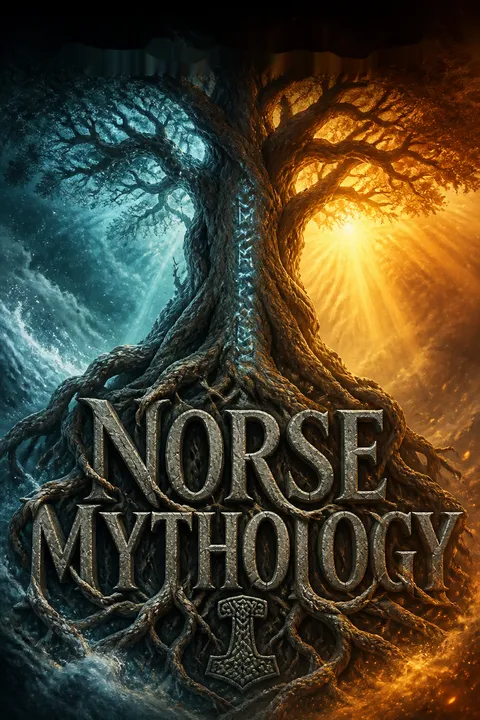
The three brothers shape the worlds from his remains: flesh becomes land, bones become mountains, and blood becomes sea. They raise a barrier around Midgard and breathe life into two logs, Ask and Embla, the first humans. Yggdrasil, the world-tree, joins nine worlds, while the norns tend its roots and shape each life’s fate.
Creation here is neither clean nor innocent. The gods make a habitable world through an act of violence, so civilization begins with the destruction it is meant to contain. Even human life is a crafted gift, dependent on divine power and sheltered behind a wall made from the dead. Yggdrasil complicates that security: its roots are bitten, its branches grazed, and its future cared for by beings who cannot simply command fate. The cosmos is structured, but never settled. Stability is labor performed against damage that has already begun.
Wisdom Has Its Price
Odin seeks knowledge at Mimir’s well in giant country, where Mimir demands one of the god’s eyes in exchange for a drink. Odin accepts, and the water grants him deeper wisdom; his eye remains submerged in the well. Later, during the peace between the Aesir and Vanir, Odin sends Mimir to advise Hoenir among the Vanir.
Hoenir makes sound decisions only when Mimir guides him, and the Vanir, angered by his dependence, behead Mimir. Odin preserves the head with herbs and spells, then places it beside his eye at the well, where it continues to advise him. He gives Mimir’s horn, the Gjallerhorn, to Heimdall, who will sound it when the gods must wake for their final battle.
Odin’s authority rests less on effortless omniscience than on his willingness to pay for what he cannot know. He sacrifices bodily wholeness, then works to preserve knowledge even after its keeper has been killed. Yet this wisdom does not make him morally clean or politically infallible: Mimir is sent into a situation where Hoenir cannot govern independently. The severed head and the retained eye turn insight into something uncanny, a faculty sustained through injury and loss. Knowledge can warn the gods, but it cannot spare them from the consequences of their choices.
The Dwarfs’ Six Gifts
Loki cuts off Sif’s golden hair while drunk, and Thor forces him to find a remedy. Loki persuades the sons of Ivaldi and the dwarfs Brokk and Eitri to compete in craftsmanship, then turns into a fly to distract Brokk as the brothers work.
The contest yields six treasures: a new head of golden hair for Sif, Odin’s unerring spear Gungnir, Frey’s foldable ship Skidbladnir, the wealth-producing ring Draupnir, the shining boar Gullinbursti, and Thor’s hammer, Mjollnir.
Brokk’s hammer has a short handle because Loki’s bites disrupted the forging, but the gods still judge it the greatest gift. When Brokk claims Loki’s head as his prize, Loki escapes by flight. Brokk cannot take the head without cutting the neck, so he sews Loki’s lips shut instead.
The tale makes disorder productive without pretending it is harmless. Loki’s vanity injures Sif, and his schemes nearly cost him his life, yet the resulting contest equips the gods with tools they will depend on. Mjollnir’s short handle preserves the trace of sabotage inside the gods’ strongest defense: their security is made by imperfect bargains and compromised workmanship. Loki’s role is therefore difficult to reduce to villainy. He creates trouble, but the trouble generates inventions; the gods resent him while benefiting from the ingenuity they cannot control.
A Wall Built on Deception
With Thor away, Asgard lacks protection, so the gods accept a stranger’s offer to build an impregnable wall in one season. If he succeeds, he will receive Freya, the sun, and the moon; his horse, Svadilfari, is allowed to help haul stone.
The wall rises far faster than Loki predicted, and the gods realize their oath may cost them everything. Facing their anger, Loki disguises himself as a mare and draws Svadilfari into the forest on the builder’s final evening. The builder returns without enough stones to finish on time, reveals himself as a mountain giant, and attacks.
Thor has come back from the east and kills him with Mjollnir. Loki stays away for months, then returns with Sleipnir, an eight-legged foal conceived during his transformation, and gives the exceptional horse to Odin.
The bargain exposes a weakness in divine power: the gods can swear an oath before understanding what they have promised. Loki’s cleverness rescues them, but only after his own counsel helps create the crisis. His solution is not an argument or a contest of strength; it is a bodily disguise that redirects the builder’s greatest advantage. The episode also refuses to keep categories tidy. Loki’s escape makes him the parent of Odin’s remarkable horse, while Freya is treated as a prize by both the giant and the gods. Cleverness protects the community, but it does not erase the community’s willingness to risk someone else.
Three Children, Three Fears
Odin learns that Loki has three children with the giantess Angrboda and brings the gods to her hall. They seize the growing serpent Jormungandr, the wolf Fenrir, and Hel, whose body is half living and half dead.
Odin casts Jormungandr into the world ocean, where it grows until it circles Midgard, and appoints Hel ruler of the dead who do not fall in battle. Fenrir remains in Asgard, where Tyr feeds and befriends him as the wolf grows larger each day. The gods test Fenrir first with ordinary chains, then with stronger ones, and he breaks both.
At last they obtain Gleipnir, a seemingly slight binding made by dwarfs. Fenrir suspects a trap and agrees to be bound only if a god places a hand in his jaws. Tyr does so, and loses his hand when the gods refuse to release the wolf.
Odin’s response to prophecy is containment, but containment becomes the act that makes enmity personal. The children are assigned roles before they can choose them: the serpent is exiled, Hel is given a kingdom, and Fenrir is treated as a future danger despite Tyr’s affection. Tyr’s sacrifice reveals the cost of the gods’ policy. He alone offers trust in a situation built on deception, and his injury makes visible the moral price of their security. Fear does not merely anticipate violence here; it helps manufacture the grievance that keeps violence alive.
Thor’s Borrowed Bridal Veil
Thrym, lord of the ogres, steals Mjollnir and hides it underground, offering to return it only if Freya marries him. Freya rejects the demand, so Heimdall proposes disguising Thor as the bride. Thor resists the plan, but he and Loki travel to Thrym’s hall with Loki posing as his maidservant.
Thor’s enormous appetite and blazing eyes nearly expose them. Loki explains both away, and Thrym orders Mjollnir brought out to consecrate the marriage. The moment the hammer is placed in Thor’s lap, the disguise has served its purpose.
Thor takes it up and kills Thrym, then uses it against the assembled ogres. The journey home restores Asgard’s strongest defense, while Freya’s refusal prevents the gods from treating her as a payment for their own safety.
The comedy depends on Thor entering a role that unsettles his image of masculine strength, but the disguise also reveals how narrow the gods’ options have become. Freya’s anger forces the others to devise a plan that does not sacrifice her consent. Thor’s performance is awkward, yet his willingness to endure it shows that the hammer matters more than his pride. The feast converts familiar signs of marriage into tactical cover: jewelry, veils, food, and ritual all delay the enemy until the weapon returns. Humor does not soften the stakes; it gives the gods a way to act under pressure.
Odin Steals the Mead
At the Aesir and Vanir peace feast, their mingled spittle becomes Kvasir, a sage whose answers help every community he visits. Dwarfs Fjalar and Galar kill him and mix his blood with honey to make a mead that grants poetry and learning.
After they kill the giant Gilling and his wife, their son Suttung takes the mead and places it in a mountain vault guarded by Gunnlod. Odin disguises himself as Bolverkr, works for Suttung’s brother Baugi, and earns help reaching the mountain.
He drills through the rock, slips inside as a snake, and persuades Gunnlod to let him taste the mead. He drains all three vessels, becomes an eagle, and escapes as Suttung pursues him. Odin brings the mead to Asgard, though some spills in an undignified form and becomes the source of bad poetry.
Poetry’s origin is deliberately compromised. It begins in a peace agreement, passes through murder and revenge, then reaches the gods through Odin’s labor, seduction, and theft. The myth resists the comforting idea that art descends from pure inspiration. Its power is shared unevenly and guarded as property, while access depends on bargaining and deception. Odin’s journey makes cultural gifts inseparable from the methods used to acquire them. The final division between inspired poetry and its inferior residue also punctures any easy reverence for artistic authority: eloquence can be a gift, but not every claim to it deserves respect.
The Tests at Utgard
After young Thialfi breaks a bone in Thor’s goat, Thor takes him east as a servant and leaves Thialfi’s sister Roskva to care for the injured animal. On the road, the companions shelter inside what proves to be a giant’s glove and meet Skrymir, who carries their food away.
Thor’s hammer blows barely wake him. At Utgard, the king sets contests: Loki loses an eating match to Logi, Thialfi loses races to Hugi, and Thor cannot empty a horn, lift a cat, or defeat the old woman Elli.
Outside the fortress, Utgardaloki reveals the illusions: Logi is fire, Hugi is thought, the horn reaches the sea, the cat is Jormungandr, and Elli is old age. Thor’s partial success against impossible opponents transforms humiliation into proof of extraordinary strength.
Utgard’s contests measure the gap between humanly legible achievement and forces no individual can master. Thor is not weak because he cannot drain the sea or defeat old age; the apparent failure is the scale of his actual accomplishment. Still, the revelation does not simply soothe wounded pride. The king’s illusions expose how easily confidence can be manipulated when the rules are hidden. Thialfi’s speed and Loki’s appetite also have limits, but their efforts remain real. The episode teaches the companions, and the reader, to judge an action by what it confronts, not only by whether it wins.
Idunn Leaves Asgard
While Loki travels with Thor and Hoenir, the giant Thiazi forces him to promise that he will deliver Idunn and her apples of immortality. Loki later tricks Idunn into leaving Asgard by claiming that better apples grow in a nearby forest. Thiazi, waiting there in eagle form, carries her and the apples to his stronghold.
Without them, the gods rapidly grow old; Thor and the others chain Loki and threaten him until he agrees to bring her back. Wearing Freya’s falcon cloak, Loki finds Idunn imprisoned and transforms her into a hazelnut so he can carry her home. Thiazi pursues them as an eagle, but the gods ignite wood shavings along Asgard’s wall. The pursuer flies into the flames, falls, and Thor kills him before he can escape.
The apples make aging a collective dependency, so Loki’s private bargain quickly becomes a crisis for the entire divine community. His deception is not merely a single betrayal; it exposes how fragile the gods’ apparent permanence is. The rescue reverses the first trick through another act of transformation, but it also depends on cooperation: Freya’s cloak, Loki’s speed, and the gods’ prepared fire each matter. Thiazi’s death then carries consequences beyond the immediate rescue, since the gods have killed a father in front of his daughter. Restoring order does not cancel the obligations created along the way.
Skadi’s Price for Thiazi
Skadi arrives in Asgard armed to avenge her father, Thiazi. The gods negotiate compensation: she may choose a husband by looking only at the suitors’ feet, must be made to laugh, and wants her father remembered.
Expecting to identify the beautiful Balder, Skadi chooses the feet she considers most attractive, only to discover that they belong to Njord, a sea god and Frey and Freya’s father. Their marriage begins without the match she imagined. Loki then ties a rope between his own body and a goat, provoking a painful tugging contest that finally makes Skadi laugh.
To honor her last demand, Odin places Thiazi’s eyes in the night sky as stars. The settlement averts further conflict, though it cannot restore Skadi’s father or guarantee that her new marriage will satisfy either spouse.
The settlement turns grief into a public negotiation, but compensation cannot make bereavement equivalent to justice. Skadi receives choice only in a narrowed, theatrical form: she may select a husband, but cannot see the person she is selecting. The comic performance that wins her laughter likewise asks Loki’s body to absorb the humiliation. Yet the stars offer a different kind of restitution. They preserve the father not as a living presence but as a visible memory, giving loss a place in the shared world. The myth holds together political compromise, absurdity, and mourning without pretending they erase one another.
Frey Gives Away His Sword
Frey, the Vanir god of fertility and harvest, already owns a self-fighting sword, a shining boar, a ship that folds into a bundle, and the realm of Alfheim. Yet none of these fills the emptiness he feels.
From Odin’s high seat, Frey sees Gerd, a giantess whose presence seems to brighten the world, and returns home unable to eat or speak. He asks his servant Skirnir to win Gerd for him and offers his sword as payment. Skirnir visits Gerd’s father’s household and describes Frey’s power and longing; Gerd agrees to meet Frey nine days later.
They marry on the island of Barri, and Frey is content, but he does not reclaim or replace his sword. When he later fights, he must rely on other means, leaving the choice with a cost that remains visible.
Frey’s longing begins with abundance, not deprivation. He possesses objects that embody power and comfort, yet a glimpse of another person reorganizes his desires. The danger lies not in love itself but in the speed with which he converts a permanent safeguard into payment for relief from longing. Skirnir’s service makes the romance possible, but it also turns desire into a transaction managed by a subordinate. Frey’s happiness is real, and so is the vulnerability created by what he gives away. The myth refuses to treat emotional fulfillment as a cost-free reward.
Thor Hooks the World Serpent
Thor and Tyr visit the giant Hymir to borrow his enormous brewing cauldron, needed for a feast at the sea giant Aegir’s hall. Hymir tests Thor with a fishing expedition, but Thor kills Hymir’s prized ox for bait and rows farther out than the giant wants. His line hooks Jormungandr, the Midgard serpent, and Thor hauls the monster toward the boat, ready to strike with Mjollnir.
Hymir cuts the line, and the serpent disappears. Back at the hall, Thor breaks Hymir’s drinking cup by smashing it against the giant’s hard head, winning the cauldron. As they flee, Grinder stumbles and the pursuing giants catch up. Thor sets down the cauldron and fights them while Tyr joins him. Thor brings the cauldron to Aegir, securing the gods’ annual feast.
Thor’s directness makes him both effective and dangerous. He treats fishing, bargaining, and combat as problems that can be solved by applying more strength, even when doing so threatens everyone in the boat. Hymir’s cut line frustrates Thor’s desire for a clean victory over the serpent, preserving the larger conflict rather than resolving it. Yet Thor’s strength also gets the cauldron and keeps the retreat from becoming a defeat. The injured goat recalls the chain of consequences begun by Loki’s earlier suggestion to Thialfi. In these myths, even a successful adventure carries the marks of older mistakes.
Mistletoe Finds Balder
Balder, Odin’s beloved son, dreams of death, so Odin seeks answers from a dead seer and learns that Balder is in danger. Frigg tries to prevent the prophecy by taking oaths from every creature and substance except mistletoe, which she considers harmless.
The gods test Balder’s invulnerability by throwing weapons and stones at him, while his blind brother Hod is left outside the celebration. Loki learns of the overlooked plant, makes a dart from it, and guides Hod’s hand. The dart kills Balder.
At the funeral, Balder’s wife Nanna dies from grief, and the gods send Hermod to Hel to bargain for his return. Hel agrees to release Balder if all things mourn him, but a disguised Loki refuses to weep. Balder remains among the dead, and Odin’s newborn son Vali avenges him by killing Hod.
Balder’s death grows out of a failed attempt to eliminate vulnerability altogether. Frigg’s protection is nearly complete, but its tiny exception becomes the opening through which Loki weaponizes exclusion. Hod’s blindness is not the cause of the tragedy; Loki exploits his brother’s wish to participate, turning an act of inclusion into violence. The failed return deepens the loss because grief is almost universal but not unanimous. One withheld tear defeats an entire community’s mourning. The myth suggests that protection cannot be made absolute, and that revenge may answer an injury without restoring what was taken.
Loki Beneath the Serpent
At Aegir’s feast, Loki kills the servant Fimafeng and returns to insult the gods until Thor drives him away. He later hides near a waterfall, taking salmon form, but first invents a fishing net and burns it when the gods approach.
Kvasir reads the pattern in the ashes, constructs a net, and helps Thor catch Loki as he leaps from the pool. The gods carry Loki underground with his wife Sigyn and sons Narfi and Vali. They transform Vali into a wolf, and he kills Narfi; then they use Narfi’s entrails to bind Loki beneath a venomous serpent.
Sigyn stays beside her husband, holding a bowl to catch the poison, but must leave when it fills. Each drop that reaches Loki makes him writhe and shakes the earth. His confinement is to last until the world’s final crisis.
Punishment reproduces the betrayal it claims to answer. The gods condemn Loki through the death of one son and the transformed violence of another, binding him with the remains of his family. Sigyn’s care does not absolve him, nor does it make the punishment less severe; her vigil instead introduces loyalty into a scene organized around vengeance. Kvasir’s deduction shows that Loki’s invention can be turned against him, while Thor supplies the force needed to make capture final. The earthquake becomes the physical remainder of pain the gods have tried to bury. Their victory is therefore unstable, held together by suffering.
The Gods Fall, Earth Returns
Ragnarok begins with Fimbulwinter, social collapse, earthquakes, and the release of Fenrir and Jormungandr. Heimdall sounds the Gjallerhorn, and the gods ride to Vigrid. Frey falls to Surtr; Tyr and the hound Garm kill one another; Thor kills Jormungandr but dies from its poison. Fenrir devours Odin, then Vidar kills the wolf.
Loki and Heimdall mortally wound each other, and Surtr sets the world ablaze. The sea covers the ashes, but green land rises again. Life and Life’s Yearning emerge from Yggdrasil and begin humankind anew. Odin’s sons Vidar and Vali, Thor’s sons Modi and Magni, and the returned Balder and Hod gather in the renewed world. They find golden game pieces among the grass and begin to play again.
The ending takes prophecy seriously without treating it as proof that nothing matters. The gods cannot prevent their deaths, but they still meet the battle with courage, and individual choices retain their consequences: Frey lacks the sword he surrendered, while Vidar uses a shoe assembled from discarded scraps to defeat Fenrir. The world’s destruction is neither punishment nor simple renewal; it is an irreversible rupture followed by a life that cannot remember everything firsthand. The golden pieces let the survivors inherit the past as an object of play. Beginning again does not erase what happened; it gives its remnants another arrangement.
Analysis
This collection is arranged less like a single hero’s journey than like a chain of explanations, bargains, and consequences. The myths begin by making a world from violence, then populate it with gods who repeatedly try to manage risk through knowledge, strength, and cleverness. Those methods work, but never cleanly. Odin’s foresight cannot cancel fate. Thor’s strength cannot make him master of the sea or of age. Loki’s inventions can rescue the gods and endanger them, often in the same sequence. Their stories make power feel relational: a hammer needs a craftsperson, a prophecy needs interpretation, and a community’s safety may depend on someone it distrusts.
The book also treats care as a form of labor that official power tends to overlook. Idunn’s apples sustain the gods, Tyr’s trust shapes Fenrir’s understanding of the Aesir, and Sigyn’s vigil keeps watch over a husband the gods have bound. Such acts do not always prevent disaster, but they change what disaster means. Likewise, the myths resist simple moral sorting. The gods can be brave and self-serving; Loki can be useful and cruel; giants can threaten Asgard while also grieving, bargaining, or loving. Their conflicts arise from choices made under partial knowledge, not from a tidy contest between good and evil.
Ragnarok gathers these tensions rather than resolving them. The gods meet a fate they have anticipated, and their courage matters even though it cannot preserve the old world. The reborn landscape does not restore everything: people begin again, the surviving gods inherit memories and objects, and the story ends with the recovery of golden game pieces. The image suggests that history may return in altered form, with old rivals placed across a board once more. Renewal is not an escape from repetition. It is the chance to encounter inherited patterns again, this time with the knowledge that every move carries a cost.
Review Summary
Norse Mythology by Neil Gaiman retells classic Norse myths in an accessible, engaging style. Many readers praised Gaiman's storytelling and found the book an excellent introduction to Norse mythology, though some felt it lacked depth or originality. The audiobook narrated by Gaiman was highly regarded. Readers enjoyed the humor and characterizations of gods like Thor, Odin and Loki. While some wanted more stories or details on lesser-known figures, most found it an entertaining, informative read that brought the myths to life for modern audiences.
People Also Read
Characters
Odin
The one-eyed seekerThe oldest and most powerful of the Aesir, Odin is driven by a hunger to know what lies beyond ordinary sight. He sacrifices an eye for wisdom and seeks runic power through self-inflicted suffering, yet knowledge does not make him gentle or perfectly just. He watches the worlds, gathers news through his ravens, and makes decisions shaped by visions of what may come. His authority depends on strategic thought, but his choices can impose costs on others, as when he responds to danger by controlling it. Odin embodies the uneasy link between foresight and responsibility: seeing more does not mean being able to repair what one sees.
Thor
The thunderous protectorOdin’s son and Asgard’s strongest defender, Thor meets danger with blunt courage and an almost childlike confidence in physical action. His hammer Mjollnir makes him formidable, but it does not make him immune to confusion, humiliation, or the consequences of his own impatience. He protects gods and humans, yet can mistake force for a complete answer, as when he rows toward a monster despite the danger to his companions. Thor’s warmth and directness make him dependable in a crisis, while his limitations give his victories texture. He is not a strategist like Odin or Loki; his defining response is to stand between danger and those he loves.
Loki
The ingenious destabilizerOdin’s blood brother and a giant’s son, Loki lives among the Aesir while remaining partly outside their loyalties. Handsome, persuasive, and exceptionally inventive, he can solve a crisis with the same mind that created it. Envy, appetite, and resentment repeatedly overcome his ability to judge consequences, especially when drink loosens his restraint. He is neither simply evil nor secretly benevolent: his actions create gifts and disasters in equal measure, and the gods keep relying on him even as they distrust him. Loki’s deepest talent is making other people act, often before they understand the price. His shifting identity makes him difficult to contain, even for those who know him best.
Freya
The unyielding goddessA powerful and beautiful goddess, Freya is not content to be treated as property or payment. She rejects the proposal that she marry an ogre to recover Thor’s hammer, and her anger forces the gods to find another solution. Her necklace and falcon-feather cloak connect her to the stories of divine treasure and disguise. Freya’s independence is practical as well as personal: she lends the cloak when the gods need it, but she makes clear that cooperation does not mean surrendering her judgment.
Frey
The yearning harvest godFreya’s brother and a Vanir god associated with fertility and harvest, Frey has power, wealth, and prestige, yet remains vulnerable to longing. His possessions cannot answer the private emptiness he feels, and one glimpse of Gerd redirects his attention entirely. Frey’s story shows how desire can make even a capable god impatient and how emotional fulfillment may require surrendering something valuable. His love is sincere, but the bargain he makes carries consequences beyond the immediate courtship.
Tyr
The steadfast war godA god of war who has only one hand, Tyr is notable for a steadiness that contrasts with the other gods’ suspicion and bravado. He continues to care for Fenrir when the wolf grows frightening, and he accepts a personal risk when the gods seek to bind the animal. Tyr’s courage is not theatrical. It comes from keeping faith with a bond even when he knows that other people may break theirs. He also fights bravely as a companion to Thor, bringing discipline and loyalty into the group’s more chaotic expeditions.
Sigyn
The patient companionLoki’s wife and the mother of Narfi and Vali, Sigyn is often portrayed as expecting the worst from her husband’s disappearances and schemes. Her loyalty is quiet rather than approving: she remains emotionally connected to Loki without being responsible for the choices he makes. The image of her carrying a bowl beside him makes care visible as repeated labor, not a single grand gesture. Sigyn offers a counterpoint to the gods’ public contests and punishments, showing how intimate devotion can persist amid consequences it cannot undo.
Balder
The beloved judgeOdin’s son, Balder is renowned for beauty, wisdom, fairness, and a warmth that draws affection from gods and other beings. His home is associated with music and learning, and he is accustomed to bringing people together through good judgment. Troubling dreams reveal a more vulnerable side beneath his radiant reputation. Balder’s closeness to his brother Hod matters as much as his public status: he is a beloved figure whose relationships make the threat to him personal for the gods.
Hod
Balder’s blind brotherOdin’s blind son and Balder’s brother, Hod is strong but often excluded from events he cannot see. His isolation is sharpened when the other gods celebrate Balder without making room for him. Hod wants to share in his brother’s happiness and trust his companions’ guidance. That openness makes him vulnerable to manipulation, but it should not be confused with malice or foolishness. His character foregrounds the ethical responsibility others have when offering help to someone who depends on their account of the world.
Idunn
Keeper of renewalIdunn is the gentle goddess who carries golden apples that restore the gods’ youth. Her care is woven into the daily stability of Asgard, though the gods’ dependence on her gift can make them overlook her own agency. She trusts Loki enough to follow him into the forest, a decision that exposes her to danger. Idunn is more than the guardian of a magical object: her absence changes the condition of the entire community, demonstrating how much divine strength rests on the work of someone who is not a warrior.
Skadi
The grieving huntressThe daughter of the giant Thiazi, Skadi is a skilled, armed figure who enters Asgard as a daughter demanding recognition for her father. Her grief does not make her passive; she names what she wants and bargains with the gods. The terms she accepts reveal both her expectations and the limits of what compensation can provide. Skadi’s presence brings a perspective from giant country into the divine hall, challenging the Aesir to account for the relationships and losses created by their victories.
Gerd
The luminous giantessGerd is the daughter of the giant Gymir and the woman whose appearance transforms Frey’s sense of what is missing from his life. She is not merely a distant vision: when Skirnir reaches her household, she listens to his account of Frey and chooses to meet him. Her response makes her an active participant in the courtship, not only its object. Gerd’s story joins the worlds of gods and giants through desire, while the terms of her meeting with Frey reveal how romance in these myths is shaped by bargains and intermediaries.
Skirnir
Frey’s trusted messengerA light elf and Frey’s capable servant, Skirnir is valued for his judgment, loyalty, and ability to act beyond the safety of his master’s household. Frey entrusts him with the difficult journey to Gerd and gives him a treasured sword as payment. Skirnir’s role shows how servants and messengers can shape divine affairs through action rather than command. He is dependable, but his service also draws him into bargains whose consequences extend beyond the immediate mission.
Heimdall
The watchman of AsgardHeimdall watches over the gods and sees events that others miss. His vigilance makes him a natural adviser when Thor’s hammer is stolen, and his proposal to disguise Thor supplies a workable route to its recovery. He is associated with the Gjallerhorn, whose sound will call the gods to attention when danger reaches its greatest scale. Heimdall’s role is defined by readiness: he observes, warns, and acts at the moment when seeing clearly must become responsibility.
Mimir
The well’s wise keeperMimir guards the well of wisdom and memory, and his counsel is valuable to gods who need knowledge beyond their own experience. Odin’s sacrifice at the well establishes how costly insight can be. Even after Mimir is killed and his head preserved, his advice remains part of the gods’ attempts to understand what lies ahead. Mimir represents knowledge that outlives the body, but also the dependence of rulers on counsel they cannot simply produce for themselves.
Thialfi
The swift young travelerA farm boy who can run faster than anyone around him, Thialfi becomes Thor’s servant after breaking a bone in one of the god’s goats. He accepts responsibility for his mistake and offers himself rather than allow his parents to suffer for it. His speed makes him proud, then the contests at Utgard test his understanding of what speed can overcome. Thialfi brings a human scale to Thor’s journeys and shows how a young person can enter divine danger through an ordinary lapse in judgment.
Roskva
Thialfi’s loyal sisterThialfi’s sister, Roskva refuses to let him leave the farm without her. Thor leaves her behind to care for the goats while Thialfi travels with him. Her brief appearance establishes her loyalty and willingness to share her brother’s burden.
Hel
The divided queenDaughter of Loki and Angrboda, Hel has a face and body marked by a division between living flesh and the appearance of death. She is composed, self-possessed, and more comfortable among the dead than among the living, whose reactions often make her an outsider. Odin assigns her authority over those who die outside battle. Hel’s character challenges the assumption that strangeness signals cruelty: she can be severe, but she judges requests according to her own terms.
Fenrir
The growing wolfLoki and Angrboda’s wolf-child grows with startling speed and strength. He is proud of his power, but not unaware of the gods’ fear; he tests their promises before accepting their restraints. His bond with Tyr gives him a relationship built on care before betrayal enters it. Fenrir’s character draws attention to the difference between being dangerous and being treated as doomed. The gods’ attempts to control him shape how he understands them.
Jormungandr
The world-encircling serpentLoki and Angrboda’s serpent-child is cast into the world ocean and grows until its body surrounds Midgard. Its immense scale makes it a threat beyond the reach of ordinary combat, while Thor’s determination to face it turns their relationship into a recurring contest. Jormungandr is associated with the boundary between land and sea, a living danger that cannot be removed simply by putting it out of sight.
Sif
Thor’s golden-haired wifeThor’s wife, Sif is known for her golden hair, which Loki’s thoughtless prank removes. Her injury is treated as more than a cosmetic inconvenience because it exposes her to false assumptions about shame and punishment. The dwarfs’ replacement hair restores her appearance and becomes part of the story of the gods’ treasures. Sif’s place in the episode reminds the reader that Loki’s games can harm people who are not participants in his contests.
Kvasir
The born-from-peace sageKvasir is formed from the mingled spittle of the Aesir and Vanir after they make peace, and becomes renowned for answering questions wisely. His origins unite two rival divine communities in a single person. Kvasir’s travels make wisdom a public good, but his knowledge also attracts those who want to possess it. He is associated with both the origin of poetry’s mead and the sharp observation that helps the gods understand Loki’s plan.
Angrboda
Loki’s giantess partnerA giantess who lives in Jotunheim, Angrboda is the mother of Loki’s three remarkable children. The gods encounter her household as they try to take the children away, while her later presence in a vision links Loki’s family to the danger the gods fear. Her limited appearances leave much unknown, making her one of the figures whose story seems larger than the surviving tales.
Surtr
The waiting fire giantSurtr stands in Muspell with a flaming sword, present before the gods and waiting at the edge of the world’s story. He is not a schemer or a rival who negotiates; his defining force is the fire he carries and the destruction associated with it. His presence gives the world a visible horizon of danger, a reminder that the cosmos contains powers older than Asgard.
Utgardaloki
The illusion-making giant kingA giant king whose stronghold welcomes visitors claiming unusual skill, Utgardaloki is a host who controls what his guests believe they are seeing. He tests Thor, Loki, and Thialfi through contests that make each of them confront the limits of familiar abilities. His intelligence is playful but not harmless; he uses humiliation as a form of power. Utgardaloki serves as a counterpoint to Loki, showing that deception is not confined to the gods.
Plot Devices
Yggdrasil and the Nine Worlds
A map under strainThe world-tree connects the nine realms and gives the myths a shared geography. Its roots reach different sources of power, while creatures gnaw, graze, and carry messages through its branches. The norns tend the tree and represent past, present, and future, linking individual lives to a wider pattern of fate. Yggdrasil is more than scenery: it gives travel, prophecy, and the eventual survival of life a common structure. Its constant damage suggests that the universe endures through care, not through untouched perfection.
The Gods’ Treasures
Power made portableDwarven craftsmanship produces objects that carry practical and symbolic power: Mjollnir defends the gods, Gungnir finds its mark, Draupnir reproduces wealth, and Idunn’s apples restore youth. Their effects help drive later adventures, from the theft of Thor’s hammer to the gods’ dependence on Idunn. These objects also preserve the circumstances of their creation. Mjollnir’s short handle records Loki’s interference, while Frey’s sword becomes a measure of what he gives away. The treasures rarely solve a problem without exposing another vulnerability.
Shape-Shifting and Disguise
Escape through transformationLoki and other figures change shape to deceive enemies, cross barriers, or survive pursuit. Loki becomes a mare, a fly, a snake, an eagle, and a salmon; he also disguises himself in human forms. Thor’s bridal disguise uses clothing and performance rather than magic. Transformation makes identity flexible, but not consequence-free: each disguise can create new obligations or expose someone else to danger. The device also makes recognition a recurring test, since characters must learn whether the body before them can be trusted.
Oaths and Bargains
Promises with hidden costsThe gods repeatedly try to manage danger through bargains: the builder’s wager, Thrym’s marriage demand, Frey’s payment to Skirnir, and the conditions around Fenrir’s binding. An oath can protect an agreement, but only if its terms are understood and the parties respect what it implies. Loki exploits loopholes, while others discover that promises can place loved ones in danger. These bargains move the stories forward because characters must decide what they are willing to risk. Their apparent solutions often become the next source of conflict.
Prophecy and Ragnarok
An ending already approachingDreams, visions, and inherited warnings tell the gods that a final catastrophe is coming, but they do not provide a reliable way to prevent it. Odin seeks knowledge, and the gods attempt to contain threats such as Fenrir, yet those actions can deepen the very enmity they fear. Ragnarok gathers earlier relationships and objects into a final reckoning: the wolf, the serpent, the Gjallerhorn, Mjollnir, and Frey’s surrendered sword all matter. Its destruction is followed by renewed life, making fate both an ending and a condition for beginning again.
FAQ
Synopsis & Basic Details
What is Norse Mythology about?
- Epic tales of gods: Norse Mythology retells the interconnected stories of the Norse gods, their creation, their interactions, and their eventual doom. It explores their complex relationships, their battles, and their individual quests for power, wisdom, and love.
- A world of nine realms: The narrative spans across the nine realms of Norse cosmology, from the fiery Muspell to the icy Niflheim, and the human realm of Midgard, all connected by the world-tree Yggdrasil. It details the unique inhabitants and characteristics of each realm.
- The cycle of destruction: The book culminates in Ragnarok, the prophesied end of the world, where gods and monsters clash in a final battle, leading to the destruction of the old world and the promise of a new beginning.
Why should I read Norse Mythology?
- Engaging storytelling: Neil Gaiman's retelling makes the complex and often fragmented Norse myths accessible and captivating, with a narrative voice that is both modern and respectful of the source material.
- Exploration of universal themes: The book delves into timeless themes of fate, free will, sacrifice, betrayal, and the cyclical nature of life and death, offering insights into the human condition through the lens of mythology.
- Rich character development: The gods and other figures are portrayed with depth and nuance, showcasing their strengths, weaknesses, and internal conflicts, making them relatable and compelling characters.
What is the background of Norse Mythology?
- Oral tradition: Norse myths were originally part of an oral tradition, passed down through generations of storytellers and poets, before being written down much later, often by Christian scholars.
- Viking Age culture: The myths reflect the values, beliefs, and worldview of the Viking Age, a period of exploration, warfare, and cultural exchange in Scandinavia and beyond. They provide insights into the social structures, religious practices, and daily life of the Norse people.
- Christian influence: The written versions of the myths were often influenced by Christian perspectives, which sometimes altered or reinterpreted the original stories, leading to variations and inconsistencies in the narratives.
What are the most memorable quotes in Norse Mythology?
- "There is no glory without danger": This quote, spoken by Fenrir, encapsulates the Norse ethos of embracing risk and challenge in the pursuit of honor and renown, a central theme in the stories of gods and heroes.
- "That was the thing about Loki. You resented him even when you were at your most grateful, and you were grateful to him even when you hated him the most.": This quote perfectly captures the complex and contradictory nature of Loki, highlighting his role as both a source of trouble and a catalyst for change.
- "Rebirth always follows death": This quote, spoken by Heimdall, encapsulates the cyclical nature of the Norse cosmos, where destruction is not an end but a prelude to renewal, offering a sense of hope amidst the chaos of Ragnarok.
What writing style, narrative choices, and literary techniques does Neil Gaiman use?
- Conversational tone: Gaiman employs a conversational and accessible tone, making the complex myths feel like stories told by a familiar storyteller, drawing the reader into the world of the Norse gods.
- Focus on character: The narrative prioritizes character development, exploring the motivations, flaws, and inner lives of the gods, making them relatable and human despite their divine status.
- Blending of sources: Gaiman skillfully blends different versions of the myths from the Prose Edda and the Poetic Edda, creating a cohesive and engaging narrative while acknowledging the inherent contradictions and variations in the source material.
Hidden Details & Subtle Connections
What are some minor details that add significant meaning?
- The significance of names: The names of characters and objects often carry symbolic weight, such as Svadilfari, meaning "one who makes an unlucky journey," foreshadowing the horse's role in the master builder's downfall, or the names of Loki's children, each reflecting their monstrous nature.
- The recurring motif of eyes: Eyes are a recurring motif, from Odin's sacrifice of his eye for wisdom to the description of the Midgard serpent's eyes, emphasizing the importance of sight, perception, and knowledge in the Norse world.
- The importance of oaths: The emphasis on oaths and their binding nature highlights the importance of honor and integrity in Norse society, as seen in the gods' unbreakable oaths and the consequences of breaking them.
What are some subtle foreshadowing and callbacks?
- The mention of Surtr: The early mention of Surtr, the fire giant who waits at the edge of Muspell, foreshadows his crucial role in Ragnarok, where he will destroy the world with his flaming sword, creating a sense of impending doom.
- The creation of Mjollnir: The story of Mjollnir's creation, with its slightly short handle due to Loki's interference, is a subtle callback to the theme of imperfection and the idea that even the greatest creations are flawed.
- The Gjallerhorn's significance: The Gjallerhorn, initially used by Mimir, is later given to Heimdall, foreshadowing its crucial role in signaling the beginning of Ragnarok, connecting the past to the future.
What are some unexpected character connections?
- Loki and Odin's blood brotherhood: The blood brotherhood between Loki and Odin, often overlooked, adds a layer of complexity to their relationship, highlighting the tension between loyalty and betrayal, and the personal stakes in their conflict.
- Tyr and Hymir's familial ties: The connection between Tyr and Hymir, as stepfather and stepson, adds a layer of irony to their interactions, as Tyr seeks to borrow the cauldron from his own family, highlighting the complex web of relationships among gods and giants.
- Skadi and Loki's shared history: Skadi's presence at Loki's binding, and her role in placing the serpent above him, is a callback to their earlier encounter when Loki stole her necklace, highlighting the long-lasting consequences of Loki's actions.
Who are the most significant supporting characters?
- Mimir: Mimir, the wise guardian of the well of wisdom, plays a crucial role in Odin's quest for knowledge, and his severed head continues to offer counsel, highlighting the importance of wisdom and memory in the Norse world.
- Sigyn: Sigyn, Loki's wife, is a figure of quiet devotion and suffering, her unwavering loyalty to her husband, even in his darkest moments, provides a counterpoint to Loki's chaotic nature.
- Kvasir: Kvasir, the wisest of the gods, is a figure of knowledge and insight, his creation from the mingled spittle of the Aesir and Vanir, and his subsequent murder, leads to the creation of the mead of poetry, highlighting the power of knowledge and creativity.
Psychological, Emotional, & Relational Analysis
What are some unspoken motivations of the characters?
- Odin's fear of Ragnarok: Odin's relentless pursuit of wisdom and power is driven by his unspoken fear of Ragnarok, the prophesied end of the world, and his desire to find a way to avert or at least prepare for it.
- Loki's desire for recognition: Loki's mischief and trickery are often motivated by his unspoken desire for recognition and acceptance, as he struggles to find his place among the gods, leading to a cycle of chaos and resentment.
- Thor's need for validation: Thor's constant need to prove his strength and bravery stems from an unspoken desire for validation, as he seeks to live up to his reputation as the mightiest of the gods, often leading to impulsive actions.
What psychological complexities do the characters exhibit?
- Odin's internal conflict: Odin's character is marked by an internal conflict between his desire for knowledge and his fear of the future, leading to a complex and often contradictory personality, as he seeks to control fate while also being bound by it.
- Loki's self-destructive tendencies: Loki's actions are often driven by self-destructive tendencies, as he sabotages his own relationships and opportunities, highlighting his internal struggle with envy, resentment, and a desire for chaos.
- Thor's emotional simplicity: Thor's emotional simplicity, while making him a straightforward hero, also makes him vulnerable to manipulation, as seen in his interactions with Loki, highlighting the limitations of brute strength without cunning.
What are the major emotional turning points?
- Balder's death: Balder's death is a major emotional turning point, plunging the gods into grief and despair, and setting in motion the events leading to Ragnarok, highlighting the fragility of life and the inevitability of loss.
- Loki's binding: Loki's binding, and the subsequent torture he endures, marks a shift in his character, as he moves from a mischievous trickster to a figure of bitterness and resentment, highlighting the consequences of his actions.
- Thor's encounter with the Midgard serpent: Thor's battle with the Midgard serpent, and his subsequent death, is a major emotional turning point, highlighting the tragic nature of the gods' fate and the inevitability of their doom.
How do relationship dynamics evolve?
- Odin and Loki's complex bond: The relationship between Odin and Loki evolves from a blood brotherhood to a bitter rivalry, highlighting the tension between loyalty and betrayal, and the personal stakes in their conflict.
- Thor and Loki's love-hate dynamic: The relationship between Thor and Loki is characterized by a love-hate dynamic, as they are both friends and enemies, highlighting the complex interplay of cooperation and conflict in their interactions.
- The gods' collective grief: The gods' collective grief over Balder's death highlights their shared vulnerability and the fragility of their existence, as they struggle to cope with loss and the impending doom of Ragnarok.
Interpretation & Debate
Which parts of the story remain ambiguous or open-ended?
- The nature of fate: The extent to which the gods are bound by fate versus their ability to exercise free will remains ambiguous, raising questions about the nature of destiny and the limits of divine power.
- The motivations of the norns: The role of the norns, the weavers of fate, is left somewhat ambiguous, raising questions about their power and influence over the gods' lives and the unfolding of events.
- The details of the new world: The details of the new world that emerges after Ragnarok are left somewhat open-ended, raising questions about the nature of rebirth and the future of the cosmos.
What are some debatable, controversial scenes or moments in Norse Mythology?
- Odin's actions: Odin's actions, such as his pursuit of wisdom at any cost and his manipulation of others, are often morally ambiguous, raising questions about the nature of leadership and the ethics of power.
- Loki's role in Balder's death: Loki's role in Balder's death is a source of debate, as it is unclear whether he is simply a pawn of fate or a truly malevolent force, highlighting the complexities of good and evil.
- The treatment of Loki's children: The treatment of Loki's children, particularly Fenrir, Jormungundr, and Hel, raises questions about the gods' morality and their willingness to sacrifice others for their own safety, highlighting the darker aspects of their rule.
Norse Mythology Ending Explained: How It Ends & What It Means
- The destruction of the old world: Ragnarok represents the destruction of the old world, including the gods, their enemies, and the structures of the cosmos, symbolizing the end of an era and the inevitability of change.
- The promise of rebirth: The emergence of a new world from the ashes of the old, with a new sun and new life, symbolizes the cyclical nature of existence and the hope for renewal after destruction, offering a sense of optimism amidst the tragedy.
- The continuation of the cycle: The final scene, with the surviving gods playing chess, suggests that the cycle of creation and destruction will continue, highlighting the eternal struggle between order and chaos, and the enduring nature of the human condition.
About the Author

Download PDF
Download EPUB
.epub digital book format is ideal for reading ebooks on phones, tablets, and e-readers.








