

Plot Summary
A Child Among Graves
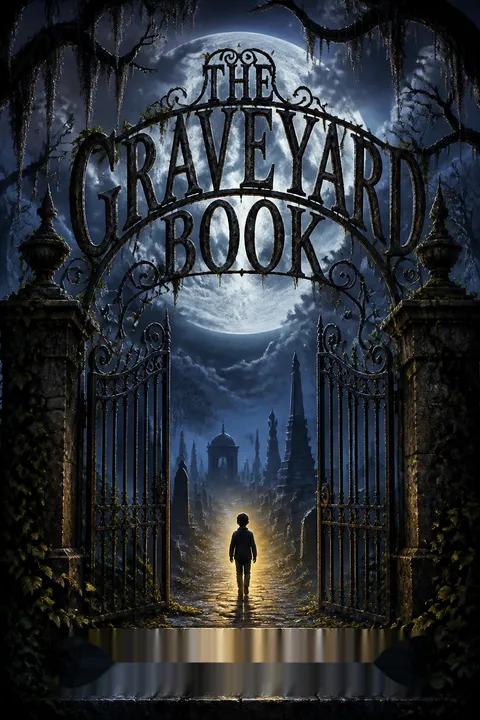
After a knife-wielding man kills the Dorian family, their toddler escapes his crib and wanders uphill into an old graveyard. The ghosts Mr. and Mrs. Owens find him there, while the killer climbs the wall in pursuit. The child’s dead mother begs the graveyard to protect her son, and Mrs. Owens accepts him as her own.
Silas, a mysterious guardian who can pass between the living and dead, persuades the cemetery’s inhabitants to give the boy the Freedom of the Graveyard. They name him Nobody Owens, or Bod, and hide him from the killer by bending the man’s memory. The murderer leaves believing he has lost the trail, but the organization behind his mission still expects him to finish it.
Bod’s beginning is an accident answered by a collective choice. He survives not through a heroic act of his own, but because the dead decide that kinship can be made rather than inherited. Their decision turns the graveyard from a refuge into a community with obligations: the Owenses parent him, and Silas takes responsibility for his safety. The killer’s retreat also establishes the story’s central imbalance. Bod receives a home, but the danger outside remains active, making protection both an act of love and a limit on his freedom.
The Girl Who Returned
Bod learns to read from the grave markers and grows curious about the people buried around him. When five-year-old Scarlett Perkins visits the graveyard, the children become friends: she tells him about the living world, while he shares its history as remembered by the dead.
Bod leads her through a hidden entrance beneath a mausoleum, where they encounter an ancient guardian called the Sleer. Scarlett sees a frightening figure Bod identifies as an illusion, then hears the Sleer claim it guards old treasures for a master who will return.
Police find Scarlett after her parents report her missing, and she leaves town soon afterward. Bod is left with the knowledge that someone beyond the graveyard can be his friend, and with a warning about the powerful thing sleeping inside the hill.
Scarlett gives Bod a first glimpse of companionship unmediated by death. Their friendship is reciprocal: she brings news of ordinary life, while he offers access to a history no living child could know. The hidden chamber complicates that intimacy. Bod can move through darkness safely, but Scarlett cannot, so his home’s privileges become a source of risk for someone he cares about. The Sleer introduces a different model of protection from the graveyard’s communal care: it guards by frightening intruders and waits for a single master, an arrangement whose apparent loyalty may also become a trap.
Miss Lupescu's Lessons
When Silas leaves to investigate the danger surrounding Bod, he appoints Miss Lupescu, a stern Hound of God, as caretaker. Bod dislikes her food and memorized lessons, especially her insistence on learning calls for help in unfamiliar languages. Feeling ignored, he accepts an invitation from three ghouls and is carried through a grave into their bleak realm, where they plan to make him one of them.
The ghouls fear unseen predators, but Bod’s new knowledge lets him summon night-gaunts. Miss Lupescu arrives in the form of a huge grey hound, rescues him from a fall, and carries him home. Bod recognizes that her lessons saved him; when Silas returns, he welcomes her offer to teach him again.
Bod mistakes care for control because Miss Lupescu’s protection arrives in an unappealing form: strict routines, strange food, and knowledge without immediate explanation. The abduction gives those lessons their meaning. Unlike the ghouls, who offer belonging by erasing Bod’s past, Miss Lupescu equips him to survive as himself. Her rescue turns instruction into a relationship built on trust, while Bod’s willingness to learn marks a shift from passive dependence toward practical agency. The episode also shows that the graveyard is not the whole supernatural world, and that its safety cannot prepare him for every danger without help from beyond its borders.
Liza's Unmarked Grave
Bod meets Liza Hempstock, a girl buried without a headstone in the unconsecrated ground, and learns that villagers drowned and burned her after accusing her of witchcraft. Wanting to give her a marker, Bod takes a treasured brooch from the Sleer’s chamber and leaves the graveyard to sell it.
Antique dealer Abanazer Bolger traps him in a storeroom, while Bolger and his partner Tom Hustings realize the brooch may lead to more treasure and consider contacting the man Jack. Liza helps Bod use Fading, and he escapes with the brooch and a card meant to summon Jack. Back home, Bod returns the brooch to the chamber, then clears nettles from Liza’s grave and makes her a simple memorial.
Bod’s plan begins as gratitude, but it requires him to break the rule that has kept him safe. Liza’s history gives his kindness a sharper context: she was denied even the ordinary dignity of a named grave, so his memorial counters a community’s attempt to erase her. The failed sale exposes how readily adults convert a child’s trust into leverage. Yet Liza does not merely rescue Bod; she teaches him a skill he had struggled to master. Their bond therefore joins compassion to competence, while the recovered card brings the distant threat of the man Jack closer to Bod’s world.
The Macabray Dance
As winter approaches, graveyard residents prepare for a mysterious dance called the Macabray, while Bod’s mother sends him away without explaining why. White flowers bloom in the graveyard, and the Lady Mayoress and her companions distribute them through the Old Town. Drawn by strange music, Bod leaves the cemetery and joins hundreds of townspeople as the dead process into the square at midnight.
The living dance with the dead, and Bod dances with Liza and then the Lady on the Grey, a figure associated with death. Silas watches from the shadows but does not join. Afterward, the dead refuse to discuss what happened, and Bod understands that he attended as one of the living, not as a ghost.
The dance briefly dissolves the boundary that organizes Bod’s life, but it does not abolish it. Living people and ghosts share partners and music, yet they return to separate worlds when the ritual ends. Bod’s place beside the living matters: his attachment to the dead is real, but his future cannot be contained by their customs. Silas’s refusal to dance sharpens this distinction. He belongs fully to neither category, while Bod, for all his graveyard upbringing, remains part of the world that changes. The episode offers belonging without permanence, a rehearsal for separation rather than an escape from it.
A Name in Black
At a private gathering, the man Jack’s fellow conspirators demand that he finish the job he began with the Dorian family before Bod grows up. Their warning shows that the failed murder was part of a larger plan, not a private vendetta. Meanwhile, Bod asks Silas to let him attend school because he wants to learn about the living world.
At school, he helps Paul Singh resist bullies Nick Farthing and Mo Quilling, using the graveyard skills of Fading and Dreamwalking to frighten them. His intervention draws attention, and Silas orders him to stop attending. Bod argues with his guardian and walks away, but Mo’s uncle, a policeman, detains him. Silas stages a collision to reach Bod and get him home, and the two make peace.
The gathering of conspirators converts the killer’s patience into a deadline, while Bod’s school experiment gives that threat a personal counterpoint. He wants ordinary contact with people his own age, but his first use of that contact is to protect a vulnerable classmate. His supernatural tactics work, yet they make him visible, undermining Silas’s strategy of concealment. Their argument is not simply obedience against rebellion: Silas fears a real pursuer, while Bod recognizes that perfect safety would cost him the experiences he needs to grow. The staged crash forces both to confront the stakes without resolving their disagreement entirely.
Scarlett Finds the House
Years after leaving town, Scarlett returns as a teenager and encounters Bod again in the graveyard. He has grown older but remains isolated, and Silas is often away pursuing the organization that targeted Bod. When Scarlett learns that a family was murdered in the house where she now meets local historian Jay Frost, she searches old newspapers and identifies the Dorians as the victims.
Frost investigates and discovers that a baby survived. Bod visits his childhood home with Scarlett, hoping to learn who he is and why his family died. Upstairs, Frost reveals a hidden knife and identifies himself as the man Jack. Bod Fades and escapes the attic, while Jack’s associates arrive at the house and begin hunting both teenagers.
Scarlett’s return connects Bod’s secluded childhood to the ordinary record of public life. The newspaper offers only a thin trace of the murder, while the hidden letter and knife expose how thoroughly the truth was suppressed. Frost’s genial manner makes the revelation especially destabilizing: danger has not arrived as a stranger but has been welcomed into Scarlett’s home. Bod’s decision to investigate also shows the limits of Silas’s protective secrecy. He needs more than reassurance that the killer remains out there; he needs to see the past for himself, even when that knowledge makes the threat immediate.
The Graveyard Turns Against Jack
Bod slips Scarlett into the hidden chamber and calls on the graveyard’s inhabitants to track Jack’s associates. He uses Fading and the cemetery’s overgrown paths to separate them: one pursuer falls into a deep grave, while Bod opens a ghoul-gate beneath two others and sends them into the dangerous world beyond.
The remaining conspirator, Jack Dandy, confronts Bod and explains that the order targeted him because of a prophecy about a child who could cross the boundary between life and death.
Jack Frost reaches Scarlett first and holds her at knifepoint in the chamber. Bod reminds him that the order has collapsed, then identifies himself as Nobody Owens. He offers Jack to the Sleer as its long-awaited master, and the creature coils around him, pulling him into the stone.
Bod wins by using the very place that once sheltered him, but the victory is not simple mastery. The dead help because he belongs to them, and the graveyard’s landscape becomes an extension of his knowledge; each pursuer is defeated through a different feature of that home. The decisive move depends on Bod understanding the Sleer’s loneliness and its desire for a master. He does not merely overpower Jack; he redirects the killer’s ambition into a promise of protection that becomes captivity. Naming himself Nobody is also an act of self-definition: the identity given by the graveyard is now one he consciously claims.
The Cost of Safety
After Jack’s capture, Scarlett calls Bod a monster for knowingly using the Sleer against him. Silas arrives and takes her memories of the impossible events, allowing her and her mother to return to Glasgow without the knowledge that would endanger them. Bod objects to losing his friend, but Silas believes forgetting is safer for her.
He also reveals that he and the Honour Guard pursued the Jacks across the world, and that Miss Lupescu died fighting them. The order’s surviving members are gone or defeated; Silas deals with the last injured conspirator. Bod and Silas share a meal outside the graveyard, where Bod begins to experience ordinary life directly, though Scarlett’s fear leaves him questioning what his own choices have made him.
The danger ends, but its emotional price is not erased. Scarlett’s accusation forces Bod to consider whether a good outcome can excuse using another person as part of a plan, while Silas’s memory intervention repeats the protective logic that has shaped Bod’s childhood. Safety here means both rescue and removal: Scarlett is spared the truth, but Bod loses a witness to what they endured together. Miss Lupescu’s death gives the global conflict its human cost, even for those who fought to protect him. The meal outside the cemetery marks a tentative opening to life, shadowed by grief and moral uncertainty.
The Gate Stands Open
As Bod approaches adulthood, the dead become harder for him to see, and familiar paths no longer admit him as easily. The graveyard’s residents begin saying farewell: Mother Slaughter remembers his arrival, and Liza kisses him before disappearing from his daily life. Silas packs Bod a suitcase, a passport, and money, then explains that Bod must leave because the graveyard’s inhabitants have already lived their lives.
Bod promises to help Silas if he is ever in trouble, and refuses an escort to the gate. Mrs. Owens waits there to say goodbye, recalling the lullaby she sang when he was small. Bod walks into the brightening city, eager to meet people and see the world, while carrying the home that raised him within his memory.
Leaving resolves the tension established at Bod’s adoption: the graveyard has kept him alive, but its care cannot become the shape of his whole life. His fading access to the dead makes departure bodily as well as symbolic; the home itself is beginning to release him. The farewells preserve different kinds of attachment: Liza offers an intimate, unfinished tenderness, while Silas gives practical tools and a promise of continued regard. Mrs. Owens’s song returns the story to infancy, but its meaning has changed. Bod is no longer being lulled into safety; he is being sent toward a life whose risks are part of its value.
Analysis
The Graveyard Book treats growing up as a change in the terms of protection. Bod’s guardians save him by making a home inside a place where ordinary life has stopped, but that shelter cannot offer the full range of experience that his living body requires. The graveyard’s virtues are also its limits: its residents love him, yet they cannot grow with him, and their lessons are necessarily shaped by lives already completed.
The story makes memory and naming central to belonging. Bod is given a name by people who never knew his birth family, and he gradually makes that name his own. Liza’s missing headstone shows the violence of being denied a public identity, while the Sleer’s endless waiting shows how devotion can become imprisonment when it is not allowed to change. Bod’s choice to define himself, rather than accept the identity Jack offers or the protection the Sleer promises, is therefore both practical and moral.
The adults around him embody competing forms of care. Silas protects through secrecy and restraint; Miss Lupescu protects by insisting that Bod learn what he would rather ignore; the Owenses protect through affection and belonging. None is wholly sufficient. Bod’s development depends on receiving all three kinds of care and eventually acting beyond them. His defeat of the Jacks depends on what the graveyard taught him, but it also requires him to take responsibility for the consequences of his choices, especially the danger he directs toward Scarlett.
The ending refuses to make departure a rejection of home. Bod leaves because the graveyard succeeded in raising him, not because its love failed. The open gate marks the shift from a life organized around avoiding death to one capable of risk, attachment, and change. The dead have given him a past; the living world is where he must make the rest.
Review Summary
The Graveyard Book is a beloved children's fantasy novel that tells the story of Nobody Owens, a boy raised by ghosts in a graveyard. Readers praise Gaiman's imaginative storytelling, charming characters, and the book's themes of family, growing up, and facing death. Many consider it Gaiman's best work, appreciating its blend of whimsy and darkness. While some found it slow-paced or disjointed, most reviewers were captivated by the unique premise and Gaiman's skillful writing. The book's emotional ending resonated with many readers.
People Also Read




Characters
Nobody Owens
The graveyard's living childKnown as Bod, Nobody Owens is a human boy raised among ghosts after escaping the killer of his family. His curiosity drives him toward books, the buried history beneath the hill, and eventually the world beyond the gates. The graveyard gives him unusual abilities, but his deeper education comes from living with people unlike himself: the Owenses teach affection, Silas teaches caution, and Miss Lupescu teaches preparedness. Bod is compassionate, sometimes impulsive, and increasingly willing to act rather than wait for adults to decide what he can know. His central tension is not whether he belongs among the dead, but how to honor that home while becoming fully alive.
Silas
Bod's guarded guardianSilas is a solitary, unnaturally composed guardian who lives at the boundary between the living and the dead. He provides Bod with food, education, and protection, and explains a strange world with more clarity than the graveyard’s residents can. His reserve makes him difficult for a child to read, but his reliability is a form of affection: he keeps his promises and takes danger seriously. Silas understands that Bod needs more than safety, even when fear makes him reluctant to grant independence. His own history is guarded, and his sense of duty reaches beyond one child or one graveyard.
Mrs. Owens
Bod's devoted ghost motherMrs. Owens is the warm, practical ghost who first takes Bod into her arms and insists that the graveyard care for him. Her maternal instinct is decisive: she treats the promise made to Bod’s dying mother as a responsibility, not a passing sentiment. She offers comfort and ordinary affection in a place where most residents have no experience raising a living child. Her country humor and firm judgments help make the graveyard feel like a home rather than a collection of tombs. She loves Bod without confusing love with ownership, even when his growing independence brings the separation she has long known must come.
Mr. Owens
Bod's patient ghost fatherMr. Owens agrees to become Bod’s father beside his wife, though he initially doubts that a graveyard can raise a living child. A former cabinetmaker, he is mild, observant, and more comfortable offering a story or a practical reassurance than making grand declarations. His affection appears in the steady presence he gives Bod and in the pride he takes in the boy’s growth. He also offers a gentler model of manhood than the dangerous men Bod encounters outside the cemetery.
Scarlett Perkins
Bod's first living friendScarlett is a bright, inquisitive child who meets Bod during visits to the graveyard with her parents. She is lonely from her family’s repeated moves, and her friendship with Bod gives her a companion who shares her appetite for discovery. Her curiosity is practical as well as imaginative: she asks questions, explores the old burial chamber, and later searches records when a mystery touches someone she cares about. Scarlett is brave without being fearless, and she expects to be treated as a person with her own judgment. Her changing relationship with Bod reflects the difficult distance between childhood wonder and adult understanding.
Liza Hempstock
The unmarked witchLiza Hempstock is a young woman buried in unconsecrated ground after her neighbors accused her of witchcraft and executed her. Sharp-tongued and proud, she resists pity, but her longing for a headstone reveals how much she still wants to be remembered. She becomes Bod’s friend and helps him understand that the living and the dead have different ways of moving through the world. Liza offers counsel without pretending to be gentle, and her relationship with Bod contains both affection and friction. Her history makes the graveyard’s exclusions visible, even within a community that has given Bod sanctuary.
Miss Lupescu
The stern supernatural tutorMiss Lupescu is a Hound of God entrusted with Bod’s care while Silas is away. Blunt, disciplined, and unimpressed by childish complaints, she teaches him the names and skills he dismisses as useless. Her care is expressed through preparation rather than softness, though a rare smile reveals warmth beneath her severity. Miss Lupescu represents a wider supernatural world and insists that Bod learn how to call for help before he needs it. She expects effort from him because she takes his vulnerability seriously.
The man Jack
The patient family hunterThe man Jack is a methodical killer who approaches violence as professional work. His control and patience make him more unsettling than a hot-tempered pursuer; he can wait years, follow a scent, and use other people as tools. He is tied to a larger organization whose expectations shape his mission, and his confidence depends on the belief that careful planning can master every uncertainty. His pursuit of Bod makes him the human threat at the edge of the graveyard’s otherwise protected world.
The Lady on the Grey
The graveyard's deathly visitorThe Lady on the Grey rides a great pale horse and appears to the dead as a figure they recognize without needing introduction. She intervenes at a crucial moment in the graveyard’s debate over Bod, and later leads the Macabray, a dance shared by the living and the dead. Calm and remote, she embodies death without cruelty or haste. Her presence gives the supernatural world a scale beyond the graveyard and reminds its inhabitants that every life moves toward an ending.
Jay Frost
The friendly local historianJay Frost is a local history enthusiast who befriends Scarlett after she takes the wrong bus and gets caught in the rain. He makes grave rubbings, enjoys research, and approaches unfamiliar people with a slightly nervous friendliness. His interest in the past helps Scarlett uncover information unavailable in ordinary conversation. Frost’s easy manner makes him seem approachable, and his house becomes a point of connection between Scarlett’s present life and the history of the neighborhood.
The Jacks of All Trades
A secretive old orderThe Jacks of All Trades are a far-reaching fraternity whose members meet in secret and pursue an old, specific form of power. They are disciplined enough to plan across generations, and insulated enough to conceal their actions from ordinary authorities. Their members treat shared purpose as both a source of authority and a reason to demand results from one another. The organization gives the man Jack’s pursuit a larger context and makes Bod’s safety a matter of more than one killer.
Nick Farthing
The schoolyard bullyNick Farthing is an older, physically intimidating pupil who helps Mo Quilling bully younger students and take their money. He relies on force and obedience rather than much imagination, and becomes unsettled when Bod refuses to respond as an ordinary target would.
Mo Quilling
The bully's calculating partnerMo Quilling is Nick’s sharp, observant partner in bullying. She identifies targets and helps control younger students through threats, but she is more imaginative than Nick and more sensitive to fear. Her cleverness makes her dangerous, while her own insecurities shape how eagerly she tries to control others.
Abanazer Bolger
The grasping antiques dealerAbanazer Bolger runs a murky antiques and pawn shop, where he buys objects with few questions and trusts profit more than people. When Bod brings him an ancient brooch, Bolger’s caution gives way to greed. He represents the ordinary human opportunism Bod encounters outside the graveyard.
Plot Devices
Freedom of the Graveyard
A supernatural shelterGranted to Bod when the dead agree to raise him, the Freedom of the Graveyard lets him move through spaces and shadows that remain closed to ordinary living people. It gives him practical skills, including seeing in darkness and passing through parts of the cemetery, while also making the graveyard feel like an extension of his body. Its protection is local, however. Bod cannot rely on it outside the gates, which creates the central conflict between the safety of home and the need to enter the wider world.
The Sleer
A guardian awaiting a masterThe Sleer is an ancient presence beneath the hill, charged with guarding a small collection of treasures until its master returns. At first it seems to threaten intruders through fear alone, but its longing for a master gives the chamber a deeper danger. Bod encounters the Sleer as a child and later understands that its desire to protect someone can be turned against the man Jack. Its function shifts from eerie world-building to the mechanism that resolves the final confrontation.
Fading and Dreamwalking
Skills of concealmentBod learns supernatural techniques that let attention slide past him, frighten others, and enter a sleeping person’s dream. The skills do not work automatically: practice, concentration, and help from Liza matter. Fading lets him escape danger and move through the graveyard without notice, while Dreamwalking lets him confront a bully without a physical fight. Both abilities have limits. They are less effective when people are focused on him, and they cannot replace judgment or protect him everywhere.
The Ghoul-Gates
Passages between worldsCertain graves open into a harsh, red-sky realm inhabited by ghouls and other creatures. Bod first discovers this passage when ghouls abduct him, and later learns how to open and close a ghoul-gate himself. The gates make the supernatural world physically reachable, but they are dangerous rather than convenient: the route exposes travelers to predators, unfamiliar terrain, and the ghouls’ own appetite. Bod’s knowledge of them becomes essential when he must divert his pursuers during the graveyard fight.
The Freedom to Leave
Protection becoming independenceThe graveyard’s protection begins as the answer to a toddler’s immediate danger, but Bod’s growth gradually changes what safety must mean. Silas’s warnings, Bod’s school experience, and his encounters beyond the walls all test the belief that remaining hidden is the best way to live. The device is not a magical object but a structural rule: the cemetery can shelter Bod only while he stays within its world. His eventual departure resolves the tension between being protected and being free to make a life.
FAQ
Synopsis & Basic Details
What is The Graveyard Book about?
- Orphan Raised by Ghosts: A toddler escapes a murder and is adopted by the ghosts of a graveyard, learning their ways and growing up among them.
- Graveyard as a Sanctuary: The graveyard becomes his home, a place of safety and learning, where he is protected from the outside world and the man who seeks to harm him.
- Coming-of-Age Journey: The story follows his unique childhood and his eventual transition into the world of the living, exploring themes of identity and belonging.
Why should I read The Graveyard Book?
- Unique Coming-of-Age Story: It offers a fresh take on the coming-of-age narrative, blending fantasy, horror, and heartfelt moments in a unique setting.
- Exploration of Life and Death: The book delves into profound themes of life, death, and what it means to belong, all through the lens of a boy raised by ghosts.
- Richly Imagined World: Gaiman creates a vivid and captivating world, filled with memorable characters and a compelling plot that keeps readers engaged.
What is the background of The Graveyard Book?
- Fantasy and Folklore: The story draws heavily on fantasy tropes and folklore, creating a world where ghosts, witches, and ancient beings coexist.
- Gothic Influences: The setting and atmosphere are influenced by gothic literature, with a focus on graveyards, the supernatural, and a sense of mystery.
- Exploration of Childhood: The book explores the themes of childhood innocence, the transition to adulthood, and the search for identity, set against a fantastical backdrop.
What are the most memorable quotes in The Graveyard Book?
- "He was Nobody Owens, after all.": This quote encapsulates Bod's unique identity and his journey of self-discovery, highlighting his belonging to both the living and the dead.
- "The dead should have their own place.": This quote emphasizes the importance of respecting the dead and their space, a central theme in the book.
- "You're always you, and that don't change, and you're always changing, and there's nothing you can do about it.": This quote speaks to the constant flux of life and identity, a key theme in Bod's growth.
What writing style, narrative choices, and literary techniques does Neil Gaiman use?
- Third-Person Limited Omniscient: Gaiman primarily uses a third-person perspective, focusing on Bod's experiences and thoughts, allowing readers to connect with his journey.
- Fairy Tale Elements: The narrative incorporates elements of fairy tales, such as magical beings, quests, and a clear sense of good versus evil, creating a familiar yet unique story.
- Descriptive and Evocative Language: Gaiman's writing is rich in sensory details, bringing the graveyard and its inhabitants to life, immersing the reader in the story's atmosphere.
Hidden Details & Subtle Connections
What are some minor details that add significant meaning?
- The Ghoul Gate: The seemingly random mention of the Ghoul Gate early on foreshadows the later appearance of ghouls and their role in the story, adding a layer of subtle horror.
- The Lady on the Grey's Prophecy: Her cryptic words during the Macabray hint at Bod's future and the challenges he will face, adding depth to her seemingly brief appearance.
- The Sleer's Treasure: The description of the Sleer's treasure as "things that were not things" hints at the abstract nature of power and protection, adding a layer of philosophical depth.
What are some subtle foreshadowing and callbacks?
- The Initial Murder: The opening scene of the murder foreshadows the constant threat Bod faces and the reason for his unique upbringing, creating a sense of suspense.
- Bod's Ability to Fade: His early ability to fade into the background foreshadows his later use of this skill to evade danger, highlighting the importance of his graveyard training.
- The Promise to Liza: Bod's promise to get Liza a headstone is a callback to his sense of loyalty and his willingness to help others, even at personal risk.
What are some unexpected character connections?
- Silas and the Night-Gaunts: The subtle hints about Silas's past and his connection to the Night-Gaunts suggest a deeper, more complex history than initially revealed.
- The Jacks and the Prophecy: The prophecy that drives the Jacks is a direct link to Bod's existence, highlighting the interconnectedness of their fates and the larger narrative.
- Scarlett's Return: Scarlett's return as a teenager is an unexpected connection that helps Bod uncover his past, showing the importance of human connections in his life.
Who are the most significant supporting characters?
- Silas, the Enigmatic Guardian: Silas's mysterious nature and his role as Bod's protector make him a crucial figure, influencing Bod's development and safety.
- Liza Hempstock, the Witch: Liza's friendship with Bod and her knowledge of magic provide him with valuable skills and insights, highlighting the importance of unconventional allies.
- Mr. and Mrs. Owens, the Ghostly Parents: Their love and guidance shape Bod's character, demonstrating the power of family, even in the afterlife.
Psychological, Emotional, & Relational Analysis
What are some unspoken motivations of the characters?
- Silas's Protection: Silas's unwavering protection of Bod stems from a deep sense of responsibility and perhaps a hidden past that connects him to the boy's fate.
- The Jacks' Fear: The Jacks' relentless pursuit of Bod is driven by a deep-seated fear of the prophecy and the potential end of their order, not just malice.
- Bod's Curiosity: Bod's insatiable curiosity about the outside world is fueled by a desire to understand his own identity and his place in the world, beyond the confines of the graveyard.
What psychological complexities do the characters exhibit?
- Bod's Dual Identity: Bod struggles with his dual identity as both a living boy and a member of the graveyard community, leading to internal conflicts and a search for belonging.
- Silas's Detachment: Silas's detachment and mysterious nature suggest a complex emotional history and a struggle to connect with others, despite his care for Bod.
- The Jacks' Fanaticism: The Jacks' fanaticism and unwavering belief in their cause reveal a deep-seated psychological need for control and order, highlighting their distorted worldview.
What are the major emotional turning points?
- The Macabray: The Macabray is a turning point for Bod, connecting him to both the living and the dead, and giving him a sense of belonging and purpose.
- Bod's School Experience: His experience at school forces him to confront the differences between the living and the dead, leading to a deeper understanding of his own identity.
- Leaving the Graveyard: Bod's decision to leave the graveyard is a major emotional turning point, marking his transition into adulthood and his acceptance of the unknown.
How do relationship dynamics evolve?
- Bod and Silas: Their relationship evolves from a guardian-ward dynamic to a deeper bond of trust and understanding, highlighting the importance of mentorship.
- Bod and the Ghosts: Bod's relationships with the ghosts shift as he grows, moving from a child's dependence to a more mature understanding of their roles in his life.
- Bod and Scarlett: Their friendship evolves from childhood innocence to a more complex connection, highlighting the importance of human relationships in Bod's journey.
Interpretation & Debate
Which parts of the story remain ambiguous or open-ended?
- Silas's True Nature: Silas's origins and his connection to the Night-Gaunts remain ambiguous, leaving readers to speculate about his true nature and past.
- The Sleer's Purpose: The Sleer's purpose and the true nature of its treasure are left open to interpretation, adding a layer of mystery to the graveyard's ancient secrets.
- Bod's Future: The ending leaves Bod's future open-ended, allowing readers to imagine his life beyond the graveyard and the challenges he will face.
What are some debatable, controversial scenes or moments in The Graveyard Book?
- Bod's Use of Graveyard Powers: Bod's use of his graveyard abilities to manipulate and intimidate the bullies at school raises questions about the ethics of his actions.
- The Nature of the Jacks: The Jacks' motivations and their unwavering belief in their cause can be interpreted as either pure evil or a misguided sense of duty.
- The Ending's Ambiguity: The open-ended nature of the ending can be seen as either a satisfying conclusion or a frustrating lack of closure, depending on the reader's perspective.
The Graveyard Book Ending Explained: How It Ends & What It Means
- Bod's Departure: Bod's decision to leave the graveyard signifies his transition into adulthood and his acceptance of the challenges and opportunities of the living world.
- Loss of Graveyard Abilities: The fading of Bod's ability to see and interact with the dead symbolizes his separation from his childhood and his integration into the world of the living.
- Embracing the Unknown: The ending emphasizes the importance of embracing change and facing the unknown, highlighting the themes of growth, identity, and the search for belonging.
About the Author



Download PDF
Download EPUB
.epub digital book format is ideal for reading ebooks on phones, tablets, and e-readers.








