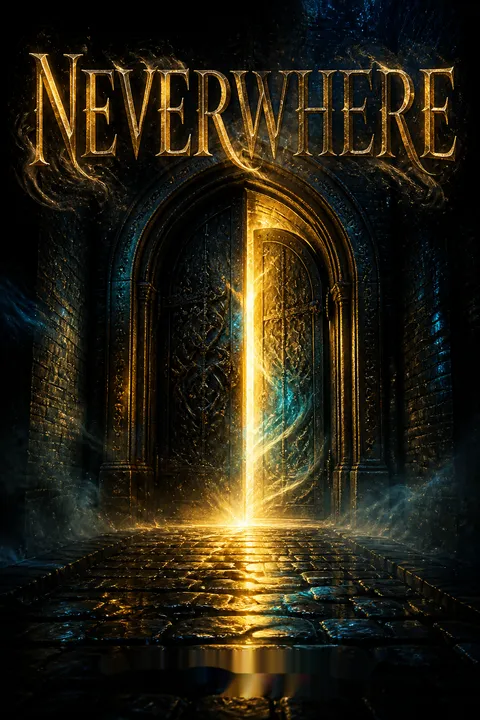


Plot Summary
Prologue
The night before leaving his Scottish hometown for a job in London, Richard Mayhew gives his map-printed umbrella to an old woman caught in the rain. She reads his palm and warns him that his journey will begin with doors.
Richard laughs off the warning, then boards the train the next morning with a cake from his mother and no idea how literally the prediction will come true.
The umbrella is a small act of kindness, but it also gives Richard his first map of a city that cannot be navigated by maps alone. The old woman’s warning frames London as a place where ordinary gestures can open extraordinary consequences. Richard leaves home expecting opportunity and order; his instinct to help a stranger is already stronger than his instinct to protect his plans. That generosity will become both the means by which he loses his old life and the quality that lets him survive the new one.
A Door in the Wall
Three years after moving to London, Richard has a respectable office job and an engagement to Jessica, a polished marketing executive who hopes to shape him into a more ambitious partner. On the night he is meant to impress her powerful boss, Richard forgets their restaurant booking and arrives late. Their argument stops when a bloodied young woman collapses from a doorway in a blank wall.
Jessica wants to leave her for someone else to help. Richard sees that she is injured, lifts her into his arms, and takes her to his flat. The girl refuses a hospital, insisting that people are hunting her. Richard’s choice costs him the evening Jessica had carefully planned, but it brings London Below to his doorstep.
Richard’s rescue is not a calculated moral performance. He acts before he can make a list of consequences, and that spontaneity exposes how little his existing life actually asks of him. Jessica’s priorities are not simply cruelty: she thinks in terms of reputation, timing, and controlled risk, while Richard responds to the visible person in front of him. Their conflict turns an engagement that has largely been organized around his potential into a test of his present character. The injured stranger arrives through a literal breach in the wall, but the more consequential opening is Richard’s willingness to abandon the script Jessica has written for him.
The Girl Called Door
The girl wakes in Richard’s bathroom and cleans and bandages her own wound. She calls herself Door, not the name on the search poster Richard finds outside.
Two men in ill-fitting black suits, Mr. Croup and Mr. Vandemar, claim to be her brothers and search the flat; Door hides where Richard cannot see her, and they leave after failing to find her. Jessica’s recorded message ends the engagement, while Croup and Vandemar have cut Richard’s telephone line. Door summons help with a pigeon and a rat, then sends Richard to meet the marquis de Carabas.
The marquis leads him through hidden routes, up a rooftop ladder, and back to his building through a broom closet. Door thanks Richard, then vanishes with the marquis before he can learn where she is going.
Door’s name is also her gift: she can make passage where other people perceive only walls. Yet in Richard’s flat she must conceal herself, and he cannot even register how she does it. The sequence makes visibility unstable before Richard himself becomes invisible to London Above. Croup and Vandemar’s false family story shows how easily care can be imitated as a means of capture, while the marquis offers a different kind of protection, exacting payment and withholding information. Richard has helped Door without understanding her world; her departure leaves him with the costs of that choice but none of its explanations.
Erased from London
On Monday, taxis pass Richard without stopping, ticket machines reject his coins, and his coworkers cannot remember him. Jessica recognizes neither his face nor their engagement. Back at his flat, he discovers strangers viewing it as vacant, and the people inside cannot hear him. Croup calls to threaten him, making clear that Door’s pursuers have not forgotten his involvement.
Richard packs what he can and tries to withdraw money, but his bank card is no longer useful. An elderly homeless man does see him. After Richard explains that he needs to find Door and the Floating Market, the man takes him through a basement door into an underground gathering of rat-speakers. Richard has lost the life he knew, and London Below is his only lead.
The disappearance is social before it is physical. Richard still occupies the same office, Tube platforms, and apartment, but other people’s attention no longer confirms that he belongs there. The scene turns ordinary bureaucracy into a kind of metaphysical border control: money, employment, and housing work only for someone the system can recognize. The homeless guide matters because he sees Richard without demanding that he prove his worth through status. Richard’s old world has not vanished; it has become inaccessible to him, revealing how much identity depends on other people’s routine acknowledgment.
The Rat-Speaker’s Route
The Lord Rat-speaker nearly treats Richard as a spy, but Master Longtail, a rat who has already encountered him, recognizes him and orders that he be taken to the Floating Market. A young rat-speaker named Anaesthesia becomes his guide.
She explains that she was born Above and fell into London Below after running from abuse and homelessness; the rats took her in and taught her their language. As they travel, Richard begins to understand that this city shelters people the surface has abandoned.
Anaesthesia is nervous about the route through Knightsbridge, but she leads him onward. At Night’s Bridge, a leather-clad woman joins them, promising to cross with them. The bridge is not a simple passage: its darkness gives shape to old human fears.
Anaesthesia’s history gives London Below a human geography. People do not arrive there because they are enchanted or chosen; some are pushed out of ordinary life by neglect and danger. Her bond with rats is practical as well as wondrous: the creatures offer a community where no human institution has protected her. Richard, who has just become socially erased, recognizes her loneliness more readily than he first expects. Their brief companionship makes the hidden city feel less like an adventure setting and more like a refuge built from whatever the surface fails to hold.
Night Takes Its Toll
On Night’s Bridge, the darkness overwhelms Richard’s sight and turns his remembered fears into living impressions. The leather-clad woman keeps him moving, but Anaesthesia disappears in the darkness; her quartz necklace beads are all that remain. The woman leads Richard into Harrods, where a Floating Market has filled the department store with traders, food, weapons, and stranger goods.
Richard finds Old Bailey, a rooftop dweller who trades information, and learns that Door and the marquis are auditioning bodyguards. He heads toward the trial, carrying the loss of Anaesthesia with him. The market offers shelter through a strict truce, but its bustle cannot make the bridge’s cost feel smaller.
The bridge makes fear a physical environment, then charges a real price for crossing it. Richard cannot rescue Anaesthesia simply by caring about her, and the failure punctures the comfortable belief that good intentions guarantee good outcomes. The market immediately contrasts that loss with abundance: food, commerce, and communities flourish below the surface, but protection depends on customs rather than dependable institutions. Richard’s grief does not stop him from continuing toward Door. The missing beads become a portable reminder that he is no longer merely observing the hidden world; someone trusted him with a life, and he could not keep it safe.
Hunter Wins the Trial
Richard finds Door and the marquis watching the bodyguard auditions. Varney, a violent candidate with the ability to strike at a distance, appears to have the advantage until a formidable woman steps forward.
She defeats him with speed and precision, identifies herself as Hunter, and accepts the job of protecting Door. Richard tells Door that Anaesthesia is gone. Although Door is angry that he has followed her, she cannot ignore that he saved her life and brought the marquis to her.
After the market closes, the marquis says Richard cannot return to his former existence and leaves him behind. Door turns back, finds Richard alone in a sewer, and invites him to join the search for the angel Islington. Richard accepts, though the prospect of finding an angel sounds absurd even to him.
Hunter’s arrival gives Door the practical defense her family’s enemies have made necessary, but Richard’s presence complicates the group’s neat division between protector and protected. Door initially resists his involvement because she understands the danger better than he does; her decision to bring him back acknowledges a debt she cannot treat as abstract. The marquis’s blunt account of Richard’s lost life forces the question the novel has been postponing: whether he is trying to return to an old identity or discovering a capacity the old one concealed. His laughter at the angel is not disbelief so much as a mind straining to accommodate one more impossible fact.
The Earl’s Lost Library
The travelers board the Earl’s Court train, a medieval court hidden inside an Underground carriage. The earl resents the marquis, but Door secures his help by invoking her family’s old ties to his.
In the earl’s library of lost objects, she obtains directions and learns that the Angelus can carry them to Islington, though it works only once for each traveler. The train leaves them at the abandoned British Museum station. Door opens a sealed passage into the museum’s hidden storage area, where Croup and Vandemar confront them.
They escape, then enter the museum’s crowded angel exhibition, where ordinary guests barely notice them. Door searches among the exhibits while Richard recognizes Jessica across the room. He cannot recover his old relationship, but the Angelus is close.
The earl’s library gives physical form to what London’s surface discards: not just possessions, but histories and loyalties that no longer fit the present. Door’s ability to persuade him rests on inherited bonds, while the marquis’s exclusion shows that relationships below have long memories and costs. Richard’s encounter with Jessica places his former life in plain sight without restoring access to it. The museum’s exhibition sharpens the irony: an elite crowd gathers around images of angels, while the actual search for one unfolds unnoticed beside them. The passage to Islington is made from history’s leftovers, and each threshold asks Door to spend her strength opening it.
The Angelus Opens
The Angelus is an enormous carved cathedral door displayed at the exhibition. When guards seize Richard as an uninvited guest, Door screams through the microphone, distracting the room long enough to touch the Angelus and open it. She and Richard pass through into Islington’s underground hall.
The angel welcomes them, listens to Door’s account of her murdered family, and offers to help Richard regain his life. To reach that help, they must obtain a key held by the Black Friars.
Islington gives Door a small obsidian figure to guide them through the final stage of the journey. The promise appears generous, and Door accepts it as a route toward understanding her family’s murder. Before they can return, they must cross a dangerous landscape and persuade the friars to surrender their relic.
The Angelus is both an artifact and an event: it allows Door to turn an object admired by London’s wealthy into a working passage. Her power is not merely to enter hidden places, but to make closed meanings accessible. Islington’s offer answers the needs each traveler has voiced, so trust seems emotionally reasonable rather than naïve. Yet the arrangement also converts their hopes into obligations: Door must retrieve a key, while Richard invests in the possibility of going home. The obsidian guide appears to simplify the route, but the journey’s real danger lies in how easily a beautiful promise can direct people toward a purpose they have not examined.
Richard Faces the Ordeal
Hunter refuses to cross into London Above, so Richard and Door enter the British Museum alone and escape Croup and Vandemar again. At the Black Friars’ bridge, Hunter joins them, but the order requires three travelers to face three tests.
Richard must undergo the Ordeal of the Key. The friars lock him in a shrine, where visions make him believe he has lost his mind and is about to die by suicide on a station platform. A quartz bead from Anaesthesia’s necklace recalls the friend he lost and gives him reason to endure.
Richard chooses to board a train of the dead rather than surrender to despair. He survives, takes the silver key, and returns changed. During the ordeal, the marquis is captured and tortured by Croup and Vandemar for information.
The ordeal is designed to isolate Richard from every story that makes his life seem coherent. His familiar reality appears to offer a plausible explanation for London Below, and the temptation to accept it is bound to relief from fear and pain. The quartz bead interrupts that logic: memory of Anaesthesia reconnects him to an obligation beyond his own survival. Richard’s choice is not proof that he can distinguish madness from magic with certainty. It is a decision to keep living despite uncertainty. The key is therefore earned through a psychological act before it becomes a tool for opening doors.
The Marquis Returns
The marquis had offered Croup three answers in exchange for a coveted figurine and time to escape. He learned that Door was kept alive because only she could open a particular door, but Croup and Vandemar caught him before his head start expired and killed him.
His body drifts through the sewers until the rats alert Old Bailey. At the marquis’s request, Old Bailey breaks open a silver box containing a strange egg, releasing the force that restores him.
Wounded and weak, the marquis reaches the Floating Market aboard HMS Belfast, where Door and Richard have arrived with the key. Door has had Hammersmith make a copy, then hidden the original in Richard’s pocket. With the marquis missing, Richard hires Lamia, a Velvet guide, to lead them toward Islington.
The marquis’s apparent death reveals the danger of treating him as merely clever or untouchable. His bargain is an act of controlled risk: he trades information and a prized object to learn enough to protect Door, then relies on favors and hidden reserves when the plan collapses. Old Bailey’s intervention shows that the city’s informal networks can reach where formal power cannot, though every rescue carries a debt. Meanwhile, Door’s concealed original key changes Richard’s role. He is unknowingly carrying the object everyone seeks, an arrangement that makes trust more consequential than his conscious understanding of events.
Hunter Takes the Spear
Lamia leads the group down Down Street, a vast spiral descent, and asks Richard to pay her with his warmth. Her kiss drains his life until the marquis, newly returned, forces her to give it back. Ahead, Croup and Vandemar ambush the travelers. Hunter kicks Richard aside and admits she has been working for their employer. The killers bind Door and take her obsidian guide.
Hunter’s payment is a legendary spear made for hunting the Beast of London, the quarry she has pursued for years. The marquis reveals that Islington is behind the plot. Richard discovers that the silver key is still safe, having lied about giving it up, and takes Hunter’s spear. The marquis keeps Hunter with them at crossbow-point because she may still be useful.
The double betrayal tests Richard’s growing ability to judge people by actions rather than appearances. Lamia makes intimacy transactional, turning his warmth into a resource she can consume; Hunter makes loyalty transactional, exchanging Door’s safety for the object that defines her private ambition. Neither woman is reduced to a simple villain: Lamia needs what she takes, and Hunter’s desire for the spear has shaped her identity. Richard’s choice to deceive Croup and Vandemar protects the key, while the marquis’s restraint toward Hunter preserves a difficult possibility of repair. Trust has become an active risk, not a default virtue.
The Beast in the Maze
Croup and Vandemar take Door through the labyrinth toward Islington, while Richard, the marquis, and Hunter follow with the remaining obsidian token. In the shifting maze, the marquis drops the token into a marsh. Richard finds it, but it sinks beneath a bursting gas bubble just as the Beast appears. Hunter attacks with her coveted spear and is crushed beneath the creature.
Mortally wounded, she tells Richard how to strike when it charges again. Richard obeys, drives the spear into the Beast, and kills it. Hunter gives him her knife and asks him to touch the Beast’s blood to his eyes and tongue, which lets him navigate the labyrinth. She dies, and Richard runs ahead toward Door while the marquis follows.
Hunter’s ambition reaches its purest form in the duel: she meets the creature she has organized her life around, but desire and expertise do not make her invulnerable. Her final instruction transfers not just a weapon but a way of acting under pressure. Richard, who once struggled to move on a rooftop ladder, now has to choose and strike while terror is close enough to touch. The Beast’s blood grants passage through the maze, but the price is Hunter’s life. The victory is therefore not a simple transformation into a hero; it is a responsibility inherited through loss.
Islington’s False Heaven
Richard reaches Islington’s hall, where Door is chained beside a black stone door and the angel holds the silver key. Islington reveals that it ordered Door’s family killed because it needed an opener and the key to escape its prison. Croup and Vandemar had altered her father’s journal to lure her there.
Door surrenders the key to spare Richard further torture, then uses a forged copy made by Hammersmith to create a keyhole and open the door herself. The opening leads not to Heaven but to a violent, consuming void. Islington is pulled through. Croup and Vandemar are dragged after it, and the door slams shut before Richard and Door are lost as well. Door frees her companions, exhausted but alive.
The revelation recasts Islington’s kindness as strategic patience. Its language of sorrow and assistance was persuasive because it mirrored the travelers’ losses while concealing its own grievance. Door’s father did not send her to safety; the journal was manipulated to make her the final component in the angel’s escape. Her solution depends on a distinction between possession and agency: the key is real, but Door controls what the door opens. By making a distant opening rather than obeying the intended lock, she turns the very gift Islington exploited into a means of refusing its design.
Richard Chooses Below
The Black Friars nurse Richard, Door, and the marquis back to health. Their abbot explains that Richard passed the ordeal and still possesses the true key, which can return him to London Above. Richard takes the opportunity. He regains visibility, money, and his job, receives a better apartment, and learns that Jessica has returned the engagement ring.
Yet his possessions stay packed, and ordinary office life feels smaller than it once did. After telling Gary what happened, Richard tries to make a door in a wall with Hunter’s knife. The marquis appears through the opening. Richard follows him back into the hidden city, leaving his old life behind by choice rather than accident.
The return resolves the novel’s opening question in an unexpected way. Richard can recover access to London Above, but access does not restore the person he was before Door’s arrival. His promotion, apartment, and renewed visibility are real, yet they do not answer his need for a life that feels inhabited. The distinction is not that the surface is false and the underside authentic; Richard has simply learned that safety without engagement can become another form of disappearance. When he cuts a doorway into a wall, he acts with the agency he lacked at the start, choosing uncertainty rather than being carried into it.
Analysis
Neverwhere turns the social experience of being overlooked into a literal change of worlds. Richard’s ordinary London does not vanish when he helps Door; instead, its institutions and inhabitants cease to register him. Work, money, housing, and recognition prove to be linked systems, each available only while he remains legible to the people around him. London Below gives physical form to the people and histories those systems leave behind, but it is not an uncomplicated refuge. Its communities offer belonging alongside danger, and survival depends on improvised obligations, barter, and fragile truces.
The novel’s doors make choice visible. Door can open barriers, but the power to enter is not the same as the power to control what waits beyond. Islington exploits this distinction, disguising self-interest as benevolence. Door ultimately defeats the scheme by recognizing that the door’s destination can be chosen, not merely accepted. Richard’s own development follows a related path. He begins by letting other people organize his future, then discovers that helping, enduring, and deciding for himself are forms of agency, even when they cannot guarantee safety.
The book also refuses to make courage synonymous with fearlessness. Richard trembles on ladders and bridges; Hunter is skilled yet vulnerable to the desire that governs her; Door can command a room while still carrying grief. Their actions matter because they proceed despite those limits. Richard’s return Above proves that restoration is possible in a practical sense, but not sufficient in an emotional one. A job, apartment, and familiar city cannot return him to the person who entered London Below. His final choice is not a rejection of ordinary life as worthless. It is a recognition that he has become someone who needs to participate in the world, not simply be safely accommodated by it.
Review Summary
Neverwhere is a beloved urban fantasy novel that transports readers to a magical underground London. Many praise Gaiman's vivid worldbuilding, memorable characters, and clever humor. The story follows Richard Mayhew as he discovers a hidden world beneath the city. While some found the plot predictable, most enjoyed the imaginative setting and Gaiman's engaging writing style. Criticisms include a slow start and underdeveloped characters. Overall, readers appreciate the book's whimsical yet dark tone and its exploration of themes like identity and belonging.
People Also Read




Characters
Richard Mayhew
Reluctant underworld heroRichard begins as a considerate but unfocused young Scotsman whose office job and engagement to Jessica offer a tidy future he has not actively chosen. He is not naturally fearless or worldly; heights, confusion, and social embarrassment unsettle him, and he often struggles to understand the rules of London Below. His instinct to help Door precedes any calculation of what it will cost. That same responsiveness allows him to form attachments to people whom the surface has made invisible. Richard’s central tension is not bravery versus cowardice, but passive comfort versus meaningful participation. He wants his old life back, yet increasingly notices how much of it depended on other people deciding who he was.
Door
Opener of impossible waysDoor is the young daughter of Lord Portico, heir to a family whose unusual talent is opening doors that ordinary hands cannot. Quick, watchful, and accustomed to surviving danger, she dresses in layered clothes that offer both warmth and protection. Her humor and occasional impatience sit beside profound grief for the family she has lost. She seeks answers about their fate, but her journey also draws on her father’s belief that London Below could be less divided. Door knows how to command attention when necessary, yet she is still young enough to need help and to resent needing it. Her bond with Richard develops through shared danger and mutual kindness, not instant trust.
Marquis de Carabas
Debt-collecting tricksterThe marquis is a restless, impeccably theatrical fixer who navigates London Below through information, favors, and carefully arranged appearances. He is capable of cruelty, deception, and genuine loyalty, sometimes in the same breath. His name and grand manner are constructed, but his obligations are not: he takes Lord Portico’s old debt seriously and measures relationships by what is owed and what has been repaid. He dislikes being surprised and rarely gives anyone a complete explanation. Under the performance is a sharp survival instinct and a cautious attachment to people he claims to be helping for practical reasons. Richard finds him exasperating, but learns that the marquis’s cynicism does not mean he has no principles.
Hunter
Legendary beast hunterHunter is a formidable fighter with a reputation built across the dangerous undercities of the world. She moves quietly, assesses threats quickly, and treats protection as skilled work rather than sentiment. Her calm competence can make her seem emotionally unreachable, while her attention to weapons and old hunts reveals a deep, private devotion to the chase. Door hires her because few people can match her physical ability. Hunter has worked for powerful figures before, and she knows that service, survival, and ambition do not always point in the same direction. Her presence steadies the group, but her own desires remain as forceful as the dangers she is hired to meet.
Jessica Bartram
Architect of the expected lifeJessica is Richard’s beautiful, efficient fiancée and a rising marketing executive who values planning, status, and visible competence. She believes she is helping Richard by steering him toward a more successful version of himself, though her advice often leaves little room for who he already is. She is not without affection: her feelings for Richard are real, even as her expectations place strain on their relationship. Jessica’s confidence in the world she understands makes Richard’s impulsiveness difficult for her to accept. Her connection to him highlights how a relationship can be loving and still fail to recognize the person it is trying to shape.
Mr. Croup
The eloquent assassinMr. Croup is a small, foxlike killer with a taste for elaborate language, clever turns of phrase, and psychological intimidation. His polished manner sits uneasily over a ruthless professional nature. He and Mr. Vandemar work as a pair, with Croup usually planning, negotiating, or explaining while his partner supplies blunt force. Croup enjoys verbal control and resents being treated as a mere instrument by employers. His wit does not soften his violence; it makes cruelty feel carefully staged.
Mr. Vandemar
The hungry enforcerMr. Vandemar is a towering, nearly expressionless killer who treats violence and eating with the same practical simplicity. He is difficult to frighten and more literal than his partner, though not unintelligent. His physical power makes him dangerous, but his dependence on Croup’s plans gives their partnership its peculiar balance. Vandemar takes pleasure in bodily harm and has little interest in social conventions. He is not a supernatural abstraction so much as a person who has stripped away nearly every restraint that might make another person hesitate.
Anaesthesia
Rat-speaking guideAnaesthesia is a young rat-speaker who knows the routes and customs of London Below. Born Above, she came underground after adults failed to protect her from abuse and homelessness. She is hungry, wary, and often shy, but her knowledge gives her a confidence Richard lacks. Her friendship with the rats is both a practical skill and a form of belonging. Around Richard, she can speak about her past without pretending it was harmless. She embodies the vulnerable people who find community in London Below without losing the marks of what drove them there.
Angel Islington
The radiant recluseIslington is a beautiful, androgynous angel who inhabits a vast underground hall and is spoken of as a source of knowledge and help. It receives visitors with ceremonial generosity, offering food, extraordinary wine, and the promise of answers. Its remote existence is tied to the old city it once cared for, and it carries a solemn awareness of loss. Islington’s authority rests as much on its apparent compassion as on its supernatural power. Door approaches it because her father trusted it, while Richard is drawn by the hope of recovering his ordinary life.
Old Bailey
Keeper of rooftop loreOld Bailey is a rooftop dweller wrapped in feathers and rope, at home among birds and wary of the world beneath him. He trades knowledge, favors, and curiosities, and his apparent rambling often conceals a useful memory of London’s older layers. His fondness for birds and skies gives him a perspective unlike that of the tunnel-dwellers. He can be comic and shrewd at once, reluctant to venture below but willing to help when an old obligation matters. His roof is both shelter and chosen boundary.
Lamia
Velvet guideLamia is one of the Velvets, pale, elegant, and at home moving through the hidden routes of London Below. She presents herself as a guide who knows every stretch of the Underside and is skilled at making a request sound intimate and reasonable. Her cool manner contrasts with Richard’s warmth, which she finds valuable in more than a figurative sense. Lamia understands exchange differently from Richard, who is inclined to trust anyone who appears friendly. She embodies the danger of confusing charm with care.
Lord Portico
Door’s reform-minded fatherLord Portico is the head of Door’s family and a thinker concerned with London Below’s divisions. His work and recorded messages reveal an educated, curious man who believes the baronies and fiefdoms need not remain permanently at odds. He teaches Door to understand her family’s gift through attention and patience rather than force alone. Portico’s influence persists through his journal, his study, and the people who remember his dealings. His idealism makes him respected by some and troublesome to others.
The Earl
Lord of lost thingsThe Earl rules the strange territory of the Underground trains and keeps a library filled with lost property. Once a powerful figure, he is now an elderly, volatile host whose memory slips between periods of his life. Beneath the confusion remain flashes of authority, old grievances, and generosity. His connection to Door’s family allows her to ask for help, though winning that help requires patience. The Earl’s domain makes forgetting tangible, while his own fading memory gives that domain a melancholy human center.
Gary
Richard’s office friendGary works alongside Richard and jokes freely about his romantic choices and office life. He represents the familiar social world Richard leaves behind, but he is more perceptive and loyal than his teasing manner first suggests. When Richard tells him an extraordinary account of London Below, Gary listens while offering the ordinary explanations he can believe. He does not simply mock Richard or certify the story; he gives him a friend’s imperfect, grounded attention. Their relationship helps Richard measure the distance between the life he has returned to and the life he now misses.
Hammersmith
The market’s master smithHammersmith is a huge, genial blacksmith who works at the Floating Market. His strength is matched by delicate craftsmanship, and he is visibly respectful toward Door and impressed by Hunter. He can shape metal into objects of surprising beauty and is willing to trade his work for what he values. His skill provides the travelers with an important resource, while his warmth offers a brief contrast to the market’s rougher bargains.
The Abbot
Guardian of the keyThe blind Abbot leads the Black Friars, an order entrusted with protecting a sacred key. He speaks gently but enforces the order’s tests without bending them for a petitioner’s urgency. His blindness is not presented as helplessness: he knows the rituals, remembers the cost of failure, and carries responsibility for those who undertake the ordeal. The Abbot’s quiet regret distinguishes him from a simple gatekeeper. To him, keeping the key safe also means preserving the painful rules attached to its transfer.
Varney
A brutal bodyguard candidateVarney is a heavily armed fighter who uses mental force to move weapons and injure opponents from a distance. He advertises himself as the finest bravo in London Below and treats the bodyguard audition as an opportunity to display dominance. His skills are real, but so is his appetite for intimidation. Varney’s presence shows that physical power in the Underside does not automatically make someone trustworthy or protective.
Lord Rat-speaker
Human voice of the ratsThe Lord Rat-speaker leads a community that communicates with and serves the rats of London Below. He is suspicious of strangers and uses fear to maintain authority, but he also obeys the commands of the rats he represents. His role reveals a society organized through relationships with creatures the surface world dismisses. He treats Richard as a threat until Master Longtail’s recognition changes the balance.
Master Longtail
Rat who remembers RichardMaster Longtail is a rat of the Gray clan whose brief encounter with Richard gives him a claim on the human’s future. He recognizes Richard when the rat-speakers threaten him and directs them to send Richard to the Floating Market. His authority depends on the respect other rats and their human interpreters grant him. Longtail demonstrates that London Below’s smallest inhabitants can redirect the fate of its largest travelers.
Plot Devices
London Below
A city beneath recognitionLondon Below is the hidden world inhabited by people, places, and histories that have fallen through the cracks of London Above. Its routes link abandoned Tube stations, sewers, rooftops, old buildings, and places that should not fit together. The surface city often fails to notice its inhabitants, while Below develops its own customs, communities, and markets. This geography makes exclusion literal: Richard’s loss of social recognition becomes the condition that allows him to enter the world he once could not see. It also turns London’s accumulated history into a living landscape rather than background.
Door’s opening gift
Walls become passagesDoor’s family can open locked doors, create openings where none seem to exist, and find routes between separated places. The ability is tied to attention and intuition, not simply physical strength. It gets Door through barriers, allows her to move through her family’s unusual house, and makes her valuable to those seeking access to a guarded destination. The gift shapes both the adventure’s geography and its central conflict: a person who can open any passage is never merely a traveler, but can be turned into a tool by anyone who controls the destination.
The key and ordeal
A test grants passageThe Black Friars guard a silver key and require seekers to pass an ordeal before they may take it. Islington presents the key as a means to reach the answers Door needs and the life Richard wants back. The ordeal instead confronts Richard with a convincing collapse of his understanding of reality. The key’s meaning grows beyond its use as a prison key: it is tied to the authority to choose between worlds. Door’s forged copy later allows her to trick Islington, while Richard retains the original and its power.
Floating Market truce
A temporary ground of safetyThe Floating Market moves from place to place, gathering London Below’s many communities to barter, compete, eat, and trade information. Its truce forbids violence; breaking it brings consequences that make even hardened fighters cautious. The market allows Door to audition a bodyguard and gives Richard a rare chance to encounter the hidden city as a functioning society rather than a succession of threats. Its constantly changing location also makes it a meeting point no single faction can permanently control.
The Beast’s blood
A hunter’s skill transferredThe Beast of London is a legendary creature hidden in the labyrinth, and Hunter’s pursuit of it motivates her desire for a particular spear. When Richard must face the creature, Hunter’s instructions give him the precise action he needs to survive. Touching the Beast’s blood to his eyes and tongue then allows him to find his way through the maze. The blood transforms a victory into a passage, but the capability comes through Hunter’s sacrifice rather than a power Richard sought for himself.
London Below Series
About the Author




Download PDF
Download EPUB
.epub digital book format is ideal for reading ebooks on phones, tablets, and e-readers.








