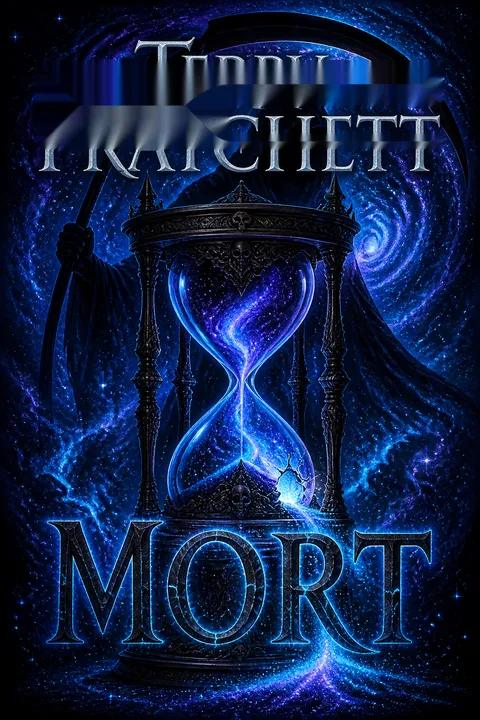


Plot Summary
Death Chooses Mort
Death studies the life-timers that record every living person and fixes on Mort, a lanky, curious boy whose family cannot find a trade for him. At the hiring fair in Sheepridge, Mort waits until midnight while the other boys find masters and his father, Lezek, worries that his son will be left behind.
Death arrives on a great white horse, slips on the icy cobbles, and asks Mort to work for him. Mort learns the position does not require him to die, and accepts before his father can talk him out of it. Lezek sees only an unusual employer and hopes the apprenticeship will make Mort useful. Mort leaves home with Death, drawn by the chance to learn how the world works.
The offer arrives at the exact point where Mort's ordinary options have closed. His rejection by local employers is not evidence of stupidity; it reflects a mismatch between his questioning mind and a community built around practical continuity. Death recognizes a capacity the farmers cannot use, but the choice is not simply a rescue. Mort accepts because curiosity has become more compelling than security. Lezek's confused approval adds a gentler pressure: the boy departs with affection intact, but without any clear understanding of what he has chosen. The apprenticeship begins as a job and a coming-of-age test at once.
Lessons in the Last Door
At Death's immense black-and-purple home, Mort meets Ysabell, Death's adopted daughter, and Albert, the prickly cook and steward. His first lesson is mucking out the stables, which Death presents as training in clear thinking rather than grandeur. On Mort's first ride into the mortal world, Death explains that people often fail to notice him because their minds refuse what seems impossible.
At King Olerve's crowded court, Mort sees the king's cousin, the Duke of Sto Helit, arrange an assassination. Mort tries to warn the king, but time slows and his legs cannot reach him before the crossbow bolt lands. Death collects Olerve's soul. Mort also glimpses Princess Keli, the king's red-haired daughter, who alone seems to notice him.
Mort's first lesson is not that death is mysterious, but that his compassion cannot yet alter what happens. The failed warning makes the limit bodily: time thickens, Mort's effort becomes useless, and the king dies despite his intervention. Death's insistence on procedure can sound callous, yet it gives Mort a structure for encountering suffering without pretending he controls it. Keli's glance creates a different disturbance. She registers Mort across the boundary that makes Death invisible, turning his first attraction into a question about perception as well as desire. The scene establishes both the rule Mort will break and the person who makes that rule matter personally.
A Borrowed Afternoon
After days of chores, reading the self-writing biographies, and accompanying Death on his rounds, Mort asks for time away from the house. Death grudgingly gives him an afternoon and a pouch of gold.
In Ankh-Morpork, Mort buys a fast horse and rides toward Sto Lat, hoping to learn whether Keli's ability to see him meant something. He cannot enter the castle, so he seeks out Igneous Cutwell, a young wizard whose grand titles conceal a disorderly home and limited skill.
Mort describes walking through walls without knowing how; Cutwell agrees to investigate. Before Mort can return to the palace, Death appears in the city and calls him back to work. Mort's private longing now has a destination, while his apprenticeship is about to become independent.
Mort's request for an afternoon off is a small act of self-definition. Until then, Death's household has supplied food, work, and a purpose, but Mort wants contact with people whose lives do not end within minutes. His journey to Sto Lat reveals how quickly that desire narrows around Keli. Cutwell's comic incompetence offers a contrast to Death's authority, while his interest in Mort's wall-walking plants a clue Mort cannot yet interpret. The scene also marks Mort's movement from passive apprentice to someone who chooses where to go. His emotional life is beginning to pull against the role he has accepted.
The Princess's Unspent Hour
Death sends Mort alone to collect three souls. The witch Goodie Hamstring meets her appointed hour calmly, and the abbot of the Listeners treats death as one stage in his cycle of reincarnation. At Sto Lat, Mort finds Keli's hourglass nearly empty and reaches her bedroom just as an assassin attacks. He kills the assassin instead of allowing the murder that history expects, then leaves Keli alive.
Back at Death's house, Mort reads her biography and discovers that the written future still records her death and the political upheaval that followed it. Meanwhile, the living world begins behaving as though Keli is already gone. Cutwell confirms that fate and the public record have stopped recognizing her, despite her continued breathing.
The three encounters give Mort contrasting models of death before he violates its timetable. Goodie treats an ending as chosen closure; the abbot sees it as a passage in a cycle; Keli is not ready to surrender anything. Mort's rescue is therefore more than a romantic impulse, though attraction intensifies it. He acts from the belief that a person should not be reduced to a scheduled event. The consequence exposes the instability of that belief: Keli survives physically, but the world's shared expectations begin erasing her. Pratchett makes the cost concrete, turning a compassionate intervention into a crisis of reality rather than a simple triumph.
A Kingdom Forgets Keli
Keli discovers that servants and courtiers increasingly look through her, and even ordinary routines treat her as absent. She forces a maid to acknowledge her, then finds Cutwell, who confirms that her life-timer and the cards both register her as dead.
Cutwell becomes her Royal Recogniser and tries to make the court remember her through proclamations and portraits. Mort returns to Death's estate carrying the knowledge that the world is dividing around Sto Lat.
He sees a shimmering boundary where one version of history presses against another, while his own growing ability to pass through solid objects suggests that he is becoming unnaturally real. At the same time, Death leaves his duties to experiment with human pleasures, leaving Mort increasingly responsible for the work.
Keli's crisis is social before it is physical. She remains capable of commanding a room, but authority cannot function when other people cannot hold her existence in mind. Cutwell's recognition campaign treats belief as a practical force, not mere opinion: repeated images and public rituals may help stabilize the reality that Keli inhabits. Mort's changing body mirrors the disturbance. He grows more substantial as the world around Keli becomes less coherent, a reversal that binds his personal power to the damage he caused. Death's absence adds emotional and institutional pressure, forcing Mort to shoulder tasks before he understands the system behind them.
The Missing Keeper
Death's prolonged absence leaves the life-and-death calculations unattended. Mort and Ysabell study the node ledger, which maps the points that keep mortality in balance, but Mort cannot interpret its symbols. Ysabell can, because Death taught her while she worked nearby.
To find a way to slow the approaching historical boundary, they search the oldest biographies and discover that Albert has concealed a life as a powerful wizard from centuries earlier. Albert refuses to help until Mort threatens to send him back to his remaining lifespan.
He finally provides a spell that can slow time in a small area, but insists Mort first complete the assigned deaths. Ysabell chooses to join Mort on the dangerous journey, and Albert sets out to recover his old magical power.
The ledger turns Death's work from a sequence of individual encounters into infrastructure. Mort had thought the task was mainly the act of collecting souls; now he sees that timing and balance require constant calculation. Ysabell's knowledge exposes how much of Death's household has been built through quiet teaching rather than formal authority. Albert's resistance is more than misanthropy: the refuge he has made from time protects him from the consequences he fears. Mort's threat works, but his willingness to use Death's power marks a troubling change in him. Ysabell's decision to accompany him counters that hardening with chosen loyalty.
Two Lives Across the Disc
Mort and Ysabell race across the Disc to complete the remaining assignments. In the Agatean Empire, Mort intervenes as the young Emperor turns the Vizier's poisoned delicacy against him, then collects the Vizier's soul.
In a Tsortian pyramid, Mort finds a young woman poisoned so she can serve a dead king in the afterlife; he frees her soul from that expectation and completes the second duty. With each death, Mort's manner grows colder and more like Death's.
Albert, meanwhile, returns to the Unseen University and performs the Rite of AshkEnte to summon Death. The spell catches the Death-like force within Mort instead. In the pyramid, Ysabell refuses to let that identity consume him and knocks him down, breaking its hold just as the true Death is summoned back.
The journey tests Mort through decisions that cannot be reduced to a single moral rule. The Vizier is dangerous, while the girl in the tomb has been taught to welcome a future shaped by others. Mort's work must respect what each soul believes, even when that belief reflects coercive custom. Yet carrying out the duty changes the carrier: Mort's voice and conduct begin to resemble Death's, suggesting that power is not psychologically neutral. Ysabell's intervention matters because she recognizes the boy underneath the office. Her physical refusal interrupts a transformation that Mort's own will can no longer reliably resist.
The Night Runs Backward
Back in Tsort, Mort realizes that the slow movement of night gives him a chance to reach Sto Lat before the historical boundary closes around Keli. He and Ysabell ride Binky at impossible speed while Cutwell prepares Keli's coronation.
The Duke of Sto Helit tries to seize power during the ceremony, but Cutwell knocks him down with a silver candlestick. Mort arrives as the dividing wall of reality swallows the palace, and the four of them are left inside a shrinking pocket of Keli's history.
With no priest available, Mort appoints Cutwell to crown her. They escape on Binky just before the pocket disappears, carrying Keli, Cutwell, and Ysabell toward Death's estate. Their rescue preserves the people, but Mort still has to answer for the disruption he caused.
The shrinking boundary makes abstract causality visible as a deadline that eats the stage itself. Mort's insight about the speed of night is a practical counter to the fatalism he once accepted: he cannot command the universe, but he can search its overlooked mechanics. Cutwell's improvised coronation gives Keli the public recognition she has been denied, while the duke's defeat prevents his ambition from exploiting the collapse. Still, escape is not resolution. Mort has saved the people caught inside the alternate history, but the act has endangered the larger order. The scene converts a rescue into a reckoning that can no longer be postponed.
Mort Faces Death
Death is waiting at home, furious that Mort neglected the duty, endangered reality, and brought others into his domain. He dismisses Mort and claims the newcomers as his own. Mort challenges him rather than abandon them.
In the lifetimer room, they fight among the hourglasses; broken glasses alter lives elsewhere, while Ysabell and Cutwell try to prevent further damage. Mort eventually pins Death, but when Death orders him to strike, Mort refuses. Ysabell then challenges Death for interfering with individual fates, including Mort's, and stands between them.
Her defiance forces Death to confront the contradiction between his rule against interference and his own actions. He finally turns Mort's nearly empty hourglass over, restoring the life Mort risked losing.
The duel makes Mort's central conflict intimate: he has learned to wield Death's power, but must decide whether its logic has become his own. His refusal to kill is not a claim that he has defeated death; it is a refusal to treat victory as permission to reproduce the same coercion. Ysabell's challenge shifts the argument from Mort's guilt to Death's responsibility. She recognizes that rules cannot excuse an authority that exempts itself. Death's decision to reverse Mort's timer acknowledges a limit without abolishing his office. The turning point is moral rather than martial: restraint changes what force alone could not.
A Future of Their Own
After Death speaks with the gods, the altered reality settles into a form that can hold the people Mort rescued. Keli rules Sto Lat, Cutwell serves at court, and Mort and Ysabell marry. Mort becomes Duke of Sto Helit, though the title matters less to him than the life he and Ysabell can build together.
Death attends the wedding reception, gives the couple a pearl containing concentrated reality, and explains that it may one day seed another universe. He also gives Mort the book of his life, whose remaining pages leave room for choices not yet made. Death returns to his work, but no longer mistakes duty for the whole of existence. Mort has left the apprenticeship without severing the bond that formed him.
The resolution does not erase the cost of Mort's intervention; it gives the consequences a livable shape. Keli's authority becomes public and durable, Cutwell's awkward loyalty finds a civic role, and Mort and Ysabell choose a future beyond Death's household. The pearl makes that future material: reality is not merely a fixed script but something preserved, vulnerable, and capable of beginning again. Death's wedding gift and attendance signal a limited emotional opening, not a conversion into an ordinary person. Mort's life-book counters the impersonal ledger with a biography still unfinished. The ending values choice while acknowledging that no one chooses outside consequence.
Analysis
Mort is a comic fantasy about the difference between performing a role and understanding what the role costs. Death's work appears mechanical because it depends on schedules, hourglasses, and rules, yet Mort's encounters with Goodie, the abbot, Keli, and the poisoned girl expose how differently people inhabit an ending. The same procedure cannot mean the same thing to every person. Mort's mistake begins when he treats compassion as sufficient justification for changing a life; the resulting fracture demonstrates that individual rescue can carry consequences for communities and history. The novel neither dismisses mercy nor lets it remain innocent.
Death's parallel education in eating, drinking, dancing, and companionship turns the cosmic figure into a character with a problem of knowledge. He can observe human behavior, but observation alone cannot give him the bodily vulnerability through which people experience it. Mort, by contrast, begins with too much feeling and too little perspective. Their apprenticeship runs in both directions: Mort learns the necessity of limits, while Death discovers that a life cannot be understood only from its endpoint. Ysabell's confrontation makes that lesson ethical. Authority is not absolved by consistency if it ignores the harm of its own choices.
The story's devices make these questions tangible. Hourglasses externalize lifespan, biographies render history inspectable, and the advancing boundary gives causality a physical edge. Yet none supplies an automatic moral answer. The decisive actions come from characters who must interpret incomplete knowledge and accept responsibility for acting. Mort's eventual refusal to strike Death is therefore not a victory over mortality. It is a refusal to become identical with the power he has borrowed. The ending grants him a future, not immunity from consequence, and leaves Death with a small but consequential awareness that duty need not be the only possible form of existence.
Review Summary
Mort receives high praise for its humor, imaginative world-building, and philosophical undertones. Readers appreciate Pratchett's witty writing style and character development, particularly Death's portrayal. Many consider it a strong entry in the Discworld series, with some viewing it as a good starting point. While a few found the plot lacking or struggled with the style, most reviewers enjoyed the blend of comedy and thoughtful themes. The book's exploration of mortality and human nature resonates with many fans.
People Also Read


Characters
Mort
The questioning apprenticeMort is a tall, awkward farm boy whose curiosity makes him a poor fit for the practical life his family expects. He notices the unanswered questions in ordinary things and approaches the world as if it ought to explain itself. That habit brings him to Death's attention and gives him unusual sympathy for people caught inside the machinery of fate. Mort is earnest rather than naturally heroic; he often acts before understanding the consequences, then has to live with what his choices set in motion. His central tension is between learning to perform a necessary duty and retaining the human judgment that makes each life more than an entry in a ledger.
Death
The cosmic undertakerDeath is the skeletal personification who collects souls after life ends. His black robes, blue eyes, and formal methods make him seem absolute, but his curiosity about food, work, and human company reveals an outsider studying a world he can never quite inhabit. He treats his responsibilities with seriousness while struggling to understand why mortals make their short lives so complicated. His relationship with Mort brings him into contact with questions of mentorship, affection, and judgment that his cosmic role does not answer. Death is neither a simple villain nor a kindly guardian; he is an immense function developing an uncertain interest in the people it serves.
Ysabell
Death's restless daughterYsabell is Death's adopted daughter, raised in his strange estate and cut off from the ordinary passage of time. At first she meets Mort with hauteur and impatience, using sharpness to protect herself from the monotony of a life in which little changes. She is observant, proud, and more emotionally perceptive than her barbed manner suggests. Her fascination with romantic stories reflects a hunger for intensity and change, while her loyalty to Death remains sincere even when she sees his limitations. Mort becomes someone her own age who can meet her as an equal, not merely as a resident of her father's house.
Albert
The guarded stewardAlbert runs Death's household, cooks its meals, and keeps its routines moving with the authority of someone who has been there for a very long time. He is irritable, suspicious of questions, and protective of the refuge he has made for himself. His practical bluntness often punctures Mort's grand ideas, but his evasions suggest a past he does not want examined. Albert's relationship with Death is built on old familiarity rather than servility; he can scold, advise, and disagree with his master. Beneath the crusty humor is a man who understands that security can become another form of imprisonment.
Princess Keli
The determined heirKeli is the red-haired daughter and heir of King Olerve, trained to survive the dangerous etiquette of court. She is intelligent, proud, and accustomed to being noticed, but her confidence rests on a position that can be undermined by political violence and public perception. When faced with uncertainty, she asks direct questions and refuses easy consolations. Her royal upbringing gives her a strong sense of responsibility, yet she is not simply a symbol of succession; she has a forceful temperament and an appetite for choosing her own course. Her encounters with Mort and Cutwell bring her beyond the protective walls of court life.
Igneous Cutwell
The accidental wizardCutwell is a young wizard whose impressive titles far exceed his skill and whose home is as cluttered as his magical practice. He is good-natured, curious, and more willing than most people to revise his understanding when strange evidence appears. Keli's need for help draws him into royal affairs, where he becomes a practical ally despite his uneven magic. Cutwell's humor and awkwardness conceal a thoughtful mind that can recognize the significance of a problem before he knows how to solve it. He prefers observation and common sense to grand claims, a useful counterweight to both courtly certainty and Mort's impulsive idealism.
Lezek
Mort's worried fatherLezek is Mort's hardworking father, a farmer who loves his son but cannot find a place for his distracted, unconventional nature on the family land. He wants Mort to become useful and independent, and the apprenticeship seems a practical answer to a problem he cannot solve himself. His concern is genuine, even when it comes wrapped in awkward advice and limited expectations. Lezek represents the affection of home without the understanding Mort needs to grow. Their parting is loving and uncertain, giving Mort a human attachment that contrasts with the immense, impersonal world of Death's work.
The Duke of Sto Helit
The ambitious royal cousinThe Duke of Sto Helit is King Olerve's cousin and a practiced court operator with an interest in succession. He presents himself as a reassuring member of the royal circle, but his ambition makes him difficult to trust. The duke understands how power moves through family ties, public appearances, and carefully timed actions. His presence gives Mort an early glimpse of political motives that do not resemble the straightforward villains of traveling plays. He functions as a human threat rather than a supernatural one, showing how ordinary calculation can place lives at risk.
King Olerve
Sto Lat's reigning kingKing Olerve is a steady, experienced ruler whose court appearance reveals a man more perceptive than his unassuming manner suggests. He understands the danger around him and meets the end of his life with composure. His brief encounter with Mort teaches the apprentice that personal worth does not determine when a life ends.
Goodie Hamstring
The prepared witchGoodie Hamstring is an elderly witch who knows her appointed time is near and prepares for it with practical attention to her affairs. Her calmness unsettles Mort, who expects fear where she feels readiness. She offers him a different model of death, shaped by experience and a willingness to move on.
The Abbot
The practiced reincarnatorThe 88th Abbot of the Listeners has died many times and expects to begin life again. His cheerful familiarity with the process contrasts with Mort's alarm and makes reincarnation seem less like a grand revelation than an inconvenient routine. He is an old hand at endings, but not necessarily eager for another beginning.
Binky
Death's sky-running horseBinky is Death's large, living white horse, a capable and steady companion on journeys between worlds. He carries Death and Mort through the sky without the grotesque fragility of a skeletal mount. His appetite, patience, and physical warmth make him one of the few ordinary-feeling presences in Death's otherwise artificial home.
The Sun Emperor
The young imperial rulerThe young Sun Emperor rules the Agatean Empire amid elaborate protocol and the threat of a powerful Vizier. He is observant enough to use the court's rituals against the man who underestimates him. His encounter with Mort reveals a ruler learning to protect his authority through wit rather than physical strength.
Plot Devices
Life-timers
The measure of a lifeEach living person has an hourglass in Death's collection, with sand marking the span of that life. The glasses make mortality visible and give Death a practical guide for his work. When Mort is entrusted with particular timers, he can find the people whose deaths are due, but the device does not tell him what those people believe or whether their endings feel just. A timer's presence also exposes the danger of Mort's choices: changing one life can disturb events far beyond that person. The device turns abstract fate into an object characters can hold, inspect, and fear.
Self-writing biographies
History made visibleThe biographies in Death's library record the lives of people who have died and continue writing the lives still underway. Mort uses them to study the pace of lives and to discover what the written record says about Keli. Their pages reveal that her expected death has consequences beyond her own family, and later help Mort and Ysabell investigate Albert's guarded past. The books are not neutral histories: they show how thoroughly a person's existence is embedded in a larger account. When the present diverges from the page, Mort can see the size of his mistake, but reading the record does not tell him how to repair it.
The reality boundary
History pushes backAfter Mort saves Keli, a shimmering boundary forms between her continuing life and the history in which she has already died. It advances toward Sto Lat, altering people and places as the world tries to restore the expected sequence of events. Most people cannot perceive it because their minds accept the version of reality they expect. Mort sees it because his changing nature has made him unusually real, and Cutwell recognizes its danger through magical study. The boundary supplies a visible clock for the third act: if it reaches Keli before her coronation, the life Mort preserved will be erased from history.
The node ledger
Death's balance sheetDeath's ledger maps the nodes that maintain the balance of life and death across the Disc. Mort initially knows only the practical work of collecting souls, so the symbols are incomprehensible to him. When Death disappears, the ledger reveals that the office also requires careful calculation; the work cannot simply be abandoned without wider consequences. Ysabell, who learned the system while spending time in Death's study, can interpret the chart and help Mort continue. The ledger broadens the story's idea of duty from an individual's appointment with death to an interdependent structure that requires attention and skill.
Rite of AshkEnte
A summons across worldsThe Rite of AshkEnte is a magical procedure used by wizards to summon Death. Albert arranges the rite when the balance of the world is threatened by Death's absence, but Mort's transformation complicates the spell: it catches the Death-like force within the apprentice instead of simply bringing Death back. The event makes Mort's loss of self visible to Ysabell and gives her an urgent chance to intervene. The rite also reconnects the story's separated threads, bringing Death back into the conflict while Mort and Ysabell race to save Keli. Its consequences depend less on spectacle than on knowing whom the spell has actually seized.
FAQ
Synopsis & Basic Details
What is Mort about?
- Apprentice to Death: The story follows Mort, a young man who becomes the apprentice to Death, learning about the nature of mortality and the universe.
- Interference with Fate: Mort's compassionate nature leads him to interfere with fate, saving a princess from assassination and causing a ripple effect in reality.
- Balancing Duty and Humanity: The narrative explores Mort's struggle to balance his duties as Death's apprentice with his own human emotions and desires, leading to a challenge of the natural order.
Why should I read Mort?
- Unique Perspective on Death: Terry Pratchett's humorous and philosophical take on Death as a character offers a fresh and thought-provoking perspective on mortality.
- Exploration of Free Will: The story delves into the themes of fate versus free will, questioning whether individuals can truly alter their destinies.
- Engaging Characters and World: The book features a cast of memorable characters and a richly imagined world, blending fantasy with satire and wit.
What is the background of Mort?
- Discworld Setting: Mort is set in Terry Pratchett's Discworld, a flat world balanced on the backs of four elephants standing on a giant turtle, a setting that allows for absurd and magical elements.
- Fantasy with Satire: The book blends traditional fantasy tropes with satire, humor, and philosophical musings, creating a unique and engaging narrative.
- Cultural and Social Commentary: Pratchett uses the Discworld setting to comment on various aspects of human society, including bureaucracy, religion, and the nature of power.
What are the most memorable quotes in Mort?
- "PEOPLE GET KILLED, BUT THAT'S THEIR BUSINESS. I JUST TAKE OVER FROM THEN ON.": This quote from Death encapsulates his detached yet necessary role in the cycle of life and death.
- "REALITY is NOT ALWAYS WHAT IT SEEMS.": This line highlights the theme of perception versus reality, a recurring motif in the book.
- "THERE'S NO JUSTICE. THERE'S JUST ME.": This quote, also from Death, underscores the impersonal nature of his duty and the absence of inherent fairness in the universe.
What writing style, narrative choices, and literary techniques does Terry Pratchett use?
- Third-Person Omniscient Narration: Pratchett employs a third-person omniscient narrator, allowing him to provide insights into the thoughts and feelings of multiple characters and to comment directly on the narrative.
- Humor and Satire: The book is filled with Pratchett's signature wit, satire, and absurd humor, often used to explore serious themes in a lighthearted way.
- Foreshadowing and Irony: Pratchett uses subtle foreshadowing and dramatic irony to create tension and engage the reader, often subverting expectations.
Hidden Details & Subtle Connections
What are some minor details that add significant meaning?
- Reannual Plants: The detail of reannual plants, which grow backward in time, symbolizes the disruption of causality caused by Mort's actions and the backward flow of time in Death's realm.
- The Little Moloch Stove: The stove in Death's kitchen, named "The Little Moloch," hints at the hidden power and ancient nature of Death's domain, contrasting with the mundane activities of cooking.
- Binky's Name: The name "Binky" for Death's horse, a seemingly ordinary name for an extraordinary creature, underscores Pratchett's use of humor to subvert expectations and highlight the absurdity of the Discworld.
What are some subtle foreshadowing and callbacks?
- Lezek's Comment on Inheritance: Lezek's comment about apprentices inheriting their master's business foreshadows Mort's eventual succession to a position of power, though not in the way Lezek imagined.
- Mort's Reading Habit: Mort's habit of reading, initially seen as a hindrance, foreshadows his ability to understand and manipulate the rules of reality, as well as his connection to the library in Death's realm.
- The Clockwork Men: The clockwork men in Sheepridge's clock tower, who mark the passage of time, foreshadow the themes of time manipulation and the mechanical nature of fate that Mort will encounter.
What are some unexpected character connections?
- Albert and Alberto Malich: The revelation that Albert is actually the ancient wizard Alberto Malich adds depth to his character and explains his knowledge of magic and the universe, creating a surprising link between the mundane and the extraordinary.
- Ysabell and Death: The fact that Ysabell is Death's adopted daughter, not his biological child, adds a layer of complexity to their relationship and highlights Death's capacity for a form of familial love.
- Cutwell and Granny Weatherwax: The mention of Granny Weatherwax's "Ramrub Invigoratore" in Cutwell's possession subtly connects him to the wider Discworld universe and hints at his bumbling but well-meaning nature.
Who are the most significant supporting characters?
- Albert: As Death's manservant and a former wizard, Albert provides both practical assistance and a link to the magical history of the Discworld, influencing Mort's understanding of his role.
- Ysabell: As Death's adopted daughter, Ysabell's evolving relationship with Mort and her own desire for a normal life add emotional depth to the story and challenge the nature of Death's world.
- Cutwell: The bumbling wizard Cutwell serves as a source of comic relief and provides a contrast to the more serious characters, while also playing a crucial role in helping Mort navigate the complexities of magic and reality.
Psychological, Emotional, & Relational Analysis
What are some unspoken motivations of the characters?
- Death's Curiosity: Death's unspoken motivation is his curiosity about human life and emotions, which drives his interactions with Mort and his attempts to understand human pleasures.
- Ysabell's Longing: Ysabell's unspoken motivation is her desire for a life outside of Death's timeless realm, which fuels her attraction to Mort and her willingness to challenge her father.
- Albert's Fear: Albert's unspoken motivation is his fear of returning to the mortal world and facing the consequences of his past actions, which explains his reluctance to help Mort.
What psychological complexities do the characters exhibit?
- Mort's Internal Conflict: Mort exhibits a complex internal conflict between his desire to do his duty and his compassionate nature, leading to his rebellion against Death's impersonal approach.
- Death's Detachment: Death's psychological complexity lies in his struggle to understand human emotions while remaining detached from them, highlighting his unique position as an anthropomorphic personification.
- Ysabell's Yearning: Ysabell's psychological complexity is rooted in her yearning for a normal life and her struggle to reconcile her timeless existence with her desire for human connection.
What are the major emotional turning points?
- Mort's Intervention: Mort's decision to save Princess Keli is a major emotional turning point, driven by compassion and setting the stage for his conflict with Death and the disruption of reality.
- Ysabell's Confession: Ysabell's confession of love for Mort is a major emotional turning point, revealing her vulnerability and her desire for a life beyond Death's realm.
- Mort's Acceptance: Mort's acceptance of his own mortality and his decision to leave Death's service mark a significant emotional turning point, highlighting his growth and his embrace of humanity.
How do relationship dynamics evolve?
- Mort and Death: The relationship between Mort and Death evolves from a master-apprentice dynamic to one of conflict and eventual understanding, as Mort challenges Death's authority and seeks his own path.
- Mort and Ysabell: The relationship between Mort and Ysabell evolves from antagonism to romance, as they find common ground in their shared experiences and their desire for a life beyond Death's realm.
- Mort and Albert: The relationship between Mort and Albert evolves from a reluctant alliance to a grudging respect, as Albert's past is revealed and he is forced to confront his own fears.
Interpretation & Debate
Which parts of the story remain ambiguous or open-ended?
- The Nature of the Creator: The nature and intentions of the Creator of the Discworld remain ambiguous, leaving the reader to ponder the ultimate purpose of existence and the role of fate.
- The Afterlife: The details of the afterlife and the nature of souls are left somewhat open-ended, allowing for multiple interpretations and raising questions about the nature of consciousness and existence beyond death.
- The Future of the New Universe: The ending leaves the future of the new universe created by the pearl of reality open to interpretation, suggesting that the cycle of creation and destruction is ongoing.
What are some debatable, controversial scenes or moments in Mort?
- Death's Actions: Death's actions, particularly his initial detachment and his later anger, can be interpreted in different ways, raising questions about the nature of his role and his capacity for emotion.
- Mort's Choice: Mort's decision to leave Death's service and embrace a mortal life can be seen as both a triumph of free will and a rejection of his unique potential, sparking debate about the value of immortality versus humanity.
- The Nature of Justice: The book's exploration of justice, or the lack thereof, can be seen as both a cynical commentary on the universe and a call for individual responsibility and compassion.
Mort Ending Explained: How It Ends & What It Means
- Mort's Departure: Mort chooses to leave Death's service, embracing a mortal life with Ysabell, signifying his rejection of a predetermined path and his embrace of human experience.
- The Pearl of Reality: Death's gift of the pearl of reality symbolizes the potential for new beginnings and the cyclical nature of creation and destruction, suggesting that even in the face of death, there is always the possibility of renewal.
- Acceptance of Imperfection: The ending emphasizes the acceptance of imperfection and the importance of human connection, suggesting that true meaning is found not in escaping mortality but in embracing the complexities of life.
Death Series

About the Author
Other books by Terry Pratchett

Download PDF
Download EPUB
.epub digital book format is ideal for reading ebooks on phones, tablets, and e-readers.








