

Plot Summary
Prologue
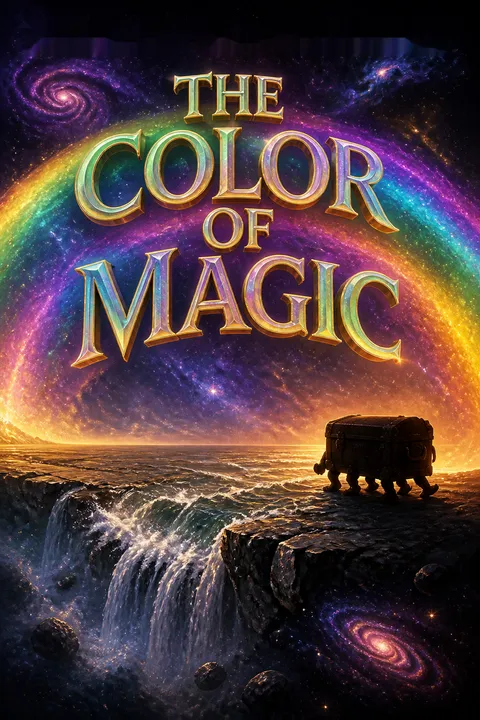
Great A’Tuin carries the Disc through space, four elephants bearing its world on their backs. At the Rim, scholars argue over the turtle’s purpose while a distant city burns. Above the world, the gods play a game with mortal lives as pieces.
The Lady, an elusive goddess, makes an unlikely move: she places a failed wizard and a foreign clerk on the board. Their journey will test whether chance can interrupt Fate, and whether the power to imagine a world can make it real.
The two prologues establish the novel’s double scale. The first treats the Disc’s impossible structure as a fact that scholars can study without explaining; the second turns that cosmos into a board on which gods gamble. Together they make the absurdity of the setting consequential rather than decorative. Human confusion and divine calculation occupy the same system, but neither guarantees control. The Lady’s decision to risk an unlikely pair introduces the book’s central tension: events may be arranged from above, yet accident, imagination, and stubborn human choices keep disturbing the design.
A Tourist Buys a Guide
Twoflower, an Agatean clerk with four eyes and a phrasebook, arrives in Ankh-Morpork hoping to experience the dangerous city he has only heard about in sailors’ tales. His fortune seems modest to him, but its pure gold makes him a beacon to every thief. The Luggage, a walking chest made from sapient pearwood, follows him from the docks and makes the danger harder to ignore.
Rincewind, an expelled wizard who speaks many languages, discovers that Twoflower can understand him only when he uses Trob. The tourist hires him as a guide, paying generously in advance. Rincewind sees a chance to escape poverty, then realizes the newcomer will be helpless alone and stays.
Twoflower and Rincewind enter the story with opposite relationships to risk. Twoflower has spent years converting his security into a chance to encounter the world directly; Rincewind has survived by treating danger as something best avoided. Their agreement joins these impulses without reconciling them. Twoflower’s money makes him vulnerable precisely because he does not understand its local meaning, while Rincewind’s linguistic skill gives him a role he never sought. The Luggage complicates the arrangement: it is simultaneously wealth, protection, and a threat no one can assess. The adventure begins not with a quest, but with a misread transaction and a reluctant act of care.
The Patrician’s Leash
Twoflower’s gold quickly attracts Ankh-Morpork’s gangs, and Rincewind tries to get away before the city’s appetite catches them. After buying a horse with an Agatean coin, he is arrested for passing unfamiliar currency. The Patrician explains that the Agatean Empire is powerful, and that Twoflower’s safety now concerns the whole city.
He orders Rincewind to serve as the tourist’s guide and threatens him with a brutal death if Twoflower is harmed. Meanwhile, the Luggage’s pearwood construction draws the attention of thieves who want it as much as its contents. Rincewind returns to find the Broken Drum under attack, and understands that his new employment has made escape more dangerous than staying.
The Patrician transforms a casual guide’s job into a political obligation. Rincewind is not recruited for competence or virtue; he is useful because he is already entangled with Twoflower and expendable if diplomacy fails. His instinct to flee remains intact, but the threat makes every attempt at self-preservation serve someone else’s interests. The city’s thieves and rulers also mirror each other: both treat the visitor as a resource, differing mainly in the scale of their calculations. Rincewind’s predicament exposes a recurring irony in his character. His survival skills repeatedly place him in positions of responsibility, even as he insists that responsibility belongs to someone else.
Insurance Sets Morpork Ablaze
Twoflower explains insurance to the Broken Drum’s innkeeper, Broadman, and sells him cover against the tavern burning down. The idea gives the city’s merchants a reason to organize against the thieves and assassins who are frightening away visitors.
Their confrontation erupts into a battle involving Ymor’s gang, the Assassins’ Guild, and armed traders. Rincewind throws bags of Twoflower’s gold into the melee to scatter the fighters, while the Luggage attacks anyone who threatens its master.
Broadman, hoping to collect the insurance, ignites the Drum; the fire escapes his control and spreads through Morpork. Rincewind and Twoflower flee through the burning streets, and the Luggage eventually catches up. Rincewind now has no safe city to return to.
Twoflower’s financial invention becomes a force in a society that has no settled distinction between business, violence, and public order. His policy does not prevent danger; it gives Broadman a stake in the destruction and gives merchants a reason to challenge the gangs. The resulting fire literalizes the danger of importing a system without understanding how local incentives will distort it. Rincewind responds with improvised tactics rather than mastery, scattering gold because it is the one tool available. The Luggage’s loyalty provides a strange counterweight to the city’s transactional logic. By the time the travelers escape, their ordinary choices have made the familiar world physically uninhabitable.
The Road Splits Them
Beyond the ruined city, Rincewind and Twoflower travel toward Chirm with the Luggage and a growing collection of strange experiences. Rincewind tries to explain that magic obeys rules and exacts a cost, while Twoflower remains curious about every unfamiliar sight.
Their journey is interrupted when a troll appears on the road through a sudden disturbance in reality. Rincewind’s thrown sword strikes a hidden boulder, rebounds, and kills it, but the startled horses bolt in opposite directions.
Twoflower is left alone in the forest and follows an ancient marker toward the temple of Bel-Shamharoth, trusting its promise of shelter. Rincewind, pursued by wolves and a snake, is pulled into a dryad’s tree and learns that his companion is in greater danger.
The travelers’ separation turns their contrasting temperaments into separate plot engines. Twoflower’s trust draws him toward the temple, while Rincewind’s fear sends him through a series of accidental escapes. The troll’s sudden arrival and the ricocheting sword make causality feel both real and unstable: Rincewind survives through an outcome he did not intend and cannot reproduce. The forest also brings the novel’s comic metaphysics close to bodily peril. A sign that appears helpful leads Twoflower toward an ancient predator, while the dryad’s rescue proves to be a form of captivity. Safety, in this world, is often only danger under a kinder name.
The Eightfold Temple
Druellae, the dryad who has taken Rincewind into her tree, reveals that Twoflower is inside Bel-Shamharoth’s temple and brings the wizard to watch. Rincewind escapes his guards when the dangerous spell lodged in his mind briefly frightens the dryads, then blunders through their magical circle and appears inside the temple.
There he finds Twoflower, Hrun the Barbarian, and the Luggage. Hrun’s talking sword, Kring, provokes the forbidden number associated with the temple’s god.
Bel-Shamharoth rises from beneath the floor and drags the group toward its pit. Twoflower’s camera imp flashes the salamanders attached to the device; their stored magical sunlight strikes the creature, which retreats beneath its slab. The temple collapses, and the travelers escape with Hrun.
The temple makes Rincewind’s greatest liability, the spell he cannot control, briefly useful without making him powerful in any conventional sense. His escape depends on the dryads’ fear of what they cannot identify, not on his command of magic. The climax then converts Twoflower’s habit of documenting experience into a survival tool: the camera’s unseen mechanisms and salamanders injure a being that brute force cannot stop. Hrun contributes physical skill, but even he cannot solve the threat alone. The episode’s unlikely coalition suggests that competence is distributed across the group. No single person understands the whole danger, yet their mismatched abilities combine at the moment it matters.
The Wyrmberg Takes Them
With Hrun traveling beside them, the group enters a region where old magic makes ordinary events behave erratically. Coins land on their edges, vanish, or change form, and even their meal flies away. Liessa, daughter of the dead wizard Greicha and a claimant to the Wyrmberg, sees the travelers from her stronghold and sends dragonriders after them.
Their attacks separate Rincewind from Twoflower and Hrun. Rincewind wakes in the forest beside Kring, which has been left embedded in a tree, and reluctantly uses the sword to capture a rider. He learns that his companions have been taken to the Wyrmberg, an inverted mountain whose dragons draw their form from concentrated magic. With Kring forcing his hand, Rincewind agrees to go after them.
The Wyrmberg introduces a new rule for the novel’s magic: imagination can create beings, but only where the world is permeable enough to receive them. This makes the dragons both physically dangerous and ontologically uncertain. Rincewind’s reluctant rescue mission begins under coercion from Kring, another object with a will of its own. His bravery is therefore not a revelation that fear has vanished; it is action taken while fear remains overwhelming. Liessa’s pursuit also shifts the conflict from random peril to a contested political order, where dragon power underwrites claims to rule. The travelers have entered a place where belief itself is a weapon.
A Dragon Made Real
At the Wyrmberg, Liessa offers Hrun a path to rule if he passes three tests, including defeating her brothers. Rincewind is forced into a hanging sword duel with her brother Lio!rt, while Twoflower is locked away. In the dungeon, Twoflower’s lifelong belief in dragons gives shape to a great, fire-breathing creature he names Ninereeds.
The dragon breaks open his cell and carries him to Rincewind just as the wizard falls from the ceiling rings. Meanwhile, Hrun defeats Liessa’s brothers in their own imaginary dragons and refuses to kill them. Liessa’s courtship of Hrun is interrupted when Twoflower’s dragon lifts him away. The three escape together, but the dragon’s existence depends on Twoflower’s concentration.
Twoflower’s imagination is no longer a private refuge or a tourist’s filter; it alters the material conditions of the world. The dragon appears because he has sustained belief in it, while Liessa’s less vivid creatures expose the limits of power without conviction. Rincewind’s duel and Hrun’s tests provide contrasting forms of action. Rincewind survives by improvising under coercion, while Hrun turns a succession ritual into a contest of physical skill and personal judgment. His refusal to kill defeated opponents complicates his reputation as a conventional barbarian. Yet their escape remains precarious because the wonder carrying them is dependent on the person least likely to regard it as impossible.
The Sky Gives Way
As Ninereeds carries Rincewind, Twoflower, and Hrun high above the Wyrmberg, the thin air and fading magic weaken the dragon. It disappears, leaving the three travelers falling toward the Disc. Rincewind’s buried spell begins to surface, but Twoflower remains unconscious and cannot imagine them a rescue.
Instead, they pass through the sky into a passenger aircraft in another universe. Rincewind’s sudden appearance disrupts a hijacking, and the universe rearranges its history to absorb the impossible visitors.
The Luggage arrives too, terrifying the passengers, before the travelers are expelled back into the Disc’s sea. They are rescued by a slaver ship, but escape in a small boat without the Luggage, which remains aboard. Their route now leads toward the Rimfall.
The episode turns imaginative power into a question of limits. Twoflower can make a dragon real near the Wyrmberg, but neither desire nor belief can suspend the conditions that weaken it at altitude. The sudden passage through an aircraft gives the novel’s fantasy an unsettling mirror: another world appears ordinary to its inhabitants, just as the Disc appears ordinary to its own. The universe’s adjustment of history preserves its stability while making reality feel less like a fixed stage than a negotiable arrangement. Rincewind’s survival again depends on events he cannot control, and the loss of the Luggage leaves the travelers exposed just as they approach the world’s edge.
Caught at the Rim
The small boat is swept toward the Rimfall, where the sea pours over the edge of the Disc. A sea troll named Tethis rescues Rincewind and Twoflower using the Circumfence, a vast salvage net stretched around the world’s rim. He explains that he fell from another world and has spent years guarding this section of the net, unable to take the final step back into space.
The travelers are stranded on his island, where the water troll is both their host and their jailer. Before they can decide what to do, the Circumfence bells report that Krull has sent a magical flyer to collect them. Tethis recognizes that they are wanted for a purpose beyond ordinary slavery, and the flyer carries them toward Krull.
Tethis’s island makes the edge of the world an emotional as well as physical boundary. He has survived the fall between worlds, yet survival has not become freedom; years of watching the stars have left him unable to choose whether to return home. His story offers a counterpoint to Twoflower’s restless desire to see more. Curiosity can propel a person toward the unknown, but it cannot guarantee the courage to cross back. Rincewind sees the Circumfence as an ingenious practical device, while Twoflower sees another marvel. Their divergent responses persist, but Tethis’s captivity gives the adventure a human cost that the earlier spectacle often obscured.
Two Sacrifices for Space
In Krull, Rincewind and Twoflower learn that the city’s astronomers intend to send a bronze vessel over the Rimfall to discover Great A’Tuin’s sex. The Arch-astronomer has bargained with Fate for a successful launch by promising two human sacrifices, and the travelers are the chosen victims. The Lady, a goddess who has secretly aided them, explains the bargain and offers them one chance.
When Garhartra comes to take them, the delayed bottle from Rincewind’s earlier spell strikes him and gives them time to escape. They evade the water-fearing Krullian wizards, find the room containing the explorers’ suits, and knock out the two chelonauts. Rincewind and Twoflower disguise themselves in the suits and enter the launch procession.
Krull’s scientific ambition is inseparable from its political and theological machinery. The expedition seeks knowledge about the cosmic creature that carries the world, yet its leaders treat two strangers as expendable fuel for that inquiry. The bargain with Fate makes violence appear orderly and rational, while the Lady’s intervention preserves a narrow opening for choice. That opening is not a miraculous rescue: it depends on a bottle whose spell has been decaying for hours and on the travelers’ ability to exploit a brief opportunity. Their escape therefore echoes the novel’s recurring logic. Fate may set the terms, but material accidents can still change who acts next.
The Luggage Reaches Krull
As the Potent Voyager begins its launch, the Luggage storms into the arena, pursued across the Circumfence by its determination to find Twoflower. Krull’s magicians attack the chest with spells, but the concentrated magic feeds a runaway storm instead of stopping it. Rincewind, Twoflower, and Tethis reach the vessel, and the Luggage eventually joins them.
Tethis emerges from inside the chest, which has carried him across the sea, and climbs aboard with Twoflower. The launch mechanism has already started, so Rincewind scrambles after them as the ship races down its track and over the Edge. The Luggage follows. Rincewind is left falling into space, while the Potent Voyager carries Twoflower and Tethis away from Krull.
The Luggage’s return converts a private bond into a force that overwhelms an entire system. Krull’s magicians rely on controlled spells and institutional power, but their attacks intensify the danger because the chest resists their categories. Its loyalty is not gentle: it destroys whatever stands between it and its owner. The launch, designed as the culmination of decades of planning, proceeds amid disorder that its planners cannot manage. Tethis’s emergence from the chest is especially significant because it makes the Luggage a container of improbable possibilities, not merely possessions. The group’s escape is partial, however. Twoflower and Tethis leave aboard the vessel, while Rincewind is separated from them once again.
Epilogue
Rincewind wakes bruised in a small tree growing from a rock beside the Rimfall. Death has sent the minor demon Scrofula to claim him, but Rincewind argues that the demon has no proper cause for his death.
As they quarrel, the branch breaks and sends Rincewind tumbling into space. Below him, the Disc, Great A’Tuin, and the stars fill the darkness. He has no way to steer and no visible rescue, only the universe ahead.
The ending refuses the comfort of a completed escape. Rincewind survives the launch only to be returned to the threshold between worlds, still falling and still negotiating with the forces that claim authority over his life. His exchange with Scrofula turns death into another bureaucratic encounter, one he challenges through stubborn technicality rather than courage or magic. The final fall echoes Tethis’s history but does not settle whether Rincewind will follow the same path. Ending on motion preserves the novel’s governing uncertainty: each apparent conclusion opens onto a larger danger, and survival remains a temporary argument with the cosmos.
Analysis
The novel’s comic logic depends on treating impossible things as ordinary enough to have consequences. A world carried by a turtle still has currency disputes, political threats, and failed attempts to escape responsibility. This collision allows the book to test its absurd cosmology against practical behavior: Twoflower’s gold attracts predators; his insurance policy changes a city’s incentives; his camera becomes a weapon; and his imagination gives dragons substance.
Rincewind and Twoflower form the story’s central contrast, but neither simply corrects the other. Rincewind understands that the world is dangerous, yet his instinct to flee often leaves him responsible for someone more exposed. Twoflower’s curiosity is ethically generous, though it can disregard consequences that others must bear. Their partnership makes survival a shared labor between caution and openness. Hrun adds a third model of action, the familiar hero who is capable of violence but not wholly governed by it.
Magic in the book is not an escape from causality. It is another system with costs, limits, and strange side effects. The Octavo spell constrains Rincewind, the Wyrmberg makes belief physically consequential, and Krull’s concentrated spells can become a disaster for their casters. Even the gods’ game cannot fully stabilize events. Fate can bargain for sacrifices, but the Lady can introduce a chance, and mortals can act within it in ways neither deity controls.
The repeated escapes do not produce a settled victory. Each apparent refuge opens onto a more extreme boundary: city to road, forest to temple, mountain to sky, sea to Rimfall, and finally the edge of the Disc. The pattern gives the humor an existential undertow. Rincewind’s survival is not mastery, and Twoflower’s wonder is not immunity. Their world remains astonishing because it is never completely safe or completely explained.
Review Summary
The Color of Magic introduces readers to Discworld, a flat world carried by elephants on a turtle. The story follows incompetent wizard Rincewind and naive tourist Twoflower on their misadventures. Reviews praise Pratchett's humor, imagination, and world-building, though some find the plot disjointed. Many recommend it as a starting point for the series, while others suggest later books. Opinions vary on the effectiveness of the comedy, with some finding it hilarious and others struggling with the British humor. Overall, readers appreciate the book's creativity and quirky characters.
People Also Read



Characters
Rincewind
The reluctant wizardRincewind is a failed wizard from Unseen University, marked by a single dangerous spell lodged in his mind and an exceptional talent for languages. He survives less through confidence than through quick reactions, luck, and a finely developed sense of when to run. His instinct is to avoid responsibility, yet he repeatedly stays beside people who would be lost without his knowledge of the world. He regards magic as an impractical profession and wants a life with fewer surprises, though his adventures make that wish increasingly absurd. Rincewind’s humor comes from the gap between his self-image as a coward and the actions he takes when someone else is in danger.
Twoflower
The fearless touristTwoflower is an Agatean clerk who has saved for years to travel beyond the world he knows. He approaches danger as an experience worth understanding, not as a warning to retreat, and his unfamiliarity with local customs makes him both generous and vulnerable. A phrasebook helps him communicate, while his iconograph lets him record the sights he came to see. His habit of asking questions unsettles Rincewind, whose first concern is usually immediate survival. Twoflower’s optimism is not simple ignorance: it reflects a deep conviction that the world contains more than the safe routine he left behind. His curiosity repeatedly changes what the people around him consider possible.
The Luggage
The walking bodyguardThe Luggage is a large chest made from sapient pearwood, with hundreds of little legs and an almost absolute devotion to Twoflower. It follows its owner across roads, forests, seas, and stranger distances, while its lid and hidden teeth make it dangerous to anyone who threatens him. It carries ordinary travel gear alongside powers no observer can reliably explain. The Luggage does not reason like a person, and its loyalty can be as destructive as it is protective. Its presence gives Twoflower a dependable companion in a world where he often misunderstands the danger around him, while making every attempt to steal his belongings a potentially fatal mistake.
Hrun the Barbarian
The professional heroHrun is a powerful hired fighter whose reputation rests on surviving the kind of dangers that define heroic adventure. He is physically formidable, direct in his ambitions, and more practical than the grand stories about barbarians might suggest. Treasure and status interest him, but he also follows a personal code that can restrain his violence when a fight is already won. Rincewind views him as an unpredictable threat; Twoflower sees him as the sort of hero he has long wanted to meet. Hrun’s presence brings conventional fantasy heroics into the group, though his choices reveal a person more complicated than a sword arm or a stock adventure.
Liessa
The dragonland claimantLiessa is the daughter of Greicha and one of the claimants to rule the Wyrmberg. She is forceful, ambitious, and skilled at using the mountain’s magical power to make dragons serve her designs. The tradition that only a man may rule frustrates her, sharpening her determination to secure authority on terms the established order recognizes. Her manner combines command with a calculated sensuality, and she expects potential allies to prove their usefulness. Liessa’s confidence is real, but it rests on a system whose rules are contested and whose power depends on imagination.
Tethis
The stranded sea trollTethis is a water troll from another world who has been stranded at the edge of the Disc and assigned to guard the Circumfence. He can change size with the tides and appears more like a man shaped from seawater than a conventional troll. His work brings him salvage from countless places, but it has not brought him home. Tethis is hospitable when he can be, yet he remains a prisoner of the system he serves and will use force to keep others from escaping it. His long view of the stars gives him a wistful perspective on the travelers’ restless curiosity.
The Lady
The unnamed goddessThe Lady is a goddess associated with chance, recognized by her vivid green eyes and her preference for remaining unnamed. Unlike the gods who openly govern through temples and rituals, she appears unpredictably and aids people who have not directly summoned her. She is difficult to interpret as benevolent or cruel, since her help offers opportunity rather than certainty. In the gods’ game, she is a patient player willing to risk an unlikely move. Her presence makes luck feel like an active intelligence, though even she cannot simply dictate what mortals will do with the chance she provides.
Fate
The cosmic opponentFate is a god who treats mortal lives as pieces in a larger game and regards outcomes as matters of design. His dark, distant eyes signal a perspective that exceeds ordinary human time. He is not merely a force of prediction; he bargains, places stakes, and takes pleasure in arranging an endgame. The Lady is his most consequential rival, and their contest gives cosmic structure to the travelers’ uncertain journey. Fate’s confidence suggests that events can be controlled, but the novel’s repeated accidents challenge the assumption that a plan can account for every possible turn.
Death
The persistent reaperDeath appears as a tall figure carrying a scythe, visible to those who can perceive the magical dimensions of the Disc. He treats his work as a duty, but his encounters with Rincewind acquire a personal edge because the wizard repeatedly escapes the moment of collection. Death is neither a simple villain nor a comforting guide; he is an office of the universe with a dry, occasionally irritable personality. His presence reminds the characters that survival is never permanent, even when it can be delayed by luck, argument, or an inconveniently timed fall.
Greicha
The dead wizard patriarchGreicha was the powerful wizard who ruled the Wyrmberg and fathered Liessa and her brothers. Even after death, his magical knowledge and awareness of events make him a presence in the succession struggle. He explains the relationship between imagination and dragons, and his history reveals how authority in his family is maintained through both magic and violence. Greicha’s perspective is warped by his unusual state beyond ordinary time, so he can be informative while remaining difficult to follow. He treats family conflict as a political problem, though his own methods helped create it.
Kring
The coercive magic swordKring is a black magical sword with a voice, memories of many owners, and a strong opinion about how it should be used. It is proud of its history and impatient with anyone who hesitates to fight. When Rincewind finds it, the weapon becomes a reluctant partner in his journey and can even compel his movements. Kring embodies the danger of tools that possess agency without wisdom: it may help Rincewind survive, but it does not share his fear or his priorities. Its constant commentary punctures the solemnity of heroic violence.
Druellae
The dryad captorDruellae is a dryad whose life is bound to her tree and whose knowledge of old magic far exceeds Rincewind’s. She rescues him from immediate danger, then keeps him captive because he has injured the tree. Her calm authority reflects a world where human ideas of rescue and consent do not necessarily apply. Druellae sees Rincewind as an incompetent wizard, yet she recognizes the danger carried by the spell in his mind.
Ymor
The city’s thiefmasterYmor is a calculating leader among Ankh-Morpork’s thieves, accustomed to treating people and opportunities as pieces in a criminal economy. He notices the value of Twoflower’s gold and the Luggage, and he manages threats through information, intimidation, and the loyalty of his ravens. His polished patience makes him more dangerous than a simple street thug. Ymor represents the city’s organized appetite for wealth and control.
Bravd
The seasoned adventurerBravd is a large Hublander adventurer who watches the burning of Ankh-Morpork with his companion, the Weasel. He is strong and confident, but more interested in practical gain than in heroic ideals. His brief encounter with Rincewind frames the wizard’s story as an unlikely tale told after the city has already been lost.
The Weasel
The shadowing swordsmanThe Weasel is a small, agile swordsman and Bravd’s companion. He is observant, opportunistic, and quick to recognize the value of a good story or a valuable object. His presence beside Bravd offers a sharp contrast between physical size and practical cunning.
Marchesa
Krullian wizard escortMarchesa is a young Krullian wizard assigned to escort Rincewind and Twoflower to Krull. She is trained in powerful magic but visibly uneasy about the people she has been ordered to control. Her fear complicates Rincewind’s reputation as a dangerous magician: she believes his survival proves he must be more capable than he claims.
The Arch-astronomer
Krull’s ambitious rulerThe Arch-astronomer leads Krull’s effort to study the Disc and launch a vessel beyond its edge. He values knowledge, but his ambition accepts human sacrifice as an administrative cost. His position joins scientific authority to religious bargaining, revealing how easily the search for answers can become an excuse for coercion.
Bel-Shamharoth
The temple’s ancient powerBel-Shamharoth is an ancient entity worshipped in an eight-sided temple deep in the forest. The dryads’ account presents him as something stranger than an ordinary evil god, a presence that feeds on those drawn into its domain. His association with the number eight makes language itself dangerous around him, and his temple turns architecture into part of the threat.
Plot Devices
The Octavo spell
A spell Rincewind cannot releaseOne of the eight great spells from the Creator’s grimoire has lodged itself in Rincewind’s mind. He cannot identify it, remove it, or use ordinary magic while it occupies his spell memory. Under extreme danger, it pushes toward being spoken, making Rincewind both a possible source of immense power and a risk to himself and others. The spell connects his expulsion from Unseen University to the larger magical structure of the Disc, and gives his repeated brushes with death a specific source of tension. It is not a dependable solution: Rincewind does not know what it does, and the danger lies partly in saying it.
The sapient pearwood Luggage
A relentless guardian chestThe Luggage is made from rare sapient pearwood and follows Twoflower wherever he goes. Its many legs allow it to cross terrain that would stop an ordinary chest, while its lid and teeth make it a formidable defender. The object appears to have no ordinary mind, yet it recognizes its owner and pursues him with unwavering purpose. It carries Twoflower’s belongings, including tools that prove important to the travelers, but its interior and limits remain uncertain. The Luggage changes the meaning of safety: Twoflower has a protector, but anyone who mistakes it for an easy prize may trigger its violence.
The iconograph
A camera powered by demonsTwoflower’s iconograph is a picture-taking device operated by a demon in a tiny internal room. Its unusual process produces images that astonish people unfamiliar with photography and can make them obey the person holding it. The device also has practical limits: its supply of color is exhausted, and the tourist’s attachment for salamanders can store magical sunlight. That attachment becomes important in the temple, where the creatures’ accumulated energy is released in a brilliant flash. The iconograph embodies Twoflower’s urge to observe and preserve experience, while showing how a tool meant for documentation can affect the events it records.
The Wyrmberg’s Power
Imagination gives dragons formThe Wyrmberg sits within an intense magical field that weakens the boundary between thought and physical existence. Skilled dragonlords use concentration to imagine dragons into temporary reality, but the creatures fade as they move beyond the field. The strength and detail of a dragon depend on the quality of its creator’s belief. This explains why Liessa’s dragons are limited and why Twoflower, who has imagined dragons vividly since childhood, can summon a more complete one. The mechanism turns imagination into a material force while imposing a clear vulnerability: a dragon’s existence is neither permanent nor independent of the person sustaining it.
The Circumfence and Voyager
A net at the world’s edgeThe Circumfence is a huge salvage net maintained around the Disc’s Rim by the kingdom of Krull. Its ropes and pulleys catch drifting people, wreckage, and other objects before they plunge over the Rimfall. Krull uses the net to gather resources and maintain a society built around the edge of the world. The bronze Potent Voyager is designed to launch over the Rimfall and investigate Great A’Tuin. Its planned voyage ties practical engineering to astronomical ambition and the city’s bargain with Fate. Together, the net and vessel turn the Disc’s boundary into both an infrastructure and a route toward the unknown.
FAQ
Synopsis & Basic Details
What is The Color of Magic about?
- A chaotic journey begins: The Color of Magic follows the misadventures of Rincewind, a cowardly wizard, and Twoflower, a naive tourist, as they navigate the bizarre and dangerous Discworld.
- Unlikely duo faces peril: Their journey is filled with encounters with mythical creatures, gods, and various factions, all while trying to survive the chaotic events they inadvertently cause.
- Humor and fantasy blend: The story blends humor, satire, and fantasy, creating a unique and entertaining narrative that subverts traditional fantasy tropes.
Why should I read The Color of Magic?
- Unique fantasy world: Experience the Discworld, a flat planet on the backs of elephants, offering a fresh and imaginative take on fantasy settings.
- Humorous and satirical: Enjoy Terry Pratchett's signature wit and satire, which poke fun at fantasy conventions and human nature.
- Engaging characters: Follow the unlikely duo of Rincewind and Twoflower as they stumble through absurd situations, providing both humor and heart.
What is the background of The Color of Magic?
- Parody of fantasy tropes: The Discworld is a deliberate parody of traditional fantasy settings, subverting common tropes and clichés with humor and wit.
- Magical and absurd world: The Discworld operates under its own unique rules, where magic is commonplace and the laws of physics are often bent or broken.
- Social commentary: Pratchett uses the Discworld to comment on various aspects of society, including politics, religion, and human behavior, often through satire.
What are the most memorable quotes in The Color of Magic?
- "It was octarine, the colour of magic. It was alive and glowing and vibrant and it was the undisputed pigment of the imagination...": This quote defines the unique nature of magic on the Discworld and its connection to imagination.
- "The Luggage was a box on legs. It was, in a very real sense, a dead weight.": This quote highlights the absurdity and unique nature of the Luggage, a recurring and beloved character.
- "It could be worse," he said by way of farewell. "It could be me.": This quote encapsulates Rincewind's cynical and self-preserving nature, a recurring theme throughout the book.
What writing style, narrative choices, and literary techniques does Terry Pratchett use?
- Third-person omniscient narration: Pratchett employs a third-person omniscient narrator, allowing him to provide commentary, foreshadowing, and insights into the characters' thoughts and the world around them.
- Frequent use of footnotes: Pratchett often uses footnotes to add humorous asides, explain Discworld lore, or provide additional context, enhancing the reader's understanding and enjoyment.
- Satire and parody: Pratchett's writing is characterized by its satirical and parodic nature, subverting traditional fantasy tropes and conventions with wit and humor.
Hidden Details & Subtle Connections
What are some minor details that add significant meaning?
- The nature of octarine: The description of octarine as the "color of magic" and its effects on the world subtly hints at the underlying magical forces that shape the Discworld.
- The Luggage's behavior: The Luggage's seemingly random actions, such as snapping at butterflies or stretching, foreshadow its sentience and protective nature, hinting at its deeper connection to Twoflower.
- The recurring number eight: The frequent appearance of the number eight, especially in the Temple of Bel-Shamharoth, foreshadows the chaotic and unpredictable nature of magic and the dangers associated with it.
What are some subtle foreshadowing and callbacks?
- Rincewind's one spell: The repeated mention of Rincewind's one spell, which he cannot control, foreshadows its eventual use and the chaos it unleashes.
- Twoflower's insurance policy: The seemingly throwaway detail of Twoflower's insurance policy foreshadows the fire in Ankh-Morpork and the subsequent events.
- The description of the Circumfence: The early mention of the Circumfence and its purpose foreshadows the characters' eventual encounter with it and the sea troll, Tethis.
What are some unexpected character connections?
- The Lady and Rincewind: The Lady's interest in Rincewind, despite his ineptitude, hints at a deeper connection or purpose for his chaotic journey.
- Fate and Twoflower: Fate's determination to see Twoflower meet his end suggests that the tourist's journey is more significant than it initially appears.
- Tethis and the Disc: Tethis's backstory as a displaced being from another world highlights the interconnectedness of the Disc and the vastness of the universe beyond it.
Who are the most significant supporting characters?
- The Arch-astronomer of Krull: His obsession with discovering the sex of Great A'Tuin drives the plot and highlights the absurdity of some of the Discworld's inhabitants.
- Kring the sword: The sentient sword's constant commentary and influence on Hrun's actions add a layer of humor and complexity to the barbarian's character.
- The picture imp: The imp's presence in Twoflower's iconograph adds a touch of the bizarre and foreshadows the magical nature of the device.
Psychological, Emotional, & Relational Analysis
What are some unspoken motivations of the characters?
- Rincewind's fear of death: Rincewind's actions are primarily driven by his fear of death, which often leads him to make cowardly but ultimately self-preserving decisions.
- Twoflower's desire for adventure: Twoflower's naivety masks a deep-seated desire for adventure and a longing to experience the world beyond his mundane life.
- The Lady's amusement: The Lady's interventions are often motivated by her amusement at the chaos and unpredictability of mortal lives, highlighting her capricious nature.
What psychological complexities do the characters exhibit?
- Rincewind's self-doubt: Despite his magical abilities, Rincewind is plagued by self-doubt and a lack of confidence, which often hinders his attempts to control his fate.
- Twoflower's obliviousness: Twoflower's unwavering optimism and obliviousness to danger reveal a complex psychological defense mechanism against the harsh realities of the Discworld.
- Liessa's ambition and insecurity: Liessa's desire for power is driven by a deep-seated insecurity and a need to prove herself, leading to her ruthless actions.
What are the major emotional turning points?
- Rincewind's acceptance of his role: Rincewind's reluctant acceptance of his role as Twoflower's guide marks a shift in his character, as he begins to take responsibility for someone other than himself.
- Twoflower's encounter with the dragon: Twoflower's summoning of a real dragon highlights the power of his belief and marks a turning point in his understanding of the Discworld.
- Hrun's decision to help: Hrun's decision to help Rincewind and Twoflower, despite his initial disinterest, reveals a hidden sense of honor and loyalty.
How do relationship dynamics evolve?
- Rincewind and Twoflower's reluctant friendship: Their relationship evolves from one of reluctant guide and naive tourist to a genuine, if often exasperated, friendship.
- Hrun and Liessa's power struggle: Their relationship is marked by a power struggle, with Liessa seeking to control Hrun and Hrun resisting her attempts at domination.
- The Lady and the mortals: The Lady's interactions with Rincewind and Twoflower highlight the complex and often unpredictable relationship between gods and mortals on the Discworld.
Interpretation & Debate
Which parts of the story remain ambiguous or open-ended?
- The nature of the Great Spells: The exact nature and purpose of the Eight Great Spells, particularly the one residing in Rincewind's mind, remain ambiguous, leaving room for speculation and future exploration.
- The true nature of The Lady: The Lady's motivations and her role in the larger scheme of the Discworld remain mysterious, leaving her as a powerful and enigmatic figure.
- The fate of the characters: The ending leaves the characters' future uncertain, suggesting that their journey is far from over and that their fates are still subject to chance and destiny.
What are some debatable, controversial scenes or moments in The Color of Magic?
- The treatment of the slaves in Krull: The casual depiction of slavery in Krull raises questions about the morality of the Discworld and the author's intent in portraying such a system.
- Rincewind's cowardice: Rincewind's constant cowardice and self-preservation can be seen as both humorous and problematic, raising questions about the nature of heroism.
- The Lady's interventions: The Lady's capricious interventions, while often helpful, can also be seen as manipulative and ultimately detrimental to the characters' agency.
The Color of Magic Ending Explained: How It Ends & What It Means
- The chaotic escape: The ending sees Rincewind and Twoflower escaping the clutches of Krull in a chaotic and improbable manner, highlighting the unpredictable nature of the Discworld.
- The Luggage's role: The Luggage's continued pursuit of Twoflower, even across dimensions, emphasizes its unwavering loyalty and the power of the bond between them.
- The open-ended conclusion: The ending leaves the characters' fates uncertain, suggesting that their journey is far from over and that they will continue to face new challenges and adventures.
Discworld - Rincewind Series
About the Author
Other books by Terry Pratchett

Download PDF
Download EPUB
.epub digital book format is ideal for reading ebooks on phones, tablets, and e-readers.








