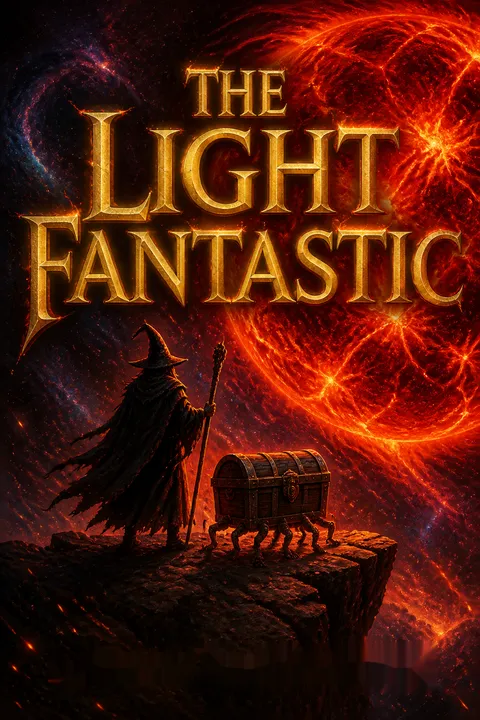


Plot Summary
Back From the Rim
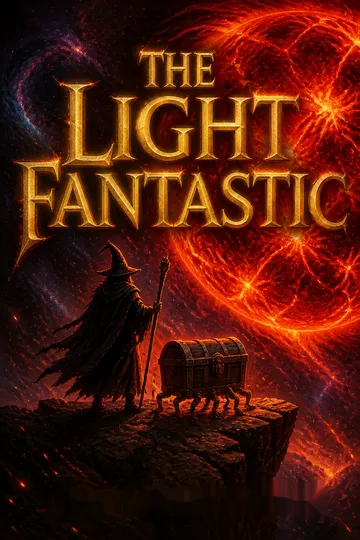
During an escape from Krull, tourist Twoflower is sealed inside a bronze vessel while his unwilling guide, the failed wizard Rincewind, tumbles through the sky without a helmet. Both should die. Instead, a surge of magic reshapes reality: Rincewind lands in a forest, and Twoflower emerges from his sinking craft beside a lake.
Twoflower’s sapient pearwood Luggage, a trunk that walks on hundreds of little legs, finds him and leads him to Rincewind. The rescue is tied to a spell lodged in Rincewind’s mind, though he knows neither why it is there nor what it can do. He has survived the fall, but the world has quietly begun to change around him.
The opening makes survival feel less like a triumph than an unexplained administrative correction. Rincewind is saved without earning or understanding his rescue, a pattern that unsettles the usual fantasy bargain between courage and reward. Twoflower’s calm acceptance of the impossible offers a counterpoint: his trust does not solve the mystery, but it keeps the pair moving. The Luggage’s independent search also establishes loyalty as an action rather than a feeling. Here, magic is not a tool the characters command. It is a force with its own priorities, and Rincewind is already caught in them.
Eight Spells, One Deadline
At Unseen University, the Octavo, the Creator’s book of eight great spells, erupts with power. One spell is missing, lodged in Rincewind’s mind, and the remaining seven threaten to break loose. The Supreme Grand Conjuror, Galder Weatherwax, summons Death to learn what is happening.
Death explains that the Octavo has pulled Rincewind back from the edge because all eight spells must be spoken together by Hogswatchnight, or the Disc will be destroyed. A new red star is moving toward the world. Galder’s ambitious second-in-command, Trymon, hears the warning and searches for a prophecy that promises power to the person who reunites the spells. While the senior wizards worry, Trymon begins turning disaster into an opportunity.
The prophecy converts a private oddity in Rincewind’s head into a public deadline. Yet the University’s response is not united purpose: Galder relies on old ritual, while Trymon treats the crisis as a route to advancement. Their disagreement is more than generational style. Galder trusts inherited practices whose logic he cannot fully explain; Trymon wants a system in which every uncertainty can be managed and every reward claimed. The red star makes both approaches inadequate. The world is facing a danger too large for institutional confidence, and Trymon’s hunger for control begins to look especially dangerous.
The Gingerbread Ambush
Lost in the Forest of Skund, Rincewind and Twoflower accept shelter from Swires, a tiny forest resident, in a cottage built from sweets and sustained by old magic. The Luggage follows them there. Twoflower sees a charming curiosity; Rincewind sees a house likely to attract trouble, and he is proved right when rival wizard groups break in, each trying to seize the spell in his head.
In the confusion, Twoflower discovers a flying broomstick. Rincewind takes control, and the two escape through the cottage wall as wizards battle below. A magic arrow aimed along a path to Rincewind strikes the Luggage instead, sending the trunk elsewhere. Their escape carries them into the storm clouds, where they see the red star glaring beyond the Disc.
The cottage turns Twoflower’s appetite for quaint experience into a practical hazard: what he treats as a picturesque stop becomes a contested site because the wizards value Rincewind as a container. Rincewind’s instinct is to flee, but this time escape requires him to act, seize the broom, and steer. The lost Luggage complicates that narrow victory. The trunk is not merely baggage, and its sudden disappearance leaves the travelers without their most reliable protector. The red star, glimpsed from above the clouds, gives their local pursuit a scale neither man can dismiss.
The Computer in the Sky
Rincewind and Twoflower crash onto a floating slab operated by Belafon, a druid who calls himself a computer hardware consultant. His rock flies because the universe can be persuaded to keep it aloft, but his destination, a vast stone circle used to calculate celestial events, is malfunctioning.
The druids’ readings confirm that the heavens are behaving abnormally. When Rincewind’s spell briefly takes control of his mind, he learns in a dream that the ancient spells chose him because his habit of surviving is useful: he must keep the missing spell from being spoken too soon.
Back at the University, Trymon takes command after Galder disappears and hires the swordswoman Herrena to find Rincewind. A prophecy directs Herrena toward the druids.
Belafon’s airborne stone literalizes a world held together by persuasion, custom, and stubborn belief, rather than by laws the characters can confidently inspect. The broken stone computer exposes the danger in trusting a model simply because generations have used it. Rincewind’s dream supplies purpose, but not comfort: the spells value him for endurance, not talent or consent. Meanwhile, Trymon replaces magical uncertainty with administrative command and hires a professional tracker. The parallel developments tighten the plot. Rincewind is being recruited by ancient forces from within, while a human institution sends a hunter after him from without.
Cohen at the Altar
At a stone-circle ceremony, Twoflower objects when the druids prepare to sacrifice Bethan, a young woman who had hoped the rite would make her a goddess. Rincewind is held at knifepoint by an old stranger who rushes the priests and reveals himself as Cohen the Barbarian, a famous warrior now eighty-seven and painfully worn down by his career.
Rincewind and Twoflower help free Bethan, but an archdruid strikes Twoflower and leaves him unconscious, strangely light and barely attached to ordinary life.
Cohen recognizes that his friend is not simply dead, and an old nomad woman’s medicine sends Rincewind after him into the spirit world. There Rincewind finds Twoflower in Death’s house and escapes with him before Death’s daughter can sever their lifelines.
The rescue makes the group’s different moral instincts collide. Twoflower intervenes because he assumes a person can be reasoned with; Rincewind recognizes the danger but follows; Cohen acts with the reflexes of a veteran who has spent a lifetime entering fights before considering the cost. Bethan’s disappointment complicates the apparent rescue, since she had invested years in the ritual’s promised status. Twoflower’s passage into Death’s domain turns his optimism into a genuine vulnerability. Rincewind’s decision to follow him is a shift from mere survival: for once, he risks himself because another person matters.
The Trolls Keep Their Promise
After the party reunites, Cohen, Bethan, and Twoflower travel with Rincewind across snowy country. When Rincewind searches for onions, he speaks to a rock that introduces him to Kwartz and the other trolls. Their old legend tells them to protect Rincewind, so they escort him toward the campsite and discover that Herrena’s mercenaries have captured his companions.
The captors shelter inside a cave that is actually the mouth of Old Grandad, a vast troll sunk into centuries of thought. Their fire burns his tongue and wakes him. The Luggage snaps up the mercenary Gancia, while the others flee or free the prisoners amid the shaking stone. At sunrise, Old Grandad freezes back into a mountain, leaving Rincewind alive beneath his enormous fist.
The trolls’ prophecy is deliberately unimpressive in its wording, but it produces concrete care: they feed Rincewind, guide him, and risk confronting a dangerous elder. Their culture turns geology into family history, and their fear of becoming inert stone gives their assistance a quiet urgency. The episode also redefines the landscape as inhabited rather than inert. The mercenaries’ mistake is not simply tactical; they treat a living being as scenery and light a fire in its mouth. The Luggage’s violence, by contrast, protects its companions with the blunt certainty of an instinct no one else can command.
The Ferryman’s Ambush
After escaping Old Grandad, Rincewind and Twoflower try to leave Cohen and Bethan behind, then turn back and are captured by Herrena’s remaining mercenaries. At the River Smarl, Cohen appears disguised as the ferryman, with Bethan close behind. Their attack breaks the ambush: Cohen fights Herrena despite his painful back, Bethan knocks her down, and the Luggage charges out of the river to chase Weems.
Once safe, Cohen admits he plans to marry Bethan. Twoflower’s false teeth give the old warrior an idea, and Cohen later trades diamonds from troll teeth for dentures of his own. The company heads toward a city under the red star, while Cohen’s new smile restores a small piece of the authority age has taken from him.
Cohen’s return is a reversal of the group’s assumptions about him. His body is unreliable, but his practiced judgment still makes him formidable; he wins by choosing timing and leverage rather than by pretending to be young. Bethan is not simply his attendant: she helps defeat Herrena and makes her own decision about their future. Twoflower’s dentures matter because they reveal a practical answer to Cohen’s shame, not because they restore his old body. The episode lets care take an unheroic form. A new set of teeth cannot erase age, but it can change how Cohen expects others to see him.
The Star’s New Faith
In a city emptied by fear, the red star has given rise to followers who paint its mark on doors and temples. Their leader preaches that magic and the gods are false, and that the world must be cleansed. When the crowd identifies Rincewind as a wizard, he tries to bluff, but the spell in his mind takes over and unleashes magic that kills a pursuer.
Bethan and Twoflower drag him from the mob. The three enter a wandering shop whose doors vanish and whose owner can travel between places. Rincewind resists the shopkeeper’s offer to leave the Disc, because he senses the star’s purpose is bound to his. Meanwhile, Cohen and the dwarf Lackjaw confront the cult’s book burners and follow the Luggage into the same shop.
The star cult offers certainty at the moment when established authorities have none. Its promise to eliminate magic turns fear into a program of purification, and the burning of books makes that program physical. Rincewind’s sudden power does not feel like mastery: he cannot control the spell or take responsibility for its violence in the usual way. The wandering shop provides escape, yet Rincewind chooses to remain involved, a decision made against his deepest instinct. Cohen’s defense of a dwarf jeweler and his resistance to book burning show a complementary response. He protects particular people and objects instead of arguing about an abstract doctrine.
Trymon Takes the Octavo
The wandering shop delivers Rincewind, Twoflower, and Bethan to Ankh-Morpork, where the star is now too large to ignore. The city’s frightened crowds converge on Unseen University, demanding that the wizards stop the catastrophe or abandon magic. Inside, Trymon leads the senior wizards below to unlock the Octavo, then takes the book and traps them behind a magically sealed door.
Rincewind enters the University through a secret gap in its old wall with his companions. Hearing the imprisoned wizards, he forces the ancient lock open by concentrating until the strain nearly overwhelms him. They tell him Trymon has carried the Octavo toward the Tower of Art. With the sky filling with unfamiliar moons, Rincewind and Twoflower climb after him.
The crowd outside the University and the betrayal inside it are two forms of the same institutional failure. The citizens want a simple remedy, while Trymon exploits the crisis to make himself the sole authority. Rincewind’s unglamorous knowledge of a student’s secret entrance and an old lock proves more useful than the senior wizards’ rank. His effort to open the door is also a rare moment of deliberate magical action, though it costs him dearly. The climb to the Tower is not a triumphal ascent. It is the narrow route left to people who have no reliable plan and cannot accept surrender.
The Spell’s Last Word
Trymon speaks the seven spells he stole, and a creature from the Dungeon Dimensions takes hold of him. Rincewind resists it with fists, teeth, and sheer refusal to yield; Twoflower strikes the creature with a sword, and it tumbles from the tower, taking Rincewind over the edge. Rincewind catches a stone ledge and is hauled back by Twoflower and Cohen.
The Octavo returns to the tower, and Rincewind reads its spells aloud, but one appears wrong. Bethan spots the mispronunciation and helps him correct it. The book rises in a flare of light. Above the Disc, eight star-bound shells crack open, revealing young turtles carrying new worlds, while Great A’Tuin turns away from the red star.
The climax rejects the fantasy that the right person wins by having the greatest power. Trymon has gathered magical force but cannot master what he has invited in; Rincewind survives through improvisation, anger, and help from people who know different things. Bethan’s attention to a mispronounced symbol is as consequential as Cohen’s rescue or Twoflower’s intervention. The resolution in the sky reframes the red star: it marks a birth rather than an extinction. The Disc’s survival depends on reading accurately, not merely speaking with authority. Cooperation here is practical, distributed across people whose skills no institution would have ranked together.
The Tourist Goes Home
With the danger passed, the crowd turns toward the Octavo, and the Luggage snaps shut around the book, keeping it out of eager hands. Rincewind and Twoflower leave the tower and find Cohen and Bethan preparing for their own future. The next morning, Twoflower tells Rincewind he has decided to return to his distant home, because traveling means little without somewhere to remember it from.
He gives Rincewind his belongings and the Luggage. Rincewind initially tries to send the trunk away, but when it stays behind, he relents and lets it follow him. Twoflower buys passage on a ship, and Rincewind heads back toward the University, considering a fresh start in wizardry.
Twoflower’s departure completes a change in how he understands travel. He has spent the story collecting sights, but now recognizes that experience needs a home from which it can be recalled. Rincewind cannot easily name what he has gained, yet his acceptance of the Luggage makes the separation tangible: the tourist leaves, while the wizard inherits an unpredictable companion and a life he once wanted to escape. Their friendship has not turned Rincewind into an optimist. It has made him less willing to pretend that attachment is someone else’s problem.
Analysis
The novel’s central joke is also its governing problem: everyone tries to impose a sensible account on a universe that does not owe them one. Trymon turns magic into administration, the druids build a computer from stones, the star cult turns fear into doctrine, and Twoflower assumes that good will can make any encounter manageable. Each approach reveals something true, but none can contain the whole. Rincewind’s advantage is not superior understanding. He is too frightened to mistake confidence for control, and he survives by responding to what is immediately in front of him.
That survival begins as a burden. The spell in Rincewind’s mind has restricted his education and made his body a contested object, while the wizards treat him as a means to an institutional end. His later resistance matters because it is personal before it is heroic. He refuses to hand himself over to Trymon, then keeps acting despite having no mastery of magic. The story therefore makes agency less about choosing one’s circumstances than refusing to let another person define the only possible response.
The supporting characters broaden that ethic of action. Bethan corrects the final spell by paying close attention; Cohen adapts his fighting to an aging body; the trolls honor a legend by offering practical help; Twoflower’s curiosity repeatedly exposes danger but also preserves his openness to other people. Even the Luggage expresses attachment through unruly protection. Together, these characters provide the cooperation Trymon’s centralized power cannot.
The red star’s revelation finally replaces apocalypse with reproduction. The world is not saved by defeating the unknown through force, but by recognizing what the approaching event actually is and speaking the spells accurately. That resolution does not make uncertainty disappear. It changes uncertainty from an enemy to a condition of life, one met through attention, companionship, and the willingness to act without a complete map.
Review Summary
The Light Fantastic continues the adventures of Rincewind and Twoflower from The Color of Magic. Most readers found it funnier and more engaging than its predecessor, with improved character development and worldbuilding. The story follows the duo as they try to save the Discworld from destruction by reciting eight spells. Highlights include the introduction of beloved characters like Cohen the Barbarian and Death's daughter, as well as Pratchett's signature wit and clever puns. Many reviewers praised the book's humor and creativity, considering it a stronger entry in the series.
People Also Read


Characters
Rincewind
The reluctant survivorRincewind is an inept, anxious wizard whose instinct is to flee before danger can become personal. A powerful spell lodged in his mind makes him valuable to forces he neither understands nor trusts, and it prevents him from practicing ordinary magic. He is sharp at recognizing immediate peril, less capable of admitting when another person matters to him. His friendship with Twoflower repeatedly pulls him into risks he would never choose alone. Beneath his self-protective complaints is a stubborn capacity to act when escape would leave someone else in danger.
Twoflower
The optimistic touristTwoflower is the Disc’s first tourist, an outsider whose curiosity makes unfamiliar places seem welcoming rather than threatening. His trust in people can appear absurd, and he often mistakes danger for a cultural experience, but his optimism is not merely foolishness. He notices possibilities others have dismissed, from practical inventions to unexpected kindness. His friendship with Rincewind rests on a curious balance: Rincewind protects him from the world, while Twoflower’s expectations keep Rincewind from reducing every choice to self-preservation. He travels with a camera demon and a self-directed magical trunk.
Cohen
The aging barbarian legendCohen is a storied warrior whose long career has left him with injuries, missing teeth, and a body that no longer obeys heroic expectations. He remains alert to openings, unfair advantages, and the practical details younger adventurers overlook. His pride is real, but so is his comic awareness of what age has cost him. Meeting Rincewind and Twoflower places him among people who admire the legend while encountering the vulnerable man underneath it. Cohen measures dignity not by looking invincible, but by continuing to act when his back, knees, or reputation fail him.
Trymon
The orderly power climberTrymon is a methodical young wizard who dislikes the disorder and theatrical traditions of the University. He prefers plans, charts, and clear chains of authority, and believes that competence should earn him control. His coolness can resemble reason, especially beside older wizards who protect their own privileges, but his ambition makes other people’s uncertainty look like an opening to exploit. He treats magic less as a mystery than as a resource to organize. That mindset makes him an unsettling rival to Rincewind, whose survival depends on improvisation rather than command.
Bethan
The practical ritualistBethan is a young woman raised among the druids, where she has attached hopes of status and belonging to a dangerous religious custom. Her reaction to being rescued is more complicated than gratitude, because she had understood the rite as a possible route to a new life. She is capable of confronting people directly and taking action when others hesitate. Her relationship with Cohen grows through practical care rather than idealized romance, and she retains a clear judgment of her own needs.
Galder Weatherwax
The traditionalist archwizardGalder is the Supreme Grand Conjuror of Unseen University, a senior wizard who takes pride in ritual, authority, and the theatrical trappings of his office. His habits look absurd beside Trymon’s administrative efficiency, but he is not merely a figure of pomp. He understands that magic resists tidy control and remains alert to danger even when he jokes or smokes through it. His rivalry with Trymon exposes the University’s uneasy transition between inherited practice and managerial ambition.
Death
The patient professionalDeath is the Disc’s skeletal personification of mortality, carrying a scythe and taking his work seriously even when others fear his appearance. He is formal, curious, and more attentive to the living than his reputation suggests. His conversations with the wizards reveal that he can explain the danger without being able to prevent it. He values the distinction between ordinary death and the destruction of a person’s mind, which gives him an unexpectedly humane perspective on the crisis.
Ysabell
Death’s restless daughterYsabell is Death’s adopted daughter, raised in a lonely house where visitors are usually dead and conversation is scarce. She is curious about the living and impatient with the limits of her strange home. Her manner can be playful, but her understanding of death is shaped by constant proximity to it rather than ordinary human experience. She wants company and excitement, even when she fails to grasp what those desires may cost others.
Herrena
The pragmatic swordswomanHerrena is a skilled mercenary who has built a living in a profession that offers few easy choices to women. She is observant, self-reliant, and wary of the men she employs, whose obedience is less dependable than their weapons. Her interest in Rincewind is professional rather than personal, and she treats risk as something to assess rather than romanticize. She wants enough security to choose a future beyond the sword, though she has not settled on what that future should be.
Belafon
The experimental druid engineerBelafon is a druid with an engineer’s interest in cosmic machinery. He pilots a floating stone and helps maintain the druids’ vast celestial computer, believing the universe can be understood through both ritual and experiment. His confidence in new theories makes him an awkward guide for Rincewind, whose main concern is staying alive. Belafon brings an inventive, workmanlike view of magic to a world where explanations are often part science, part persuasion.
The Luggage
The sapient pearwood chestThe Luggage is Twoflower’s living trunk, made of rare sapient pearwood and able to follow its owner over almost any terrain. Its many legs, locked lid, and unnerving determination make it both companion and hazard. It protects Twoflower without needing to be asked, but its loyalties do not make it tame or predictable. Other characters struggle to decide whether it is luggage, creature, weapon, or friend. Its presence turns an ordinary travel chest into an independent force with its own judgments.
Kwartz
The troll elder guideKwartz is a thoughtful troll who remembers the old stories passed down through his rocky people. He is concerned that his kind are growing still and losing their place in a changing world. His caution does not stop him from honoring the legend connected to Rincewind, and he helps the wizard despite the danger. Kwartz treats landscape as kin and history, a perspective that makes human assumptions about lifeless stone seem very small.
Plot Devices
The Octavo
The world’s spellbookThe Octavo is a book said to have been left behind by the Creator, holding eight spells of exceptional power. One spell escapes into Rincewind’s mind, leaving seven inside the book and linking his survival to the Disc’s fate. The spells must be spoken together at the right moment, but neither the wizards nor Rincewind initially understand what that moment means. The Octavo gives Trymon a reason to seize power and gives Rincewind a task he never chose. Its pages also make the act of reading, and reading correctly, a matter of cosmic consequence.
The Eighth Spell
A spell hidden in RincewindThe missing spell has lived in Rincewind’s mind since his student days, displacing every other spell he tries to learn. It can surface when he is frightened or exhausted, sometimes speaking through him and producing magic he cannot control. The ancient spells chose Rincewind because he survives danger, though he resents being used as a container. This device makes his apparent incompetence central to the plot: the person least able to command magic is the person whose choices determine whether the full set can be used.
The Luggage
A fiercely loyal companionTwoflower’s Luggage is a magical chest made from sapient pearwood. It follows him across the Disc, moves on hundreds of little legs, and can be more protective than its owner expects. Its lid and impossible interior create both comedy and danger, while its independent decisions repeatedly alter who can escape, who is found, and what happens to the Octavo. The Luggage is not a neutral container. Its behavior suggests an intelligence that acts according to its own attachments, even when the humans around it cannot read its intentions.
The Red Star
A cosmic deadlineThe red star appears beyond the edge of the known sky and grows larger as it approaches the Disc. Its presence disrupts magical readings, frightens the population, and gives the star cult a focus for its claims that magic must be purged. The wizards interpret it as a collision threat, while Rincewind gradually senses that it has a different purpose. The star drives the story’s urgency and tests the difference between predicting an event and understanding it.
The Wandering Shop
A door between placesThe wandering shop appears without warning, offers an assortment of strange goods, and can carry customers between distant locations. Its cursed owner cannot settle or close for the day, so a chance encounter becomes a means of escape from the star cult and a route back to Ankh-Morpork. The shop’s whimsical merchandise masks a practical narrative function: it connects separated characters and brings them to the final crisis. Its mobility also reflects the book’s unstable world, where familiar boundaries and destinations can suddenly give way.
FAQ
Synopsis & Basic Details
What is The Light Fantastic about?
- Discworld faces cosmic threat: A red star looms, threatening the Disc, while a failed wizard, Rincewind, carries a powerful spell.
- Rincewind and Twoflower's journey: Rincewind and the Disc's first tourist, Twoflower, embark on a chaotic journey, pursued by those seeking the spell.
- Magic and mayhem ensue: The story involves wizards, a sentient Luggage, and a quest to prevent the Disc's destruction, blending humor and fantasy.
Why should I read The Light Fantastic?
- Classic Pratchett humor: The book is filled with Pratchett's signature wit, satire, and absurd situations, making it a highly entertaining read.
- Unique fantasy world: It offers a unique and imaginative take on the fantasy genre, with a flat world carried on the backs of elephants and a giant turtle.
- Engaging characters: The story features memorable characters like the cowardly Rincewind, the naive Twoflower, and the fiercely loyal Luggage, creating a compelling narrative.
What is the background of The Light Fantastic?
- Fantasy satire: The book is a satire of traditional fantasy tropes, subverting common themes and characters with humor and irony.
- Discworld setting: It is set in the Discworld, a flat world balanced on the backs of four elephants standing on a giant turtle, a setting that allows for unique magical and physical laws.
- Magical system: The magic system is chaotic and unpredictable, often leading to humorous and absurd situations, reflecting the Discworld's whimsical nature.
What are the most memorable quotes in The Light Fantastic?
- "The sun rose slowly, as if it wasn't sure it was worth all the effort.": This opening line sets the tone for the Discworld's quirky and whimsical nature, highlighting its unique physics and magic.
- "Actually, the philosophers have got it all wrong. Great A'Tuin is in fact having a great time.": This quote subverts the serious philosophical debates about the Discworld's turtle, adding a touch of humor and absurdity.
- "Hot water, good dentistry and soft lavatory paper.": This quote, spoken by Cohen the Barbarian, humorously contrasts the grand expectations of a hero with the simple comforts of life, revealing a more human side to the legendary warrior.
What writing style, narrative choices, and literary techniques does Terry Pratchett use?
- Third-person omniscient narration: Pratchett uses a third-person omniscient narrator, allowing him to comment on the story, characters, and the world with wit and irony.
- Frequent digressions and asides: The narrative often digresses into humorous asides, footnotes, and commentary, breaking the fourth wall and engaging the reader directly.
- Satire and parody: Pratchett employs satire and parody to poke fun at fantasy tropes, societal norms, and human behavior, creating a unique and humorous reading experience.
Hidden Details & Subtle Connections
What are some minor details that add significant meaning?
- The nature of the Octavo's spells: The spells are not just words but have a life of their own, seeking a mind to inhabit, which explains Rincewind's burden and the book's restlessness.
- The description of the Luggage: The Luggage's sapient pearwood construction and its ability to follow its owner anywhere foreshadow its crucial role in the story and its unique nature.
- The mention of the Pyramid of Tsort: The pyramid's description as a place of ancient wisdom and power foreshadows Trymon's quest for knowledge and his eventual downfall.
What are some subtle foreshadowing and callbacks?
- The tree's conversation with Rincewind: The talking tree foreshadows the later importance of the forest and the interconnectedness of all things on the Disc.
- The mention of the red star: The early descriptions of the red star as a malevolent force foreshadow its true nature as a harbinger of new worlds.
- The librarian's sadness: The librarian's sadness when Trymon takes the book about the Pyramid of Tsort foreshadows the danger Trymon poses and the importance of the book.
What are some unexpected character connections?
- The connection between Rincewind and the Spell: The Spell's presence in Rincewind's mind is not just a burden but a form of protection, highlighting a complex relationship between the two.
- The connection between Cohen and Bethan: The unlikely romance between the aged barbarian and the young woman adds a layer of humor and heart to the story, subverting traditional tropes.
- The connection between the shopkeeper and the Luggage: The shopkeeper's curse and the Luggage's sentience hint at a deeper connection between magical items and their creators, suggesting a shared origin.
Who are the most significant supporting characters?
- The Librarian: The Librarian, though mostly silent, is a powerful figure who protects the library's knowledge, highlighting the importance of preserving information.
- The senior wizards: The senior wizards, despite their incompetence and infighting, represent the established order of magic, and their actions drive much of the plot.
- The shopkeeper: The shopkeeper, cursed to wander, represents the unpredictable nature of magic and the hidden connections between seemingly unrelated events.
Psychological, Emotional, & Relational Analysis
What are some unspoken motivations of the characters?
- Rincewind's desire for normalcy: Rincewind's primary motivation is to return to his mundane life, highlighting his fear of responsibility and his longing for a simple existence.
- Trymon's yearning for recognition: Trymon's ambition stems from a deep-seated need for recognition and power, driving his actions and ultimately leading to his downfall.
- Twoflower's need for experience: Twoflower's optimism and curiosity mask a deeper desire to experience the world and collect memories, driving his journey and his interactions with others.
What psychological complexities do the characters exhibit?
- Rincewind's cowardice and hidden bravery: Rincewind's constant fear is juxtaposed with his occasional acts of bravery, revealing a complex character who is more than just a coward.
- Trymon's ambition and insecurity: Trymon's ambition is fueled by his insecurity and a need to prove himself, leading to his ruthless pursuit of power and his eventual madness.
- Twoflower's naivety and wisdom: Twoflower's naivety is balanced by his inherent wisdom and his ability to see the good in others, making him a surprisingly insightful character.
What are the major emotional turning points?
- Rincewind's decision to confront Trymon: Rincewind's decision to confront Trymon marks a turning point in his character arc, as he chooses to face his fears and take responsibility.
- Twoflower's acceptance of his journey's end: Twoflower's decision to return home marks a shift in his character, as he realizes the value of reflection and memory.
- Cohen's acceptance of his age: Cohen's acceptance of his age and his decision to marry Bethan mark a turning point in his character, as he embraces a new chapter in his life.
How do relationship dynamics evolve?
- Rincewind and Twoflower's reluctant friendship: The relationship between Rincewind and Twoflower evolves from a reluctant partnership to a genuine friendship, highlighting the importance of human connection.
- Cohen and Bethan's unlikely romance: The relationship between Cohen and Bethan challenges traditional notions of love and companionship, showcasing the power of connection across age and experience.
- The wizards' distrust and cooperation: The wizards' initial distrust and infighting evolve into a grudging cooperation, highlighting the importance of unity in the face of a common threat.
Interpretation & Debate
Which parts of the story remain ambiguous or open-ended?
- The true nature of the Octavo: The Octavo's origins and the full extent of its power remain ambiguous, leaving room for interpretation and further exploration in the series.
- The fate of the Dungeon Dimensions: The exact nature of the Dungeon Dimensions and the creatures that inhabit them remains mysterious, leaving the reader to imagine the horrors that were averted.
- The future of the Discworld: The long-term consequences of the red star's appearance and the birth of new worlds are left open-ended, hinting at future challenges and changes for the Discworld.
What are some debatable, controversial scenes or moments in The Light Fantastic?
- The treatment of the star people: The portrayal of the star people as a fanatical mob raises questions about the nature of belief and the dangers of extremism.
- The wizards' incompetence: The wizards' incompetence and self-interest can be seen as a critique of authority and the limitations of traditional power structures.
- The nature of heroism: The portrayal of Rincewind as a reluctant hero challenges traditional notions of heroism, raising questions about the nature of courage and responsibility.
The Light Fantastic Ending Explained: How It Ends & What It Means
- The Octavo's return and the star's transformation: The Octavo's return to its own dimension and the red star's transformation into a birthing ground for new worlds symbolize the cyclical nature of creation and destruction.
- Rincewind's choice to let go of the Spell: Rincewind's decision to release the Spell represents his acceptance of his own limitations and his desire for a normal life, highlighting the importance of self-discovery.
- Twoflower's return home and the Luggage's choice: Twoflower's return home and the Luggage's decision to stay with Rincewind emphasize the importance of personal choice and the enduring power of friendship.
Discworld - Rincewind Series
About the Author
Other books by Terry Pratchett

Download PDF
Download EPUB
.epub digital book format is ideal for reading ebooks on phones, tablets, and e-readers.








