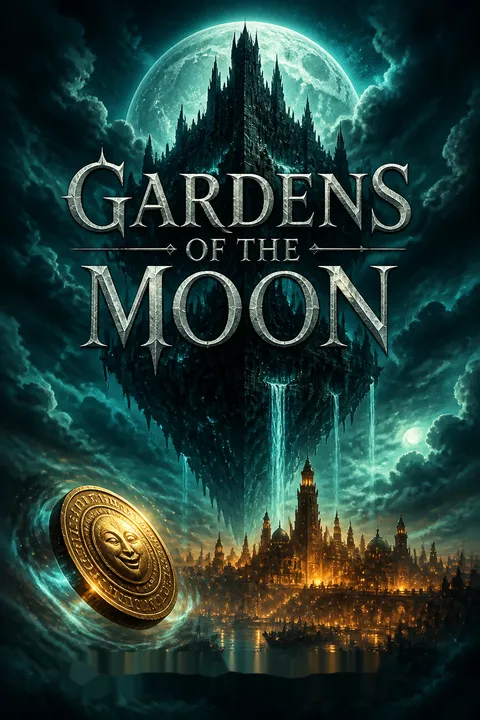


Plot Summary
Prologue
As a twelve-year-old in Malaz City, Ganoes Paran watches sorcery burn through the poor Mouse Quarter while the Bridgeburner commander Whiskeyjack argues with Surly, the woman who will become Empress Laseen. Ganoes has heard that the Emperor’s First Sword, Dassem Ultor, is dead, and he dreams of becoming a soldier himself.
Whiskeyjack warns him that quiet lives escape the notice of gods and rulers. The boy rejects the advice. Years later, his choice will place him inside the Empire’s wars and the schemes that gather around them.
The prologue frames ambition as an invitation to be claimed. Ganoes sees the Empire’s violence from a protected height, but mistakes distance for understanding and imagines a soldier’s life as a route to significance. Whiskeyjack’s warning is not cowardice: it is the hard-earned knowledge that attention from powerful people can turn a person into an instrument. The scene also plants the book’s central political wound. Laseen’s rise is not abstract history to the soldiers who remember the old Emperor; it is a living fracture that shapes their loyalties long after the throne changes hands.
The Coast Road Slaughter
Years after Laseen’s accession, Adjunct Lorn arrives at a bloodied road in Itko Kan, where more than four hundred people, including a cavalry regiment, have been torn apart. Lieutenant Ganoes Paran finds no tracks or survivors, only two empty fishing huts and evidence of an old woman’s candles.
The massacre began when soldiers killed the seer Rigga after she warned a fisher girl of a shadow destined to claim her. Cotillion and Shadowthrone take the girl, leaving her father alive, and give her the army name Sorry. Lorn recognizes that the slaughter was deliberate misdirection. Impressed by Paran’s composure and blunt honesty, she recruits him to her staff and orders him to trace the missing girl.
The massacre introduces the novel’s characteristic collision between imperial procedure and supernatural agency. Lorn treats the dead as evidence to be managed, while Paran cannot keep their bodies at the safe distance his rank once afforded him. Sorry’s recruitment makes the cost more intimate: the Empire’s machinery absorbs a child whose life has already been rearranged by gods. Rigga’s warning links private grief to public violence, but the prophecy does not protect anyone. It only gives later events a shape that the characters can recognize after the damage is done.
Pale's Burning Bargain
Two years later, the Malazan siege of Pale ends in a sorcerous assault on Moon’s Spawn. High Mage Tayschrenn leads the attack while High Fist Dujek Onearm and the Second Army wait below. The Lord of Moon’s Spawn, Anomander Rake, answers with destructive Elder magic. Tattersail survives the battle, but her fellow mages die, including Calot, whom she loved, and most of the Bridgeburners are buried in collapsing tunnels.
Pale falls, and the Moranth begin their promised hour of slaughter against the city. Whiskeyjack discovers that his squad was kept underground when Tayschrenn’s assault struck. The survivors suspect that the Empire sacrificed its own soldiers, and Tattersail begins to believe the High Mage engineered the disaster.
Pale makes loyalty difficult to distinguish from obedience. The Empire wins the city, but the victory exposes how readily its command structure spends soldiers to protect political advantage. Tattersail’s grief is sharpened by survivor’s guilt: she lived while the people who trusted her died within reach of her magic. Whiskeyjack’s suspicion grows from the same wound, but he carries it as a commander responsible for the living. Their shared doubt begins as an investigation into one battle and widens into a question about what the Empire has become.
Hairlock Takes a Puppet Body
Quick Ben saves the mortally wounded Hairlock by transferring his soul into a wooden marionette, an ancient technique that leaves the wizard powerful, unstable, and hungry for revenge. Hairlock claims Tayschrenn directed magic against the Bridgeburners during the battle, and the squad accepts Tattersail’s help while withholding the full plan from her.
In a Deck of Dragons reading, Tattersail sees Oponn’s coin, the Rope of Shadow, the Knight of Dark, and Darujhistan connected in one dangerous pattern. Meanwhile, Tayschrenn begins searching for the survivors. Paran, now commissioned as the Bridgeburners’ captain, receives orders to join Whiskeyjack and secretly watch Sorry. He learns that the Empress also wants Dujek’s following weakened.
Hairlock’s survival is both a tactical resource and a warning about the price of refusing death. His new body preserves his will but distorts it, making the Bridgeburners’ instrument increasingly difficult to control. Tattersail’s reading offers structure where political testimony cannot be trusted, yet it supplies no simple answer. The cards show entanglement rather than command. Paran’s assignment echoes the same problem: he accepts a mission before understanding its purpose, because a career built on service has taught him to mistake orders for clarity.
A Captain Meets the Bridgeburners
Topper escorts Paran through the Imperial Warren to Pale, where he discovers that the Bridgeburners have lost most of their strength and cycled through several captains. Veterans Picker, Antsy, Hedge, Mallet, and Trotts test him before Whiskeyjack returns. Paran refuses to pretend that his noble birth makes him their equal; he tells the squad he will accept their judgment if he fails them.
Before he can settle into command, an assassin stabs him twice in an alley. Oponn intervenes before his soul passes through Hood’s Gate, bargaining with Death to return him at the cost of another life. Shadowthrone arrives to finish the killing, but allows Paran to live so he can discover who has entered the divine game.
Paran’s first real command strips away the protective meaning of rank. The Bridgeburners care about whether he can stand beside them, not whose family sent him to the academy. His murder then makes that test stranger: he survives not through discipline or merit, but because gods find his life useful. This rescue is not reassurance. It creates a debt without a clear creditor and teaches Paran that survival can deepen his entanglement rather than free him from it.
Chance Cheats Death
Paran awakens in the Bridgeburners’ quarters after Mallet heals his wounds, though the deeper shock of dying remains. Tattersail explains that Oponn restored him, while Quick Ben and Kalam suspect Shadow’s recruit, Sorry, arranged the attack. Paran remembers the Hounds and the gods only in fragments.
He also learns that his sword, which he named Chance, wounded Gear, one of Shadowthrone’s Hounds, during the attack on Tattersail’s room. Hairlock now fears the weapon and wants Paran kept close, while Paran distrusts everyone’s account of his role. He agrees to stay long enough to protect Tattersail, whose magic is too weakened to defend herself, and begins to care for the sorceress despite their mutual suspicion.
The sword’s name gives Paran an image for a life that no longer obeys ordinary cause and effect. Yet its power does not make him master of his fate. Oponn’s intervention, the Hound’s wound, and Hairlock’s fear all make him more valuable to competing forces. His decision to stay with Tattersail is one of the first choices that is plainly his own. It grows from reciprocal care, not a command, and so offers a fragile alternative to the instrumental relationships surrounding him.
A Coin in Darujhistan
In Darujhistan, seventeen-year-old thief Crokus Younghand breaks into the D’Arle estate and steals jewels from Challice, a noblewoman he has never met. He returns the haul after seeing her asleep and realizing he has violated her privacy more deeply than he intended. On the night of the theft, a strange two-faced coin clatters at his feet and saves him from an assassin’s bolt.
Crokus keeps it as a charm. His mentor Kruppe recognizes that Oponn’s influence has attached itself to the boy, while Baruk, the city’s secretive High Alchemist, orders his agents to protect the Coin Bearer. Crokus’s friends Murillio, Rallick, and the disgraced noble Coll become involved, though he does not yet know why.
Crokus begins as a talented opportunist, but his return of the jewels reveals a conscience more developed than his profession suggests. He understands the theft not only as property loss, but as an invasion of a private refuge. The coin then turns that moral awakening into cosmic risk. Its apparent luck protects him, yet it also attracts protectors and hunters who treat him as a piece on a board. His desire to become worthy of Challice is sincere, but the social distance between them complicates the fantasy before he understands the larger danger.
The Guild War Opens
Baruk meets Rake and agrees to oppose the Malazan advance, though each man distrusts the other’s priorities. Rake believes Laseen will try to hire the city’s Assassins’ Guild to eliminate Darujhistan’s hidden rulers, so he sends his Tiste Andii assassins against the Guild first. The attack kills several Guild members and leaves the Master Assassin, Vorcan, in hiding.
Meanwhile, Councilman Turban Orr pushes a neutrality proclamation that would prepare the city for peaceful annexation on his terms. His ally, Lady Sinital, urges him to exploit the coming Empire. As the Guild disappears from the streets, Malazan agents Kalam and Quick Ben lose the local contacts they need to make their own offer.
The assassination war reveals that Darujhistan’s survival depends on systems its respectable citizens pretend not to see. The Guild’s violence regulates political rivalries, while Rake’s attempt to prevent an Imperial contract risks destabilizing the very city he intends to defend. Baruk understands these civic dependencies better than Rake, but neither can control the consequences of acting without the other’s trust. Orr’s neutrality is similarly double-edged: it promises to spare the city a battle while making its capture a matter of negotiation among elites.
The Bridgeburners Go Undercover
Whiskeyjack rejects the Empire’s plan to send the Bridgeburners through mined gates, suspecting that the assignment is designed to kill them. He divides the squad: Kalam and Quick Ben will seek the Assassins’ Guild, while Whiskeyjack’s group enters Darujhistan disguised as road workers.
Hedge and Fiddler conceal Moranth munitions inside replacement cobbles and plant them at key intersections. The squad crosses Lake Azur in a fishing boat, with Sorry serving as the only member who knows how to fish.
Quick Ben’s effort to track Hairlock through Chaos draws him into Shadowthrone’s realm, where he bargains to deliver the puppet in exchange for his own life. Sorry finds the Coin Bearer, but follows her own designs rather than returning to the squad.
The Bridgeburners turn the Empire’s suspicion into a practical plan: they use the tools supplied for siege warfare to prepare an escape and a threat of their own. Their disguises depend on being overlooked by a city that has no reason to imagine road repairs as sabotage. Sorry’s unexplained competence unsettles Whiskeyjack because it makes her seem both familiar and alien. Quick Ben’s bargain shows a different kind of soldierly calculation. He enters a god’s realm not to win outright, but to shape the moment when a dangerous ally can be destroyed.
Lorn Finds Her Past
After arriving in Pale, Lorn discovers that Dujek and Tayschrenn are close to open conflict over the treatment of the Second Army. She also learns that Tattersail survived the Hound’s attack and orders her to attend a formal dinner. There, Lorn reveals that Tattersail’s first command helped burn the Mouse Quarter, killing Lorn’s family and ending her childhood.
Tattersail accepts responsibility, while Dujek refuses to treat the crime as hers alone: the order came from Laseen, and the Empire’s leaders share the stain. Lorn suppresses the woman who might have accepted an apology and resumes the Adjunct’s mission. Tattersail later realizes Paran had been sent to help hunt Sorry and decides to leave Pale to warn the Bridgeburners.
Lorn’s history makes imperial authority personal without making it simple. Tattersail’s remorse cannot undo the deaths, and Lorn’s acceptance of that fact would require her to act as a person rather than an office. Dujek’s refusal to isolate blame exposes the Empire’s structure as a chain of shared responsibility, but it does not absolve anyone. Tattersail recognizes the same trap in herself: guilt can become a reason to flee, or a demand to remain present when the next harm can still be prevented.
Tattersail Is Born Again
Tattersail leaves Pale through her Thyr Warren but loses access to its power near Tool, whose Tellann magic deadens other sorcery. Bellurdan intercepts her and reveals that Tayschrenn sent him to study an ancient Jaghut text about a buried Tyrant. Tattersail understands that Lorn and Tool intend to free the creature, hoping Rake will be forced to destroy it.
She refuses to return, opens her Warren, and embraces Bellurdan in the resulting blaze. Their bodies burn together. In a dream shaped by Kruppe, the Rhivi Bone Caster Pran Chole and a Rhivi woman use ancient magic to give Tattersail a new body. She is reborn as a silver-furred child, while Pran Chole is promised a future as an Imass Bone Caster.
Tattersail’s choice is not a clean escape from guilt. She refuses to be returned to the Empire as a prisoner, but her final act binds her fate to an older history she can neither control nor fully remember. The rebirth makes identity a material question: memory, body, and responsibility no longer align neatly. Pran Chole’s transformation likewise shows that even ancient beings are changed by contact with the present. The scene offers renewal, but not restoration; Tattersail’s former life ends, and whatever follows must be lived without its old guarantees.
Hairlock Loses His Strings
Paran and Toc ride after Lorn, but Hairlock ambushes them on the plain and sends Toc through a tear in the world. Quick Ben, watching through a link to the puppet, cuts the strings that control Hairlock’s body. The Hounds of Shadow arrive before Hairlock can escape and tear the marionette apart. Paran expects them to kill him too, but Rake appears and challenges the Hounds.
He kills two with Dragnipur, then forces Shadowthrone to withdraw the rest. Paran later touches a dead Hound and is drawn into the sword’s inner realm, where chained souls pull an enormous wagon. He bargains with Oponn to lure the Hounds into the darkness, freeing them from their chains at the cost of the gods’ influence over him.
This encounter changes the meaning of Paran’s survival. He is no longer merely carried forward by Oponn’s luck; by choosing to bargain for the Hounds’ release, he acts inside a system designed to make every life a tool. Dragnipur makes that system literal: the dead are chained to labor even beyond death. Paran cannot repair the whole structure, but he can refuse to preserve it unchanged. His decision also costs him the god’s protection, leaving him responsible for whatever comes next.
The Barrow's Hidden Door
Lorn and Tool reach the ancient marker in the Gadrobi Hills. Tool opens a passage into the Jaghut Warren, where the pair enter a tomb preserved in ice beyond ordinary time. He explains that the Jaghut Tyrant’s power is stored in a Finnest, a separate object that can be carried away.
Lorn recognizes an acorn among the frozen offerings and takes it, intending to keep it under the deadening influence of her Otataral sword. Tool admits that freeing the Tyrant is a gamble: if control fails, only Rake may be strong enough to stop it. He offers Lorn a chance to leave the Empire and seek answers with him. She refuses, choosing to complete her mission and carry the Finnest toward Darujhistan.
The acorn compresses the book’s political logic into a small, portable danger. Lorn believes she can direct the Tyrant’s power by controlling its source, but Tool tells her that the plan rests on someone else surviving the consequences. His offer of departure is an alternative to the role that has consumed her, yet she remains loyal to the office even as doubt returns. The choice is not simply courage versus fear. It is a choice between an uncertain life beyond the Empire and a familiar duty whose failure could endanger an entire continent.
Five Lances and a Promise
Paran continues toward Darujhistan after the Hounds’ attack and rides into a Rhivi herd, where warriors mistake him for an enemy. His sword, Chance, breaks their weapons without harming them, and a small Rhivi girl persuades the elders to let him live. Through an old woman, the child tells Paran that Tattersail has not passed through death and will return to him.
The revelation changes his pursuit of Lorn: vengeance no longer seems a sufficient reason to kill her. Paran later meets Coll, the dispossessed Darujhistan noble wounded during Lorn’s earlier attack on Kruppe’s party. Paran shares his food and his own history of being used by the Empire; Coll, in turn, tells how Lady Sinital stripped him of his name and life.
The Rhivi encounter interrupts the logic of retaliation with an act of judgment that does not depend on military allegiance. Paran is spared because the child sees more in him than his uniform, and her promise restores a future he had treated as closed. His meeting with Coll then translates that shift into human terms: both men have been dispossessed by systems that equate status with identity. Their frank exchange does not erase betrayal, but it allows each to imagine a life beyond the role others assigned.
The Fête Breaks Its Masks
At Lady Sinital’s masked Fête, Rallick confronts Councilman Turban Orr for accepting Sinital’s contract to kill Coll. Rallick kills him in a public duel, with Rake acting as his second, and the Eel’s spy, Circle Breaker, receives permission to leave his dangerous post and begin a new life. Elsewhere, Crokus finds Challice, who denies betraying him and admits she expects to marry Gorlas Tholius.
Their meeting punctures his romantic hopes without making her a villain. Lorn tracks Crokus and unleashes a Galayn demon against him, then attacks him herself. Meese and Irilta intervene and kill the Adjunct. Paran finds Lorn dying, but he cannot undo the choices that brought them to that alley.
The fête turns disguise into a test of what remains when status is stripped away. Orr’s political mask cannot save him from the contract he helped unleash; Circle Breaker’s anonymity, by contrast, has been a form of service that now earns him release. Crokus’s encounter with Challice is smaller but equally decisive: he must confront the difference between loving an imagined future and knowing an actual person. Lorn dies after her own identity has narrowed to a mission. The cost of that narrowing is not only her life, but the relationships she might still have chosen.
Raest Meets the Azath
The Jaghut Tyrant Raest emerges from his barrow and begins tearing the earth apart as he searches for the acorn Lorn removed. Five dragons attack him, but his magic drives most away and wounds Silanah. Tool and the Elder God K’rul confront Raest within Kruppe’s dream, where the Imass cuts the Tyrant down. Raest’s power escapes into Mammot, who becomes possessed and unleashes destruction at Sinital’s estate.
Quick Ben opens seven Warrens to hold him back while Witch Derudan helps restrain the Jaghut spirit. Hedge fires a Moranth explosive, destroying Mammot’s body, but the Finnest’s power survives. An Azath house grows from Rallick’s wooden block, takes the spirit, and imprisons it before it can possess another body.
Raest’s release makes domination visible as a force that consumes both ruler and subject. The Tyrant does not merely threaten the city; he reproduces his old empire by turning Mammot’s body into a vessel. The Azath answers with a different kind of power, neither negotiation nor conquest, but containment. Its sudden growth suggests that the world has mechanisms no faction fully commands. The resolution is therefore not a victory earned by one hero. It is a precarious convergence of ancient magic, modern explosives, and people who act before they understand the whole design.
The City Survives the Night
A Galayn Lord sent by the Empire attacks Darujhistan, but Rake transforms into a dragon and kills it with Dragnipur. Vorcan nearly kills the remaining T’orrud mages before Crokus reaches Baruk’s estate and knocks her down with bricks.
Rallick’s earlier use of Baruk’s magic-deadening powder had helped stop the Azath’s growth until it could capture Raest. With Lorn dead, the Finnest contained, and the demon destroyed, the Bridgeburners abandon the plan to detonate mines that would have ignited the city’s gas network.
Dujek confirms that Laseen has outlawed his army, so the survivors join his rebellion. Kalam and Fiddler escort Apsalar toward Itko Kan; Crokus stays in Darujhistan, while Coll wakes and prepares to reclaim his place in the city.
The city survives because no single faction gets everything it wants. Rake protects Darujhistan but cannot dictate its future; Baruk’s network endures, yet the Empire’s internal crisis has become open rebellion. The Bridgeburners abandon their destructive plan once its real cost becomes clear, a choice that distinguishes their loyalty from obedience. Apsalar’s departure offers a modest form of repair after the years stolen from her, while Crokus remains among the people and places he has begun to value. The ending replaces certainty with provisional shelter: the city is intact, but the larger conflict has only changed shape.
Epilogue
The closing poem imagines a rumor beginning among the Gadrobi hills and traveling toward a city washed in blue light. It carries no new plot event, but turns the story’s aftermath into something that can be retold: a distant disturbance becomes a local legend, and the people who lived through it become part of the account. The city’s survival does not make the night smaller. It gives the night a life beyond the people who witnessed it.
The epilogue shifts the scale from action to memory. Rumor is the book’s most durable form of consequence: it moves where armies cannot, compressing complicated events into images that strangers can carry. The poem’s movement from hills to city also reverses the novel’s political geography. The Empire measures territory by conquest, while rumor travels through attention, fear, and curiosity. What survives is not a clean history or a settled lesson, but a story already changing as it passes from witness to witness.
Analysis
Gardens of the Moon treats power as a relationship that tries to disguise itself as a right. Empires claim obedience, gods claim pawns, commanders claim the authority to spend soldiers, and even private revenge can claim to be justice. The book repeatedly tests those claims against concrete choices: Tattersail stays with the Bridgeburners despite her fear; Whiskeyjack risks disobedience to protect his squad; Paran refuses to let the gods’ interventions erase his responsibility; and Crokus learns that desire does not make another person his story to write.
The novel’s many competing plots are not separate so much as echoes. Darujhistan’s Guild regulates noble violence, the Malazan Empire regulates conquered cities, and Raest’s ancient tyranny turns domination into an explicit system. Each claims to impose order, yet each makes other lives expendable. The Azath’s capture of Raest offers no moral victory. It is containment, an impersonal answer that arrives when human plans and divine bargains have all failed to control the danger they released.
The book’s emotional argument emerges through fellowship. The Bridgeburners endure because their humor and loyalty keep grief visible instead of converting it into statistics. Coll and Paran recognize one another through their losses; Apsalar’s recovery depends on others treating her as a person rather than a weapon. The ending preserves no easy innocence. Darujhistan survives, the Empire fractures, and the characters carry their unfinished responsibilities elsewhere. What remains hopeful is not the promise that power will become benevolent, but the possibility that people can still refuse to let power decide what their loyalties mean.
Review Summary
Gardens of the Moon receives mostly positive reviews, praised for its complex worldbuilding, intricate plot, and diverse characters. Many readers find it challenging initially but rewarding once they become immersed in the story. The magic system and political intrigue are highlights. Some criticize the steep learning curve and numerous characters, while others appreciate the depth and rereadability. Overall, it's considered a strong start to an epic fantasy series, with many readers eager to continue the Malazan journey.
People Also Read


Characters
Ganoes Paran
The reluctant instrumentA noble-born Malazan officer who wants a life larger than his family’s sheltered expectations, Paran enters the campaign believing that service will give his ambition a clear purpose. His bluntness makes him useful to Lorn and uncomfortable to those who prefer obedience without questions. He is drawn to responsibility, but repeatedly discovers that others have chosen his role before he understands the stakes. His relationships with Tattersail and the Bridgeburners offer him a kind of fellowship he has not found in the Imperial hierarchy. Paran’s central tension is between being used and choosing to act, a distinction he must learn while gods, commanders, and enemies all try to define him.
Whiskeyjack
The burdened sergeantA veteran commander reduced to leading a battered Bridgeburner squad, Whiskeyjack is disciplined, observant, and protective of the soldiers who have survived beside him. He distrusts the Empire’s treatment of its own troops, yet his loyalty to the army and its ideals remains difficult to sever. His care often appears as blunt command because he has learned to hide grief behind decisions. He wants his squad to live, but fears that admitting attachment will make every death unbearable. Paran’s arrival tests his judgment; his bond with Quick Ben, Kalam, Fiddler, and the rest gives him a community he has tried to keep at arm’s length.
Tattersail
The grieving sorceressTattersail is an experienced cadre mage whose humor and physical ease conceal a long accumulation of guilt. She has survived by treating intimacy as a brief diversion and duty as a structure that can contain painful memories. The deaths at Pale break that arrangement. Her loyalty to the soldiers of the Second Army is not abstract patriotism; she knows what they have risked to protect her and feels responsible when they are lost. Tattersail’s relationship with Paran unsettles her because it asks her to trust someone again. Her intelligence is formidable, but her deepest struggle is whether knowledge and remorse can become action rather than another reason to retreat.
Apsalar
The divided young womanApsalar is the name the former Sorry chooses as she begins to understand a life beyond her military identity. She arrives in Darujhistan with gaps in memory and an unsettling competence that makes others wary of her. Her quietness can resemble coldness, but it also reflects the effort required to distinguish her own feelings from what has been placed inside her. Crokus treats her first as a threat, then as a companion whose confusion deserves patience. She seeks the ordinary anchors of home and family even while carrying skills and memories that do not belong to an ordinary fisher girl. Her character raises the question of whether a self can be recovered after its history has been overwritten.
Adjunct Lorn
The Empress’s hard handLorn is the Empress’s agent, trained to treat sorcery, political risk, and personal feeling as problems to be contained. She believes in discipline because it has given shape to a life taken from her as a child, and she often mistakes that structure for strength. Her history with Tattersail exposes the human cost of an imperial order she has learned to embody. Lorn is perceptive and capable, but her role depends on suppressing questions that might make obedience impossible. Her interactions with Tool and Paran challenge the boundary she has built between the woman she once was and the office she serves.
Anomander Rake
The wary Lord of DarknessThe Lord of Moon’s Spawn is an ancient Tiste Andii whose power is matched by a marked reluctance to spend it carelessly. Rake acts from duty to the remnants of his people and to the allies who fight beside them, even when their cause is not his own. His reserve can look like arrogance, but it also reflects the burden of centuries and the bleak prospects facing his people. He distrusts easy alliances, particularly when they make a city or a people into a tool against the Empire. His black sword, Dragnipur, carries a power he uses with terrible seriousness. Rake’s choices repeatedly force others to reckon with the cost of intervention.
Quick Ben
The tactical mageQuick Ben is the Bridgeburners’ brilliant and evasive wizard, valued for seeing the hidden shape of a problem before anyone else. He rarely reveals everything he knows, partly because secrecy is his trade and partly because he fears what an uncontrolled plan can cost his friends. His bargains with supernatural powers show both nerve and calculation, but his confidence can push him toward risks that others must survive. Quick Ben is especially loyal to Whiskeyjack and Kalam, though he expresses that loyalty through tactics rather than confession. His many talents make him difficult to read, even for other mages, and his fear of losing control is as important as his ambition to win.
Kalam
The ex-Claw assassinKalam is a former Imperial assassin who has kept the skills of the Claw while redirecting his loyalty toward Whiskeyjack and the Bridgeburners. His physical directness contrasts with Quick Ben’s intricate planning, but both men understand how easily the Empire turns people into expendable instruments. Kalam is a formidable killer who does not confuse competence with virtue. He respects the squad’s bonds and is willing to risk himself for them, even when he knows the odds are poor. His wariness around Sorry reflects a practical fear of what she may be, while his later care for her reflects the possibility of seeing a person beneath a dangerous role.
Crokus Younghand
The thief with a conscienceCrokus is a young Darujhistan thief raised by his scholar uncle, Mammot, and trained by Kruppe in the practical arts of surviving the city. He enjoys the freedom of rooftops and shadows, but his theft of Challice’s jewels forces him to recognize that skill does not excuse the harm of intrusion. His attraction to a highborn woman feeds an ambitious fantasy of becoming someone she might respect. Apsalar’s arrival draws out a more patient, protective side of him, even as he struggles to understand her. Crokus grows through embarrassment, fear, and responsibility, learning that living in a city means more than taking what can be carried away.
Kruppe
The smiling master-spyKruppe presents himself as a self-indulgent, comic thief whose chief concerns are food, comfort, and the next entertaining story. Beneath that performance is an unusually perceptive mind, able to read patterns in dreams, politics, and the movements of gods. He protects people by appearing harmless, a strategy that makes his influence difficult to measure. His care for Crokus and his service to Baruk coexist with a strong instinct for self-preservation. Kruppe’s humor is not merely disguise; it is also a method of surviving knowledge too large and frightening to face directly. He sees that cleverness can change events, but he does not mistake it for control.
Dujek Onearm
The general under pressureDujek is the High Fist commanding the Malazan forces on Genabackis, a seasoned strategist whose missing arm has not diminished his authority or his attention to the soldiers under him. He values loyalty, but knows that loyalty cannot be demanded through rank alone. His conflicts with Tayschrenn and Laseen arise from a growing conviction that the Empire is sacrificing the people who sustain it. Dujek’s decisions are practical and often opaque, even to those closest to him, because he must balance the survival of his army against a political order turning against it. Whiskeyjack remains an old and trusted connection whose judgment Dujek takes seriously.
Baruk
The city's guarded alchemistBaruk is Darujhistan’s High Alchemist and one of the city’s concealed powers. He prefers foresight, diplomacy, and careful preparation to direct confrontation, but the arrival of gods and armies repeatedly makes prediction inadequate. His alliance with Rake is founded on shared opposition to Laseen, though Baruk worries that the Tiste Andii Lord treats the city as a battlefield rather than a home. He uses intermediaries such as Kruppe because information is safer when its sources remain hidden. Baruk’s protectiveness toward Darujhistan is both political and emotional: he wants the city’s institutions to endure, even when their corruption is plain.
Tool
The unbound ImassTool is a T’lan Imass warrior whose immense age has made him skeptical of simple claims about progress, loyalty, and human nature. Unlike many of his kind, he speaks openly and offers Lorn information about the ancient conflicts that shaped the present world. His service to the Adjunct is constrained by vows, but he is not a mindless weapon. He understands the danger of freeing the Jaghut Tyrant and admits his own doubts about the mission. Tool’s dry manner and occasional humor reveal a consciousness that has endured beyond the usual measures of a human life.
Toc the Younger
The one-eyed scoutToc is a soldier and Claw operative whose battlefield experience has left him scarred and suspicious of easy explanations. He serves as a link between Lorn’s mission and the Bridgeburners, but his loyalties are complicated by the people he has fought beside. Toc is observant, wry, and willing to trust what he sees over what his training tells him to report. His father’s reputation follows him, yet Toc is not content to become a copy of that legacy. He represents the human cost of making loyalty a profession.
Coll
The dispossessed nobleColl was once a powerful Darujhistan noble, but betrayal stripped him of title, property, and the social identity on which his life depended. He retreats into drink and resignation rather than fight a system that has already declared him dead. Beneath that surrender, he retains a soldier’s instincts and a capacity for loyalty, particularly toward Crokus and the friends who refuse to abandon him. His frank exchange with Paran lets both men speak about the difference between status and being alive. Coll’s story makes political erasure intimate: a person can survive physically while a city stops recognizing him.
Murillio
The dandy with a planMurillio moves easily among Darujhistan’s noble circles, using charm and cultivated manners as practical tools. He is an accomplice in Rallick’s effort to restore Coll’s standing, though he understands the moral cost of using deception and intimacy to reach that goal. His elegant self-presentation conceals an old friend’s loyalty and a growing fear that revenge may hollow him out. Murillio is also one of Crokus’s protectors, even when the boy is excluded from the details. His wit makes danger easier to endure, but not easier to escape.
Rallick Nom
The assassin seeking justiceRallick is a Darujhistan Guild assassin whose professional precision is matched by a personal code against betrayal. He has spent years believing that life and hope belong to other people, yet his loyalty to Coll drives him to challenge the political arrangement that erased his friend. He trains Crokus in caution by warning him away from dangerous targets, though his own life remains steeped in violence. Rallick sees assassination as a controlled alternative to wider bloodshed, a belief the book tests as political conflicts spread beyond the Guild’s rules.
Fiddler
The sapper who remembersFiddler is a Bridgeburner sapper with a practical talent for explosives, games, and reading danger by instinct. His humor makes him seem careless, but he is acutely aware of the human cost of the squad’s work. He challenges Whiskeyjack when the sergeant’s emotional armor threatens to turn the dead into abstractions. Fiddler’s loyalty is expressed through action, from surviving the tunnels to carrying out difficult missions. He is wary of grand causes, but refuses to let that wariness erase the friends beside him.
Hedge
The reckless sapperHedge is a Bridgeburner sapper whose appetite for explosives is matched by a rough, affectionate loyalty to the squad. He shares Fiddler’s expertise with Moranth munitions and tends to meet danger with irreverence. That bravado is not the same as indifference; Hedge cares about the people around him, even when he masks it with jokes and risky decisions. His willingness to act quickly can save lives, but also make him a source of alarm to his friends.
Mallet
The squad's healerMallet is the Bridgeburners’ healer, a steady and practical man who understands that wounds affect the mind as well as the body. He keeps the squad functioning through injuries, exhaustion, and the aftermath of sorcery. His work demands both technical skill and judgment, especially when he must decide whether to help Apsalar recover memories that may overwhelm her. Mallet is not a distant medic; his care is part of the squad’s shared survival.
Tayschrenn
The Empress's High MageTayschrenn is the Empire’s High Mage, powerful, politically exposed, and difficult for the Bridgeburners to trust. His command of the assault at Pale leaves the surviving soldiers convinced that he was willing to sacrifice them for a larger Imperial purpose. Whether motivated by ambition, loyalty, or both, he is a reminder that authority can conceal its reasons even from those it commands. His relationship with Lorn is shaped by their service to Laseen and by the consequences of decisions made in the Emperor’s name.
Cotillion
The Rope of ShadowCotillion, also called the Rope, is the Patron of Assassins and Shadowthrone’s companion. He treats mortals as pieces in a slow political game, yet his restrained manner contrasts with Shadowthrone’s more theatrical cruelty. His possession of Sorry makes the question of identity central to the young woman’s life. Cotillion is driven by a personal conflict with Laseen and by a strategic desire to weaken the Empire, but his actions carry consequences beyond his intended targets.
Shadowthrone
The Lord of ShadowShadowthrone rules the newly accessible Shadow Realm and schemes to undermine Laseen’s Empire. He is capricious, sharp, and adept at turning uncertainty into leverage. His partnership with Cotillion makes divine plans feel less like distant prophecy than a dangerous political operation. Shadowthrone’s dealings with Paran show that even gods can be forced to reconsider a plan when a mortal becomes unpredictable.
Oponn
The Twins of ChanceOponn are the paired gods of luck, one associated with the push of success and the other with the pull of misfortune. Their influence is playful in manner and serious in consequence. By attaching their coin to Crokus and intervening in Paran’s fate, they turn ordinary decisions into points of supernatural leverage. They do not offer protection without a price, and their interest in mortal lives is bound to the game rather than to compassion.
Circle Breaker
The anonymous city spyKnown publicly only by his cover as a City Watch guard, Circle Breaker serves the Eel by observing Council members and passing information to Baruk. Years of anonymity have made him careful and inward, but his work is not merely self-preservation. He wants Darujhistan to survive its own political rivalries and the Empire’s approach. His quiet service contrasts with the louder ambitions of the men he watches.
Plot Devices
Oponn's Coin
Luck with a priceThe two-faced coin represents the competing push and pull of Oponn, the gods of chance. It appears to Crokus during his escape from an assassin and becomes a visible sign that divine attention has entered the city. The coin’s influence protects and endangers him at once, drawing in Baruk’s agents, Shadow’s servants, and the Bridgeburners. Paran’s sword, also named Chance, connects his survival to the same divine game. The coin is not a simple charm that guarantees success. Its changing fortunes show how an apparent gift can make its bearer a target and how luck can create obligations no mortal agreed to.
The Warrens
Magic as geographyWarrens are pathways and sources of sorcery that allow mages, gods, and other beings to cross distance, shape matter, and attack one another. Their different powers have distinct limits and effects: Lorn’s Otataral sword suppresses magic, Tool’s Tellann influence deadens other Warrens, and Quick Ben’s use of Chaos lets him reach places few would risk entering. The Warrens make political boundaries porous. A distant command can arrive in an instant, while a magical crossing can also expose its traveler to hostile realms. Their use in the novel emphasizes that power is never just a weapon; it is an environment that changes whoever enters it.
Otataral Ore
Magic's deadening edgeThe red ore called Otataral suppresses sorcery, making it valuable to the Empire and dangerous to mages. Lorn carries an Otataral sword that can cut through magical defenses, while Rallick uses a powder made from the ore to resist sorcery during his confrontation with Ocelot. Its effects are not limited to combat: contact can interfere with magic and may alter the person exposed to it. Otataral gives non-mages a way to challenge powers otherwise beyond them, but it is not a universal solution. Its usefulness depends on proximity, preparation, and the wielder’s understanding of what the ore can disrupt.
The Finnest and Azath
Power stored, danger containedThe Finnest is the Jaghut Tyrant Raest’s concentrated power, preserved in the form of an acorn and separated from the body buried in the barrow. Lorn takes it in the hope that Otataral can keep its influence subdued, but Raest’s awakening makes the object a beacon for destruction. When the Tyrant’s power possesses Mammot, an Azath house grows from a block Rallick had been holding in check. Its roots capture Raest and his Finnest, turning a political crisis into an inexplicable act of containment. The device joins two kinds of danger: power that can be carried and a house that chooses what it will imprison.
Moranth Munitions
Siege weapons in disguiseThe Moranth alliance introduces explosive weapons that change Malazan warfare. Bridgeburner sappers Hedge and Fiddler use the charges as concealed mines, hiding them beneath replacement cobbles during supposed road repairs. Their plan gives Whiskeyjack leverage against the Empire’s forces and could cripple Darujhistan if detonated. The explosives are powerful enough to destroy buildings, but the city’s network of gas-fed lamps makes careless demolition catastrophic. The device therefore has both military and civic consequences: the same new technology that helps an army breach walls can set an entire city alight when used without regard for the infrastructure beneath its streets.
FAQ
Synopsis & Basic Details
What is Gardens of the Moon about?
- Intrigue in Darujhistan: The story centers on the city of Darujhistan, a place of political maneuvering, hidden magic, and ancient secrets, where various factions vie for power.
- Clash of Gods and Mortals: The narrative involves the awakening of an Elder God, K'rul, and the machinations of other powerful beings, impacting the lives of the city's inhabitants.
- Uncertain Fate: The plot follows multiple characters, including a thief, assassins, and mages, as they navigate a complex web of alliances, betrayals, and impending conflicts, with the city's fate hanging in the balance.
Why should I read Gardens of the Moon?
- Complex Worldbuilding: The novel offers a richly detailed and immersive world with a deep history, intricate magic systems, and diverse cultures, providing a unique reading experience.
- Intricate Plot and Characters: The story features a large cast of morally ambiguous characters with complex motivations, engaging in a multi-layered plot filled with twists and turns.
- Exploration of Themes: The book delves into profound themes of power, fate, morality, and the consequences of ambition, prompting readers to contemplate these concepts.
What is the background of Gardens of the Moon?
- Ancient History: The world is steeped in ancient history, with references to Elder Gods, Jaghut Tyrants, and T'lan Imass, whose past actions shape the present conflicts.
- Political Instability: The city of Darujhistan is politically unstable, with a council vying for power and the looming threat of the Malazan Empire, creating a tense atmosphere.
- Magical Undercurrents: Magic is a significant force, with various types of magic users, including mages, alchemists, and those who draw power from Warrens, influencing the events of the story.
What are the most memorable quotes in Gardens of the Moon?
- "The coin spins, Kruppe sees.": This quote, often repeated, encapsulates the theme of fate and chance, highlighting Kruppe's prophetic role and the uncertainty of the future.
- "Power is a cage, Rake. And you are its prisoner.": This quote, spoken by Baruk, reveals the complex nature of power and its potential to corrupt, foreshadowing Rake's internal struggles.
- "The past is a foreign country; they do things differently there.": This quote, though not directly from the book, encapsulates the theme of the weight of history and how it shapes the present, a recurring idea in the novel.
What writing style, narrative choices, and literary techniques does Steven Erikson use?
- Multiple Perspectives: Erikson employs a multi-perspective narrative, shifting between various characters' viewpoints, providing a broad understanding of the events and their motivations.
- Dense Prose: The writing style is dense and descriptive, with a focus on world-building and character development, often requiring careful attention from the reader.
- Subtle Foreshadowing: Erikson uses subtle foreshadowing and callbacks, rewarding attentive readers with deeper insights into the plot and character arcs.
Hidden Details & Subtle Connections
What are some minor details that add significant meaning?
- Kruppe's Dreams: Kruppe's seemingly whimsical dreams are not just random musings but are often prophetic, foreshadowing key events and revealing the influence of the Elder God K'rul.
- The Azath's Emergence: The Azath's sudden appearance in the garden is not just a random event but a direct response to the chaos and magic unleashed in the city, highlighting its role as a force of balance.
- Circle Breaker's Anonymity: The fact that Circle Breaker's identity remains unknown even to those he serves emphasizes the hidden networks and secret agendas operating within Darujhistan.
What are some subtle foreshadowing and callbacks?
- The Spinning Coin: The recurring image of the spinning coin foreshadows the unpredictable nature of fate and the influence of chance on the characters' lives.
- Rake's Weariness: Rake's constant weariness and the burden he carries foreshadow the immense power he wields and the sacrifices he has made.
- Hairlock's Chaos: Hairlock's chaotic nature and his use of the Warren of Chaos foreshadow the destructive potential of unchecked power and the dangers of the magical world.
What are some unexpected character connections?
- Kruppe and K'rul: The connection between Kruppe and the Elder God K'rul is unexpected, with K'rul communicating through Kruppe's dreams, highlighting Kruppe's hidden significance.
- Rallick Nom and the Azath: Rallick Nom's inexplicable connection to the Azath is surprising, suggesting a deeper purpose for him beyond his role as an assassin.
- Crokus and Oponn: Crokus's role as the Coin Bearer, manipulated by the god Oponn, is a hidden connection that shapes his destiny, revealing the influence of the gods on mortal lives.
Who are the most significant supporting characters?
- Circle Breaker: Circle Breaker's role as a spy provides crucial information, influencing the actions of Baruk and highlighting the hidden conflicts within the city.
- Tool: Tool's presence as a T'lan Imass warrior provides insight into the ancient history and the powers at play, adding depth to the world-building.
- Quick Ben: Quick Ben's cunning and magical abilities make him a key player in the city's defense, showcasing the importance of magic in the unfolding events.
Psychological, Emotional, & Relational Analysis
What are some unspoken motivations of the characters?
- Rake's Burden: Rake's unspoken motivation is to protect his people and fulfill his responsibilities, even at great personal cost, revealing his sense of duty.
- Baruk's Caution: Baruk's cautious nature stems from his desire to protect Darujhistan from external threats, highlighting his deep-seated loyalty to the city.
- Lorn's Doubt: Lorn's unspoken doubts about the Empire's motives reveal her internal conflict and her growing disillusionment with her role.
What psychological complexities do the characters exhibit?
- Rake's Isolation: Rake's immense power and long life have led to a sense of isolation and weariness, highlighting the psychological toll of his responsibilities.
- Crokus's Confusion: Crokus's confusion and uncertainty about his role as the Coin Bearer reflect his struggle to find his place in a world of powerful forces.
- Rallick's Obsession: Rallick's obsession with revenge against Lady Sinital reveals his deep-seated anger and his inability to let go of the past.
What are the major emotional turning points?
- Crokus's Freedom: Crokus's realization that he is free from Oponn's influence is a major emotional turning point, marking his journey towards self-discovery.
- Rake's Victory: Rake's victory over the Galayn Lord, though a triumph, is tinged with weariness and a sense of loss, highlighting the emotional cost of his actions.
- Lorn's Disillusionment: Lorn's growing disillusionment with the Empire is a significant emotional shift, leading her to question her loyalties and her purpose.
How do relationship dynamics evolve?
- Rake and Baruk: The relationship between Rake and Baruk evolves from wary alliance to a grudging respect, highlighting the complexities of power dynamics.
- Crokus and Kruppe: The relationship between Crokus and Kruppe develops into a mentor-student dynamic, with Kruppe guiding Crokus through his journey.
- Rallick and Lady Sinital: The relationship between Rallick and Lady Sinital is defined by hatred and revenge, culminating in a deadly confrontation.
Interpretation & Debate
Which parts of the story remain ambiguous or open-ended?
- The Azath's Purpose: The Azath's true purpose and its connection to the city remain ambiguous, leaving room for interpretation and speculation.
- K'rul's Motives: K'rul's motives for intervening in the city's affairs are not fully explained, raising questions about his role in the larger conflict.
- The Future of Darujhistan: The future of Darujhistan remains uncertain, with the city's power structures irrevocably changed, leaving the reader to wonder what will happen next.
What are some debatable, controversial scenes or moments in Gardens of the Moon?
- Lorn's Actions: Lorn's decision to release the Jaghut Tyrant is controversial, raising questions about the morality of her actions and the consequences of her choices.
- Rake's Methods: Rake's use of Dragnipur and his willingness to sacrifice lives for the greater good are debatable, highlighting the complexities of his character.
- The Nature of Power: The novel's exploration of power and its corrupting influence is open to interpretation, with different characters embodying different aspects of this theme.
Gardens of the Moon Ending Explained: How It Ends & What It Means
- Rake's Victory: Rake's victory over the Galayn Lord secures the city's immediate safety, but it comes at a cost, leaving him weakened and the city's future uncertain.
- The Azath's Influence: The Azath's emergence signifies a new balance of power in the city, with its presence shaping the future of Darujhistan.
- Unresolved Conflicts: The ending leaves many conflicts unresolved, setting the stage for future events and highlighting the ongoing nature of the struggle for power and control.
Malazan Series


About the Author
Other books by Steven Erikson
Download PDF
Download EPUB
.epub digital book format is ideal for reading ebooks on phones, tablets, and e-readers.








