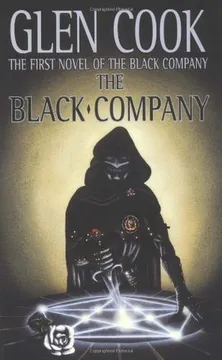


Plot Summary
Beryl Comes Apart
Croaker,1 physician and Annalist of the Black Company, traces a subtle poison killing soldiers in Beryl, where the Company serves a frightened Syndic. Captain2 Mercy’s raid on the suspected tavern uncovers a nest of political enemies, but the arrests help ignite riots and a mutiny by the city’s Urban Cohorts. As the streets fill with corpses, a disciplined northern force arrives behind a black-morioned envoy.8
The envoy8 offers Beryl an alliance and hints that the Syndic could be removed, while the Captain2 refuses to let the Company be sacrificed to restore order. The city’s old warnings about the sealed tomb of a forvalaka begin to seem less like folklore as strange deaths multiply and the northern ship waits offshore.
The opening makes the Company’s professional code both its shelter and its trap. Croaker records a city already failing under bad rule, but the Company’s raid accelerates the collapse instead of correcting it. The Captain distinguishes hired duty from suicide, while Croaker worries that accepting pay still creates an obligation. The arrival of the envoy changes the scale of the problem: Beryl’s riots are no longer merely local disorder, but an opening through which a larger power can enter. Croaker’s attention to old records also establishes a crucial habit: the past is not safely past in this world.
The Tomb Opens
Croaker1 joins the wizards investigating the shattered tomb and finds its bones, fresh soldiers’ corpses, and signs of a creature that drains blood and organs. Tom-Tom15 recognizes the forvalaka as an ancient wereleopard, too dangerous for the Company to defeat cleanly.
The monster later slips into the Bastion and massacres its way through the Syndic’s tower. The Company’s assault wounds it, but Tom-Tom15 is fatally mauled, and the Syndic is found cowering in a strongbox.
With their employer dead and the northern envoy8 ready to take over, the Company withdraws. Before leaving, the Captain2 turns the Company against the mutinous cohorts, killing them in their barracks. On the ship, One-Eye5 realizes the caged wereleopard is not the beast that killed his brother.15
The forvalaka makes the Company’s moral predicament physical: it is an old violence released into a city already trained to accept cruelty as ordinary. The Captain’s decision to punish the mutineers gives the Company a kind of justice, but it also exposes how easily justice becomes vengeance when administered by an armed brotherhood. Tom-Tom’s death lands especially hard because the wizards’ knowledge cannot protect them from the past they recognize. The caged creature’s difference from the killer leaves One-Eye with grief and unfinished suspicion, while Croaker’s account keeps the Company’s departure from Beryl morally unsettled.
Taken by the North
On the crossing, the envoy8 pins the Company with badges bearing the silver skull from his ship. Croaker1 recognizes the name Soulcatcher8 from the old history he has been studying: the Lady,9 her husband the Dominator, and the Ten Who Were Taken, once buried by the White Rose.
The Company has entered the service of one of the empire’s most feared sorcerers. In Opal, the Captain2 considers a ragged recruit called Raven,3 whose presence terrifies powerful officers.
Raven3 settles old accounts by killing three people connected to his betrayal, including a woman whose wedding ring he keeps, then joins the Company despite its misgivings. The Captain2 leads the Company north toward the war, while Raven3’s silence and Croaker1’s curiosity become two different ways of carrying a past.
This turning point overturns the apparent meaning of the Company’s new commission. The badge is not simply proof of employment; it places the mercenaries inside a history of domination that Croaker had treated as distant legend. Raven arrives as a parallel figure, someone whose private history is visible in violence but not explained. Croaker wants stories, names, and motives; Raven wants the past closed without exposing it. Their contrasting habits sharpen the book’s central tension between recording events and surviving them. The Company’s sense of itself as a family persists, but that family is now bound to powers whose history predates its own traditions.
Raven Saves Darling
In Forsberg, Raven3 and Croaker1 enter a village devastated by the Limper10’s troops. They find a mute, deaf girl being abused by soldiers and an old man forced to watch. Raven3 shoots the attackers, and the Company backs his intervention despite the danger of defying the Limper10’s officers.
The girl, whom they call Darling,4 and her grandfather Flick17 find shelter with the Company at Deal, where the soldiers capture the fortress and begin fighting the Rebels. When a patrol later carries Raven,3 Darling,4 and Flick17 to Oar for supplies, enemies attack the stable.
Flick17 dies protecting Raven,3 who is left gravely wounded. The assault is not a battlefield accident: the wounded Raven3 names Colonel Zouad,18 linking his old private grievance to the Company’s increasingly dangerous place in imperial politics.
Raven’s rescue is not a conversion into a conventional hero. He remains capable of lethal vengeance, yet he refuses to treat the girl’s suffering as acceptable collateral. That choice makes his past newly consequential: the people he once meant to punish can now reach the fragile life he has taken responsibility for. Darling’s presence also changes the Company’s family language from metaphor into practice. The men provide food, protection, and a place to belong, while Raven’s guarded tenderness emerges through actions rather than confession. The retaliation against the patrol shows how quickly a personal act of conscience can become a political liability in a war where every faction claims authority.
Shifter’s Oar Trap
Elmo14 identifies the attack as part of a plot by Zouad18’s network. The Company’s informant, stablekeeper Cornie, proves to be a Rebel agent, but his movements help Elmo14 trace the captured colonel to a hidden torture chamber.
Soulcatcher8 sends Shapeshifter,11 who disguises himself as Cornie and leads Raven,3 Elmo,14 and Croaker1 inside. When the Limper10 arrives, Shapeshifter11 triggers a collapse that buries the rebels, Zouad,18 and the Limper10 beneath the building. Raven3 disappears in the rubble, so the Company assumes he is dead.
He returns later, alive, and takes his place in the ranks beside Darling.4 The Limper10 survives, however, and the Company’s apparent victory becomes a weapon in the Taken’s feud. Raven3 has found a home, but the Company has become a pawn in a conflict it barely understands.
The Oar operation reveals how little difference political labels make inside the torture chamber: the rebels’ methods resemble those of the empire they oppose. Shapeshifter’s disguise turns trust into a tactical instrument, while the collapse converts a rescue and revenge mission into a spectacle engineered for the Taken’s rivalries. Raven’s disappearance briefly shows the cost of treating a comrade as a legend rather than a vulnerable person. His return matters because he chooses the Company after experiencing its loyalty, not because his past has been erased. Yet the Limper’s survival ensures that private debts and factional politics remain connected.
Raker’s Price
At Deal, Elmo14 and Silent7 bring back a strand of Raker13’s hair, enough for One-Eye5 and Goblin6 to build a sorcerous trap. Soulcatcher8 funds it with a fortune piled beneath a carved stone, daring anyone to place Raker13’s head in its hollow.
The plan is meant to wreck the Rebel general’s credibility as would-be claimants crowd Roses and Raker13 repeatedly tests the trap. After an attacker wounds Otto, Raven3 tracks the suspected assailant through a blizzard and finds Raker13 himself.
Raven3 and Croaker1 kill him, take his head, and claim the money without telling Soulcatcher.8 The Limper10 arrives looking for the treasure, but Soulcatcher8 forces him to leave by invoking the Lady9’s summons. Raker13’s death weakens the rebellion, while Raven3’s revenge gives the Company another secret to hide.
The bounty is a weapon built from predictable human motives. Soulcatcher does not simply seek Raker’s death; he uses greed, curiosity, and public rumor to make the Rebel movement watch its leader fail. Raven breaks the intended script by killing Raker outside the trap, an action that serves his own judgment as much as the Company’s interests. The stolen reward registers as a small assertion of autonomy, but it also deepens the Company’s secrecy. The scene’s moral balance is deliberately unstable: Raker is an enemy, yet Croaker’s discomfort with decapitating him keeps victory from becoming clean or celebratory.
Whisper’s Hidden Papers
At Meystrikt, the Company raids a Rebel camp and Croaker1 discovers the campaign orders of Whisper,12 the Rebel general expected to attack Lords. Papers buried near her quarters include old documents tied to Bomanz, the wizard who awakened the Lady.9
Croaker1 shares their clues with Raven,3 then gives the material to Soulcatcher,8 who learns the true names of several Taken and recognizes Whisper12 as a threat. Soulcatcher8 sends Croaker1 and Raven3 to intercept her and the Limper.10 They wound both and bring Whisper12 within the Lady9’s reach.
The Lady9 transforms her into a Taken, replacing the disgraced Limper,10 but Whisper12’s forces move swiftly elsewhere. Lords falls, and the Company retreats with the battered remnants of the northern army, carrying knowledge that has made them more valuable and more exposed.
The papers turn archival work into direct participation in power. Croaker’s role as Annalist has trained him to notice what others discard, but the documents show that preserving knowledge can also make him complicit in its use. True names offer control over beings who otherwise seem beyond reach, converting memory into a weapon. Whisper’s fate sharpens the irony: the Lady defeats her by making her part of the very order she fought. The Company wins a tactical success, yet the Rebel adapts quickly enough to take Lords. Information shifts the war’s balance without giving Croaker or his comrades control over what that information enables.
The Stair Breaks
The Company retreats through the Windy Country as Stormbringer20’s unnatural sandstorm shields three thousand exhausted soldiers from the Rebel pursuit. At the Stair of Tear, the Captain2 organizes a defense while the Hanged Man19 arrives with reinforcements.
The Rebel attacks beneath supernatural storms and molten rock, but the Company holds long enough to retreat again toward Charm. Croaker1 notices the Taken’s political rivalries turning lethal: the Hanged Man19 dies, and the Circle loses several leaders.
Later, Bonegnasher21 kills the forvalaka that attacked the Company’s medics, settling One-Eye5’s long grief over Tom-Tom.15 Croaker1 begins to suspect a scheme to restore the Dominator, but cannot prove who among the Taken is involved. The Lady9’s empire is losing ground even as the Rebel pays heavily for each advance.
The Stair is a military bottleneck and a moral bottleneck. The Company’s discipline keeps frightened survivors functioning, but the spectacle of men being destroyed by sorcery makes tactical success hard to distinguish from complicity. Croaker’s growing suspicion matters because he has seen the Taken’s rivalries from close range, yet his evidence remains partial. One-Eye’s relief at the forvalaka’s death offers a rare, intimate resolution amid strategic collapse. It does not undo Tom-Tom’s loss, but it lets grief find an object. The Company keeps moving because belonging and obligation outlast confidence in the war’s larger purpose.
Elephants at Charm
At Charm, the Lady9’s armies build layered trenches and firing platforms around the Tower while Rebel forces gather in overwhelming numbers. She assigns the Black Company to guard her, and Croaker1’s unease grows as a ballista accident nearly kills him.
The first assault pushes through the defenses until the Lady9 signals her hidden answer: armored war elephants burst through the retaining wall and scatter the Rebel ranks. The Company watches the counterattack turn near disaster into a temporary victory.
That night, the Taken fight among themselves; Shapeshifter11 is lost, and the Lady9’s forces prepare for another assault. Croaker1 also sees the forvalaka crucified in the open, still alive. The first reprieve has not ended the siege. It has only bought the Lady9 time to arrange a more terrible reckoning.
The elephants are a surprise of material history, not sorcery: the Lady wins a moment by importing a form of warfare the Rebel has never faced. That tactical ingenuity sits beside the Tower’s exacting order, where every trench and firing lane expresses an appetite for control. Croaker’s near-fatal accident and the nightly conflict among the Taken undermine any simple distinction between battlefield danger and political danger. Even apparent victory is provisional. The living, crucified forvalaka makes that uncertainty visible: the Lady’s machinery can preserve a creature through extraordinary punishment, just as it can preserve an empire through repeated retreats.
Croaker Shoots Soulcatcher
Before the final assault, the Lady9 tells Croaker1 that the Dominator is awakening and influencing both the Circle and some of the Taken. She gives him a bow and marked arrows, warning that he may have to decide whom they should strike.
Rebel ranks break through the defenses, while the Howler’s disease spreads among them and the Lady9 rides out with Croaker1 to pursue Soulcatcher.8 Croaker1 first kills a decoy wearing the Taken’s guise, then finds the real Soulcatcher8 fleeing on horseback.
When the Lady9’s carpet crashes, Croaker1’s arrow wounds Soulcatcher8 and he beheads the sorcerer. The pair return to find the battlefield buried beneath the dead; the Lady9’s plan has annihilated the Rebel host, though the Company’s fate inside the Tower remains uncertain.
The revelation makes the war’s apparent sides less important than the older struggle underneath them. The Lady is defending her rule, but also resisting the Dominator’s return; Croaker must act without being able to make her morally innocent. His arrow is therefore not a simple heroic instrument. It is a choice made within a chain of manipulation, after he has watched the Lady’s armies and the Taken treat human lives as strategic material. Killing Soulcatcher resolves one immediate threat while leaving Croaker with the cost of having helped preserve the Lady’s power. The mass death on the field denies any comfortable reading of that outcome as uncomplicated victory.
Raven Leaves the Ranks
The Lady9 wins at Charm, but the Company survives as a battered force still sworn to her service. Croaker1 argues that the Captain2 should break with Soulcatcher8’s influence, then learns Raven3 and Darling4 have slipped away.
He and Silent7 ride after them and find the pair heading south. Croaker1 warns Raven3 that the Limper10 is alive and now serves the Lady9 again, gives him his share of the Roses treasure, and offers Darling4 an amulet that can warn of danger. Raven3 invites Croaker1 to leave with them, but Croaker1 stays with the Company and its Annals.
He records Raven3 and Darling4 as dead so the Lady9’s powers cannot follow their trail. A final vision suggests Darling4 may have a part in the White Rose’s future, though Croaker1 cannot know what will come.
The ending resolves the book’s competing meanings of loyalty without pretending they can be reconciled. Croaker remains with the Company because its shared past and obligations still define him; Raven leaves because protecting Darling requires a different kind of fidelity. Their separation is not a rejection of brotherhood but one of its costs. Croaker uses the Annals both to preserve the Company and to conceal the fugitives, making historical record an act of care as well as a record of violence. His uncertain vision offers a future beyond the Lady’s victory, but its uncertainty matters: hope arrives as a possibility, not a promise.
Analysis
The novel’s most consequential conflict is not simply the Lady9 against the Rebel. It is the gap between a soldier’s immediate loyalties and the immense political histories that recruit those loyalties for larger purposes. The Black Company survives by treating itself as a family: shared habits, remembered dead, and the Annals give its members continuity when employers and causes change. Yet that intimacy does not make the Company innocent. Its soldiers raid, kill, and carry out orders for rulers they recognize as dangerous. Croaker1’s unease grows not because he discovers a pure side, but because he sees that the Rebel’s methods can reproduce the cruelty he claims to oppose.
Croaker1’s position as physician and historian gives him two related duties. He must tend bodies without deciding who deserves care, and he must record events without making the Company look better than it is. His writing preserves individual lives against the scale of war, but it also becomes a tool of concealment when he invents a death for Raven3 and Darling.4 The Annals therefore embody the book’s tension between truth and protection: a record can serve justice, memory, or survival, sometimes all at once.
The Taken make power feel both supernatural and bureaucratic. Their magic can destroy armies, but their rivalries resemble court politics, complete with patronage, sabotage, and competition for the Lady9’s favor. The Company is useful precisely because it is small, skilled, and bound by an internal code. That code cannot prevent compromise, but it gives the soldiers a standard by which they can recognize betrayal and cruelty. At the end, Croaker1 remains with the Company while Raven3 leaves to protect Darling.4 Neither choice cancels the other. The book’s hard-won hope lies in that distinction: loyalty can mean staying to bear witness, or leaving before a vulnerable person is absorbed by the machinery of war.
Review Summary
Reviews of The Black Company are deeply divided. Fans praise its groundbreaking grimdark tone, morally ambiguous characters, brotherhood themes, and lean, soldier-like prose, crediting it as an influential precursor to works by Abercrombie and Erikson. Critics cite confusing world-building, abrupt pacing, minimal descriptions, and a jarring first-person narrative as major drawbacks. Many readers struggled with the opening chapters but warmed to the story later. The recurring cast, particularly Croaker, Raven, and feuding wizards Goblin and One-Eye, resonated strongly with those who persisted.
People Also Read




Characters
Croaker
Company physician and witnessCroaker treats the Company’s wounded and records its history, bringing a physician’s attention to bodies and an Annalist’s attention to causes. His dry humor keeps fear at a manageable distance, while his curiosity about old stories and the Lady9 repeatedly draws him toward danger. He is neither an idealist nor a detached observer: he serves a mercenary company whose choices trouble him, yet he understands its bonds from the inside. Croaker’s writing becomes a way to preserve the dead and examine his own complicity. His divided loyalties, to the Company, to truth, and to his conscience, make him the novel’s moral center without making him morally certain.
The Captain
Commander of the CompanyThe Captain leads through restraint, practical judgment, and a loyalty to the Company that is stronger than his attachment to any employer. He often appears taciturn or irritable, but his decisions reveal a careful awareness of how much risk his soldiers can bear. He protects the Company’s traditions while adapting them to wars that threaten to erase the old mercenary brotherhoods. His relationship with Raven3 grows through shared silences and mutual recognition rather than explanation. The Captain’s central conflict is how to keep the Company alive without letting survival become an excuse for every betrayal.
Raven
The Company’s dark newcomerRaven arrives from the Lady9’s northern territories in ragged clothes and guarded silence, carrying an old grievance he refuses to explain. He is controlled, observant, and frighteningly capable with knives, yet his actions toward vulnerable people reveal a decency he tries to conceal. He forms a strong bond with the Captain2 and a protective attachment to Darling4, while Croaker1’s questions make him wary. Raven’s self-control is not emotional emptiness; it is armor built around shame, rage, and the fear that his past can endanger anyone near him. He values action over confession and belonging, once found, more than he admits.
Darling
Deaf orphan under Company protectionDarling is a deaf, mute girl rescued from a war-torn village. She communicates through signs, reads people sharply, and often understands the emotional shape of a situation before the soldiers around her do. Her attachment to Raven3 grows from the protection he offers, but she also makes her own choices and shows a lively curiosity about the Company’s life. To Croaker1, she is a rare source of uncomplicated warmth in a world built on suspicion. Her presence reveals how the Company’s rough fraternity can become a genuine family, while her vulnerability forces Raven3 and Croaker1 to consider a future beyond the next battle.
One-Eye
Old wizard and sharp-tongued veteranOne-Eye is a diminutive, centuries-old wizard whose boasts, feuds, and appetite for schemes make him a source of comic disorder. Beneath the performance is a capable sorcerer and a veteran deeply attached to the Company. His long partnership with his brother Tom-Tom15 gives him a private history that he rarely shares, while his rivalry with Goblin6 supplies an ongoing contest in magical invention. One-Eye protects his feelings with bluster and mischief, but grief can silence even his quarrels. His magic is useful in war, though he often prefers using it to embarrass a fellow wizard.
Goblin
Wizard of inventive mischiefGoblin is a short, quick-witted Company wizard whose theatrical illusions and elaborate pranks turn fear into entertainment. He is One-Eye5’s constant rival, but their feuding rests on a familiarity that neither would willingly surrender. Goblin’s abilities also carry real costs: contact with the Lady9 can overwhelm him, and his magic makes him valuable to powers far greater than himself. He often sees when a comrade is shaken and knows how to offer practical care without making it sentimental. His humor is a form of resilience, not evidence that he takes danger lightly.
Silent
Company wizard without wordsSilent communicates through gestures and sorcery, making him difficult to read but invaluable to the Company. He detects spies, conceals movements, and supports plans without needing recognition. His silence is not passivity: he acts decisively when others hesitate, and his loyalty emerges through the risks he takes rather than declarations. Croaker1 often treats him as a trusted sounding board, while Darling4 develops her own ease in communicating with him. Silent’s self-possession contrasts with the louder wizards, and his actions suggest that attention and restraint can be as powerful as spectacle.
Soulcatcher
The Company’s masked patronSoulcatcher is one of the Ten Who Were Taken, a sorcerer whose black morion conceals the face and whose changing voices make identity feel unstable. The Company serves under Soulcatcher’s patronage, receiving protection and dangerous assignments in a court where the Taken compete for influence. Soulcatcher can be unexpectedly patient with Croaker1 and practical toward the soldiers, which makes the threat beneath that courtesy harder to judge. The character’s layered presentation invites Croaker1 to search for a human motive, even as the Company learns that closeness to power can make them tools in conflicts they do not understand.
The Lady
Ruler of the northern empireThe Lady rules through the Taken and commands an empire feared by its enemies. She rarely appears in public, making her a source of fascination for Croaker1, who tries to imagine the person behind the legends. Her attention can feel intimate even when it is strategic, and she treats power as something to be arranged with patience rather than displayed constantly. The Lady is capable of planning on a vast scale, but her rule depends on unstable alliances and servants who carry their own ambitions. Her relationship with Croaker1 unsettles his assumptions about villains, admiration, and the danger of being noticed.
The Limper
Ruthless imperial sorcererThe Limper is one of the Taken, a powerful and vicious figure whose damaged body and dragging gait make him recognizable even before his sorcery is seen. He commands imperial forces but is also caught in the rivalries among the Lady9’s champions. Raven3’s history is connected to the Limper’s circle, making the sorcerer a personal threat as well as a military one. The Limper treats cruelty as an instrument of authority, and his ability to survive punishment makes him difficult to contain. His presence turns the Company’s operations into more than ordinary mercenary work.
Shapeshifter
Master of disguise and terrorShapeshifter is one of the Taken and an ally of Soulcatcher8, feared for his grotesque appearance and ability to change forms. He uses disguise and infiltration as readily as open sorcery, turning the enemy’s assumptions into vulnerabilities. His theatrical cruelty can make him seem more like a monster than a strategist, but he understands how people respond to fear and uncertainty. The Company benefits from his intervention while remaining wary of the power he represents. Shapeshifter’s shifting identity also echoes the novel’s wider uncertainty about who can be trusted within the Lady9’s empire.
Whisper
Rebel strategist and commanderWhisper is among the Rebel’s most capable generals, known for disciplined planning and the ability to hold a front together under pressure. Unlike the more chaotic forces around her, her campaigns depend on preparation, coordination, and a clear understanding of the enemy. Croaker1 and the Company encounter her first through the orders she leaves behind, which reveal how much of the Rebel effort rests on her work. Her reputation makes her a serious threat to the Lady9’s empire, while her calculated reserve suggests a commander who guards both information and feeling.
Raker
Rebel general of ForsbergRaker is a Rebel leader whose battlefield skill and prophetic reputation make him a symbol of hope in Forsberg. His successes have embarrassed the Limper10 and challenged the Lady9’s control of the northern provinces. Raker’s position is therefore both military and psychological: his followers need to believe he can win, while his enemies understand that belief is part of his strength. Croaker1 sees him less as an abstraction than as an aging opponent caught in the same violent machinery as the Company. His refusal to disappear quietly makes him difficult to dismiss.
Elmo
Hard-edged Company sergeantElmo is a veteran sergeant who turns the Captain2’s decisions into action and keeps his soldiers moving when fear or exhaustion threatens to stop them. He is blunt, disciplined, and practical, with a sharp understanding of both battlefield tactics and Company loyalties. His temper can make him seem simple, but Croaker1 knows he is perceptive and politically alert. Elmo often protects the Company by acting decisively before a threat grows, even when that means accepting risks his men may resent. His attention to Raven3 and Darling4 shows the care underneath his professional severity.
Tom-Tom
One-Eye’s brother and wizardTom-Tom is One-Eye5’s younger brother, a wizard whose small drum accompanies his magic and whose long service has made him weary of the Company’s decline. He knows old lore, especially the danger posed by the forvalaka, but his knowledge does not make him fearless. His bond with One-Eye5 is visible in their shared habits and old arguments, even when neither says plainly what the relationship costs them. Tom-Tom’s history reaches back to their apprenticeship, giving the Company’s present dangers a personal connection to its distant past.
The Lieutenant
Company disciplinarianThe Lieutenant is the Company’s steady second-in-command, responsible for discipline and the practical order that lets the Captain2 lead. He rarely speaks more than necessary, but his authority is clear to soldiers and officers alike. He trusts competent subordinates, expects obedience, and can recognize when a show of force would create more danger than it prevents. His restraint balances Elmo14’s hard edge and the Captain2’s strategic caution. Though he reveals little of his personal history, his conduct shows a durable loyalty to the Company’s shared rules.
Flick
Darling’s protective grandfatherFlick is an old villager and Darling4’s grandfather. He survives the Limper10’s violence by enduring what is done to him and remains fiercely protective of the girl. His presence gives Darling4 a family bond outside the Company, while his cautious dealings with the soldiers show how little reason ordinary people have to trust armed factions.
Colonel Zouad
The Limper’s political fixerZouad is an officer and political operator associated with the Limper10. His name links Raven3’s private history to the power struggles surrounding the Company. He is accustomed to using intermediaries and coercion, making him difficult to approach directly and dangerous to anyone who draws attention to his role.
The Hanged Man
A strangled imperial championThe Hanged Man is one of the Taken, physically marked by the noose that left his neck swollen and his head at an unnatural angle. His arrival at the Stair of Tear brings imperial reinforcements and another formidable sorcerer into the Company’s orbit. His damaged appearance suggests how far the Lady9’s champions lie from ordinary human life.
Stormbringer
Sorceress of violent weatherStormbringer is one of the Taken, associated with the brutal weather that shields the Company during its retreat. Her magic can make a landscape itself hostile to an advancing army. She is a powerful figure in the Lady9’s military effort, but the rivalries among the Taken make even her authority unstable.
Bonegnasher
The Taken’s brutal strongmanBonegnasher is a massive Taken whose strength is as frightening as his appetite for violence. He can overwhelm threats that would defeat ordinary soldiers, making him a valuable presence in close combat. His blunt physical power contrasts with the subtler schemes of other Taken, though he is no less part of their dangerous hierarchy.
Plot Devices
The Annals
Memory against erasureCroaker1 records the Company’s actions in a history passed between Annalists. The record gives the soldiers a sense of continuity and preserves the dead, but it also forces Croaker1 to decide what to include and what to conceal. His account is not neutral: he is writing about his own family, his employers, and his participation in violence. The Annals let the novel keep military events concrete while showing how memory can become both testimony and protection.
The Taken and true names
Power through hidden knowledgeThe Taken are ancient sorcerers serving the Lady9, each powerful enough to shape battles and political outcomes. Their true names are guarded because learning one gives an enemy a way to pierce magical defenses. The Company’s discoveries about those names shift the balance among the Taken, drawing Croaker1 and his comrades deeper into conflicts that began long before their commission. The device makes knowledge tangible: a scrap of writing can become more dangerous than a battlefield victory.
The forvalaka
Ancient terror set looseThe forvalaka is a wereleopard sealed in a tomb for centuries, released when the tomb’s protections are damaged. It hunts with intelligence and speed, leaving bodies drained or mutilated. Its presence first disrupts Beryl’s fragile order, then follows the Company into the northern war. The creature connects current violence to old history, and its repeated appearances force the soldiers to confront threats that cannot be handled by ordinary discipline or weapons.
Raker’s stone bounty
Greed becomes a weaponSoulcatcher8 places a fortune beneath a carved stone and promises it to whoever brings Raker13’s head. The spectacle draws the public into the conflict and encourages the Rebel general to investigate the trap himself. The scheme is designed to damage confidence as much as to secure a physical target. Raven3’s decision to kill Raker13 outside the intended setup complicates the plan and gives the Company a secret reward to manage.
The comet and White Rose
Prophecy over the battlefieldA great comet hangs over the war, and both sides read it as a sign of approaching change. The Rebels search for a child believed to embody the White Rose, whose return is tied to their hopes of overthrowing the Lady9. Prophecy influences morale and strategy even when no one can prove what it means. It also gives Croaker1 a way to imagine that the Lady9’s apparent triumph may not be the last word, though his own visions remain uncertain.

Download PDF
Download EPUB
.epub digital book format is ideal for reading ebooks on phones, tablets, and e-readers.








