

Plot Summary
The Postmaster Gets Bored
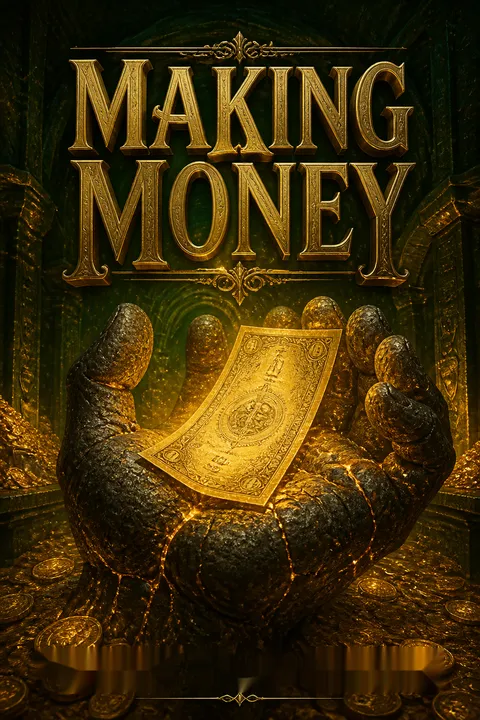
Moist von Lipwig has turned Ankh-Morpork’s failing Post Office into a reliable service, and finds that success has left him hungry for risk. One night he climbs the building for excitement, slips, and talks his way past the coachmen who catch him. The next morning, Lord Vetinari summons him and offers a new challenge: become Master of the Royal Mint and take charge of the Royal Bank.
The bank is failing, its gold-bound customs keep money scarce, and the city needs financing for major public works. Moist resists, knowing he has no banking experience, but Vetinari makes the choice plain: a safe, dull career or a job that may get him killed. Moist goes to inspect the bank.
Moist’s restlessness is not simply impatience with routine. He has learned to experience danger as proof that he is still choosing his life, while respectable work threatens to make his second chance feel like a sentence. Vetinari recognizes this and recruits him by turning the offer into a trap Moist can enter voluntarily. The irony is central: a former criminal is appointed to repair institutions precisely because he understands how people respond to risk, appearance, and appetite. The bank’s crisis begins as an economic problem, but the story frames it first as a problem of human motivation.
Gold Behind the Counter
Chief cashier Mavolio Bent shows Moist a vault of gold he considers the only trustworthy basis for money, then leads him through a Mint where workers make some coins at a loss and families complete others at home. Moist also sees the Glooper, Hubert Turvy’s glass-and-water model of the city’s economy, which traces how panic can drain banks and destroy jobs.
At the center of this old system sits Topsy Lavish, the bank’s elderly chairwoman. She recognizes Moist as a practiced fraud, yet respects his ability to make people believe in an enterprise. Topsy explains that her bank has lost public confidence through bad lending and repeated crashes. She wants Moist to restore its energy, not merely preserve its rituals.
The tour pits two kinds of credibility against one another. Bent trusts what can be counted and stored; Moist notices that money only matters because people can exchange it for food, labor, and services. Topsy understands that an institution can be legally sound yet socially dead, and sees in Moist an ability to make people participate. The Glooper complicates both men’s confidence by rendering economic interdependence visible, though its elaborate precision also invites false certainty. The bank’s machinery reflects its governing beliefs: gold promises permanence, while the city’s living activity is what actually produces wealth.
A Dog Inherits the Bank
Topsy dies the night after meeting Moist, leaving her shares to Mr Fusspot, her beloved, ill-tempered little dog. Because the dog already owns one share from Topsy’s late husband, he becomes the bank’s controlling shareholder and chairman, with Moist required to act for him and live in the bank. Topsy’s will also threatens Moist with the Assassins’ Guild if Fusspot dies unnaturally.
Her stepson Cosmo Lavish immediately offers money for the dog, then warns that the family intends to reclaim the bank. Moist refuses to sell. Black arrows from the Assassins’ Guild arrive as reminders that the threat is real, and Cosmo’s attempt to buy Fusspot becomes the first open move in a fight over control.
Topsy’s will turns affection into corporate power. Fusspot is not a cute accessory to the plot but a legal person whose vulnerability rearranges the bank’s ownership and forces Moist into responsibility. The arrangement also reveals Topsy’s strategic intelligence: she understands that her family will pursue wealth by any available route, so she places the institution behind a guardian who can resist them. Moist’s obligation is half absurd, half serious. Caring for a dog becomes the practical test of whether he can accept a role whose consequences extend beyond his own appetite for danger.
Cosmo Borrows a Tyrant
Cosmo Lavish is determined to understand and imitate Lord Vetinari, whom he regards as the model of power. His secretary, Heretofore, obtains pieces of Vetinari’s appearance, including old boots and a skullcap, and arranges for a jeweler to make a convincing replica of the Patrician’s black signet ring. Cosmo’s fixation turns lethal: the jeweler is murdered, and Cosmo wears the ring despite its painful, unnatural heat.
He believes that copying Vetinari’s possessions will let him absorb the man’s authority. Meanwhile, he begins cultivating the bank’s chief cashier, Bent, hoping to use Bent’s loyalty to remove Moist. Cosmo’s imitation is not harmless vanity; it becomes a weapon aimed at both the bank and the city’s ruler.
Cosmo confuses signs of authority with authority itself. The boots, cap, and ring are not tools he understands but objects he hopes will transfer another man’s identity to him. His fixation is therefore both political and psychological: he cannot tolerate being merely Cosmo when he can imagine himself as the person who controls the city. Heretofore’s complicity shows how power attracts people through proximity as much as conviction. Each stolen object promises Cosmo a shortcut around self-knowledge, while the violence used to obtain them exposes the fragility beneath his cultivated confidence.
A Dollar on Paper
Thinking about a desert island, Moist realizes that gold is useless without a community that agrees to value it. He creates experimental dollar notes, backed by the bank’s promise rather than bullion, and tests them among the small traders of Tenth Egg Street.
Shopkeepers argue over what a note represents, then accept and spend one when Moist demonstrates that the next merchant will take it too. Their confidence is real but conditional: they still want to believe gold lies somewhere in the bank.
Moist’s first public experiment nevertheless attracts attention. Cosmo’s sister Pucci tries to ambush him in a hired cab, but Moist escapes through its window with Fusspot. The next day, new customers arrive, drawn by the note and the excitement around the bank.
The experiment makes value a social event rather than a property of metal. The traders do not accept the note because they have mastered monetary theory; they accept it after watching another person take it and spend it. Their lingering demand for hidden gold shows how deeply trust depends on familiar guarantees, even when those guarantees are poorly understood. Moist’s method is performative: he creates a public demonstration in which belief can circulate before certainty catches up. His escape from Pucci also preserves his characteristic improvisation, but the bank’s future will require more than clever exits. It will require a confidence he cannot manufacture alone.
Loans, Ink, and Old Crimes
When customers begin depositing money, Moist turns the influx into loans instead of locking it away. He backs small-time food seller Dibbler’s plan for a new barrow and grants waste magnate Harry King a much larger loan after Harry stakes his reputation and property deeds.
The bank’s old cashier, Bent, objects to lending beyond established circles. To produce secure notes, Moist moves printer Teemer & Spools’ presses into the Mint and discovers that the finest engraver is Owlswick Jenkins, awaiting execution for forging stamps.
Moist breaks Jenkins out of prison and asks him to design the banknotes. An Igor gives Jenkins a mental treatment meant to ease his paranoia, but it strips away his artistic skill, forcing Moist to have the treatment reversed before the design can be completed.
Moist’s lending policy treats economic exclusion as a failure of the bank, not evidence that borrowers are unworthy. He judges Dibbler and Harry by their actual businesses and character, while Bent relies on inherited categories of respectability. The rescue of Jenkins extends the same principle to talent: the city is about to destroy a gifted engraver for a crime that can be repurposed into public service. Yet the failed treatment warns against confusing relief from suffering with improvement. Jenkins’s anxieties are entwined with his artistic vision; removing the troubling parts also removes the capacity the bank needs.
Adora Finds the Deep Past
Adora Belle Dearheart returns from a remote dig with a fragment of an ancient golem and news that her team found signs of four more, buried half a mile underground. Their excavation has collapsed, and she has brought the fragment to Unseen University for translation. A dead scholar, Professor Flead, identifies the language as Umnian and suggests the buried golems may be connected to legends of golden beings.
Adora suspects they are still alive and has arranged for them to be brought toward Ankh-Morpork by sea. Her discovery collides with Moist’s financial campaign: dwarf law forbids removing precious metals from the leased land, and the golems may be made of gold. At the same time, the Glooper indicates that the bank’s gold has vanished.
Adora’s archaeological work turns the novel’s debate over value into a literal problem of living beings buried beneath it. The golems are at once cultural inheritance, possible wealth, and persons whose freedom cannot be reduced to ownership. Their ancient language also unsettles the assumption that present institutions control the meaning of the past. The threatened breach of dwarf law shows how moral urgency can collide with contractual obligations, even when the people involved believe their cause is just. The Glooper’s report of missing bullion sharpens the collision: the bank’s abstract crisis is connected to a material secret that has been hidden for decades.
The Empty Gold Vault
Bent disappears after a junior clerk proves one of his calculations wrong, a humiliation Bent experiences as a collapse of his entire identity. Moist searches for him and realizes he may have locked himself inside the gold vault.
With Adora Belle and Gladys, he breaks through the floor above the room and finds Bent unconscious beside the bullion boxes. The rescue exposes the vault’s emptiness: the ten tons of gold are gone, except for a thin coating over lead.
The Watch discovers Moist among the broken beams with lockpicks and a blackjack, while the bank’s missing reserve makes him the obvious suspect. Cosmo compounds the danger by recruiting Cribbins, an old criminal who recognizes Moist’s former identity as Albert Spangler and can threaten to expose him.
Bent’s breakdown and the vanished bullion expose the cost of treating error as moral failure. He has built his self-worth on perfect calculation, so a correction from a junior employee feels less like new information than the destruction of his place in the world. Moist responds with practical care, but his rescue also places him beside the strongest possible evidence against himself. The missing gold turns an institutional secret into a personal accusation. Cribbins’s recognition then links Moist’s present authority to the criminal past he believes he has successfully buried, making the question of trust inseparable from the question of who he has become.
Four Thousand Marching
The golems reach Ankh-Morpork in vast numbers, and their arrival jolts the city into panic. Translation of the Umnian text reveals that the force is not four golden golems but four thousand, including horse-shaped ones.
Their single purpose is to guard the city, yet their presence looks like an army poised for conquest. Moist recognizes that the golems will respond to a command delivered in the right language by someone they recognize as an Umnian authority.
He orders them to march beyond the walls and bury themselves in a remote site rather than let the city turn them into weapons or laborers. The formation obeys, leaving one sentinel kneeling in the square. Ankh-Morpork is spared immediate violence, but its neighbors see a threatening force at its border.
The golems’ arrival converts a private archaeological discovery into a geopolitical crisis. Their capacity is immense, but their purpose is narrow; the danger comes from the human institutions eager to reinterpret protection as military advantage. Moist’s command does not defeat the golems. It redirects them by recognizing the structure of their purpose and the cultural authority they obey. That solution is morally and politically provisional, since moving an army beyond the walls does not make it harmless. The episode tests whether the city can resist the habitual belief that every useful power must be owned, employed, or conquered.
The Bank’s Missing Past
At a public inquiry into the missing gold, Moist admits that he once lived as Albert Spangler, a confidence trickster, rather than let Cosmo control the revelation.
As the hearing turns against him, Fusspot’s wind-up toy skitters through the hall, and a costumed clown appears: Bent, wearing the identity he was forced to suppress as a child. Miss Drapes brings ledgers from Bent’s room that show the Lavish family sold the gold years earlier and concealed the truth in the accounts.
Cosmo, increasingly feverish from wearing Vetinari’s stolen stygium ring, insists that he is becoming the Patrician. Pucci blurts out that her family took the gold, confirming the evidence. Moist removes the ring and gets Cosmo into daylight before its heat kills him.
The inquiry makes public truth depend on forms that once concealed it: Bent’s ledgers expose how accounting can be used to bury theft as efficiently as it records legitimate exchange. Bent’s clowning is not a sudden comic disguise but the return of a self suppressed by shame and family pressure. Moist’s confession reverses Cosmo’s intended blackmail by refusing to let secrecy set the terms of the hearing. Cosmo, meanwhile, mistakes the imitation of power for its possession and is physically consumed by the object he treats as proof. The scene exposes fraud as both financial practice and a failure to recognize reality.
A Bargain with Vetinari
After the inquiry, Vetinari takes Moist aside and demands the secret that let him command the golems. Moist explains that they obey the correct Umnian command when spoken by someone wearing the golden suit, which they mistake for the authority of an ancient priest.
In return for the knowledge, Vetinari promises the golem horses to the Post Office, places the other golems under the Golem Trust, and proposes using some to improve the clacks network. Moist also argues that golems can support a currency more honestly than buried bullion.
The secret is sent anonymously to other cities, making it harder for any ruler to claim the force for conquest. Later, Cribbins corners Moist and Adora Belle, but his badly made dentures spring apart before he can hurt them.
Moist’s discovery that the golden suit functions as authority is a comic mechanism with serious political consequences. The golems do not obey personal charisma in the modern sense; they obey a visible sign that fits an ancient social order. Vetinari’s bargain attempts to convert overwhelming force into infrastructure and custodianship, while the spread of the secret prevents a single city from monopolizing it. Moist remains a negotiator rather than a pure reformer: he accepts compromises and protects the city by shaping incentives. Cribbins’s defeat by his own dentures offers a final reversal of blackmail, where the old criminal’s unreliable tools undo his attempt to control another man’s past.
Paper Money Takes Root
Moist reopens the bank with printed notes designed by Jenkins and produced by Teemer & Spools. Bent returns with Miss Drapes, acknowledges how his devotion to gold and flawless arithmetic distorted his judgment, and accepts the work of rebuilding the bank.
Their engagement gives him a life beyond the counting house. The new currency enters circulation while the bank’s staff and customers test whether promises can hold value without a vault of metal behind them.
Then Hubert and Igor use the Glooper to restore the missing bullion to the vault, and gold pours down in a glittering flood, just as the paper system is beginning to stand on its own. Moist and Adora Belle leave the crisis together, still drawn to a life in which security never entirely extinguishes risk.
The resolution refuses a neat victory for either side of the argument. Moist’s notes establish that trust and productive civic life can support money, yet the sudden return of bullion means the old material guarantee has not disappeared. Bent’s return matters as much as the gold: the institution is repaired by allowing its most exacting worker to admit error and imagine a different life. His engagement with Miss Drapes makes emotional change visible rather than merely theoretical. The ending’s excess, gold flooding the vault just as paper circulates, keeps the economic question open while suggesting that confidence grows through shared practice, not a single perfect foundation.
Epilogue
Cosmo wakes in a hospital ward reserved for men who believe themselves to be Lord Vetinari. He accepts the guards and surroundings as evidence that he is the real Patrician, and even wins the ward’s eyebrow-raising contest.
Meanwhile, the Pink PussyCat Club remains packed, except for one front-row seat that no patron can occupy for long. The club’s owners decide the strange seat is worth keeping, especially now that paper money can be tucked into a dancer’s garter.
Cosmo’s ending is a precise inversion of the ambition that drove him. He wanted to become Vetinari by collecting the right objects and gestures; now he lives among other men who mistake imitation for identity, unable to recognize that they are copies too. The hospital accommodates his delusion rather than correcting it, showing how institutions can manage a false belief without resolving its cause. The club’s impossible seat offers a lighter echo of the novel’s economic argument: value can attach to a thing because people agree to treat it as valuable, even when its usefulness is difficult to explain.
Analysis
Making Money treats currency as a shared civic agreement rather than a substance hidden in a vault. Moist’s argument is not that promises are automatically trustworthy, but that a city’s people, skills, laws, businesses, and productive habits create the value that money represents. The traders’ first reaction to his paper notes captures the difficulty: they want to believe in the promise, but still want gold somewhere behind it. Moist earns confidence not by offering a perfect theory, but by making the note work in public, one exchange at a time.
The bank’s other crisis concerns who gets to count as a credible participant. Bent trusts exact numbers but cannot tolerate the possibility that he may be wrong. The Lavishes possess inherited wealth and influence, yet treat both as permission to conceal theft. Harry King and Dibbler, by contrast, are excluded by respectable finance despite their real businesses. Moist’s lending decisions challenge a system that mistakes social status for reliability. His criminal past helps him recognize how easily official respectability can disguise a con.
The golems extend this argument beyond money. They are useful, powerful, and often treated as property, but their own history makes self-ownership the central question. Adora Belle’s work insists that rescuing them is not the same as deciding their future for them. The ancient army also reveals how quickly a useful resource becomes a military temptation. Vetinari and Moist try to place its power under civic restraint, though neither can guarantee that institutions will remain wise.
Moist’s transformation is therefore not a conversion from dishonesty to goodness. He keeps his improvisational instincts, his appetite for risk, and his talent for performance. What changes is the scale of his responsibility. He learns that trust is not a trick that can be completed once. It is a relationship sustained by transparent conduct, reliable institutions, and people who have a stake in the outcome. The book’s comedy keeps puncturing solemn claims, but its central demand is serious: a society must decide whose promises count, and then make those promises worth keeping.
Review Summary
Making Money receives generally positive reviews, with readers praising Pratchett's humor, clever satire, and exploration of economic themes. Many enjoy the return of Moist von Lipwig and the Ankh-Morpork setting. Some find it less engaging than its predecessor, Going Postal, citing predictable plot elements and weaker villains. However, most agree it's still an entertaining read with Pratchett's trademark wit and social commentary. Fans appreciate the continued development of familiar characters and Pratchett's ability to make complex topics like banking and economics accessible and amusing.
Characters
Moist von Lipwig
The charming reformerMoist is a gifted confidence trickster who has been forced into respectable civic work and is discovering that competence can feel like confinement. He reads people quickly, improvises under pressure, and instinctively understands how presentation shapes belief. His criminal past gives him sympathy for outsiders and a sharp eye for institutional hypocrisy, but his appetite for danger can blur the line between courage and self-sabotage. He is engaged to Adora Belle Dearheart and often uses humor to control a room before it can control him. Beneath the performance is a man trying to decide whether reform means surrendering his old self or putting its talents to a better use.
Adora Belle Dearheart
The fearless golem advocateAdora Belle, often called Spike by Moist, works for the Golem Trust, finding and freeing golems. She is direct, composed, and difficult to distract from work she considers morally urgent. Her smoking and sharp manner are not mere decoration; they help her keep control in rooms where powerful people expect deference. She loves Moist without mistaking him for a safer or simpler man than he is. Her commitment to golems comes from a practical understanding of exploitation and self-ownership, and she is willing to risk comfort, reputation, and legal approval when their freedom is at stake.
Havelock Vetinari
The city’s patient strategistAnkh-Morpork’s Patrician rules through attention, timing, and carefully designed choices rather than constant force. Vetinari sees people as systems of motives and knows how to make them act from their own desires. He gives Moist dangerous responsibilities because he believes the former swindler can succeed where conventional bankers have failed. His courtesy is precise, his threats rarely need emphasis, and his apparent amusement can conceal a serious political calculation. Vetinari’s deepest loyalty is to the functioning city, not to any single guild or family, and he treats compromise as an instrument rather than a surrender of control.
Mavolio Bent
The exacting chief cashierBent has spent his life mastering the Royal Bank’s numbers, believing that precision and gold are the strongest defenses against chaos. His discipline makes him exceptionally capable, but his rigid standards leave little room for error, pleasure, or uncertainty. He mistrusts Moist’s charm because it seems to replace measurable proof with performance. Bent’s guardedness has roots in a childhood shaped by shame and exclusion, though he rarely speaks about himself. He is not simply a miserly traditionalist: he has built real skill, supported capable clerks, and wants the bank to deserve the trust it claims.
Cosmo Lavish
The heir who imitates powerCosmo is a wealthy Lavish heir whose ambition is inseparable from his fascination with Vetinari. He studies the Patrician’s clothes, habits, and possessions, hoping that imitation can supply the authority he lacks. In business he is shrewd and ruthless, but his obsession makes him unusually credulous whenever someone promises access to Vetinari’s life. Cosmo treats people as pieces in a private performance and expects money or intimidation to settle resistance. His fixation reveals a man who would rather become someone else than examine what his own power is built on.
Topsy Lavish
The sharp-eyed chairwomanTopsy is an elderly bank chairwoman whose irreverence conceals a clear view of her family and the institution they control. She recognizes Moist’s criminal intelligence without confusing it with bad character, and she values style, invention, and public confidence alongside financial results. Her affection for Mr Fusspot is genuine, but she is not sentimental about the Lavishes’ appetite for power. Topsy’s humor and bluntness let her test people quickly, while her command of the bank’s ownership gives her a practical means of shaping its future.
Pucci Lavish
The family’s blunt heiressPucci is Cosmo’s sister, rich, proud, and convinced that her status should make others listen. She is more impulsive than strategic, yet her confidence makes her willing to intervene in public and take risks her family prefers to hide. Pucci understands the Lavish instinct for entitlement but has little patience for subtlety or self-questioning. Her social ambition is matched by a talent for dramatic entrances, though she often mistakes attention for influence.
Mr Fusspot
The bank’s small chairmanTopsy’s tiny, many-breed dog is affectionate, food-focused, and much more consequential than his size suggests. He becomes the legal center of the bank’s ownership and gives Moist a responsibility he cannot reduce to paperwork. Fusspot judges people through instinct rather than status, growls at those he dislikes, and accepts friendship with uncomplicated enthusiasm. His toys and habits repeatedly disrupt solemn proceedings, reminding the human characters that institutions can depend on creatures who have no interest in their theories.
Gladys
The searching clay womanGladys is a tall golem who works at the Post Office and wears a blue dress after human colleagues classify her as female. She takes that identity seriously, studies human etiquette, and seeks guidance from the books she is given. Her earnestness makes her both funny and vulnerable, especially when she applies social rules literally. Gladys is learning that freedom involves deciding who she is rather than simply following orders, a process complicated by the humans who believe they already know what she needs.
Hubert Turvy
The economic model-makerHubert is an anxious, enthusiastic economist who has built the Glooper, a vast glass model that tracks money through Ankh-Morpork. He thinks in mechanisms and correlations, and becomes most confident when explaining his work. His isolation in the bank’s cellar has left him awkward with strangers, but his ideas can reveal consequences that more powerful people overlook. Hubert’s belief in the model is both a strength and a danger, since its apparent precision can make its operators feel they understand more than they do.
Igor
The resourceful technicianHubert’s Igor is an inventive, capable assistant whose medical and technical skills are matched by a practical sense of humor. He works with lightning, glass, and machinery, and treats unusual procedures as ordinary professional practice. His clan’s reputation often causes others to overlook his intelligence. Igor tends to follow orders, but he also understands that a patient’s wishes and a machine’s purpose can become ethically complicated when a treatment changes the person it is meant to help.
Owlswick Jenkins
The meticulous engraverJenkins is a gifted stamp engraver whose intricate work exceeds the skill of the official printers. He is distracted, anxious, and absorbed in the small world of his art, which makes ordinary social expectations difficult for him to navigate. His precise eye and need for a model give him a distinctive creative process: once he has something to study, he can reproduce it with extraordinary care. He represents the talent a punitive institution may destroy when it mistakes a useful craft for nothing more than a crime.
Cribbins
The old blackmailerCribbins is a shabby former criminal who recognizes Moist from their shared past. He is manipulative, opportunistic, and skilled at turning private embarrassment into leverage. His false teeth, constant chatter, and sudden religious persona make him an unsettling presence, but his real weapon is his knowledge of how shame can isolate a person. Cribbins expects others to pay for silence and believes his experience entitles him to a share of their success.
Miss Drapes
Bent’s perceptive senior clerkMiss Drapes is a capable senior clerk who understands the bank’s routines and pays close attention to Bent’s behavior. She is respectful of his standards without being blind to the toll they take on him. Her quiet affection for Bent is expressed through loyalty and practical care rather than grand declarations. When the bank’s crisis exposes hidden records, her persistence helps preserve evidence others might overlook.
Sacharissa Cripslock
The sharp newspaper reporterSacharissa is a reporter for the Times who knows how to press Moist without accepting his charm as an answer. She combines skepticism with curiosity and understands that a bank crisis is also a public story about who deserves trust. Her questions expose the gap between Moist’s performance and the actual consequences of his decisions. She is not easily diverted, even when the subject is a dog with a title or a currency that has only just been invented.
Harry King
The waste-trade magnateHarry King has built a large business by collecting and reselling the city’s waste, employing many people whom respectable bankers prefer not to see. His bluntness and physical presence conceal a disciplined sense of responsibility: he pays what he owes and expects his word to count. He understands reputation as a form of security because his business cannot rely on polite approval. Harry sees in Moist a fellow risk-taker and is willing to trust him when established banks refuse to lend.
Mr Spools
The trusted printerMr Spools runs Teemer & Spools, a reputable printing business that has grown through its work for the Post Office. He values craft, quality, and security, and recognizes that paper money requires more than attractive design. His practical knowledge helps Moist turn an improvised financial idea into something reproducible and difficult to forge. Spools is cautious without being hidebound, making him an important bridge between Moist’s vision and the technical work needed to realize it.
Samuel Vimes
The suspicious commanderVimes commands the City Watch and approaches public disorder with a policeman’s suspicion of easy explanations. He does not trust Moist’s elaborate accounts, but he also refuses to let wealthy men dictate his decisions. Vimes’s authority comes from persistence and a deep knowledge of how power behaves when it thinks it is unobserved. He wants the city kept safe, even when the people causing the trouble claim to be acting for its good.
Captain Carrot
The earnest investigatorCaptain Carrot is a Watch officer whose courtesy does not soften his investigative focus. He asks direct questions, records answers carefully, and follows evidence even when the situation grows absurd. His open manner makes people underestimate how difficult he is to mislead. Carrot treats everyone as subject to the same law, an approach that frustrates Moist but offers a necessary counterweight to Vetinari’s political maneuvering.
Nobby Nobbs
The Watch’s wily corporalNobby is a small, quick-witted Watch corporal who notices practical details that more dignified people miss. His observations are often blunt and unexpectedly useful. He has an instinct for the city’s informal rules and knows that official procedure rarely tells the whole story.
Sergeant Angua
The Watch’s sharp sergeantAngua is an observant Watch sergeant who is calm around danger and unimpressed by Moist’s attempts to redirect attention. She works closely with Carrot and has a practical grasp of people and physical evidence. Her presence gives the Watch a disciplined, clear-eyed perspective amid the bank’s confusion.
Ponder Stibbons
The University’s working wizardPonder is an industrious wizard overseeing the University’s investigation of the Cabinet of Curiosity. He is exact, patient, and more interested in understanding how a strange device behaves than in pretending he already knows what it is. His work provides Adora Belle with access to the ancient golem fragment and its language.
Professor Flead
The persistent dead scholarFlead is a long-dead scholar summoned by the University’s post-mortem communications department. He is knowledgeable about ancient languages and history, vain about his expertise, and inclined to treat any conversation with an attractive woman as an opportunity for flirtation. Beneath the theatrical manner is genuine intellectual curiosity, especially when confronted with artifacts from the ancient world.
C. M. O. T. Dibbler
The street-food entrepreneurDibbler is a familiar street trader whose sausages and pies have an enduring appeal despite their uncertain ingredients. He is always looking for a way to expand his business, but prefers the flexibility of a barrow to grand plans that might trap him. Moist’s small loan gives him a practical chance to grow.
Plot Devices
The Banknote
Trust made portableMoist’s paper dollar is a promise that can pass from hand to hand without carrying its value in metal. He first tests it with Tenth Egg Street shopkeepers, where acceptance spreads through observation and exchange. The notes later receive intricate designs and security features from Owlswick Jenkins and Teemer & Spools. Their success depends on the public believing the bank will honor them, making the currency both a practical tool and a public test of confidence. The device challenges the assumption that money must be valuable as an object before it can function as value.
The Glooper
An economy made visibleHubert’s Glooper uses water, glass tubes, valves, and reservoirs to model the circulation of money through Ankh-Morpork. It shows how lost confidence can move savings out of banks, reduce lending, and set off business failures and unemployment. Its apparent precision gives the model great authority, but its operators must still decide what the measurements mean. The Glooper also becomes a way to detect that the bank’s gold reserves are missing. It links a grand, intricate machine to the ordinary consequences of financial decisions.
Fusspot’s Share
A dog holds the powerTopsy’s will gives her controlling bank shares to Mr Fusspot, who already owns one share from her late husband. The bank’s own rules make him chairman, while Moist must act on his behalf and care for him. This legal arrangement blocks the Lavish heirs from immediately reclaiming control and ties Moist’s fortunes to a small, vulnerable animal. Fusspot’s title is comic, but the consequences are serious: a dog’s ownership determines who may direct the bank, and his safety becomes a condition of Moist’s continued role.
The Umnian Commands
Ancient authority redirects forceThe buried golems follow a purpose laid down in an ancient language and recognize authority through specific signs. Moist discovers how to issue commands that make them leave the city and bury themselves rather than serve as an army. Their response depends on the right speaker, words, and visible authority, not on a modern chain of command. The mechanism turns language and costume into political power, while the golems’ original purpose creates a limit on what their immense strength can be made to do.
The Stygium Ring
Imitation becomes dangerousCosmo’s stolen signet ring is made of stygium, a rare material that becomes dangerously hot in direct sunlight. Because Cosmo believes it carries Vetinari’s authority, he wears it despite its pain and uses it to support his fantasy of becoming the Patrician. The ring’s physical danger makes his delusion visible to others, while the real signet design and its theft connect his imitation to a trail of crimes. It is a symbol of power that cannot safely be borrowed.
FAQ
Synopsis & Basic Details
What is Making Money about?
- A Conman's Second Chance: Moist von Lipwig, a reformed con artist, is thrust into the world of banking and finance by Lord Vetinari, becoming the Master of the Royal Mint and tasked with revolutionizing the city's economy.
- Challenging Traditional Systems: The story explores Moist's attempts to introduce paper money backed by golems, challenging the established reliance on gold and traditional banking practices.
- Navigating Political Intrigue: Moist must navigate the complex world of Ankh-Morpork politics, dealing with the scheming Lavish family and the machinations of Lord Vetinari, all while trying to make the bank work.
Why should I read Making Money?
- Witty Social Commentary: Pratchett's signature humor and satire are on full display, offering a sharp critique of economic systems, power structures, and human nature.
- Intriguing Characters: The novel features a cast of memorable characters, from the resourceful Moist von Lipwig to the enigmatic Lord Vetinari, each with their own unique quirks and motivations.
- Thought-Provoking Themes: Making Money explores complex themes of trust, value, and the nature of progress, prompting readers to question conventional wisdom and consider alternative perspectives.
What is the background of Making Money?
- Ankh-Morpork Setting: The novel is set in the vibrant and chaotic city of Ankh-Morpork, a recurring location in the Discworld series, known for its diverse population and blend of magic and technology.
- Economic Instability: The story is set against a backdrop of economic instability, with failing banks and a lack of public trust in the financial system, creating a need for innovative solutions.
- Technological and Magical Elements: The novel blends elements of technology, such as the Glooper, with magical elements, such as golems, creating a unique and fantastical world.
What are the most memorable quotes in Making Money?
- "What does gold know of true worth?": This quote, spoken by Lord Vetinari, encapsulates the novel's central theme of questioning traditional notions of value and worth, highlighting the importance of human ingenuity and effort.
- "The money should be on the inside!": This line, delivered by Vetinari, reveals his unconventional approach to banking and his belief in Moist's ability to think outside the box, emphasizing the need for a new perspective.
- "It costs more than a penny to make a penny.": This quote, from Mr. Shady, highlights the absurdity of the existing financial system and the inherent inefficiencies in the production of currency, underscoring the need for change.
What writing style, narrative choices, and literary techniques does Terry Pratchett use?
- Satirical and Humorous Tone: Pratchett employs a witty and satirical tone, using humor to critique social and political institutions, making complex themes accessible and engaging.
- Third-Person Omniscient Narration: The novel is narrated from a third-person omniscient perspective, allowing Pratchett to delve into the thoughts and motivations of multiple characters, providing a comprehensive view of the story.
- Foreshadowing and Irony: Pratchett uses subtle foreshadowing and dramatic irony to create suspense and engage the reader, often hinting at future events and revealing hidden truths through character interactions and dialogue.
Hidden Details & Subtle Connections
What are some minor details that add significant meaning?
- The Bad Penny: The treadmill in the Mint, known as the Bad Penny, symbolizes the repetitive and often futile nature of traditional economic systems, highlighting the need for innovation.
- The Golem's Dress: Gladys's blue dress, initially a matter of etiquette, becomes a symbol of her evolving identity and her acceptance into the sisterhood of the Post Office counter girls, showcasing the fluidity of identity.
- The Black Glove: Cosmo Lavish's black glove, an affectation of the Assassins' Guild, reveals his desire to emulate Vetinari and his misguided belief in the power of appearances, highlighting his superficial understanding of power.
What are some subtle foreshadowing and callbacks?
- Moist's Night Climbing: Moist's nighttime climb up the Post Office foreshadows his later daring actions and his restless nature, hinting at his inability to settle into a mundane life.
- The "Angels" Conversation: The conversation between Moist and Vetinari about angels foreshadows Moist's second chance at life and his new role in the city, highlighting the theme of redemption and second chances.
- The Mention of Hemlines: Hubert's comment about hemlines rising in times of national crisis foreshadows the economic turmoil that will grip the city, connecting seemingly unrelated details to broader themes.
What are some unexpected character connections?
- Mr. Bent and the Lavish Family: Mr. Bent's long history with the Lavish family, revealed through his past as a clown, highlights the hidden connections and complex relationships within the city's elite.
- Moist and the Golems: Moist's ability to command the golems, stemming from his golden suit and his understanding of their language, reveals a surprising connection between him and the ancient beings, highlighting his unique position in the city.
- Topsy Lavish and Moist: Topsy Lavish's recognition of Moist as a fellow rogue and her decision to leave the bank to him, despite his past, reveals a deeper understanding of his character and a shared appreciation for unconventional thinking.
Who are the most significant supporting characters?
- Gladys: The golem, initially a tool, develops a personality and a sense of self, becoming a symbol of the evolving nature of golems and their place in society.
- Mr. Bent: The chief cashier, with his hidden past and rigid adherence to tradition, represents the old guard and the challenges of adapting to change, highlighting the conflict between tradition and innovation.
- Hubert: The eccentric inventor of the Glooper, represents the potential for both innovation and chaos, highlighting the unpredictable nature of progress and the importance of human ingenuity.
Psychological, Emotional, & Relational Analysis
What are some unspoken motivations of the characters?
- Vetinari's Control: Vetinari's unspoken motivation is to maintain control over the city, using Moist as a tool to achieve his goals while subtly guiding events to his advantage.
- Moist's Restlessness: Moist's unspoken motivation is to find a sense of purpose and excitement, using his skills and ingenuity to navigate the challenges of his new role and to avoid the boredom of a mundane life.
- Cosmo's Envy: Cosmo's unspoken motivation is to emulate Vetinari and gain power, driven by his envy of the Patrician and his desire to be seen as a worthy successor, highlighting his insecurity and ambition.
What psychological complexities do the characters exhibit?
- Moist's Internal Conflict: Moist struggles with his past as a conman and his desire to be a respectable citizen, highlighting the internal conflict between his old self and his new role.
- Mr. Bent's Obsession: Mr. Bent's obsession with numbers and his rigid adherence to tradition reveal his deep-seated fear of chaos and his need for control, highlighting his psychological fragility.
- Cosmo's Delusions: Cosmo's delusions of grandeur and his obsession with emulating Vetinari reveal his deep-seated insecurities and his inability to see himself as he truly is, highlighting his psychological instability.
What are the major emotional turning points?
- Moist's Acceptance of the Bank: Moist's decision to embrace his role as Master of the Royal Mint marks a turning point in his emotional journey, as he begins to find purpose and meaning in his new position.
- Mr. Bent's Breakdown: Mr. Bent's emotional breakdown after making a mistake highlights the fragility of his carefully constructed world and his deep-seated fear of failure, marking a turning point in his character arc.
- Adora Belle's Concern for Moist: Adora Belle's concern for Moist's safety and her willingness to help him, despite her own reservations, reveals the depth of her feelings for him and the strength of their relationship.
How do relationship dynamics evolve?
- Moist and Vetinari: The relationship between Moist and Vetinari evolves from one of manipulation and control to one of mutual respect and understanding, highlighting the complex power dynamics between them.
- Moist and Adora Belle: The relationship between Moist and Adora Belle deepens as they navigate the challenges of their respective roles, revealing their mutual respect and affection, despite their differences.
- Moist and Mr. Bent: The relationship between Moist and Mr. Bent evolves from one of mutual distrust to one of grudging respect, highlighting the potential for understanding and collaboration between different perspectives.
Interpretation & Debate
Which parts of the story remain ambiguous or open-ended?
- The Nature of the Golems: The true nature and purpose of the ancient golems remain somewhat ambiguous, leaving the reader to ponder their origins and their role in the city's future.
- Vetinari's True Motives: Vetinari's true motives and long-term plans remain somewhat opaque, leaving the reader to speculate about his ultimate goals and his true intentions for the city.
- The Future of the Bank: The long-term implications of Moist's revolutionary banking system and the future of the Royal Bank remain open-ended, leaving the reader to consider the potential for both progress and unforeseen consequences.
What are some debatable, controversial scenes or moments in Making Money?
- Moist's Manipulation of the Public: Moist's use of his charisma and showmanship to win over the public can be seen as both innovative and manipulative, raising questions about the ethics of his methods.
- Vetinari's Control Over Moist: Vetinari's subtle manipulation of Moist and his use of him as a pawn in his own schemes can be seen as both strategic and exploitative, raising questions about the nature of power and control.
- The Golems' Autonomy: The question of whether the golems are truly free or simply tools of the city raises ethical questions about the nature of sentience and the responsibilities of those who wield power.
Making Money Ending Explained: How It Ends & What It Means
- Moist's Success: Moist successfully launches his paper money system, backed by the city's resources and the potential of the golems, marking a significant shift in the city's financial landscape.
- The Golems' Integration: The golems are integrated into the city's infrastructure, becoming a symbol of progress and innovation, while also raising questions about their autonomy and their role in society.
- A New Beginning: The ending suggests a new beginning for Ankh-Morpork, with a more dynamic and adaptable financial system, but also hints at the potential for future challenges and the ongoing need for innovation and change.
Discworld - Industrial Revolution Series
About the Author
Other books by Terry Pratchett

Download PDF
Download EPUB
.epub digital book format is ideal for reading ebooks on phones, tablets, and e-readers.








