

Plot Summary
A Crown in the Storm
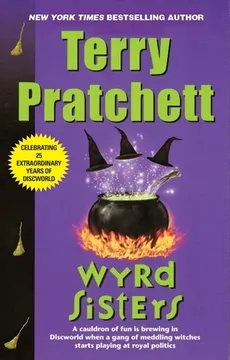
As a storm batters Lancre, King Verence is killed at his castle by Duke Felmet, who intends to take the throne. Verence wakes as a ghost and learns he is bound to the place where he died, unable to follow the fleeing coach that carries his young son away. On the moor, the coachman reaches Granny Weatherwax, Nanny Ogg, and their inexperienced fellow witch, Magrat Garlick, before an arrow kills him.
A soldier demands the child and crown. Granny stands her ground; another soldier kills the captain rather than let him murder her, then escapes. The surviving pursuer vanishes into the storm. The witches find the crown in the coach and understand that the sleeping child has brought the kingdom’s succession into their hands.
The opening makes political inheritance physical: a child is carried through weather and violence, while the crown arrives as an object that seems to exert its own pressure. The witches do not set out to challenge the new ruler; they are forced into responsibility by a dying courier and a soldier’s demand. Verence’s ghostly helplessness introduces a second form of powerlessness: the king can see what has happened, but cannot yet change it. The contrast gives the plot its engine, pairing a living heir in motion with a dead father trapped in place.
The Heir Among Actors
Granny decides the boy cannot remain in Lancre, so the witches entrust him to Olwyn Vitoller, a travelling actor-manager, and his wife. The couple, grieving the loss of their own child, agree to raise him as Tomjon; Granny leaves them money and warns them to keep his origins secret. Magrat buries the crown among theatrical props, trusting that nobody will search a troupe’s ordinary clutter for a royal claim.
When Granny briefly tries the crown on, she experiences the burden of kingship through generations of conflict and suffering. The witches also attempt traditional gifts for their godchild: Magrat wishes him easy friendships, Nanny Ogg grants him a flawless memory, and Granny hopes he will become whoever he believes himself to be.
The child’s safety depends on a deliberate change of setting. The witches choose actors because performance can disguise an heir as an ordinary boy, while the crown is hidden among objects that imitate authority without possessing it. Granny’s brief encounter with the crown complicates her instinctive distance from politics: she feels the accumulated cost of rule, not its glamour. The three gifts reveal the witches’ differing ethics. Magrat offers connection, Nanny offers remembrance, and Granny offers self-determination. Their care is genuine, but it does not make them agree on what a life should be.
The Kingdom Wakes
Duke Felmet takes the throne beside his ambitious wife, Lady Felmet, and tries to impose taxes and authority on a kingdom that has little patience for either. He orders pressure on the witches, but a nervous sergeant returns from Granny’s cottage with nothing more alarming than tea and a currant bun.
The witches’ local standing makes direct persecution difficult, so the duke and duchess cultivate suspicion instead. On Hogswatchnight, however, the kingdom’s usual magical portents abruptly cease.
Granny senses a vast, distressed presence, and a gathering of animals surrounds her cottage. When the witches summon a demon, it explains that the land itself has awakened and wants a ruler who cares for it. The threat is not merely human discontent: Lancre has become an actor in its own crisis.
Felmet’s difficulty is not that he lacks force, but that force fails to produce recognition. His taxes and threats meet the quiet evasions of people who do not grant him the importance he expects. The kingdom’s awakening makes that mismatch literal: authority is a relationship between a ruler and a place, not simply possession of a throne. The animals’ gathering also resists an easy moral allegory. They do not arrive because Verence was kind to them; they respond to the land’s larger distress. The witches must interpret a political crisis through forms of life that have no interest in human legal arguments.
A Witch in Chains
Granny refuses to use magic to dictate who rules, even as reports of Felmet’s cruelty accumulate. Magrat, who has begun to care for the Fool at the castle, sees the cost of that restraint differently.
When Nanny visits the castle and is arrested on suspicion of witchcraft, Magrat goes after her despite being cold, frightened, and unsure of her own skill. The Fool tries to help, and Magrat fends off two guards with her bread knife before reaching the locked dungeon.
She calls life back into the ancient wooden door until it sprouts roots and branches, tearing the entrance apart. Granny arrives as the wood gives way. Nanny is freed, but Felmet refuses to abdicate, arguing that magic cannot legitimately choose a king without making him a puppet.
Magrat’s rescue marks a shift from borrowed identity to practiced agency. Her jewellery and spellbooks once seemed to her the visible proof of witchcraft; the prison door teaches her that attention, nerve, and an understanding of living material matter more. Granny’s arrival does not erase Magrat’s achievement, even though Granny evaluates it by her own standards. Felmet, meanwhile, identifies a real ethical danger: replacing him through supernatural coercion would make the next ruler dependent on the witches. The scene refuses the convenient solution of magical force and makes the problem of legitimate power harder, not easier.
Fifteen Years in Flight
Verence’s ghost reaches the witches through a piece of castle stone and pleads for his son’s return. Granny initially refuses to interfere, but Felmet’s rule keeps eroding the kingdom’s respect for its old customs, and the witches themselves are increasingly blamed.
After a cart nearly runs them down, Granny’s anger breaks through her caution. She devises a spell to move all of Lancre fifteen years forward, giving Tomjon time to reach adulthood without leaving Felmet in power for those years.
The witches fly across the kingdom, transferring their strength between broomsticks; Nanny’s family helps delay the cockerels’ dawn chorus until Granny completes the spell at Lancre Bridge. The spell does not make the years pass in the ordinary way. The whole kingdom slips around time and emerges fifteen years older.
Granny’s decision is neither a clean abandonment of her principles nor a straightforward surrender to destiny. She changes the problem’s scale: rather than enthroning a child or magically removing Felmet, she gives the heir time to become capable of acting. The spell’s danger makes the choice costly, especially because Granny’s authority rests on self-command. Nanny’s family and Magrat’s assistance turn the witches’ supposed isolation into practical cooperation. Yet the solution carries an irony: to avoid controlling the kingdom politically, Granny uses immense magic to alter its calendar. Restraint here is not purity; it is an imperfect limit repeatedly tested.
The Fool Finds His Playwright
After the time jump, Tomjon has grown into a gifted actor, and Felmet sends the Fool to Ankh-Morpork to find a playwright who can make the duke’s rule appear legitimate. There, Tomjon and the dwarf dramatist Hwel encounter the Fool during a tavern brawl. Tomjon recites a speech from one of Hwel’s plays, and its force stops the fighting long enough for the Fool to be rescued from an assault.
The Fool recognizes that the troupe can supply the performance Felmet wants and persuades them to travel to Lancre. Hwel hesitates when he understands the play will reshape the story of Verence’s murder, but the theatre’s debts and the promised payment press him toward the commission. Tomjon joins the journey, unaware of his concealed royal history.
Tomjon’s gift is not merely memorization or vocal skill. His performance reorganizes a room, turning people who were attacking one another into listeners. The event demonstrates the political potency the Fool has already sensed in language: a speech can move bodies without issuing orders. Yet the same power can serve competing purposes. Felmet wants a performance to manufacture legitimacy, while Hwel and Tomjon understand theatre as a craft with its own emotional truth. Their agreement to travel is shaped by money and obligation, not by a clear grasp of the consequences.
The Road Back to Lancre
The troupe’s journey home is rougher than its performances. When bandits threaten the players, Tomjon’s grand speech fails to change their minds, and a milk jug drops from the sky to strike the bandit chief, giving the company time to escape.
The witches have been watching through Nanny’s crystal ball and quietly steer events, though Granny insists that she is not meddling. They also disguise themselves as wood gatherers to guide the lost troupe through Lancre’s roads and forests. Meanwhile, Hwel struggles to write a play that presents Felmet’s preferred account of the king’s death.
The Fool tells Magrat when the performance will take place and makes clear that the duke expects the witches to attend. Magrat passes the warning on, even as her affection for the Fool complicates her loyalty to the coven.
The road episode tests the difference between theatrical effect and actual danger. Tomjon’s famous rhetoric cannot persuade armed robbers, while an absurdly literal intervention saves the troupe. That contrast keeps the book from treating eloquence as an all-purpose cure. The witches’ guidance is similarly ambiguous: they claim to preserve the heir’s independence while arranging his route and shielding him from danger. Hwel’s script becomes the clearest instrument of manipulation, yet his uncertainty matters. He is not simply a propagandist; he is a working artist whose craft is being purchased by people who want to control collective memory.
The Stage Rewrites History
At the castle, Hwel’s play turns Felmet’s version of events into a polished drama: Verence becomes a villain, the witches become murderous schemers, and the duke’s accession appears justified. The audience responds to the performance as if it were history.
Granny recognizes the danger in the transformation, while Nanny objects to the invented crimes and Magrat rejects the false portrait of witches. Felmet’s guards, meanwhile, mistake three actors playing witches for the real coven and arrest them.
The actual witches enter the production backstage, where Hwel has already ordered them to perform as hags. Rather than leave their public image to the script, Granny decides they will disrupt the play from within. The staged story has become powerful enough that the witches must fight for what people will remember.
The theatre’s threat is not that audiences are foolish, but that shared memory is vulnerable to form. A coherent story can feel more convincing than a messy event, especially when the powerful control the stage and the vocabulary surrounding it. The mistaken arrests make the boundary between representation and reality unstable: actors are punished for playing witches while actual witches are absorbed into the same spectacle. Granny’s response is strategic rather than purist. She does not reject theatre as false; she recognizes that refusing to participate would leave Felmet’s version uncontested.
The Truth Takes the Stage
During the performance, Granny turns the actors’ lines toward the truth of Verence’s murder. The script’s invented account gives way to the actual betrayal, and the duke loses control in front of the assembled people, confessing his part in the killing.
The Fool confirms that he witnessed the murder, breaking the silence he had maintained out of loyalty. Felmet stabs him with a stage dagger, which proves to be a prop and leaves him alive. Granny then identifies Tomjon as the rightful heir.
Lady Felmet tries to seize control, but Granny uses headology to force her to confront herself. The duchess is not repentant; she embraces her cruelty, until Nanny knocks her unconscious with the cauldron. The performance collapses, but the truth it has released cannot be recalled.
The climax makes competing stories collide in public rather than settling the conflict through a private revelation. Felmet’s confession emerges because the theatrical fiction has created a space where the past can be reenacted and recognized, while the Fool’s testimony supplies the human witness the legal order lacked. The duchess’s response prevents a sentimental resolution: self-knowledge does not guarantee remorse. Granny’s headology exposes rather than reforms her, and Nanny ends the confrontation with practical force. The prop dagger briefly makes performance dangerous, but its harmlessness also lets the Fool survive the role that loyalty has trapped him inside.
A King Chooses His Role
Tomjon refuses the crown, explaining that he wants to act rather than rule. Magrat notices how closely he resembles the Fool, whose real name is Verence, and the witches establish that the two men are brothers. Their account of the family history places Verence as the elder heir, allowing him to take the throne as Verence II.
A month later, Magrat feels excluded from court life and cries at a coven meeting; the new king eventually visits her cottage, where exhaustion overtakes his plans to speak with her.
Lady Felmet escapes her cell, but the forest blocks her path and the assembled animals close around her. The duke, meanwhile, falls from the castle battlements and becomes a ghost. The witches accept a king who means to serve Lancre, though they leave their meetings informal and their future open.
The resolution refuses the fantasy that bloodline alone produces a suitable ruler. Tomjon’s refusal is an act of self-definition, not cowardice, and Verence’s acceptance makes kingship a chosen responsibility rather than a prize. The witches’ account of their kinship settles the succession pragmatically, without turning genealogy into a perfectly transparent truth. Magrat’s disappointment shows that political repair does not automatically heal private longing. The final fates of the Felmets also distinguish kinds of consequence: the duchess meets a collective force she cannot intimidate, while the duke enters the ghostly condition he had feared. Lancre is restored imperfectly, through decisions made by fallible people.
Analysis
Wyrd Sisters treats authority as a contest over attention. Felmet has the legal force of a ruler, but Lancre’s inhabitants do not grant him the recognition he expects, and the land itself registers his estrangement. The witches are powerful enough to intervene, yet they understand that magical coercion would reproduce the very problem they oppose: a ruler dependent on someone else’s permission. Granny’s time spell is therefore both a solution and a compromise, preserving the heir’s future while revealing that no exercise of power is politically innocent.
The novel’s sustained interest in theatre deepens this argument. Felmet commissions a play because he knows that public memory can be edited; Hwel’s art gives his preferred account emotional plausibility. But performance is not only propaganda. Tomjon’s acting can quiet a brawl, and the witches can use the stage to make suppressed history visible. The difference lies not in whether a story is performed, but in whether its audience can examine the claims it asks them to accept.
The character arcs turn on roles that have been imposed or chosen. The Fool resents his hereditary costume but remains loyal to its obligations; Tomjon is raised to act and refuses to let royal expectation define his life; Magrat begins by trying to resemble a proper witch and discovers her own practical power. Granny’s restraint is tested until anger becomes action, while Nanny’s apparent frivolity repeatedly proves socially useful. Their disagreements prevent the coven from becoming a simple emblem of female solidarity. They care for one another, but they must negotiate what care permits.
The final succession remains deliberately untidy. Lineage, public consent, personal desire, and competence do not align neatly, so the witches accept a plausible settlement rather than a perfect one. The book’s answer to political uncertainty is not that destiny guarantees justice. It is that people must interpret inherited stories, accept responsibility for their choices, and remain willing to revise the roles they have been given.
Review Summary
People Also Read






Characters
Granny Weatherwax
The Ramtops' hard judgeGranny is a formidable village witch whose authority comes less from spectacle than from reading people accurately and refusing to be hurried. She distrusts decorative magic, theatricality, and political interference, but her restraint is not indifference: she protects the child entrusted to her and keeps watch over Lancre’s changing condition. Her pride makes cooperation difficult, particularly with Nanny Ogg and the younger Magrat, yet she can revise her judgment when events demand it. Granny treats power as something that must be governed, not displayed. Her sharpness can wound, but it also keeps fear from dictating her choices.
Nanny Ogg
The coven's social forceNanny is an experienced witch, mother, and grandmother whose sprawling family gives her practical influence throughout Lancre. She is sociable where Granny is guarded, irreverent where Magrat is earnest, and rarely embarrassed by bodily appetites or public opinion. Her apparent frivolity conceals a strong instinct for when people need comfort, when a plan needs help, and when restraint has become an excuse. Nanny is loyal to her friends and attached to the kingdom’s familiar customs, but she is not bound by Granny’s austere interpretation of witchcraft. Her warmth is a form of competence, not a lack of seriousness.
Magrat Garlick
The earnest apprenticeMagrat is the youngest witch in the coven and approaches the Craft through books, ritual objects, and an ideal of harmony that the older witches find quaint. She wants to be taken seriously, to build a genuine coven, and to act kindly without being dismissed as foolish. Her insecurity makes her susceptible to romantic fantasy and to other people’s judgments, but it does not make her passive. When a crisis arrives, she can act decisively and discover forms of magic her training did not prepare her for. Magrat’s growth is a movement from imitating what witchcraft should look like toward trusting her own judgment.
Tomjon
The actor raised as heirTomjon grows up among travelling players, learning to inhabit roles before he understands the political history surrounding his birth. He has a remarkable memory and a voice that can command attention, but his ambition is theatrical rather than royal. His ease onstage comes from a capacity to imagine another person’s feelings and make them legible to an audience. That talent gives him influence, yet it also tempts others to treat him as a useful instrument. Tomjon’s central tension is between the identity assigned by heritage and the life he has made through performance, craft, and chosen family.
The Fool, later Verence
The reluctant court witThe Fool has been trained from childhood to perform a hereditary role he despises, and his obedience is partly habit, partly a desperate belief that keeping his word is the one thing he can control. He is observant about language and power, even when fear makes him seem timid. His loyalty to the court is tested by his growing attachment to Magrat and his awareness of Felmet’s cruelty. Under the costume and capering lies a man who wants to be seen as more than the job imposed on him. He is both a comic presence and a serious witness to how institutions shape identity.
Duke Felmet
The haunted usurperFelmet is a ruler who wants recognition but cannot bear the moral knowledge that accompanies his power. His ambition is sharpened by his wife’s certainty and his own fear of exposure. He tries to govern Lancre through taxes, force, and eventually a manufactured public story, yet the kingdom’s resistance intensifies his paranoia. His mind moves between cold calculation and destabilizing guilt, making him dangerous in both moods. Felmet is not simply a schemer who feels nothing; he is a man who repeatedly tries to escape responsibility by changing the account of what he has done.
Lady Felmet
The throne's iron willLady Felmet is the forceful political partner of the duke, driven by a belief that power belongs to those willing to use it without hesitation. She reads weakness as an invitation and sees cruelty as an effective instrument of rule. Her confidence gives her a clearer strategic focus than her husband’s, but it also narrows her understanding of other people to fear and obedience. She dislikes the witches not merely as magical rivals but as authorities the population respects without needing her permission. Her presence makes the regime more deliberate and more threatening.
King Verence
Lancre's absent fatherVerence is Lancre’s reigning king and the father of an infant whose safety becomes central to the story. He is vigorous, direct, and more comfortable with immediate experience than with reflection. His attachment to the kingdom is personal and rooted in its people, customs, and landscape, even though his own rule is not free of harm. The story’s supernatural events place his sense of responsibility in a new light, while his concern for his child gives his political identity an intimate dimension.
Hwel
The dwarf playwrightHwel is a dwarf playwright whose imagination produces more ideas than he can easily shape. He has left his traditional mining life for the unstable world of travelling theatre, where he works closely with Vitoller and Tomjon. His craft makes him sensitive to the difference between words that merely fill a stage and words that move an audience. Financial pressure and professional pride can draw him into compromises, but he remains troubled when his work is used to falsify the past.
Olwyn Vitoller
The troupe's generous managerOlwyn Vitoller leads a travelling acting company with grand language, a generous spirit, and a practical understanding of what keeps a troupe alive. He and his wife take responsibility for a child who needs a home, even though their wandering life offers little security. His affection for Tomjon is expressed through mentorship and sacrifice, while his theatrical ambition pushes him toward risks he cannot comfortably afford. Olwyn represents the family created by daily care rather than ancestry alone.
Mrs Vitoller
Tomjon's adoptive motherMrs Vitoller is perceptive, practical, and emotionally steady. She recognizes that the witches are asking more than a simple act of charity, but she agrees to take in the child because the need is clear and her husband shares her resolve. Her history of grief informs her compassion without making her sentimental. Within the troupe, she supplies a quieter form of stability, balancing Olwyn’s theatrical temperament with care for the everyday needs of a family.
Greebo
Nanny's fearsome catGreebo is Nanny Ogg’s enormous, scarred tomcat, notorious for his appetite, aggression, and complete confidence in himself. Nanny sees traces of the kitten he once was, while everyone else encounters a formidable animal with a talent for causing trouble. His presence gives the ghostly plot an unexpected opening and reflects Nanny’s fondness for unruly creatures she refuses to sentimentalize completely.
Death
The courteous reaperDeath is the skeletal guide who appears when people reach the end of life. He is exact about the limits of his office, but his manner is often patient and unexpectedly considerate. His brief encounters clarify that ghosts belong to a separate condition with their own rules, rather than being ordinary living people with unusual appearances.
Champot
The castle's ancient ghostChampot is a long-dead king who has spent centuries haunting Lancre Castle. He knows the habits and limitations of ghosts and tries to make the condition seem bearable to a newer spirit. His practical advice contrasts with the living king’s impatience and helps establish the castle as a place crowded with histories its current rulers would rather ignore.
Plot Devices
The Lancre Crown
A portable claim to ruleThe crown links the infant heir to Lancre’s history and makes political inheritance tangible. Its power is not limited to legal symbolism: it attracts attention and seems to invite people to wear it, while Granny’s brief experience of it reveals the weight of the office. The witches hide it among theatrical props, where a convincing imitation of authority sits beside the object itself. Later, its recovery helps make the succession visible to the people. The crown therefore carries both the promise of continuity and the danger of confusing a symbol with a capable ruler.
The Living Kingdom
Lancre's land protests ruleLancre’s forests, creatures, and accumulated magical life form a presence that can sense the condition of the realm. It is not simply a human political faction or a personified moral judge. Its distress becomes visible when ordinary portents vanish and animals gather together, and a demon explains that the land wants a king who cares for it. This device expands the meaning of kingship beyond possession of a crown. A ruler’s relation to the land is tested by what the kingdom can endure, remember, and eventually resist.
Theatre and Memory
Performance reshapes public historyThe play commissioned by Felmet demonstrates how performance can make an account of the past feel more vivid than the events themselves. Hwel’s skill gives the duke’s preferred story emotional force, and the audience begins to treat the invented version as history. The witches answer by redirecting the performance toward the truth, using the stage’s own conventions to expose the murder. Theatre is neither inherently honest nor inherently deceptive. It is a medium whose power depends on who controls the story, how it is embodied, and whether audiences can recognize the difference between persuasive form and reliable testimony.
The Time Spell
A kingdom skips fifteen yearsRather than install a child on the throne or remove Felmet by force, Granny arranges for the entire kingdom to move fifteen years forward. The spell requires the witches to combine their strength across Lancre and to complete the journey before dawn. Its effect is not a conventional fast-forward in which everyone experiences fifteen years passing; the kingdom shifts around time and emerges later. The device protects Tomjon from growing up under immediate political pressure, but it also exposes the witches’ contradiction: they avoid ruling through magic by using magic to transform the conditions of rule.
Ghostly Witness
The past presses into the presentThe ghosts of Lancre’s former rulers and victims make the castle’s history physically present. Verence can observe events but initially cannot leave the place where he died or affect the living world. His gradual ability to move objects and attach himself to a piece of castle stone turns memory into a limited form of action. The ghosts also complicate the idea that a palace belongs only to its current occupants. Its walls hold earlier violence, and those histories can intrude when rulers attempt to conceal what happened.
Discworld - Witches Series
About the Author
Other books by Terry Pratchett



Download PDF
Download EPUB
.epub digital book format is ideal for reading ebooks on phones, tablets, and e-readers.








