


Plot Summary
Prologue
After twenty-two years as a mercenary, Viv,1 an orc warrior, kills the Scalvert Queen and pulls a glowing stone from its skull. The cavern around her is packed with treasure, but she takes only the stone, leaving her old adventuring companions behind without explanation.
Bloodshed has become a life she no longer wants. She sets out for Thune, hoping the stone and an old verse will guide her toward something she has never tried to build: a home.
The prologue makes Viv’s departure a decision made at the height of her old competence, not after defeat. She has won the battle and could claim the hoard, yet refuses both its wealth and the familiar reward of another campaign. That choice gives the stone an immediate double meaning: it is a possible instrument of luck, but also the last object she carries from a life she is trying to leave. Viv’s abrupt exit protects her from being argued back into the old role. It also shows the cost of change: even among people she cares for, she cannot yet explain what she wants without fearing she will abandon it.
The Orc Chooses Thune
With the Scalvert’s Stone hidden in her pack, Viv1 follows a witching rod through Thune, searching for a strong ley line and a place to start over. The rod leads her to an abandoned livery on Redstone Street. Viv1 buys it from its owner, Ansom,17 paying enough to secure the deed and keys.
She tells him she intends to open a coffee shop, though the city has never heard of coffee. That night she buries the stone beneath a loose flagstone in the stable floor and sleeps in the derelict building. She has traded a sword-for-hire’s uncertain camps for property, plans, and a roof that leaks. The new life begins with one risky purchase and a secret underfoot.
Viv’s first investment is deliberately mismatched to her former identity. She uses money earned through violence to buy a building associated with horses and labor, then imagines it as a café selling a drink nobody there recognizes. The move is not a clean break: Blackblood and the stone remain close, and she sleeps rough in the place she owns. Her new life begins as a material experiment before it can become an emotional one. The deed matters because it gives her something she has rarely had: a decision whose consequences extend beyond the next job.
A Stable Becomes a Shop
At the shipyards, Viv1 hires Cal,3 a hob shipwright whose careful workmanship has earned him little respect from other workers. He accepts the job after seeing the livery and begins turning its stalls into booths, repairing the roof, and planning a kitchen.
Viv1 clears out the filth herself, while neighbor Laney14 welcomes her and warns that the Madrigal9 controls the district. A stone-fey in an oversized hat10 soon visits, probing Viv’s1 plans; she refuses to reveal them.
When he returns with armed companions, he identifies himself as Lack10 and demands a monthly payment for the Madrigal’s9 protection. Viv1 refuses. Cal3 warns that thugs can attack the business rather than her, but Viv1 still hopes her reputation will deter them without forcing her back into violence.
The first threat tests whether Viv can inhabit her new role without relying on the old one. Her strength still shapes every interaction: she can frighten a visitor away, but cannot make a business safe simply by being dangerous. Cal’s warning shifts the stakes from personal survival to stewardship. Viv has begun to care about a building that can burn, workers who can be threatened, and neighbors who can be affected. Her refusal of Lack is therefore both principled and incomplete. She wants to prove that force is no longer her answer, but has not yet learned what other forms of protection look like.
Coffee Finds Its Keepers
Viv1 advertises for an assistant and hires Tandri,2 a reserved succubus who knows little about coffee but is willing to learn. Tandri2 proves adept at choosing furnishings and negotiating with merchants.
A delivery from Azimuth brings Viv’s1 elaborate gnomish coffee machine, carried by Roon,5 her former dwarf companion. Their reunion lets Viv1 apologize for leaving the old crew abruptly, though she is not ready to return to them. Roon5 gives her a paired Blink Stone for emergencies, and she demonstrates the machine to Tandri.2
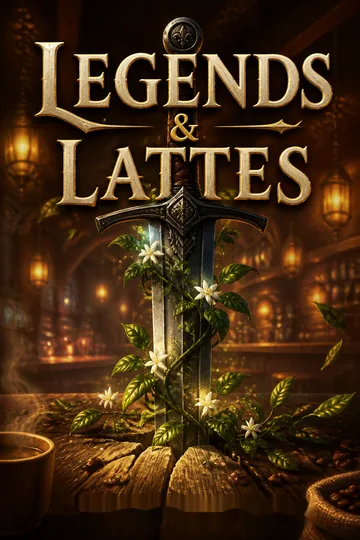
Cal3 presents a hand-carved sign naming the shop Legends & Lattes. As the three share their first successful drinks, the livery becomes more than a project: Viv1 begins to picture it as a place she will still belong to tomorrow.
The shop becomes real through other people’s contributions, not through Viv’s strength alone. Tandri supplies judgment and commercial imagination, Roon reconnects Viv to the relationships she left behind, and Cal gives the dream a public name. The machine is a practical object, but its first successful brew also makes an unfamiliar future sensory and shareable. Viv’s apology to Roon acknowledges that choosing herself did not erase the hurt she caused. Yet she does not reverse her choice. The scene lets loyalty and separation coexist, a necessary step toward building a new community without pretending the old one meant nothing.
Free Samples, Warm Bread
The café’s opening brings almost no customers, so Tandri2 designs signs and a free-sample promotion to introduce coffee to Thune. The first visitors return, but the quiet afternoons make Viv1 doubt the plan. A rattkin customer named Thimble4 turns out to be a gifted baker. Viv1 hires him after tasting his enormous cinnamon rolls, whose smell draws passersby through the door and empties the first batch within minutes.
Thimble4 develops durable fruit-and-nut biscuits, later named Thimblets, while Tandri2 updates the menu and prices. Regulars gather, linger, and talk over their cups. The business finally works, not because Viv1 has explained coffee perfectly, but because Thimble’s4 baking gives strangers a reason to enter and stay.
The café’s breakthrough comes from a collaboration Viv did not plan. Her original idea depends on people wanting an unfamiliar drink; Thimble’s baking gives them an immediate, embodied reason to try it. Tandri’s signs and pricing turn that accident into a repeatable business, while Thimble’s quiet expertise earns him room to work on his own terms. The shift from empty tables to lingering customers also changes the shop’s social function. It is no longer only Viv’s refuge from the old life. It becomes a public place where people begin to recognize one another.
Music and More Room
Cal3 installs an auto-circulator powered by the stove’s rising heat, easing the kitchen’s punishing warmth. Pendry,13 an anxious young musician from a stonemason family, first frightens customers with an unfamiliar Thaumic lute, then returns with gentler songs and an unexpectedly lovely voice.
Viv1 gives him a regular paid performance slot. Meanwhile, student Hemington12 discovers an unusually stable ley-line nexus beneath the café and asks permission to study it. He places a ward that will tug Viv’s1 palm if someone enters the premises.
Thimble4 expands the menu with chocolate-filled pastries, and Tandri2 proposes named mugs customers can carry away. Each new idea draws more people in, while Viv1 and Tandri2 grow closer without quite naming what is happening between them.
The café’s growth is measured not only in sales but in the number of people who find a place for their particular skill. Pendry’s awkward first performance does not disqualify him; Viv’s willingness to let him try again allows him to discover how his music fits the room. Hemington’s research introduces a danger hidden inside the business’s success: the ley-line anomaly may be connected to the stone under the floor. Tandri’s mug idea shows how closely she now thinks as a partner. Their closeness remains cautious, however, because practical cooperation is easier for Viv than direct emotional risk.
The Madrigal's Bargain
When Lack’s10 collectors return, Viv1 asks her former adventuring companions Roon,5 Gallina,6 and Taivus7 for advice, not a contract to fight. Tandri2 argues that using force would turn the café into another version of Viv’s1 old life. Taivus7 arranges a meeting with the Madrigal,9 a formidable older woman who confirms that Fennus,8 Viv’s1 former elf companion, told her about the Scalvert’s Stone.
She declines to seize it, but Viv1 still refuses to pay ordinary protection money. Instead, the Madrigal9 accepts a weekly delivery of Thimble’s4 baking. Viv1 later uses her authority to make Kellin,16 an Ackers student who harasses Tandri,2 leave the shop. She has found a way to protect her business that depends on a negotiated relationship rather than a fight.
This conflict forces Viv to distinguish restraint from helplessness. She initially wants the old crew’s presence to make a threat disappear, but Tandri recognizes that even a victorious use of force would restore violence as Viv’s default instrument. The Madrigal’s bargain offers a third option: an unequal relationship negotiated through the café’s own product. Viv does not simply submit, and the Madrigal does not need to pretend the district is free of coercion. The arrangement is pragmatic, not pure. Its value lies in letting Viv protect what she has built without making domination the defining language of the place.
A Kiss Before the Storm
After the meeting, Tandri2 takes Viv1 on a picnic and explains that she left her birthplace and later Ackers because people judged her by her succubus nature despite the university’s formal welcome. Viv1 offers no grand reassurance, but her blunt solidarity makes Tandri2 laugh. Their closeness grows, though Viv1 stops short of saying what she feels.
She later lets Hemington12 place a one-use ward around the café. Weeks after Fennus’s8 visit, the ward wakes Viv1 as he sneaks toward the stone. Amity,11 the huge dire-cat who has begun sleeping in the shop, drives him out before he can reach it. The stone remains beneath the floor, but the attack confirms that Fennus8 is willing to come after it himself.
Tandri’s account of Ackers clarifies why competence alone cannot protect her from prejudice. She sought a place where ideas would outweigh ancestry, then found that institutional permission did not guarantee belonging. Viv’s response matters because it does not convert Tandri’s history into a lesson or demand disclosure in return. Meanwhile, the ward and Amity transform the shop’s domestic details into defenses. The danger is no longer abstract, yet Viv still treats the stone as the central threat. She has not fully grasped that Fennus can attack the life gathered around it, not just the object under the floor.
Green Fire at Midnight
After the Madrigal9 warns that trouble is coming, Tandri2 refuses to let Viv1 face it alone. That night, unnatural green fire races across the café. Viv1 gets Tandri2 out, then repeatedly reenters the flames to rescue the lockbox and the coffee machine. Amity11 escapes through the burning doorway. The roof collapses over the table and the place where the Scalvert’s Stone was buried.
At dawn, Viv1 searches the ashes and finds no stone; the Madrigal’s9 people bring clothes, and Cal3 helps move the surviving equipment. Viv1 later returns for Blackblood, whose blade has been warped beyond use. The café is gone, the stone is missing, and the sword that once defined Viv’s1 strength is now another casualty of the life she chose.
The fire destroys the shop at the exact point when Viv’s identity has become inseparable from what she built there. Her rescue of Tandri, the machine, and the lockbox shows that her old physical courage has not vanished; its purpose has changed. Blackblood’s ruin makes that change visible, but the lost stone complicates it. Viv cannot tell whether she has lost a source of luck, the cause of the catastrophe, or merely an object she invested with hope. The catastrophe exposes how much emotional weight she had placed on the café, and leaves her without the protection of either certainty or property.
What the Ashes Leave
Burned and exhausted, Viv1 initially retreats into despair and tells Cal3 and Tandri2 that she has nothing left. Tandri2 reminds her that Viv1 had saved more than equipment in the fire; Viv1 finally accepts the feeling between them, and they kiss.
Cal3 begins clearing the site, joined by Pendry,13 Tandri,2 Thimble,4 and neighbors. Viv1 keeps working even when she cannot yet believe the new building will matter. Hemington12 adds fire-resistant wards to the foundation.
The elderly gnome Durias15 explains that Scalvert’s Stones do not grant wealth or luck as people imagine. They gather people suited to one another. Viv1 starts to understand that the community formed around the café may be the stone’s real effect, though she cannot know what will survive without it.
Viv’s collapse is not merely grief for a building. She interprets the fire as proof that her chance at a different life has been spent, then tries to flee before anyone can witness her need. Tandri’s reminder returns Viv to her own words and makes care possible without denying the loss. Rebuilding begins before Viv regains confidence, carried by people who choose to show up. Durias’s explanation shifts the stone’s meaning from a vending machine for good fortune to a point of convergence. It does not undo the fire. It changes what Viv can recognize as the lasting result.
Fortune Means Together
The rebuild takes months. Cal3 redesigns the café with a larger kitchen, and Pendry’s13 skill as a stonemason helps lay the walls. Thimble’s4 new ovens arrive through gifts from Roon5 and Gallina,6 who learned what happened from Tandri.2 The Madrigal’s9 people quietly provide materials, while Hemington’s12 wards protect the foundation.
Cal3 and Tandri2 restore the burned Legends & Lattes sign, replacing the sword image with a piece of Blackblood’s ruined blade. On reopening day, snow falls as customers line up outside. Hemington12 returns for hot coffee, Pendry13 plays on a new stage, and the Madrigal9 visits. The ley-line anomaly has vanished, but the café fills again. Its future now rests on people and work, not a promise of supernatural luck.
The rebuilt shop is not a return to the original arrangement. It incorporates lessons learned through loss: more kitchen space, fire wards, a stage, and a sign that preserves Blackblood without restoring her as a weapon. Help arrives from former rivals, former companions, and workers who have made the café their own. Their contributions make recovery communal rather than miraculous. Hemington’s report that the ley-line anomaly has passed removes the possibility that the shop’s success depends on continued magical favor. The reopening therefore tests whether the community can endure without the conditions that first gathered it.
A Partnership Made Home
After the reopening, Viv1 gathers Tandri,2 Cal,3 and Thimble4 and thanks them for building a life she could not have made alone. She presents partnership papers giving each of them an equal share of Legends & Lattes. Cal3 objects that he is not an employee, but signs after the others insist that his work deserves ownership. Viv1 then takes Tandri2 upstairs.
One room is Viv’s1 new bedroom; the other is furnished for Tandri,2 with space for her art supplies. Viv1 offers it without demanding an answer. Tandri2 accepts the invitation with an embrace and a kiss. The woman1 who once slept in a stable and feared that any attachment might vanish has made both a business and a home where other people can stay by choice.
Viv’s final act of generosity is also a correction to the way she first built the café. At the beginning, ownership meant security from dependence; now she recognizes that the work has never been hers alone. Equal partnership makes that recognition material, especially for Cal, whose modesty might otherwise keep him outside the benefits he helped create. The second bedroom offers Tandri more than shelter: it gives her a place that is neither borrowed nor conditional. Viv’s new security comes not from possessing everything, but from making room for other people to belong.
Epilogue
Fennus,8 now carrying the Scalvert’s Stone, returns to Thune to investigate whether it ever gave Viv1 the fortune she seemed to find. The rebuilt café appears just as successful, deepening his doubts. Before he can leave the city, Lack10 and the Madrigal’s9 people corner him and demand the stone.
Fennus8 escapes onto the rooftops, where Amity11 appears behind him, fur bristling and fangs bared. She leaps. The story ends before we learn what happens to Fennus,8 but the stone has drawn him into the same dangerous orbit he once set in motion.
The epilogue denies Fennus the clean reward he expected from stealing the stone. He possesses the object, but the café’s continued life makes its supposed power difficult to measure, and the Madrigal’s network closes around him. His flight across the rooftops contrasts with Viv’s decision to stay and rebuild. Amity’s return gives the ending a physical jolt, but the leap remains unresolved; the book does not need to show whether she catches him. Instead, it leaves Fennus inside the consequences of his own pursuit, while Viv’s story has already moved beyond the object he coveted.
Analysis
Legends & Lattes treats reinvention as a material practice. Viv1 does not become a different person through a single revelation; she buys a neglected building, learns how to serve a drink, hires people whose skills exceed her own, and keeps returning to work after doubt. The café makes this change visible. Its communal table, named mugs, pastries, music, and repaired sign are small structures that invite people to remain rather than pass through.
The book also distinguishes protection from domination. Viv’s1 strength remains real, but the danger of the Madrigal’s9 demands forces her to ask what defending a home should mean. Her refusal to turn the café into territory guarded by violence is not effortless virtue. She considers the old answer, misses the certainty it offered, and must accept the help of people who disagree with her. The bargain with the Madrigal9 is pragmatic rather than ideal, which keeps the story’s ethics grounded in the compromised city where Viv1 lives.
The Scalvert’s Stone provides a useful counterpoint to the fantasy of self-made success. Viv1 initially believes it may grant luck; its actual significance, as Durias15 explains, is its power to gather people. That interpretation does not make the fire or the loss harmless, nor does it prove that every fortunate event was caused by magic. Instead, the story relocates fortune from possession to relationship. The stone can draw a circle, but the people within it choose whether to stay, contribute, forgive, and share ownership.
The romance follows the same logic. Tandri2 and Viv1 do not resolve their differences through a grand confession; intimacy grows through honest work, boundaries, and the willingness to risk being misunderstood. The final partnership papers extend that emotional recognition into economics. The café becomes a home not because Viv1 can claim it alone, but because she makes its future belong to the people who helped build it.
Review Summary
Legends & Lattes receives mostly positive reviews for its cozy fantasy setting, heartwarming story, and lovable characters. Readers appreciate the low-stakes plot centered around an orc opening a coffee shop. Many find it a comforting read with themes of friendship, found family, and new beginnings. Some criticize the lack of complex plot or world-building, while others praise its accessible fantasy elements. The book's slice-of-life approach and focus on everyday moments in a fantasy world resonate with many readers seeking a feel-good story.
People Also Read



Characters
Viv
Retired orc adventurerViv is a towering orc who has spent most of her adult life hunting monsters and surviving by being the most dangerous person in the room. Beneath that competence is fatigue with violence and an unpracticed longing to make something that lasts. She researches her café carefully, yet has little experience asking for help or making herself vulnerable. Her directness can protect others, but it can also conceal how much she fears losing what she has built. Viv’s central struggle is not whether she can stop fighting; she remains capable of it. It is whether she can choose forms of courage that require trust, patience, and dependence on other people.
Tandri
Café's clear-eyed partnerTandri is a precise, self-possessed succubus who refuses to perform the seductive role others expect of her. She has studied at Ackers and learned to read people, business problems, and the assumptions hidden inside polite behavior. Her practicality makes Viv’s1 café viable, but her artistic eye and emotional sensitivity also give it warmth. Tandri is wary of being reduced to her nature or treated as a problem to manage. She wants her skills and choices to be seen clearly, without having to disguise the parts of herself that others find unsettling. Her developing trust with Viv1 grows through shared work, frank disagreement, and care offered without pressure.
Cal
Hob builder and steady friendCal is a skilled hob shipwright, meticulous with tools and economical in both movement and speech. Other workers’ prejudice leaves him isolated at the docks, but it does not blunt his pride in craft or his willingness to take on a difficult job. He sees practical needs Viv1 overlooks, from a kitchen and stove to a cooling mechanism and sturdier construction. Cal’s support is expressed through labor, attention, and quiet loyalty rather than grand declarations. He respects Viv’s1 strength while recognizing that a business needs protection beyond one person’s ability to fight. His modesty can make him reluctant to claim credit, even when his work is foundational.
Thimble
Rattkin bakerThimble is a soft-spoken rattkin whose flour-dusted apron hints at a talent far greater than his reluctance to speak suggests. He communicates through gestures, short phrases, and carefully prepared lists, preferring to let his work make the case for him. His baking transforms the café’s prospects, and each new recipe shows both technical mastery and imaginative risk. Thimble is earnest, observant, and intensely devoted to making good food. Viv1 and Tandri2 give him room to shape the kitchen rather than treating him as a pair of hands. His quiet pleasure in the work is part of what makes the café feel generous.
Roon
Dwarf from Viv's old crewRoon is a broad, affable dwarf and one of Viv’s1 longtime adventuring companions. He is loyal enough to bring her a delivery, offer a way to summon help, and reconnect her with the friends she left behind. His instincts favor action, especially when someone threatens a person he cares about. That impulse can clash with the quieter life Viv1 is trying to build, but his affection is not conditional on her returning to the crew.
Gallina
Knife-loving gnomeGallina is a quick, fearless gnome from Viv’s1 old adventuring party. She is blunt about feeling hurt when Viv1 left without explanation, but her frustration does not erase her affection. Gallina trusts action more than negotiation and is always ready to offer a blade or a sharp assessment. Her fierce protectiveness gives Viv1 a reminder of the old crew’s loyalty, even as Gallina learns to respect the different life Viv1 is choosing.
Taivus
Quiet stone-fey mediatorTaivus is a reserved stone-fey and former member of Viv’s1 adventuring crew. He speaks sparingly, keeps his oaths, and notices connections others miss. His knowledge of the Madrigal9 gives Viv1 a path to negotiation when the gang’s demands threaten her business. Taivus’s calm does not mean passivity; he understands that restraint can require more judgment than violence.
Fennus
Elegant former elf companionFennus is a graceful, highly capable elf who once adventured alongside Viv1. His polished manners conceal a sharp instinct for advantage and a habit of treating personal slights as matters of principle. He values control, information, and the appearance of reason, even when pursuing his own interests. His history with Viv1 gives their conflict an intimate edge: he knows how she thinks, and she knows how he can wound without raising his voice.
The Madrigal
Thune's formidable crime bossThe Madrigal is an elderly woman who leads the criminal organization controlling Viv’s1 district. She is composed, observant, and accustomed to gathering information before choosing a move. Her authority rests on both force and careful judgment; she does not confuse intimidation with intelligence. The Madrigal can recognize a kindred ambition in someone who has rebuilt a life in a new direction, though she never stops thinking strategically. Her interactions with Viv1 are marked by candid bargaining rather than false friendliness.
Lack
Madrigal's polished enforcerLack is a stone-fey enforcer whose conspicuous hat and polished manner make him memorable before his threats become clear. He collects the Madrigal’s9 payments and prefers to frame coercion as orderly business. Beneath the cultivated presentation is a quick, capable fighter who understands how intimidation can escalate into damage that hurts everyone involved. His respect for the Madrigal’s9 judgment gives him more nuance than a simple thug.
Amity
Enormous dire-catAmity is a shaggy, soot-colored dire-cat large enough to dominate a room without seeming to care who is watching. She appears and disappears on her own schedule, sleeps where she chooses, and regards most people with regal indifference. Her appetite and imposing presence make her an unlikely companion to the café’s quieter routines. Amity is not a trained guard, and nobody can reliably summon her, but she has a fierce instinct for choosing when to act.
Hemington
Ackers ley-line studentHemington is an earnest, distractible student at the Thaumic Academy, fascinated by ley lines and ward-glyphs. He can lose himself in research and forget that a café is a business with customers, but he is careful to ask permission before placing magical work on the premises. His awkwardness softens as he becomes part of the shop’s daily life. Hemington represents scholarship that is curious and useful, even when its practitioners are socially clumsy.
Pendry
Anxious bard and masonPendry is a large, shy young man from a family of stonemasons who is trying to become a musician. His first performance is startling, but he returns, experiments, and finds a style that suits both his unusual instrument and his gentle singing voice. He is uncomfortable asking for payment and uncertain how to occupy space, even though his music draws an audience. His story parallels the café’s: ability alone is not enough; he needs a place willing to hear him.
Laney
Broom-wielding neighborLaney is Viv’s1 sharp-eyed elderly neighbor, usually found sweeping her already spotless porch. Her gossip gives Viv1 useful information about the district, but her more important gift is a steady, ordinary welcome. She worries about Viv’s1 safety, brings food to celebrate the shop, and becomes a familiar customer. Laney’s humor and stubborn pride in her own baking make her a small but essential part of the café’s neighborhood life.
Durias
Cryptic chess-playing gnomeDurias is an elderly gnome who visits the café to drink coffee, eat pastries, and tend a chess game whose history he describes in riddles. He recognizes something meaningful in the community forming around Viv’s1 shop. His knowledge of old stories gives the Scalvert’s Stone a different interpretation.
Kellin
Tandri's persistent harasserKellin is an Ackers student who mistakes Tandri’s2 succubus nature for an invitation and persists after she rejects him. He relies on his connection to the Madrigal’s9 organization to make himself feel untouchable. His entitlement exposes the difference between attraction and consent, and Viv’s1 refusal to serve him makes the café a place where Tandri’s2 boundaries are enforced.
Ansom
Former livery ownerAnsom is the broad, heavy former owner of the Redstone livery, more comfortable drinking than managing property. He knows enough to bargain when Viv1 offers to buy, but he has let the building fall into disrepair. His sale gives Viv1 the first tangible foothold in Thune.
Plot Devices
The Scalvert's Stone
A strange gathering pointViv1 takes the stone from a slain Scalvert Queen after hearing an old verse suggesting it draws fortune. She buries it beneath a flagstone in the café, where its proximity coincides with unusual success and a stable ley-line reading. The stone attracts Fennus’s8 attention and ultimately places the café in danger. Durias15 later explains that such stones do not simply grant wealth or luck; they gather people who are suited to one another. The stone therefore functions less as a guarantee than as a catalyst whose meaning Viv1 misunderstands until the community has already formed.
The Gnomish Coffee Machine
A business made tangibleThe elaborate machine lets Viv1 serve coffee in a city where the drink is unknown. Its hiss, steam, and rich aroma give the café a distinctive presence, while its unfamiliarity creates an early barrier between Viv’s1 dream and local customers. Tandri’s2 promotions and Thimble’s4 baking help people cross that barrier. Viv1 risks herself to save the machine from the fire, making it a practical symbol of the life she is determined to rebuild.
Blackblood
The old life on displayBlackblood is Viv’s1 greatsword, a weapon she has carried through decades of adventuring. At Cal’s3 urging, she mounts it on the café wall rather than keeping it close at hand, gradually turning it from ready weapon into part of the room’s history. The sword’s place in the shop makes Viv’s1 renunciation visible without pretending her past never happened. After the fire damages the blade, a piece of it is incorporated into the restored sign, preserving its history in a changed form.
Hemington's Ward
An early warningHemington12 sets a one-use ward around the café and links its trigger to Viv1 through a gentle tug in her palm. It gives her advance warning when Fennus8 enters at night, allowing her and Amity11 to confront his attempt to reach the hidden stone. The ward does not stop the later attack, but its limited protection makes clear that preparation can buy time without guaranteeing safety.
The Blink Stone
A tether to old alliesRoon5 gives Viv1 one of a pair of Blink Stones, explaining that throwing hers into a fire will alert him and allow him to find her. The object represents the old crew’s continued willingness to answer a call, even after Viv1 leaves without explaining herself. When Viv1 faces pressure to use violence again, she throws the stone into the stove rather than keep an easy route back to her former life. Her friends later reconnect with her by choice and through messages, not because the magical signal forces them together.
FAQ
Synopsis & Basic Details
What is Legends & Lattes about?
- Orc seeks peaceful retirement: Viv, a battle-hardened orc adventurer, decides to hang up her greatsword, Blackblood, and pursue a quiet life running a coffee shop in the city of Thune, a place where coffee is unknown.
- Building a new community: She buys a dilapidated livery and, with the help of unexpected allies like Cal the hob carpenter, Tandri the succubus assistant, and Thimble the rattkin baker, transforms it into a cozy café that becomes a beloved local spot.
- Facing old and new threats: Viv's past catches up to her in the form of a greedy former crewmate, Fennus, who seeks a magical stone she possesses, while a local crime syndicate, the Madrigal, initially poses a threat to her new business.
Why should I read Legends & Lattes?
- Heartwarming cozy fantasy: The book offers a low-stakes, feel-good narrative focused on building community, finding peace after a violent past, and the simple pleasures of good food and drink, subverting typical fantasy adventure tropes.
- Rich character development: Readers witness Viv's vulnerable journey of self-discovery and transformation, alongside the compelling arcs of her diverse crew, each finding belonging and purpose in the café.
- Evocative sensory details: The narrative excels at bringing the café to life through vivid descriptions of smells (coffee, cinnamon, dust), sounds (hissing machine, Pendry's lute, Amity's purr), and tastes (pastries, coffee), immersing the reader in the comforting atmosphere.
What is the background of Legends & Lattes?
- Fantasy world with diverse races: The story is set in a world populated by various fantasy races like orcs, elves, dwarves, hobs, rattkin, stone-fey, and succubi, each with distinct cultural traits and appearances, integrated into a bustling city environment.
- Thaumic energy and ley lines: The city of Thune is built upon powerful ley lines, channels of Thaumic energy, which are studied by scholars at the Ackers university and play a subtle role in the plot, particularly concerning the Scalvert's Stone and Hemington's research.
- Established trade and social structures: Thune has a functioning economy with markets, trade depots, guilds (like shipwrights), and social strata, including a criminal element led by the Madrigal, providing a grounded setting for Viv's entrepreneurial venture.
What are the most memorable quotes in Legends & Lattes?
- "Things don't have to stay as what they started out as.": Viv's response to Ansom questioning why she'd buy a stable for a coffee shop encapsulates the core theme of transformation and leaving behind one's past identity for a new future.
- "It was like drinking the feeling of being peaceful.": Viv's attempt to describe coffee to Cal highlights the profound emotional impact the simple beverage had on her, symbolizing the tranquility and contentment she seeks in her new life.
- "What flames could not consume, never shall be extinguished.": This line, added to the menu board after the fire, becomes a powerful motto for the rebuilt shop and its crew, representing their resilience, the strength of their bonds, and the enduring spirit of their community.
What writing style, narrative choices, and literary techniques does Travis Baldree use?
- First-person perspective (Viv): The story is told primarily from Viv's point of view, offering intimate access to her thoughts, anxieties, and evolving emotions, making her transformation deeply personal and relatable.
- Sensory-rich descriptions: Baldree frequently employs detailed descriptions appealing to taste, smell, and sound, particularly when depicting the café, coffee, and baked goods, creating an immersive and comforting atmosphere central to the "cozy fantasy" genre.
- Subtle foreshadowing and thematic resonance: The narrative weaves in hints of future events (Lack's threats, Fennus's presence, the Madrigal's warning) and uses recurring motifs (Blackblood, the Scalvert's Stone, the concept of "home") to deepen thematic exploration without heavy-handedness.
Hidden Details & Subtle Connections
What are some minor details that add significant meaning?
- Laney's constant sweeping: The old woman across the street is perpetually sweeping her stoop, a seemingly mundane detail that symbolizes her rootedness, diligence, and watchful presence, establishing her as a fixture of the neighborhood and a source of local knowledge and gossip.
- Hemington's ley-compass: The Thaumic student's glowing hand-sigil, a "ley-compass," is initially presented as a quirky academic tool but subtly confirms the presence and unusual behavior of the ley lines beneath the shop, hinting at the Scalvert's Stone's influence long before its power is fully discussed.
- Amity's early appearances: The dire-cat's initial, fleeting appearances (thud on the roof, stealing Laney's cake) are presented almost as background oddities, but they foreshadow her later role as a guardian drawn to the shop, suggesting a connection to the Stone's ability to gather "like to like."
What are some subtle foreshadowing and callbacks?
- Lack's apology to Tandri: During his first visit with Kellin, Lack offers Tandri a confusingly apologetic look and bow, a subtle hint that he knows something about her past or nature that sets her apart, foreshadowing her later explanation of fleeing prejudice.
- Fennus's comment on the machine: Fennus's seemingly innocuous observation that the coffee machine "does indeed have the ring of fortune about it" is a direct callback to the verse about the Scalvert's Stone, confirming his knowledge of its lore and his suspicion about Viv's true motive for retirement.
- Tandri's Arcane Reciprocity theory: Tandri's explanation of Thaumic blowback, where removing power causes a reciprocal effect, subtly foreshadows the potential consequences of losing the Scalvert's Stone, suggesting the despair Viv feels after the fire might be more than just emotional loss.
What are some unexpected character connections?
- Taivus and the Madrigal: The revelation that the stoic stone-fey Taivus knows the Madrigal personally, having met her under a different name and being bound by oaths, is a surprising connection that highlights the hidden depths of Viv's old crew and provides a crucial link for arranging the parley.
- Durias and the Scalvert's Stone lore: The elderly gnome Durias, initially just a quiet chess player, unexpectedly reveals deep knowledge of the Scalvert's Stone's true nature and history, connecting his seemingly random presence to the central magical element of the story and offering a new interpretation of its power.
- Pendry's family business: The shy bard Pendry, who seems out of place with his large, rough hands, is subtly revealed to come from a stonemason family, explaining his unexpected skill and comfort when helping rebuild the shop's stone walls, connecting his artistic passion to a grounded, practical background.
Who are the most significant supporting characters?
- Tandri: As Viv's first employee and later partner, Tandri is arguably the most significant, bringing business acumen, artistic talent, emotional intelligence, and a parallel journey of seeking acceptance, becoming Viv's closest confidante and romantic interest.
- Cal: The hob carpenter's practical skills are essential for the physical transformation and rebuilding of the shop, while his steady, no-nonsense presence and quiet loyalty provide Viv with crucial stability and support, embodying the value of reliable craftsmanship and friendship.
- Thimble: The rattkin baker's extraordinary talent for creating irresistible pastries (cinnamon rolls, Thimblets, crescents) is the primary driver of the café's popularity and financial success, making him indispensable to the business and a symbol of unexpected genius found in quiet places.
Psychological, Emotional, & Relational Analysis
What are some unspoken motivations of the characters?
- Viv's fear of regression: Beyond seeking peace, Viv is deeply motivated by a fear of falling back into her old, violent ways. Her reluctance to use Blackblood or engage in physical conflict, even when threatened, stems from a desperate need to prove she can be something other than a warrior, as highlighted by Tandri's observation about the sword becoming a "relic."
- Tandri's search for acceptance: Tandri's eagerness to learn and contribute, her initial nervousness during the job interview, and her reaction to Kellin's prejudice reveal a deep-seated motivation to find a place where she is valued for her skills and character, not judged or objectified based on her succubus nature.
- Fennus's wounded pride: While presented as greedy, Fennus's actions, particularly his passive-aggressive comments and the targeted nature of the fire, suggest a motivation rooted in wounded pride and resentment over feeling cheated or underestimated by Viv, rather than purely financial gain.
What psychological complexities do the characters exhibit?
- Viv's identity conflict: Viv grapples with the psychological dissonance between her past as a brutal warrior and her desired future as a peaceful shop owner. This is evident in her awkwardness in social situations, her internal struggle over using violence, and her reliance on the Scalvert's Stone as a potential external source of her new life's success.
- Tandri's guarded vulnerability: Tandri maintains a composed, almost severe exterior, a psychological defense mechanism developed from facing prejudice. Her moments of vulnerability (nervousness during the interview, reaction to Kellin, sharing her university experience) reveal the emotional toll of her past and her cautious hope for genuine connection.
- Pendry's performance anxiety: The stark contrast between Pendry's physical presence and his timid demeanor, particularly his crippling stage fright with his Thaumic lute, illustrates the psychological burden of trying to reconcile a perceived identity (farmhand/bard) with a hidden talent, a struggle that resonates with Viv's own journey.
What are the major emotional turning points?
- The first successful coffee/latte: Viv's deep emotional reaction to the smell and taste of coffee in Azimuth, and later her relief and elation when she successfully brews it in her shop, marks the initial emotional turning point, solidifying her desire for this new path and providing the core motivation for the entire venture.
- The first busy morning: The moment the shop fills with customers, particularly seeing their peaceful enjoyment of the coffee and pastries, is a major emotional turning point for Viv, shifting her from nervous uncertainty to a profound sense of accomplishment and belonging, realizing her dream is becoming a reality.
- The fire and its aftermath: The devastating fire is the most significant emotional turning point, stripping away the physical manifestation of Viv's dream and forcing her to confront her deepest fears of loss and isolation, ultimately leading to a deeper appreciation of the community she has built and a pivotal moment of emotional intimacy with Tandri.
How do relationship dynamics evolve?
- Viv and Tandri: Their relationship evolves from a cautious employer-employee dynamic, marked by Tandri's initial reserve and Viv's awkwardness, to a close friendship built on mutual respect, shared vulnerability, and collaboration, culminating in a romantic connection that signifies Viv finding deep personal fulfillment beyond her professional goals.
- Viv and her old crew: Viv's relationship with Roon, Gallina, and Taivus shifts from a professional bond forged in combat to a test of friendship after her abrupt departure. Their willingness to help, despite her silence, and their acceptance of her new life (even if they don't fully understand it) demonstrates the enduring loyalty of their past connection, while highlighting the different values of her old and new lives.
- The café crew as found family: The individual relationships between Viv, Tandri, Cal, and Thimble gradually coalesce into a supportive, collaborative unit that functions like a found family. Their shared work, mutual reliance, and genuine care for one another (Cal building the stove, Tandri designing signs, Thimble baking, Viv providing the space) create a dynamic of belonging that replaces the transient bonds of Viv's adventuring past.
Interpretation & Debate
Which parts of the story remain ambiguous or open-ended?
- The true nature and extent of the Scalvert's Stone's power: While Durias offers an interpretation ("draws like to like"), the exact mechanism and limits of the Stone's influence remain somewhat ambiguous. It's debatable whether it caused the good fortune or simply attracted individuals who would create it, leaving room for interpretation on the role of fate versus free will.
- Durias's identity and abilities: The elderly gnome's cryptic remarks ("which go-round this is," "polishing the stone before the cut"), his one-sided chess game, and his seemingly prescient knowledge of the Stone's lore suggest he is more than he appears, possibly possessing some form of foresight or connection to time/destiny, but his true nature is never fully explained.
- Amity's connection to the Stone/Shop: While Durias's explanation links Amity's presence to the Stone drawing "like to like," the dire-cat's specific connection to the shop, her unpredictable appearances, her protective behavior during threats (Fennus, fire), and her eventual decision to stay remain somewhat mystical and open to interpretation as either magical guardian or simply a creature drawn to the unique energy/community.
What are some debatable, controversial scenes or moments in Legends & Lattes?
- Viv's refusal to pay the Madrigal: Viv's decision to defy the Madrigal's demand for protection money is debatable. While it aligns with her desire to not be controlled or revert to violence, it puts her business and employees at significant risk, leading directly to the fire. Readers might question if this was a principled stand or reckless stubbornness.
- Viv's reaction after the fire: Viv's descent into despair and lashing out at Cal and Tandri after the fire, particularly her harsh words about not deserving them and wanting to flee, can be seen as controversial. While understandable given the trauma, it's a moment where her old, hardened self resurfaces, potentially alienating the very people who are trying to help her.
- The nature of Viv and Tandri's relationship development: The progression of Viv and Tandri's relationship, particularly the timing and nature of their first kiss after the fire, could be debated. Some might see it as a natural culmination of their growing bond and shared vulnerability, while others might find the shift from friendship to romance, especially in the immediate aftermath of trauma, to be sudden or emotionally complex.
Legends & Lattes Ending Explained: How It Ends & What It Means
- Rebuilding and Found Family: The ending sees the café rebuilt through the collective effort of Viv, Tandri, Cal, Thimble, and even unexpected helpers like Pendry and those sent by the Madrigal. This signifies that the true strength and "fortune" of the shop lie not in the magical stone, but in the bonds of community and found family they have forged, which proved resilient enough to overcome devastation.
- Partnership and Shared Ownership: Viv makes Tandri, Cal, and Thimble equal partners in the business, formalizing the reality that the shop's success and identity are a result of their combined efforts and talents. This act solidifies Viv's transformation from a solitary warrior to a leader who values collaboration and recognizes the worth of others, sharing her dream rather than holding onto it alone.
- Viv and Tandri's Relationship: The ending confirms the romantic relationship between Viv and Tandri, symbolized by Viv creating a dedicated room for Tandri upstairs and their shared kiss. This signifies Viv finding deep personal connection and love, fulfilling the "aspect of heart's desire" hinted at by the Scalvert's Stone's lore, and demonstrating that her new life offers emotional fulfillment beyond just peace and purpose.
Legends & Lattes Series
Download PDF
Download EPUB
.epub digital book format is ideal for reading ebooks on phones, tablets, and e-readers.








