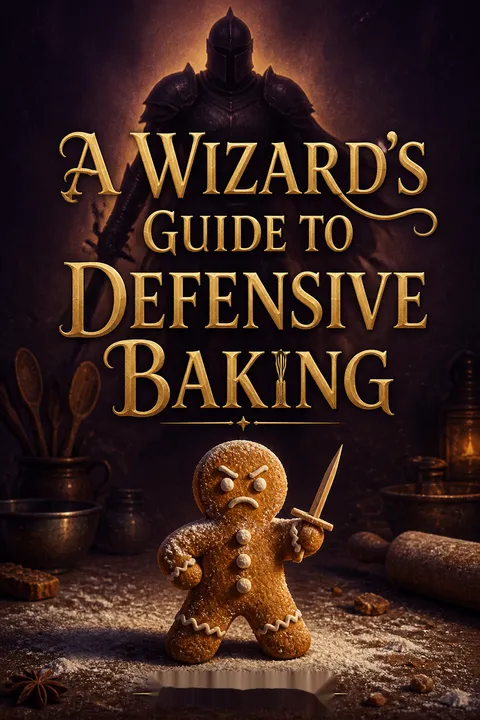


Plot Summary
Four A.M. in the Bakery
Fourteen-year-old Mona,1 an apprentice baker whose small magic can coax dough, bread, and gingerbread to move, finds a young woman12 dead on the floor of her aunt's3 bakery. Aunt Tabitha3 sends for the constables, then keeps the shop running by baking buns for the investigators.
While Mona1 serves customers, she learns that another local child, Sidney, has disappeared and that wizardly people may be vanishing too. Inquisitor Oberon7 arrives from the Duchess's5 government and treats Mona's1 magic and discovery of the body as evidence. He orders the constables to take her to the palace before anyone has established who the dead girl12 was or how she died.
The opening makes ordinary labor the measure of what is at stake. Mona's first instinct after finding a body is to keep the ovens going, not because she is callous but because baking is the structure through which she understands competence and care. Oberon turns that modest skill into grounds for suspicion, exposing a political order in which an unusual capacity can be recast as guilt. The vanished boy and the unidentified dead girl widen the incident beyond a single crime, but Mona's limited perspective keeps the threat frighteningly legible: authority has taken her, and she cannot tell why.
The Long Walk Home
At the palace, the Duchess5 hears Mona1 explain that her magic only works on baked goods and releases her, overruling Oberon's7 attempt to treat suspicion as proof. Oberon7 offers no meaningful apology, and Mona1 has to walk across the rain-soaked city alone. In the Rat's Elbow, Knackering Molly,4 a volatile minor wizard who makes dead horses walk, escorts her past the neighborhood's wary residents.
Molly4 says that magickers are in danger and names a mysterious hunter, the Spring Green Man.8 Mona1 is too exhausted to investigate the warning. On the short walk from the bakery to her room, someone2 grabs her from the dark and demands to know where a girl named Tibbie12 has gone.
Mona's release is a narrow victory, not a restoration of safety. The Duchess can intervene in one hearing, but cannot undo the fear created by an official who has already marked Mona as suspect. The humiliating walk home converts abstract vulnerability into physical exposure: no carriage, no escort, and no reliable protection between palace and bakery. Molly's warning matters because it comes from someone whose own strange magic has taught her how institutions use people they consider marginal. Mona dismisses it partly from fatigue, showing how exhaustion can make a true warning feel less urgent than getting home.
Tibbie's Bracelet
The person who seized Mona1 is Spindle,2 a hungry street boy who says his sister12 Tibbie12 entered the bakery during the night and never came out. He refuses to believe Mona's1 account that the dead girl12 was likely Tibbie,12 so he returns after dark and searches the kitchen for a sign. Mona1 animates a stale gingerbread man to reach beneath a table.
The cookie14 retrieves a broken silver bracelet, and Spindle2 recognizes it as the one their mother left Tibbie.12 He runs before Mona1 can comfort him. The bracelet confirms that the dead girl12 was his sister,12 while Spindle's2 account of a stranger in yellow-green clothing8 gives Mona1 a clue linking Tibbie's12 death to Molly's4 warning.
The bracelet makes grief concrete. Spindle has no trust in official investigation, so he seeks proof in the physical space where his sister disappeared; Mona's small magic helps him find it, but cannot soften what it means. His refusal to accept the death is not simple denial. It is a survival strategy built by someone who has learned that adults and institutions often fail to return the missing. Mona's restraint, even when she is tired and frightened, begins a bond based on shared loss rather than instant friendship. The gingerbread helper also shifts from amusing trick to a tool for recovering evidence.
Bob in the Dark
A few days later, the Spring Green Man8 attacks Mona1 in the bakery before dawn. His strange scent clouds her thoughts, and he says she has been moved up a list of magickers marked for elimination. Mona1 escapes down to the cellar and throws Bob,13 her enormous living sourdough starter, over him. The furious starter burns the attacker, buying Mona1 time to run.
Spindle2 appears and leads her into the Rat's Nest, where Molly4 shelters them in a derelict house. Mona1 pieces together the connection between the assassin,8 Tibbie's12 death, and Inquisitor Oberon.7 Molly4 leaves to question her contacts, while Mona1 and Spindle,2 frightened and hungry, argue over whether they can trust the constables.
The attack destroys Mona's belief that work can keep danger outside the bakery door. Her defense is not a newly discovered combat power but an intimate, improvised use of something she has tended for years. Bob embodies the unruly consequence of care: Mona once saved the starter from dying, and now its fierce vitality protects her. Spindle's arrival makes alliance practical before it becomes comfortable. Both children are operating with incomplete evidence, but his distrust of authority and her residual faith in civic order will soon collide. The scene also establishes the threat's bureaucratic dimension: the assassin speaks of a list, suggesting organized elimination rather than an isolated killing.
Bread Floats Away
Mona1 storms out to seek a constable, convinced that a uniformed officer will protect her. The constable knows her name before she gives it and admits that orders require him to bring her in. Spindle2 tackles him, while Mona's1 gingerbread man14 attacks his face, and the children escape through the streets.
Trapped at a locked sewer grate with pursuers closing in, Mona1 turns Spindle's2 stale loaf into floating stepping stones. They ride the bread through the filthy canal and emerge in old smuggler tunnels. Spindle2 finds food by stealing meat pies from a tavern kitchen, then gets them clean clothes. Molly4 eventually hides them in a church belltower, where they can avoid the patrols and the Spring Green Man's8 search.
Mona's failed appeal is the turning point in her relationship with authority. The constable's gentleness initially reassures her, then makes the betrayal more destabilizing when his grip proves coercive. Her escape depends on joining her domestic knowledge to Spindle's street competence: she can alter bread, but he knows routes, locks, and how to move unseen. The floating loaf is comic in its materials and serious in its consequence. It converts a skill dismissed as trivial into a means of survival. Their flight also reverses their earlier disagreement: Spindle's suspicion was not paranoia, and Mona must revise her understanding of whom the city's systems protect.
A City Turns on Wizards
From the belltower, Mona1 practices animating discarded bread while Spindle2 brings her food and reports on the streets. He delivers broadsheets declaring Mona1 wanted for murder and treason, imposing a night curfew, and ordering every magicker to register with a Loyalty Board. The notices call wizards potential traitors and invite neighbors to report one another.
Mona1 understands that Oberon7 is not simply hunting her: he is collecting names so the government can locate every magical person. Her former carpenter customer, Master Elwidge, has vanished, and other magickers are fleeing. Rather than leave Riverbraid and abandon Aunt Tabitha,3 Mona1 decides to reach the Duchess5 directly. She and Spindle2 plan an illicit entrance to the palace.
The posters show persecution being manufactured through familiar civic language: safety, loyalty, and neighborly vigilance. The campaign asks ordinary people to participate, making exclusion seem like routine administration rather than violence. Mona's discovery also reframes her own arrest. She was useful to Oberon as a suspect and dangerous to him as a witness who remained free. Her choice to stay is not a simple triumph of courage; it grows from attachment to her aunt, her work, and the city she knows. The belltower offers physical refuge but narrows her world, while practice with bread creatures gives her a tentative sense that her magic may exceed its familiar, commercial uses.
Out Through the Garderobe
Spindle2 breaks into the palace, steals a cesspit worker's key, and guides Mona1 up the shaft of the Duchess's5 garderobe. Caught halfway through, Mona1 persuades the Duchess5 to hear her warning about the assassin,8 the disappearances, and the anti-magicker orders. The Duchess5 admits she knew nothing of the registration campaign.
She explains that Oberon7 wants to unite neighboring city-states under one ruler,5 using the Duchess5 as a figurehead; uncontrolled magickers stand in his way. The Duchess5 has been isolated from the streets while the army and Lord Ethan6 are away. She brings Mona1 and Spindle2 to Master Gildaen,9 an elderly palace wizard, because he may be able to send a message to the army.
The garderobe entrance is both farce and political diagnosis: the children reach the ruler through the part of the palace designed to dispose of waste because legitimate channels have been sealed against inconvenient information. The Duchess's tears do not absolve her; they reveal how isolation and overreliance on advisers have made her govern through filtered reality. Mona's ability to describe danger in ordinary terms gives the Duchess evidence she could not obtain from her own court. Their alliance begins with mutual vulnerability, not uncomplicated trust. The revelation about Oberon's ambition ties the persecution of magickers to the larger structure of power: those he cannot command become obstacles to be removed.
The Wizard in the Water
Master Gildaen9 agrees to contact the army through a pair of linked water bowls, explaining that magical sympathy lets matched objects carry a message over distance. He identifies the Spring Green Man8 as Elgar,8 a palace wizard whose craft manipulates air, scent, and concealment. As Gildaen9 reaches the army's messenger, Elgar8 enters and stabs him.
With his last strength, Gildaen9 throws enchanted boiling water over Elgar,8 while Mona1 screams for help. Joshua11 arrives and knocks the assassin8 unconscious with a chair. The Duchess5 now has proof that Elgar8 serves the plot, but the message is incomplete and the army remains distant. She resolves to act before Oberon7 can consolidate control, rather than wait for outside rescue.
Gildaen's death exposes the cost of relying on a single remaining channel of communication. The matched bowls work because of a relationship between objects, a principle that echoes Mona's own magic, but the message is vulnerable to interruption by someone already inside the palace. Gildaen's final action is not a spectacular display of power so much as a precise use of what remains to him. Mona's scream and Joshua's intervention make survival collective, even when no one can prevent the loss. The scene removes the comforting idea that a loyal expert will solve the crisis. Knowledge can guide action, but it cannot substitute for timely political judgment.
Oberon Leaves the City
The Duchess5 gathers the palace guard and confronts Oberon,7 who tries to discredit Mona1 and deny the charges. Spindle2 identifies Elgar8 as Tibbie's killer,8 and the Duchess5 orders Oberon7 exiled rather than allowing a fight inside the palace. He leaves under guard. A watcher follows him to a Carex mercenary camp, revealing that Oberon7 had been working with the force the city's army was supposedly pursuing.
The Carex are only two days away, while the army is more than three days from returning. Oberon's7 plan had been to seize Riverbraid from within, then exploit the mercenaries' attack. The Duchess5 asks Mona1 to help defend the city, since the other magickers are dead, gone, or hiding.
Oberon's expulsion is a decisive act, but it does not restore the conditions that made his rise possible. The revelation that he has invited the Carex transforms a political coup into an imminent siege and makes his ambition materially dangerous to everyone in the city. The Duchess acts with greater resolve once she has direct evidence, though the delay has left almost no margin for error. Mona is recruited not because her power has suddenly become conventional, but because the city's institutions have depleted every alternative. The shift from accusation to emergency defense forces her to see that being innocent is not enough; survival now requires using her limited skill publicly.
A Bakery Builds an Army
With the Carex approaching and no time for the army to return, Mona1 studies Master Gildaen's9 book and decides to animate enormous bread figures. Blacksmith Argonel17 builds a vast heated baking surface, while bakers across Riverbraid send dough to the palace.
Mona1 creates seven towering golems, burns her fingers linking their mixed dough into single beings, and gives them barrel shoes and fence-post clubs. She also makes twenty-three oversized gingerbread saboteurs, adding cayenne and rat poison so they will harass the enemy camp rather than be eaten.
Spindle2 carries them outside the walls. Aunt Tabitha3 brings Bob13 to the palace, where Mona1 divides the sourdough starter13 into jars for slingers. A messenger pigeon reports that the army cannot arrive in time.
The defense grows from collaboration between kinds of expertise that formal hierarchies often separate. Mona supplies magical insight, Argonel solves the problem of heat and scale, Tabitha knows dough, and Spindle understands stealth. None can produce a complete defense alone. Mona's magic becomes powerful through the same principle that defines her baking: material must be understood and handled, not merely commanded. Yet the preparations also exact a physical price, from burned skin to the draining effort of maintaining many animated creatures. The approaching army's delay denies the fantasy that a celebrated general will rescue the city. Ordinary people must make a defense from what their occupations have taught them.
The Dead Horses Charge
At dawn, the Carex batter down the gate. Mona's1 seven bread golems block the first waves, while jars of angry Bob13 sourdough burn and scatter the attackers. The gingerbread saboteurs disrupt the camp, but Mona1 grows dangerously exhausted.
Elgar8 escapes prison and attacks her during the fighting; Nag, Molly's4 skeletal horse, kicks him down before he can kill her. Carex fighters begin toppling the golems and breaking through a barricade. Mona1 animates a sprawling chocolate-chip dough creature to hold the breach, then nearly collapses trying to strengthen it.
Molly4 reveals the scale of her own magic by summoning the city's dead horses. Their charge smashes the barricade, tears through the Carex ranks, and sends the mercenaries fleeing. Molly4 and Nag do not survive the effort.
The climax refuses a single-hero solution. Mona's inventive defenses delay the assault, but each success exposes their limits: bread can be cut, dough consumes the baker's strength, and a clever plan cannot erase the enemy's numbers. Molly's intervention is both an extraordinary act of agency and the consequence of a system that once treated her as a useful weapon. Her power saves the city, but the victory carries a cost that cannot be converted into uncomplicated celebration. The dead horses make the city's buried history physically present, turning neglected remains into collective defense. Survival arrives through the labor of the overlooked, not through the army or the supposedly indispensable general.
A Victory With a Cost
After the Carex rout, Mona1 and Spindle2 find Molly4 dead beside Nag, surrounded by the silent bone horses she summoned. The Duchess5 closes Molly's4 eyes, and Spindle2 asks that she and Nag be buried together in a park rather than placed in a grand tomb. The horses collapse back into dust. The army arrives two days later, pursues stragglers, and puts captured Carex to work rebuilding the farms.
Riverbraid has lost seven defenders in the battle, as well as Molly,4 and one guard is believed to have been killed by Elgar.8 Oberon's7 body is never identified, leaving his fate uncertain. Mona1 returns to the bakery, where Aunt Tabitha3 embraces her and Bob,13 badly scattered but recoverable, recognizes her.
The aftermath insists that victory cannot make the losses incidental. Spindle's choice of a modest park burial rejects the state's instinct to turn Molly into a polished emblem, while still allowing the Duchess to honor what she did. The city's low casualty count depends on the combined work of the golems, Bob, the saboteurs, and the dead horses; reducing the outcome to one miraculous intervention would erase that chain. Mona's homecoming restores sensory continuity through flour, family, and the familiar sourdough, but it does not erase trauma. Oberon's uncertain fate further resists a perfectly closed ending: political danger can be contained without being made morally tidy.
Back Behind the Counter
The Duchess5 awards Mona1 and Spindle2 medals, and names Mona1 a Royal Wizard. Mona's1 gingerbread companion14 receives a tiny medal of its own. The ceremony makes the children public heroes, but Mona1 remains uneasy with praise that obscures how adults failed to protect the city.
Uncle Albert,10 who once received honors after his army post was abandoned through bureaucratic neglect, helps her see how medals can replace accountability. Lord Ethan6 invites Mona1 to train, warning that people may expect future heroism from her.
Mona1 remains willing to learn, but refuses an army career and returns to baking with Aunt Tabitha.3 She continues caring for Bob13 and keeps her gingerbread guard14 nearby, grateful for ordinary work yet alert to the power she now knows she possesses.
The ending treats recognition as an ambivalent social transaction. Medals give Mona and Spindle public standing, but Albert's history shows how institutions can use honors to close discussion of their own failures. Mona's resistance to military service is not a rejection of learning or responsibility; it is a boundary against being converted into a repeatable defense mechanism. Her return to baking matters because it restores choice, not because the bakery is an escape from politics. She now understands that small magic can alter a city's fate, while also recognizing the danger of letting others define her worth by what she can do in a crisis.
Analysis
The novel makes a political argument through the literal materials of work. Mona1's magic is dismissed because it operates on bread, a substance associated with kitchens, routine, and service rather than warfare. Yet her knowledge of dough's behavior becomes indispensable when official power has failed. The story does not claim that domestic labor is secretly identical to military force; it shows that expertise ignored by institutions can become the only expertise available when crisis arrives.
Riverbraid's danger is not produced by magic alone. Oberon7 weaponizes public fear through registration orders and accusations, while the Duchess's5 isolation allows those measures to proceed without her knowledge. The city is nearly lost not because no one has power, but because information and responsibility are badly distributed. The constable who reassures Mona1 before restraining her, the council that filters access to the ruler,5 and the army that cannot communicate quickly all make the same point: systems can fail through ordinary procedures as surely as through deliberate violence.
Mona's1 arc complicates the conventional reward of becoming a hero. She grows from underestimating her abilities to using them creatively, but she does not conclude that greater power should determine her life. Albert's10 story exposes medals as a way institutions can honor survival while avoiding responsibility for preventable danger. Molly's4 sacrifice makes that critique more painful: the people called upon to save the city are often those previously treated as expendable or eccentric.
The ending therefore preserves tension rather than offering simple restoration. Mona1 returns to the bakery because it is her chosen vocation, not because she has forgotten the political crisis. She accepts that she may learn more, while resisting the expectation that past heroism makes her permanently available for future emergencies. The book's deepest distinction is between usefulness imposed by others and skill exercised by choice.
Review Summary
A Wizard's Guide to Defensive Baking is a charming, witty fantasy novel about a young baker with bread magic who must defend her city. Readers praise the unique magical system, quirky characters like Bob the sourdough starter, and blend of humor and darkness. Many appreciate the empowering message for young readers. While some found pacing issues or felt it skewed too young, most reviewers thoroughly enjoyed the imaginative story, likable protagonist, and Kingfisher's signature style. The book won multiple awards and is recommended for all ages.
People Also Read



Characters
Mona
The baker with dough magicMona is a fourteen-year-old apprentice baker orphaned by illness and raised partly under the care of her aunt3, Tabitha3. Her gift works through dough and baked goods: she can make bread rise, prevent pastries from burning, and animate gingerbread. Because her magic seems narrow, she measures herself against spectacular wizards and assumes she has little to offer beyond the bakery. She is observant, stubborn, funny under pressure, and more attached to routine than she admits. Her instinct to feed people and keep working is both a source of steadiness and a way to avoid fear. Mona's choices are shaped by loyalty to her family, her city, and the craft she hopes to master.
Spindle
A streetwise survivorSpindle is a hungry, sharp-witted street boy and Tibbie's12 younger brother. He knows how to pick locks, steal food, read danger in a neighborhood, and distrust promises from officials. His toughness protects him, but it also makes it difficult for him to accept help or show grief. He initially sees Mona1 as a stranger connected to his sister's12 disappearance; after she helps him find Tibbie's12 bracelet, he becomes her closest partner. Spindle's practical skills repeatedly complement Mona's1 magic. He is impatient with ceremony and sentimental reassurance, yet his actions reveal a strong capacity for loyalty and a longing for someone to treat his survival as more than a nuisance.
Aunt Tabitha
The bakery's force of natureTabitha is Mona's1 aunt, guardian, and employer, a large, capable baker who responds to catastrophe by feeding investigators and keeping the shop functioning. Her practical confidence gives Mona1 a model of competence, while her fierce protectiveness sometimes makes it hard for her to understand why Mona1 wants to take risks. Tabitha's care is tactile and immediate: tea, food, work, and an embrace. She does not dismiss danger, but she measures it against the needs of the people in front of her. Her generosity reaches beyond family, and she is willing to put her own body between a threat and those she loves.
Knackering Molly
The dead-horse wizardMolly is a minor wizard who can make dead horses walk, a skill that keeps the city's streets clear and earns her a living. She rides Nag, a skeletal horse padded with rags, and cultivates an unnerving, eccentric presence that helps people underestimate how perceptive she is. Her distrust of government wizards comes from experience, and she warns Mona1 that people with small, useful talents can still be exploited by powerful institutions. Molly understands the city's neglected corners and relies on informal networks rather than official channels. Her blunt humor and hard bargaining coexist with a deep, unsentimental regard for other marginal people.
The Duchess
Riverbraid's isolated rulerThe Duchess governs Riverbraid through a balance of council, guard, and civic custom rather than absolute command. She is not a distant warrior monarch, but a tired, practical woman whose authority depends on advisers and institutions she cannot always see through. Her instinct for fairness lets her recognize Mona's1 innocence, yet her seclusion leaves her vulnerable to filtered information. She cares about the city's tradition of treating magickers as ordinary citizens and is capable of warmth, self-doubt, and public resolve. The Duchess is psychologically defined by the tension between responsibility and avoidance: she knows that ruling means acting, but fear and counsel can delay action until the consequences become severe.
Lord Ethan
The celebrated war wizardLord Ethan, known as the Golden General, leads Riverbraid's army and is admired for his military magic and battlefield victories. Mona1 first sees him as a figure from heroic stories, handsome and seemingly invulnerable. Later, his attention to her work is more respectful than grandiose: he recognizes that creative use of a limited talent can matter more than raw power. Ethan understands that even a powerful wizard depends on trained people and institutions. He offers Mona1 a chance to learn without demanding that she surrender her life to the army, though his warning about the expectations attached to heroism makes clear that admiration can become another form of pressure.
Inquisitor Oberon
The law's ambitious faceOberon is a senior official who speaks and acts with the confidence of someone accustomed to making suspicion sound like evidence. He arrives at the bakery in immaculate robes and treats Mona's1 minor magic as a reason to question her. His power lies not only in formal authority but in controlling what information reaches the Duchess5 and how public danger is described. Oberon is composed, strategic, and attentive to appearances; even when challenged, he prefers to recast the dispute rather than answer it directly. He embodies an institutional temperament that treats people as risks to be managed, especially when their abilities exist outside its control.
The Spring Green Man
A hunter of magickersThe Spring Green Man is a mysterious assassin who wears yellow-green clothing and hunts people with magical gifts. His talent involves air, scent, and concealment, allowing him to cloud victims' thoughts and approach without being noticed. Unlike a merely efficient killer, he displays a disturbing pleasure in pursuit and intimidation. He treats vulnerable people as entries on a list, revealing the cold administrative logic behind his violence. Mona's1 narrow magic and his contempt for it make their encounters especially perilous: he assumes that a baker's gift cannot meaningfully threaten him, while she survives by improvising with the materials she knows.
Master Gildaen
The palace's elder wizardGildaen is an elderly palace wizard whose specialty is water. He is irritable, disorganized, and self-deprecating, but his apparent frailty conceals hard-earned knowledge and loyalty to Riverbraid. He understands that magic depends on relationships between materials, and he treats Mona's1 bread talent as a real discipline rather than a childish novelty. Gildaen's explanation of paired objects gives Mona1 a framework for thinking beyond instinct. He has lived long enough to know that power fades and institutions fail, yet he remains willing to use what ability he has left in service of the city.
Uncle Albert
The quiet veteranAlbert is Tabitha's3 husband and Mona's1 uncle, a former soldier who now helps around the bakery. He is quiet and often lets Tabitha3 take charge, but his account of being abandoned by military bureaucracy gives Mona1 a crucial perspective on official heroism. His unit received medals for surviving a crisis caused by neglect, and he understands how praise can substitute for accountability. Albert does not try to argue Mona1 out of her anger. Instead, he recognizes the pattern and shares his own experience, offering a rare form of adult support that does not require her to pretend everything is all right.
Joshua
The Duchess's loyal guardJoshua is a palace guard who serves as the Duchess's5 protector and a practical organizer during Riverbraid's emergency. He remains alert to threats, but he is also willing to listen when Mona1 proposes unconventional defenses. His military experience helps him distinguish an individual fighter from an army that can act together, and he is candid about the limits of the city's hastily assembled forces. Joshua respects Mona's1 contribution without pretending she can solve everything alone. His steadiness gives the children a reliable adult ally, though his loyalty to the Duchess5 does not erase the larger failures of the institutions he serves.
Tibbie
Spindle's resourceful sisterTibbie is Spindle's2 older sister, a streetwise thief with a magical knack for hiding in shadows. She looks after her brother2 and uses her ability to move through the city without attracting attention. Spindle2 remembers her as clever, protective, and particular about the small choices that let her retain control over her appearance and work. Her story connects the precarious lives of street children with the danger facing magickers. Even before she appears directly, Spindle's2 memories make her a vivid presence and give his distrust of authority an intimate, personal foundation.
Bob
The carnivorous sourdoughBob is Mona's1 sourdough starter, accidentally given an unusually strong life when she was a frightened child. He grows beyond his original bucket, feeds himself, and can become dangerous when angered. Mona1 tends him with affection and treats him as a companion, while most people see an alarming mass of living dough. Bob represents how an ordinary craft can produce something unruly when care and magic meet. His appetite, loyalty, and tendency to dissolve whatever holds him make him simultaneously a beloved kitchen presence and an unexpectedly effective defense.
The Gingerbread Man
Mona's cookie companionMona's1 animated gingerbread man begins as a familiar bakery trick, but he develops into an observant companion who follows her beyond the shop. He dances, fetches small objects, stands guard, and can communicate through gestures rather than speech. His practical loyalty grows alongside Mona's1 understanding of her magic. Because he is both a cookie and a continuing presence, he blurs the line between tool and companion; Mona1 increasingly treats him as someone whose safety and judgment matter. His small scale makes his acts of courage more affecting, not less.
Lena
The wary market wizardLena is a young magicker who performs colorful tricks with fruit at her father's market stall. She is alert to the danger gathering around Riverbraid and plans to leave before the campaign against wizards tightens. Her warning gives Mona1 an early chance to understand that the disappearances are not local rumor. Lena's choice to flee is practical rather than cowardly, and Mona's1 decision not to follow reflects how deeply the bakery and her family anchor her.
Jenny
The palace scullery maidJenny is a young kitchen worker who meets Mona1 when she slips into the palace disguised as a scullery maid. She is candid, hardworking, and more interested in competent help than in status. Later, she chooses to contribute to the city's defense and treats Mona's1 magic with uncomplicated enthusiasm. Jenny gives Mona1 an ally among ordinary workers, someone who sees her as a person rather than an official symbol.
Argonel
The inventive blacksmithArgonel is the palace's skilled blacksmith, a broad, scarred craftsman who meets Mona's1 strange requests with practical curiosity. He designs the enormous heated surface used to bake the golems and helps solve the problem of their unstable feet. His response shows the value of technical craft beside magic: he does not need to understand Mona's1 gift fully to make it usable. Argonel respects her authority because the situation requires it, not because he confuses her with a conventional wizard.
Plot Devices
Dough magic
Turns craft into defenseMona's1 magic can influence dough and baked goods, making it rise, stay soft, avoid burning, or move. Its apparent narrowness initially shapes her low opinion of herself. The story repeatedly tests the material limits of the gift: baked bread resists transformation, fresh dough is more suggestible, and too much magical force can make a creation unstable. The climax grows from these rules rather than abandoning them, as Mona1 animates gingerbread saboteurs and enormous bread golems. The device makes a domestic skill politically consequential without turning Mona1 into a conventional battle wizard.
Magical sympathy
Links separated objectsThe principle of magical sympathy allows objects that share a source or history to remain connected at a distance. Master Gildaen9 uses paired bowls and shared water to communicate with the army, while Mona1 experiments with linked baked goods and shared dough. The idea gives her a way to command or sense creations beyond immediate reach, but the connection also drains her energy and makes her vulnerable to the fate of animated objects. It supplies the conceptual bridge between her early cookie tricks14 and the larger defensive work, showing that magic can scale through relationship rather than raw force.
The Loyalty Board
Makes persecution bureaucraticOberon's7 broadsheets urge citizens to report suspected spies and require magickers to register. The notices borrow the language of patriotism and public safety, turning prejudice into a civic procedure and encouraging neighbors to police one another. They also provide Mona1 and Spindle2 with evidence that the danger extends beyond the assassin8 targeting individual wizards. Once the Duchess5 learns of the orders, their existence helps expose the gap between her rule and the actions taken in her name. The device shows how state power can target a vulnerable group without announcing itself as open violence.
Bob and the golems
Improvised edible weaponsBob13 begins as an overgrown sourdough starter, a comic secret of the bakery, but his ability to feed and defend himself makes him a weapon when Mona1 is attacked. During the siege, she divides him into jars so city defenders can sling the angry starter at the Carex. Her bread golems and gingerbread saboteurs extend the same principle: familiar baked forms can act when infused with magic. Their limitations remain important. Golems can be damaged, animated dough drains Mona1, and the creations need practical help from bakers, smiths, and soldiers. Together they turn Riverbraid's food craft into a temporary defense.
Nag and the bone horses
Turns neglect into cavalryMolly's4 talent for making dead horses walk first appears as a practical city service, embodied by Nag4, her rag-covered skeletal mount. This prepares the reader for the immense but costly power she can call upon in battle. The dead horses have accumulated through generations in the city and its knackeryards, making the eventual charge an eruption of buried civic history. Their presence also counters the assumption that magic belongs only to officials and battlefield specialists. Molly's4 ability is at once intimate, useful, frightening, and far larger than the authorities who once tried to recruit her understood.
About the Author
Other books by T. Kingfisher







Download PDF
Download EPUB
.epub digital book format is ideal for reading ebooks on phones, tablets, and e-readers.








