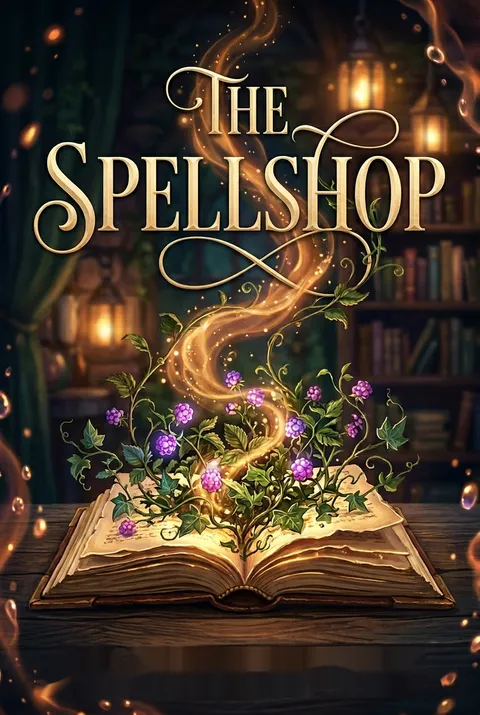


Plot Summary
Flight from Alyssium
For eleven years, Kiela has lived among the spellbooks of Alyssium’s Great Library, more comfortable with its shelves than with people. When revolutionaries seize the city and fire reaches the library, her anxious assistant Caz, a walking spider plant, forces her to stop packing and escape.
They take five crates of books on a library boat, leaving behind Kiela’s childhood keepsakes and nearly everyone she once knew. With no plan beyond getting away, Kiela remembers that her family still owns a cottage on remote Caltrey, the island where she was born. She steers north, carrying the last pieces of her old life toward a home she has not seen since childhood.
The fire breaks the routine Kiela has mistaken for permanence. Her rescue of books is both an act of professional duty and a choice to preserve the knowledge that made her feel safe. Yet the crates cannot restore the life around them: Kiela has no colleagues beside her, no family to return to, and no destination prepared. Her first step toward change is therefore not confidence but improvisation. Caz, whose fear contrasts with her fixation on the collection, is already the companion who can make survival a shared task.
A Cottage Reclaimed
The cottage is nearly swallowed by vines, and Kiela enters its dark rooms unsure whether she has made a terrible mistake. At dawn, she wakes to find Larran, a tall merhorse herder, checking on the abandoned house; his scythe frightens her, but he backs away when she panics. As she and Caz clean, pump water, and inventory the things her parents left behind, Kiela realizes they cannot live on the food they brought.
She goes to the village and meets Bryn, the talkative baker, whose customers stare at the returning daughter of Caltrey. Bryn explains that the island is struggling because imperial sorcerers stopped tending its weather, farms, and waters. Kiela buys provisions, seeds, and a hen, spending most of her remaining coins.
The cottage makes Kiela’s inner condition visible without turning it into a diagnosis: its useful rooms are still there, but neglect has obscured them. Cleaning becomes a practical rehearsal for inhabiting a life rather than merely hiding in it. The village complicates her private definition of safety. Its people are intrusive, yet their hardship comes from the same distant decisions that shaped her work inside the library. Bryn offers the first bridge between Kiela’s protected knowledge and the island’s unmet needs, while Larran’s help tests her boundary between care and unwanted intrusion.
Tomatoes Break the Law
Kiela’s first attempt to cook ends with smoke pouring from a stove whose chimney is clogged. Larran clears it, brings food, and teaches her how to light the fire safely, though his unasked-for help makes her bristle. A ride on his golden merhorse Sian opens the sea to Kiela and shows her how much the island has lost: the herd has not produced foals for years without sorcerers’ help.
Back at the cottage, she finds a plant-growth spell in a rescued book and uses it on her garden seeds. The tomato plants grow and fruit in moments. Their success offers more than a meal. Kiela decides to sell jam openly and conceal a second business beneath it, offering spells as harmless remedies.
The tomato spell marks Kiela’s shift from preserving knowledge to using it. This is not a sudden rejection of caution: she acts because ordinary survival has become impossible without skills she was never taught. Her irritation with Larran also reveals that help can feel like a threat when it arrives without permission. The merhorse ride gives her a different model of trust, one that requires accepting uncertainty rather than controlling every outcome. By imagining a shop, Kiela turns a private violation of the rules into a public service, though she has not yet reckoned with the risks of being known.
Jam Behind the Shelves
Kiela finds her parents’ handwritten raspberry-jam recipe and turns the fruit from her magically enlarged brambles into jars of preserves. Bryn tastes the first batch and agrees to supply sugar and wax in exchange for a share, making the shop a partnership rather than a solitary scheme.
With Larran’s help, Kiela builds shelves and learns that he once watched her care for a fragile merhorse foal when they were children. She and Caz then test a tree-strengthening spell, first producing an unexpected cactus and later healing a sick willow.
They adapt the working into a pine-cone remedy that takes effect gradually. Bryn and Eadie become the shop’s first customers, while Tobin befriends Caz and Fenerer, a sour dockworker, dismisses Kiela’s business before buying anything.
The jam is not only a cover; it is Kiela’s first way of converting memory into livelihood. Her parents’ recipe links the cottage to a family life she had stored away, while Bryn’s business partnership gives that inheritance a future-facing use. The pine-cone remedy makes the ethical tension concrete: Kiela wants to share knowledge, but she must disguise it to avoid punishment. Her first failed spell also matters. Magic here is not effortless wish fulfillment; it requires correction, humility, and attention to consequences. The shop lets her practice those skills among people rather than behind a library desk.
The Forest Comes Asking
After a customer asks about a spring that has stopped flowing, Kiela searches her books for possible remedies. The next morning, cloud bears gather in her garden, carrying a willow leaf, an apple branch, and a dead twig.
They lead Kiela and Caz deep into the forest to a huge, failing sycamore. Kiela buries one of their prepared pine cones among its roots and repeats the healing spell. Green life surges through the trunk and branches; one small cloud bear sheds bright tears that bring pale flowers from the soil.
A unicorn appears briefly among the guardians before vanishing into the trees. When Kiela and Caz return home, the forest spirits have left them food, spell ingredients, blueberries, and a woven coop containing the hen Kiela had lost.
The forest changes Kiela’s work from a bargain with individual customers into a relationship with a living community. The cloud bears do not ask for a performance or a price; they bring evidence of need and trust her to respond. Healing the old sycamore also tests the limits of the remedy on a scale larger than a garden tree. The gifts that follow reverse the direction of care: Kiela helps the forest, and the forest helps her survive. Her attention is no longer confined to what can be cataloged or owned. The book learning remains essential, but it now answers to reciprocal responsibility.
A Storm Brings a Stranger
Kiela misses the village’s storm warning and is caught on the shore as a magic storm turns its clouds into a sea serpent. She takes shelter at Larran’s house, where the two watch him ride Sian into the maelstrom to reach a capsized boat. He returns carrying a red-haired survivor, Radane, and Kiela helps warm and bandage both woman and her rescuer.
After the storm, a mermaid climbs to Kiela’s cottage with her storm-sick baby. Kiela searches a veterinary spellbook, finds the required rare verisad leaves, and mixes a cure. The merbaby’s lightning-like symptoms fade, allowing his mother to return him to the water. The rescue makes Kiela’s hidden magic useful in a crisis, but it also brings a politically complicated stranger into her new life.
Larran’s rescue gives Kiela a direct encounter with the kind of care she has rarely received: someone risks his own life for a stranger without first calculating what is owed. Kiela answers that act not with retreat but with skilled attention, turning research into lifesaving practice. The merbaby’s illness makes the storms’ abstract political cost bodily and immediate. It also forces Kiela to accept that keeping books safe is not enough if the knowledge inside them remains unused. Her choice to cast the cure is compassionate, but every success makes her secret harder to contain.
Sian’s Second Chance
Sian becomes sick after carrying Larran through the storm, showing the same dangerous symptoms as the merbaby. Kiela prepares another cure from the spellbook, distracts Larran with requests for ingredients, and applies it while Radane watches nearby.
Sian recovers, but Kiela cannot know how much Radane has understood. She then secretly uses another spell to restart Caltrey’s dry fountain. Islanders gather around its returning water, only for Radane to identify herself as an imperial inspector and demand the person responsible for illegal magic.
Fenerer points suspicion at Kiela. Radane searches the cottage and confiscates Kiela’s parents’ cookbook, then warns that anyone hiding the spellcaster could lose their property. Kiela realizes the danger now reaches beyond herself and Caz.
Kiela’s successful cures have made her useful, but usefulness does not protect her from institutions built to monopolize power. Radane’s accusation turns public gratitude into a potential liability: the fountain’s visible restoration cannot be passed off as ordinary gardening. Kiela’s fear is sharpened by the cookbook’s seizure because the threat reaches into family memory as well as legal safety. The sequence reveals a central conflict between knowledge as a shared resource and authority as its gatekeeper. Kiela cannot resolve it through private virtue alone; her choices have consequences for neighbors who did not choose to break the law.
The Books Go Underground
After Radane’s search, Kiela decides to hide the spellbooks in her boat and escape Caltrey before her friends are punished for helping her. Larran carries the heavy crates down to the cove without demanding an explanation, while Caz and the newly created cactus Meep insist on going with Kiela.
A mermaid guides them to a hidden cave whose walls glow with ancient painted flowers. Kiela returns to the cottage, where she tells Larran she stole the spellbooks while escaping the library fire and admits she wants to stay.
They kiss. In the cave, she discovers that Caz and Meep have tied Radane up after catching her trying to steal a spellbook. Radane finally admits she is a fugitive from the capital, not an inspector, and that she wants an ordinary life.
The hidden cave gives Kiela temporary physical safety, but the more consequential shelter is the trust Larran offers before knowing what she has done. Her confession marks a break from the evasions that have protected her, while their kiss makes leaving emotionally costly as well as practically difficult. Radane’s unmasking reverses the apparent power dynamic: the woman who threatened Kiela is also fleeing a system that has made her unsafe. The encounter asks whether a person can be judged only by the role they performed under pressure. Kiela’s instinct is to preserve life first, even when trust has not yet been earned.
An Heir Chooses Caltrey
In the cave, Radane reveals that she is Ravandil Etra L’sari, a distant heir to the dead emperor’s throne. The revolutionaries have won and installed a parliament, but factions on both sides could use her as a reason for further violence.
Kiela verifies Radane’s education with questions about the Great Library, then chooses to trust her rather than hand her over. Radane returns Kiela’s parents’ cookbook after the first inspector’s search, and she begins helping Kiela and Caz organize their books.
The group adapts a spell to help merhorses conceive; Kiela casts it on Marri with Larran and the healer Ivor present. As they confirm the spell works, an imperial warship arrives, forcing the islanders to hide Radane before its captain recognizes her.
Radane’s identity makes the political crisis personal rather than distant: the struggle over who governs the islands has turned her ancestry into a weapon. Her desire to refuse power parallels Kiela’s own effort to stop being defined by the library’s rules, though their risks differ. Kiela’s trust is not naïveté; she tests Radane’s knowledge and watches what she does with the cookbook she took. Their collaboration on the merhorse spell converts an alliance into shared work. The approaching warship then tests whether this new community can protect someone without pretending that danger has disappeared.
A House Disappears
To keep the captain from recognizing Radane, Bryn and Eadie draw the villagers toward the harbor while Radane slips away disguised in bakery clothes. The cloud bears hide her inside a tree.
Kiela uses the fast-growth spell to cover her cottage in vines and raspberries, concealing the bookshelves and entrance; Caz and Meep hide in the brambles. At the bakery, Captain Varrik questions the islanders about Radane, while Fenerer accuses Kiela of sorcery and helps direct the search toward her cottage.
Varrik’s soldiers find only thorns, and the captain accepts Kiela’s false account that Radane left by boat. He also protects his crew by ordering them clear of the supposedly poisonous berries. The ship departs, but an immense storm catches it at sea.
Concealment becomes a collective craft rather than Kiela’s solitary reflex. Bryn, Eadie, Larran, and the cloud bears each contribute a different kind of cover, from public distraction to literal transformation of the landscape. The overgrown cottage is an ingenious defense, but it also sacrifices the home Kiela has worked to restore. Captain Varrik’s conduct remains morally ambiguous: he asks questions, yet he gives his crew a reason to stop searching and does not force the issue. The scene tests how much protection can be built through small acts of judgment when formal law offers none.
The Pine Cone Coven
Kiela recognizes that the ship cannot survive the storm and persuades Radane, Larran, Bryn, Eadie, Ulina, Ivor, Caz, and Meep to help cast a wind-speaker spell. Ivor glides the group to the bakery, where Ulina coordinates their breathing and the others speak the spell in unison as seawater floods the floor. They must repeat it despite the rising water and the fear of failing.
During the casting, Caz tells Captain Varrik that the librarian who created him was punished for illegal magic and left trapped in the burning library. The storm finally breaks. Rain gives way to flowers, and the village survives. The spell saves the ship too, but its public, unmistakable magic leaves the group exposed to the imperials.
The climax answers the book’s central question through action: knowledge kept by a few can preserve authority, while knowledge practiced together can preserve lives. No single character can stop the storm. The spell requires coordination, shared breath, and a willingness to remain in danger while others falter. Caz’s account of his creator gives that choice personal history; the law has already destroyed someone who acted from care. The rain of flowers makes the rescue impossible to disguise, so the group’s triumph is not a return to safety but a public commitment to the values that made the risk necessary.
Varrik Chooses Mercy
The damaged imperial ship returns to Caltrey after the storm, and Captain Varrik can see the flowers and the magic that saved his crew. Kiela and her friends do not hide; they stand together on the dock, with Caz and Meep beside them. Varrik confirms that the laws against unapproved spellwork still stand, but he also acknowledges that he has no proof of who cast the spell.
Kiela asks him to choose what he does next rather than hide behind his orders. He publicly credits a traveling sorcerer, sends his crew to help repair the island, and leaves without arresting anyone. Fenerer boards the ship after Kiela secures his removal from Caltrey as compensation for his false accusations. Radane stays and begins work at Bryn’s bakery.
Varrik’s decision does not abolish the law or make the island safe by decree. Its importance lies in his refusal to treat obedience as moral innocence. Kiela cannot force him to protect the group, but she gives him the facts and leaves the choice with him. The dockside scene also turns solidarity into something visible: the plants, villagers, and outsiders stand together rather than allowing one suspect to be isolated. Radane’s new work offers a practical beginning, not an instant cure for political trauma. The ending grants safety through a person’s judgment and a community’s willingness to act.
Foals in the Cove
Four months later, Kiela, Caz, Meep, and the Pine Cone Society have turned spell research into shared island work, recording Caltrey’s remedies and improving local food and water. The storm-sickness cure and merhorse conception spell have held; Larran now has six pregnant mares.
When four begin labor at once, Kiela prepares the birthing mixture while Bryn, Eadie, Ulina, Radane, and Caz chant the spell and Larran steadies each mare. Four healthy foals are born, including Sian’s colt. After the others leave to prepare dinner, Larran tells Kiela he loves her and asks her to marry him without requiring either of them to abandon their home or work. Kiela accepts, certain at last that Caltrey is home.
The four-month leap measures change in daily practice rather than status. Kiela has become a researcher whose knowledge circulates through a community, while the coven’s coordinated spellwork replaces the empire’s distant, centralized intervention. The foals are a material answer to the island’s earlier decline, but they are also the result of care distributed among many people. Larran’s proposal respects Kiela’s attachment to her cottage, books, and work; he offers partnership without asking her to become smaller. Her acceptance resolves the opening’s displacement not by recovering the life she lost, but by building a new one she actively wants.
Analysis
The Spellshop links a personal recovery story to a political conflict over who is allowed to know and use magic. Kiela begins with a librarian’s instinct to preserve books by keeping them safe and separate. Caltrey makes that model inadequate: a dry fountain, dying orchards, sick merhorses, and violent storms are not solved by protecting knowledge from use. The novel does not claim that sharing knowledge is automatically safe. Kiela’s experiments produce dangerous surprises, and the threat of punishment is real. Instead, it contrasts solitary authority with accountable learning. Kiela researches, tests, admits uncertainty, and increasingly works with people who can question or assist her.
The island’s recovery is therefore communal rather than heroic in the singular. Bryn provides an economic foothold; Larran contributes practical skill and care; Radane brings formal magical training; Ivor supplies medical judgment; and the Pine Cone Society learns to coordinate its work. Even nonhuman characters participate as agents with their own needs, from Caz’s insistence on plant worth to the cloud bears’ guardianship. The eventual storm spell requires shared timing, not exceptional power from one person. Its flowers make the result beautiful, but also impossible to hide, forcing the group to rely on Captain Varrik’s choice rather than on a perfect escape from consequences.
Kiela’s emotional change follows the same movement. She does not stop loving books or solitude; she stops treating them as substitutes for mutual life. Her parents’ cottage, recipes, and memories become useful not because she retreats into nostalgia, but because she builds with them. Larran’s affection matters in this framework because he learns to respect her boundaries and offers a partnership that does not require her to surrender her work or home. The novel’s answer to institutional harm is not innocence or private goodness alone. It is knowledge made practical, relationships built through consent, and communities willing to share both risk and responsibility.
Review Summary
The Spellshop is a cozy fantasy romance that has garnered mixed reviews. Many readers praise its heartwarming atmosphere, magical creatures, and relatable characters, especially the talking plant Caz. The story follows Kiela, an introverted librarian, as she flees to a remote island and opens a spell shop disguised as a jam store. While some readers found the plot simplistic and the character development rushed, others appreciated the book's comforting tone and enchanting world-building. The romance subplot received mixed reactions, with some wanting more development.
People Also Read







Characters
Kiela
Librarian turned island-makerKiela is a sky-blue islander who has spent years tending spellbooks in Alyssium’s Great Library, where order and solitude have protected her from the uncertainty of ordinary relationships. She is careful, learned, and much better at researching people’s questions than answering personal ones. Her loyalty to books is profound, but it can narrow her sense of responsibility to what she can preserve rather than what she can share. On Caltrey, practical needs force her to learn gardening, cooking, business, and trust. Her curiosity makes her willing to experiment, while her caution reflects a real understanding of the danger she faces. Kiela is most herself when knowledge becomes useful to someone beyond her.
Caz
Anxious botanical companionCaz is a dog-sized, sentient spider plant and Kiela’s closest companion. Clever, bookish, and prone to imagining disasters, he is both her assistant and an independent moral voice. His botanical knowledge helps Kiela identify ingredients, plan the garden, and test spells, while his fears keep their risks from seeming trivial. Caz treasures books as much as Kiela does, but he also insists that plants possess worth beyond their usefulness. His humor softens difficult moments, and his growing ease with people challenges Kiela’s assumption that the two of them can manage best by remaining alone.
Larran
Merhorse herder next doorLarran is Caltrey’s strong, practical merhorse herder, a capable cook and builder who notices trouble before he is asked to help. His generous instincts can make him overstep, especially around Kiela, who needs to feel that her home and choices remain her own. When she pushes back, he learns to ask rather than assume. Beneath his steadiness is a history of loss and a deep commitment to caring for the people and animals around him. He values Caltrey’s interdependence, even when its future seems threatened, and his bond with Kiela grows through ordinary acts of work, apology, and attention.
Bryn
Caltrey’s relentless bakerBryn owns Caltrey’s bakery and meets uncertainty with food, practical generosity, and a rush of conversation. Her curiosity can feel intrusive, but she notices when someone is overwhelmed and knows how to turn welcome into concrete help. She supports Kiela’s jam business, supplies ingredients, and makes room for people who need a second chance. Bryn’s own past has taught her that a community can become a family through deliberate acts of protection.
Radane
Guarded capital fugitiveRadane is a red-haired newcomer whose polished education and guarded manner mark her as someone shaped by the capital. She wants a life beyond the political role others have assigned her, but fear makes her secretive and, at first, willing to manipulate the people around her. Her training in wind-speaking gives her knowledge Kiela and Caz lack, making her a useful collaborator as well as a wary guest. Radane’s conflict is between the safety of concealment and the harder work of being known. She is capable, proud, and more vulnerable than her formal bearing suggests.
Bryn
Caltrey’s relentless bakerBryn owns Caltrey’s bakery and meets uncertainty with food, practical generosity, and a rush of conversation. Her curiosity can feel intrusive, but she notices when someone is overwhelmed and knows how to turn welcome into concrete help. She supports Kiela’s jam business, supplies ingredients, and makes room for people who need a second chance. Bryn’s own past has taught her that a community can become a family through deliberate acts of protection.
Eadie
Blunt centaur elderEadie is an outspoken centaur who has lived long enough on Caltrey to remember how the island worked before imperial magic withdrew. Her bluntness can be comic, but it also carries hard-earned knowledge about grief, injustice, and the cost of looking away. She values loyalty without romanticizing it and is often the first to challenge someone who treats islanders as suspects rather than neighbors. Eadie’s practical courage helps turn Kiela’s private remedies into shared work.
Ulina
Four-armed harpistUlina is a four-armed musician and longtime Caltreyan whose harp can carry both melody and harmony. She is perceptive without needing to dominate a conversation, and she offers a quieter form of support than Bryn or Eadie. Her musical skill later proves useful beyond performance: she can coordinate a group through difficult, precisely timed work. Ulina values the island’s traditions of mutual aid and helps make those traditions active rather than merely nostalgic.
Tobin
Curious baker’s nephewTobin is Bryn’s energetic nephew, a boy with small horns and more questions than patience. He helps carry supplies, quickly befriends Caz, and is eager to get close to the merhorses. His enthusiasm makes him a natural messenger between newcomers and islanders.
Meep
Needled garden companionMeep is a mobile cactus accidentally brought to life through Kiela’s early spell experiments. They communicate in brief sounds, enjoy poetry, and quickly form a close bond with Caz. Their small size and sharp needles make them unexpectedly useful, from finding rare leaves to helping guard the hidden books. Meep’s presence also makes Kiela responsible for a new kind of life, extending her care beyond the plants she already understands.
Ivor
Winged island healerIvor is Caltrey’s healer, a small, antlered man with leathery wings and knowledge he does not advertise. He understands the island’s creatures and can recognize when a spell has succeeded, but he also knows why some kinds of knowledge must be kept discreet. Ivor treats Kiela as a potential partner in healing rather than a curiosity, and his willingness to help connects traditional local care with her book-based research.
Sian
Golden merhorse mareSian is Larran’s golden merhorse, intelligent, spirited, and particularly fond of tomatoes. Her trust is earned rather than commanded, and her close bond with Larran reflects the care he gives his herd. Sian embodies the mutual dependence between Caltrey’s fishermen and merhorses, whose dwindling numbers threaten the island’s food supply.
Marri
Pale-blue merhorse mareMarri is a young pale-blue mare in Larran’s herd. Her health and age make her central to his hopes for future foals, and her calm response to his handling allows Kiela to try a carefully researched spell.
Fenerer
Suspicious dockworkerFenerer is a scaled dockworker who distrusts newcomers and is quick to blame Kiela for anything unusual. His complaints give voice to real Caltreyan suspicion, but his grudges make him a poor judge of evidence. He resents Kiela’s presence and covets the land around her family cottage.
Halio
Keeper of a dry springHalio is an elderly islander with mottled blue-green skin and a soft voice. Her family’s spring has stopped flowing, and her question leads Kiela toward researching ways to restore old enchantments. Halio remembers that Caltrey once relied more on its own small acts of magic.
Captain Varrik
Imperial ship captainCaptain Varrik is a disciplined commander whose assignment brings him to Caltrey in search of a politically important fugitive. He is observant, understands the limits of evidence, and does not mistake courtesy for weakness. His loyalty to orders is real, but so is his capacity to question what those orders require. Varrik’s choices show how institutional power can be exercised with restraint, even when its laws remain unjust.
Terlu Perna
Caz’s librarian creatorTerlu Perna is a librarian whose compassion and curiosity lead her to create a sentient plant. She is remembered by Caz as gentle and unwilling to cause even small creatures pain. Her story connects his existence to the risks of forbidden magic and to the tenderness that can motivate rule-breaking.
The mermaid
Protective cove motherThe mermaid who lives near Kiela’s cove is fiercely protective of her child and capable of communicating with land-dwellers when urgency demands it. Her trust in Kiela grows from the librarian’s willingness to help rather than from any shared history. She later guides Kiela and her friends to safety, making the relationship between islanders and merfolk an active alliance.
The merbaby
Storm-struck sea childThe merbaby is a curious child who swims near Kiela’s cove and delights in small discoveries. His vulnerability to excess storm magic shows how the island’s political imbalance reaches even its youngest inhabitants.
Plot Devices
The rescued spellbooks
Knowledge under protectionKiela’s five crates of spellbooks preserve knowledge that the old empire restricts to approved sorcerers. The books give Kiela the means to grow food, heal trees, restore water, treat storm sickness, and help merhorses reproduce. They also make her vulnerable: if an imperial authority discovers them, Kiela and her friends could be punished, and the books might be confiscated or destroyed. Their movement from burning library to boat, cottage, and hidden cave tracks Kiela’s changing understanding of her duty. Protecting the books matters, but using and sharing their knowledge becomes just as important.
The jam shop
A wholesome public coverKiela uses her parents’ preserves jars and raspberry recipe to open a legitimate jam business. Bryn supplies sugar and wax, while the shop gives Kiela a reason to meet villagers and earn food without explaining the spellbooks. Behind the shelves, she offers magical pine cones as ordinary remedies. The shop’s familiar goods make the hidden work possible, but its customers also create relationships and obligations that Kiela cannot treat as a disguise. It becomes both cover and the first public institution Kiela builds for herself.
Pine-cone remedies
Slow magic made portableKiela and Caz adapt a tree-healing spell into a prepared pine cone that can be buried among a tree’s roots. By speaking the spell before the cone is planted, Kiela delays the visible effect and makes the treatment easier to mistake for a traditional remedy. The device lets Kiela share useful magic without requiring every customer to have her books or training. Its imperfect development also creates risk: changing ingredients or pronunciation can produce surprising results, so Kiela must learn to test carefully and teach others the correct method.
Caltrey’s magic storms
Political neglect made weatherThe empire’s concentration of magic in the capital leaves the outer islands without the sorcerers who once balanced weather, soil, and sea. Caltrey suffers failing crops, shrinking merhorse herds, erratic temperatures, and storms powerful enough to threaten homes and ships. These storms turn policy into immediate physical danger, forcing Kiela and her new community to decide whether knowledge should remain restricted. The final storm also makes the consequences of their spellwork public, so survival and exposure arrive together.
The cloud bears
Forest guardians and refugeCloud bears, mistaken in local stories for forest spirits, guard trees and communicate through gestures and offerings. They bring Kiela ailing branches, allowing her to heal an ancient sycamore and establish trust with the forest. Later, they help conceal Radane inside a tree while the imperial ship searches Caltrey. Their intervention gives the natural world agency in the plot: the forest is not scenery or a supply of ingredients, but a community that responds to care and offers protection in return.
FAQ
Synopsis & Basic Details
What is The Spellshop about?
- Librarian flees burning city: Kiela, a librarian, escapes a revolution in Alyssium with her sentient plant assistant, Caz, taking with her a collection of powerful spellbooks.
- Seeking refuge on Caltrey: They arrive on Caltrey Island, where Kiela's family once lived, and try to build a new life while keeping the spellbooks secret.
- Balancing magic and community: Kiela opens a jam shop as a cover, but she also uses her knowledge of magic to help the islanders, leading to both challenges and connections.
Why should I read The Spellshop?
- Unique blend of genres: The book combines elements of fantasy, adventure, and cozy mystery, creating a unique and engaging reading experience.
- Compelling characters: The story features a diverse cast of characters, each with their own unique motivations and complexities, making them relatable and memorable.
- Exploration of themes: The book explores themes of knowledge, power, community, and the importance of finding one's place in the world, offering readers plenty to ponder.
What is the background of The Spellshop?
- Fantasy world with magic: The story is set in a world where magic exists but is controlled by an empire, leading to social and political unrest.
- Revolution and its aftermath: The revolution in Alyssium is a key event that sets the plot in motion, highlighting the consequences of unchecked power and the desire for change.
- Outer islands and their struggles: The outer islands of the empire, like Caltrey, are depicted as places where people struggle due to the empire's neglect and the withdrawal of magical support.
What are the most memorable quotes in The Spellshop?
- "They invited you in, fluffed up the pillows on the couch, offered you tea and toast, and shared their hearts with no expectation that you'd do anything more than absorb what they had to give.": This quote encapsulates Kiela's love for books and their comforting nature.
- "We'll be all right. We'll make it all right. Kiela, you can't break down on me now. You're all I've got.": Caz's words highlight the deep bond between him and Kiela and their reliance on each other.
- "Because knowledge is power, and the powerful want—wanted—to keep it all to themselves.": This quote reflects the central theme of the book, the struggle for access to knowledge and the consequences of its control.
What writing style, narrative choices, and literary techniques does Sarah Beth Durst use?
- Character-driven narrative: The story focuses on the internal thoughts and emotions of Kiela, making her journey relatable and engaging.
- Use of humor and wit: The book incorporates humor through the interactions between Kiela and Caz, as well as through the quirky personalities of the islanders.
- Foreshadowing and symbolism: Durst uses subtle foreshadowing and recurring symbols, such as the color blue and the image of the sea, to enhance the story's themes and create a sense of depth.
Hidden Details & Subtle Connections
What are some minor details that add significant meaning?
- The mermaid statue: The broken mermaid statue in the town square foreshadows the broken state of the island and the need for healing and restoration.
- The winged cats: The winged cats of Caltrey, initially described as plump and pampered, become thinner and rougher, reflecting the island's decline and the impact of the empire's policies.
- The cinnamon buns: The recurring appearance of cinnamon buns, both as a gift from Larran and as a staple in Bryn's bakery, symbolizes the warmth and community that Kiela finds on Caltrey.
What are some subtle foreshadowing and callbacks?
- The mention of a librarian turned to wood: The story of the librarian punished for using magic foreshadows the potential dangers Kiela faces for possessing the spellbooks.
- The description of the library lift: The lift's slow and creaky descent foreshadows the challenges Kiela will face in her new life, as well as her longing for the familiar comfort of the library.
- The merbaby sighting: The merbaby's appearance in the cove foreshadows the connection Kiela will form with the merfolk and the role they will play in her journey.
What are some unexpected character connections?
- Larran's childhood connection to Kiela: Larran's childhood memory of Kiela and her parents reveals a deeper connection between them, adding a layer of complexity to their relationship.
- Bryn's past in the southern isles: Bryn's backstory as a refugee from the southern isles adds depth to her character and explains her empathy for Kiela's situation.
- Ivor's knowledge of magic: Ivor's ability to recognize the spellwork and his understanding of merhorse biology hints at a hidden depth to his character and his connection to the island's magic.
Who are the most significant supporting characters?
- Bryn: As the owner of the bakery, Bryn provides a sense of community and support for Kiela, offering her a place to belong and a way to connect with the islanders.
- Eadie: As a centaur with deep roots on Caltrey, Eadie offers wisdom and guidance to Kiela, helping her understand the island's history and traditions.
- Ulina: The multi-armed harpist provides a sense of joy and creativity, reminding Kiela of the importance of art and music in the face of adversity.
Psychological, Emotional, & Relational Analysis
What are some unspoken motivations of the characters?
- Kiela's desire for belonging: Beneath her love for books, Kiela craves connection and a sense of belonging, which she finds on Caltrey.
- Larran's need to protect: Larran's actions are driven by a deep-seated need to protect others, stemming from his past losses and his desire to make up for his parents' actions.
- Radane's yearning for freedom: Radane's desire to escape her imperial obligations reveals a yearning for a life free from the constraints of power and tradition.
What psychological complexities do the characters exhibit?
- Kiela's social anxiety: Kiela's preference for books over people stems from her social anxiety and her fear of rejection, which she gradually overcomes as she forms new relationships.
- Larran's survivor's guilt: Larran's tendency to put others' needs before his own is rooted in his survivor's guilt and his desire to make up for his past losses.
- Radane's internal conflict: Radane's struggle to reconcile her desire for an ordinary life with her obligations as the emperor's heir highlights her internal conflict and her search for identity.
What are the major emotional turning points?
- Kiela's decision to open the shop: Kiela's decision to open the jam shop marks a turning point in her journey, as she begins to embrace her new life and use her knowledge to help others.
- The merhorse ride: The merhorse ride with Larran is a pivotal moment for Kiela, as she experiences a sense of freedom and connection that she had never felt before.
- The storm and the rescue: The storm and Larran's rescue of Radane force Kiela to confront her feelings for him and her fears about the future.
How do relationship dynamics evolve?
- Kiela and Caz's codependency: Kiela and Caz's relationship evolves from a reliance on each other to a more balanced partnership, as they both learn to trust others.
- Kiela and Larran's growing intimacy: Kiela and Larran's relationship evolves from a neighborly connection to a deep and meaningful bond, as they share their vulnerabilities and support each other.
- The Pine Cone Coven's camaraderie: The formation of the Pine Cone Coven highlights the importance of community and the power of shared experiences, as the women come together to support one another.
Interpretation & Debate
Which parts of the story remain ambiguous or open-ended?
- The future of the empire: The story leaves the future of the Crescent Islands Empire ambiguous, raising questions about the long-term impact of the revolution and the new government.
- The nature of magic: The source and nature of magic remain somewhat mysterious, leaving room for interpretation and further exploration in future stories.
- The extent of Radane's influence: The story leaves open the question of how Radane will use her knowledge and power, and whether she will ever return to Alyssium.
What are some debatable, controversial scenes or moments in The Spellshop?
- Kiela's decision to steal the spellbooks: Kiela's decision to steal the spellbooks from the Great Library raises questions about the ethics of her actions and the justification for breaking the law.
- The use of magic for personal gain: Kiela's use of magic to create a successful jam shop raises questions about the morality of using power for personal gain, even if it also benefits others.
- The decision to hide Radane: The decision to hide Radane from the imperial authorities raises questions about the ethics of defying the law and the potential consequences for the islanders.
The Spellshop Ending Explained: How It Ends & What It Means
- A new beginning: The ending of The Spellshop emphasizes the importance of community, resilience, and the power of hope. Kiela finds a new home and a new purpose on Caltrey, surrounded by friends and loved ones.
- The power of choice: The ending highlights the importance of making choices that align with one's values, even in the face of uncertainty and danger. Kiela chooses to stay on Caltrey, embracing her new life and her growing love for Larran.
- Open to interpretation: While the ending provides a sense of closure, it also leaves room for interpretation and further exploration, suggesting that the characters' journeys are far from over. The future of the empire and the role of magic in the world remain open-ended, inviting readers to imagine what might come next.
About the Author


Download PDF
Download EPUB
.epub digital book format is ideal for reading ebooks on phones, tablets, and e-readers.








