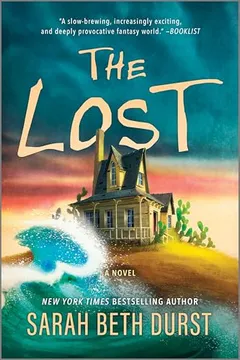


Plot Summary
The Turn She Misses
Lauren Chase,1 twenty-seven and afraid of what her mother’s4 latest medical tests may show, drives straight through the turn she usually takes toward work. She tells herself she only needs distance, but the empty highway and her unanswered phone leave her alone with the news she is avoiding. A strange dust bank swallows the road.
Inside it, Lauren1 glimpses a beautiful, tattooed man in a black coat,2 then emerges beneath a night sky with the storm gone. An unmarked exit leads to a wooden sign welcoming travelers to Lost. Lauren1 has no signal, no clear idea where she is, and no plan beyond finding food and delaying the call home. She follows the road into town.
Lauren’s flight begins as an attempt to control the timing of bad news. She cannot change her mother’s test results, so she changes direction instead, mistaking motion for agency. The dust makes that avoidance visible: it erases the familiar road while offering no actual escape. Lauren’s jokes and practical plans are defenses against a fear she cannot yet name. The encounter with the black-coated stranger hints that the landscape may respond to emotional disorientation, but Lauren still interprets the impossible through the habits of an office worker trying to manage a crisis.
A Town Called Lost
At the decaying Pine Barrens Motel, teenage clerk Tiffany8 accepts Lauren1’s Life Savers in exchange for a suitcase rather than money. The Moonlight Diner refuses her credit card, and its residents mention a Missing Man5 who can explain the town. In the morning, Lauren1 drives out, but every passage through a dust bank deposits her beside the welcome sign again.
She turns around repeatedly until her car runs out of gas inside the storm. The black-coated stranger2 appears on the roof and pushes the dead car for miles, eventually getting Lauren1 back to Lost. He identifies himself as Peter,2 a Finder who brings lost people out of the void. He cannot send her home, but warns that the void can destroy her.
Lost turns ordinary inconvenience into a trap with rules Lauren cannot negotiate around. Barter, unreliable roads, and a car without fuel strip away the assumptions that money and competence guarantee mobility. Peter’s rescue complicates her fear: he behaves like a threat but uses his strength to help her. His distinction between finding and sending also establishes a crucial limit. Lauren has found a guide, not an exit, so her old strategy of simply leaving becomes impossible.
The Missing Man Refuses
Lauren1 searches town for fuel and a working phone, but every resident sends her to the Missing Man.5 Even the diner’s rotary phone connects only to dead numbers. When the Missing Man5 finally arrives, the whole town treats him as its lifeline. He offers to explain Lost, then hears Lauren1’s full name and abruptly leaves.
The residents follow him, pleading for help, while Victoria,6 the diner’s formidable waitress, orders Lauren1 out. The townspeople blame Lauren1 for driving away the one person who can send them home. With no other source of help, Lauren1 walks after him through abandoned houses, but he vanishes into the desert. She sleeps in her car, stranded between a town that hates her and a mother4 she cannot reach.
The Missing Man’s rejection converts Lauren’s private fear into a communal crisis. She did not choose to strand the town, yet the residents treat her as the cause because her arrival coincides with the loss of their rescuer. That reasoning is emotionally understandable and ethically dangerous: desperation simplifies causality until someone must be blamed. Lauren’s pursuit also repeats her original pattern. She believes that if she can catch the person holding the answer, she can repair what has gone wrong, even when she does not understand what happened.
Claire Finds the Finder
When Lauren1 returns to town, the angry residents gather outside the motel and demand that she bring back the Missing Man.5 Claire,3 a small girl in a torn princess dress, takes Lauren1’s hand and leads her through a maze of alleys to Peter2’s hidden apartment. There, amid Christmas lights, toys, and photographs, Peter2 offers food and shelter.
Claire3 explains that her parents left her behind in a grocery store, and Peter2 found her. He takes Lauren1 to a deserted yellow house suited to her imagined art studio. Upstairs, Lauren1 discovers Mr. Rabbit, the childhood toy she lost years earlier. Peter2 cannot explain how the house and rabbit appeared, but Lauren1 accepts his help because the crowd outside has made trust a necessity.
Claire’s courage disrupts the adult town’s logic of blame. She does not demand an explanation from Lauren before helping; she responds to the immediate danger and lets trust grow afterward. Peter’s apartment and the yellow house provide an alternative to Lost’s public hostility, but the rabbit unsettles Lauren because it reaches into a private past she thought she had outgrown. The refuge offers comfort without certainty. Lauren accepts both, learning that safety sometimes begins with dependence before it becomes understanding.
Lessons on the Rooftops
Peter2 teaches Lauren1 and Claire3 how to scavenge without drawing attention, climb across roofs, and avoid the town’s armed collectors. In one house, they find a man dead on the couch, apparently lost there after dying elsewhere.
Before they can leave, teenagers fire into the house, forcing the trio to hide. Lauren1 struggles to accept that Lost contains real danger and that death offers no simple way out. Later, an intruder steals Claire3’s new teddy bear, Prince Fluffernutter.
Peter2 returns to guard the girls and eventually recovers the bear, though the thief is already dead. To keep the hostile residents away, Lauren,1 Peter,2 and Claire3 stage their own deaths with red paint and recordings of feral dogs, buying themselves several days of safety.
Survival in Lost requires Lauren to revise the moral categories she brought from home. Taking food from an abandoned house feels like theft, yet refusing to scavenge could leave Claire hungry. The dead man and armed teenagers make danger concrete, while the staged deaths show Lauren learning to manipulate appearances rather than plead for fairness. Peter’s protection is practical, not unlimited, and Claire’s competence comes from a childhood spent managing threats. Their improvised household is becoming a team, even as Lauren insists it is temporary.
The Wall Has No End
After several days, Peter2 gives Lauren1 a bicycle, water, and a blond wig so she can search for an escape without being recognized. She circles Lost, watching the void spit out lost objects and even a house, but finds no break in its immense boundary. Returning defeated, Lauren1 admits that she has no route home.
Peter2 takes her to a hidden barn where stolen and missing masterpieces hang under sheets, including paintings Lauren1 recognizes from art history. The sight gives her a rare moment of wonder. She begins to understand that Lost is more than a junkyard, though she still refuses to call it home. Peter2’s gift has failed as an escape plan but opened a different way of seeing.
The bicycle gives Lauren a new instrument of agency, but the ride ends by proving that effort cannot always produce an exit. The void’s ability to expel houses makes the landscape feel both generative and predatory. Peter answers Lauren’s despair not with a route out but with art, a form of beauty that has survived being displaced. His gesture is intimate because he understands what might reach her, yet it also asks her to attend to the present rather than treating Lost only as an obstacle.
The Train Through Nothing
The void advances toward town, and Victoria6’s cook, Sean,7 disappears inside it. Victoria6 points a shotgun at Lauren,1 blaming her arrival for the danger. To save Sean7 and win Victoria6’s trust, Lauren1 walks into the void, where guilt and fear make her begin to fade.
Peter2 arrives on a ghostly steam train, pulls Lauren1 aboard, and finds Sean7 hiding in its engine. Lauren1 emerges carrying a blue star sapphire ring that Sean7 recognizes as an old engagement ring. He proposes to Victoria,6 and the two discover their renewed bond.
The desert then gives Lauren1 an ocean from her childhood. She swims with Peter,2 a dolphin, and strange fish, while Victoria6 and Sean7’s outlines begin to glow. Lauren1 has helped them recover what they need without the Missing Man.5
Lauren’s first deliberate entry into the void changes her from a person waiting for rescue into someone willing to risk herself for another. The void attacks through the very thoughts she has avoided, making despair feel like a fact rather than a state. Peter’s train offers a route through that mental and physical danger, while the ring connects Sean’s past to his present with Victoria. The sudden ocean translates Lauren’s buried longing into landscape. Lost is not merely taking things from her; it is making what she has neglected impossible to ignore.
A Lie Buys Time
Victoria6 and Sean7 accept Lauren1’s help and bring food to the yellow house, though Lauren1 stays wary of the town. At dinner, Peter2 reveals that the Missing Man’s5 absence has preceded disaster before: once, the void consumed an entire town. Since Lost needs people to believe the Missing Man5 will return, Lauren1 proposes a cover story.
Victoria6 and Sean7 tell the residents he left to help someone and will come back. The void retreats as the story spreads. Lauren1 and Peter2 shelter in the art barn, where she kisses him; he returns the kiss, then pulls away. The next morning, Claire3 reports that the town is celebrating. Peter2 leaves to search for the Missing Man,5 while Lauren1 remains with Claire3 and waits for his return.
The lie works because it gives frightened people a story they can inhabit together. It is not a cure, and Lauren knows the reprieve may be temporary, but collective hope changes the town’s behavior and the void’s reach. Her kiss with Peter similarly tests a new possibility without resolving it. Both forms of intimacy remain provisional: the residents borrow confidence from an absent guide, while Lauren and Peter cannot yet say what their closeness means. The section makes hope an action, something people sustain through choices rather than receive as reassurance.
Tiffany’s Last Prom
Tiffany8 brings Lauren1 toiletries and asks her to search the void for the memory she lost on prom night. She also knows that Claire3’s parents searched for their missing daughter and now live in Scottsdale. Lauren1 enters the void through the ocean and finds her own yellow prom dress, then a newspaper dated 1986. Its report identifies Tiffany8 as a teenager killed in a car crash on the way to prom.
Lauren1 returns with the evidence. Tiffany8 reads the article, accepts that she died, and tells Claire3 where her parents moved before running toward town. The discovery gives Claire3 a real destination beyond Lost. It also proves Lauren1 can emerge from the void carrying objects connected to another person’s deepest loss.
Tiffany’s story turns the town’s strange customs into evidence of grief held in suspension. Her fixation on prom details preserves the threshold before the event she cannot remember, while the newspaper forces that missing night into view. Lauren’s own dress appears first, suggesting the void is responsive to memory, but her task is to attend to Tiffany rather than retreat into her own history. The revelation offers Claire a path toward family, yet it also raises the cost of staying: people may be able to leave if they can face what they have lost.
Lauren Becomes a Finder
As residents begin seeking Lauren1’s help, some recover what they need and others reject what she brings. Colin,9 a teenage boy, explains that he spread cruel lies about a girl who later died by suicide. Lauren1 enters the void and finds a handmade photograph of Colin9 and his younger brother. Colin9 first insists it is not the answer, then recognizes that his brother needs him; a soft glow appears around him.
Lauren1’s uncertain successes draw more people to the yellow house. The Missing Man5 returns and tells her that her mother4 is dying. He says he brought the house and Mr. Rabbit for Lauren,1 then demonstrates his power by sending Colin9 home. He invites Claire3 to go too, but she refuses and runs away.
Lauren’s help is not a supernatural vending machine that supplies the object a person names. Colin receives a keepsake from a past he cannot repair, but its meaning changes when he sees an obligation to someone still living. The distinction between recovering an object and recovering a capacity for responsibility is central to Lauren’s emerging role. The Missing Man’s return then collides with her own unspoken crisis. His offer exposes a cruel asymmetry: the town can be sent onward, while Lauren’s unresolved attachment to her mother still holds her.
Claire Refuses Home
Lauren1 follows Claire3 to Peter2’s apartment and learns that the girl3 has run toward the void, where Peter2 must search for her. He tells Lauren1 that her mother4 is dying, and she finally says the truth aloud. While Peter2 searches, Lauren1 returns to town to tell the residents the Missing Man5 is back. She leads a crowd to the yellow house, but he is gone.
Claire3 hides in the attic, terrified of leaving Lauren.1 As Lauren1 promises they can go together once she finds what she has lost, Claire3 turns translucent and disappears. Lauren1 understands too late that she has repeated the Missing Man’s5 sending gesture. Unable to face the crowd, she escapes through the attic window and falls into the ocean below.
Claire’s refusal is not childish ingratitude; Lost has become the first place where she has found dependable care, so departure feels like another abandonment. Lauren tries to reassure her with a future promise, but the act of naming their shared return releases Claire before Lauren is ready. The accidental sending dramatizes the difference between wanting someone safe and controlling what safety means. Lauren’s flight into the ocean echoes her childhood refuge, but now the water is not an escape from responsibility. It is the only route away from a crowd expecting her to perform a miracle.
The Art She Lost
Exhausted, Lauren1 swims to shore and escapes a pack of dogs by crossing Peter2’s rooftop bridges to the art barn. Alone among the hidden paintings, she gathers bicycle parts, ribbon, a feather, and tiny teddy bears into a moving sculpture. Peter2 finds her and explains that she lost more than an object: illness pushed aside her artistic dreams and the future she imagined.
Lauren1 realizes she can help people find what will heal them, then send them onward, as the Missing Man5 does. Peter2 begs her to stay because Lost needs her and because he has come to love her. Lauren1 chooses to return to her mother4 and sends Peter2 away with the words that release the found. The barn dissolves, and Lauren1 wakes in a hospital.
Lauren’s sculpture is not a recovered masterpiece but a new work made from what Lost discards. Its motion and odd materials show her creating rather than merely retrieving, which marks the difference between the artist she was and the person she can become. Peter’s plea makes the choice costly: staying would answer a real need in Lost and offer him companionship, while leaving means facing an irreversible human loss. Lauren’s power does not erase that conflict. It lets her act, but action still requires choosing whom she can be present for.
Three Months Awake
Lauren1 wakes with a breathing tube in a Los Angeles hospital. Doctors explain that her car flipped on Route 10 and that she has been in a coma for three months, not trapped in Lost for weeks. Her ribs have healed, but she can barely stand. Her mother’s4 oncologist, William Barrett,10 tells her that the ovarian cancer has spread and is terminal.
Lauren1 insists on visiting her mother,4 then tells her the whole story of Lost. Her mother4 listens, jokes with her, and admits she once wanted to act but abandoned the dream. She says that loving Lauren1 kept her from feeling lost. For the first time, Lauren1 stops treating the illness as information she can postpone and stays beside her mother4 without demanding a cure.
The coma revelation offers a medical explanation without dissolving the emotional reality of Lauren’s experience. Lost may be dream, supernatural place, or both, but its central confrontations have prepared her to meet facts she once evaded. Her mother’s abandoned acting ambition mirrors Lauren’s suppressed art, making their conversation a recognition between two people who have deferred parts of themselves. William’s blunt diagnosis also replaces the distant test result with a person and a prognosis. Lauren’s growth is not certainty about what happened, but a willingness to remain present despite uncertainty.
A Goodbye Without Evasion
Lauren1 moves from her own hospital bed to her mother’s4 room and remains there despite pain and weakness. Her mother4 asks her to eat, rest, and speak honestly about what she feels. Lauren1 admits she is not ready for the loss, then listens as her mother4 describes a childhood dream of acting and the life she chose instead.
On the day her mother’s4 condition worsens, Lauren1 sits beside her, shows her sketches, and confesses that she had hoped to take her to Lost. Her mother4 says she would not have belonged there because her love for Lauren1 meant she was not lost. Lauren1 tells stories of the town and their shared life until her mother4 dies. At the funeral, she reads poems and gathers memories from friends and family.
The goodbye reverses the opening’s central evasion. Lauren first drove away rather than hear what her mother’s tests might mean; now she stays through the hours when there is no solution to pursue. Her mother’s refusal of Lost reframes belonging as a relationship rather than a place or a guarantee of survival. The sketches matter because Lauren uses her art to hold attention on a person she cannot save. Grief does not become orderly, but it becomes shared and witnessed, which is different from the solitude Lauren sought on the highway.
Claire Is Safe
At the cemetery, Lauren1 glimpses the Missing Man5 walking away but cannot catch him before he vanishes. After the funeral, she tells William10 she needs to travel and drives to Scottsdale with Mr. Rabbit and a plant from her mother’s4 apartment. News reports lead her to Claire3’s elementary school. Lauren1 watches from her car as Claire,3 older and alive, plays hopscotch with other girls and joins her classmates in line.
Claire3 does not see her. Lauren1 chooses not to interrupt the child’s3 new life or claim the bond they formed in Lost. She leaves Scottsdale in tears, carrying the knowledge that Claire3 has a family and a school, while Lauren1 has no proof she can ever return to the strange town or find Peter2 again.
Seeing Claire safe does not give Lauren the reunion she wants. It asks her to distinguish love from possession: the child she protected in Lost now has a life that does not need Lauren to enter it. Lauren’s restraint completes a difficult lesson that began with her mother. Care cannot always mean keeping someone close, and longing does not grant authority over another person’s future. The Missing Man’s brief appearance at the cemetery keeps Lost uncertain, but Lauren’s choice is concrete. She leaves Claire undisturbed and accepts the grief that follows.
Route Ten Again
Lauren1 drives east, hoping the road will lead her back to Lost, but the sky stays clear. She passes the point where she could turn toward her old routines, then deliberately leaves Route 10 on foot when the car runs out of gas. This time she carries water, food, sketches of her mother,4 a funeral memory book, and Mr. Rabbit.
The walk is dangerous, and Lauren1 imagines the ordinary future she might have built with William,10 her art, and a child named Claire.3 She keeps going anyway. Only when the desert blurs around her does dust finally gather. Lauren1 steps into it, then runs, carrying her grief and her hope toward the place she once fled.
The ending returns Lauren to the same geography with a different motive. Her first drive east began in avoidance, without a destination or even the courage to hear her mother’s news. Now she leaves the highway deliberately, prepared for the physical danger and aware of the life she is choosing not to pursue. The imagined future with William is not dismissed as false or worthless; it is a genuine possibility she must relinquish. The dust offers no guarantee of return, only a threshold Lauren enters by choice.
Analysis
The Lost makes avoidance spatial. Lauren1’s first refusal to turn toward home becomes a road that loops back, then a town sealed behind dust. The fantasy does not simply punish her for running away; it gives her a place where the costs of emotional evasion become visible. Lost’s residents are surrounded by abandoned objects, but the important losses are rarely possessions. A ring can lead Sean7 toward a renewed commitment, a school photograph can redirect Colin9 toward someone still alive, and a childhood toy can reveal how deeply Lauren1’s past remains attached to her present.
The novel also distinguishes rescue from possession. Peter2 can bring people into Lost, but he cannot make them stay or send them onward. His loneliness is understandable, yet it does not entitle him to Lauren1’s future. Claire3’s dependence on Lauren1 is real, but Lauren1’s eventual decision not to disrupt the child3’s life in Scottsdale recognizes that affection is not ownership. These tensions make the relationships more than rewards for the protagonist. Each person asks Lauren1 to care without pretending that care guarantees control.
Lauren1’s development is measured less by whether she finds a magical answer than by whether she can remain present. At first, she avoids her mother’s4 test results and hides behind plans, jokes, and motion. In Lost, she learns to enter danger for Sean,7 to listen to Tiffany8’s history, and to sit with her mother4 without trying to turn grief into a solvable task. Art becomes the clearest sign of this change. Lauren1 once abandoned it as an impractical dream; in the barn, she makes something from discarded materials, converting attention into creation.
The hospital revelation leaves the ontology unsettled, but the emotional knowledge survives it. Whether Lost is supernatural, a coma dream, or a form that grief takes in Lauren1’s mind, it has changed what she can acknowledge. Her final walk into the dust is not a repetition of her first flight. She now knows what she risks, what she has lost, and why she is choosing to go.
Review Summary
Reviews of The Lost are largely positive, averaging 3.99/5 stars. Readers praise the unique premise of a town where lost things and people gather, the relatable protagonist Lauren, and the emotionally resonant mother-daughter relationship. The mysterious love interest Peter and child character Claire are frequently highlighted as standouts. Common criticisms include choppy writing style, slow pacing in the middle sections, underdeveloped romance, and inconsistent worldbuilding. The 2025 updated edition, which includes a new ending, was generally welcomed by readers frustrated by the original's unresolved cliffhanger.
People Also Read




Characters
Lauren Chase
Reluctant lost travelerLauren is a twenty-seven-year-old project manager who once hoped to become an artist. She is quick with jokes, prone to imagining worst-case scenarios, and skilled at building practical plans that can also help her avoid painful truths. Her closeness to her mother4 is the emotional center of her life, though fear makes her retreat when that bond is threatened. In Lost, Lauren begins as an observer who wants to get home without changing. Her growing care for Claire3 and Peter2 challenges that self-protective distance, while the strange town brings her neglected creativity back into view. She is neither naturally fearless nor instinctively selfless; her courage appears when she chooses to act despite uncertainty.
Peter
Hope’s wandering FinderPeter is a striking, black-coated guide who can find lost people in the void and bring them to Lost. He hides his loneliness behind teasing, literary allusions, and a restless, almost theatrical manner. With Claire3, he is playful and protective; with Lauren1, he alternates between provocation and tenderness, wary of attachment because people repeatedly leave him. His compassion is active rather than sentimental: he searches the void, teaches others how to survive, and protects the people he finds. Yet his devotion to Lost can make him resent those who still want a life elsewhere. Peter embodies the painful difference between helping someone and being able to keep them.
Claire
Feral princess survivorClaire is a small girl in a battered princess dress who carries a teddy bear and knows how to use a knife. She says her parents left her in a grocery-store cart, and she has survived in Lost by scavenging, watching danger, and relying on Peter2. Beneath her toughness, she is polite, imaginative, and hungry for ordinary childhood pleasures such as school, stories, and cupcakes. Claire recognizes kindness quickly, but her independence has been shaped by years without dependable adults. Her bond with Lauren1 gives her a new model of care, while her attachment to Peter2 makes their makeshift family feel precious. She resists being treated as helpless, even when she needs protection.
Lauren’s mother
Lauren’s anchor at homeLauren’s mother is warm, observant, and wry, using humor to make difficult truths bearable without pretending they are harmless. She has raised Lauren1 largely on her own and remains attentive to her daughter’s1 habits, ambitions, and evasions. Her own postponed dreams and love of flowers reveal a life that is larger than her role as a parent, even as illness narrows her choices. She gives Lauren1 affection without indulging every excuse, and she can turn a practical request into a lesson in honesty. Their relationship is intimate but not simple: Lauren1 wants to protect her mother4, and her mother4 wants her daughter1 to build a life beyond caregiving.
The Missing Man
Gatekeeper of returnThe Missing Man is an older, carefully dressed guide whom Lost’s residents depend on to help them recover what they need and return to their lives. His cane, briefcase, and gentle manner give him the air of a trusted professional, but he is not always available and does not explain everything he knows. His relationship with Peter2 is strained by a history neither man readily shares. To the residents, he represents the possibility that their time in Lost is temporary. To Lauren1, his choices create both hope and frustration, because he understands more than he is initially willing to reveal.
Victoria
Hard-edged diner keeperVictoria is the polished, commanding waitress who runs the Moonlight Diner and keeps its unruly customers in line. Her beauty and sharp humor conceal a guarded temperament; she values control because life has given her reasons to distrust easy promises. She initially sees Lauren1 as a threat to the town’s fragile order, then has to reconsider that judgment as Lauren1 acts on behalf of others. Victoria’s relationship with Sean7 is both affectionate and complicated by a painful past. She is capable of loyalty, but she expects it to be earned through deeds rather than assurances.
Sean
Kitchen’s guarded heartSean is the diner’s broad-shouldered cook, known for turning an improbable assortment of ingredients into memorable meals. He is warmer and less confrontational than Victoria6, though his history with Peter2 includes conflict and mistrust. Cooking gives him a way to care for people without making a performance of tenderness. He and Victoria6 share a bond shaped by what each has lost and by the possibility of beginning again. Sean’s steadiness makes him an important counterweight to the town’s suspicion, even when he cannot make its dangers disappear.
Tiffany
Stranded teenage clerkTiffany is the Pine Barrens Motel clerk, frozen in an adolescent style of leg warmers, loud hair, and practiced disdain. Her casual manner can make alarming statements sound like routine complaints, but beneath the pose she is searching for an explanation of her own place in Lost. She experiments with new looks as if identity might be chosen from a costume rack. Her bargaining instincts fit the town’s economy, yet her vulnerability shows through whenever she asks whether she has become the person she should be.
Colin
Remorseful lost boyColin is a teenage boy who arrives at Lauren’s1 house carrying shame over harm he caused at school. He can describe his own cruelty plainly, but he is initially convinced that guilt must be paid through punishment rather than changed behavior. His bluntness is mixed with a real wish to take responsibility toward people still living. Colin’s story gives Lauren1 an early test of whether helping someone means finding the exact object they request or helping them see what remains possible.
William Barrett
Steady hospital oncologistWilliam Barrett is Lauren’s mother’s4 oncologist, a thoughtful physician who makes time for patients and families beyond the minimum demanded by his work. He is organized and somewhat perfectionistic, but his care for Lauren1 is personal as well as professional because her mother4 once helped him through a family loss. He offers companionship at a moment when Lauren1 is vulnerable, and his reliability contrasts with the dreamlike intensity of Peter2. William is kind without being effortlessly understood; Lauren1 has to decide whether she can meet him as a real person instead of as an answer to loneliness.
Merry
Merry diner guideMerry is a friendly diner regular who welcomes newcomers and offers advice with a light touch. She notices more than she initially explains, and her warmth helps Lauren1 see that Lost’s strange residents are not all hostile. Her ease with the town’s customs makes her a quiet guide to its emotional rules.
The penny collector
Pennies and vanished fortuneA former business magnate now searches Lost’s gutters for pennies, convinced that one coin may restore his luck. His fixation reduces an enormous former life to a handful of small objects. He illustrates how residents can mistake the thing they chase for the need beneath it.
Plot Devices
The Void
A border that feeds despairThe motionless dust wall surrounds Lost and separates it from the ordinary world. It swallows sound, returns lost objects and places, and can make people fade when they surrender to despair. Lauren1 first mistakes it for a weather problem, then learns it is dangerous even when it seems calm. Its changing distance from town gives the residents a visible measure of their hope and fear. The void is both a physical barrier and a landscape that draws buried grief into the open.
The Finder and Missing Man
Arrival and return, split apartThe Finder2 brings lost people safely out of the void and into Lost. The Missing Man5 helps them discover what they need and sends them back to their lives. Neither role can simply replace the other, which leaves the town vulnerable when the Missing Man5 vanishes. Their divided powers create the story’s central practical problem: being found is not the same as being able to go home. Lauren’s1 encounters with both men gradually reveal that the roles may depend on more than the titles they carry.
Lost Objects
Objects make private grief visibleThe town is built from misplaced, abandoned, and discarded things, from wallets and lunch boxes to houses and paintings. Some objects are useless scraps; others connect a person to a memory, responsibility, or abandoned desire. Lauren1 learns that an object’s importance is not measured by its price or age. The right find can reveal what someone has been unable to face, while the wrong one can deepen pain. This device lets the novel turn emotional history into something tangible without making recovery as simple as picking up a possession.
The Glow
A sign of readiness to leaveSome residents develop a faint light when they have found what they need and are ready to move on. The glow is subtle and visible more easily from the edge of someone’s vision, making it a fragile rather than authoritative signal. Lauren1 begins to notice it around people whose inner conflicts have shifted. It distinguishes being physically present in Lost from remaining emotionally bound to it, while leaving open the question of whether another person can decide that someone else is ready.
The Remembered Ocean
Memory turns into landscapeAn ocean appears in the desert after Lauren1 reconnects with her childhood memories of swimming with her mother4. Its tides, fish, boats, and dolphin change alongside Lauren1’s attention and feelings. The sea gives her a place to move through memories rather than merely describe them, and it becomes both refuge and route into the void. Its presence blurs the boundary between external magic and inner experience, sustaining the story’s ambiguity even after Lauren1 wakes in a hospital.
About the Author



Download PDF
Download EPUB
.epub digital book format is ideal for reading ebooks on phones, tablets, and e-readers.








