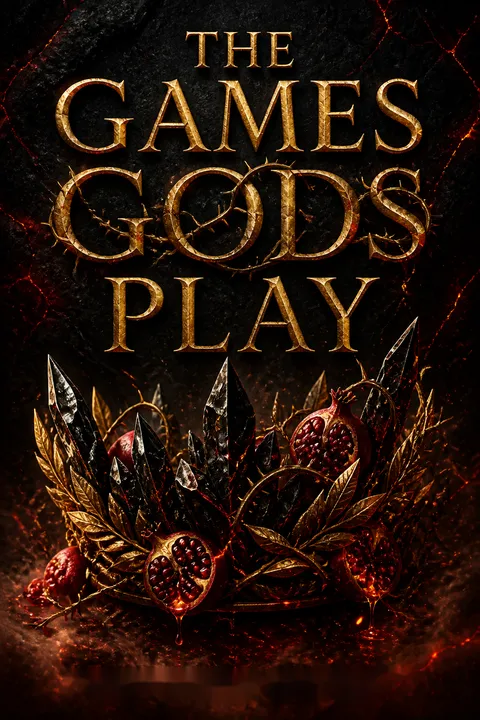


Plot Summary
Prologue
Lyra1 lies wounded on blood-soaked ground, close enough to see Zeus5 approaching. She knows she has come near to breaking her curse and reaching the man she wants,2 yet the path that brought her here may have cost her everything.
As Zeus5 nears, she braces for the final blow. The opening frames the story as a race toward disaster, then sends the reader back to the night Lyra1 first defied a god and met Hades.2
The prologue makes the book’s central uncertainty immediate: Lyra may be nearing love and freedom, but she may also be dying because she reached for more than survival. Its future glimpse does not explain the cause of her injuries, so suspense rests on how her choices accumulate rather than on whether danger exists. The image of Zeus standing over her also turns the story’s divine hierarchy into a personal threat. The narrative’s promise is not simply that Lyra will fight the gods, but that her struggle to be loved will become entangled with the power to decide who lives.
Lyra Defies Zeus
In San Francisco, Lyra Keres1 works as a clerk for the Order of Thieves, watching apprentices pick pockets near Zeus’s5 lightning-lit temple. She has lived with a curse since birth: Zeus5 decreed that no one would love her, and her parents surrendered her to the Order when she was three.
When master thief Chance exposes Lyra’s1 unreturned feelings for Boone,3 the kind, capable thief she has loved from afar, humiliation breaks through her practiced self-control. Lyra1 abandons her post and heads for Zeus’s5 temple, intending to force the god to undo the curse. She reaches for a rock to throw at the building, but a stranger2 catches her wrist before she can strike.
Lyra’s first decisive action is not a bid for romance but a refusal to keep absorbing humiliation as if it were ordinary. Her clerical position has trained her to observe others’ risks while remaining outside the work she longs to do. Chance’s taunt exposes how that exclusion has become intimate: she expects affection to be impossible before she has the chance to ask for it. Approaching Zeus’s temple converts private despair into an act with public consequences. Her rebellion is reckless, but it is also the first time she treats the curse as an imposition to challenge rather than a fact that defines her.
Death Chooses Lyra
The stranger restraining Lyra2 is Hades,2 King of the Underworld2 and Zeus’s brother.5 Instead of punishing her, he learns about her curse and lets her leave, addressing her by her real name despite her attempt to hide it. At the Crucible’s opening, the gods choose mortal champions to compete in twelve dangerous Labors for the right to rule Olympus.
Hades2 has never entered before, but he selects Lyra,1 publicly challenging Zeus.5 At Olympus, he privately promises to remove her curse if she wins. The rules establish that champions can die and that refusing the contest may endanger someone in their place. Lyra1 understands she has been caught in a divine contest, but the promised chance to be loved makes escape impossible to accept.
Hades’s choice gives Lyra what Zeus’s curse has denied her: a consequential place in a world that usually treats her as disposable. Yet the offer is not straightforward rescue. Hades chooses for her before she understands the contest, and the binding rules sharply limit her ability to refuse. The bargain therefore fuses hope with coercion. Lyra enters not because she trusts the gods, but because the possibility of lifting the curse is too powerful to dismiss. Hades’s public challenge to Zeus also makes her a symbol in a conflict she did not create, forcing her to distinguish her own desire from the gods’ ambitions.
The Bowl’s Hidden Message
The champions’ first test gives each a hidden token among enchanted treasures. Lyra1 notices that the token symbols are etched on the undersides of objects, a clue she discovers by watching Zai Aridam,4 Hermes’s6 withdrawn champion.
She gives Artemis’s22 token to its rightful champion17 and explains the pattern to the group. Ares25 retaliates by destroying Lyra’s1 own token, apparently leaving her without the gifts needed for the coming trials. Hades2 reminds her indirectly that the objects carry directions, and Lyra1 finds raised cryptic marks on a bowl.
She follows their route up Olympus’s dangerous stairs, running through illusions of monsters and reaching Hades2 just before time expires. He awards her living animal tattoos that can scout and carry messages, and a kiss that grants safe passage through the Underworld.
Lyra’s instinct to share information is both generous and costly. She improves the other champions’ odds, then loses her own obvious path to success when Ares destroys her token. Her recovery depends on the skills the Order undervalued: patient observation, reading hidden codes, and finding a loophole in a system designed by people who expect obedience. The animal tattoos extend her intelligence outward, turning perception into a practical power. Hades’s kiss is simultaneously a protective tool and an intimate encounter, making the line between magical utility and personal desire difficult for Lyra to keep clear.
Boone Brings a Thief’s Kit
Before the first official Labor, Boone3 sneaks into Hades’s2 penthouse to bring Lyra1 practical supplies: her clothes, a tactical vest, his personal lockpicking kit, and his own relic, enchanted dragon teeth that can summon bone soldiers. He reveals that he has known about Lyra’s hidden axe for years and never reported her. His help unsettles her because she has long mistaken his distance for indifference.
Hades2 outfits her for the coming trials and gives her six black pearls, hinting that they can protect her. He also admits he chose her because she did not cower when they first met, while withholding the larger reason for entering the Crucible. Lyra1 accepts Boone’s equipment and recognizes that she has a real stake in surviving.
Boone’s visit challenges Lyra’s assumption that the curse makes every relationship hollow. His concrete choices matter more than reassurance: he risks his standing, lends tools he values, and entrusts her with a relic that could secure his own future. Lyra has learned to interpret care as pity or accident, so accepting help requires a more difficult skill than stealing: allowing another person to choose her. Hades’s gifts complicate this emerging trust. His support is useful, but his secrecy leaves Lyra unable to tell where protection ends and strategy begins.
The Sea Dragons Hatch
Poseidon’s7 Labor begins with the champions tied above cold water inside Fingal’s Cave in Scotland. Lyra1 climbs her post, uses her relic to cut herself loose, then returns to free the others rather than escape alone. As the tide falls, warnings carved into the cave wall reveal eggs that hatch into fast-growing sea monsters.
Lyra1 uses Boone’s dragon teeth to summon bone soldiers, which fight the creatures while the champions discover that covering the remaining eggs prevents them from hatching. The survivors reach safety, but Isabel’s earlier bite begins consuming her body with blackened venom. Lyra1 holds Isabel’s hand as she dies in agony. Zeus5 declares Demeter’s8 champion Diego13 the winner for identifying the hatchlings’ weakness.
The trial makes the difference between individual survival and collective responsibility brutally concrete. Lyra risks losing her gear and her chance to win by returning to free others, then deploys a tool Boone entrusted to her when ordinary strength fails. Yet cooperation cannot undo the damage already done: Isabel dies after the immediate puzzle is solved. The scene forces Lyra to experience leadership as presence rather than control. She cannot rescue Isabel, but she refuses to leave her alone. The gods’ announcement of a winner immediately after a champion’s death exposes the emotional distance built into the Crucible’s rules.
Zai Becomes Her Ally
After Isabel’s death, Lyra1 approaches Zai,4 who is sick with allergies and belittled by his father, Mathias, the previous Crucible winner. Zai4 could have freed himself earlier but followed Mathias’s advice not to trust anyone, a choice that left Isabel without help. Lyra1 offers an alliance based on their different strengths.
In Hermes’s6 Labor, champions must solve a truth-and-lies riddle while their narrow platforms shrink whenever anyone asks a question. Lyra1 shares her partial deduction through her tattooed owl, and Zai4 supplies the decisive question. He wins the winged sandals and keeps his promise to fly Lyra1 down. Dex,15 who had plotted with other champions to eliminate rivals, retaliates by helping drive Zai4 from their shared house.
Zai’s alliance begins in the shadow of a preventable death. His father’s demand for mistrust has protected Zai from vulnerability at the cost of his capacity to cooperate, and the price is visible in Isabel’s fate. Lyra does not ask him to become stronger or more socially polished; she offers a reciprocal arrangement in which his reasoning and her attentiveness complement each other. The riddle’s mechanics reward that exchange. Winning does not erase the risk of trust, as Dex’s retaliation demonstrates, but Zai’s choice gives both champions something they lacked: a partner whose judgment they can use.
Vodka Becomes Medicine
Dionysus sets the champions a race through a rainforest cavern, where the winner must carry the most vodka to a distant waterfall before night. Lyra,1 Zai,4 Meike,14 Trinica,18 and injured Amir build a pallet to transport their share. Poison ivy blisters their skin, but a broken bottle reveals that the vodka relieves the burns.
When living vines attack after dark, Lyra1 takes medicine from Zai’s4 supplies and runs to treat Dex’s15 separated group as well. Meike’s14 reaction worsens after the team runs out of vodka, so Lyra1 swallows one of Hades’s pearls and carries her back to obtain an EpiPen. The Daemones seize Hades2 for violating the rules by giving Lyra1 the pearls. Jackie, who flew ahead with two bottles, wins.
The Labor turns its apparent prize into the only available treatment, making success depend on recognizing that care and competition cannot be cleanly separated. Lyra repeatedly spends time and resources on people who may later oppose her, including Dex’s group. That choice does not make her naïve; it reflects an ethical refusal to let the game define whose suffering counts. Saving Meike requires breaking a rule Lyra has been warned about, and the consequences fall on Hades as well as her. Her compassion now has a cost measured in punishment, not merely lost points.
A Melody Opens Olympus
Apollo21 and Artemis22 combine their Labors. In Apollo’s21 room, a grotesque harp bites champions who try to play it; Lyra1 discovers that humming is the music it needs, opens the next door, and wins Apollo’s21 prize, the Tears of Eos, which reveal darkness and enchantments. Artemis’s22 obstacle course sends champions past bats, electrified tunnels, and a dragon.
Lyra1 loses her Courage flag and suffers a severe burn, but reaches Hades2 at the finish. Dae17 wins by arriving with all four flags. Asclepius cannot immediately heal Lyra,1 and Hades2 has already been taken by the Daemones for the pearl she used to rescue Meike.14 Lyra1 is left injured and without her patron beside her.
Lyra’s accidental humming, once treated as a flaw that could expose a thief, becomes the exact skill the harp requires. The reversal is not a sudden transformation into a conventional hero; it is an instance of her existing habits finding a context in which they matter. Artemis’s course then strips away any easy triumph. Lyra reaches Hades but cannot prevent injury or secure a win. The contrast between her sensory attentiveness and the games’ physical demands emphasizes that survival depends on varied forms of intelligence, while divine rule-making continues to place her at a disadvantage.
Boone Wakes in the Forest
Aphrodite’s9 Labor sends each champion into a dream to find the mortal they love most and wake them before sunset. Lyra’s1 pegasus carries her to Boone’s3 cabin in Muir Woods, where giant spiders guard his sleeping body. She first admits she loves him, but he cannot wake because her confession does not express the full truth.
Lyra1 explains that she has carried a crush since adolescence and values the kindness he showed her, freeing Boone3 from the dream. He returns with her to Olympus and joins the next Labor. Dae’s grandmother,17 however, remains trapped until sunset and dies. Neve16 wins by rescuing her sister Nora, leaving Lyra1 to face both relief at Boone’s3 return and fresh grief for another champion’s family.
Aphrodite’s test distinguishes the fantasy of being loved from the more specific truth of what Lyra feels. Lyra’s first confession is sincere, but it cannot release Boone because it carries the weight of an imagined mutual romance. Her second account is smaller and more accurate: gratitude, a long crush, and the importance of ordinary kindness. That honesty frees him without changing his feelings. The Labor therefore gives Lyra an emotionally meaningful connection without turning desire into a prize she can claim. Dae’s grandmother’s death also makes the deadline literal, showing that emotional revelation cannot guarantee rescue.
Boone Falls From the Tower
Hephaestus pairs each champion with a loved one for a tower challenge. Boone3 joins Lyra,1 and they defeat a murderous golden child automaton, then solve a chess puzzle. To save time, Boone3 proposes climbing the tower’s exterior instead of confronting more machines. A hidden metal tentacle strikes through a window and knocks him from the wall.
Lyra1 watches him fall onto iron spikes, then forces herself to keep climbing while carrying his death with her. At the top, Hades2 brings her to the Underworld, where grief finally overwhelms her. Hades2 tells her that winning could let him make Boone3 immortal, giving Lyra1 a reason to continue beyond her own survival. She is wounded, but the full damage is still masked by shock.
Boone’s death collapses the distinction Lyra has tried to maintain between a crush and a life that matters. His last action is protective, but the tower’s design makes that care physically fatal. Lyra’s continued climb is not proof that she feels less; it is the survival discipline that has kept her functioning since childhood. Hades’s offer redirects grief into a possible future, but it also risks turning Boone into a goal that Lyra must earn. The promise gives her agency at a moment when loss has made her feel powerless, while intensifying the cost of every later decision.
The Styx Burns Her Wound
Lyra’s1 tower wound becomes infected, and mortal doctors cannot stop its spread. Hades2 stays at her bedside, seeking treatments while she slips in and out of fever. When ordinary care fails, he gives her his own blood and pours River Styx water over the wound, a dangerous treatment that could kill her. Lyra1 survives and wakes in the Underworld, scarred but lucid.
During her prolonged unconsciousness, the other champions complete Demeter’s,8 Hera’s,23 and Ares’s25 Labors: Diego13 wins twice, Zai4 and Rima12 share a victory, and Neve16 dies. The scoreboard now places Lyra1 far behind. Hades2 asks her to abandon the contest, but Lyra1 insists on returning because she still wants a chance to save Boone.3
Hades’s vigil shifts their bond from attraction and tactical cooperation toward a form of care that neither can fully control. His treatment is not safe, and its danger makes his investment legible through action rather than declaration. Lyra’s recovery, however, does not restore the time she has lost. While she lies unconscious, the contest moves forward and other champions suffer without her. The resulting gap forces her to choose between protecting her body and pursuing the only path she can imagine toward Boone’s return. Her determination is not simple optimism; it is grief converted into a decision she can still make.
Elysium Changes the Stakes
After she recovers, Lyra1 gathers the surviving champions in Hades’s2 Underworld home. She offers a bargain: if she wins, Hades2 will give those who died in the Crucible a choice between remaining in Elysium and returning to life. Hades2 shows her Elysium, where souls inhabit worlds shaped to their own deepest wishes, and assures her Boone3 will be safe there even if she fails.
Lyra1 and Hades2 finally surrender to their mutual desire, though he insists he cannot promise a mortal future. The next morning, Rima12 reports that the champions rejected Lyra’s1 proposal because her prophetic visions show Hades2 ruling Olympus and burning the world. Lyra1 must compete against the people she had hoped to unite.
The offer expands Lyra’s motive beyond her private grief: she wants the dead to have choices, not merely rewards imposed by gods. Hades’s tour of Elysium complicates her urgency by showing that death need not mean abandonment, yet Lyra still wants Boone back among the living. Their intimacy arrives amid clear limits, with Hades naming the future he cannot offer. Rima’s prophecy then makes the conflict ethical rather than merely romantic. The champions’ refusal is not simple betrayal; they fear a future they believe they have seen, leaving Lyra to act without the coalition she tried to build.
Meike Dies in the Maze
Athena20 sends the champions into a glass maze filled with enlarging spiders, scorpions, ants, and hornets. Lyra1 uses her animal tattoos to navigate and helps other champions when she can, but Meike14 reaches the exit first. Dex,15 made increasingly aggressive by a blessing or enchantment, attacks her and kills her after she has already won.
Lyra,1 Trinica,18 and Zai4 intervene; when Dex15 turns on Lyra,1 Trinica’s18 strike and Zai’s4 sword bring him down, with Zai4 delivering the fatal blow. Lyra1 denounces Athena20 for engineering the violence. The Daemones remove Lyra1 from the arena and imprison her for challenging the goddess, while Zai4 is left to bear the guilt of killing Dex.15
The maze turns a competition for points into a moment when victory offers no protection from violence. Meike has completed the task, yet Dex kills her, exposing how little the rules can restrain a champion already manipulated by divine power. Lyra’s instinct is to intervene, but rescue does not prevent death and can leave survivors with a burden of responsibility. Zai’s action stops Dex’s assault, while forcing him to confront the possibility that he has become the kind of killer his father praised. Lyra’s public accusation rejects the gods’ framing of cruelty as merely a fair contest.
Aphrodite Reveals Persephone
During her confinement, Lyra1 learns that her birth parents lied publicly about her childhood and have no claim over her; the Order is the only home she has known. She asks Zai4 to secure a promise from Hermes6 that Boone3 could become a god if Zai4 wins. Aphrodite9 visits and hears Lyra’s1 secret: Persephone24 is not dead, but trapped in Tartarus.
Aphrodite9 refuses to tell Demeter,8 fearing another war. As the final Labor approaches, Hades2 remains distant, and Lyra1 suspects his affection was a strategy to make her win. He takes her to Zeus’s5 desert challenge and tells her to finish and forget him. His answer leaves her hurt, but she enters the trial with her own judgment still intact.
Confinement strips away Lyra’s remaining hope that her birth family might offer an uncomplicated home. She responds by building chosen obligations: she asks Hermes to help Boone and entrusts Aphrodite with a dangerous truth about Persephone. The revelation makes Hades’s motive clearer but not simpler. He has concealed a life-threatening secret, and Lyra is right to question the cost of that secrecy. His coldness before the final Labor appears to confirm her worst interpretation, yet she does not surrender her judgment to his wishes. The section makes trust a contested practice, not an automatic reward for intimacy.
The Sirens Cannot See Her
Zeus’s5 final Labor sends the champions through three gates and past monsters, beginning with a minotaur and a kraken. Lyra1 uses Boone’s dragon teeth to summon bone soldiers while the others help close each gate. At the last stretch, sirens’ songs lure the champions away; Lyra1 alone resists. She realizes Zeus’s curse has made her invisible to them because she cannot be loved.
Though the final gate is within reach, she refuses to claim the win while her friends remain captive on the sirens’ island. Lyra1 spends her remaining pearls ferrying the champions back to the desert. They refuse to leave her behind and push her across the finish line, turning her rescue into a shared act of loyalty.
The curse that has governed Lyra’s loneliness becomes, at the climax, a tactical advantage. The reversal is deliberately bitter: the quality that has made her feel unseen also lets her move among creatures who hunt through desire. Yet Lyra refuses to use that advantage only for herself. She could win by taking the final gate, but she chooses to risk her remaining means of escape to recover the others. Her friends’ decision to wait and push her across completes the reversal. The person who believed no one would choose her becomes the person a group chooses to carry home.
Zeus Strikes Cerberus
After the finish, Zeus5 sends an enchanted Cerberus11 against Lyra.1 She gives the hellhound11 her last pearl so he can reach the Styx and be healed, but Zeus5 then blasts her with lightning, opening a mortal wound. Hades2 arrives after escaping Zeus’s5 imprisonment and defeats his brother;5 Dae’s17 Lantern of Diogenes exposes Zeus’s5 cheating during the Labors, and the Daemones take him away.
Lyra1 is dying, and Hades2 admits he chose her partly because the curse would let her pass unseen by the sirens. She understands that he pushed her away so she would choose for herself, but she cannot survive the wound. Hades2 gives Lyra1 his Underworld crown, surrendering his rule to bring her back as a goddess.
Zeus’s attack confirms that the contest’s rules offer no protection once he fears losing power. Lyra’s final pearl is spent not on her own escape but on Cerberus, a choice that preserves the relationship rather than the competition. Dae’s lantern supplies evidence against Zeus, showing that truth itself must be made visible before authority can be challenged. Hades’s admission exposes the painful mixture of strategy and love in his choice of Lyra. His transfer of the crown is not a victory over death by force; it is a relinquishing of the power he sought, because Lyra matters more than the throne.
Lyra Wins the Crucible
Lyra1 awakens as a goddess and Queen of the Underworld. At the coronation, the Daemones rule that she crossed Zeus’s5 finish line while mortal and won the final Labor’s three bonus points. Her earlier victory in Apollo’s21 challenge makes her the Crucible’s overall winner. She uses her boon to ask Hades2 to make Boone3 a god.
Hades2 grants the request, and Boone3 takes the mantle of god of thieves from Hermes.6 Hades2 then promises a boon to every champion and blessing to their families, including the dead. As ruler of Olympus,2 he demands Pandora’s Box, the instrument he believes can reach Persephone24 in Tartarus. Lyra1 and Hades2 leave the ceremony with a new family, new power, and a dangerous plan.
The victory is recognized not because Lyra defeats every rival, but because the rules count her survival, her earlier win, and her choice to return for the others. She spends the prize on Boone, converting a reward intended for one champion into a new future for someone she loves. Hades’s coronation similarly answers his hidden aim, but his promise to bless every champion redirects sovereign power away from exclusive privilege. The ending appears to resolve Lyra’s opening wound: she is no longer excluded from love or authority. The demand for Pandora’s Box, however, warns that power used for rescue may carry consequences beyond the lovers’ intentions.
Epilogue
The day after Hades2 becomes King of the Gods,2 he and Lyra1 use Pandora’s Box to open the gates of Tartarus and reach Persephone.24 The box is not a harmless key: opening it could release the Titans, and it can be used only once.
As the door opens, Boone3 suddenly grabs Lyra1 and she is pulled inside with him. The gates shut, trapping her in Tartarus beside Cronos, Hades’s Titan father.2 Outside, Hades2 pounds against the sealed door. Lyra1 realizes that Rima’s12 vision of Hades2 destroying the world may not have been averted after all.
The epilogue turns the apparent reward of the main story into a new moral crisis. Hades’s love has become explicit, Lyra has gained power, and Boone has returned, yet the method chosen to save Persephone strands Lyra beside the being whose imprisonment shaped the gods’ order. The abrupt transfer from agency to captivity echoes Lyra’s earliest loss of control, but this time Hades is outside, actively trying to reach her. Rima’s prophecy remains unresolved rather than disproved. The ending therefore refuses to equate romantic fulfillment with safety: love gives the characters a reason to risk the world, not proof that their gamble will succeed.
Analysis
The novel’s most consequential reversal is that Lyra’s curse becomes both a wound and a form of access. Zeus5 defines her as unlovable, and Lyra1 internalizes that sentence as a forecast of every relationship. Yet the final Labor makes her inability to inspire desire useful against sirens who hunt through it. The reversal does not suggest that suffering was secretly beneficial. Rather, it shows that an imposed identity cannot exhaust the person living under it.
The Crucible’s structure repeatedly converts ethics into a tactical disadvantage. Champions can save time by betraying one another, but Lyra’s1 instinct to intervene creates the alliances that later save her. Her choices are not rewarded consistently: she fails to save Isabel, Meike14 dies, and Boone3 is killed despite their teamwork. This unevenness matters. The story does not treat compassion as a magical guarantee of success; it treats it as a chosen practice whose value persists even when outcomes are brutal.
Hades2 and Lyra1 mirror each other through secrecy. Both have learned that vulnerability can be used against them, so Hades2 withholds his purpose and Lyra1 hides her need. Their intimacy becomes credible only when Lyra1 begins to interpret his actions rather than accept his claims. His final sacrifice of the Underworld crown answers the fear behind his possessiveness: love cannot be secured by naming another person as one’s own. It is demonstrated by surrendering power and accepting the possibility of loss.
The ending expands this personal resolution into a political question. Lyra1 wins through loyalty, not domination, and Hades2 promises boons beyond the victor’s household. Yet the epilogue shows that care can still produce catastrophe when it is guided by secrecy and desperate certainty. The book’s strongest lesson is not that love defeats power, but that power becomes more humane when it answers to chosen responsibility, shared truth, and the freedom of others to decide.
Review Summary
The Games Gods Play receives mixed reviews, with praise for its engaging trials, Greek mythology elements, and entertaining plot. Critics enjoy the action sequences and Hades' character. However, some find the writing immature, characters underdeveloped, and romance forced. Readers debate whether it's better suited for YA or NA. Many compare it to Percy Jackson and The Hunger Games. Despite criticisms, fans eagerly anticipate the sequel, drawn in by the cliffhanger ending and overall enjoyment of the story's premise and execution.
People Also Read




Characters
Lyra Keres
Cursed thiefLyra is a twenty-three-year-old clerk in the Order of Thieves, trained to observe details and keep accounts but denied the status of a full thief. Zeus’s curse has convinced her that lasting affection is impossible, so she masks loneliness with sarcasm, competence, and a stubborn refusal to ask for help. Her attention to codes, habits, and small changes becomes a practical strength in the Crucible. Beneath her self-protective humor is a persistent instinct to notice who is vulnerable and act, even when doing so costs her. Her central struggle is to distinguish self-respect from isolation and to choose care without surrendering her agency.
Hades
King of the UnderworldHades is the feared ruler of the dead, an outsider among the Olympian gods and a master of both power and concealment. He enters the Crucible with a purpose he initially refuses to explain, selecting Lyra1 because she meets a god’s gaze without submission. His public persona is controlling, sardonic, and deliberately provocative; in private, he shows a deep sense of responsibility for mortal souls and fierce loyalty to a very small circle. Hades’s difficulty is not a lack of feeling but a conviction that revealing it gives others leverage over him. His connection with Lyra1 challenges his reliance on secrecy and control.
Boone Runar
Master thief and first loveBoone is a master thief in Lyra’s1 den, physically imposing, quick-witted, and unusually patient with apprentices. His cocky manner conceals a generous streak and a strong practical intelligence. He has known Lyra1 since she was young, but his teasing and friendliness have left her unsure whether she matters to him beyond the Order. Boone trusts skill over status, values loyalty among thieves, and acts decisively when someone needs help. His relationship with Lyra1 carries the history of her first serious attachment and the painful gap between loving someone and being loved in return.
Zai Aridam
Asthmatic strategistZai is Hermes’s6 champion and the son of Mathias Aridam, winner of the previous Crucible. Thin, observant, and often weakened by allergies and asthma, he is easy for others to mistake for fragile or passive. He is highly intelligent, cautious, and shaped by a father who treats trust as a liability. Zai’s reasoning helps him solve problems that strength cannot, while his emerging friendship with Lyra1 asks him to risk dependence on another person. He is not simply a grateful ally: he makes deliberate choices, weighs consequences, and tries to protect the people who place their confidence in him.
Zeus
King of the OlympiansZeus rules Olympus through spectacle, authority, and the expectation of obedience. His lightning gives his power a visible signature, while his immaculate presentation makes his public image seem inseparable from his rule. He is proud, punitive, and accustomed to treating mortal lives as small matters, as shown by the lasting curse he places on Lyra1 and his failure to remember it. His rivalry with Hades2 is not merely sibling resentment; it is a contest over who controls divine order. Zeus’s desire to preserve his position makes him especially dangerous when a human being disrupts the rules he expects everyone else to accept.
Hermes
Patron of thievesHermes is the quick, calculating messenger god and traditional patron of the Order of Thieves. His relationship with Lyra1 is uneasy: he knows her as one of his Order’s pledges but does not accept her as his champion. He prizes wit and movement, and his Labor tests both through a riddle that punishes careless questions. Hermes represents the difference between belonging to an institution and being recognized by its patron.
Poseidon
God of the seaPoseidon is a theatrical and proud Olympian whose first Labor turns cold water, falling tides, and hidden sea creatures into instruments of fear. He expects the champions to respond to the spectacle he has created, and his temper rises when the outcome threatens his standing. His conduct shows how the gods’ public role as hosts can conceal a personal appetite for control and display.
Demeter
Grieving goddess of harvestDemeter is a powerful goddess of harvest whose grief over Persephone24 leaves her defensive and volatile. She reacts sharply when Lyra1 mentions her daughter24, revealing how loss can make even a divine parent retreat behind anger. Demeter’s champion, Diego13, reflects the value she places on care for family and community. Her unresolved grief influences how she sees Hades2 and makes truth about Persephone24 politically dangerous.
Aphrodite
Goddess of loveAphrodite is the goddess of love and beauty, but she is more than the seductive image other gods expect her to embody. She can compel obedience through her power, yet she is capable of restraint, warmth, and honest concern. Her relationship with Hades2 is affectionate and teasing, and she recognizes both his hidden tenderness and his capacity for ruthlessness. Aphrodite’s Labor forces champions to confront the difference between genuine attachment and the appearance of romance.
Charon
Ferryman of the deadCharon ferries the dead across the River Styx and is one of Hades’s2 oldest friends. His easy humor makes him less frightening than the Underworld’s legends suggest, but he is perceptive about Hades’s2 guarded nature. He advises Lyra1 about the pomegranate pearls and loyalty, sometimes testing her before he trusts her. Charon functions as both guide to the Underworld and a candid witness to the ways Hades2 protects himself.
Cerberus
Three-headed hellhoundCerberus guards the Underworld, a towering three-headed hound whose heads have distinct voices and temperaments. He is formidable to the dead and unexpectedly affectionate toward Lyra1, whom he treats as someone worth protecting. His bond with Hades2 is long-standing, but his willingness to speak with Lyra1 shows how quickly her place in Hades’s household2 begins to change.
Rima Patel
Surgeon and seerRima is Apollo’s21 champion, a neurosurgeon whose professional composure makes her an observant and capable participant in the Labors. Her gift of prophecy is not under her control, and repeated visions of Hades2 destroying the world shape her decisions. Rima’s caution is not simple hostility toward Lyra1; it comes from believing she is responsible for preventing catastrophe. She embodies the burden of information that cannot be verified until it is too late.
Diego Perez
Father and steady competitorDiego is Demeter’s8 champion, a warm and principled father whose thoughts repeatedly turn to his children. He competes with integrity and earns victories by identifying solutions rather than overpowering other champions. His blessing removes his ability to feel pain, including grief, which complicates the compassion he naturally shows others. Diego’s steady kindness makes him a genuine rival to Lyra1 without making him an enemy.
Meike Besser
Optimistic championMeike is Dionysus’s champion, a cheerful and practical woman who chooses to treat uncertainty as an adventure rather than surrender to bitterness. Her knowledge of plants helps her team, and her willingness to join Lyra1 and Zai4 grows from a desire for cooperation rather than a plan to dominate the contest. Meike’s warmth gives the surviving champions a glimpse of companionship without rivalry.
Dex Soto
Ambitious rivalDex is Athena’s20 champion, a strong and strategic competitor who treats the Crucible as a route to securing a better future for his family. His foreknowledge makes him valuable to other champions and dangerous to Lyra1. Dex is not motivated only by vanity: his care for his nephew and sick sister gives his ambition a concrete human stake. His willingness to treat fellow contestants as obstacles reveals how desperate goals can distort a person’s moral limits.
Neve Bouchard
Competitive championNeve is Ares’s25 champion, a sharp-tongued Canadian with a fierce competitive streak and a powerful attachment to her sister, Nora. Her behavior toward Lyra1 is often antagonistic, but it is shaped by the pressure to win and by a blessing that intensifies her competitiveness. Neve’s loyalty to her family complicates the harsh image she presents to her fellow contestants.
Dae-hyeon
Artemis’s chosen archerDae-hyeon is Artemis’s22 first male champion, a watchful competitor with unusual gifts that help him detect and approach others. He is particularly close to his grandmother, and the prospect of losing her shapes his choices. Dae can seem guarded, but he is capable of empathy and shares Lyra’s1 understanding that the champions are people with lives beyond the competition.
Trinica Cain
Calm school principalTrinica is Hephaestus’s champion, a school principal whose steadiness under pressure makes her a natural organizer. She is practical, protective of younger champions, and determined to return to the family life she values. Her judgment is measured rather than passive, and she earns trust by acting when danger becomes immediate.
Samuel Sebina
Strong, principled championSamuel is Zeus’s5 champion, a powerful and physically imposing man who values protection and responsibility. His strength makes him a formidable presence, but he is not merely a fighter. He tries to restrain the group’s most violent impulses and repeatedly helps other champions in dangerous situations. His choices show the tension between loyalty to allies and fear of what Hades’s2 rule might mean.
Athena
Goddess of wisdom and warAthena is a strategist who joins wisdom to war and treats difficult knowledge as an unavoidable part of survival. Her Labor tests the champions inside a lethal maze, while her manner makes it difficult to separate intellectual rigor from cruelty. She is alert to Lyra’s1 influence on the other contestants and sees her as a threat to the existing divine order.
Apollo
God of music and prophecyApollo is a radiant god whose warmth can make mortals feel welcome even while he designs a dangerous test. His Labor rewards Lyra’s1 instinctive music rather than technical performance, and his prize helps her see through darkness and magic. Apollo’s apparent gentleness coexists with the Olympians’ casual acceptance of mortal risk.
Artemis
Goddess of the huntArtemis is a disciplined huntress who values competence and self-command. Her obstacle course attacks champions through physical danger and the loss of their defining strengths. She presents herself as stern and unimpressed, but her selection of an unconventional champion shows that her choices need not follow tradition.
Hera
Goddess of marriageHera is Zeus’s queen5 and a goddess of marriage, women, and the stars. Her role in the Crucible reveals both political awareness and a capacity to protect people through the blessings she grants. She must navigate a marriage to the most powerful god while retaining a will of her own, making her interventions subtle but consequential.
Persephone
Queen of spring and ElysiumPersephone is the goddess of spring and the former queen of Elysium, remembered by Hades2 for her gentle, generous nature. Her bond with him is familial rather than romantic, despite the stories mortals tell. Her absence shapes Hades’s2 choices and Demeter’s8 grief, while the beauty of Elysium reflects the care she helped bring to the Underworld.
Ares
God of warAres is a battle-ready god whose first appearance in the Crucible is marked by his destruction of Lyra’s1 token. His champion, Neve16, inherits a fiercely competitive drive. Ares represents the Olympians’ capacity to treat intimidation as an ordinary instrument of power.
Plot Devices
Zeus’s curse
Makes love seem impossibleZeus5 curses Lyra1 before her birth so that she cannot be loved. The curse shapes her childhood, her parents’ decision to surrender her to the Order, and her conviction that Boone3 cannot return her feelings. It also affects how she interprets kindness: she expects indifference and often protects herself by keeping others at a distance. In the final Labor, the curse has an unexpected practical effect, making Lyra1 invisible to the sirens. The device links emotional deprivation to plot mechanics, while asking whether a person can outgrow the identity imposed by a divine sentence.
The Crucible
Turns mortals into divine proxiesEvery hundred years, gods choose mortal champions to compete in twelve Labors for the right to rule Olympus. The champions face puzzles, monsters, physical ordeals, and opportunities to cooperate or sabotage one another. Their victories earn relics and points, while their deaths bring blessings to their families. The Crucible prevents the gods from fighting directly, but transfers divine conflict onto human bodies. Its rules also contain loopholes that Hades2 and Lyra1 exploit, while Zeus5 repeatedly violates them to protect his throne.
Hades’s gifts
Turn observation into survivalHades2 gives Lyra1 animal tattoos that can scout, carry messages, and fight, as well as a kiss that lets her travel safely through the Underworld. He also supplies pomegranate pearls hidden in her tiara, which can transport her to a person or place she pictures. Each gift expands Lyra’s1 options, but using the pearls risks punishment from the Daemones. The tattoos reward her close attention to people and environments, while the pearls repeatedly test whether she will spend a scarce escape route on herself or someone else.
Thief tools and relics
Make cunning physically usefulLyra1 carries an axe, lockpicking tools, wire, and enchanted dragon teeth supplied or entrusted by the Order and Boone3. The teeth grow into obedient bone soldiers when planted, giving her a way to confront creatures too large for a mortal to fight. Her crypticodes and habits of observation also help solve the first token challenge and later trials. These tools do not make Lyra1 invulnerable; they reward planning and improvisation, while their use can draw the Daemones’ scrutiny because some relics belong to gods.
Pandora’s Box
Opens a path into TartarusHades2 seeks Pandora’s Box as his boon for becoming King of the Gods2. It is actually a shrunken container that functions as a one-use entrance to Tartarus, where Persephone24 is trapped. Hades2 and Lyra1 use it after the Crucible, believing it offers the only way to reach her. The attempt does not simply free Persephone24: Boone3 and Lyra1 are pulled inside, and the gates seal behind them with Cronos waiting. The box turns a hard-won political victory into a new danger and makes rescue inseparable from risk.
The Crucible Series

About the Author

Download PDF
Download EPUB
.epub digital book format is ideal for reading ebooks on phones, tablets, and e-readers.








