

Plot Summary
Fog Over Ten Alders
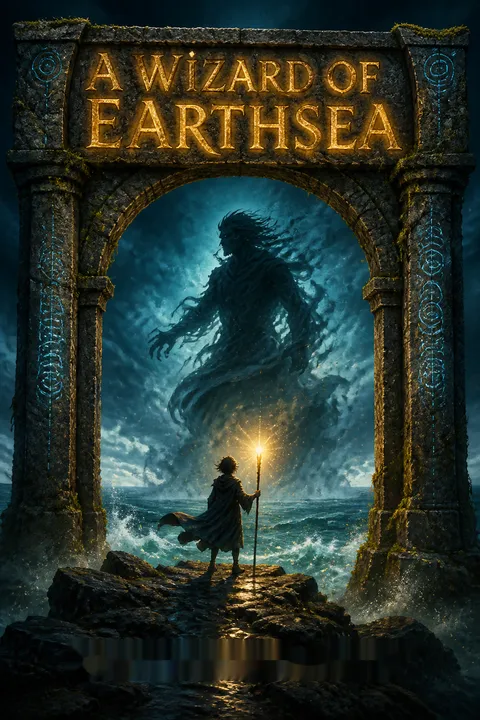
Duny grows up on Gont without a mother, under the stern eye of his blacksmith father, until his aunt discovers that he can make animals obey. Her lessons feed his hunger for power, but he is still a boy when Kargish raiders climb toward Ten Alders. As the outnumbered villagers prepare to fight, Duny gathers the morning fog around their homes and fills it with phantom shapes.
The Kargs chase the false village toward the High Fall, where some plunge over the cliff, while the survivors flee. The spell saves most of Ten Alders, but drains Duny so badly that he lies speechless and senseless. Ogion, a mage from Re Albi, heals him, gives him his adult name, Ged, and takes him as an apprentice.
Ged's first victory establishes the book's central tension in miniature: his talent is real, but his understanding is not yet equal to it. He acts from urgent care for his neighbors, yet the spell leaves him helpless once its work is done. The village celebrates the result without grasping the cost paid by the boy. Ogion's arrival therefore matters as more than a reward for bravery. By naming and guiding Ged, he places power inside a relationship of responsibility, where knowledge must grow alongside ability.
The Choice of Roke
Ogion teaches Ged to watch plants and weather instead of scattering spells at every inconvenience. Ged finds the patience frustrating, especially when a lord's daughter on the hillsides admires his story of defeating the Kargs and presses him to prove he can transform himself. Wanting her approval, he opens Ogion's forbidden lore-books and stumbles onto a spell for summoning the dead.
A shadow gathers beside the door until Ogion drives it away with his staff. Ogion warns that power used for praise can bring a price beyond the caster's control, then offers Ged a choice: stay with him or study at Roke, the island school of wizardry. Though love for Ogion pulls him toward the quiet life, Ged chooses Roke and its promise of mastery.
Ged's departure is not a simple rejection of Ogion. He loves his teacher, but mistakes slowness for withholding and formal learning for a route to public proof. The girl's challenge works because it touches an insecurity already present: Ged's belief that power should make others recognize his worth. Ogion offers freedom rather than coercion, making the choice genuinely Ged's and therefore making its consequences his as well. The shadow at the door is an early warning that forbidden knowledge is not merely a technical risk. It can answer an emotional weakness before the learner understands what he has invited.
Roke's First Lessons
At Roke, a magical door admits Ged only after he gives the Doorkeeper his true name. The school overwhelms him with its traditions, and Jasper, an elegant older student, turns their first meeting into a test Ged fails through pride and inexperience.
Vetch, a blunt, generous student from the East Reach, offers friendship instead of judgment. Ged excels at his lessons, especially illusion, but the Masters insist that appearances are not the same as changes to the world. They teach that every true change risks disturbing Equilibrium, the balance that sustains life across Earthsea.
Ged hears the warning, yet keeps measuring himself against Jasper. The school gives him knowledge and companionship, but he treats achievement as a way to win a rivalry rather than as a duty to understand what power can alter.
Roke gives Ged a community, but belonging does not immediately soften his defenses. Jasper's polished status makes Ged feel exposed as a village outsider, so he converts embarrassment into competition. Vetch offers an alternative form of recognition: a friendship that asks no performance in return. The Masters' distinction between illusion and real change gives intellectual shape to Ogion's earlier caution. Yet information alone cannot correct Ged's motives. He can repeat the doctrine of balance while still wanting power to settle a personal score, a gap that makes later danger more than a failure of schooling.
The Tower of Names
At the Isolate Tower, Ged spends a year learning the true names of places and living things from the Master Namer, Kurremkarmerruk. The work is difficult and endless, but Ged begins to understand that knowing a thing means more than knowing how to use it. On his return, a wild otak curls inside his cloak; Ged names it Hoeg, and the silent animal chooses to stay with him.
At the Winter Festival, Jasper enchants the school with a dazzling tree for the Lady of O, winning admiration that Ged cannot share. Meanwhile, the Master Changer has secretly advanced Ged into dangerous lessons in transformation. Ged grows more capable, yet still interprets another person's acclaim as a judgment on his own worth.
Naming and the otak bring two different kinds of knowledge into Ged's life. The Tower teaches that mastery is built through attention to particulars, while Hoeg's unforced trust gives him a bond that cannot be earned through display. Jasper's festival performance exposes how little this lesson has yet altered Ged's self-measurement. The secret instruction in transformation compounds the problem: a teacher's confidence in Ged's aptitude bypasses the institutional safeguards designed to pace his development. The section thus shows that education can expand capacity faster than character, especially when both student and mentor confuse brilliance with readiness.
The Shadow Comes Free
During a rare festival when Roke's students gather to play, Jasper needles Ged until their rivalry breaks into a forbidden challenge. Ged proves he can truly change into a falcon, then accepts Jasper's dare to summon a dead spirit. On Roke Knoll, he calls for the legendary Elfarran.
The spell tears open a breach, but instead of yielding only the spirit, it releases a faceless shadow that attacks Ged and leaves him grievously wounded. Vetch runs to help as the other students scatter. Archmage Nemmerle contains the rupture and saves Ged, spending his own life in the effort. The thing escapes into the world. Ged's attempt to prove superiority has created a danger he cannot name, control, or simply send back.
The catastrophe begins as a social contest, which makes its scale especially revealing. Ged does not seek knowledge or protection; he wants Jasper to witness his power. The summoned breach literalizes the way a wounded ego can reach beyond its proper limits and release consequences into other people's lives. Nemmerle's sacrifice prevents immediate destruction but cannot erase the act, and the shadow's escape transforms a private failure into a lasting obligation. The scene also distinguishes remorse from repair. Ged may later regret his motive, but he must still learn how to live with what his action has set loose.
A Name Freely Given
Ged spends months blind, mute, and fevered while the Master Herbal tends the wounds the shadow left on his face and shoulder. When he can walk again, the new Archmage, Gensher, explains that the creature is connected to Ged and may possess him if he leaves Roke before he is ready. Ged returns to study, slowly rebuilding the skills his illness has broken.
Before leaving to continue his training, Vetch visits with Hoeg and offers his own use-name, Estarriol, as a sign of trust; Ged answers by sharing his true name. Years later, after learning at the Tower and under the Master Patterner, Ged earns a staff and accepts a post as wizard of Low Torning. His learning now carries a purpose beyond becoming admired.
Recovery does not return Ged to his earlier self. The scar, damaged speech, and lost months make the consequences of his pride bodily and social, while Gensher's refusal to let him leave turns safety into a temporary limit rather than a punishment. Vetch's exchange of names restores a measure of intimacy without denying the damage. It also contrasts sharply with Ged's earlier use of power to force recognition: his friend offers vulnerability freely. Ged's later training and modest appointment suggest a changed orientation. His skill remains, but he is beginning to accept work where usefulness matters more than prestige.
The Child He Cannot Save
At Low Torning, Ged serves fishermen as a healer and weatherworker, and friendship grows with Pechvarry, a boatmaker, and Pechvarry's son Ioeth. When Ioeth falls gravely ill, Ged recognizes that the child may be dying, but Pechvarry's faith and the family's grief make him hesitate to accept that limit.
He follows Ioeth's spirit toward the land of the dead, then struggles back across its boundary as the shadow waits on the living side. Ged returns to his body, but Ioeth dies. Hoeg licks Ged awake after he collapses, and Ged understands how close he came to being lost. The shadow's presence makes flight seem inevitable. Unable to remain while endangering the islanders, Ged asks leave to confront the dragons of Pendor before departing.
Ioeth's death confronts Ged with a boundary that skill cannot ethically erase. The family wants rescue, and Ged's impulse to answer that need is compassionate, but compassion becomes dangerous when it refuses to distinguish healing from command over death. Hoeg's simple physical care recalls a form of connection that does not depend on mastery or speech. Ged's grief also changes the meaning of the shadow: it is no longer only the consequence of an old mistake but an active presence waiting at the edge of life. Choosing to face Pendor lets Ged act for the villagers before he leaves, rather than abandon them in fear.
The Dragon of Pendor
Ged sails to Pendor, where the Dragon of Pendor and his young brood threaten the nearby islands. He draws the dragons toward his boat and kills five of the young ones, using binding spells and, when they attack together, taking dragon form himself. The old dragon, Yevaud, rises from the ruined city and offers Ged treasure and the name of the shadow in exchange for safety.
Ged refuses to trade his real purpose for either reward. Recalling old dragon-lore, he guesses the dragon's true name and uses it to demand an oath: Yevaud and his offspring must never fly into the Archipelago. The dragon swears. Ged has protected Low Torning without taking the treasure or the promised shortcut to knowledge.
Pendor tests whether Ged can use power without making personal gain its measure. He has to draw on dangerous transformation, but does so in response to an immediate threat and returns to his own form once the battle ends. The dragon's offers target exactly what might tempt him: wealth, safety, and a solution to the shadow. Ged's refusal marks a change from the boy who wanted power to impress Jasper. Knowing Yevaud's name gives him leverage, yet he uses that leverage to protect other people, not to possess the dragon's hoard. Restraint here is active judgment, not passivity.
No Wind Toward Roke
The islanders celebrate Ged's victory, but Pechvarry's grateful awe carries an accusation: Ged saved them from dragons, yet failed to save Ioeth. The next day Ged leaves Low Torning, unwilling to live inside the praise or the grief. He tries to sail back toward Roke, but a hostile wind defeats the ship's progress, showing that the shadow is close and the island's protective magic will not admit him.
In Serd, a grey-cloaked stranger directs him toward the Court of the Terrenon in Osskil, promising knowledge that might help him fight. With few options and no firm plan, Ged joins an Osskilian galley as an oarsman. There he notices Skiorh's face briefly distort, an early sign that the shadow has found a human body to use.
The celebration cannot settle Ged's inner account of himself. Public gratitude celebrates the deed that can be sung, while Pechvarry remembers the private failure that no victory cancels. Ged leaves rather than accept a heroic identity that would silence that grief. The wind against Roke removes his last imagined refuge and forces him into uncertain territory. The stranger's offer becomes persuasive because it promises knowledge, not merely shelter, but Ged's desperation makes him vulnerable to being steered. Skiorh's altered face shows the danger already moving among ordinary people, turning the shadow from a distant pursuer into a threat that can occupy another life.
The Stone's Bargain
On the bleak road to the Court of the Terrenon, Skiorh reveals himself as a gebbeth, a man whose body the shadow has taken. Ged strikes at it with his staff, then runs through the night until he reaches the court and collapses. Serret, the young woman who once provoked his ambition on Gont, tends him beside her husband, Benderesk.
She shows Ged the Terrenon, an ancient power sealed beneath the tower, and urges him to use it to learn the shadow's name. When she promises mastery and dominion, Ged sees that she and Benderesk mean to make him a servant of the Stone. He refuses to touch it. As Benderesk moves against Serret, Ged stops him and escapes with her through the court's magical boundary.
The Terrenon scene repeats Ged's earlier test in altered form. Once, he risked forbidden magic to win another person's admiration; now the promise of absolute control appeals to his fear and shame. Serret's apparent kindness makes the temptation psychologically plausible, while Benderesk's presence reveals the power structure beneath it. Ged resists not because he feels no desire for an easy answer, but because he recognizes that the Stone's help would demand surrender of his will. The scene treats consent as a meaningful defense: evil can exploit weakness, but Ged's refusal prevents it from claiming him outright.
The Falcon's Return
Outside the court, Ged finds Hoeg dead in the snow. Dark creatures rise from the tower, and Serret changes into a gull, but the creatures overtake her. Ged shapes a staff from a blade of grass and drives them off with its white light. He then takes falcon form and flies east, but rage and fear keep him in the bird's instincts until he reaches Gont.
Ogion draws him back into human shape and listens as Ged recounts the pursuit, the Stone, and his escape. Rather than offer a hiding place, Ogion tells him to stop fleeing and seek the thing that seeks him. He warns Ged against changing shape again and makes him a yew staff. At dawn, Ged leaves a message that he is going hunting.
Hoeg's death gives Ged's escape a personal cost that cannot be disguised as victory. His first response is fury, and the transformation that once displayed mastery now threatens to erase the person beneath it. Ogion's intervention restores Ged physically, but his counsel demands a deeper change: Ged must stop letting fear choose his route. The staff is both practical equipment and the continuation of a relationship founded on patience. Ogion does not promise that facing the shadow will be safe. He helps Ged become capable of choosing danger deliberately, a crucial distinction between being driven and accepting responsibility.
The Hunter Turns
Ged leaves Gont in a small, spell-repaired boat and calls the shadow into the open sea. It appears in a rough human likeness, then flees as he drives after it with a magewind. Mist hides the rocks ahead, and the boat breaks apart on a reef. Ged survives by clinging to Ogion's staff and crawling ashore, where an isolated old couple shelter him.
The woman gives him a broken piece of a ring hidden in a child's royal dress; Ged guesses that the pair were once children of the Kargish royal house, though he cannot confirm it. He repairs his boat with spells, makes the couple's brackish spring run clear, and sets out again. The shadow has escaped, but Ged now follows its trail rather than running from it.
The pursuit reverses the earlier pattern without making Ged suddenly invulnerable. He chooses to call the shadow, yet the chase still ends in disaster because his attention narrows to the enemy and the fog conceals the reef. Survival depends on the staff, bodily persistence, and the hospitality of strangers, not a decisive display of magic. The old couple's isolation offers a brief human counterpoint to the vast, hostile sea; Ged repays their care with clean water rather than treating them as incidental to his quest. This episode also shows that choosing the hunt means accepting uncertainty, including clues whose meaning lies beyond what Ged can know now.
A Bond in the Inlet
Ged sails south and east, following the connection he feels to the shadow. On the island of the Hands, he enters a narrow inlet and discovers the creature standing in his boat. He lunges to seize it with his bare hands. The touch nearly overwhelms him, but the shadow breaks free and flees toward the sea.
Ged survives, then realizes that the struggle has changed their relationship: neither can simply escape the other. The shadow can no longer draw its strength from him while he stands against it, but it remains bound to him, and he still does not know its name. Ged reaches a village on the Hands, exhausted but alive. There he can rest and prepare to continue, no longer mistaking pursuit for a solution in itself.
This encounter is a midpoint in Ged's understanding, not a victory over the enemy. His willingness to meet the shadow directly breaks the cycle of flight, but his hands cannot grasp a being that has no solid substance. The resulting bond makes the conflict more intimate and more demanding: distance will not solve it, and force alone cannot finish it. Ged's new knowledge is therefore relational rather than tactical. He understands that his own acts shape the shadow's form and power, even if he does not yet know how. The failed seizure narrows his choices while clarifying what the final task must involve.
Vetch Joins the Voyage
On the Hands, Ged buys a sound boat from an old man and heals his failing eyesight in return. He names the vessel Lookfar and sails south, learning that people on Vemish have seen a shadow shaped like him. In Ismay, on Iffish, he finds Vetch, now the island's wizard, living with his younger sister Yarrow and their brother Murre.
Vetch first mistakes Ged for the apparition he recently saw, then welcomes him and hears the full account of the quest. Ged wants to go alone, fearing that Vetch may be harmed, but Vetch insists that someone should carry warning if the quest fails and bear witness if it succeeds. Yarrow provisions Lookfar. At dawn, the two friends leave Iffish together.
The reunion changes the emotional terms of the quest. Ged's instinct is to protect Vetch by excluding him, but this also repeats the prideful belief that he must bear every consequence alone. Vetch offers practical reasons for joining, yet his choice rests on friendship and shared responsibility rather than confidence in a guaranteed outcome. Yarrow's provisions and the warmth of Vetch's household give Ged a glimpse of ordinary life without persuading him to abandon his duty. Their departure is therefore both a farewell to refuge and a refusal of isolation. The companion's presence does not remove danger; it makes the danger witnessed.
Beyond the Lastland
Ged and Vetch sail past the outer islands to Astowell, which its people call Lastland, then continue east into the Open Sea. Ged senses that the shadow has drawn them beyond the known world. Wind and waves fade; the ocean becomes a silent expanse of dark sand.
Ged walks toward the approaching creature, whose changing faces include people linked to his past. As it loses those borrowed forms, Ged recognizes that the shadow is himself, the part of his being he released and refused to face.
He speaks its true name, and it speaks his; then he embraces it, joining what he had divided. The sea returns around Vetch, who hauls Ged back into Lookfar. Ged wakes to the moon, declares himself whole, and weeps. After sixteen days at sea, they return to Ismay and Yarrow.
The ending refuses a conventional victory in which a hero destroys an external enemy and remains untouched. The shadow has gathered faces from Ged's history because it is inseparable from the life he tried to disown. Naming it as himself does not excuse the harm he caused; it makes denial impossible and restores responsibility to the person capable of choosing. Vetch's presence matters at the threshold, but Ged must make the recognition himself. The restored sea and the long return voyage bring him back into ordinary time, hungry and vulnerable. Wholeness here means integration, not invulnerability: Ged is free because no divided part of himself can now be used against him.
Epilogue
The return voyage brings Ged and Vetch back to Ismay, but their deed does not become a famous public song. Stories of a boat grounded in the Open Sea circulate among the islands in altered forms, each community claiming a different version.
The tale of Ged's confrontation with the shadow survives only in fragments, while the better-known accounts of his later life leave this journey out. His first great deed is thus both completed and half-forgotten, held most clearly by the friend who shared it.
The coda separates the truth of a life from the stories a culture chooses to preserve. Ged's inward achievement cannot be neatly converted into public legend, because its decisive act was not conquest but recognition. The shifting local versions of the voyage mirror the limits of any single account: events travel, but their meanings blur. Vetch's witness supplies a human memory where formal history falls silent. By ending on partial remembrance, the book resists turning Ged's growth into a simple heroic credential. The deed matters even when it is not widely sung, and the people who understand it may be more important than the fame it fails to earn.
Analysis
A Wizard of Earthsea makes magical education inseparable from ethical education. Ged's gift is not the problem; the danger lies in his belief that ability entitles him to act before he understands the world he is altering. The true names of things promise precision, but precision alone cannot supply wisdom. Equilibrium demands that a mage consider consequences beyond immediate intention, while Ged's early hunger for recognition narrows his attention to the audience before him.
The shadow gives this failure a physical form. At first it appears to be an alien pursuer, but its connection to Ged gradually reveals the cost of treating fear, pride, and vulnerability as foreign enemies to be expelled. The final confrontation does not reward domination. Ged becomes whole by naming and accepting the thing that belongs to him, a recognition that ends the possibility of being possessed by it. Integration is not absolution: his earlier choices still caused injury and death, and he must carry their memory.
The book also distinguishes solitude from self-sufficiency. Ogion's patient teaching, Vetch's freely offered trust, Hoeg's wordless care, and the villagers' hospitality repeatedly interrupt Ged's wish to define himself alone through power. Each relationship makes responsibility concrete. Magic can alter the conditions of life, but it cannot replace friendship, skill, grief, or the ordinary work of sustaining one another.
The ending's modest return to Iffish resists the usual logic of heroic fame. Ged's achievement is profound, yet it survives in fragments and private witness rather than a clear public legend. That form suits the story's deeper claim: becoming whole is less a performance for the world than an inward act that changes how one lives among it. The hawk's flight matters not because it escapes darkness, but because it can finally fly as itself.
Review Summary
A Wizard of Earthsea is praised for its inventive world-building, magical system, and coming-of-age narrative. Readers appreciate Le Guin's lyrical prose and the depth of themes explored. Many note its influence on later fantasy works. Some find the pacing slow or the writing style challenging. The book is frequently compared to Harry Potter, with debates about which is superior. Overall, it's considered a classic of the genre, though opinions on its accessibility and entertainment value vary.
People Also Read



Characters
Ged
The gifted young wizardBorn Duny on Gont, Ged is quick, proud, and hungry to prove that his unusual magical ability makes him exceptional. His talent for naming and shaping the world develops faster than his patience or judgment, and he is especially vulnerable to challenges that make him feel small. He is also attentive to animals, skilled with practical crafts, and capable of deep loyalty once he trusts someone. His relationships with Ogion and Vetch offer different models of guidance and companionship, while his encounters with danger force him to question whether power means control. Ged's defining struggle is not simply to become stronger, but to understand what belongs to him and what responsibility comes with it.
Ogion
The patient mountain mageOgion is a powerful Gontish mage whose quiet manner conceals a precise understanding of magic and its limits. He teaches by directing Ged's attention toward plants, weather, silence, and the living world, rather than satisfying the boy's appetite for spectacular spells. Ogion respects Ged's independence, even when the choice pains him, and offers counsel without demanding obedience. His trust is grounded in patience rather than flattery. For Ged, Ogion represents a form of strength that does not need to announce itself, and a kind of knowledge built through close attention rather than possession.
Vetch
Ged's steadfast friendVetch, whose true name is Estarriol, is a fellow student from the East Reach and Ged's most dependable friend. Plainspoken, warm, and observant, he is able to see when Ged's pride is carrying him toward danger, yet he does not reduce him to his worst choices. His kindness is active: he offers companionship, speaks honestly, and is willing to share risk without claiming that he can control the outcome. Vetch's life on Iffish also shows Ged a rooted, communal way of living. He values loyalty, but his loyalty is not blind; it includes the courage to challenge Ged and the humility to stand beside him.
Jasper
The polished rivalJasper is a talented, socially confident student at Roke whose refined manners and pointed remarks unsettle Ged. Their rivalry is partly about skill, but also about class, belonging, and the different forms of recognition each expects from the school. Jasper knows how to provoke Ged without openly breaking its rules, and his composure makes Ged's reactions more visible. He is not simply an obstacle; he exposes the vanity Ged would prefer to call ambition. Jasper's presence gives Ged a human target for feelings that later prove much more dangerous than a schoolyard contest.
Serret
The silver-tongued noblewomanSerret is a young noblewoman raised between Gontish and Osskilian worlds. Her intelligence, beauty, and guarded manner make her difficult for Ged to read, and she understands how recognition and promises of power can influence him. She is connected to the Court of the Terrenon and to the political uses of its ancient magic. Serret's character occupies the uneasy ground between vulnerability and ambition: she can appear to seek rescue while also advancing aims of her own. Her presence tests Ged's ability to distinguish compassion from invitation and attraction from trust.
Nemmerle
Roke's elder ArchmageNemmerle is the aged Archmage who leads Roke when Ged arrives. His physical frailty contrasts with immense spiritual authority, and he recognizes the scale of Ged's potential without mistaking potential for readiness. He responds to crisis with decisive care, embodying the responsibility that accompanies the highest level of magical power. His presence teaches the students that mastery is not spectacle but a willingness to bear consequences others cannot. Ged's understanding of leadership is altered by Nemmerle's example.
Gensher
The sober new ArchmageGensher succeeds Nemmerle as Archmage of Roke. Serious and direct, he assesses Ged's condition without either condemning him as irredeemable or pretending the danger has passed. He gives Ged protection while making clear that protection is temporary and conditional on learning. Gensher represents institutional judgment at its best: he recognizes what the school can and cannot repair, and refuses easy reassurance.
Yevaud
The ancient dragon of PendorYevaud is an old dragon who rules the ruined island of Pendor and guards a hoard accumulated over generations. He is powerful, patient, and dangerous in conversation as well as in battle, since dragons can twist truth to serve their own purposes. His intelligence makes him more than a creature to be slain; he understands leverage and temptation. Ged must meet him through knowledge of names and careful limits rather than brute strength.
Pechvarry
The boatmaker of Low TorningPechvarry is a boatmaker who befriends Ged when the young wizard arrives at Low Torning. He values practical skill and welcomes Ged as a neighbor rather than merely as a celebrated mage. Their work together teaches Ged the handling and construction of ordinary boats. Pechvarry's trust in Ged is sincere, which makes his hopes and disappointments consequential. Through him, Ged encounters the human cost of failing to separate a healer's duty from the desire to overcome every limit.
Ioeth
Pechvarry's sick sonIoeth is Pechvarry's young son, a child whose illness brings Ged into a crisis of healing and mortality. His family loves him fiercely, and their hope presses Ged to attempt more than his knowledge can safely justify. Ioeth's role is brief but central to Ged's understanding that care cannot always mean rescue.
Benderesk
Lord of the TerrenonBenderesk is the aging lord who rules the land around the Court of the Terrenon and guards the ancient Stone. His formal hospitality masks a possessive relationship to power and to the people within his household. He is patient enough to let others approach a desired prize, but his authority rests on coercion rather than mutual trust. Benderesk embodies the danger of treating an ancient power as property to be commanded.
Kurremkarmerruk
The Master NamerKurremkarmerruk trains students at Roke's remote Isolate Tower. He assigns immense lists of true names and expects patience without complaint, presenting knowledge as an unfinished discipline rather than a prize to possess. His spare teaching style helps Ged understand the scale and limits of naming.
The Master Changer
The gifted, careless teacherA young Master at Roke, the Master Changer recognizes Ged's exceptional aptitude and teaches him advanced spells of transformation. He intends to encourage a promising student, but his private lessons bypass the Archmage's oversight. His good intentions show how admiration for talent can become a risk when caution is treated as an obstacle.
The Master Hand
The cheerful illusionistThe Master Hand teaches illusion and the lesser arts of changing at Roke. He enjoys the elegance of magical craft, but explains that making something appear different is not the same as changing its true nature. His warmth makes a difficult warning approachable, even if Ged is not yet ready to accept it.
The Master Summoner
Roke's grave spellmasterThe Master Summoner teaches the forces underlying true magic and warns students that working with wind, water, and other powers can disturb the balance elsewhere. His severity reflects the weight of the art he teaches. He offers little easy comfort, but his care for Ged becomes visible through his attention during Ged's recovery.
Duny's aunt
The village witchDuny's maternal aunt is a village witch who first discovers his unusual ability and teaches him spells. Her craft is practical and uneven, shaped by local custom rather than a full understanding of magic's balance. She recognizes potential in him, but her teaching also gives him early access to power before he knows how to judge its consequences.
Duny's father
The stern bronze-smithDuny's father is a hard, unsentimental bronze-smith who raises his youngest son without much tenderness. During the Kargish raid, he stays at his forge and turns available metal into weapons for the villagers. His practical courage contrasts with Duny's magical improvisation, though their relationship is marked by distance and harsh discipline.
Skiorh
The Osskilian oarsmanSkiorh is an Osskilian sailor who shares a galley with Ged and later offers to guide him inland. He is a hard, wary man shaped by a harsh crew and unfamiliar customs. His path crosses Ged's at a moment when the young wizard is isolated and exhausted, making him a vulnerable point of contact between the shadow and the human world.
Yarrow
Vetch's perceptive sisterYarrow is Vetch's younger sister, an observant and curious girl who helps prepare food and supplies for the voyage. She asks plain questions about magic and its limits, prompting Ged to explain ideas that he has struggled to understand himself. Her practical kindness and emotional perceptiveness make her household feel like a refuge without turning her into a passive observer.
The old couple
The isolated castawaysAn elderly man and woman survive on a barren islet far from settled shores. They fear strangers and have almost no shared language with Ged, yet they give him fire, water, and food when he is shipwrecked. Their fragile trust and hard-won isolation remind him that even a short stop on a quest carries obligations.
Plot Devices
True names and the Old Speech
Knowledge that bindsIn Earthsea, a thing's true name belongs to its deepest identity, and knowing that name can give a wizard power over it. Mages learn the Old Speech through years of study, while guarding their own true names from all but trusted intimates. Ged's education in names helps him understand magic as a form of exact knowledge, not mere command. The same principle enables him to confront Yevaud and eventually understand the shadow. Naming is therefore both a tool of power and a discipline that demands care about what one claims to know.
Equilibrium
A limit on powerMagic in Earthsea operates within a balance among forces, places, and living beings. A spell that changes one condition may produce consequences elsewhere, so a wizard must consider need, knowledge, and cost before acting. The Masters use this principle to distinguish responsible craft from displays of control. Ged hears the teaching early, but only experience makes its stakes personal. Equilibrium gives the fantasy system ethical weight: power is never an isolated private possession, because the world altered by a spell is shared by others.
The shadow
A divided self made dangerousA forbidden summoning releases a faceless being that pursues Ged across islands and seas. It can appear in dreams and darkness, take over another person's body, and draw on Ged's own strength. Its changing shape and uncertain nature make it difficult to fight with ordinary spells. As the pursuit continues, Ged's choices affect how the shadow appears and what it can do. The creature drives the plot outward through the archipelago while forcing Ged to examine what he has tried to deny within himself.
Wizard staffs
Craft made tangibleA mage's staff is a sign of training, but it is also a tool through which a wizard directs power. Ogion gives Ged the yew staff he later carries into danger, and its durability repeatedly matters when magic alone cannot protect him. The staff's meaning changes with Ged's understanding: it is not a shortcut around judgment or a guarantee of victory, but an aid to disciplined action. Its presence ties his journey to the teachers who formed him and to the responsibilities he accepts as a practicing wizard.
Hoeg the otak
Companionship without speechHoeg is a small, fierce, silent animal that chooses Ged and travels with him. The bond is not based on spells of control: Ged names the otak, but its attachment remains its own. Hoeg repeatedly offers physical companionship when Ged is isolated, and its instinctive care emphasizes forms of understanding that do not depend on language or magical mastery. The animal's presence also gives Ged a personal stake in the dangers surrounding him, reminding him that his choices affect beings unable to explain their needs in human speech.
FAQ
Synopsis & Basic Details
What is A Wizard of Earthsea about?
- Coming-of-age wizard story: The novel follows the life of Ged, a young boy with magical abilities, from his childhood on the island of Gont to his training at a wizarding school and his subsequent journey to confront a shadow he unleashed.
- Exploration of power and responsibility: It delves into the nature of magic, the importance of balance, and the consequences of unchecked ambition, as Ged learns to control his powers and understand their impact on the world.
- A journey of self-discovery: The story is as much about Ged's internal growth as it is about his external adventures, as he confronts his fears, his pride, and the darkness within himself.
Why should I read A Wizard of Earthsea?
- Classic fantasy foundation: It's a foundational work of fantasy literature, influencing many subsequent authors and works in the genre, offering a rich and immersive world with unique magic systems.
- Profound thematic depth: The novel explores complex themes of identity, responsibility, and the balance between light and darkness, providing a thought-provoking and emotionally resonant reading experience.
- Character-driven narrative: The focus on Ged's internal struggles and growth makes the story deeply personal and relatable, offering a compelling character arc that resonates with readers of all ages.
What is the background of A Wizard of Earthsea?
- Archipelago setting: The story takes place in Earthsea, a world of numerous islands scattered across a vast ocean, each with its own unique culture, geography, and history, creating a rich and diverse setting.
- Magic system based on true names: The magic system is unique, relying on the knowledge and use of the true names of things, emphasizing the power of language and the importance of understanding the essence of all beings.
- Cultural influences: The world of Earthsea draws inspiration from various cultures, including Celtic, Norse, and Japanese, creating a unique blend of traditions and beliefs that shape the society and its magic.
What are the most memorable quotes in A Wizard of Earthsea?
- "To hear, one must be silent.": This quote, spoken by Ogion, encapsulates the importance of patience and observation in learning, highlighting the need for inner stillness to understand the world and oneself.
- "Only in silence the word, only in dark the light, only in dying life.": This quote, from the Creation of Ea, speaks to the interconnectedness of opposites and the cyclical nature of existence, emphasizing the balance between light and darkness, life and death.
- "Who knows a man's name, holds that man's life in his keeping.": This quote underscores the power of names and the responsibility that comes with knowing someone's true name, highlighting the vulnerability and trust involved in sharing one's deepest identity.
What writing style, narrative choices, and literary techniques does Ursula K. Le Guin use?
- Understated prose and evocative descriptions: Le Guin's writing style is characterized by its simplicity and elegance, using precise language and vivid imagery to create a sense of place and atmosphere, drawing the reader into the world of Earthsea.
- Focus on character development: The narrative prioritizes Ged's internal journey, using his thoughts, feelings, and experiences to explore complex themes and ideas, making the story deeply personal and emotionally resonant.
- Symbolism and allegory: Le Guin employs symbolism and allegory throughout the novel, using characters, objects, and events to represent deeper concepts and ideas, inviting readers to interpret the story on multiple levels.
Hidden Details & Subtle Connections
What are some minor details that add significant meaning?
- The Doorkeeper's riddle: The doorkeeper's riddles at the School of Roke, such as "The wise don't need to ask, the fool asks in vain," and "You cannot always find the Warder where he is, but sometimes you find him where he is not," foreshadow the importance of inner knowledge and the limitations of seeking answers externally.
- The description of the Immanent Grove: The Immanent Grove, which Ged can never quite see clearly, symbolizes the hidden and mysterious aspects of magic and the deeper truths that are not easily accessible, foreshadowing the complexities of his journey.
- The otak's behavior: The otak's loyalty to Ged and its ability to sense danger, especially its scream when the shadow attacks, highlights the connection between humans and animals and the intuitive wisdom that can be found in the natural world.
What are some subtle foreshadowing and callbacks?
- The fog spell: Ged's use of a fog spell to save his village foreshadows his later struggles with illusion and the need to understand the true nature of things, as well as his ability to manipulate the elements.
- The girl in the meadow: Ged's encounter with the Lord's daughter in the meadow, and her questions about magic, foreshadows her later role as Serret, the enchantress who tries to manipulate him, highlighting the dangers of pride and the allure of power.
- The ship's name, Shadow: The name of the ship that takes Ged to Roke, "Shadow," foreshadows the shadow creature that he will later unleash and the dark path he will have to walk, highlighting the interconnectedness of his journey.
What are some unexpected character connections?
- Serret's true identity: The revelation that Serret is the same girl Ged met in the meadow as a boy, and that her mother is an enchantress, connects his past to his present and highlights the long-reaching consequences of his actions.
- Ogion's past with Nemmerle: The fact that Ogion was once a student of Archmage Nemmerle reveals a deeper connection between the two mages and emphasizes the importance of mentorship and the passing down of wisdom.
- The Doorkeeper's true role: The revelation that the Doorkeeper is also a Master of Roke, and that he tests Ged by asking for his name, highlights the importance of self-knowledge and the hidden wisdom that can be found in unexpected places.
Who are the most significant supporting characters?
- Ogion: As Ged's first mentor, Ogion's teachings about patience, silence, and the true nature of power shape Ged's understanding of magic and the world, providing a moral compass for his journey.
- Vetch: Ged's loyal friend, Vetch, provides unwavering support and companionship, offering a counterpoint to Ged's solitary nature and highlighting the importance of human connection in the face of adversity.
- The Master Hand: The Master Hand's lesson about the difference between illusion and true change, and the importance of knowing the consequences of one's actions, is a crucial turning point in Ged's understanding of magic and responsibility.
Psychological, Emotional, & Relational Analysis
What are some unspoken motivations of the characters?
- Ged's desire for recognition: Ged's actions are often driven by a deep-seated need for recognition and validation, stemming from his difficult childhood and his desire to prove his worth, leading him to seek power and mastery.
- Jasper's insecurity: Jasper's condescending behavior towards Ged masks his own insecurities and fears of being surpassed, revealing a hidden vulnerability beneath his arrogant facade.
- Ogion's quiet concern: Ogion's seemingly detached demeanor hides a deep concern for Ged's well-being, as he subtly guides him towards self-discovery and understanding, demonstrating a quiet but profound love for his apprentice.
What psychological complexities do the characters exhibit?
- Ged's internal conflict: Ged struggles with his pride, his fear, and his desire for power, creating a complex internal conflict that drives his actions and shapes his journey, highlighting the human struggle with inner demons.
- Jasper's envy and resentment: Jasper's envy and resentment towards Ged reveal a deep-seated insecurity and a need for validation, showcasing the destructive nature of unchecked ambition and rivalry.
- Ogion's stoicism and wisdom: Ogion's stoicism and quiet wisdom mask a deep understanding of the human condition and the complexities of power, demonstrating a profound emotional depth beneath his calm exterior.
What are the major emotional turning points?
- The summoning on Roke Knoll: The summoning of the shadow is a major emotional turning point for Ged, as it forces him to confront the consequences of his pride and recklessness, leading to a period of intense self-reflection and growth.
- The death of Ioeth: The death of Pechvarry's son, Ioeth, forces Ged to confront his limitations and the limits of his power, leading to a period of self-doubt and a deeper understanding of the balance between life and death.
- The encounter with the shadow in the Open Sea: Ged's final confrontation with the shadow is a major emotional turning point, as he accepts his own darkness and integrates it into his being, leading to a sense of wholeness and peace.
How do relationship dynamics evolve?
- Ged and Ogion: Their relationship evolves from a master-apprentice dynamic to one of mutual respect and understanding, as Ged learns to appreciate Ogion's wisdom and guidance, highlighting the importance of mentorship in personal growth.
- Ged and Vetch: Their friendship deepens over time, as they support each other through trials and tribulations, demonstrating the power of loyalty and companionship in the face of adversity.
- Ged and Jasper: Their rivalry transforms into a complex relationship of mutual understanding, as Ged learns to let go of his need for validation and Jasper's arrogance is revealed as a mask for his own insecurities.
Interpretation & Debate
Which parts of the story remain ambiguous or open-ended?
- The nature of the shadow: The exact nature and origin of the shadow remain ambiguous, leaving room for interpretation about its connection to Ged's inner self and the broader forces of darkness in the world.
- The power of the Terrenon: The true extent and nature of the Terrenon's power are left somewhat ambiguous, raising questions about the dangers of seeking absolute power and the limits of human understanding.
- The future of Earthsea: The ending of the novel leaves the future of Earthsea open-ended, suggesting that the journey of self-discovery and the quest for balance are ongoing processes, not finite destinations.
What are some debatable, controversial scenes or moments in A Wizard of Earthsea?
- Ged's summoning of the shadow: Ged's reckless summoning of the shadow is a controversial moment, raising questions about the ethics of magic and the responsibility that comes with power, sparking debate about the nature of good and evil.
- Ged's decision to hunt the shadow: Ged's decision to hunt the shadow, rather than seek refuge, is a debatable moment, raising questions about the nature of courage and the importance of confronting one's fears, sparking debate about the best way to deal with inner demons.
- The ending's interpretation: The ending, where Ged merges with his shadow, is open to interpretation, sparking debate about the nature of self-acceptance and the integration of one's darker aspects, leaving readers to ponder the meaning of wholeness and balance.
A Wizard of Earthsea Ending Explained: How It Ends & What It Means
- Ged confronts his shadow: In the final confrontation, Ged doesn't defeat the shadow as an external enemy but rather accepts it as a part of himself, speaking its name, which is also his own, and merging with it.
- Integration of the self: This act of integration symbolizes Ged's journey of self-discovery, where he learns to accept his flaws and fears, achieving wholeness and balance by acknowledging all aspects of his being.
- The end of the hunt: By merging with the shadow, Ged ends the cycle of pursuit and flight, freeing himself from the fear and self-doubt that had driven him, and finding peace by accepting his true self.
Earthsea Cycle Series
About the Author
Other books by Ursula K. Le Guin
Download PDF
Download EPUB
.epub digital book format is ideal for reading ebooks on phones, tablets, and e-readers.








