

Plot Summary
The Wall Opens
The crowd at the Port of Anarres has come to stop Shevek, a celebrated physicist, from boarding a freighter to Urras. Some call him a traitor; others want to protect his right to leave. Their confusion delays the attackers long enough for Shevek to cross the field, but a thrown stone kills a Defense worker before the ship takes off.
As Anarres shrinks on the screen, Shevek feels the terror of losing his world, though this is the journey he chose. He wants to break the isolation separating the planets and share his work beyond the circle of people who control knowledge at home. The narrative then turns back to show what brought him to the Port.
The opening makes the boundary physical, political, and psychological at once. The crowd does not behave as a single obedient mass: its competing purposes accidentally save Shevek, while its violence leaves a real cost. That tension previews a society whose lack of formal rulers has not eliminated coercion. Shevek’s fear during takeoff complicates his apparent resolve. Leaving is not a clean liberation from Anarres but a chosen estrangement from the only community he knows, undertaken because its ideals have begun to close around him.
The Child Who Waited
Shevek’s mother, Rulag, leaves their young family for an engineering posting, and his father, Palat, moves into a dormitory while Shevek grows up in communal care. As a child, Shevek insists that sunlight belongs to him, then discovers that Anarres expects even its youngest members to share.
At eight, he proposes that a thrown rock can never reach a tree because there is always another halfway point. His learning-group director dismisses the idea as selfish disruption, teaching Shevek that communal language can silence as readily as it can connect.
Later, Shevek and his friends build a prison cell and lock Kadagv inside. When the boys leave him confined for thirty hours, Shevek’s revulsion forces them to release him. The experiment leaves him sick with shame.
Shevek’s childhood supplies the book’s central distinction between mutual aid and enforced conformity. The rule about sharing the sunlight begins as a humane lesson, yet the director’s accusation shows how moral vocabulary can turn a child’s original thought into misconduct. The prison game makes that danger concrete: the boys discover that roles can overtake intention, and Shevek experiences the bodily nausea of recognizing his own participation. His mathematical instinct and his moral discomfort arise together. Both make him attentive to systems that appear coherent while concealing an unexamined cost.
The Moon Becomes Unfamiliar
As a teenager, Shevek questions whether Anarres knows the truth about Urras or merely repeats frightening images selected by its administrators. His friend Bedap sees the danger of enforced ignorance, while Shevek initially defends the society that raised him.
At eighteen, a labor assignment sends him to plant trees in the Dust, where heat, grit, and exhausting work strip away his pride in intellectual distinction. He is rejected by Gimar, beaten by a resentful coworker named Shevet, and then discovers adult sexuality with Beshun.
When the crews finish, a faint green veil covers the barren ground. The collective achievement moves him more than he expected, and he returns to study changed: less certain that solitary brilliance is enough, but still unwilling to surrender his independence.
Urras first matters as an uncertainty rather than a destination. The adolescents’ debate tests whether Anarres’s identity depends on knowing its enemy only through inherited stories, and Shevek’s resistance shows how deeply even an anti-authoritarian society can shape its members. The Dust then makes collective labor an experience rather than a doctrine. Shevek resents the assignment, yet the planted seedlings give him a satisfaction that no private intellectual triumph has provided. His emotional education is not a conversion from individuality to solidarity. It is the beginning of his effort to understand how the two can correct and sustain each other.
Sabul Claims the Work
Back at the regional institute, Shevek’s mentor Mitis recognizes the promise in his physics and urges him to move to Abbenay, where the best books and minds are concentrated. There, senior physicist Sabul gives him Urrasti texts but orders him to keep their contents from other Anarresti.
Shevek learns the language, advances the work, and discovers that Sabul has used imported ideas in his own publications. Their first joint paper gives Sabul credit alongside Shevek’s, and Sabul later blocks Shevek’s independent work while controlling the route to publication.
During a bout of pneumonia, Shevek is visited by Rulag, now a respected engineer. He learns that Palat died years earlier in an earthquake while rescuing children. Shevek cannot accept Rulag’s late attempt to renew their relationship.
The conflict with Sabul exposes power without a legal authority to name it. Sabul cannot formally command Shevek, but access to texts, publication, and institutional approval gives him leverage that resembles ownership. Shevek recognizes the moral ugliness yet continues to bargain because he needs scientific exchange. The reunion with Rulag makes this institutional story intimate: both mother and son are shaped by work, but their choices have left them strangers. Palat’s death deepens Shevek’s sense that solidarity is expressed through concrete acts, not abstract allegiance, while Rulag’s regret cannot retroactively supply the childhood bond she missed.
Bedap Names the Wall
After years of isolation and stalled research, Shevek tells his old friend Bedap that he has considered suicide and may abandon physics. Bedap argues that Anarres has developed an unofficial power structure: public disapproval, institutional habits, and fear of being called selfish can suppress people without police or laws.
He describes their former friend Tirin, whose satirical play drew a public reprimand and whose later assignments isolated him from his peers. Shevek resists Bedap’s diagnosis but begins to see that an open society can still punish difference.
On a hiking trip, he recognizes Takver, a fellow student he had once failed to notice. Their frank conversation reveals that both want a lasting partnership rather than casual pleasure. They choose each other and move into a shared room.
Bedap’s critique forces Shevek to consider social pressure as a form of power, not merely the byproduct of scarcity. Tirin’s experience is especially disturbing because no single villain appears responsible; ordinary judgments and assignments combine to make a vulnerable person feel abandoned. Shevek’s bond with Takver offers a counterexample to both institutional conformity and solitary purity. Their commitment is not a retreat from freedom but a voluntary limitation that makes freedom consequential. The section shifts the question from whether society is good or bad to whether people can remain answerable to each other without turning that responsibility into obedience.
Love Makes Time
With Takver beside him, Shevek returns to temporal physics and gradually builds the argument that becomes the Principles of Simultaneity. Their partnership gives his concentration a home, though Takver must protect him from working until exhaustion.
When drought tightens its grip on Anarres, Takver becomes pregnant and Shevek completes the manuscript. Sabul refuses to approve it unless it is cut and presented under his name. Takver persuades Shevek to accept a compromised edition so the ideas can reach the presses; he secretly sends the complete manuscript to Urrasti physicist Atro.
Their daughter Sadik is born soon afterward. As the famine worsens, Takver accepts an emergency assignment far from Abbenay, while Shevek is sent to the Dust. Their family is separated by work the planet urgently needs.
The relationship turns time from Shevek’s abstract subject into a lived practice of fidelity. Takver does not simply inspire his science; she makes sustained attention possible while insisting that his body and their shared life also matter. The book’s publication compromise tests their belief that good ends cannot excuse every means. Their choice is understandable but costly, since Shevek experiences the surrender of authorship as a surrender of self. Famine then subjects private commitment to collective necessity. Anarres is neither cruelly indifferent nor effortlessly just: its survival depends on assignments that can fracture the very bonds its ethics are meant to protect.
The Dust Separates Them
Shevek’s famine posting takes him through the southern settlements, where shortages and exhausting work make solidarity harder to sustain. On a delayed journey, hundreds of workers go hungry while a town protects its limited food supply; Shevek sees how quickly scarcity can make neighbors behave like owners.
Four years after leaving Abbenay, he reaches Chakar and finds Takver and Sadik. Their reunion restores the intimacy they have kept alive through separation, but Shevek has also seen how the pressure of custom can silence dissent.
Takver agrees that his decision to let Sabul control the book was a capitulation, not simply a generous sacrifice. Together they return to Abbenay and help build the Syndicate of Initiative, which prints, teaches, and broadcasts ideas that established institutions have obstructed.
The famine tests the Anarresti ethic at its material limit. Hunger does not automatically create selfishness, but the stopped train reveals that good intentions cannot erase the conflict between one community’s survival and another’s need. Shevek’s reunion with Takver restores personal trust without pretending the years were harmless. Their judgment of the book’s compromise also marks a new maturity: sacrifice is not automatically virtuous when it lets a gatekeeper decide what may be shared. The Syndicate turns this insight into practice, offering a voluntary alternative to institutions that have come to treat public consensus as an unquestionable authority.
A Door to Urras
The Syndicate’s attempt to reopen communication with Urras meets growing hostility. Shevek and Bedap argue that Anarres has no right to call itself free while denying individuals harmless choices, including the choice to travel.
At a PDC meeting, Shevek faces Rulag and other opponents who fear that contact will expose their small world to domination. The dispute becomes personal when Sadik reports that children at her learning center have called her family traitors because of the Syndicate. Takver and Shevek see that their public work now places their children under social pressure.
Takver urges Shevek to accept the invitation to Urras: he could continue his research, demonstrate that Anarres exists, and challenge both planets’ habits. Shevek agrees to take the risk, though he cannot know whether either world will let him return.
The journey’s political stakes become visible at home before Shevek ever reaches Urras. Sadik’s ostracism shows how adult ideological conflict migrates into children’s lives, where a label can wound before its meaning is understood. Rulag’s opposition is not simple malice: she sees a genuine danger in unequal contact, which prevents the debate from collapsing into an easy argument for openness. Takver’s support matters because she does not mistake risk for romance. She weighs the danger against Shevek’s need to work freely and the harm already caused by enforced silence. The trip becomes an experiment in whether freedom survives contact with fear.
Paradise Has Owners
After the freighter journey, Shevek arrives on Urras to cameras, officials, and lavish rooms. The world’s forests, animals, abundant water, and rich farmland astonish him, but so do its servants, money, and waste. Physicists Atro, Pae, and Oiie welcome him to Ieu Eun University, where he finally meets scientific peers able to challenge his ideas.
He also learns that women are largely excluded from science and public authority, a fact the men treat as natural. The university’s comfort initially feels like hospitality, yet Shevek notices that people bow to him and that newspapers invent statements he never made. His hosts present him as a harmless emblem of friendship while keeping him away from working people and political dissent.
Urras refuses to fit the moral picture Shevek brought with him. Its beauty is not an illusion, and neither is its hierarchy; his response must include both rather than dismiss one to preserve the other. The university offers intellectual reciprocity he could not find at home, but that generosity is entangled with an effort to manage his public image. The gendered assumptions expose how domination can be normalized as common sense, even among educated men. Shevek’s wonder therefore becomes double-edged: every new pleasure opens his understanding while making him more susceptible to the carefully curated role his hosts have prepared.
The Guest Becomes Useful
Shevek teaches at the university and explores A-Io, but his students often want credentials more than independent inquiry. Chifoilisk, a Thuvian official, warns that Pae reports to A-Io’s security service and that the government wants Shevek’s physics for a faster-than-light communication device.
Atro, though a genuine scientific ally, hopes the discovery will raise Cetian prestige. When A-Io intervenes in Benbili’s revolution, Shevek sees the language of order used to justify armed power.
He begins to distrust the protected life arranged for him and tries, unsuccessfully, to reach ordinary workers through his servant Efor. At a gathering hosted by Vea, he sees his hosts’ luxury and political indifference collide. Drunk and misreading her resistance, he assaults her, then wakes in shame at the violence he has done.
The section shows how a gift can be captured before it is given. Shevek’s theory is valuable to governments because communication across distance also promises strategic advantage, while each ally interprets the work through a different allegiance. The Benbili intervention makes that logic visible in bodies and weapons rather than in academic debate. Shevek’s assault on Vea is a devastating personal consequence of his failure to understand Urrasti sexual codes and her refusal. His shame is not merely embarrassment: it breaks his self-image as a harmless observer. The book insists that structural critique does not absolve individual responsibility, especially when a person’s own power is suddenly exposed.
Efor Finds the Exit
After the party, Shevek recognizes that A-Io has treated him as a resource, not an equal. He completes the crucial step in his General Temporal Theory, then realizes that handing it to the state would turn shared knowledge into a weapon.
Efor, the servant who has tended him, explains the poverty and humiliations hidden beyond the university’s polished rooms. Though he fears for Shevek, Efor identifies a contact in Old Town and arranges a taxi.
Shevek reaches Tuio Maedda, an organizer among anti-authoritarian workers, who shelters him and helps circulate his account of why he came to Urras. The government closes the newspaper that prints it, so the organizers move the text to clandestine handbills. Shevek chooses public exposure over another protected room.
Efor changes Shevek’s understanding by making poverty personal without turning himself into a lesson or symbol. His help is a dangerous act of judgment, not the obedience expected from a servant, and it gives Shevek a route out of his manufactured isolation. The theory’s completion creates a parallel choice: knowledge can remain property or become a common resource. Shevek’s decision to publish his presence is not naïve faith that publicity guarantees safety. It is a refusal to let the state determine who may know that an alternative society exists. His action joins scientific communication to political visibility.
The Square Turns Deadly
Shevek joins a vast, nonviolent demonstration in Nio Esseia against the war, conscription, and rising prices. Speaking from the Directorate steps, he describes Anarres as a poor world whose people have no property but one another, and insists that freedom cannot be purchased or imposed.
Police helicopters open fire on the crowd. Shevek escapes into the Directorate with a wounded Socialist Worker, then breaks into a locked warehouse to hide them both.
He binds the man’s ruined hand and searches for help, but passersby refuse to return and soldiers seal the district. The worker dies beside him after three nights in hiding. Shevek survives the massacre, but the demonstration has shown him that Urras will defend property and authority with lethal force.
The demonstration is the novel’s sharpest collision between political ideals and institutional violence. Shevek’s speech gives the crowd a language of freedom, but language cannot shield bodies from machine guns. His choice to stay with the wounded worker rather than flee alone makes solidarity immediate and imperfect: he can bind a wound, offer warmth, and remain present, but cannot save the man. The locked warehouse crystallizes the contradiction of a society where shelter exists behind private barriers even as people bleed outside. The worker’s death denies any comforting claim that moral action guarantees rescue.
The Gift Crosses Worlds
Escaping the cordoned district, Shevek reaches the Terran Embassy, where Ambassador Keng offers him safety and a channel to Anarres. He learns that Earth itself has been damaged by human excess and survives under strict central control, complicating any simple contrast between free and unfree worlds.
Shevek gives the equations of his theory for transmission to physicists across Urras and the other known worlds, preventing A-Io from owning the discovery. He asks the Terrans to help him return rather than remain as a political trophy. On the Hainish ship Davenant, officer Ketho chooses to accompany him to Anarres despite the danger. As their landing craft prepares to descend, Shevek faces home with empty hands and a renewed hope of reunion.
The gift completes Shevek’s scientific and ethical argument without pretending that one invention will cure political division. Ansible communication can make exchange immediate, but its consequences depend on who controls access and for what purposes. Keng’s account of ruined Earth also dismantles the temptation to treat any planet as a finished moral answer. Shevek’s return is therefore neither a victory parade nor a withdrawal from history. He brings no guarantee that Anarres will welcome him, only the work shared beyond ownership and the willingness of Ketho to take the same uncertain step. The closing movement holds hope as an action, not a promised outcome.
Analysis
The Dispossessed refuses to let either of its societies serve as a finished answer. Anarres rejects private property and formal government, yet custom, scarcity, and administrative habit can narrow freedom until dissent looks like selfishness. Urras offers extraordinary beauty, scientific resources, and intellectual company, yet ownership organizes access to comfort and authority, while state power protects those arrangements with force. Shevek’s journey tests both worlds against the same practical question: can people cooperate without turning cooperation into obedience?
The novel’s paired timeline makes this question a problem of time as well as politics. Shevek leaves Anarres before the story fully explains why, then his memories revise the meaning of departure. His physics seeks to connect succession with coexistence; his life does similar work, joining childhood and adulthood, separation and fidelity, private choice and collective consequence. The theory is not a decorative metaphor. It matters materially because it could enable communication across interstellar distances, and its ownership becomes a struggle over who may shape the future.
Le Guin also challenges the comforting idea that good intentions guarantee good outcomes. Anarres can sacrifice individuals in the name of the common good; Shevek can condemn Urrasti domination and still violate Vea’s refusal. The famine, the prison game, and the massacre keep ethics attached to bodies, hunger, and risk. Solidarity is neither a feeling nor a system that runs by itself. It is the repeated work of seeing another person as real, especially when doing so costs security or advantage.
The ending does not certify that Shevek’s return will reform Anarres or that his discovery will unite the known worlds. Instead, it leaves him approaching home beside a foreigner who has chosen to share the danger. That unfinished arrival suits the novel’s central claim: freedom is not a perfect social arrangement reached once and preserved. It is a continuing practice of reopening what fear, habit, and possession have closed.
Review Summary
The Dispossessed is widely praised as a thought-provoking exploration of political systems and human nature. Readers appreciate Le Guin's nuanced portrayal of anarchist and capitalist societies, complex characters, and philosophical depth. Many find the book intellectually stimulating and emotionally engaging, with profound insights into freedom, individuality, and social structures. Some criticize the slow pace and dense writing, while others consider it a masterpiece of science fiction. The novel's themes of revolution, utopia, and human potential resonate strongly with many readers, making it a beloved and influential work.
People Also Read







Characters
Shevek
Anarchist time physicistA gifted Anarresti physicist whose work seeks to reconcile time’s forward movement with recurring patterns. Shevek is intellectually daring but often emotionally reserved, and he can mistake self-sufficiency for moral clarity. His upbringing in a society committed to mutual aid gives him a powerful instinct to trust, while his experience with institutional gatekeeping teaches him to question whether communal approval is always just. He is drawn to people who challenge him honestly and treats scientific understanding as something that should circulate freely. His central drive is not prestige but the chance to do necessary work without surrendering personal initiative or the bonds that make freedom meaningful.
Takver
Shevek’s steadfast partnerA fish geneticist raised in a demanding rural community, Takver combines practical competence with a deep attentiveness to living things. She values useful work, but refuses to reduce human worth to productivity. Her partnership with Shevek is frank, passionate, and built on mutual recognition rather than possession. She is able to challenge his abstractions without belittling his mind, and her common sense often reveals the emotional cost hidden inside his ethical decisions. Takver’s loyalty is active rather than self-erasing: she supports Shevek’s ambitions while expecting him to recognize their shared responsibilities. Her care for children, research, and the natural world gives her a grounded perspective on what a society’s ideals mean in daily life.
Bedap
Dissident friend and criticShevek’s sharp-minded friend from youth, Bedap is willing to question the unspoken rules of Anarres even when doing so isolates him. His bluntness and argumentative streak can wound, but they come from a conviction that a society must remain open to criticism if it is to remain free. He notices how reputation, customary pressure, and institutional inertia can function as power without formal laws. Bedap is less confident in action than in analysis, and his friendships give him a form of intimacy he does not easily build elsewhere. He serves as both a political critic and an emotional anchor, pushing Shevek toward uncomfortable truths rather than offering easy reassurance.
Rulag
Engineer of hard choicesA capable, controlled engineer who gives priority to demanding work and professional responsibility. Rulag’s reserved manner makes her difficult for Shevek to read, and her choices have left a lasting distance between them. She tends to favor order, practicality, and the protection of Anarres from outside power. In political debate, she can articulate the risks of opening the planet to a wealthier and more militarized society. Her strength is also a limitation: she trusts systems that promise security and has difficulty meeting emotional needs that cannot be solved by efficient administration.
Palat
Shevek’s tender fatherShevek’s father is a thoughtful engineer whose gentle loyalty gives his son an early experience of reliable affection. Palat accepts communal life without demanding that Shevek become less unusual, and he takes his son’s questions seriously. Their limited time together is marked by curiosity, play, and an ease that contrasts with Shevek’s isolation elsewhere. Palat’s quiet nature does not make him passive; he is committed to caring for a child within the constraints of a society that distributes work and living arrangements collectively. His example helps shape Shevek’s belief that love is expressed through attention and shared responsibility.
Tirin
Satirist under pressureA clever, theatrical friend from Shevek’s youth, Tirin uses humor to expose assumptions others prefer not to examine. He is drawn to absurdity and invention, but his sensitivity makes him vulnerable when a community treats satire as disloyalty. Tirin’s experience illustrates the precarious position of an artist in a society that praises cooperation yet may distrust work it cannot immediately classify as useful. His bond with Shevek belongs to a formative circle of friendship, argument, and intellectual play. Through Tirin, Shevek begins to see that a person can be harmed not only by laws but also by the social demand to appear agreeable.
Sabul
Gatekeeper of physicsA senior physicist in Abbenay, Sabul controls access to books, publication, and professional networks. He is intelligent enough to recognize valuable work, but his ambition and insecurity distort his use of that ability. Because Anarres has no formal academic hierarchy, his influence relies on informal authority and the willingness of others to defer to established custom. Sabul’s relationship with Shevek is a study in dependence: Shevek needs the channels Sabul controls, while Sabul needs the younger man’s originality. He embodies how possessiveness can reappear even in a culture that rejects private property.
Gvarab
Visionary elder physicistAn older Anarresti physicist whose work on frequency and cycles points toward ideas most of her colleagues do not understand. Gvarab is brilliant, vulnerable, and increasingly isolated within her field. She recognizes Shevek’s capacity to follow her thought and responds to the rare experience of being genuinely heard. Their intellectual kinship offers him an important model of scientific exchange outside competition. Gvarab’s career also reveals the cost of a society that can neglect original work without formally banning it. She values the pursuit of knowledge even when recognition arrives too late to make her work widely shared.
Mitis
Shevek’s perceptive mentorA respected physicist at the regional institute, Mitis sees Shevek’s intellectual potential early and encourages him to seek colleagues and resources in Abbenay. She is direct, compassionate, and alert to the difference between genuine expertise and social status. Her warning that access to a central institution can create dependence shows her understanding of power in a society without official rulers. Mitis cannot do Shevek’s work for him, but she gives him the confidence to pursue it and the caution to watch how institutional relationships shape his choices.
Saio Pae
Charming state physicistA young A-Io physicist whose charm and professional skill help make Shevek feel welcome on Urras. Pae is ambitious and perceptive about which scientific work may bring advantage, but his courtesy conceals his relationship to state interests. He treats Shevek as both a colleague and a valuable resource, rarely acknowledging the conflict between those roles. Pae’s behavior is not openly brutal, which makes his influence more revealing: power can operate through access, flattering attention, and a controlled environment as effectively as through threats.
Demaere Oiie
Scholar divided by privilegeAn A-Io scholar who welcomes Shevek at the university and later gives him a glimpse of private family life. Oiie can be thoughtful and humane in personal relationships, yet he also accepts assumptions about class, gender, and political authority that Shevek challenges. His discomfort around those contradictions makes him more complex than a simple representative of A-Io’s ruling order. He is fond of his family and capable of genuine respect, but his loyalty to a society built on ownership limits how far he can follow Shevek’s critique.
Chifoilisk
Thuvian warning voiceA Thuvian official and scholar who sees more clearly than Shevek how A-Io’s hospitality serves strategic interests. Chifoilisk believes in his own centralized socialist state, yet understands that the governments competing over Urras may all want to control Shevek’s discovery. His warnings are edged with suspicion and patriotism, but he has enough respect for truth to speak plainly. He represents a political alternative to A-Io that remains authoritarian, complicating any assumption that opposition to capitalism automatically means freedom.
Odo
Anarres’s absent founderThe revolutionary thinker whose writings shaped the society of Anarres. Odo argued for mutual aid, free association, and a social order that would resist permanent concentrations of power. She lived on Urras and endured imprisonment, so her legacy carries the history Anarres risks forgetting. Her ideas are treated as practical guidance by some and as unquestionable doctrine by others. Odo’s importance lies in that tension: a revolution can preserve its purpose only if later generations keep interpreting it rather than converting its principles into fixed rules.
Dr. Kimoe
Shevek’s first Urrasti doctorThe freighter doctor responsible for Shevek’s vaccinations and early adjustment to Urras. Kimoe is nervous but well meaning, and his conversations with Shevek expose the assumptions Urrasti society treats as ordinary. He becomes a small but important first point of contact between worlds.
Atro
Eminent, old-school physicistAn elderly and influential A-Io physicist who respects Shevek’s scientific ability and offers him a serious intellectual exchange. Atro is generous in personal dealings, skeptical of money, and fiercely attached to the status of his own people. His aristocratic inheritance and scientific integrity coexist uneasily with nationalist pride. He can recognize the value of a theory while still hoping it will strengthen his civilization’s standing. Through Atro, Shevek encounters a form of respect that is genuine but not free from political possession.
Efor
Servant with a hidden mapThe man assigned to serve Shevek in A-Io, Efor is observant, guarded, and far more candid than his formal role permits. He understands the gulf between the university’s comfort and the hardship endured by people outside it. His sympathy for Shevek grows from daily contact, but he knows that helping him could bring danger. Efor’s knowledge of the city and its dissidents makes him a crucial intermediary between a sheltered visitor and the people his hosts have kept out of sight.
Keng
Terran ambassador and listenerThe Terran ambassador on Urras, Keng offers Shevek refuge after the violence in Nio Esseia. She is calm, perceptive, and willing to admit that her first understanding of Anarres was incomplete. Her account of Earth’s damaged environment and rigid social controls gives Shevek a perspective beyond the conflict between Anarres and Urras. Keng understands the practical importance of Shevek’s theory while listening seriously to his insistence that it must not become one government’s property.
Ketho
Hainish officer and volunteerA Hainish officer aboard the Davenant, Ketho is disciplined, curious, and unusually willing to take personal initiative. His interest in Anarres comes from a serious engagement with Odo’s thought, not merely diplomatic duty. He approaches Shevek with caution but does not hide his wish to experience the society for himself.
Sadik
Shevek and Takver’s daughterThe daughter of Shevek and Takver, Sadik is observant, serious, and emotionally resilient. She grows up within Anarres’s communal institutions while remaining closely connected to her parents. Her experiences help reveal how public judgments affect children, who may be asked to bear conflicts they did not choose. Sadik’s curiosity and directness give Shevek a tender counterweight to his abstract work.
Vea
A-Io’s alluring socialiteDemaere Oiie’s sister, Vea is wealthy, socially adept, and skilled at using the codes of attraction and status around her. She enjoys provoking Shevek’s assumptions about gender and freedom. Her confidence masks dissatisfaction with the limits imposed on women, though she expresses that dissatisfaction through the very social performances she knows how to control.
Tuio Maedda
Old Town organizerAn organizer among A-Io’s anti-authoritarian workers, Maedda shelters Shevek when he reaches Old Town. He is politically committed, cautious about the danger of publicity, and determined to connect the Anarresti experiment with local resistance. His disagreement with more militant allies reflects a movement struggling over whether nonviolence can withstand state violence.
Salas
Composer denied a hearingA composer and friend of Bedap, Salas writes music that the established syndicate considers unsuitable. He chooses manual labor rather than accepting a teaching role that would force him to promote music he dislikes. His situation shows how informal cultural standards can restrict creative work even without legal censorship.
Desar
Hoarding mathematicianA mathematician who shares an institute domicile with Shevek, Desar accumulates objects and prefers work that few colleagues can assess. His guarded, self-interested habits make him an unsettling contrast to Anarres’s public ethic of sharing. He is neither a powerful official nor an obvious enemy, which makes his small possessiveness revealing.
Plot Devices
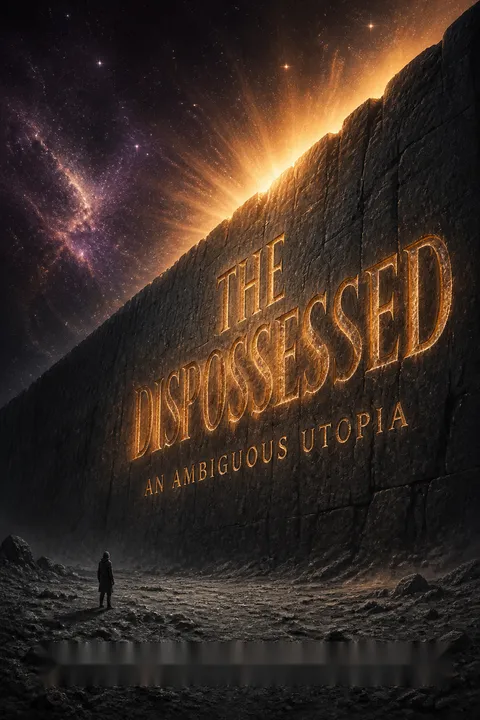
The wall at the Port
Boundary made visibleThe low stone boundary around the Port of Anarres separates the planet from Urrasti ships and the rest of the universe. It can be crossed physically, yet carries the force of a political agreement and a social taboo. At the beginning, a crowd gathers beside it to challenge Shevek’s departure. Across the story, the wall also names less visible barriers: the distance between worlds, the gatekeeping of scientific knowledge, and the pressures that restrict choice within Anarres itself. Its ambiguity matters because each society can describe its own enclosure as protection and the other side as confinement.
Temporal physics
Science as shared timeShevek’s work attempts to join two accounts of time: one that emphasizes change and sequence, and another that treats events as coexisting within a larger whole. His research drives his need for conversation with physicists beyond Anarres, where isolation has left his ideas without adequate challenge. On Urras, the theory also has practical value because it could make instantaneous communication between distant worlds possible. The scientific problem therefore mirrors the political one: whether separate perspectives can be related without one claiming ownership of the whole.
The Syndicate of Initiative
Voluntary dissent networkFounded by Shevek, Bedap, and their allies, the Syndicate of Initiative seeks open communication with Urras and a freer exchange of ideas on Anarres. It works through printing, teaching, and radio rather than formal political authority. Its existence challenges the assumption that majority opinion always represents genuine solidarity. The Syndicate also gives Shevek a way to act on the principles he studies: a community should make room for individual initiative, even when that initiative is unpopular. Its members’ isolation and the hostility directed at their families reveal the risks of dissent in a society without official censorship.
The Anarres famine
Solidarity under scarcityA prolonged drought threatens food supplies across Anarres, prompting rationing, emergency work assignments, and the dispersal of families. The crisis reveals both the strength and limits of the planet’s mutual-aid system. Volunteers repair water lines and communities work to feed one another, yet Shevek also encounters hunger, transport breakdowns, and the temptation to protect local stores from outsiders. The famine drives his separation from Takver and Sadik and forces him to ask whether a society can preserve freedom when survival requires coordination on a vast scale.
The ansible
Communication without delayThe ansible is a device that Shevek’s temporal physics could make possible: a means of communicating across space without the long delays of ordinary transmission. A-Io’s government wants the scientific advantage for its own research and prestige, while Shevek sees the danger of one power controlling it. He ultimately gives the equations for distribution among physicists on Urras and other worlds. The device turns the novel’s concern with isolation into a concrete invention, while leaving open the political question of whether better communication will produce understanding or merely make conflict faster.
FAQ
Synopsis & Basic Details
What is The Dispossessed: An Ambiguous Utopia about?
- Anarchist physicist's journey: The story follows Shevek, a brilliant physicist from the anarchist moon Anarres, as he travels to the capitalist planet Urras to share his groundbreaking theories.
- Clash of ideologies: The novel explores the stark contrasts between Anarresti and Urrasti societies, examining themes of freedom, oppression, wealth, poverty, and the nature of utopia.
- Quest for understanding: Shevek's journey becomes a quest to understand both worlds and to bridge the ideological gap between them, challenging the reader to question their own assumptions about society and human nature.
Why should I read The Dispossessed: An Ambiguous Utopia?
- Thought-provoking social commentary: Le Guin's novel offers a deep exploration of political and economic systems, prompting readers to consider the strengths and weaknesses of both capitalist and anarchist societies.
- Complex characters and relationships: The characters are richly developed, with nuanced motivations and relationships that challenge simplistic notions of good and evil.
- Exploration of universal themes: The novel tackles timeless themes of freedom, justice, and the search for meaning, making it relevant to readers of all backgrounds.
What is the background of The Dispossessed: An Ambiguous Utopia?
- Odonian philosophy: The novel is rooted in Odonianism, an anarchist philosophy developed by Laia Odo, which emphasizes individual freedom, mutual aid, and the rejection of hierarchical power structures.
- Anarres as a social experiment: Anarres is presented as a social experiment founded on Odonian principles, offering an alternative to the capitalist and state-controlled societies of Urras.
- Cold War influences: Le Guin wrote the novel during the Cold War, and the ideological conflict between Anarres and Urras can be seen as a reflection of the tensions between the United States and the Soviet Union.
What are the most memorable quotes in The Dispossessed: An Ambiguous Utopia?
- "There was a wall.": This opening line immediately establishes the central theme of division and the ambiguous nature of boundaries, both physical and ideological.
- "To lock out, to lock in, the same act.": This quote encapsulates the novel's exploration of the duality of freedom and confinement, highlighting how attempts to protect can also imprison.
- "You cannot buy the Revolution. You cannot make the Revolution. You can only be the Revolution. It is in your spirit, or it is nowhere.": This quote emphasizes the importance of individual action and internal transformation in achieving social change.
What writing style, narrative choices, and literary techniques does Ursula K. Le Guin use?
- Alternating chapters: Le Guin employs a non-linear narrative structure, alternating between Shevek's experiences on Urras and flashbacks to his life on Anarres, creating a sense of temporal simultaneity and highlighting the interconnectedness of past and present.
- Descriptive prose: Le Guin's writing is rich in detail, vividly depicting the landscapes, cultures, and social dynamics of both Anarres and Urras.
- Philosophical dialogue: The novel is filled with thought-provoking conversations and debates between characters, exploring complex philosophical and political ideas in an accessible way.
Hidden Details & Subtle Connections
What are some minor details that add significant meaning?
- The scarcity of water: The constant references to water scarcity on Anarres highlight the challenges of survival in a harsh environment and the importance of resource management in Odonian society. This contrasts sharply with the abundance of water on Urras, where it is often wasted, symbolizing the inequalities of a propertarian system.
- The color green: The color green, associated with life and growth, is rare on Anarres, emphasizing the planet's barrenness. Its presence on Urras, particularly in the lush landscapes, underscores the planet's vitality and abundance, but also hints at the potential for exploitation and waste.
- The use of Pravic: The constructed language of Pravic, with its emphasis on non-possessive pronouns and collective action, reflects the Odonian values of Anarres. Its limitations in expressing certain concepts, such as ownership and hierarchy, reveal the challenges of translating Odonian ideals into practice.
What are some subtle foreshadowing and callbacks?
- Shevek's childhood dream: Shevek's dream of a wall that stops him foreshadows the obstacles he will face in his attempts to bridge the gap between Anarres and Urras. The cornerstone with the number 5 symbolizes the potential for unity and balance, hinting at the possibility of overcoming division.
- The "Beggarman": Shevek's self-identification as the "Beggarman" upon arriving on Urras foreshadows his reliance on the Urrasti for sustenance and resources, highlighting the economic dependence of Anarres on Urras.
- The Numerical Harmonies: The recurring motif of the Numerical Harmonies, a system of musical and mathematical relationships, symbolizes the Odonian search for order and balance in a chaotic world. Its presence in both Anarresti and Urrasti cultures suggests a shared human capacity for reason and harmony, despite ideological differences.
What are some unexpected character connections?
- Shevek and Rulag's shared traits: Despite their estrangement, Shevek and Rulag share a strong will, intellectual curiosity, and a tendency towards isolation, suggesting a deeper connection than either is willing to acknowledge.
- Atro and Odo's shared values: Despite living in vastly different societies, Atro and Odo share a commitment to truth, justice, and the pursuit of knowledge, highlighting the potential for common ground across ideological divides.
- Shevek and the Terran Ambassador: Both Shevek and the Terran Ambassador are exiles in a way, and both are trying to find a way to make the world better.
Who are the most significant supporting characters?
- Mitis: As Shevek's mentor, Mitis provides guidance and support, encouraging him to pursue his intellectual passions while also warning him of the dangers of power and influence.
- Efor: As Shevek's servant on Urras, Efor offers a glimpse into the lives of the working class and the inequalities of Urrasti society. His loyalty and compassion provide Shevek with a sense of connection and hope.
- Gimar: As a workmate in the afforestation project, Gimar offers Shevek a different perspective on Odonian values, emphasizing the importance of sharing and connection in all aspects of life.
Psychological, Emotional, & Relational Analysis
What are some unspoken motivations of the characters?
- Shevek's desire for recognition: While outwardly committed to Odonian principles of selflessness, Shevek also craves recognition for his intellectual achievements, creating an internal conflict between his personal ambition and his social ideals.
- Takver's fear of dependence: Takver's initial reluctance to fully commit to a partnership with Shevek stems from a fear of losing her independence and autonomy, reflecting a broader tension between individual freedom and social connection in Odonian society.
- Sabul's insecurity: Sabul's manipulative behavior is driven by a deep-seated insecurity about his own intellectual abilities, leading him to exploit Shevek's talent to bolster his own reputation.
What psychological complexities do the characters exhibit?
- Shevek's internal conflict: Shevek struggles to reconcile his intellectual pursuits with his social responsibilities, experiencing guilt and anxiety about his privileged position and his potential to betray his Odonian values.
- Takver's emotional restraint: Takver often suppresses her emotions in favor of practicality and efficiency, reflecting a cultural emphasis on self-control and emotional detachment in Odonian society.
- Atro's nostalgia: Atro's longing for a bygone era of aristocratic privilege reveals a deep-seated ambivalence about the egalitarian values of Odonianism, highlighting the enduring appeal of hierarchy and tradition.
What are the major emotional turning points?
- Shevek's disillusionment with Urras: Shevek's initial awe at the beauty and abundance of Urras gives way to disillusionment as he uncovers the inequalities and exploitative practices of Urrasti society, leading him to question his initial assumptions and motivations.
- Shevek's encounter with the Fort in Drio: Shevek's visit to the Fort in Drio, where Odo was imprisoned, forces him to confront the reality of oppression and the sacrifices required to achieve freedom, solidifying his commitment to Odonian ideals.
- Shevek and Takver's reunion: Shevek and Takver's reunion after years of separation is a moment of profound emotional release, reaffirming their commitment to each other and to their shared values.
How do relationship dynamics evolve?
- Shevek and Takver's partnership: Shevek and Takver's relationship evolves from a youthful infatuation to a deep and enduring partnership based on mutual respect, intellectual stimulation, and a shared commitment to Odonian values.
- Shevek and Bedap's friendship: Shevek and Bedap's friendship is tested by ideological differences and personal conflicts, but ultimately endures due to their shared history, mutual respect, and a deep-seated commitment to each other's well-being.
- Shevek and Sabul's mentorship: Shevek and Sabul's mentorship is characterized by a power imbalance and a gradual erosion of trust, reflecting the corrupting influence of power and the challenges of maintaining integrity in a hierarchical system.
Interpretation & Debate
Which parts of the story remain ambiguous or open-ended?
- The future of Anarres: The novel leaves the future of Anarres open-ended, suggesting that the Odonian experiment is an ongoing process with no guaranteed outcome. The challenges and contradictions within Anarresti society raise questions about the long-term viability of its anarchist ideals.
- The nature of true freedom: The novel offers no easy answers about the nature of true freedom, suggesting that it is a complex and multifaceted concept that is constantly being negotiated and redefined.
- The possibility of reconciliation: The novel hints at the possibility of reconciliation between Anarres and Urras, but ultimately leaves the question unanswered, suggesting that the path to understanding and cooperation is long and arduous.
What are some debatable, controversial scenes or moments in The Dispossessed: An Ambiguous Utopia?
- Shevek's sexual encounter with Vea: Shevek's impulsive and ultimately unsatisfying sexual encounter with Vea raises questions about the nature of desire, consent, and the complexities of human relationships.
- The violence at Capitol Square: The violent suppression of the demonstration at Capitol Square raises questions about the limits of nonviolent resistance and the potential for revolution to be co-opted by authoritarian forces.
- Shevek's decision to publish with Sabul: Shevek's decision to publish his work with Sabul, despite his ethical reservations, raises questions about the compromises required to achieve social change and the potential for individual actions to be used for unintended purposes.
The Dispossessed: An Ambiguous Utopia Ending Explained: How It Ends & What It Means
- Shevek's return to Anarres: Shevek's return to Anarres signifies a renewed commitment to his society's ideals, but also a recognition of its limitations. His experiences on Urras have broadened his perspective and strengthened his resolve to work for change from within.
- The meeting with Ketho: Shevek's decision to allow Ketho, a Hainish representative, to land on Anarres symbolizes a willingness to embrace new perspectives and challenge existing boundaries, suggesting a more open and inclusive future for Odonian society.
- The ongoing struggle for freedom: The novel's ending is not a resolution, but a beginning, emphasizing that the struggle for freedom and justice is a continuous process that requires constant vigilance, self-reflection, and a willingness to challenge the status quo.
About the Author
Other books by Ursula K. Le Guin





Download PDF
Download EPUB
.epub digital book format is ideal for reading ebooks on phones, tablets, and e-readers.








