

Key Takeaways
Listen for the rhythm that makes one sentence invite the next.
Sound carries the story. Prose reaches readers through meaning, but also through its beat, pauses, and verbal texture. A sentence can feel choppy, sluggish, or fluent before a reader has consciously analyzed its grammar. Le Guin urges writers to develop an inner ear by reading their work aloud and noticing where the rhythm supports or resists the action.
Kipling’s exuberant storytelling and Twain’s conversational dialect create very different musical effects; Hurston’s prose shows how rhythm can also give a scene emotional force. The point is not to make every passage ornate. Sound should suit the moment, whether that means a rush of words or a deliberate quiet.
What's striking is that sound here is not decoration added after meaning. Rhythm helps direct attention, signal emphasis, and make a sentence easier to follow, much as timing does in music or conversation. Reading aloud can expose awkward transitions that silent reading overlooks because the eye can skim past them. Yet pleasing sound is not proof of clarity: a polished sentence can still obscure its thought. The useful test is whether the sentence's music strengthens the reader's grasp of what is happening.
Treat grammar as steering gear, not a cage or a status test.
Rules enable choice. Punctuation helps readers hear how parts of a sentence relate. A comma, semicolon, or period can change the pace and meaning, while an unpunctuated passage can become difficult to parse. Grammar supplies names for the tools a writer is using, making revision more precise than simply declaring a sentence wrong or awkward.
Le Guin also separates clarity from social policing. Standard usage can act as a class marker, and some supposed rules are false: “passive tense,” for instance, confuses verb voice with tense. But purposeful departures differ from accidental confusion. Twain’s written dialect remains legible partly because its punctuation carefully guides the reader through its spoken rhythms.
This distinction matters beyond fiction. Shared conventions let strangers communicate without access to tone of voice or facial expression, while language policing can mistake prestige for correctness. The writer's task is neither blind obedience nor rule-breaking for its own sake. It is to know what a convention does, who benefits from treating it as mandatory, and what readers may lose when it is ignored. That approach respects both linguistic variation and the practical need to be understood.
Vary sentence length to match the movement and complexity of thought.
Coherence comes first. A sentence must hold together clearly enough to carry a reader forward. Misplaced phrases, dangling modifiers, or strings of clauses joined without control can muddle who did what. Short sentences can sharpen a moment, but using only short, simple sentences creates a monotonous beat and can flatten complicated experience.
Long sentences are not automatically more literary or more natural. They need clear connections between their parts. Austen’s carefully linked sentences can follow a character’s reasoning; a passage in Stowe uses extended, jolting syntax to convey a carriage lurching over rough ground. In revision, vary sentence lengths according to what the scene needs, rather than obeying a blanket preference for shortness.
Sentence variety is a form of pacing, but it also manages cognitive effort. A short sentence asks the reader to process one beat at a time; a well-built complex sentence can hold several related thoughts in view. The key is not to keep every sentence easy, but to make its difficulty purposeful. Advice to simplify can help untangle a draft, yet treating simplicity as the only virtue leaves writers with fewer ways to represent hesitation, accumulation, or layered thought.
Repeat with purpose; echoes can turn separate moments into story structure.
Repetition builds expectation. Reusing a word, image, phrase, or event is not automatically careless. A phrase that returns can become comic, ominous, or moving as its context changes. In Dickens, the hopeful refrain of Mr. Micawber gains force through recurrence, so the reader begins to anticipate it and notice the disappointment beneath the humor.
Repetition can also shape a whole narrative. Jane Eyre’s early experiences of isolation and resistance echo later situations in her life, giving the novel’s events a pattern beyond simple sequence. Repeated details help readers sense connections that the narration may never explain outright. The craft question is whether each return develops the meaning, rather than merely making the same point again.
Echoes make a narrative easier to remember because readers can compare a current moment with an earlier one. That comparison creates meaning in the gap between repetitions: the second occurrence may reveal change, irony, or an old pattern resurfacing. The same technique can become heavy-handed if every recurrence announces its importance. Subtle variation often does more than exact duplication, especially when the reader is trusted to recognize the link without being told what it means.
Choose exact verbs before decorating sentences with modifiers.
Precision beats padding. Adjectives and adverbs can enrich prose, but they often compensate for a vague noun or weak verb. Replacing “ran quickly” with a more exact verb can make the action sharper; choosing a specific noun may carry a description more efficiently than adding several adjectives. Habitual qualifiers such as “very,” “kind of,” and “sort of” can soften a sentence without adding useful meaning.
Le Guin’s “Chastity” exercise asks writers to describe a scene without adjectives or adverbs. The restriction forces attention onto nouns, verbs, and sentence structure. It is a diagnostic, not a permanent ban: after drafting, a writer can restore a modifier when it supplies a distinction or sensation that the other words cannot.
The exercise works like a temporary constraint in music or design: removing one easy option makes overlooked choices visible. Strong verbs often compress action and attitude together, giving a sentence energy without extra explanation. Still, minimalism is not inherently precise. A modifier may distinguish one quality from another, while a supposedly vivid verb may overstate what happened. The standard is not fewer words at any cost, but whether each word earns its place by making the scene clearer or more alive.
Choose tense by the story's time field, not by fashion.
Tense shapes the frame. Present-tense narration concentrates attention on what is unfolding, often creating a narrow, immediate field. Past tense can move more freely among earlier events, later consequences, and the present of the telling. Neither is inherently more real: both are crafted ways of presenting events on a page.
The choice affects more than verb endings. Le Guin’s exercise about an older woman remembering youth asks writers to tell the same basic story in different combinations of person and tense, then compare the effect. Frequent, unexplained shifts can disorient readers, while deliberate changes can mark a new time or voice. Choose the form that gives this particular story the reach and pressure it needs.
The useful insight is that grammatical time is also a decision about context. A tightly focused present can create suspense, but it may leave little room for historical perspective; past narration can hold an event alongside what preceded or followed it. This is not a law that present tense cannot contain reflection or that past tense must feel detached. It is a reminder to assess what the chosen form makes easy to show, and what it pushes out of view.
Choose a viewpoint that controls what readers can know and feel.
Access determines meaning. Point of view is the narrator’s relationship to the events and the limits on what the narration can reveal. In first person and limited third person, readers receive the perceptions and thoughts of one character. An involved author can move among people and comment more openly; a detached narrator reports observable behavior without entering anyone’s mind. An observer-narrator tells what a witness sees.
The choice changes the story, not just its pronouns. Huck Finn, for example, often misunderstands the people around him. His limited understanding reveals the world’s injustice to readers who can see what he cannot. In memoir and nonfiction, claims about another person’s private thoughts need to be marked as interpretation, not presented as known fact.
Viewpoint is an instrument for shaping reader knowledge and sympathy. Restriction can make a character’s blind spots visible, while a broader narrator can connect experiences that no single character can see. That does not mean access automatically produces empathy: a close perspective can also trap readers inside prejudice. The distinction between observation and inference is especially valuable in nonfiction, where an elegant narrative choice cannot turn a guess about another person into evidence.
Let setting, speech, and detail carry information without lectures.
Information can become action. Stories often need to explain a place, a process, or a character’s history. When background arrives as a block of explanation, it interrupts the narrative. Le Guin calls such a block an Expository Lump and recommends breaking information into details, dialogue, and action that belong naturally in the scene.
A room can suggest the absent person who inhabits it; a landscape can establish a story’s mood and pressure. Dialogue can reveal a crisis through what two people say, while leaving the reader to infer the rest. This does not mean that nothing should be explained. It means explanation should help build the reader’s sense of the world as the story moves.
The strongest indirect storytelling invites readers to participate. A detail can do double duty, grounding a setting while hinting at a relationship or an approaching event. That efficiency resembles good teaching: information is easier to retain when attached to a concrete situation. But inference has limits. If essential context is omitted, readers may not feel intrigued; they may simply be lost. The writer has to judge which gaps create productive curiosity and which prevent comprehension.
Pack in telling details, then leap over everything that does not matter.
Selection creates momentum. Le Guin uses “Crowding and Leaping” for two complementary choices: crowd a passage with vivid, relevant details, then leap over what does not serve the story. An inventory of everything in a room can smother a scene; a few chosen objects can suggest a person or an event more powerfully.
Virginia Woolf’s brief account of Mr. Floyd traces much of his life while also illuminating the people around him. The passage feels compact because it omits explanations and lets connections emerge. Le Guin recommends drafting freely, then cutting repetitions, padding, and detours. Her exercise “A Terrible Thing to Do” asks writers to halve a narrative while preserving its clarity and sensory force.
Compression is not simply deletion. A good cut can make a remaining detail carry several kinds of meaning, while a careless cut can remove the context that makes it legible. This is why revision needs both subtraction and attention to the story’s center. The method also challenges the assumption that action must be narrated blow by blow: selection can increase urgency by directing the reader to the few moments that change the scene.
Practice technique, then use criticism to hear what the page actually says.
Skill makes freedom usable. Le Guin presents exercises as practice in noticing sound, syntax, voice, and narrative movement. Reading a draft after time has passed, revising it, and reading it aloud can reveal problems that disappear during the first flush of writing. Imitating a passage as an exercise can also teach technique, provided the practice is not passed off as original work.
A peer workshop can extend that learning. Members read one another’s work, offer concise responses about the writing, and let the author listen without defending or explaining during the critique. The group should aim for mutual respect, useful criticism, and attention to what works as well as what fails. Solitary work remains valid: the writer must ultimately make the decisions.
The workshop method separates receiving information from reacting to it. Silence can help an author notice what readers actually understood, rather than steering them toward the intended interpretation. That makes critique a form of feedback, not a vote on whether a writer has talent. Still, groups are only useful when members can offer candid responses without humiliation and when the author can judge which suggestions fit the work. Community supports craft; it cannot replace individual responsibility.
Analysis
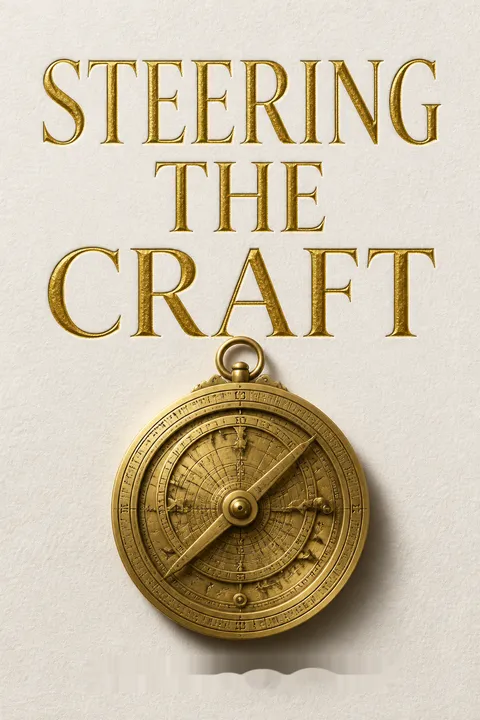
Steering the Craft is both a technical handbook and an argument about artistic agency. Its exercises make grammar, rhythm, tense, and point of view perceptible by temporarily exaggerating them: write without punctuation, restrict sentence length, remove modifiers, or tell one scene through competing perspectives. The constraint is not a formula for finished prose. It is a way to notice choices that habit has made invisible.
The book’s central tension is between control and surrender. Writers need enough command of language to shape a reader’s experience, yet excessive control can produce stiff, overexplained prose. Le Guin resolves this not by dismissing technique, but by making practice the route to fluent choice. A practiced writer can depart from convention intentionally, while a writer who does not know what a convention does may mistake accident for innovation.
The same concern reaches beyond style. Grammar is a shared system that helps writing travel between people, but its standards can also serve as social gatekeeping. Point of view likewise governs the ethics of what a narrator claims to know. In nonfiction, imagining another person’s thoughts is not equivalent to reporting them. These sections make craft a matter of responsibility as well as elegance.
The book is especially valuable because it treats narrative as more than plot. A quiet action, a remembered event, or a room described before its occupant appears can move a story through change and implication. Its advice to cut, however, should not be confused with a universal preference for brevity. Some stories need accumulation, detours, or ornate language. The enduring principle is fit: each technique earns its place when it serves the movement and meaning of the particular work.
Review Summary
Steering the Craft is praised as an insightful guide for writers, focusing on language and style rather than plot. Readers appreciate Le Guin's clear explanations, practical exercises, and expert analysis of literary examples. The book is seen as valuable for both beginners and experienced writers, offering tools to improve craft and understand narrative techniques. Some reviewers note that while the literary examples are impressive, they may not reflect current market trends. Overall, the book is highly recommended for its concise advice and emphasis on the beauty of language.
People Also Read




Glossary
Expository Lump
Background that interrupts the storyA block of explanatory information inserted into a narrative in a way that feels separate from the events. It is especially noticeable when a character delivers information mainly for the reader’s benefit. Le Guin recommends distributing necessary facts through dialogue, action, description, and passing references so that they help construct the story rather than pause it.
Crowding and Leaping
Select vivid detail and meaningful omissionA paired approach to narrative selection. Crowding means making a passage rich with precise, relevant sensations, implications, and connections. Leaping means leaving out material that pads, repeats, or distracts from the story’s focus. The technique balances density with omission so that a narrative feels full without becoming an exhaustive inventory.
limited third person
Third person through one characterA narrative mode using pronouns such as he or she while limiting what can be known to one character’s perceptions, feelings, thoughts, memories, and guesses. It shares the information restriction of first-person narration, but creates a different relationship between reader and narrator. The viewpoint can shift between characters, but those shifts need control.
involved author
A narrator with broad accessA narrative voice that is not confined to a single character’s knowledge. It can enter different minds, describe events no character witnesses, and offer judgments or interpretations. Le Guin prefers this term to “omniscient author” because it emphasizes the narrator’s engagement with the story rather than suggesting detached, limitless knowledge.
detached author
A narrator limited to observationA narrative mode that presents what an outside observer could see or hear, without directly entering characters’ thoughts or feelings. Values and interpretations must be suggested through behavior, speech, and detail. Because the narrator’s judgments remain implicit, this apparently neutral mode still shapes what the reader notices and infers.
observer-narrator
A witness tells another’s storyA narrator who is present in the events but is not their central participant. The observer recounts what they witness and may interpret other characters through their own perspective. This mode can use first or third person in fiction; memoir and other nonfiction can also use a witnessing narrator.
The Rule of Silence
Authors listen during critiqueA workshop practice in which the writer whose work is being discussed does not explain, defend, or answer comments during the critique. The writer listens, takes notes, and considers the responses afterward. The rule is meant to reveal what the text communicates on its own, rather than letting the author’s explanation replace the readers’ experience.
Chastity
Description without modifiersLe Guin’s exercise in writing descriptive narrative without adjectives or adverbs. By temporarily removing these common modifiers, the writer must rely on nouns, verbs, and sentence construction to create vividness. The exercise is intended to sharpen attention to word choice, not to establish a rule that modifiers should never be used.
trajectory
The story’s overall movementThe shape of a narrative’s movement from its beginning toward its end. A trajectory need not be a strict outline or a chain of conflicts, but it gives the story direction and helps its passages cohere. Details, events, and omissions should contribute to this movement rather than depart from it without purpose.
FAQ
What is "Steering the Craft" by Ursula K. Le Guin about?
- Handbook for Storytellers: "Steering the Craft" is a practical guide for writers of narrative prose, focusing on the craft and technique of storytelling rather than inspiration or self-expression.
- Not for Beginners: Le Guin explicitly states the book is intended for writers who have already worked hard at their writing and want to refine their skills.
- Workshop-Based Approach: The book originated from a writing workshop and is structured as a series of discussions and exercises, suitable for individuals (the "Lone Navigator") or groups (the "Mutinous Crew").
- Focus on Fundamentals: It covers the essential elements of narrative prose, such as sound, rhythm, grammar, syntax, point of view, and more, with the aim of developing skill and awareness in writers.
Why should I read "Steering the Craft" by Ursula K. Le Guin?
- Expert Guidance: Le Guin is a master storyteller, and her advice is grounded in decades of experience and literary achievement.
- Practical Exercises: The book offers hands-on exercises that help writers practice and internalize key narrative techniques.
- Focus on Craft: It emphasizes the importance of skill, technique, and conscious control over language, which are often overlooked in favor of inspiration or "finding your voice."
- Applicable to All Narrative: The lessons apply to both fiction and nonfiction writers, as the fundamentals of narrative are universal.
What are the key takeaways from "Steering the Craft" by Ursula K. Le Guin?
- Sound and Rhythm Matter: The sound of language, including rhythm, repetition, and sentence structure, is foundational to good prose.
- Grammar and Punctuation as Tools: Mastery of grammar and punctuation is essential for clarity and effective storytelling.
- Variety in Sentence Structure: Effective narrative prose uses a variety of sentence lengths and structures to create rhythm and maintain reader interest.
- Point of View and Voice: Understanding and controlling point of view is crucial; shifts must be intentional and clear.
- Revision and Cutting: Ruthless editing and the ability to cut unnecessary words or passages are vital skills for any writer.
How is "Steering the Craft" by Ursula K. Le Guin structured, and what topics does it cover?
- Chapter-Based Discussions: Each chapter focuses on a specific element of narrative craft, such as sound, punctuation, repetition, adjectives/adverbs, verbs, point of view, and more.
- Examples from Literature: Le Guin includes examples from classic and modern writers to illustrate each concept.
- Exercises for Practice: Every chapter ends with exercises designed to raise awareness and develop skill in the topic discussed.
- Appendix on Workshops: The book concludes with practical advice on running or participating in peer group writing workshops.
What is Ursula K. Le Guin’s philosophy on writing craft as presented in "Steering the Craft"?
- Craft Enables Art: Le Guin believes that skill and technique are what free writers to create art, not the other way around.
- Conscious Control: She advocates for conscious awareness of language, structure, and technique, rather than relying solely on inspiration or intuition.
- Play and Pleasure: While emphasizing discipline, she also encourages writers to play with language and enjoy the process.
- Respect for Language: Le Guin stresses the importance of understanding the tools of language—grammar, syntax, punctuation—as essential for any serious writer.
What are the most important exercises in "Steering the Craft" and what do they teach?
- Being Gorgeous: Focuses on the sound and rhythm of prose, encouraging writers to play with language for its own sake.
- Am I Saramago: Challenges writers to write without punctuation, raising awareness of how punctuation shapes meaning and rhythm.
- Short and Long: Explores the effects of sentence length and complexity on narrative flow and emotional impact.
- Chastity: Requires writing without adjectives or adverbs, sharpening the use of nouns and verbs for vivid description.
- Points of View: Involves retelling the same story from different points of view, deepening understanding of narrative voice and perspective.
How does "Steering the Craft" by Ursula K. Le Guin address point of view and voice in narrative writing?
- Detailed Definitions: The book defines and distinguishes between first person, limited third person, involved author (omniscient), detached author (objective), and observer-narrator points of view.
- Examples and Exercises: Le Guin provides sample passages and exercises to help writers practice shifting and controlling point of view.
- Risks of Shifting POV: She warns against careless or frequent shifts in point of view, which can confuse readers and weaken narrative focus.
- Voice as Narrative Identity: Voice is treated as the unique narrative presence, shaped by point of view, diction, and rhythm.
What advice does "Steering the Craft" give on grammar, punctuation, and sentence structure?
- Punctuation as Music: Punctuation is described as a way to guide the reader’s ear, shaping the rhythm and clarity of prose.
- Grammar as Foundation: Le Guin insists that understanding grammar is essential for any writer, likening it to knowing the difference between a hammer and a screwdriver.
- Sentence Variety: She advocates for a mix of short and long sentences, tailored to the needs of the narrative, rather than following arbitrary rules.
- Cutting and Revising: The book encourages writers to revise for clarity, coherence, and rhythm, often by cutting unnecessary words or sentences.
How does "Steering the Craft" by Ursula K. Le Guin approach the use of adjectives, adverbs, and repetition?
- Use with Care: Adjectives and adverbs are valuable but should be used thoughtfully and sparingly to avoid weakening prose.
- Vivid Verbs and Nouns: Writers are encouraged to rely on strong verbs and precise nouns for vivid, muscular writing.
- Repetition as Rhythm: Repetition is not inherently bad; when used deliberately, it can create rhythm, emphasis, and structural unity.
- Avoiding Cliché and Padding: The book warns against overused qualifiers and unnecessary repetition that add nothing to the narrative.
What does "Steering the Craft" by Ursula K. Le Guin say about narrative structure, plot, and storytelling?
- Story vs. Plot: Le Guin distinguishes between story (a narrative of change over time) and plot (a tightly connected chain of events, often driven by conflict).
- Not All Stories Need Plot: She argues that not all stories require a traditional plot; some great stories are driven by character, setting, or theme.
- Focus and Trajectory: Every story needs a central focus and a sense of movement or trajectory, even if it’s not a conventional plot.
- Crowding and Leaping: Writers should "crowd" their prose with vivid, relevant detail but also "leap" by omitting what’s unnecessary, maintaining momentum and focus.
How does "Steering the Craft" by Ursula K. Le Guin recommend writers use workshops and peer groups?
- Mutual Learning: Workshops are valuable for mutual encouragement, criticism, and support among writers.
- Rule of Silence: During critique, the author remains silent to fully absorb feedback without becoming defensive.
- Impersonal Critique: Criticism should focus on the writing, not the writer, and be delivered respectfully and constructively.
- Online and In-Person: The book offers advice for both in-person and online groups, emphasizing preparation, participation, and clear protocols.
What are the best quotes from "Steering the Craft" by Ursula K. Le Guin and what do they mean?
- "Skill in writing frees you to write what you want to write. It may also show you what you want to write. Craft enables art." — Emphasizes that technical mastery is the foundation for creative freedom and discovery.
- "The chief duty of a narrative sentence is to lead to the next sentence—to keep the story going." — Highlights the importance of forward momentum in storytelling.
- "To break a rule you have to know the rule. A blunder is not a revolution." — Stresses the necessity of understanding conventions before intentionally deviating from them.
- "To make something well is to give yourself to it, to seek wholeness, to follow spirit. To learn to make something well can take your whole life. It’s worth it." — Encourages dedication to the lifelong pursuit of craft and excellence in writing.
What makes "Steering the Craft" by Ursula K. Le Guin unique among writing guides?
- Focus on Language and Sound: Unlike many writing guides, it delves deeply into the sound, rhythm, and musicality of prose.
- Emphasis on Practice: The book is structured around exercises that require active engagement, not just passive reading.
- Literary Examples: Le Guin draws on a wide range of literary examples, from classic to contemporary, to illustrate her points.
- Author’s Voice: The book is infused with Le Guin’s wit, wisdom, and humility, making it both authoritative and approachable for writers at many levels.
About the Author
Other books by Ursula K. Le Guin







Download PDF
Download EPUB
.epub digital book format is ideal for reading ebooks on phones, tablets, and e-readers.








