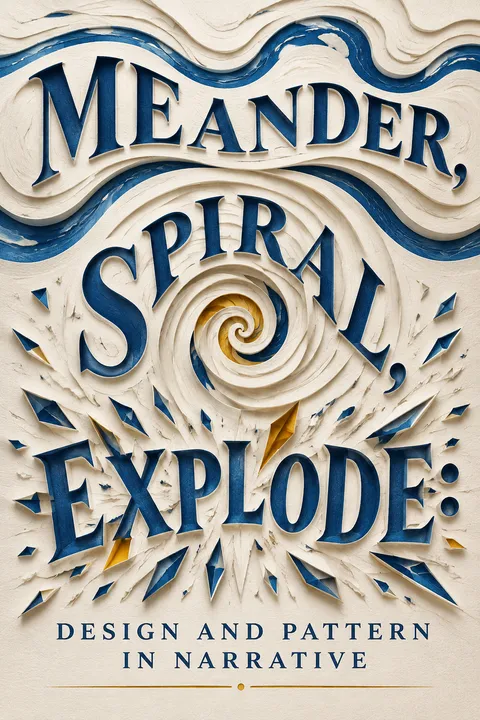


Key Takeaways
Stop treating the dramatic arc as fiction's only natural shape

Form can follow life. Architect Eileen Gray watched how people moved through a house and how sunlight crossed it, then designed a home around those patterns. Alison sees a parallel in writing: a narrative gives readers a route through experience, and its overall shape can become visible only after the journey is complete.
The arc is one option. Aristotle described the shape of Greek tragedy, where events build toward a decisive turn and resolution. That model can serve a novel, but it does not define every novel. Fiction can mix genres, follow thoughts, or build meaning through recurring images rather than a chain of causes. The writer's task is not to abandon structure, but to find a structure that suits the material.
The architectural comparison makes narrative form practical: a route is not decoration if it changes how someone experiences a place. The same is true of a reader's route through a story. This perspective frees writers from treating inherited conventions as laws. It also preserves the arc's value: stories about irreversible choices or escalating danger may need its accumulating pressure. Formal freedom works best as a choice among tools, not as a rule that linear plotting is unsophisticated.
Tune sentences, silence, and color to choreograph the reader's attention

Language has texture. Alison uses texture to mean the felt quality of text as readers move through it: sounds, word lengths, syntax, paragraph shape, and white space all affect pace and emphasis. In a Raymond Carver story, a fragment repeating the idea of two separate sides interrupts otherwise varied sentences, making a divided relationship visible in the prose itself. Long, layered sentences can make a reader linger; short paragraphs can create breathing room.
Color directs the eye. Tobias Wolff's novella about soldiers uses relatively few color words, with red recurring around its most tense moments. W. G. Sebald's four linked narratives create a gray, dusty tone across separate lives. Color can therefore work through placement and recurrence, not only as a symbol with a fixed meaning.
This account treats reading as both interpretation and sensation. Syntax can make a reader wait, rush, or reconsider, while white space gives an image room to resonate. Such choices resemble visual composition: attention is guided by contrast, repetition, and empty space. But a recurring color should not be decoded as a universal symbol. Red may suggest violence in one work and vitality in another. Its force comes from its relationship to the surrounding scenes and the pattern the text establishes.
Control narrative time by deciding what deserves a scene

Story time and page time differ. Narrative speed describes how much text a writer gives to an event compared with how long that event takes in the story. A scene roughly matches event time; summary compresses a longer period; a gap skips events; dilation stretches a brief moment; and a pause gives space to description or reflection while story action stops.
Tobias Wolff demonstrates the range in "Bullet in the Brain," a story about a critic caught in a bank robbery. A glance at a ceiling painting expands into a long passage, and the instant of a fatal gunshot opens into an extended account of what the character does not remember. These shifts control suspense and direct the reader toward the moment that matters.
Narrative speed is a form of emphasis. Spending a page on a second can make it feel more consequential than years summarized in a sentence. This is close to how memory behaves: some moments become vivid, while long stretches blur. The technique also carries a responsibility. A writer's allocation of time tells readers whose experience merits attention. Dilation can deepen a moment, but without a meaningful change in perception or pressure, it can turn intensity into mere delay.
Let recurring tensions create motion without depending on one climax
A wave need not be one grand swell. The familiar dramatic arc resembles a wave: tension rises, reaches a peak, and subsides. Alison also describes wavelets, small repeated movements of tension and release that can better match uneven experience. In Raymond Carver's story about an alcoholic drying out, wet and dry details alternate, making sobriety feel both necessary and frightening. The pattern carries the conflict even when the plot remains quiet.
Small reversals can accumulate. Tobias Wolff's story of a soldier repeatedly moves between the desire for closeness and the impulse to reject others. Philip's brief gestures of care or cruelty gather into a deeper pattern than any single incident. In Philip Roth's novella about Neil and Brenda, paired scenes echo one another while showing that the relationship has changed.
Repeated tensions can represent relapse, hesitation, and partial change more honestly than a clean march toward a single turning point. Their rhythm gives readers something to feel before they can explain it. The pattern also helps prevent quiet stories from becoming shapeless: recurring contrasts supply a pulse. Yet repetition needs alteration. If each return has exactly the same force and consequence, a wavelet becomes a loop that goes nowhere.
Let digressions delay the ending while revealing what the story values
A meander moves by detour. It starts in one place and continues toward another, but loops through side paths rather than taking the shortest route. In Marguerite Duras's The Lover, the central affair is interrupted by passages about family, memory, and writing. These apparent detours help construct a portrait of the narrator's emerging identity, not just a record of the romance.
Murray Bail's Eucalyptus surrounds a fairy-tale contest for a young woman's hand with tree lore, stories, and commentary. Its wandering storyteller delays a grimly efficient suitor's progress. In Nicholson Baker's The Mezzanine, a man rides an escalator after buying shoelaces, while his attention wanders through ordinary objects and their design. The diversions reveal the book's delight in daily life.
Digression becomes structural when the side material changes the reader's understanding of the central line. It can create suspense by postponing an ending, but it can also question why that ending should dominate. The risk is genuine: a detour may feel like padding if it neither enriches the subject nor alters the atmosphere. A useful test is whether removing it would make the story faster but less meaningful.
Build spirals from returns that deepen rather than merely repeat
A spiral revisits and advances. Unlike a meander's leisurely detours, a spiral circles a central subject while moving steadily inward or outward. In Sandra Cisneros's The House on Mango Street, short portraits of girls and women recur around Esperanza's wish to leave her neighborhood. As she grows more aware of the dangers and limits facing them, each return gives that wish new weight.
Jamaica Kincaid's Mr. Potter circles the life of an absent father through a daughter's recurring interruptions, which make her role as narrator increasingly central. Stuart Dybek's short story "Pet Milk" moves through memories of swirling liquids and skies until those images lead to an intimate present-day encounter. In each case, repetition is the route by which a new layer of meaning appears.
A spiral offers a useful model for memory and obsession: the mind returns to a subject, but not from precisely the same position. That changing vantage gives repetition its force. In narrative, a returning image can accumulate emotional meaning without a character announcing what has changed. The form still requires discernible movement. If each recurrence adds no detail, pressure, or altered perspective, readers may experience circularity rather than development.
Use a fixed center to make scattered viewpoints pull together
A radial story gathers around a core. Its central event, absence, or obsession holds surrounding scenes in its pull. In Gabriel García Márquez's Chronicle of a Death Foretold, the opening reveals that Santiago Nasar will be murdered. The narrator then gathers accounts from townspeople who knew the killing was coming, circling the event instead of building suspense about its outcome. The focus shifts to how a whole community failed to prevent it.
Mary Robison's Why Did I Ever uses hundreds of brief fragments to orbit a mother's anguish over her son, who has been violently harmed. The pieces jump among jokes, errands, and anxieties, but the pain at the center gives their scatter a shape. Radial narratives can move outward from a core or repeatedly approach it, with little forward movement in story time.
A known ending can redirect attention from what happens to how people become implicated in it. That shift is especially powerful in García Márquez's town, where every account changes the moral picture without changing the outcome. Radial form can also mimic the difficulty of looking directly at trauma: attention moves away, then returns. Its limitation is that peripheral lives may seem valuable only as satellites of the central wound, so their independent complexity matters.
Make readers connect the cells, or watch one seed branch outward
Some stories are fields, not lines. In spatial form, connections among images, phrases, or episodes can matter more than chronological order. Susan Minot's "Lust" presents brief sexual encounters as separate units; their shifting imagery lets readers infer a change in the speaker's sense of herself. Sherman Alexie's "Captivity" links separate pieces through repeated situations and phrases, asking readers to assemble a larger argument.
A fractal narrative grows from a seed. Its initial pattern reappears in altered forms at different scales. Caryl Phillips's Crossing the River begins with a father's decision to sell his children, then branches into stories across centuries that echo and revise that rupture. Sebald's The Emigrants links four lives through recurring images, including a butterfly collector, rather than a single continuous plot.
These forms make the reader an active participant in composition. Meaning arises not only from what the text states but from the connections a reader builds across separated parts. That can represent histories that resist a single viewpoint or a complete account. It also places a greater burden on design: repeated images and fragments must create enough pattern for readers to connect, while leaving room for ambiguity rather than prescribing one answer.
Choose form that carries the subject's emotional and historical weight
Structure can make an argument. Alison draws on Aristotle's hylomorphism, the idea that form gives matter its organized, actual shape. A narrative's pattern is therefore not simply packaging for its subject. In David Mitchell's Cloud Atlas, six interlocking stories move through different eras and styles, with nested sections that climb toward a distant future and then return. The structure makes repeated exploitation and acts of kindness visible across time.
Formal experiment can carry feeling. Sebald's linked portraits use recurring images and documentary fragments to keep lives threatened by historical violence present to the reader. Phillips's fractured stories trace the legacy of slavery through changing relationships between black and white characters. In both, the form's connections support the subject's scale and complexity rather than serving as a puzzle for its own sake.
The strongest formal choice is not necessarily the strangest one. It is the one that helps a subject become perceptible: a network can hold dispersed historical lives, while a tight arc can sharpen a decisive moral choice. Cloud Atlas also shows how a pattern can carry an ethical proposition, not just display ingenuity. Still, a reader can overinterpret a design. Patterns invite discovery, but their meaning should remain answerable to the work's human stakes.
Analysis
Alison's central intervention is less a rejection of plot than a change in what counts as plot. A conventional account emphasizes causally linked events. Her broader account includes the reader's changing attention, the recurrence of images, shifts in pace, and the mental work of connecting separated passages. Narrative becomes an experience with both a timeline and a shape.
That distinction explains why her natural-pattern vocabulary is useful. Waves, meanders, spirals, radials, cells, and fractals offer writers different ways to organize movement. They are not strict categories, nor do they function as formulas. They are diagnostic images: a writer can ask whether a manuscript advances by escalation, return, digression, orbit, or association. The analogy to nature makes formal alternatives easier to imagine, while the literary examples show how those alternatives can create coherence without conventional suspense.
The book's strongest craft insight is that form is distributed across scales. A sentence can slow a reader; white space can suspend one; color can direct the eye; a recurring image can connect distant scenes; and the shape of the whole can echo the subject. This makes revision more precise. Instead of asking only whether a plot works, a writer can ask what the reader is being made to notice, how quickly, and through which repetitions.
The natural metaphors also need restraint. A story is not literally a river or a fern, and naming a pattern does not prove that a work succeeds. The categories overlap, as Cloud Atlas demonstrates, and some interpretations depend on subjective pattern recognition. That openness is a strength if treated as a creative heuristic, not a scientific taxonomy. Alison's argument ultimately asks writers to make form purposeful and readers to notice the route they have traveled. The result is not permission for shapelessness, but a richer standard for coherence: a work can hold together through causality, rhythm, image, association, or several at once.
Review Summary
Meander, Spiral, Explode receives strong praise overall, earning 4.09/5 stars. Readers appreciate Alison's accessible, enthusiastic approach to analyzing narrative structures beyond the traditional Aristotelian arc, using geometric and natural forms like waves, spirals, and fractals. Many find it valuable for both readers and writers. Critics note the book leans heavily on literary fiction and short works, with some arguing it ultimately reinforces conventional structure under new terminology. Familiarity with the referenced texts enhances the experience significantly.
People Also Read




Glossary
Spatial form
Meaning through nonchronological linksA broad term for narrative techniques that loosen chronological sequence or connect passages through images, motifs, analogy, or contrast. The reader's mind supplies links among parts, so the work's movement can come from recognition and interpretation rather than from asking what happens next.
Narrative speeds
Ratios of telling to event timeThe relative pace of a narrative, measured by comparing the time an event occupies in the story with the space devoted to telling it. Scene approaches real-time presentation; summary compresses events; a gap omits them; dilation expands a brief event; and pause gives text to description or reflection while story action stops.
Profluence
Forward narrative movementThe sense that a narrative is moving onward. It can arise from linked actions and reactions, but it can also be created by changes in images, ideas, or the reader's understanding. Alison uses the term to consider how even small events or contrasts can give a passage momentum.
Wavelet
Small recurring tension and releaseA modest rise and fall in narrative pressure, repeated across a work rather than gathered into one dominant dramatic climax. Wavelets can register minor changes, relapses, and psychological shifts. Their cumulative rhythm may give a quiet or episodic story a coherent sense of movement.
Meander
Forward movement by digressionA narrative pattern that proceeds toward an ending through loops, pauses, and side paths rather than by the shortest route. Digressions may delay resolution while developing atmosphere, memory, or ideas that change how the central story is understood.
Radial or explosion
Narrative gathered around a coreA pattern organized around a central event, absence, or obsession. Episodes and viewpoints radiate from it or circle back toward it, while story time may advance only slightly. The reader's attention is repeatedly drawn to the core and to its effects on surrounding lives.
Fractal
A pattern repeated across scalesAn irregular pattern that approximately reproduces its structure at different scales. In a fractal narrative, an initial situation or image acts as a seed, generating later parts that repeat and alter its pattern. The work can branch outward without simply copying its beginning.
Crots
Prose stanzas or segmentsAlison's term for short, bounded units of prose, comparable to prose stanzas. A crot gives a passage its own space and shape while allowing it to connect with neighboring units through repeated images, phrases, or themes. Crots can make fragmentation visible and purposeful.
Hylomorphism
Matter organized by formAn Aristotelian concept in which matter and form combine to make a complete thing. Alison applies it to narrative: the material of a story gains coherence through an organizing shape. That shape need not be a conventional dramatic arc; it can be another pattern suited to the work.
Crot
A discrete prose unitA short prose segment treated as a self-contained unit, often separated visually from neighboring passages. In fragmented narratives, each crot may present a distinct moment or idea, while recurring details and juxtapositions connect the units into a larger design.
Download PDF
Download EPUB
.epub digital book format is ideal for reading ebooks on phones, tablets, and e-readers.








