

Plot Summary
The House's Sole Witness
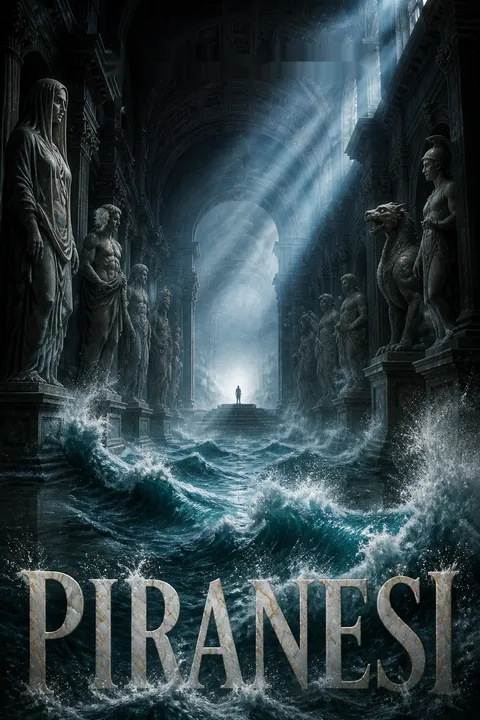
Piranesi lives in an immense House of marble halls, windows, statues, birds, clouds, and tides that can sweep through entire chambers. He maps its passages, predicts the waters, fishes for food, and brings offerings to the thirteen human skeletons he has found. He believes the House wants someone to witness its beauty.
The only other living person he knows is the Other, a neatly dressed scholar who meets him twice a week to pursue a Great and Secret Knowledge said to grant supernatural powers. The Other calls him Piranesi, though the name feels unfamiliar. During one meeting, the Other tests Piranesi's memory with the word Batter-Sea. Piranesi dismisses it as meaningless, then later experiences a troubling flash of images he cannot place.
The House is introduced not as a puzzle to solve but as Piranesi's entire ecology: it feeds him, threatens him, and gives his days a structure. His cataloguing turns isolation into service, especially through his care for the dead. The Other's research gives their relationship an apparent intellectual equality, but its terms are already uneven: he chooses the project and names his companion. The memory test quietly unsettles Piranesi's confidence in his own account of reality. His carefulness is real, yet it cannot protect him from facts he has been made unable to recognize.
A Hall Beneath the Moon
When an albatross crashes into a lower hall, Piranesi welcomes it, then gives the bird dry seaweed, feathers, and an old sweater so it can build a nest. The sacrifice costs him fuel for winter, but the birds lay an egg and raise a chick in the vestibule.
Meanwhile, the Other asks him to find a distinctive hall where a ritual might summon the Knowledge. After receiving new shoes, Piranesi makes the difficult journey and spends a night in the hall, whose statues form a crowd gathered beneath the moon.
The sight makes the House seem valuable without any hidden prize. On his way home he finds torn papers covered in distressed writing, then tells the Other he no longer believes their search matters. The Other insists Piranesi has said this before and claims he forgets whole conversations.
Piranesi's generosity toward the albatross gives concrete form to his idea of belonging: he accepts personal hardship to make room for another creature's life. The moonlit hall then changes his relation to knowledge. Rather than treating the House as a mechanism whose secret can be extracted, he sees its inhabitants and beauty as sufficient in themselves. The Other's insistence that Piranesi has forgotten earlier disagreements converts a philosophical dispute into a struggle over authority. If Piranesi cannot trust his memory, the Other can claim the right to decide what he should seek.
The Prophet Names Danger
The Other warns Piranesi that a hostile sixteenth person is approaching and tells him to hide if they meet. Soon Piranesi encounters a frail old man, who rejects the label and explains that he is Laurence Arne-Sayles, the Other's former teacher.
Arne-Sayles describes the House as a world formed from ideas and powers that drained out of another world. He confirms that the promised Knowledge is not hidden here, then reveals that the approaching stranger is searching for Piranesi, not the Other.
Arne-Sayles says he will give the stranger directions, partly to injure his old student. Piranesi listens, fascinated by the account, but keeps the encounter from the Other. The prophet's warning that Ketterley may become dangerous as the stranger draws near unsettles Piranesi's trust in his companion.
Arne-Sayles supplies a cosmology that resembles Piranesi's lived experience but refuses to make it a ladder to power. His explanation gives the House an origin while preserving its independence from the Other's ambitions. More consequentially, he reverses the roles in the supposed threat: the stranger is looking for Piranesi, while Ketterley is the person with reason to fear what she may reveal. Piranesi still interprets information through the categories the Other taught him, so he hears the warning without yet understanding its personal cost. His secrecy is an early act of self-protection.
Journals Break Their Silence
Trying to test the Other's claim that he forgets, Piranesi consults his index and finds references to journals he does not possess. His surviving notebooks were once numbered twenty-one onward, and their pages contain unfamiliar names, places, and events written in a younger version of his own hand.
The records connect the House's skeletons to people associated with Arne-Sayles, including the missing students Stanley Ovenden, Sylvia D'Agostino, and Maurizio Giussani. They also describe James Ritter, a vulnerable man found imprisoned in Arne-Sayles's home after telling others about a flooded house of statues.
Piranesi recovers scraps of another journal from gull nests, where an unnamed prisoner describes starvation, captivity, and worsening confusion. The evidence is painful and incomplete, but it proves his past includes a world beyond the House.
The index functions as an external memory, but it does not immediately restore understanding. Piranesi encounters accurate records as if they were fragments from a foreign language, and his own handwriting becomes evidence against his certainty. That estrangement complicates the idea of madness: what looks irrational may instead be a coherent record whose context has been suppressed. The missing pages matter as much as the surviving ones. They suggest that knowledge has been removed deliberately or defensively, leaving Piranesi to reconstruct a self from gaps, damaged testimony, and the bodies he has tended without knowing their histories.
The Name in Pebbles
Piranesi notices a new perfume in the First Vestibule and later finds chalk directions left by the stranger, who has carefully marked a route through the halls. He replies that she will not find him, still believing the Other's warnings.
Then he calculates that four converging tides will flood a wide region and writes instructions urging her to leave. Near a bank of white pebbles, he finds her next message arranged in enormous letters: a question asking whether he is Matthew Rose Sorensen. The name opens a vision of a rainy city crowded with people, lights, and traffic.
In his journals, he finds records of Matthew's academic work on Arne-Sayles and an entry identifying him as the person who visited Ketterley. The stranger has found the name Piranesi cannot remember, and the House no longer feels sealed from the outside.
The pebbles make language physical: the stranger must reshape the House's materials to reach someone who cannot safely read her earlier messages. Her question does not simply identify Piranesi; it gives him a bridge between two incompatible systems of memory. The city vision arrives with sensory force before it becomes usable knowledge, showing that recognition can precede explanation. At the same time, Piranesi's warning about the flood exposes an ethical independence from the Other. He acts to protect an unknown person despite being told she is an enemy, following the same care that has governed his treatment of the dead.
The Candle Door
Piranesi reconstructs the missing account of his visit to Dr Valentine Ketterley in London. He had gone as Matthew Rose Sorensen, a scholar researching Arne-Sayles, and agreed to perform an old ritual out of curiosity.
Ketterley used the ceremony to bring him into the House, where Matthew's memories gradually disappeared while Ketterley returned to the outside world. Piranesi now understands that the Other's memory tests and stories about the stranger were ways to keep him compliant.
As the four tides approach, he moves the dead and his journals to higher halls, then discovers Ketterley's hidden inflatable kayak and gun. He realizes Ketterley plans to meet the stranger during the flood. Piranesi has spent years accepting the role of assistant; now he prepares to act without his former companion's permission.
The recovered ritual recasts the House from a mysterious refuge into the site of a calculated confinement. Ketterley's apparent gifts and scientific collaboration become part of a system that depends on Piranesi's ignorance, not on mutual discovery. Yet the revelation does not erase Piranesi's House-formed self. He responds by protecting the dead, preserving his journals, and planning for another person's safety. His identity is therefore not a choice between Matthew and Piranesi, but a difficult accumulation: an earlier history returns, while the habits of care formed in the House remain his own.
Four Tides, One Gun
On the flood day, Piranesi searches for the stranger and finds Ketterley inflating his kayak in the First Western Hall. He recalls details of his London visit, forcing Ketterley to recognize that Matthew's memories have returned, then kicks the gun out of reach.
A woman's voice calls for Matthew; she emerges as Sarah Raphael, a police officer who has come to find him. Piranesi warns her about the rising water and leads her up the wall. Ketterley fires at them, but the tides surge into the hall before he can reach the boat.
Piranesi and Sarah shelter behind the marble Horned Giant as a wave throws Ketterley against the statues and carries him away. After the waters recede, Sarah treats Piranesi's injury. He tells her he cannot leave until he has returned the displaced dead to their places.
The climax makes competing forms of knowledge materially consequential. Ketterley has equipment and a plan, but he misjudges the tides; Piranesi survives because his intimate, embodied understanding of the House lets him choose where to climb and when. Sarah's arrival confirms that the outside world has not abandoned Matthew, while Piranesi's warning and rescue show that his bond with her is already an ethical one. Ketterley's death is caused by the same environment he tried to control. The House does not act as a moral judge, but its forces expose the limits of his instrumental approach.
The House Must Be Shared
Sarah explains that Matthew's family and friends have searched for him, but Piranesi is not ready to go with her. He has moved the skeletons to safety and must return them to their proper places; he also finds Ketterley's battered body and prepares it for the same care he has given the other dead.
Sarah returns and describes how she traced Matthew through Arne-Sayles and the people around him. Rather than pressing him to leave, she asks what he wants.
She later accompanies him through the House, where he shows her the People of the Alcove and the coral-covered halls. Her questions make him confront the possibility that some of the dead were murdered. The House is no longer an unseen private world, and Piranesi eventually chooses to cross its threshold with her.
Piranesi's hesitation is not a refusal of life but a claim about obligation. The dead are not symbols he can abandon once their narrative purpose is served; they are dependents within the community he has built. Sarah's restraint matters because she offers connection without treating him as a problem to be corrected. Their tour also changes what the House means: sharing it makes beauty more intimate, but it introduces histories of violence that Piranesi's reverent worldview cannot easily absorb. Leaving becomes possible only after he sees that care need not require permanent isolation.
Snow Over the Labyrinth
Back in the outside world, Matthew's family accepts the man who has returned, although he describes his missing years as life in a many-roomed house swept by the sea. He recovers some knowledge of ordinary life while Piranesi's habits and memories remain present, and he begins writing the book Matthew once planned about Arne-Sayles.
He also returns to Manchester and finds James Ritter, who still remembers the House. Matthew takes Ritter back for a visit, then brings him home because Ritter cannot safely live there alone.
Meanwhile, Ketterley's body is left in the tides to be cleaned, with Matthew planning to place his bones beside the other dead. In the final city scenes, falling snow muffles traffic into a rhythm that recalls the tides, and familiar statues appear among passing people.
The return does not restore a single, seamless identity. Matthew's family recognizes his face and gestures, while the narrator retains Piranesi's distinct attachments, preferences, and memory of the House. The ending treats reintegration as coexistence rather than cure: the outside world becomes inhabitable without invalidating the world that sustained him. James Ritter's visit gives material confirmation that Piranesi's experience was not merely private fantasy, though it cannot undo the years both men lost. Snow and urban noise echo the House without replacing it, allowing the final image to hold wonder and ordinary life together.
Analysis
Piranesi is a novel about the way environments make selves, and about the danger of allowing one person to monopolize the interpretation of that environment. The House gives Piranesi food, work, beauty, and a coherent moral life, but it also alters memory. Those facts are not mutually exclusive. The central harm comes not simply from forgetting, but from Ketterley turning Piranesi's memory loss into authority: he defines the danger, supplies the explanation, and uses the resulting dependence to direct another person's labor.
Piranesi's notebooks offer a counterweight, though not a simple cure. They preserve evidence without guaranteeing comprehension. Their gaps make the reader experience the difference between possessing information and being able to integrate it. The recovered identity of Matthew Rose Sorensen does not invalidate Piranesi; it enlarges the account of who he is. His loyalty to the House, care for the dead, and habits of attention are real even though they developed under coercive conditions.
The novel also distinguishes two kinds of knowledge. Ketterley pursues power that can be claimed and used, while Piranesi learns particulars in order to live among them. Sarah's arrival brings a third practice: investigation guided by persistence but checked by respect for another person's choice. Her presence lets Piranesi imagine connection without surrendering agency. His eventual departure is therefore neither a rejection of the House nor a simple return to normal life. He carries its patterns into a world of people, grief, and ordinary obligations. The closing snow suggests that wonder can survive translation, while the return of James Ritter shows that memory of the House belongs to more than one person.
Review Summary
Piranesi received mostly positive reviews, praised for its unique, atmospheric setting and intriguing mystery. Readers appreciated the immersive experience, engaging characters, and thought-provoking themes. Some found the beginning confusing but were ultimately captivated by the story's unfolding. Critics lauded Clarke's storytelling and world-building skills. However, a minority of readers found the book boring, repetitive, or difficult to understand. Many recommended going into the book with minimal prior knowledge to fully enjoy the unraveling of its mysteries.
People Also Read








Characters
Piranesi
The House's devoted witnessPiranesi is an observant, methodical man who maps the House, studies its tides, and treats its statues and creatures as worthy of attention. His notebooks express a scientist's wish for accuracy, but his habits also carry a devotional tenderness: he feeds the dead, protects birds, and reads meaning in the world around him. He is eager for companionship and inclined to trust, qualities that make him generous but also vulnerable to someone who controls what he knows. His identity is shaped by the House without being reducible to it. He can be practical about danger and still insist that beauty, care, and the lives of others have value beyond what they can provide.
The Other
The sole human companionThe Other is a polished, intellectually ambitious man who meets Piranesi to pursue a supposed store of ancient powers. He is disciplined about time, guarded about his research, and much less attentive to the House than Piranesi is. His cultivated manner and occasional generosity create the impression of friendship, while his fear of the tides exposes a dependence on Piranesi's skills. He prefers knowledge that promises control and treats exploration as a means to an end. This contrasts with Piranesi's patient attention to particulars. Their relationship turns on the difference between being interested in a world and being willing to live responsibly within it.
Sarah Raphael
The searching police officerSarah Raphael is a police officer who follows a trail of disappearances into an unfamiliar world. She is resourceful and persistent, yet her strongest quality is restraint: she seeks Matthew without assuming that finding him gives her the right to decide his future. Sarah is willing to enter danger despite her unease with heights, and she balances practical judgment with empathy for people whose experiences others might dismiss. Her view of the House is neither Piranesi's reverent certainty nor Ketterley's appetite for power. She can recognize its beauty while remaining alert to its history of harm. Her patience gives Piranesi room to choose how much of his old life he can bear to reclaim.
Laurence Arne-Sayles
The transgressive scholarArne-Sayles is a charismatic academic whose theories concern lost ancient powers and routes to other worlds. His ideas attract gifted students because he joins rigorous argument to imaginative possibility, but his influence can make intellectual fascination difficult to separate from personal loyalty. He is a provocative, self-regarding figure whose explanations illuminate the House while leaving his motives open to suspicion. His former students and the people who disappeared around him form a history Piranesi must piece together from notebooks and testimony.
James Ritter
The surviving witnessRitter is a former model and actor who endured periods of mental illness and homelessness. His account of a vast house with statues and rising seas is dismissed by people who do not know what happened to him. His experience makes him a crucial witness to the cost of Arne-Sayles's theories and the difficulty of distinguishing an extraordinary place from a story others are prepared to believe.
Sylvia D'Agostino
The devoted studentD'Agostino is a mathematician, poet, and filmmaker drawn to Arne-Sayles's ideas about death, stars, and other worlds. Her devotion to his intellectual project shapes her choices, while her artistic work suggests a more independent imagination. The records of her life reveal a person whose longing for meaning makes her both receptive to wonder and vulnerable to influence.
Stanley Ovenden
The questioning researcherOvenden begins as a mathematics student before turning to anthropology under Arne-Sayles. He is intellectually curious and unusually willing to voice doubts within a group that increasingly prizes loyalty. His connection to the House's history underscores how scholarly disagreement can become dangerous when a mentor treats skepticism as disloyalty.
Maurizio Giussani
The missing Italian studentGiussani is a philosophy student in Perugia who befriends people in Arne-Sayles's circle. His disappearance becomes one of the unresolved absences connecting the academic world to the House.
Angharad Scott
The biographer who noticesScott writes about Arne-Sayles and his circle. Her follow-up with Matthew's former college raises the alarm that he has disappeared, turning scattered suspicions into a lead for the police.
The House's dead
Piranesi's silent communityThe skeletons Piranesi calls the dead include the Biscuit-Box Man, the People of the Alcove, the Concealed Person, and the Folded-Up Child. Their identities are mostly uncertain, but Piranesi treats each as an individual deserving food, water, order, and company. His care for them gives daily shape to his ethics and makes leaving the House a decision about dependents, not merely a choice between two locations.
Plot Devices
The House and its tides
World as living archiveThe House's endless classical halls, statue-lined walls, upper clouds, lower seas, birds, and shifting tides provide both the novel's setting and its physical logic. Piranesi survives by learning that logic: he records water patterns, finds food, and chooses high places when floods threaten. The architecture also stores images of lives and ideas from elsewhere, so observation becomes a way to encounter the absent. The House is not a passive backdrop. Its beauty sustains Piranesi, its dangers test his knowledge, and its incomprehensible scale limits what any one person can master. The same environment can shelter, nourish, disorient, or destroy.
Journals and the index
Memory made materialPiranesi's journals record routes, tides, statues, and daily events; his index is meant to make that knowledge retrievable. The notebooks initially strengthen his belief that he remembers everything, then reveal references to missing volumes and a past he cannot recognize. Their physical damage becomes part of the mystery: pages have been removed, numbers altered, and scraps scattered among gull nests. Reading them does not instantly repair his memory, but it gives him evidence against the account imposed by the Other. The archive lets past and present selves meet through written marks, while its gaps preserve the uncertainty and pain of what cannot yet be recovered.
The threshold ritual
A path between worldsArne-Sayles's theories and ritual practices offer a means of crossing from the ordinary world into the House. For Ketterley, the ritual is not merely an object of study: it becomes the method by which he brings Matthew into the labyrinth. Later, Sarah follows a route into the House while searching for the missing man. The threshold therefore connects competing motives. It can be approached as experiment, exploitation, rescue, or escape, depending on the person who crosses it. Its existence does not settle whether either world is superior. Instead, the novel asks what obligations begin when one person can open a passage another cannot easily find.
The converging tides
Knowledge under pressureThe House's recurring tides teach Piranesi to observe, calculate, and prepare. Their rare convergence supplies the story's central deadline and turns his expertise into a matter of life and death. He warns the stranger, relocates the dead, and stores his journals above the flood line. Ketterley also plans around the rising water, but his kayak and gun cannot overcome his ignorance of its force. The tide does not select people according to virtue; it moves according to patterns that must be understood. Survival depends on attention, preparation, and the willingness to act for someone whose identity is still uncertain.
FAQ
Synopsis & Basic Details
What is Piranesi about?
- A man in a labyrinth: Piranesi lives in a vast, mysterious House with endless halls, tides, and statues, meticulously documenting his explorations and encounters.
- Search for knowledge and self: He assists the Other in a quest for secret knowledge, while also grappling with his own identity and the nature of his world.
- Unraveling a hidden reality: The story follows Piranesi as he uncovers secrets about the House, his past, and the true intentions of those around him.
Why should I read Piranesi?
- Unique and immersive world: The novel creates a captivating and dreamlike atmosphere with its detailed descriptions of the House and its mysteries.
- Intriguing philosophical questions: It explores themes of identity, memory, reality, and the nature of knowledge, prompting deep reflection.
- Emotional and thought-provoking journey: Readers will be drawn into Piranesi's personal journey of self-discovery and his struggle to understand his place in the world.
What is the background of Piranesi?
- No specific historical setting: The House exists outside of conventional time and space, creating a sense of timelessness and isolation.
- Focus on internal exploration: The background is more psychological and philosophical, exploring the nature of memory, identity, and perception.
- Subversion of fantasy tropes: While elements of fantasy are present, the novel subverts traditional tropes, focusing on the internal world of the protagonist.
What are the most memorable quotes in Piranesi?
- "The Beauty of the House is immeasurable; its Kindness infinite.": This quote encapsulates Piranesi's deep reverence for his world and its inherent goodness.
- "Many things are unknown.": This recurring phrase highlights the novel's themes of mystery, uncertainty, and the limits of human knowledge.
- "Do you trust the House?": This question, posed by Piranesi to himself, reflects his internal struggle with the nature of his reality and his place within it.
What writing style, narrative choices, and literary techniques does Susanna Clarke use?
- First-person, journal-style narrative: The story is told through Piranesi's journal entries, creating an intimate and subjective perspective.
- Detailed and evocative descriptions: Clarke uses rich, sensory language to bring the House and its inhabitants to life, immersing the reader in its atmosphere.
- Subtle foreshadowing and thematic echoes: The narrative is carefully constructed with recurring motifs, phrases, and details that gain significance as the story progresses.
Hidden Details & Subtle Connections
What are some minor details that add significant meaning?
- The color of the biscuit box: The red Huntley Palmers biscuit box containing the Biscuit-Box Man's small bones foreshadows the later revelation of the Other's manipulation and the artificiality of his world.
- The names of the constellations: Piranesi's unique names for the constellations, like "The Good Mother" and "The Iron Snake," reflect his personal connection to the House and his unique way of understanding the world.
- The description of the statues: The specific details of the statues, such as the Faun's finger to his lips or the Horned Giants' struggle, foreshadow the themes of hidden knowledge and the struggle against fate.
What are some subtle foreshadowing and callbacks?
- The "Batter-Sea" question: The Other's seemingly nonsensical question about "Batter-Sea" foreshadows the revelation that Piranesi's memories are fragmented and that the Other is testing him.
- The birds' messages: The birds' behavior and the patterns they create foreshadow the coming of 16 and the need for Piranesi to pay attention to the world around him.
- The description of the One-Hundred-and-Ninety-Second Western Hall: The Hall's unique characteristics and the sense of "Presence" foreshadow its significance as a place of revelation and the turning point in Piranesi's journey.
What are some unexpected character connections?
- The Prophet and the Other: The revelation that the Prophet was the Other's former teacher adds a layer of complexity to their relationship and highlights the Other's reliance on borrowed ideas.
- Piranesi and the Dead: Piranesi's deep connection to the Dead, his care for their remains, and his attempts to communicate with them reveal his compassion and his desire for connection.
- Piranesi and 16: The unexpected alliance between Piranesi and 16, who initially appears as a threat, highlights the importance of questioning assumptions and finding allies in unexpected places.
Who are the most significant supporting characters?
- The Prophet (Laurence Arne-Sayles): His revelations about the nature of the House and the Other's true intentions are crucial to Piranesi's journey of self-discovery.
- Sarah Raphael (16): Her role as a rescuer and a guide helps Piranesi to understand his past and to find a path back to the world outside the House.
- The Dead: Though silent, the Dead serve as a constant reminder of the passage of time, the fragility of life, and the importance of compassion and remembrance.
Psychological, Emotional, & Relational Analysis
What are some unspoken motivations of the characters?
- The Other's fear of the House: Despite his claims of seeking knowledge, the Other's fear of the Tides and his desire to control the House reveal a deep-seated anxiety and lack of connection to it.
- Piranesi's need for connection: His devotion to the Dead and his eagerness to befriend the Other and 16 reveal a deep-seated need for connection and belonging.
- 16's desire for justice: Her pursuit of Matthew Rose Sorensen and her determination to expose the Other's crimes reveal a strong sense of justice and a desire to protect the vulnerable.
What psychological complexities do the characters exhibit?
- Piranesi's fragmented identity: His struggle to reconcile his life as Piranesi with his past as Matthew Rose Sorensen highlights the fragility of identity and the power of memory.
- The Other's manipulative nature: His ability to deceive and control others, while also exhibiting fear and insecurity, reveals a complex and troubled psyche.
- 16's internal conflict: Her role as a police officer and her compassion for Piranesi reveal a tension between her duty and her empathy.
What are the major emotional turning points?
- Piranesi's encounter with the Prophet: This meeting shatters his understanding of the House and sets him on a path of questioning and self-discovery.
- The discovery of his past: The realization that he is Matthew Rose Sorensen and that the Other has deceived him triggers a profound emotional crisis.
- The flood and confrontation: The chaotic events of the flood force Piranesi to confront the Other and to make a choice about his future.
How do relationship dynamics evolve?
- Piranesi and the Other: Their relationship shifts from one of friendship and collaboration to one of suspicion and betrayal, highlighting the dangers of unchecked power and manipulation.
- Piranesi and 16: Their relationship evolves from one of potential conflict to one of trust and alliance, demonstrating the importance of questioning assumptions and finding common ground.
- Piranesi and the House: His relationship with the House evolves from one of simple reverence to a more complex understanding of its beauty, its dangers, and its role in his life.
Interpretation & Debate
Which parts of the story remain ambiguous or open-ended?
- The true nature of the House: The novel leaves the origins and purpose of the House open to interpretation, inviting readers to consider its symbolic meaning.
- The extent of the Other's knowledge: The Other's true understanding of the House and his motivations remain somewhat ambiguous, leaving room for speculation.
- The future of Piranesi: While he leaves the House, the novel does not fully resolve his identity crisis or his relationship with his past, leaving his future open to interpretation.
What are some debatable, controversial scenes or moments in Piranesi?
- The Other's death: The Other's death during the flood is both a consequence of his actions and a moment of potential tragedy, prompting debate about justice and redemption.
- Piranesi's decision to leave the House: His choice to leave the House, while understandable, raises questions about the nature of home and the possibility of finding peace in the outside world.
- The nature of reality: The novel's blurring of the lines between reality and illusion invites debate about the nature of truth and the power of perception.
Piranesi Ending Explained: How It Ends & What It Means
- Piranesi chooses to leave: He decides to leave the House with Raphael, embracing his past as Matthew Rose Sorensen while carrying the lessons and beauty of the House with him.
- Reconciliation of identities: The ending suggests a reconciliation of Piranesi's two identities, as he integrates his experiences in the House with his memories of the outside world.
- Hope for a new beginning: The ending offers a sense of hope and possibility, suggesting that even after profound loss and trauma, it is possible to find a new path forward.
About the Author
Other books by Susanna Clarke


Download PDF
Download EPUB
.epub digital book format is ideal for reading ebooks on phones, tablets, and e-readers.








