

Plot Summary
Prologue
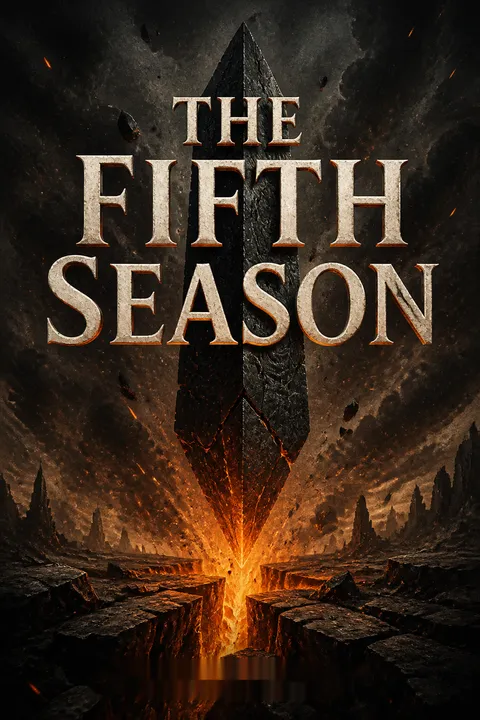
A man stands above Yumenes, reaches through the city and into the earth, and tears the continent open. The resulting ash-dark winter will last for centuries. Elsewhere, Essun sits beside her murdered son, Uche, while her daughter, Nassun, is missing.
At a shattered cliff, a heated stone shell splits and releases a strange boy who begins walking toward Essun’s town. The prologue sets the catastrophe beside its intimate cost, then plants the question of how these separate lives will meet.
The opening refuses to treat apocalypse as a single event. It moves from a continental rupture to a mother’s bereavement, then to the boy emerging from stone, making geological catastrophe and private violence parts of the same narrative problem. Its forward-looking voice gives the reader information before the characters can interpret it, but withholds the connections that would make the information comfortable. This creates a tension between knowledge and understanding: the disaster is visible, while its causes and human consequences remain fractured. The framing also establishes that survival is not automatically rescue, freedom, or justice.
The Den Goes Quiet
Essun, a forty-two-year-old teacher and secretly an orogene, returns to her Tirimo home to find her nearly three-year-old son, Uche, beaten to death. Her husband, Jija, and their daughter, Nassun, are gone. Grief leaves Essun motionless beside the body for two days, until Lerna, a local doctor who knows her secret, takes her in.
He tells her that a vast northern shake has devastated the region, though Essun had instinctively diverted its force around Tirimo to protect her home. When she learns that Uche may have revealed his own orogenic ability to Jija, the horror deepens: her children inherited the power she spent years hiding. She decides she must find Nassun before fear turns the town against her.
Essun’s paralysis is not passivity so much as the mind’s emergency refusal to turn unbearable facts into a coherent story. The body remains present, but ordinary actions continue only by habit. Her power has protected the town without earning her safety within it, exposing the difference between being useful and being accepted. The suspicion that Uche’s ability provoked Jija connects public prejudice to domestic violence without excusing the father’s choice. Essun’s decision to move is therefore not recovery. It is a narrow act of purpose built around the one child she may still reach.
Schaffa Finds Damaya
Years earlier, eight-year-old Damaya hides in a barn after her parents isolate her for using orogeny at school. Schaffa, a Guardian assigned to collect her, finds her and explains that she will be trained at the Fulcrum in Yumenes. Her mother and father give her a blanket, but neither can offer a home where she is safe from the community’s fear.
Schaffa takes Damaya away on horseback before local villagers can reach her. He presents the Fulcrum as a route to mastery and service, and his careful manner wins her trust. Damaya leaves believing that this powerful, attentive adult is the first person to understand her, though she has not yet learned what his protection demands.
Damaya’s removal is framed as rescue, but its emotional structure resembles abandonment: adults make a life-changing choice around her, while she has little real power to refuse it. Schaffa’s tenderness matters because it gives the coercive institution a human face. For a child who has been called frightening by those closest to her, recognition is persuasive even when it comes with conditions. Her willingness to trust him is not naivety alone; it is an intelligent response to the scarcity of care. That scarcity will make later control harder to name.
Tirimo Turns on Essun
Before Essun can leave, headman Rask tells her that witnesses saw Jija depart with Nassun, alive at the time. Rask gives Essun a gate pass and walks her through town, despite knowing that helping an orogene may damage his standing. At the gate, a guard raises a crossbow against her. Essun freezes the bolt in midair, then loses control of the force gathering around her.
A widening ring of cold and seismic violence kills Rask, the hostile guards, and others who come too near, while buildings collapse and the town’s aquifer is damaged. Seeing a father carry his own frightened son makes Essun understand what she has done. She stops the destruction and walks out, carrying grief and guilt with her.
Rask’s small act of public decency briefly interrupts the town’s familiar logic, but the armed guard restores it at once. Essun’s retaliation collapses distinctions between the guilty and the nearby, showing how trauma can make a whole community feel like the perpetrator. The child and father interrupt that collapse: a concrete image of care returns Essun to moral perception before she kills everyone. Yet remorse does not undo the deaths or the damaged water supply. The scene refuses an easy division between victim and monster, showing how persecution can produce violence without making its consequences imaginary.
A Fulcrum Breeding Order
At the Fulcrum, four-ring orogene Syenite learns that her next assignment is to clear coral from Allia’s harbor under the supervision of Alabaster, the institution’s sole ten-ringer. The mission is also a forced reproductive pairing: the Fulcrum expects her to conceive his child.
Alabaster is furious at the arrangement and at the assumption that Syenite must comply, but she agrees because refusal could wreck her advancement and another orogene would take her place.
Their first encounter is awkward, angry, and stripped of any pretense of romance. Alabaster tells her that she is a feral, an unpredictable orogene born outside the Fulcrum’s breeding system. The next day they set out together, each trapped in a different way by the institution.
The Fulcrum converts bodily autonomy into administrative procedure, concealing coercion beneath professional assignments and career incentives. Syenite’s consent is therefore constrained rather than freely given, while Alabaster’s ability to refuse highlights an unequal distribution of power even between two oppressed people. His resentment does not make him a simple ally, but his naming of the feral category gives Syenite a new way to understand the Fulcrum’s anxiety about those it cannot predict. The scene’s discomfort is structural: no personal chemistry can make the terms fair.
Hoa Appears in Ash
After leaving Tirimo, Essun camps beneath a sky already stained by ash. A small, mud-covered boy appears beside her without warning and introduces himself as Hoa. She gives him a bedroll, then lets him travel with her when he says he has nowhere else to go. The next morning he tells her that Nassun is alive and moving south, though she is traveling faster than Essun can.
That knowledge gives Essun a direction when grief and uncertainty might otherwise stop her. Hoa cannot explain how he senses the girl, and Essun chooses not to press him. She needs his help more than she needs an answer, and the two begin walking together through the first falling ash.
Hoa enters at the point where Essun’s private purpose meets the newly exposed world. His presence offers practical hope, but not reassurance: he can locate Nassun while remaining impossible to explain. Essun’s choice to accept him is shaped by her maternal attention, which persists even after Uche’s death and her own catastrophic violence. She treats Hoa as a child needing shelter before she understands what he is. The scene establishes a relationship founded less on trust than on care enacted despite uncertainty, a distinction that becomes central to Essun’s journey.
Pain Becomes a Lesson
On the road to Yumenes, Schaffa tells Damaya that an orogene’s instinct can mistake a minor threat for a mortal one. He uses a story about the legendary orogene Misalem to cast untrained power as a danger requiring Guardian control. Then he crushes Damaya’s hand against the saddle, forcing her to endure pain without reaching into the earth to defend herself.
A glassknife rests against her body as he warns that he can hurt her again whenever he considers it necessary. After setting the broken bones, Schaffa comforts her and insists that the violence was meant to keep others safe. Damaya accepts his terms because she has no other protector and no home to return to.
Schaffa’s lesson fuses care with threat so tightly that Damaya cannot safely separate them. He engineers the danger, then presents her restraint as proof that his method works. Her successful self-control is real, but it is produced under conditions that deny her agency. This is more than a test of power; it is training in how to interpret pain as legitimate when authority inflicts it. The emotional consequence is a conditional attachment: Damaya learns to fear Schaffa and rely on him at once, a pattern the institution can use to reproduce obedience.
The Node's Hidden Child
While traveling, Alabaster quietly settles tiny tremors to spare remote node maintainers their constant labor. A violent hot spot erupts near Mehi, and he links his power with Syenite’s to redirect the danger before it becomes a volcanic disaster.
He insists they investigate the nearby node. Inside, they find its maintainer: a child kept alive in a wire frame, surgically damaged so instinctive orogeny can stabilize the region while the child has no control. The station’s staff and soldiers lie dead around him.
Alabaster makes Syenite promise to conceal what they have found, explaining that the Fulcrum treats orogenes as weapons, breeding stock, or expendable tools. Syenite leaves the station unable to accept the institution’s polite vocabulary as an innocent disguise.
The node turns the Fulcrum’s abstract bargain into a body that cannot consent or escape. Its protective function for ordinary communities depends on the deliberate suffering of an orogene child, making public safety and institutional cruelty parts of one system rather than opposing principles. Alabaster’s forced cooperation with Syenite shows both the possibility and the limits of solidarity: he can combine their abilities, but he also decides what she may know and say. Her nausea marks a moral threshold. She can no longer mistake order for justice simply because it keeps people alive.
A Stone Beast Awakens
On the road, Essun, Hoa, and the commless traveler Tonkee return to a roadhouse for water after a night of flight. Tonkee uses a homemade test to check for contamination, revealing a practical scientific mind that she claims has no university ties. Outside, an ash-maddened kirkhusa attacks Hoa and bites down on his arm.
Essun prepares to use orogeny, but Hoa stands motionless as the animal’s body turns into stone and crystal around him. He breaks the creature’s head to free his bleeding arm. Tonkee watches in astonishment; Essun, shaken by the impossible power, still takes Hoa’s hand and leads him away. The three continue south together, bound by danger and unanswered questions.
The encounter reverses Essun’s expected role as protector. Hoa saves the group, yet his transformation of a living animal is so alien that rescue itself becomes frightening. Essun’s response is significant: she notices his injury and misery before demanding an explanation, choosing connection over immediate classification. Tonkee’s technical curiosity adds a different mode of response, one that studies anomalies rather than fleeing them. Together, the three reactions suggest that survival requires more than force. It also requires deciding how to treat the unfamiliar before certainty arrives.
Allia's Buried Obelisk
In Allia, Syenite and Alabaster meet a deputy governor who treats them as dangerous labor rather than expert visitors. Alabaster demands proper recognition, and Syenite later presses the officials to acknowledge her skill before she will risk the harbor work. Sensing the seabed, she finds that the coral blockage has grown over a vast object that her orogeny cannot directly perceive.
When she tries to shift it, an unfamiliar current of power takes hold of her and lifts the object from the harbor. A mile-long garnet obelisk rises through the water, cracked around a stone eater trapped inside it. The revelation transforms a routine commission into an event that draws scholars, officials, and hidden interests to Allia.
Syenite’s insistence on courtesy is not vanity; it is a demand to be treated as a skilled person rather than a feared instrument. The obelisk’s emergence exceeds that professional frame, making her body a conduit for a power she neither understands nor controls. The object beneath the coral also literalizes the limits of sanctioned knowledge: the harbor has been shaped by something the city could not see and the Fulcrum cannot explain. Her success brings attention, but attention is not protection. The scene makes discovery feel less like triumph than exposure.
The Grits Turn on Damaya
At the Fulcrum, Damaya’s perfect discipline attracts the attention of Maxixe, a fellow trainee, just as other grits begin targeting her. They steal her shoes and lace her drink with alcohol, hoping she will lose control and be killed for unsafe orogeny. Instructor Galena intervenes before the intoxication becomes a catastrophe.
Damaya then works with Selu, called Crack, to expose the person behind the harassment. Their trap reveals that Jasper has stolen the shoes, while Crack has been manipulating events to divert attention from her own precarious standing. The confrontation exposes how the grits have learned to survive by sacrificing one another. Maxixe is punished, Jasper is transferred, and Crack disappears from the Fulcrum.
The Fulcrum’s discipline does not merely regulate orogeny; it teaches children to internalize the institution’s suspicion and reproduce it among themselves. Damaya’s competence makes her a target, while Crack’s betrayal is both self-protection and evidence of the same coercive environment. The adults respond to visible misconduct, but the system that made the children vulnerable remains intact. Damaya’s victory therefore brings safety without intimacy. The other grits stop attacking her, yet she has learned that alliance can be a tactical arrangement rather than a dependable bond.
The Guardian Breaks the Sky
After the obelisk rises, Syenite and Alabaster receive orders to remain in Allia while the Fulcrum investigates. Alabaster suspects the shard is unstable and warns that they are being kept close for a reason. Guardian Edki arrives at the waterfront and disables their access to orogeny. He wounds Alabaster with a strange glassknife, then moves to kill Syenite.
With no ordinary reach into the earth, Syenite connects to the damaged obelisk instead. The trapped stone eater responds, and the garnet structure shatters around them. Antimony, another stone eater known to Alabaster, carries the pair away to an island far offshore. Behind them, Allia becomes a smoking volcanic catastrophe, and the Fulcrum’s agents will assume they died there.
The attack exposes the Guardians as a power distinct from the Fulcrum’s public authority, able to disable the very people they claim to supervise. Syenite’s escape depends on the same mysterious force that made her successful at the harbor, so survival deepens rather than resolves the danger. The shattered obelisk transfers the story from institutional persecution to an older conflict whose rules remain unknown. Allia’s destruction also stains Syenite’s freedom with collateral death. She survives the attempt on her life, but cannot yet know whether she has caused the disaster that will define her.
Castrima Opens Below
Following Hoa’s uncertain guidance through ash-choked roads, Essun reaches Castrima, an abandoned-looking settlement with no visible wall. Ykka, its forceful leader, recognizes Essun as an orogene and says the community has already taken in many others like her. When Essun asks whether Nassun and Jija came through, Ykka says they did not.
The answer breaks Essun’s remaining hope, and Ykka uses a subtle surge of orogeny to help her contain her grief. Ykka offers a choice: leave or enter Castrima, where the residents are preparing for a Season they know will last far longer than ordinary stores can withstand. Essun stays, not because she trusts the place, but because it may hold information about her daughter.
Ykka’s power operates differently from the coercive force Essun knows: she uses it to interrupt a breakdown rather than dominate a rival. The difference does not make Castrima automatically safe, but it gives Essun evidence that orogeny can serve communal care. Ykka’s honest answer about Nassun is devastating precisely because it removes the fantasy of immediate reunion. Essun enters the settlement with grief still active, not cured. Her choice is provisional and strategic, showing how refuge can begin as a practical need before it becomes belonging.
Meov Lives by Its Roggas
Antimony brings Syenite and Alabaster to Meov, a cliff-carved island community that survives through fishing and piracy. Its leaders, Harlas and the ship captain Innon, are orogenes who live openly and help govern rather than being confined by the Fulcrum. Syenite finds herself drawn to Innon, while Alabaster gradually trusts him as well.
Their relationship grows into a shared household, and Syenite gives birth to Corundum. For the first time, an orogene child is surrounded by people who expect to care for him instead of seize him. Alabaster helps raise Corundum and watches over the island, while Syenite struggles against the restlessness of a life that offers safety but little work for her abilities.
Meov functions as a lived counterexample to the Fulcrum’s claim that orogenes must be controlled for others to survive. Its relative stability comes from shared responsibility and local knowledge, not from separating power from community. Yet freedom does not erase the damage Syenite and Alabaster carry from institutional life. Their intimacy develops through negotiated care, not simple romantic repair, and Syenite’s restlessness persists even in a place that accepts her. The child’s welcome matters because it makes a different future imaginable, though not guaranteed.
The Room Beneath Main
During her first year at the Fulcrum, Damaya explores its neglected corridors and meets Binof, a Yumenescene Leadership girl disguised as a trainee. Binof is searching for a hidden chamber beneath Main, and Damaya helps her find a concealed door. Inside lies a vast faceted pit, a socket left by something enormously heavy, its walls lined with iron points.
A Guardian, Timay, questions Damaya about whether the chamber called to her, then speaks as if another presence has taken over her. Schaffa arrives and kills Timay by destroying the implant at the base of her skull. He then demands that Damaya pass her first ring test immediately. She agrees and chooses the name Syenite, marking the self she intends to become.
The hidden chamber makes the Fulcrum’s architecture a record of deliberate concealment. Damaya’s curiosity brings her into contact with knowledge that neither her training nor Schaffa’s authority can comfortably explain. Timay’s altered speech suggests that the Guardians themselves may be vulnerable to forces they claim to manage, while Schaffa’s swift violence restores order without resolving the mystery. Damaya’s new name is an act of authorship under pressure: she cannot leave the institution, but she can choose how to carry herself within it. The choice is both resistance and adaptation.
A City Inside Stone
Ykka leads Essun, Tonkee, and Hoa below the abandoned settlement into Castrima’s true home: a vast geode illuminated by crystal formations and threaded with platforms, bridges, and occupied rooms. Ancient machinery supplies air, water, and electricity, and Ykka explains that the mechanisms work when orogenes are present.
The community has adapted old infrastructure rather than relying only on walls and food stores. Essun remains uneasy, recognizing that the residents are living inside a dead civilization’s construction, but the refuge has survived the great northern shake.
She asks whether they can leave. Ykka does not answer directly. Essun understands that shelter may also mean confinement, even as she sees a community trying to survive by methods the Fulcrum would never permit.
Castrima’s geode challenges the assumption that survival requires repeating established designs. Its residents depend on ancient systems they do not fully understand, a risky choice that resembles the Stillness itself, where inherited lore preserves people while concealing its origins. Essun’s distrust is justified: a refuge can become a trap when its inhabitants control the exits. Yet the settlement’s use of orogeny as shared infrastructure contrasts with the Fulcrum’s extraction of individual power. The scene leaves the ethical question open, asking whether innovation is recklessness or the only response to a catastrophe beyond precedent.
Syenite Takes the Sea
Two years after Corundum’s birth, Syenite persuades Innon to take her on a raid. She uses fog to hide the Clalsu, then accidentally raises a stone pillar through an attacking ship, revealing her skill to the crews. To protect Meov from retaliation, she helps sink both vessels. Later, she returns to Allia and finds the eruption she triggered still threatening a wider Season.
Drawing on the hot spot, she forces magma back underground and seals the unstable strata. The effort stirs dangerous waves, but Alabaster quells them from far away. Syenite has helped save other communities from the disaster, yet she remains haunted by the lives already lost when the harbor first erupted.
Syenite’s work at sea changes the meaning of her power: she uses it tactically, sometimes lethally, outside the Fulcrum’s assignments. Her mistake with the stone pillar exposes the strategic cost of visibility, and Innon’s order to sink the ships binds violence to protection of Meov. Returning to Allia is an attempt to take responsibility for a disaster she helped unleash, but repair cannot restore the people killed at its beginning. Her growing competence gives her agency while making her more accountable for what that agency can destroy.
The Names Behind the Masks
Inside Castrima, Essun recognizes that Tonkee is Binof, the Leadership girl who once entered the Fulcrum in disguise. Tonkee explains that her powerful family disowned her after she rejected its expectations, and that she became a geomest devoted to studying the obelisks. Essun then learns that Hoa is a stone eater who has altered his appearance because he wanted to travel beside her.
Before they can settle the revelations, Lerna arrives, having fled Tirimo after violence and suspicion made it unsafe. He confirms that Nassun is not in Castrima. Hoa then tells Essun that Alabaster is alive, nearby, and asking to see her. Essun follows him, carrying unresolved grief into another impossible meeting.
The revelations unsettle Essun’s habit of sorting people into familiar categories. Tonkee’s disguise concealed not only an identity but a long intellectual pursuit; Hoa’s childlike form concealed a different kind of being and a deliberate desire for companionship. Lerna’s arrival reconnects Essun to the life she tried to leave, including the social cost of having befriended her. None of these disclosures provides the answer she most wants about Nassun. Instead, each relationship becomes more complicated, and Essun must decide whether intimacy can survive knowledge that arrives late.
Meov's Last Stand
Guardians arrive by ship and attack Meov. Alabaster raises a stone barrier across the harbor, while Syenite and the Meovites fight to protect Corundum. A Guardian uses skin contact to turn Innon’s orogeny against his body, killing him in front of Syenite. Schaffa then confronts her and claims the child as a useful replacement for Alabaster.
Refusing to let the Fulcrum take Corundum, Syenite reaches for the amethyst obelisk and unleashes power she cannot control. The island’s destruction sends a chain of stone spears toward Allia, splitting the land and beginning the world’s long Season. Syenite survives the catastrophe, but Corundum is lost, and she later wanders with her identity shattered.
The attack removes the fragile protections Meov had built through community, leaving Syenite face to face with the coercion she escaped. Innon’s death makes the Guardians’ power bodily and intimate; Schaffa’s claim on Corundum repeats the logic of the Fulcrum in the language of care. Syenite’s choice is made under unbearable pressure, and its consequences exceed her intention. The cataclysm is both refusal and catastrophe, not a clean liberation. Her survival without stable identity underscores that escape from an institution does not erase what it has done to the self.
Alabaster Names the Moon
At Castrima’s infirmary, Essun finds Alabaster alive but grievously damaged, with parts of his body turning to stone. He recognizes her past selves as Damaya and Syenite, revealing that all three names belong to one woman. He admits that he caused the rift that began the Season, using the obelisks and the node maintainers to rupture the continent.
He does not ask Essun to undo the disaster; he wants her to intensify it. Alabaster explains that the obelisks are connected to a larger, forgotten history and asks whether she has heard of the moon. The novel ends with Essun facing a revelation that expands the crisis beyond the survival of any single comm.
The final meeting reorganizes the novel’s braided lives into one continuous person, making identity a question of survival rather than a stable label. Essun’s hidden past is not a separate biography; it is the history that formed the woman now pursuing Nassun. Alabaster’s confession reverses the apparent moral geography of the disaster: he caused immense suffering, yet directs his anger toward a system that has long treated orogenes as tools. His request to worsen the crisis refuses restorative closure. The moon introduces a missing history large enough to challenge the world’s accepted account of itself.
Analysis
The novel makes social classification as consequential as geological force. People are sorted by use-caste, comm membership, race, and orogenic ability, then treated according to the value those labels assign them. The Fulcrum appears to solve a collective problem by controlling dangerous power, but its stability depends on coercion, hidden violence, and the conversion of people into instruments. Castrima and Meov offer alternatives, though neither is a frictionless utopia: they require trust, shared labor, risk, and difficult decisions about who belongs.
The braided identities of Essun, Damaya, and Syenite give this political structure a psychological form. Each name marks a life adapted to particular pressures, not a separate self. The narrative asks how much continuity a person can preserve while repeatedly changing in order to survive. Essun’s search for Nassun gives the catastrophe an intimate direction, while Alabaster’s history reveals that the disaster cannot be understood only as a mother’s private tragedy or a single act of vengeance.
Orogeny binds agency to consequence. It can keep a home standing, save a city from a hot spot, or destroy people when fear overwhelms judgment. The novel does not equate power with moral freedom: the Fulcrum’s trained orogenes remain captive, while untrained power may be both protective and lethal. By ending with Alabaster asking Essun to worsen the catastrophe, the book refuses the comforting idea that survival means returning to the old order. Its central challenge is not merely how people endure a broken world, but whether the world’s inherited arrangements deserve restoration.
Review Summary
The Fifth Season receives high praise for its innovative worldbuilding, complex characters, and exploration of social themes. Readers appreciate Jemisin's unique writing style and the book's ability to challenge expectations. Many find the story emotionally powerful and thought-provoking, with its examination of oppression and prejudice. While some struggle with the initial pacing and narrative structure, most agree that the payoff is worth it. The diverse representation and intricate plot twists are frequently highlighted as strengths. Overall, the novel is lauded as a masterpiece of speculative fiction.
People Also Read





Characters
Essun / Damaya / Syenite
The divided survivorAn exceptionally capable orogene whose life is shown under three names and at different ages. Essun is a mother and teacher who has learned to hide her power; Damaya is a child trying to understand why her family fears her; Syenite is a trained Fulcrum professional whose competence earns rank but not freedom. She is observant, guarded, and often more compassionate in action than in speech. Her attention repeatedly returns to children, especially those endangered by systems that call them useful. Across these identities, she struggles to reconcile self-control with autonomy and protection with the capacity to harm.
Alabaster
The ten-ring dissenterThe Fulcrum’s most powerful orogene, Alabaster is brilliant, exhausted, and difficult to approach. His sarcasm and unpredictable manner conceal a mind that keeps testing the limits of what the Fulcrum teaches. He resents the institution’s use of orogenes while remaining entangled in its expectations, including forced reproduction. His connection with Syenite begins in antagonism and grows through shared danger and hard-won care. Alabaster understands more about the world’s buried history than he initially admits, but his knowledge is fragmented, and he often withholds information when he fears others will misuse it.
Hoa
The quiet pathfinderA small, pale, ice-eyed boy who joins Essun after the catastrophe and helps guide her toward Nassun. Hoa is observant, strangely cheerful, and difficult to read; his apparent childhood does not fully explain his calm or his abilities. He wants Essun’s company but withholds much of his past, partly because he fears changing how she sees him. His loyalty is expressed through practical acts, including keeping watch and helping the group survive. Hoa makes the familiar world feel less certain, while his gentleness complicates the assumption that the strange must be dangerous.
Schaffa
The tender GuardianA Guardian responsible for collecting and training young orogenes, Schaffa combines warmth, attention, and frightening authority. He notices Damaya’s intelligence and offers her affection when her family cannot provide safety. He also believes that control must be enforced through pain, presenting his violence as protection for both the child and the world. That contradiction is central to his relationship with Damaya: he can comfort her sincerely while teaching her to fear disobedience. Schaffa embodies the intimate face of an institution that claims to protect orogenes while reserving the right to discipline their bodies.
Ykka
Castrima's fierce leaderThe outspoken leader of Castrima, Ykka is an orogene who openly gathers others of her kind. She is pragmatic, charismatic, and willing to take risks that conventional comm leaders would reject. Ykka uses her power in distinctive ways and expects newcomers to respect the community’s rules. Her welcome to Essun is neither sentimental nor naïve; she offers shelter while making clear that Castrima is an experiment with genuine dangers.
Tonkee
The restless geomestA sharp, eccentric traveler with a geomest’s appetite for evidence, Tonkee notices patterns other people ignore. She approaches danger with improvised instruments, practical knowledge, and relentless questions. Her social awkwardness can look like indifference, but she is capable of quiet generosity, sharing equipment and supplies when Essun’s group is in need. Tonkee’s curiosity gives her a route through the world when belonging does not. She prefers investigation to authority and is slow to reveal the personal history beneath her adopted identity.
Lerna
The loyal town doctorA doctor from Tirimo who has known Essun for years and understands what she is. Lerna is careful, compassionate, and willing to act when Essun cannot care for herself, though he is no fighter. His instinct is to heal, even when officials and frightened residents prevent him from helping. He represents an ordinary bond that persists beyond the town where it formed. His decency does not make him invulnerable; it places him at risk in a society that punishes people for standing beside the feared.
Jija
The frightened husbandEssun’s husband, a respected stoneknapper in Tirimo, appears to have been an ordinary and sociable comm member. He is not known as a habitual abuser, which makes the family’s rupture harder for Essun to explain. His fear of orogeny becomes inseparable from the wider culture that casts it as monstrous. Jija’s choices shape Essun’s journey, while his absence leaves her with unanswered questions about what he believes and what he intends for Nassun.
Nassun
The missing daughterEssun’s young daughter, Nassun is intelligent and strong, with an orogenic inheritance she has not yet learned to manage safely. Her disappearance gives Essun a concrete reason to keep moving through a collapsing world. Nassun’s bond with her mother is central even while she remains absent from much of the narrative. She is not simply someone to be rescued; her own developing power and judgment make the question of what has happened to her increasingly urgent.
Innon
Meov's magnetic captainA large, charismatic captain and one of Meov’s most capable leaders, Innon is an orogene raised outside the Fulcrum. He is bold, sociable, and comfortable with affection, qualities that unsettle Syenite’s habits of guardedness. His authority rests on the trust of his crew and community rather than formal rank. Innon is also practical about danger: he understands that an isolated island survives by making hard choices, even when those choices implicate the people he loves.
Antimony
Alabaster's stone allyA stone eater who appears in a carefully shaped, humanlike form, Antimony has known Alabaster for years. She communicates sparingly and acts according to motives that remain difficult for humans to interpret. Antimony intervenes when he is in danger and carries Syenite and Alabaster away from Allia. Her calm presence unsettles Syenite because it offers no familiar cues of trust or threat. She represents a species whose history and relationship to humanity remain largely beyond the characters’ knowledge.
Rask
Tirimo's decent headmanTirimo’s elected headman, Rask is practical and guarded, but he chooses to help Essun leave safely. His family history has taught him what fear of orogenes can cost. By giving Essun a gate pass and walking beside her, he risks his standing among the people he leads.
Selu, called Crack
The precarious gritA young orogene whose unstable reputation makes her a target at the Fulcrum. Damaya approaches her as a possible ally against the other grits, and Selu accepts the plan for reasons of her own. Her guarded anger shows how readily institutional pressure turns vulnerable children into competitors for safety.
Maxixe
The wary traineeAn older Fulcrum trainee who tries to befriend Damaya and brings humor into her lonely routine. Maxixe is more perceptive than his playfulness first suggests, but his connection to the dormitory’s bullying leaves him compromised. He reflects the difficulty of forming trust among children trained to expect punishment.
Edki
The obelisk hunterA Guardian who confronts Alabaster and Syenite in Allia after the obelisk rises. Edki is controlled and courteous in manner, but his calm accompanies a willingness to disable or kill the people under his order. His arrival shows that Guardian authority is not merely protective oversight. He understands the danger of the obelisk better than Syenite does, though he offers no explanation she can trust.
Timay
The compromised GuardianA Guardian who questions Damaya and Binof after they discover the chamber beneath Main. Timay’s behavior shifts from professional scrutiny to speech that seems to come from somewhere beyond her ordinary self. Her presence exposes an instability within the Guardian order that Damaya cannot yet understand.
Harlas
Meov's elder leaderAn older leader of Meov and an orogene who has helped sustain the island’s unconventional community. Harlas carries local authority and practical experience, including knowledge of how the community survives without mainland security. His example shapes the expectations Innon and other Meovites bring to Syenite and Alabaster.
Corundum
The cherished childThe son of Syenite and Alabaster, Corundum is raised within Meov’s communal network of caregivers. His presence draws tenderness from both parents, though they express it in different ways. To the adults around him, he represents a possible future for an orogene child beyond the Fulcrum’s strict control.
Plot Devices
Orogeny
Power with a priceOrogeny is the ability to manipulate heat, motion, and seismic force. An untrained orogene may react instinctively to danger, while a Fulcrum-trained one can redirect specific movements with greater control. Power can be drawn from the earth or from the warmth and motion of surrounding things, including living bodies. The same ability can protect a town, freeze people, stabilize a hot spot, or make a mistake catastrophic. It gives the story a physical language for both extraordinary skill and the danger of treating power as a simple tool.
The Fifth Season
Disaster made ordinaryA Fifth Season is an extended, often lightless winter caused by seismic upheaval or other planetary disruption. The Stillness has developed stonelore, guarded stores, walls, and emergency customs to help communities endure such periods. The opening catastrophe is unlike an ordinary Season: its scale and duration exceed what most people have prepared for. The crisis changes the value of food, water, shelter, and membership in a comm, turning survival systems into sources of power and conflict.
The Fulcrum and Guardians
Order through coercionThe Fulcrum trains and ranks orogenes, granting them a recognized place in society while demanding obedience and service. Guardians collect young orogenes, oversee training, and can use specialized means to restrain their abilities. Together, the institutions present control as protection for both orogenes and the wider population. The discovery of the node maintainer reveals how far this logic can extend when an orogene is reduced to a function. The device shapes Damaya’s childhood and Syenite’s professional life, while exposing the cost of safety built on coercion.
The Nodes
Safety built on sufferingNode stations extend the Fulcrum’s seismic protection into distant regions. Each relies on an orogene whose work helps settle local tremors, sparing nearby communities from some danger. The system is presented as a technical network until Syenite and Alabaster discover the human body being used to sustain it. That revelation changes the meaning of the Fulcrum’s promises and gives Alabaster a reason to challenge what its leaders call necessary. The nodes connect local safety to hidden institutional violence across the continent.
The Obelisks
A buried ancient powerEnormous crystalline shards float above the Stillness, treated by most people as beautiful but irrelevant remains of lost civilizations. Syenite discovers that an obelisk lies beneath Allia’s harbor and that contact with it releases a power unlike ordinary orogeny. The shards draw attention from scholars and Guardians, while their connection to stone eaters and the opening disaster gradually becomes central. They turn forgotten history into an active force in the present. Their full purpose remains unresolved when the novel ends.
FAQ
Synopsis & Basic Details
What is The Fifth Season about?
- A world in turmoil: The Fifth Season depicts a world called the Stillness, where catastrophic seismic events known as "Seasons" regularly threaten civilization. The story follows multiple characters as they navigate a world on the brink of collapse.
- Orogenes and their power: The narrative focuses on orogenes, individuals with the ability to manipulate earth energy, who are both feared and exploited. The story explores their struggles for survival and autonomy in a society that seeks to control them.
- Personal and global catastrophe: The plot intertwines personal tragedies with the larger, world-ending events, highlighting the impact of both on the characters' lives and choices.
Why should I read The Fifth Season?
- Unique worldbuilding: N.K. Jemisin crafts a richly detailed and original world with a unique magic system based on geology and seismic activity, offering a fresh take on fantasy.
- Complex characters: The novel features morally ambiguous and deeply flawed characters, each with their own motivations and struggles, making for a compelling and emotionally resonant read.
- Exploration of social issues: The Fifth Season tackles themes of oppression, prejudice, and power dynamics, prompting readers to reflect on real-world social injustices through a fantastical lens.
What is the background of The Fifth Season?
- Geologically unstable world: The Stillness is a land marked by frequent and devastating seismic events, which have shaped its culture and society, leading to a constant state of disaster preparedness.
- Racial and social hierarchies: The world is divided by race, use-caste, and orogenic ability, creating a complex social structure where power and privilege are unevenly distributed.
- Historical and cultural influences: The Stillness is influenced by a blend of historical and cultural elements, including ancient civilizations, mythology, and social structures, creating a unique and immersive setting.
What are the most memorable quotes in The Fifth Season?
- "But he was free. He wasn't. Not really. But now he will be.": This quote, spoken by Essun about her murdered son, encapsulates the themes of oppression and the desire for liberation that run throughout the novel.
- "A commandment is set in stone. Chiseled words are absolute.": This quote, spoken by Alabaster, highlights the power of language and the rigidity of the rules that govern the Stillness, foreshadowing the cataclysmic events to come.
- "Never forget what you are.": This recurring phrase, found in stonelore, serves as a constant reminder of the orogenes' unique and often dangerous nature, emphasizing the burden they carry.
What writing style, narrative choices, and literary techniques does N.K. Jemisin use?
- Second-person perspective: The novel opens with a unique second-person perspective, drawing the reader directly into Essun's experience and creating a sense of immediacy and intimacy.
- Multiple timelines and perspectives: Jemisin weaves together multiple timelines and perspectives, gradually revealing the connections between the characters and the larger events of the story.
- Rich and evocative language: The author employs vivid and sensory language to create a powerful sense of place and immerse the reader in the world of the Stillness.
Hidden Details & Subtle Connections
What are some minor details that add significant meaning?
- The use of "rust" as a curse: The frequent use of "rust" as a curse word in the Stillness highlights the decay and impermanence of the world, as well as the fragility of human creations.
- The description of the obelisks: The obelisks are described as "not quite real," hinting at their otherworldly nature and their connection to forces beyond human comprehension.
- The emphasis on touch: The recurring motif of touch, whether gentle or violent, underscores the importance of physical connection and the emotional impact of both love and abuse in the characters' lives.
What are some subtle foreshadowing and callbacks?
- The mention of "fire-under-Earth": The phrase "fire-under-Earth," used to describe orogeny, foreshadows the volcanic nature of the cataclysm and the destructive potential of the orogenes' powers.
- The description of the geode: The geode that contains Hoa is described as having an "ironlike scent reminiscent of rust and blood," foreshadowing his connection to the earth and his violent nature.
- The recurring phrase "This is the way the world ends": This phrase, repeated multiple times, emphasizes the cyclical nature of the Seasons and the inevitability of destruction, creating a sense of impending doom.
What are some unexpected character connections?
- Essun and Syenite: The revelation that Essun and Syenite are the same person, separated by time and trauma, adds a layer of complexity to both characters and highlights the cyclical nature of their struggles.
- Alabaster and the node maintainers: The connection between Alabaster and the node maintainers, who are revealed to be children used as living tools, underscores the exploitation and dehumanization of orogenes in the Stillness.
- Hoa and the stone eaters: Hoa's true nature as a stone eater, and his connection to the obelisks, reveals a hidden layer of complexity to his character and his role in the larger events of the story.
Who are the most significant supporting characters?
- Lerna: Lerna, Essun's friend and a doctor, provides a sense of compassion and humanity in a world marked by cruelty and violence. His knowledge of orogeny and his loyalty to Essun make him a crucial ally.
- Tonkee (Binof): Tonkee, a geomest with a hidden past, offers a unique perspective on the obelisks and the history of the Stillness. Her knowledge and resourcefulness make her a valuable companion to Essun.
- Ykka: Ykka, the leader of Castrima, represents a different approach to orogeny, one that values freedom and community. Her leadership and vision offer a glimpse of hope for a better future.
Psychological, Emotional, & Relational Analysis
What are some unspoken motivations of the characters?
- Essun's desire for control: Beneath her grief and rage, Essun is driven by a desire to regain control over her life and protect her daughter from the forces that have destroyed her family.
- Alabaster's self-loathing: Alabaster's actions are fueled by a deep-seated self-loathing and a desire to destroy the system that has oppressed him and others like him.
- Damaya's need for acceptance: Damaya's journey is marked by a need for acceptance and belonging, as she struggles to reconcile her orogenic abilities with her desire for human connection.
What psychological complexities do the characters exhibit?
- Essun's trauma and dissociation: Essun's trauma manifests in her dissociation and her struggle to reconcile her grief with her need for action, highlighting the psychological toll of violence and loss.
- Alabaster's nihilism and self-destruction: Alabaster's nihilism and self-destructive tendencies stem from his experiences of oppression and exploitation, making him a complex and tragic figure.
- Damaya's internal conflict: Damaya's internal conflict between her desire for control and her need for connection highlights the psychological challenges of being an orogene in a world that fears her.
What are the major emotional turning points?
- Essun's discovery of Uche's death: The discovery of her son's murder is a major emotional turning point for Essun, triggering her rage and setting her on a path of vengeance and self-discovery.
- Damaya's breaking of her hand: Schaffa's breaking of Damaya's hand is a major emotional turning point, forcing her to confront the harsh realities of her power and the control that others seek to exert over her.
- Syenite's encounter with the node maintainer: Syenite's encounter with the node maintainer, a child used as a living tool, is a major emotional turning point, forcing her to confront the dehumanization of orogenes and the dark secrets of the Fulcrum.
How do relationship dynamics evolve?
- Essun and Lerna: The relationship between Essun and Lerna evolves from a childhood friendship to a bond of mutual respect and support, highlighting the importance of human connection in a world of chaos.
- Damaya and Schaffa: The relationship between Damaya and Schaffa is marked by a complex mix of fear, obedience, and a twisted form of affection, highlighting the power dynamics between orogenes and their Guardians.
- Syenite and Alabaster: The relationship between Syenite and Alabaster is characterized by a mix of resentment, attraction, and a shared understanding of the burdens of orogeny, highlighting the complexities of power and control.
Interpretation & Debate
Which parts of the story remain ambiguous or open-ended?
- The true nature of the obelisks: The obelisks' origins and purpose remain shrouded in mystery, leaving the reader to speculate about their connection to the earth and the forces that control them.
- The stone eaters' motivations: The stone eaters' motivations and their role in the larger events of the story remain ambiguous, leaving the reader to question their true nature and their relationship with humanity.
- The future of the Stillness: The ending of the novel leaves the future of the Stillness uncertain, with the potential for both destruction and renewal, prompting readers to consider the long-term consequences of the characters' actions.
What are some debatable, controversial scenes or moments in The Fifth Season?
- Schaffa's treatment of Damaya: Schaffa's brutal methods of training Damaya are a source of debate, with some readers arguing that his actions are necessary for her survival, while others condemn them as abusive and dehumanizing.
- Essun's actions in Tirimo: Essun's unleashing of her power in Tirimo, resulting in the destruction of the town, is a controversial moment, with some readers questioning the morality of her actions and others seeing them as a justifiable response to her grief and rage.
- The nature of orogeny: The nature of orogeny itself is a source of debate, with some readers interpreting it as a curse and others as a gift, highlighting the complex and often contradictory nature of power.
The Fifth Season Ending Explained: How It Ends & What It Means
- Syenite's transformation: Syenite's transformation into a force of destruction, fueled by her grief and rage, represents the culmination of her journey and the tragic consequences of oppression and control.
- The destruction of Allia: The destruction of Allia serves as a stark reminder of the fragility of civilization and the destructive potential of both human and natural forces.
- The ambiguous future: The ending of the novel leaves the future of the Stillness uncertain, with the potential for both destruction and renewal, prompting readers to consider the long-term consequences of the characters' actions and the possibility of a new world order.
The Broken Earth Series
About the Author

Download PDF
Download EPUB
.epub digital book format is ideal for reading ebooks on phones, tablets, and e-readers.








