
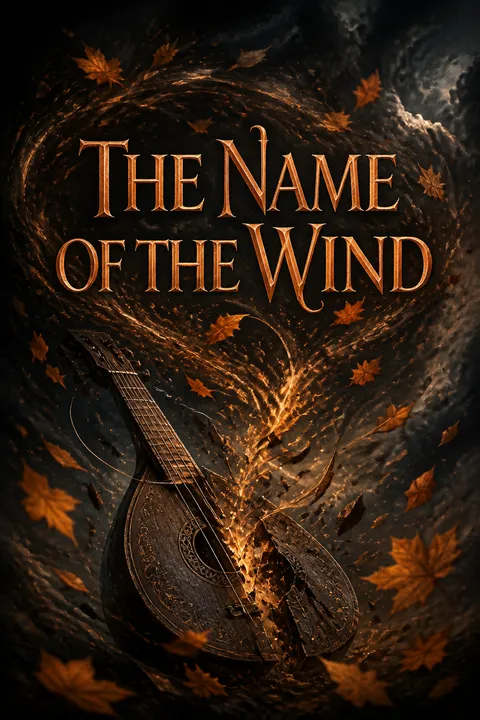


Plot Summary
Prologue
At the Waystone Inn, Kote1 polishes a bar in a silence that seems to belong to him as much as the empty room does. The innkeeper1 has red hair, distant eyes, and the practiced movements of a man keeping busy so he will not have to think.
Beyond the windows, the road is quiet; inside, even the fire seems to have gone still. This is not simply an inn between journeys. It is a refuge built around a man who has put away his old name, his old life, and almost everything that once made him vivid.
The opening makes silence an active condition rather than an absence. Kote’s work keeps the inn functioning, but it also keeps memory at bay; the polished bar and orderly room are defenses against an identity he cannot inhabit without pain. The three-part construction suggests that what is missing, what the townspeople avoid saying, and what Kote carries privately are related but not interchangeable. The frame therefore establishes a central tension before the history begins: the world remembers a legendary figure, while the man himself has chosen to live as someone smaller and quieter.
The Inn and the Scrael
When Carter staggers into the Waystone carrying the corpse of a black, many-legged creature, Kote1 recognizes it as a scrael and quietly prepares the town for danger. Chronicler,4 a traveling recorder robbed on the road, reaches a ruined house that night and finds Kote1 fighting five more of the creatures.
Chronicler4 is wounded, but Kote1 kills the scrael, burns and buries them, then carries the unconscious scribe4 back to the inn. Once Chronicler4 learns that the innkeeper1 is Kvothe,1 the famed arcanist he came to find, he asks for the truth behind the stories. Kvothe1 resists, then agrees to tell his life over three days, insisting that Chronicler4 record it faithfully.
The frame gives the legend a physical cost before it offers any explanation: Kote bleeds, stitches Chronicler, and works hard to preserve his ordinary disguise. His response to the scrael shows that the celebrated competence still exists, but he immediately conceals it from the townspeople. Chronicler’s arrival makes that concealment unstable. He wants a record that can correct public myth, while Kvothe fears that remembering will reopen wounds and attract danger. Their bargain turns storytelling into the book’s central action: a deliberate attempt to set a life in order without pretending it can be made painless.
Ben's Wagon School
Kvothe1 grows up among the Edema Ruh, a traveling troupe led by his actor-musician father, Arliden,6 and his mother, Laurian.7 When Abenthy,5 an arcanist stranded by a hostile town, joins them, Kvothe1 sees real sympathy and becomes his eager student.
Ben5 teaches him chemistry, medicine, languages, mental discipline, and the Alar, the forceful belief needed to make sympathetic bindings work. Kvothe1 absorbs lessons at startling speed, but his curiosity also makes him reckless.
After he nearly suffocates himself by binding his breath to the surrounding air, Ben5 warns Arliden6 and Laurian7 that their son’s intelligence is dangerous without judgment. Soon afterward, Ben5 leaves the troupe to tutor a widow’s son, giving Kvothe1 a book and urging him to pursue the University carefully.
The troupe gives Kvothe a childhood in which learning is social, mobile, and inseparable from performance. Ben’s teaching expands that freedom, but also introduces a discipline that Kvothe does not yet possess: power depends on belief, and belief must be controlled. His near-fatal experiment is an early version of a recurring pattern, in which talent outruns caution. Ben’s warning is not a rejection of Kvothe’s ambition. It is an attempt to distinguish brilliance from wisdom before the two become dangerously entangled.
Blue Fire at Home
While Kvothe1 is away gathering herbs, he returns to find his troupe murdered and their wagons broken or burning. Blue flames stain the ruined camp. A pale, black-eyed man named Cinder questions the boy, while the shadowed Haliax restrains Cinder and orders him to leave Kvothe1 alive.
The Chandrian vanish together, leaving Kvothe1 alone with the dead. He searches for his parents,6 then escapes into the forest carrying his father’s6 lute and Ben’s5 book. In shock, he survives by sleeping, foraging, and playing until his fingers harden and the songs become the only part of his former life he can still reach.
The massacre converts a child’s fascination with frightening stories into private knowledge, but gives him no explanation he can use. Kvothe sees enough to connect the Chandrian to Arliden’s unfinished research, yet not enough to understand why the troupe was killed. Haliax’s restraint of Cinder complicates the simple idea of a band of monsters: the killers have hierarchy, purpose, and internal conflict. Kvothe’s music becomes both refuge and memorial. It lets him feel without having to narrate his grief, until even that fragile shelter begins to fail.
Tarbean's Hard Education
After months surviving in the forest, Kvothe1 accepts a ride to Tarbean with the farmer Seth and his son Jake. Their kindness frightens him as much as their generosity; before he can return to them, street boys led by Pike beat him and smash his father’s6 lute. He spends nearly three years begging, stealing, hiding on rooftops, and learning which people are dangerous.
Trapis,17 a barefoot caretaker in a ruined basement, offers food and humane attention without demanding a story in return. Kvothe’s1 memory of his troupe remains buried behind grief, but the city gives him practical skills and a harsh belief that safety depends on expecting no help.
Tarbean does not simply make Kvothe tougher. It teaches him to treat trust as a material risk and to divide his attention between survival and feeling. His refusal of the farmers’ offer shows how grief can make kindness threatening: accepting a new home would mean explaining the loss he cannot face. The destruction of the lute removes his most reliable way to stay connected to his parents. Trapis becomes an exception to the city’s logic, offering care without ownership and giving Kvothe a rare place where vulnerability is not immediately punished.
Skarpi Names Lanre
Years into his life on the streets, Kvothe1 follows a rumor to a Dockside tavern where Skarpi16 tells a story about the ancient war between Lanre and Selitos. In Skarpi’s16 account, Lanre loses Lyra, destroys Myr Tariniel, and becomes Haliax; Selitos curses him and forms the Amyr to oppose him.
The tale reconnects with Kvothe’s1 memory of the man at his parents’6 fire. When Tehlin officers arrest Skarpi16 for heresy, the storyteller16 warns Kvothe1 to flee rather than attempt a rescue. Back on the rooftops, Kvothe1 recognizes that his parents6 were killed for their song, studies Ben’s5 inscription again, and decides the University may hold answers.
Skarpi’s story gives Kvothe a framework, not certainty. It turns a traumatic image into a historical question and links his family’s destruction to forces older than the institutions he understands. His decision to seek the University is therefore both intellectual ambition and displaced grief: he chooses the one action that seems possible when revenge is not. Skarpi’s arrest also demonstrates that stories are not harmless in this world. Authorities can punish the teller, while the listener must decide whether knowledge is worth the danger of carrying it.
The Road with Denna
Kvothe1 pawns Ben’s5 book to buy clothes and passage north, then joins the trader Roent’s caravan. There he meets Denna,2 a dark-haired traveler whose easy wit draws him out of his isolation. They share a night beside a pond, trading stories under the stars, but Kvothe1 cannot find a way to ask her to stay.
The next evening, another passenger, Josn, plays a lute, stirring Kvothe’s1 hunger for music. He borrows the instrument and plays a grief-struck piece that leaves Denna2 crying. At Imre, she invites him to continue with her to Anilin, but Kvothe1 chooses the University. They part with a promise to look for each other where their roads meet.
Denna offers Kvothe companionship without demanding an account of his past, which lets him risk closeness while keeping his grief private. Their intimacy is built from attention and wit, but his fear of offering too little makes him say nothing when a decision matters. Music breaks through the numbness Tarbean imposed, yet it also exposes how much has been lost. His choice of the University over Denna is not a rejection of her; it is a commitment to knowledge and a future he hopes can explain his past.
Admissions and Ambrose
Kvothe1 reaches the University with two jots, no sponsor’s letter, and only the knowledge Ben5 gave him. He secretly watches other admissions and answers the masters with the speed and range of a trained arcanist. The Chancellor admits him while granting him three talents, but the amount is barely enough to begin.
On his first visit to the Archives, Ambrose Jakis,9 a wealthy Re'lar, humiliates him and refuses him entry. Kvothe1 later demonstrates sympathy in Hemme’s20 class, burning the master’s foot after Hemme20 turns the lecture into a public trap. A hearing reduces the charge to reckless use; Kvothe1 is whipped, but the masters also admit him to the Arcanum.
Kvothe’s admission is a victory won through preparation, performance, and a willingness to ask for what he needs. It also places him inside an institution where status matters as much as ability. Ambrose’s contempt is not merely personal; his wealth lets him make access and security conditional. Kvothe’s answer to Hemme’s humiliation restores his agency, but the public demonstration reveals a weakness: he experiences restraint as submission and prefers a spectacular counterstroke. The punishment and promotion arriving together establish the University as both a ladder and a place where every ascent has a cost.
The Wind's Dangerous Lesson
Kvothe1 seeks Master Elodin,8 the eccentric Namer, hoping to learn the storybook magic of calling the wind. Elodin8 first rejects him, then takes him to Haven, where Kvothe1 sees the cost of advanced study in the distressed arcanist Alder Whin. Elodin8 reveals how he escaped a padded, copper-lined room by naming stone.
He then tells Kvothe1 to jump from a roof as proof of commitment. Remembering Taborlin’s fall, Kvothe1 steps off without knowing the name of the wind. He hits the ground hard, breaks ribs, and dislocates his shoulder. Elodin8 refuses to teach him, but the sight of real naming deepens Kvothe’s1 determination to understand it.
Elodin’s test exposes the difference between imitating a story and understanding the power behind it. Kvothe treats the remembered tale as a usable instruction, then discovers that confidence cannot substitute for knowledge. His leap is both courageous and reckless, a pattern that will recur whenever desire outruns judgment. The visit to Haven also changes the meaning of the University: intellectual training can alter the mind so deeply that some students lose their footing in ordinary reality. Elodin’s refusal is a warning, though Kvothe hears it chiefly as a challenge.
The Eolian's Silver Pipes
Unable to afford another term, Kvothe1 borrows four talents from Devi14 against a vial of his blood, then spends almost all his money recovering a battered lute. At the Eolian, he risks his remaining resources on a performance of the difficult Lay of Sir Savien Traliard.
A string breaks, but he finishes the song on six strings, moving the audience to tears and earning silver talent pipes. Denna,2 the singer who supplied Aloine’s part, turns out to be the traveler he met with Roent. Kvothe1 offers her the pipes in gratitude; she refuses the gift and instead keeps him owing her a favor. Count Threpe21 gives him seven talents, easing his debt and buying time.
The performance joins Kvothe’s two strongest forms of intelligence: technical mastery and emotional interpretation. The broken string turns a polished audition into a test of improvisation, while the song’s tragedy gives the audience a way to feel his own buried loss without knowing its source. Denna’s return offers intimacy, but she refuses to let gratitude become a debt she cannot control. The talent pipes and Threpe’s money grant Kvothe a temporary foothold, not security. His artistic success can sustain him, yet his freedom remains vulnerable to other people’s resources and decisions.
Fire in the Fishery
As Kvothe’s1 studies and paid work exhaust him, Simmon11 and Wilem12 intervene, prompting Kilvin13 to cut back his hours. During a Fishery accident, a bone-tar container freezes, cracks, and spills corrosive liquid that ignites into spreading fire. Fela15 is trapped beyond the flames.
Kvothe1 breaks a twice-tough drench with a blood-powered binding, drenches himself, then carries Fela15 through the fire wrapped in his wet cloak. He wakes in the Medica with burns but no lasting damage. The rescue makes him a local hero and earns him a fine green cloak from Fela.15 Denna2 sees the gift and leaves before he can explain; later he discovers she has left a note in his window.
The rescue is a genuine act of courage, but it also exposes how closely Kvothe’s competence borders on self-destruction. He uses blood as a source because he has no time to find a safer method, turning abstract knowledge into a bodily gamble. Fela’s gratitude gives him a new public identity, while Denna’s departure shows how easily silence can be mistaken for indifference. His friends’ intervention matters too: unlike Tarbean, the University gives him people who notice when he is breaking down, even when he has not admitted he needs help.
A Compass Finds Kvothe
After telling Deoch22 he has not given up on Denna,2 Kvothe1 leaves the Eolian and is ambushed by two men using a device that tracks his hair. He ignites spilled blackberry brand to escape, then blinds one attacker with burning bassal shavings and leaves the other unconscious.
Wounded and fearing they can follow his blood, he sends his bloodied shirt downstream and hides. At a dockside inn, he overhears news of a wedding party slaughtered near Trebon, with blue fire reported at the scene. Recognizing the sign from his parents’6 deaths, he borrows money from Devi,14 buys a fast horse, and rides north to investigate.
The attack strips away the University’s illusion of safety. Ambrose’s feud has crossed from insults and financial pressure into hired violence, and Kvothe survives by combining street instincts with improvised sympathy. His choice to conceal the wound protects him from institutional consequences, but it also leaves him without allies or reliable medical care. The Trebon report offers a reason to act that is stronger than his fear of being tracked. He is not pursuing an abstract legend now; he is chasing evidence that may explain the destruction of his family.
Barrow Hill's Blue Fire
In Trebon, Kvothe1 finds Denna2 injured and learns she survived the Mauthen wedding massacre. They walk to the burned farm, where rotten timber and a rusted pump echo the signs he saw after his troupe was killed. Denna2 recalls blue fire and the chaos around the house, but keeps details about her secret patron, Master Ash, close.
Kvothe1 notices the farm stands over an old hill fort, where the Mauthens unearthed an object before the wedding. A frightened girl named Nina24 later tells him it was a painted vase showing figures that match the Chandrian and their signs. For the first time, Kvothe1 has physical evidence that the killers’ images survived somewhere beyond rumor.
The farm’s decay turns folklore into forensic evidence. Rust and rotten wood are not proof by themselves, but their recurrence beside blue fire gives Kvothe a pattern he can compare with his childhood memory. Denna’s testimony both helps and frustrates him: she confirms the sign, yet her loyalty to Master Ash limits what she will say. Nina’s description of the vase changes the investigation from speculation to material history. The object suggests that the Chandrian’s likenesses, and perhaps knowledge of them, have been deliberately preserved despite the danger of remembering them.
The Draccus and the Wheel
Following the blue flames leads Kvothe1 and Denna2 to a huge draccus, a fire-breathing herbivore driven mad by denner resin. Denna2 accidentally tastes the drug; Kvothe1 makes her swallow charcoal to absorb much of it. They find a dead recluse’s lookout and a hidden denner harvest, then realize the addicted creature will seek the resin again.
Kvothe1 poisons a larger supply and lures the draccus toward the harvest fires in Trebon. He dampens the town’s spreading flames with a sympathetic heat-eater, then uses the iron-loving loden-stone and the draccus’s iron scale to pull the church’s massive wheel onto it. The town survives, and Nina’s24 account confirms the Chandrian connection.
The climax depends on practical knowledge rather than a sudden mastery of naming. Kvothe identifies the draccus as an animal with a drug problem, calculates a poison dose, and uses the loden-stone’s attraction to move a weight he could never lift. Yet every solution carries risk: Denna’s accidental exposure, the burning town, and the destructive force of the wheel. The episode also complicates heroism. Kvothe saves Trebon, but his success produces a public legend that conceals the reasoning and fear behind his actions, repeating the gap between what he does and what others say he did.
The Wind Breaks Loose
Back at the University, Kvothe1 returns to his studies, searches the Archives, and tries to keep his debts and injuries from overwhelming him. He misses Denna2 again, then encounters her beside the wealthy Lentaren, whose attention makes Kvothe1 feel replaceable. Later, Ambrose9 takes Kvothe’s1 lute and breaks it in public.
The sound reopens the grief of his father’s6 destroyed instrument; in rage, Kvothe1 speaks a name he does not know and calls a violent wind that knocks Ambrose9 down. The masters charge him with malfeasance. They find him guilty and order six lashes and expulsion, but Elodin8 intervenes, secures his continued place, and sponsors his promotion to Re'lar.
The lute is not merely valuable property; it is the instrument through which Kvothe has preserved a self that grief and poverty repeatedly tried to erase. Ambrose understands that damaging it will wound him more deeply than an ordinary insult. The wind answers before Kvothe can explain what he has done, revealing that his sleeping mind can reach power his conscious mind cannot command. The hearing then makes the cost institutional: the same act that proves his capacity threatens his education. Elodin’s intervention protects his place while making clear that this new ability is not yet under control.
A Door Beneath University
After the trial, Kvothe1 continues visiting Auri,10 the frightened young woman who lives beneath the University, bringing food and listening to her odd, tender observations. When the Fishery fire sends bone-tar through the drains, he fears it has reached her tunnels and brings the physicker Mola to check. Auri10 is safe, and the meeting gives Mola a glimpse of the hidden life below campus.
Later, Auri10 guides Kvothe1 through the Underthing’s rooms, old machinery, and wind-filled passages. The maze forces him to abandon the University’s neat divisions between study and waste, inhabited and abandoned. After days of searching, he crawls through a cramped passage and finds what he has been seeking, though the account stops before revealing it.
Auri’s refuge is built from careful attention to places other people have discarded. She names the Underthing by its own logic, while the University above organizes knowledge through systems that are repeatedly lost and rebuilt. Kvothe’s concern for her contrasts with his usual pursuit of answers: he acts first to protect a person who cannot offer him status, money, or information. His exploration then turns curiosity physical. He has to crawl, endure fear, and accept uncertainty rather than master the space at once. The discovery remains deliberately unfinished, preserving the book’s sense of a larger world beneath its visible story.
The Waystone's Intruder
After Kvothe’s1 first days of telling, a battered mercenary arrives at the Waystone and speaks in a language Chronicler4 recognizes only faintly. Chronicler4 identifies him as one of the men who robbed him on the road. When he tries to reclaim his stolen sword, the stranger bends and breaks the blade, then attacks.
Bast3 intervenes, but the attacker shrugs off wounds and moves with unnatural strength. The smith’s prentice23 finally batters him down with an iron bar, after which the man vomits a foul black substance. The townspeople settle on a story about a demon or a drugged deserter. Bast3 privately warns Chronicler4 not to question Kvothe1 about his failed attempt to use sympathy.
The attack ruptures the safety of the frame just as Chronicler begins to believe the inn can contain the story. The stranger’s resilience makes ordinary explanations inadequate, but the townspeople quickly choose familiar categories that let them resume daily life. Bast’s urgency exposes another layer of the narrative: Kvothe’s power is not simply hidden from the world; it may also be failing him. The warning to Chronicler redirects attention from the spectacle of violence to the unexplained limits of Kvothe’s present abilities. The frame closes on danger without resolving its source.
Epilogue
Night settles over the Waystone again. The guests are gone, Chronicler4 sleeps, and Kvothe1 sits with the pages he once began as a memoir, now scattered and ignored. The inn is quiet, but the silence is no longer empty: it holds the story he has told, the parts he has withheld, and the life that continues beyond the account.
Kote1 has shown Chronicler4 how his legend began, yet the man behind the bar1 remains difficult to reach. He returns to his work and waits, still carrying the weight of what he knows.
The closing silence echoes the prologue while changing its emphasis. At the beginning, Kote’s quiet seems sealed around a man waiting to die; by the end, it also contains the unfinished labor of telling. The memoir’s discarded pages imply that narration can fail even when memory is precise: the difficulty lies in deciding which self is allowed to speak. The frame has made Kvothe more visible but not more settled. His story has begun to move, while his present identity remains divided between the innkeeper others see and the person his past keeps demanding he become.
Analysis
The Name of the Wind is built around the gap between an event and the story people make from it. Kvothe1 wants accurate knowledge because the Chandrian killed his family,6 yet he repeatedly finds that evidence is partial, institutions are fallible, and witnesses protect their own secrets. His father’s unfinished song, Skarpi’s account of Lanre, Nina’s memory of the vase, and the rumors around Trebon each offer fragments rather than a complete explanation. The book’s frame makes this problem explicit: Chronicler4 can preserve Kvothe’s account, but no record can contain the whole person.
Kvothe’s1 gifts are forms of attention. He listens for musical structure, studies the behavior of materials, remembers language, and reads people quickly. Those capacities help him survive Tarbean, enter the University, and defeat the draccus. They also sharpen his vulnerabilities. He mistakes speed for readiness, pride for protection, and silence for a safe way to love Denna.2 His errors are not failures of intelligence so much as failures to accept limits, uncertainty, and dependence.
The novel also makes institutions morally mixed. The University offers learning, friendship, and medical care, but its archives are guarded by hierarchy and its masters can turn discipline into personal grievance. Tarbean is brutal, yet Trapis17 creates a sanctuary through ordinary service. In both places, survival depends on whether someone treats another person as more than a problem to manage.
Music, magic, and naming all ask for a kind of attention that cannot be forced. Kvothe1 can practice a song or a binding, but the deepest moments arrive when technique opens onto something he cannot fully command. His legend grows through spectacular acts, while the human story remains unfinished: a boy still seeking answers, a young man unsure how to approach the woman he loves,2 and an innkeeper1 afraid that remembering may cost more than forgetting.
Review Summary
The Name of the Wind received mixed reviews, with many praising its rich world-building, engaging storytelling, and complex magic system. Fans lauded Rothfuss's prose and character development, particularly enjoying Kvothe's journey. However, some critics found the protagonist too perfect and the plot slow-moving. The book's length and pacing were points of contention, with some readers finding it captivating throughout, while others struggled with certain sections. Despite criticisms, many readers considered it a masterpiece of fantasy literature.
People Also Read








Characters
Kvothe
Trouper turned arcanistA red-haired Edema Ruh performer with an extraordinary memory, a quick tongue, and an appetite for knowledge, Kvothe is shaped by movement, music, and the habit of watching closely. His parents6 and Abenthy5 teach him to perform, think, and question, but his talent often moves faster than his caution. Poverty and grief teach him to hide need behind competence. He is drawn to the University because it promises answers, especially about the Chandrian, yet he also wants to make a life through music and artificing. His greatest difficulty is not learning quickly, but judging when knowledge, pride, or desire has carried him too far.
Denna
Wandering singer and survivorDenna is a perceptive, musically gifted young woman who travels without a settled home or dependable family support. She adapts quickly to new company, notices small changes in others, and protects her independence with charm, humor, and careful omissions. Her encounters with Kvothe1 are warm but irregular; she draws close, then moves on when circumstances or danger demand it. She wants security and patronage without surrendering control of herself. Her resourcefulness is easy to mistake for caprice, while her guardedness conceals how exposed a young woman without money or allies can be.
Bast
Fae student and innkeeper's aideBast is Kvothe’s1 devoted student and companion, outwardly a charming young man with a taste for flirtation, jokes, and idleness. Beneath that easy manner lies a being with a different nature and a sharp understanding of danger. He wants Kvothe1 to teach and live fully again, but his loyalty can turn possessive when he fears his mentor1 is disappearing into grief. Bast uses humor to soften tension, then abandons it when someone threatens Kvothe1. His affection is real, though his efforts to protect his teacher1 reveal that devotion can become another form of control.
Chronicler
Historian seeking the truthDevan Lochees, known as Chronicler, is a trained recorder whose nearly perfect memory and phonetic shorthand make him unusually equipped to preserve another person’s account. He approaches Kvothe1 hoping to distinguish fact from the stories that have made the former arcanist a myth. His professional confidence is tempered by curiosity and a willingness to risk his plans for the interview. Chronicler believes accuracy can resist distortion, but the frame challenges that assumption: selecting, arranging, and interpreting a life are never neutral acts. His desire to record truth gives the story its present-day shape.
Abenthy
Kvothe's first arcanist mentorA traveling arcanist with broad scientific knowledge, Abenthy joins the Ruh troupe and becomes Kvothe’s1 first serious teacher. He values curiosity but understands that cleverness without care can be dangerous. His lessons in sympathy, medicine, and mental discipline prepare Kvothe1 for the University, while his warnings show a mentor trying to protect a gifted child without dimming him.
Arliden
Ruh father and songmakerKvothe’s1 father is a gifted actor, musician, and composer whose long research into the Chandrian becomes the center of an unfinished song. He teaches through performance and example, giving his son1 an instinct for words, rhythm, and an audience. His confidence and curiosity shape Kvothe’s1 ambitions, while his affection for Laurian7 gives the boy an image of love grounded in shared work and laughter.
Laurian
Ruh mother and wordsmithLaurian is a former noblewoman who chose the traveling Ruh life and became Arliden’s6 partner in songs and stories. She teaches Kvothe1 etiquette, judgment, and the difference between speaking to someone and speaking about them. Her warmth does not make her indulgent; she expects her son1 to think about the effects of his words. She gives him both affection and a practical understanding of how people read one another.
Elodin
Unorthodox Master NamerThe University’s brilliant, unpredictable Master Namer resists ordinary teaching and tests students through baffling challenges. Elodin has experienced the dangers of naming firsthand, so his apparent eccentricity carries both play and hard-earned caution. He recognizes Kvothe’s1 potential but distrusts the boy’s impatience. His lessons force Kvothe1 to confront the limits of explanation and the difference between repeating a story and understanding a name.
Ambrose Jakis
Wealthy student rivalAmbrose is a polished, confident Re'lar and heir to a powerful Vintish family. He understands how wealth, rank, and social connections can be used as weapons, and he dislikes being challenged in public. His feud with Kvothe1 grows from mutual contempt, but Ambrose’s greater resources make their conflict unequal. He treats humiliation as a game and expects other people to absorb the cost of his amusements.
Auri
Gentle keeper of the UnderthingAuri is a slight, skittish young woman who lives in the hidden spaces beneath the University. She avoids bright light, crowds, and abrupt approaches, yet meets Kvothe1 with delicate generosity once she trusts him. She names objects and places according to an intimate private logic, bringing order to a world most people regard as refuse. Her joy is real but fragile, and Kvothe1 protects her privacy rather than forcing her into the institution’s care.
Simmon
Warm-hearted University friendSimmon is a kind, sociable student whose humor and emotional openness soften Kvothe’s1 defensive habits. He notices when Kvothe1 is overworking or withdrawing and tries to draw him back into friendship. His privilege gives him a safety net Kvothe1 lacks, but Simmon does not use it to belittle him. His generosity is sometimes impulsive, and his advice about romance often reveals his own inexperience.
Wilem
Practical Cealdish friendWilem is a steady, observant student from a prosperous Cealdish family. His dry humor and concise judgments make him a counterweight to Simmon’s11 enthusiasm and Kvothe’s1 intensity. He helps Kvothe1 navigate the University, watches for signs of overwork, and offers friendship without fuss. Wilem’s reserve can hide how deeply he cares, but his loyalty is most visible in the practical help he gives.
Kilvin
Artificer and demanding mentorThe broad-shouldered Master Artificer values careful work, useful invention, and responsibility to the University. Kilvin is gruff without being cruel, and he judges Kvothe1 by both technical skill and the consequences of what he builds. His patient experiments with lamps contrast with Kvothe’s1 urge to finish quickly. He offers opportunity when Kvothe1 proves himself, but refuses to treat cleverness as an excuse for poor judgment.
Devi
Arcanist and dangerous lenderDevi is a sharp, capable former Arcanum student who lends money from a cramped office in Imre. She treats debt as a matter of calculation and leverage, using borrowers’ blood as a way to track them through sympathy. Her playful manner does not soften her business instincts, but she is not simply predatory. She respects intelligence, keeps her bargains, and responds to Kvothe1 as someone worth testing.
Fela
Sculptor and Archives scrivFela is a talented student and scriv whose work in sculpture and glass gives her a practical relationship with materials. She is perceptive, independent, and more physically capable than Kvothe1 initially assumes. Her gratitude after the Fishery accident is generous but not submissive. She recognizes courage in others while continuing to shape her own life through study and craft.
Skarpi
Dockside storytellerSkarpi is an old storyteller who draws children and street dwellers to hear accounts of distant cities and ancient conflicts. His stories give Kvothe1 a possible history for the figures he witnessed at the massacre, but Skarpi does not pretend that storytelling is identical to proof. His arrest shows how a sharp story can threaten religious authority. He treats Kvothe1 as a listener capable of carrying knowledge beyond the tavern.
Trapis
Caretaker of Tarbean's forgottenTrapis lives in a damp basement and cares for children and disabled people whom the rest of Tarbean ignores. He offers food in exchange for small tasks, but his most important gift is treating the children as human beings. Patient and gentle despite poverty and pain, he becomes a rare point of safety in Kvothe’s1 life. His kindness does not demand gratitude or explanation.
Manet
Veteran student and artificerManet has remained at the University for decades, accumulating practical knowledge without chasing rank. He becomes Kvothe’s1 guide in the Fishery, teaching him how patience and experience matter as much as speed. His humor is dry, his instruction generous, and his warnings grounded in the accidents he has seen. Manet’s long presence offers a counterexample to Kvothe’s1 belief that every worthwhile life must advance quickly.
Master Lorren
Guardian of the ArchivesLorren is the reserved Master Archivist who protects the Archives with uncompromising care. He values discipline, patience, and the preservation of books over a student’s intentions. Kvothe’s1 curiosity impresses him, but his repeated impatience damages their relationship. Lorren’s refusal to bend rules reflects a sincere belief that access to knowledge carries responsibilities, not merely privileges.
Master Hemme
Hostile Master RhetoricianHemme is a senior teacher who enjoys asserting authority, especially over students he dislikes. He uses embarrassment and punitive assignments to keep a room under control. Kvothe’s1 quickness challenges him, and their rivalry makes the University feel less like a neutral school than a social battlefield. Hemme represents institutional power when it is exercised for personal satisfaction.
Count Threpe
Music-loving noble patronThrepe is an enthusiastic nobleman and devoted supporter of musicians. He listens closely, gives Kvothe1 substantial financial help after the Eolian performance, and understands that talent needs material support as well as applause. His own musical ability is modest, but his generosity and connections make him valuable to artists. He is more comfortable with genuine affection than with the formalities his title demands.
Deoch
Eolian's perceptive doormanDeoch is a broad-shouldered doorman and one of the Eolian’s owners. Easygoing and observant, he understands the social currents around musicians and notices the risks in Denna’s2 unsettled life. He likes Kvothe1, speaks plainly when he believes the young man needs warning, and offers companionship without pretending to control anyone’s choices.
Aaron
Smith's watchful apprenticeAaron is a broad-shouldered apprentice at the Newarre smithy. He is practical and direct, but willing to question the easy explanations offered by the adults around him. His careful attention to danger makes him an important witness to the difference between a frightening story and an event he has actually seen.
Nina
Young witness from TrebonNina is a frightened young girl who saw an object recovered from the Mauthen hill fort. Her memory of its unusual painted figures gives Kvothe1 a clue adults in Trebon have not preserved. She is shaken by the massacre and needs reassurance, which Kvothe1 offers alongside a small protective charm.
Plot Devices
Chronicler's three-day account
Legend tested by testimonyThe frame places the famous Kvothe1 in a remote inn under the name Kote1, where Chronicler4 persuades him to record his life. The structure allows the past to unfold through Kvothe’s1 own memory while showing how legends distort the events they claim to preserve. Chronicler’s4 notes, Bast’s3 reactions, and Kote’s1 reluctance make the act of telling part of the plot. The account is not finished by the book’s end, keeping the reader aware that the life being narrated exceeds the volume.
Sympathy and the Alar
Belief turned into forceSympathy lets an arcanist move heat, light, or motion between linked objects, with efficiency depending on the strength of the connection. The Alar is the disciplined conviction that holds the link in place. Kvothe1 uses these principles to learn, fight, improvise, and survive, but every use has a cost and a mistaken binding can injure its maker. The system grounds magic in study and consequence, while contrasting with naming, which reaches beyond ordinary technique.
Names and the sleeping mind
Words reach beyond knowledgeIn the story’s naming tradition, true names are not ordinary labels but deep understandings of what a thing is. A person may speak a name without consciously knowing how it was found, and the waking mind may not understand what the sleeping mind has done. The wind, stone, and other forces can answer when called by their names. This device gives Kvothe’s1 education a second, more dangerous path, one that cannot be mastered through memorization alone.
Songs and inherited stories
Folklore preserves dangerous cluesSongs, children’s rhymes, stage plays, and tavern stories carry fragments of history that formal institutions may have lost or reshaped. Kvothe’s1 father6 collects versions of the Chandrian’s story, Skarpi16 connects Haliax to Lanre, and Nina24 remembers images from the Mauthen vase. The material is often unreliable in detail, but it keeps questions alive. Kvothe1 must learn to distinguish an entertaining story from a clue without assuming the two are unrelated.
The loden-stone
Iron pulled toward ironThe loden-stone is a piece of sky-iron that attracts other iron. First introduced as a childhood curiosity through a poem about waystones, it later becomes part of Kvothe’s1 trade with a tinker and a practical tool in Trebon. Its function connects folklore, natural philosophy, and action: a thing that sounds like a magical trinket can become a precise lever when Kvothe1 understands its properties. Its use in the climax is a spoiler.
FAQ
Synopsis & Basic Details
What is The Name of the Wind about?
- A legendary figure's tale: The Name of the Wind tells the story of Kvothe, a legendary figure, from his childhood as a traveling performer to his time as a student at a dangerous school of magic.
- A story within a story: The narrative is framed as Kvothe recounting his life story to a scribe, Chronicler, revealing the truth behind his many names and the events that shaped him.
- A journey of self-discovery: The book explores Kvothe's journey of self-discovery, his pursuit of knowledge, and his quest for revenge against the mysterious Chandrian, who destroyed his family.
Why should I read The Name of the Wind?
- Rich world-building: Rothfuss creates a richly detailed world with its own history, cultures, and magic system, drawing readers into a fully realized and immersive experience.
- Compelling characters: The characters are complex and multifaceted, with their own motivations and flaws, making them relatable and engaging. Kvothe's journey is both inspiring and heartbreaking.
- Intricate storytelling: The narrative is masterfully crafted, with layers of meaning and subtle connections that reward careful reading. The story is full of foreshadowing, callbacks, and thematic echoes.
What is the background of The Name of the Wind?
- A world of magic and music: The story is set in a world where magic is a real and dangerous force, and music is a powerful form of expression. The University is a center of learning for those who seek to master the arcane arts.
- A history of conflict and mystery: The world is marked by a history of conflict and ancient mysteries, including the Creation War and the enigmatic Chandrian. These elements add depth and complexity to the narrative.
- A blend of cultures: The story draws from various cultural influences, including the Edema Ruh, a nomadic people with a rich tradition of storytelling, and the Cealdish, a people known for their skill in metalworking and trade.
What are the most memorable quotes in The Name of the Wind?
- "Names are important as they tell you a great deal about a person.": This quote, from the beginning of the book, highlights the significance of names and identity, a central theme in Kvothe's story.
- "I have stolen princesses back from sleeping barrow kings. I burned down the town of Trebon. I have spent the night with Felurian and left with both my sanity and my life.": This quote, from the book's introduction, establishes Kvothe's legendary status and hints at the extraordinary events that have shaped his life.
- "It was the patient, cut-flower sound of a man who is waiting to die.": This quote, from the prologue, describes the profound silence that surrounds Kvothe, hinting at his weariness and the weight of his past.
What writing style, narrative choices, and literary techniques does Patrick Rothfuss use?
- First-person perspective: The story is told from Kvothe's point of view, allowing readers to experience his thoughts, emotions, and perceptions directly. This creates a sense of intimacy and immediacy.
- Frame narrative: The story is framed as Kvothe recounting his life to Chronicler, which allows for shifts in time and perspective. This technique also creates a sense of mystery and anticipation.
- Rich and evocative language: Rothfuss uses vivid and descriptive language to create a sense of place and atmosphere. His prose is lyrical and poetic, drawing readers into the world of the story.
Hidden Details & Subtle Connections
What are some minor details that add significant meaning?
- The color blue: The recurring motif of blue, especially in the context of fire, is a subtle sign of the Chandrian's presence, adding a layer of dread and foreshadowing to seemingly ordinary scenes.
- The broken lute string: The broken lute string during Kvothe's performance at the Eolian foreshadows the loss of his music and the challenges he will face in the future. It also symbolizes the fragility of his past and the pain he carries.
- The names of the donkeys: Abenthy's donkeys, Alpha and Beta, are a subtle nod to the beginning and end, hinting at the cyclical nature of stories and the journey Kvothe is about to embark on.
What are some subtle foreshadowing and callbacks?
- The children's rhyme: The children's rhyme about the Chandrian, with its references to blue fire and black eyes, foreshadows the dangers Kvothe will face and the nature of his enemies.
- The tinker's debt: The tinker's debt, with its emphasis on paying kindness twice, foreshadows the importance of generosity and the consequences of actions, both good and bad.
- The description of the Waystone Inn: The description of the Waystone Inn in the prologue, with its three silences, foreshadows Kvothe's state of mind and the weight of his past.
What are some unexpected character connections?
- Skarpi and Chronicler: The connection between Skarpi and Chronicler, revealed later in the book, shows that Kvothe's story is not just a personal journey but also part of a larger narrative that involves other key figures.
- Abenthy and the University: Abenthy's knowledge of the Arcanum and his possession of a guilder hint at a deeper connection to the University than he initially reveals, suggesting a hidden past.
- Denna and the Chandrian: Denna's mysterious patron, Master Ash, and her connection to the Mauthen wedding, hint at a possible link to the Chandrian, adding a layer of complexity to her character and her relationship with Kvothe.
Who are the most significant supporting characters?
- Bast: Bast is more than just Kvothe's student; he is a complex character with his own secrets and motivations. His loyalty to Kvothe and his knowledge of the Fae make him a significant figure in the story.
- Master Lorren: Master Lorren, the Archivist, is a figure of authority and mystery. His knowledge of the Archives and his interactions with Kvothe hint at a deeper understanding of the world and its secrets.
- Devi: Devi is a complex and morally ambiguous character who plays a significant role in Kvothe's life. Her knowledge of sympathy and her willingness to take risks make her a valuable ally and a dangerous adversary.
Psychological, Emotional, & Relational Analysis
What are some unspoken motivations of the characters?
- Kvothe's desire for recognition: Beneath his quest for revenge, Kvothe seeks recognition and validation for his talents and abilities. His desire to be seen as a hero drives many of his actions.
- Bast's fear of loss: Bast's overprotectiveness of Kvothe stems from a deep-seated fear of losing him, hinting at a past trauma or a profound understanding of Kvothe's vulnerability.
- Chronicler's need for truth: Chronicler's relentless pursuit of Kvothe's story is driven by a need to uncover the truth, even if it means confronting uncomfortable realities.
What psychological complexities do the characters exhibit?
- Kvothe's duality: Kvothe is a complex character with a duality between his legendary persona and his inner vulnerabilities. He is both a powerful magician and a deeply wounded individual.
- Denna's elusiveness: Denna's elusiveness and her tendency to keep secrets hint at a troubled past and a deep-seated fear of vulnerability. She is both charming and guarded.
- Elodin's eccentricity: Elodin's eccentric behavior and unconventional teaching methods mask a deep understanding of the arcane arts and a profound connection to the world of naming.
What are the major emotional turning points?
- The loss of Kvothe's family: The massacre of Kvothe's troupe is a major emotional turning point, leaving him scarred and driven by a desire for revenge. This event shapes his entire life.
- The destruction of Kvothe's lute: The destruction of Kvothe's lute in Tarbean is a significant emotional blow, representing the loss of his connection to his past and his passion for music.
- Kvothe's first act of sympathy: Kvothe's first act of sympathy, when he binds his breath to the air, is a moment of both triumph and terror, highlighting the power and danger of magic.
How do relationship dynamics evolve?
- Kvothe and Bast's bond: The relationship between Kvothe and Bast evolves from a teacher-student dynamic to a deep bond of friendship and loyalty. Bast's concern for Kvothe's well-being highlights the depth of their connection.
- Kvothe and Denna's dance: The relationship between Kvothe and Denna is marked by a complex dance of attraction and avoidance. Their interactions are filled with unspoken desires and hidden secrets.
- Kvothe and Ambrose's rivalry: The rivalry between Kvothe and Ambrose escalates throughout the story, highlighting the power dynamics at play in the University and the lengths to which they will go to undermine each other.
Interpretation & Debate
Which parts of the story remain ambiguous or open-ended?
- The nature of the Chandrian: The true nature and motivations of the Chandrian remain ambiguous, leaving readers to speculate about their origins and purpose.
- The meaning of the four-plate door: The four-plate door in the Archives is a mysterious and intriguing element, with its purpose and the secrets it holds remaining unknown.
- The identity of Denna's patron: The identity of Denna's patron, Master Ash, remains a mystery, leaving readers to wonder about his true nature and his connection to the Chandrian.
What are some debatable, controversial scenes or moments in The Name of the Wind?
- Kvothe's actions in Tarbean: Kvothe's actions in Tarbean, particularly his theft and violence, are open to interpretation. Some readers may see them as necessary for survival, while others may view them as morally questionable.
- Kvothe's relationship with Denna: Kvothe's relationship with Denna is a source of debate, with some readers viewing it as a romantic ideal and others as a toxic and unhealthy obsession.
- The nature of magic: The nature of magic in the story is open to interpretation, with some readers viewing it as a force for good and others as a dangerous and corrupting influence.
The Name of the Wind Ending Explained: How It Ends & What It Means
- The story is unfinished: The Name of the Wind does not have a traditional ending, as it is only the first part of a larger story. The book ends with Kvothe still in the Waystone Inn, preparing to tell the next part of his tale.
- A sense of anticipation: The ending leaves readers with a sense of anticipation, eager to learn more about Kvothe's past and the events that led him to his current state.
- A promise of more to come: The ending also serves as a promise of more to come, hinting at the larger story that is yet to be told and the mysteries that are yet to be unraveled.
The Kingkiller Chronicle Series


About the Author
Other books by Patrick Rothfuss
Download PDF
Download EPUB
.epub digital book format is ideal for reading ebooks on phones, tablets, and e-readers.








