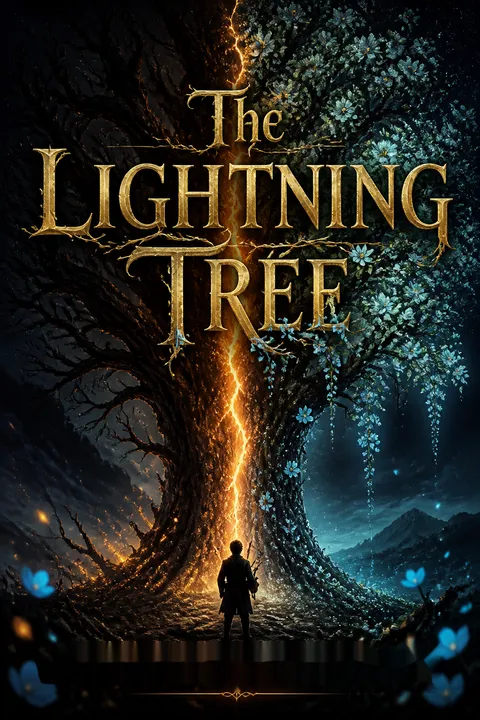


Plot Summary
The Blacktree Bargain
Reshi, the tired innkeeper Bast calls master, catches him sneaking out and sends him for eggs and carrots. Bast takes a book to the lightning tree, a charred trunk where village children meet him under rules of secrecy.
Brann, the baker’s son, needs a story to hide a cut made with his mother’s knife. Bast invents a rat scare and takes string and a green stone in payment. Kale, furious that his brother kissed the girl he likes, gets a revenge scheme involving the brother’s shoes, then trades Bast directions to a wild beehive and Crazy Martin’s hidden still.
Later, Bast fashions shepherd’s pipes and plays for a young shepherdess, drawing her into a private, languid distraction. By morning, Bast has turned childish troubles into a market of favors and information.
The tree gives Bast a place to practice power without announcing it as power. He does not simply solve problems: he teaches children how to shape stories, hide evidence, and retaliate without being caught. His fees make trust transactional, but the exchanges also invite the children to return and test his ingenuity. The contrast between Brann’s frightened lie and Kale’s calculated revenge shows Bast adapting his help to the child in front of him. His pipe-playing adds another kind of influence, less negotiated and more instinctive. Together, the encounters establish a character who treats desire as both game and craft, while leaving open what happens when someone’s need is too serious to be played with.
Kostrel Asks About Fae
Kostrel, a sharp, freckled boy, offers Bast the location of Emberlee’s bathing pool in exchange for information. Bast bargains for three focused answers on one subject, and Kostrel chooses the Fae.
Bast explains that the Fae include many kinds of beings, some dangerous, and distinguishes glammourie, which makes something seem different, from grammarie, which makes it become more fully itself. He uses Kostrel’s treasured knife to show how an object can be more than its material value because of what it means to its owner.
When Bast lets slip that he has met one of the Fae, Kostrel catches the implication, but Bast still collects his promised penny and keeps the boy’s bath secret. The conversation leaves Bast unsettled: Kostrel’s curiosity makes him want to teach, even when knowledge could become dangerous.
Bast’s lesson is also a negotiation over how much of himself he will expose. His definitions offer a usable map of Fae craft, but his examples reveal a deeper tension: value can be created by perception, attachment, or transformation, and those forces are difficult to separate. Kostrel’s knife makes that distinction intimate rather than theoretical. Bast sees the boy’s curiosity as both admirable and perilous, which complicates the effortless pleasure he usually takes in manipulating people. His impulse to protect Kostrel does not erase his instinct to bait him with a secret. Teaching becomes a form of intimacy that Bast has not yet learned how to control.
The Book in the Hawthorn
After Kostrel leaves, Bast goes to a secluded pool to wash. The village’s young women watch from the willow branches, while Bast, nearsighted and unconcerned, bathes without noticing them. He later climbs the wrong bluffs looking for Reshi’s book, then finds it where he had hidden it in a hawthorn. The book is safe, but a strip of birch bark bearing a message from Rike has been left in its place.
Rike wants to speak, and the note unsettles the ease of Bast’s day. He heads back to the lightning tree, unable to find the boy immediately. The message matters because Rike is too old to enter the clearing under Bast’s rules, and has already tried to reach him by breaking the boundary without quite crossing it.
The scene turns Bast’s apparent solitude into a comic misreading: he believes he is unobserved, while the village watches him as a spectacle. The book and birch note then shift the tone from flirtation to obligation. Bast’s hiding place is a private arrangement with the world, yet Rike has managed to leave a message there, suggesting that the boy’s need is already pressing against the limits Bast built. The tree’s rules are not abstract folklore; they decide who can approach Bast and under what conditions. Rike’s workaround foreshadows the central question of the story: whether rules designed for play can remain intact when a child’s safety is at stake.
Viette's Impossible Kitten
Viette, the mayor’s small daughter, approaches the tree carrying a white kitten with mismatched eyes. She wants Bast to confirm that it is magical and help her persuade her father to let her keep it. Bast confirms the kitten is a girl, then gives Viette a plan: hide food, ask politely once more, and, if refused, feign an illness rather than mention the kitten until her father is frightened enough to ask what is wrong.
Viette agrees and pays with two household secrets, including where her father hides his strongbox key. Bast asks for daisies, a blue ribbon, and flowers she calls touch-me-nots. She accepts the errand, leaving with a strategy that converts affection into pressure and with a kitten she hopes to keep.
Bast gives Viette a lesson in leverage disguised as help with a pet. His plan is precise because it recognizes that direct pleading has failed, but it also teaches a child to use her own distress as evidence against an adult’s refusal. The exchange reflects Bast’s fluency in motives: he understands that a parent may dismiss a request yet respond to fear. Viette, meanwhile, is not merely a spoiled child. She tests Bast’s claims, corrects his name for the flowers, and bargains with secrets. Their encounter shows how his authority depends on being useful, but also how easily useful advice can blur into manipulation.
Rike Wants Him Gone
Rike finally finds Bast beyond the clearing, returning Reshi’s book and admitting he needs help. Bast initially refuses because Rike is too old for the children’s rules and has lied to him before. Rike’s anger breaks into tears as he explains that his father drinks and beats his mother, while his little sister and baby brother remain trapped at home.
He first asks how to kill his father, but Bast presses him to decide what he actually wants. Rike chooses permanent absence, not murder: he cannot bear to become someone who kills his own father. Bast agrees, despite resenting the request, and sets a first task. Rike must find a dry river stone with a hole in it, himself, before Bast will begin the charm.
Rike’s request forces Bast out of the safe economy of pranks and favors. The boy’s first solution is violent because he can see no reliable protection for his mother, but he still fears what violence would make of him. That fear is not weakness; it is evidence that he is trying to preserve a moral self under brutal conditions. Bast’s insistence on clarifying the desired outcome prevents him from treating murder as the only available answer. Yet the price he names is severe, matching the scale of the problem. The scene exposes the limits of Bast’s usual distance: he can make a clever plan, but Rike needs someone to recognize the terror beneath it.
Flowers for Emberlee
Using the bathing place Kostrel revealed, Bast prepares a display for Emberlee. He turns Viette’s touch-me-nots blue and sends them floating downstream into the pool. Hidden in a tree, he watches Emberlee undress and enter the water, then loses his balance and crashes into the grass. Emberlee comes to him with her shift held in front of her.
Bast offers her the daisy crown and sweet bun he brought, and she accepts the flowers, puts on the crown, and kisses him. When he notices that she smells of his honeysuckle soap, he realizes she has taken it. The carefully staged seduction ends not with Bast controlling the scene, but with him flat on the ground, surprised by Emberlee’s own playful theft.
Bast approaches courtship as a performance he can choreograph: flowers altered by craft, a hidden vantage, and a planned gift. But the fall punctures his control and gives Emberlee the chance to answer on her own terms. The scene is not an uncomplicated romance, since Bast secretly watches her undress; his desire includes an entitlement to observe that the story renders comic without making it harmless. Emberlee’s kiss and theft of his soap redirect the encounter from passive display toward reciprocal mischief. Bast’s pleasure depends on surprise, and he is most disarmed when another person takes the initiative rather than merely fulfilling the role he has prepared.
Martin's Hidden Still
Kale’s directions lead Bast to Crazy Martin’s concealed still, a carefully built operation tucked into a rocky valley. Bast samples an unlabeled bottle and recognizes a smooth, strong spirit rather than the dangerous hillwine Reshi fears. Back at the inn, he persuades Reshi to buy several bottles, partly to settle Martin’s tab and partly to give the distiller a reason to visit.
Reshi agrees, pleased that Bast has been reading his chemistry book. Before the conversation ends, Rike catches up with Bast and presents the holey river stone he found. Bast sends him away again, this time to borrow a needle from a home where no men or boys live. Rike accepts the difficult errand without complaint, making the charm a task he must help create.
The still episode links Bast’s appetite for knowledge to his habit of interfering in other people’s affairs. He tastes first, studies afterward, and uses what he learns to persuade Reshi to make a practical arrangement with Martin. The innkeeper’s approval is as important as the liquor: Bast has briefly turned study into useful work and earned recognition from the person he serves. At the same time, the still’s later appearance in the tavern gossip leaves the day’s chain of events uncertain. Bast has entered a dangerous place and handled its product, but the narrative does not make every consequence transparent. His charm work likewise depends on Rike’s participation, not just Bast’s skill.
Nettie's Failing Hives
Bast visits Rike’s home and finds his mother, Nettie, caring for a baby while Rike’s younger sister watches the cradle. Jessom is away checking traps, so Bast asks Nettie for work instead. He splits wood in exchange for carrots, then notices the failing beehives and offers his knowledge. Nettie tells him winter, disease, and the need to pay a levy have reduced the family’s hives.
Bast invites her to see something, and later returns to the tree with dirt in his hair and cuts on his hand. Wilk and his younger sister Pem then ask for a riddle and an answer. Bast makes the answer cost a bottle of naturally falling water and twenty-one perfect acorns, offering honeycomb as Pem’s reward. Their errands remain unfinished when evening arrives.
Nettie’s household gives Bast a view of harm that is quieter than Rike’s plea but no less material: absent income, dwindling hives, and care work concentrated on one exhausted parent. Bast first tries to help through labor, accepting carrots rather than demanding secrets. His offer to work with the bees turns his attention from flirtation toward maintenance and recovery. That shift matters because he treats gentleness as a practical skill, not a sentimental pose. Wilk and Pem’s bargaining returns the story to the tree’s playful economy, but the errands they undertake do not receive a tidy resolution. The day’s favors accumulate faster than Bast can close every account.
A Stone for Mother
At sunset, Rike returns with the borrowed needle. On the greystone, Bast explains that the stone must belong to one person and can drive away what threatens them. Rike insists it be made for his mother, fearing both his father’s return and the possibility that he might grow cruel like him.
Bast gathers the shaking boy against him, tells him he is good, and then claims that the charm will work better if Rike tells his mother every day that he loves her. Rike pricks his finger; Bast adds his own blood through the stone’s hole, and sends him to give it as a gift.
At the inn, townspeople report that Jessom fell drunk near Littlecliff, wrecked Martin’s still, and then took the king’s coin to enlist. Carter has driven him onward to Baden. Bast tells Reshi that Nettie has found a wild hive and caught its queen, ending the day with news of care as well as departure.
Rike’s choice shifts the charm from retaliation to protection, and his fear that he could inherit his father’s violence reveals how abuse colonizes a child’s idea of himself. Bast’s embrace answers a need that his magic cannot: Rike must hear that his origins do not decide his character. Bast then disguises emotional advice as a magical requirement, using a lie to help the boy practice love aloud. Jessom’s departure fulfills the requested absence, but the precise relation between the charm, the damaged still, and the enlistment remains unstated. That uncertainty preserves Bast’s inscrutability while leaving the human consequence plain: Rike’s family has a chance to breathe without Jessom in the house.
Analysis
The story compresses a community into one day of exchanges, but its central movement is from manageable wants toward a need that resists cleverness. Children ask Bast for lies, revenge, knowledge, a kitten, and riddles. Those requests let him display a nearly effortless command of desire: he finds the pressure point, names a price, and offers a solution shaped to the person asking. Rike’s appeal changes the scale. His fear is not simply that his father will hurt his family again; he worries that violence has already entered him and may define his future. Bast cannot answer that fear with craft alone. He has to hold the boy, affirm a truth Rike cannot yet believe, and disguise an emotional practice as part of the charm.
The distinction between glammourie and grammarie gives the day a conceptual spine. Seeming and being are not clean opposites in Bast’s account. A treasured knife becomes the best knife for its owner because attachment changes its lived meaning. Likewise, Bast’s tricks are not always empty deceptions: a story can protect a child, a flower display can invite affection, and a false magical instruction can teach Rike to tell his mother he loves her. The same techniques can also serve appetite or intrusion, as Bast’s secret watching of Emberlee makes clear. His powers do not make him morally consistent; they make his choices more consequential.
The ending refuses to explain exactly how Jessom leaves. The still, the drink, the fall, and the enlistment form a chain of events, but the story does not certify Bast as their cause. That uncertainty suits a character who works through hidden pressures rather than public declarations. What is definite is the human result: Rike’s family gains distance from the man who hurt them, and Nettie has a chance to recover a hive. Bast’s day has not solved every problem or collected every promised favor. It has shown that care, unlike a bargain, sometimes begins when he chooses to stay involved without knowing what the final price will be.
Review Summary
The Lightning Tree receives mostly positive reviews, praised for its engaging writing and deeper exploration of Bast's character. Readers enjoy the whimsical tone and clever plot connections. However, some criticize Rothfuss's portrayal of female characters and Bast's occasionally questionable behavior. The novella provides insight into Bast's daily life in Newarre, showcasing his interactions with villagers and his fae nature. While not essential to the main series, fans appreciate the additional worldbuilding and character development.
Characters
Bast
Fae at the innBast is the Waystone Inn’s beautiful, sly, and restless helper, bound to Reshi by a relationship of service and affection. He moves through the village by trading secrets, favors, and carefully chosen stories, treating desire as something to pursue with playfulness and skill. His knowledge of Fae craft lets him alter appearances and shape objects, but he is also an observant reader of ordinary human motives. Under his confidence sits a growing difficulty: he can want several incompatible things at once. He likes to tease, seduce, and control, yet he is drawn to children whose curiosity and suffering make him care beyond the terms of a bargain. That tension gives his mischief a more tender and dangerous edge.
Reshi, the innkeeper
Bast's guarded masterReshi is the weary, red-haired innkeeper who directs Bast’s daily chores and quietly watches over him. He speaks with restraint, values books and practical study, and rarely lets his tiredness harden into cruelty. Bast’s teasing often draws a smile from him, but Reshi also notices when Bast is injured, drunk, or evading a question. Their relationship combines authority with an intimacy neither explains: Reshi can call Bast back with a voice that reaches through a door, while Bast is eager for his approval even when he pretends otherwise.
Rike
Boy seeking safetyRike is a poor, sharp-tempered boy whose worn clothes and guarded manner make him seem older than he is. He has a history with Bast and knows the rules of the lightning tree, but he is also willing to challenge those rules when his family is in danger. Anger gives him a way to speak about fear without appearing helpless. Beneath it, he is deeply concerned with the kind of person he might become and with the safety of his mother and younger siblings. He distrusts easy reassurance, yet he can accept help when it respects his choices rather than taking them away.
Kostrel
The curious questionerKostrel is a lean, freckled boy with a sharp eye for loopholes and a talent for making a bargain serve him twice. He approaches Bast with valuable information but insists on full answers in return. His curiosity about the Fae is more than a taste for frightening stories; he wants a coherent account of how the unseen world works. Bast respects his intelligence even as he tries to steer it. Kostrel’s wit lets him resist being treated as a passive pupil.
Viette
The mayor's determined childViette is the mayor’s young daughter, finely dressed and accustomed to adults taking her seriously, but she is also stubborn and quick to challenge Bast. She wants to keep a kitten and approaches the problem with more persistence than patience. Her questions show a child testing which claims are trustworthy and which rules can be bent. She understands status well enough to use her father’s position as a shield, yet she is still tenderly attached to the small animal she hopes to keep.
Brann
The baker's frightened sonBrann is a well-fed young boy who comes to Bast after cutting his hand while handling his mother’s knives. He fears punishment more than the injury and is willing to trade small possessions for a convincing explanation. His nervousness makes him a useful contrast to the more combative children at the tree.
Kale
The boy nursing a grudgeKale is a homespun-clad boy with a split lip and a quick temper. He wants to punish his brother for kissing the girl he likes, but he responds to Bast’s practical, indirect scheme with admiration. His appetite for revenge is strong, though he can be persuaded to choose a method that wounds pride rather than body.
Emberlee
Bast's chosen beautyEmberlee is a young woman Bast regards as one of the village’s most beautiful. She bathes in a secluded pool, enjoys flowers, and meets Bast’s attention with a playfulness of her own. She is not merely an object of his fantasy: her actions, including her small theft, give her an independent wit within their flirtation.
Nettie
Rike's hardworking motherNettie is Rike’s mother, a tired but capable woman managing a household, young children, and scarce resources while her husband is often away. She keeps a tidy home and garden despite the strain, and memories of her hives suggest a practical knowledge she has had to set aside. Bast sees both her fatigue and her competence. Her attention is divided among care, work, and worry, but she remains open to help that treats her as an able person rather than a problem to be solved.
Jessom
Rike's violent fatherJessom is Rike’s father, a trapper whose drinking and violence make home unsafe for his wife and children. His absences offer only temporary relief, because the family cannot count on him staying away. He is defined in the village through rumor as much as through direct appearance, a reminder that private harm can be known to a community without being openly confronted.
Crazy Martin
The reclusive distillerMartin is a large, isolated former soldier with strong habits, a fierce temper, and an elaborate hidden still. The villagers call him crazy, though Reshi sees a more complicated man shaped by his years in the army. Martin’s craft is meticulous even when his behavior frightens people. His strained relationship with Bast and his unpaid account at the inn connect him to both the village’s fears and its ordinary economics.
Wilk and Pem
The bargaining siblingsWilk is a serious boy who wants a riddle difficult enough to stump his sister. Pem is younger, outspoken, and quick to spot practical solutions. Their different temperaments make their dealings with Bast lively: Wilk guards his pride, while Pem eagerly pursues honeycomb and answers.
The Waystone regulars
Keepers of village rumorOld Cob, Jake, Graham, Shep, Carter, and the smith’s apprentice gather at the inn, trading competing versions of local news. Their gossip turns private incidents into communal knowledge, though no single account is always complete. Carter’s travels and the others’ fears help make the village’s understanding of Jessom’s departure visible.
Plot Devices
The lightning tree
A market for secretsThe dead, charred tree is the children’s meeting place with Bast. Its rules restrict who may approach, require secrecy, and turn problems into exchanges of favors, information, or small objects. This device gives the story an episodic structure: each visitor brings a specific want, and Bast answers by bargaining rather than acting as an ordinary adult adviser. The tree’s customs also establish boundaries that matter when Rike, too old to come openly, seeks Bast anyway. It is both a playful village institution and a threshold where childhood games begin to touch adult danger.
Fae craft
Appearance versus beingBast describes two forms of Fae craft. Glammourie makes something seem other than it is, while grammarie changes it into more of what it already is. His explanation through Kostrel’s cherished knife makes the distinction concrete: a knife’s meaning to its owner can become part of what it is. These ideas illuminate Bast’s ability to shape perception and his sensitivity to desire. They also leave open how much of his daily life is simple performance and how much is genuine transformation.
The holey river stone
A charm against harmBast asks Rike to find a dry river stone with a hole and a needle borrowed from a home with no men or boys. Rike’s blood marks the stone, and Bast adds his own. Bast describes the result as a charm that drives away threats and tells Rike to give it to one person as a gift. Its importance comes not only from the ritual but from Rike choosing his mother as its recipient. The charm gives the boy an action he can take when he cannot control the adults who endanger his family.
Bast's bargains
Desire made transactionalBast prices help in secrets, objects, errands, or favors rather than money. The system lets him learn the village’s private concerns while preserving his freedom to refuse, and it teaches children to name what they want before receiving advice. Different trades reveal different sides of him: he can be shrewd with a prank, patient with curiosity, or unexpectedly compassionate when Rike speaks of violence at home. Some errands remain open at the end, showing that Bast’s playful economy cannot neatly contain every need he encounters.
The Kingkiller Chronicle Series


About the Author

Download PDF
Download EPUB
.epub digital book format is ideal for reading ebooks on phones, tablets, and e-readers.








