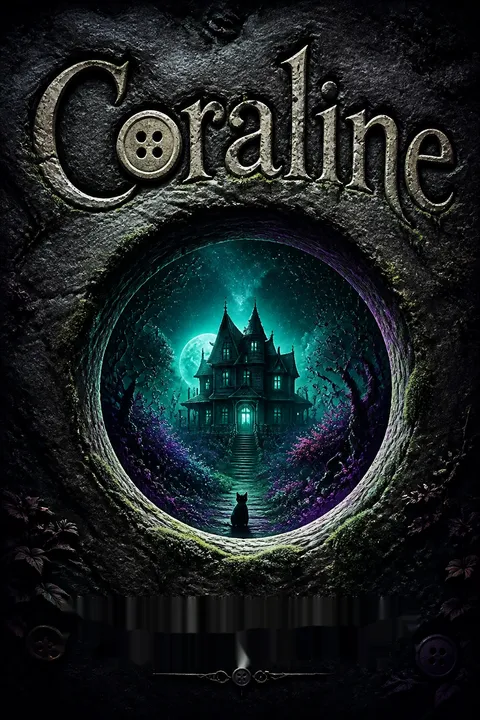


Plot Summary
The Door in the Drawing Room
After moving with her parents into a divided old house, Coraline1 finds the days too quiet and the adults too occupied to play with her. She explores the grounds, locates a dangerous old well, and meets the eccentric neighbors: retired actresses Miss Spink6 and Miss Forcible7 below, and the attic man8 who claims to train performing mice.11
When rain traps her indoors, Coraline1 counts the flat's doors and windows. One door in the drawing room is locked; her mother4 opens it to show a brick wall on the other side, left behind when the house was divided into apartments. Coraline1 accepts the explanation, but a shadow slips toward that door during the night, and she finds it slightly ajar.
The opening makes neglect ordinary rather than cruel: Coraline's parents care for her, but work and routine leave her to invent her own occupation. That distinction matters, because the other mother's appeal will be built from attention, not simply from an obvious threat. Coraline's exploration is both a response to boredom and a temperament: she tests boundaries because knowing a place means finding out what it hides. The sealed doorway gives that impulse a physical focus. Its brick wall appears to settle the question, yet the unexplained shadow makes the adults' practical account feel incomplete.
A Stone Against Bad Things
The next day, fog blurs the grounds, and the attic neighbor8 passes along a warning he attributes to his mice:11 Coraline1 should not go through the door. He cannot explain why, and she does not let the warning end her curiosity. When she visits Miss Spink6 and Miss Forcible7 for tea, the retired actresses read danger in the leaves at the bottom of her cup.
Miss Spink6 gives Coraline1 a small stone with a hole through its center, saying it might protect her. The adults offer no clear account of the threat, but their unease changes the locked doorway from a puzzle into a risk. Coraline1 pockets the stone and keeps exploring, more intrigued than frightened.
The warnings arrive through adults who seem eccentric and unreliable, so Coraline has no straightforward authority to obey. The mice's message is indirect, the tea leaves imprecise, and the stone's purpose unexplained. This uncertainty preserves her agency: she is not propelled into danger by ignorance alone, but by the belief that she can investigate and judge for herself. The stone matters first as a token of care from neighbors who notice her, even when her parents are distracted. Its protective promise is modest, which suits the story's logic: courage here is not immunity from danger, but the willingness to carry a small aid into it.
The House That Says Yes
When her mother4 leaves to shop, Coraline1 retrieves the black key and opens the drawing-room door. The brick wall has vanished; beyond it lies a corridor that resembles her own home, except that its pictures seem subtly wrong.
In the kitchen, a pale, long-fingered woman with black buttons for eyes claims to be Coraline's1 other mother.2 A button-eyed counterpart of her father5 joins them for a lavish meal, followed by wondrous toys and a room brighter than Coraline's1 real bedroom.
The attic neighbor's8 counterpart8 appears with rats, and the black cat3 from Coraline's1 garden turns up outside, able to speak. Coraline1 enjoys the feast and marvels at the toys, but her other parents' insistence2 that she stay forever begins to make the welcome feel less generous.
The counterfeit home is persuasive because it edits ordinary frustrations rather than replacing Coraline's life wholesale. Better food, vivid toys, and attentive parents answer wants she has already expressed. Yet the black buttons, the rats, and the other parents' fixed attention signal that this comfort is designed around possession. The black cat offers a contrasting model of independence: it refuses to be treated as a copy or a pet, even while it helps Coraline orient herself. The scene tests how easily care can be confused with gratification. Coraline's pleasure is real, but so is her growing ability to notice when affection comes with conditions.
The Mirror Holds Her Parents
When the other mother2 presents a needle and black buttons as the price of staying, Coraline1 refuses and returns through the dark corridor to her own flat. Her parents are gone. After an empty night alone, she sees them trapped inside the hall mirror, where they wave silently; a policeman dismisses her report as a nightmare.
Coraline1 prepares a candle, apples, the stone, and the black key, then chooses to return despite her fear. The other mother2 greets her as if she has been missed, but Coraline1 rejects the offer of a perfect family and demands her real parents. A mirror scene meant to make her doubt their love fails, and the other mother2 locks the passage, leaving Coraline1 in the counterfeit house.
The emotional hinge is not the revelation that the other world is dangerous, but the disappearance of Coraline's parents after she has chosen to leave it. Loneliness, which began as a mild domestic frustration, becomes a concrete consequence of the other mother's control. The police officer's dismissal removes the ordinary route to help, forcing Coraline to trust her own interpretation. Her memory of her father's courage gives her a usable model: fear does not disqualify action. By returning, she turns attachment into responsibility. The other mother's imitation of parental care now looks like a trap precisely because Coraline has a real, imperfect relationship against which to measure it.
Behind the Looking Glass
The black cat3 advises Coraline1 to challenge the other mother,2 who insists that she sleep before deciding what to do. In the morning, the other father9 admits that the world is only a small imitation made by the other mother.2 Coraline1 follows the woods into a blank, unfinished mist, then returns to confront her captor, who locks her inside the space behind a mirror.
There she meets three ghost children10 who have been trapped for ages. They explain that the other mother2 took their souls and hid them, leaving them unable to move on. Coraline1 promises to find what was stolen from them as well as her parents. Alone in the cramped darkness, she holds on to the idea that the other mother2 must be challenged through a game.
The ghost children turn Coraline's private rescue into a moral obligation. Their forgotten names and fading memories show what the other mother's version of love does over time: it does not merely imprison a child, but erodes the person who could resist imprisonment. Coraline's promise is significant because no reward is offered, and the children cannot promise that helping them will help her. Her confinement also strips away the sensory abundance that made the false home tempting. In the dark, she must act without spectacle or reassurance. The game becomes a way to impose rules on a captor who otherwise controls both the setting and the terms of attention.
Marbles in the Monster House
The other mother2 releases Coraline1 after she proposes a wager: if Coraline1 finds her parents and the children's lost souls, everyone must be freed; if she fails, she will stay and accept buttons in her eyes. The other mother2 agrees, swearing on her right hand. Using the hole in Miss Spink's6 stone, Coraline1 sees a hidden glow inside a glass marble among the toys in her bedroom.
The first ghost child's10 soul is there. At the ruined theater, she finds another marble inside a cocooned creature made from the twisted doubles of Miss Spink6 and Miss Forcible,7 then escapes as it wakes and calls her a thief. The other mother2 offers Coraline1 a key to the empty flat, and the changing world points her toward the next search.
Coraline's wager is a tactical compromise, not evidence that she trusts her captor. By making the other mother accept a stated outcome, she creates a structure that can be used against a creature accustomed to controlling every detail. The stone gives her perception rather than force: it reveals what ordinary sight cannot, while leaving her responsible for approaching the danger. The toy room and theater also expose the costs of the false world. Its pleasures have become abandoned objects and grotesque bodies, not a stable home. Coraline's success depends on moving through fear without mistaking the ability to see danger for the ability to avoid it.
The Third Soul Runs
The key opens the empty flat, where Coraline1 discovers a trapdoor leading to a cellar. Beneath the stairs, the other father9 has become a swollen, nearly featureless creature.
It admits that the other mother2 is forcing it to attack, and Coraline1 blinds it by pulling away its remaining button eye, then escapes and seals it below. In the attic, the other neighbor8 is only a coat and hat animated by rats. A large rat steals the final marble, and Coraline1 pursues it down the stairs, falls, and believes she has failed.
The black cat3 kills the rat and returns the marble. With all three souls recovered, Coraline1 realizes the parents must be hidden in the snow globe on the drawing-room mantel. The cat3 then discovers that the exits are flattening away.
This section replaces the other mother's polished hospitality with its discarded machinery: a damaged father-copy, a rat-made neighbor, and a cellar full of neglect. Coraline responds differently to each threat. She pities the other father even as she defends herself, but she cannot reason with the rats and needs the cat's speed and force. The near loss of the last marble exposes the limits of individual bravery; Coraline falls, and another creature's intervention saves the search. Her deduction about the snow globe comes from recognizing the other mother's limits: she can distort and relocate, but not create from nothing. The disappearing exits convert success into an immediate deadline.
The Door Slams Shut
Back in the drawing room, Coraline1 tells the other mother2 that her parents are behind the locked passage door, gambling that the creature will open it to prove her wrong. While the other mother2 gloats over the empty corridor, Coraline1 snatches the snow globe from the mantel. She throws the black cat3 at the other mother's2 face, giving herself time to run through the doorway.
The cat3 follows, and Coraline1 struggles to close the heavy door as the other mother2 reaches through the gap. The ghost children10 and Coraline's parents lend her strength, and the door finally shuts. Something drops into the corridor, but Coraline1 does not stop to inspect it. She locks the passage from her side and returns to the real flat with the cat.3
Coraline's final trick works because she understands the other mother's appetite for display. The creature needs not only to win but to make Coraline witness the victory, so it opens the door itself. Coraline's use of the cat is morally complicated: she treats a friend as a diversion, then immediately recognizes the danger and apologizes. The escape therefore does not turn courage into invulnerability or clean heroism. It depends on trust, strategy, and help from those Coraline has already tried to save. The closing door is more than a boundary restored. It is the first limit the other mother cannot simply revise to suit herself.
The Hand Comes Home
Coraline1 wakes in the drawing room to her real mother,4 who found her asleep there with the cat.3 She hugs her mother,4 eats her father's5 imperfect homemade pizza, and hangs the black key around her neck. That night, she dreams of the three ghost children10 at a picnic; they warn her that the other mother2 lied when she swore on her right hand.
Before dawn, Coraline1 hears something scuttling through the hall. The white hand, severed from the other mother2 during the escape, races out the front door in search of the key. Coraline1 understands that the passage may be shut, but the danger has not ended. She keeps the key close and begins planning how to stop the hand from reaching it.
The return to family life is deliberately ordinary: a hug, a meal, and the familiar flaws of her father's cooking. Those details make home valuable without pretending that it has become perfectly attentive or exciting. The dream gives the rescued children a brief future beyond captivity, but their warning also prevents relief from becoming complacency. The severed hand is a concentrated remnant of the other mother's will: even without a body or voice, it continues to pursue possession of the key. Coraline's new vigilance shows that bravery has matured into practical foresight. She is no longer simply entering danger to discover what lies beyond a door; she is securing a boundary she knows can be tested.
The Well Keeps Its Secret
Coraline1 notices that the hand has injured Hamish,12 one of Miss Spink6 and Miss Forcible's7 dogs, and hears the attic neighbor8 report that his mice11 are frightened by something in the house. She makes a picnic from dolls, cups, water, and a paper tablecloth, setting it over the old well and balancing the cloth with the cups. Then she walks nearby, dangling the black key as bait.
The hand scuttles after her and leaps onto the cloth; its weight sends it tumbling into the well with the key. Coraline1 covers the opening with planks. She returns the protective stone to the actresses and resumes preparing for school. The cat3 visits, the attic neighbor8 promises her the first audience at his mouse circus,11 and Coraline1 falls asleep imagining its music.
Analysis
Coraline1 is a story about the difference between being indulged and being recognized. The other mother2 identifies the girl's ordinary frustrations with striking accuracy: tedious meals, gray clothes, rainy days, and adults absorbed in work. She answers each want with a perfected substitute, but her attention is designed to eliminate Coraline's1 freedom. The bargain of buttons makes the logic explicit. To be loved in that world is to surrender the eyes through which Coraline1 judges it.
The book does not ask Coraline1 to deny that her real home can be dull or that her parents can be distracted. Its emotional force depends on preserving those imperfections. Coraline's father's5 strange cooking and her mother's4 brisk errands are not transformed into ideal parenting; instead, Coraline1 discovers that their ordinary care includes a willingness to act for her. The remembered wasp attack offers a model of courage that she can use without needing to feel fearless.
Her resistance is intellectual as well as brave. She counts, compares, notices the absent snow globe, and reasons that the other mother2 can distort what exists but cannot make a wholly new world. The pierced stone sharpens this mode of attention, while the well rewards the exploratory habits that adults and circumstances might otherwise treat as aimless. Coraline1 wins not because she becomes stronger than the monster, but because she sees the design of its traps and uses its vanity against it.
The ghost children10 widen the stakes beyond family rescue. Their fading memories show that possession can hollow out identity, while Coraline's1 promise to help them makes courage relational rather than self-protective. The final return does not erase fear; the severed hand follows her home, requiring one more plan. By turning a familiar landscape into a trap, Coraline1 claims responsibility for the boundary between worlds. Growing up here means learning that imperfect reality is not a failed version of fantasy. It is the place where choices, limits, and genuine relationships can exist.
Review Summary
Coraline is a creepy, dark fantasy children's novella that captivates readers of all ages. Many praise Gaiman's vivid imagination and ability to create a genuinely disturbing and eerie atmosphere. The story follows a brave young girl who discovers a parallel world with sinister undertones. Readers appreciate the book's themes of bravery, self-discovery, and the importance of appreciating what one has. While some found it less scary than expected, most agree it's a perfect Halloween read that leaves a lasting impression. The audiobook narrated by Gaiman himself is highly recommended.
People Also Read







Characters
Coraline Jones
Restless young explorerCoraline is curious, observant, and impatient with being dismissed. Her parents' busy routines leave her to make her own adventures, but she is not simply rebellious: she counts doors, studies the grounds, and notices when details do not fit. She wants vivid pleasures, such as unusual clothes and more exciting meals, yet learns to distinguish abundance from genuine care. Her courage is practical rather than fearless. She carries a stone, plans with whatever objects are at hand, and keeps moving when frightened. The story's emotional center is her growing ability to value imperfect real relationships without pretending that boredom or frustration never existed.
The other mother
Predatory substitute parentThe other mother resembles a parent only at first glance. Pale, sharply fingered, and button-eyed, she offers extravagant food, fascinating toys, and attentive companionship. Her apparent generosity is possessive: she wants a child who will accept her terms and remain under her control. She is patient when coaxing Coraline1 and openly menacing when refused, adapting her world and its inhabitants to pressure the girl. Her most unsettling quality is that she can imitate tenderness convincingly enough to exploit a child's real desire for attention. She represents care stripped of reciprocity, where the giver's devotion serves ownership rather than the child's independence.
The black cat
Independent uneasy allyThe black cat is proud, self-possessed, and resistant to the human habit of naming and owning everything. It can speak in the other mother's2 world, where it offers warnings and sharp observations without becoming a reassuring guide. Its independence gives Coraline1 a useful counterweight to the false household's relentless attention. The cat does not promise safety or obedience, and its help comes on its own terms. It is both a real animal from Coraline's1 world and a capable presence in the strange one, reminding her that companionship does not require possession. Its dry wit conceals a willingness to take risks when Coraline1 needs help.
Coraline's mother
Busy, loving parentCoraline's mother works from home and is often distracted by tasks, practical errands, and decisions about clothes. She can be impatient or inattentive without being unloving, a distinction Coraline1 has to hold onto when the other mother2 offers a more extravagant kind of attention. Her grounded presence helps define the ordinary family life Coraline1 misses. She represents care that is imperfect and sometimes frustrating, but not conditional on a child's surrender of independence.
Coraline's father
Distracted, inventive parentCoraline's father works at his computer and often answers her requests by suggesting she occupy herself. He likes adventurous recipes that Coraline1 dislikes, making their affection feel familiar rather than idealized. A memory of his endurance during a wasp attack becomes important to Coraline's1 understanding of courage: he acted despite fear when she needed time to escape. His practical, imperfect care offers a contrast to the other father's9 manufactured hospitality.
Miss Spink
Fortune-reading former actressMiss Spink is one of Coraline's1 downstairs neighbors, a retired actress who lives with Miss Forcible7 and several Scottie dogs. She is sociable, theatrical, and prone to mixing practical concern with eccentric predictions. Her reading of Coraline's1 tea leaves signals danger, and the stone she gives the girl offers a small measure of protection. Miss Spink's attention matters because she takes Coraline1 seriously in a way the busy adults around her often do not.
Miss Forcible
Theatrical loyal companionMiss Forcible shares a flat with Miss Spink6 and a long history on the stage. She is lively, opinionated, and affectionate, often arguing with her companion over past performances and theatrical roles. Her habit of reading Coraline's1 tea leaves reinforces Miss Spink's6 warning, while her warmth gives Coraline1 a welcome place to visit. Their theatrical world is both comic and oddly perceptive, matching the adults' capacity to seem absurd while still noticing what matters.
The attic neighbor
Mysterious mouse trainerThe attic neighbor is an eccentric older man who claims his mice11 are rehearsing a circus. He repeatedly mispronounces Coraline's1 name, but his strange stories carry warnings that prove difficult to dismiss. His counterpart in the other world is more threatening, which makes the real neighbor's harmless oddity feel newly reassuring. He represents the uncertainty of adult knowledge: his predictions may sound nonsensical, yet Coraline1 is wise to listen.
The other father
Unstable parental imitationThe other father is a constructed likeness of Coraline's real father5, initially offering food and a show of welcome. He is less forceful than the other mother2 and appears uneasy about speaking freely. His changing, unfinished appearance makes visible the instability beneath the false household's comfortable surface. He is a reminder that the other mother's2 world can imitate familiar people without granting them an independent life.
The ghost children
Forgotten former captivesThe three ghost children have been trapped by the other mother2 for so long that they have forgotten parts of their names and lives. Their memories remain vivid in fragments, which gives their warnings a poignant specificity. They tell Coraline1 what the other mother2 has taken and ask her to search for their lost souls. Though they are frightened and fading, they retain tenderness and concern for someone newly caught in the same danger.
The attic neighbor's mice
Cryptic warning chorusThe mice are described by the attic neighbor8 as a performing troupe, but their warnings and fear of the threat in the house give them a role beyond entertainment. They communicate indirectly, adding to Coraline's1 uncertainty about which apparently ridiculous details deserve attention.
Hamish
Injured Scottie dogHamish is one of Miss Spink6 and Miss Forcible's7 Scottie dogs. His unexplained injury gives Coraline1 evidence that the danger has reached beyond the locked passage and helps prompt her final plan.
Plot Devices
The black key and hidden door
Threshold between worldsThe old black key opens a door that normally leads only to a brick wall. In the other mother's2 world, the passage becomes a route between Coraline's1 familiar flat and its distorted counterpart. The key also becomes a practical vulnerability: the other mother2 wants control of it, and Coraline1 must protect it after returning home. The door gives the story a clear physical boundary, but its changing state makes that boundary unreliable until Coraline1 can secure it herself.
The stone with a hole
Sight beyond appearancesMiss Spink6 gives Coraline1 a small stone pierced through the center, saying it may help against bad things. Looking through it changes what Coraline1 can perceive: hidden souls appear as glowing marbles against an otherwise dull world. The stone does not solve the search for her; Coraline1 must still enter dangerous places and retrieve each marble by hand. Its function is both practical and psychological. It turns close observation into a tool, helping Coraline1 distinguish real clues from the other mother's2 manufactured distractions.
The glass marbles
Stolen souls made visibleThe ghost children's10 stolen souls are concealed in glass marbles scattered through the other mother's2 world. The stone reveals their glow, allowing Coraline1 to locate the marbles in the toy room, the ruined theater, and among the rats. Collecting them gives her a concrete measure of progress in the wager and a way to help the children move beyond captivity. Their fragile appearance contrasts with the difficulty of retrieving them, and the final disappearance of their contents signals that the children can at last move on.
The snow globe
Parents hidden in plain sightThe snow globe appears on the other drawing-room mantel, though the corresponding mantel in Coraline's1 real home is bare. Its unusual presence becomes the clue that lets Coraline1 infer where the other mother2 has hidden her parents. Coraline1 uses the other mother's2 eagerness to gloat, takes the globe during the confrontation, and carries it through the passage. It connects Coraline's1 ability to notice small inconsistencies with the rescue's decisive turn: what seems like decoration proves to be a container and a clue.
The old well
A trap built from playThe covered well is introduced early as a hazard on the grounds, and Coraline1 explores it before she understands how important it will become. After returning home, she uses the well's depth, a paper tablecloth, water-filled cups, dolls, and the black key to lure the other mother's2 searching hand. The hand's leap collapses the improvised picnic and sends it into the well. This payoff transforms Coraline's1 earlier curiosity into a resource: knowing the landscape lets her finish the danger without entering the other world again.
FAQ
Synopsis & Basic Details
What is Coraline about?
- A girl's parallel world: Coraline discovers a hidden door leading to a seemingly better version of her life, complete with attentive "other" parents.
- Sinister deception unfolds: This perfect world reveals a dark side, as the other mother seeks to trap Coraline and replace her real family.
- Courage and self-discovery: Coraline must use her bravery and wit to escape the other world and save her parents, learning the value of her real life.
Why should I read Coraline?
- Unique blend of genres: It masterfully combines elements of fantasy, horror, and adventure, creating a captivating and unsettling reading experience.
- Exploration of complex themes: The story delves into themes of identity, family, and the dangers of seeking perfection, offering thought-provoking insights.
- Memorable characters and world: The book features a cast of eccentric characters and a vividly imagined parallel world that will stay with you long after you finish reading.
What is the background of Coraline?
- Personal inspiration: Gaiman drew inspiration from his own childhood home, which had a mysterious door leading to a brick wall, sparking the initial idea.
- Written over a decade: The book was started for his daughter Holly, but was finished years later for his younger daughter Maddy, reflecting a long period of development.
- Exploration of childhood fears: The story taps into common childhood anxieties about neglect, boredom, and the fear of the unknown, making it relatable and resonant.
What are the most memorable quotes in Coraline?
- "We have teeth and we have tails...": This chilling song, sung by the rats, foreshadows the sinister nature of the other world and its inhabitants.
- "When you're scared but you still do it anyway, that's brave.": This quote defines Coraline's courage, highlighting that bravery isn't the absence of fear, but action despite it.
- "Mirrors are never to be trusted.": This line emphasizes the deceptive nature of the other world and the importance of looking beyond surface appearances.
What writing style, narrative choices, and literary techniques does Neil Gaiman use?
- Simple yet evocative prose: Gaiman employs a straightforward writing style that is accessible to younger readers, while still creating a rich and atmospheric world.
- Third-person limited perspective: The story is told from Coraline's point of view, allowing readers to experience her fears and discoveries firsthand, enhancing the suspense.
- Foreshadowing and symbolism: Gaiman uses subtle hints and recurring motifs, like buttons and the color green, to foreshadow future events and deepen the story's themes.
Hidden Details & Subtle Connections
What are some minor details that add significant meaning?
- The color green: The other world is often associated with green, a color that can symbolize envy, sickness, and the unnatural, highlighting its deceptive nature.
- The other father's vagueness: His increasingly vague features and lack of autonomy reveal the other mother's control and the artificiality of her world.
- The changing house: The house's transformation into a flat, two-dimensional drawing symbolizes the other mother's diminishing power and the unreality of her creation.
What are some subtle foreshadowing and callbacks?
- The rats' song: The rats' song, "We are small but we are many," is repeated in both worlds, foreshadowing their role as spies and the other mother's manipulative nature.
- Miss Spink's warning: Her advice to "not wear green in your dressing room" foreshadows the danger Coraline faces in the other world, which is filled with green.
- The cat's sarcasm: The cat's dry, sarcastic tone hints at its knowledge of the other world and its true nature, which is revealed later in the story.
What are some unexpected character connections?
- The other Spink and Forcible: Their transformation into young, button-eyed performers reveals the other mother's ability to twist and control even minor characters.
- The other father's plea: His desperate warning to Coraline in the cellar shows that even the other mother's creations can possess a spark of resistance.
- Mr. Bobo's mice: The mice's messages to Coraline, though cryptic, reveal a connection between the real world and the other world, suggesting a shared awareness of the danger.
Who are the most significant supporting characters?
- The black cat: It acts as a guide and ally, offering cryptic advice and helping Coraline navigate the dangers of the other world, highlighting the importance of intuition.
- Miss Spink and Miss Forcible: They provide Coraline with the stone, a crucial tool for her quest, and their eccentric nature adds a layer of whimsy to the story.
- The ghost children: Their stories and pleas for help motivate Coraline to fight the other mother, emphasizing the importance of empathy and justice.
Psychological, Emotional, & Relational Analysis
What are some unspoken motivations of the characters?
- The other mother's loneliness: Her desire to keep Coraline stems from a deep-seated loneliness and a need for control, rather than genuine love.
- Coraline's need for attention: Her initial attraction to the other world is driven by a desire for attention and engagement that she feels is lacking in her real life.
- The cat's independence: Its aloofness and sarcasm mask a genuine concern for Coraline, revealing a complex and nuanced character.
What psychological complexities do the characters exhibit?
- Coraline's bravery and fear: She displays both courage and fear, making her a relatable and realistic protagonist who grows throughout the story.
- The other mother's manipulation: Her ability to mimic love and care while harboring sinister intentions highlights the complexity of her psychological manipulation.
- The ghost children's longing: Their desire for freedom and peace reveals the lasting psychological impact of the other mother's actions.
What are the major emotional turning points?
- The button eyes reveal: The moment Coraline sees the other mother's button eyes, she realizes the true nature of the other world, shifting from curiosity to fear.
- The mirror scene: When Coraline sees her parents in the mirror, she understands the other mother's deception, solidifying her determination to save them.
- The children's stories: Hearing the ghost children's stories fuels Coraline's resolve to fight the other mother, adding an emotional weight to her quest.
How do relationship dynamics evolve?
- Coraline and her parents: Her journey leads to a deeper appreciation for her real parents, highlighting the importance of imperfect but genuine love.
- Coraline and the cat: Their relationship evolves from wary alliance to a form of friendship, demonstrating the power of unlikely connections.
- Coraline and the other mother: Their relationship shifts from a deceptive bond to a fierce battle, emphasizing the importance of resisting manipulation and control.
Interpretation & Debate
Which parts of the story remain ambiguous or open-ended?
- The cat's true nature: The cat's origins and motivations remain unclear, leaving its role as a guide and ally open to interpretation.
- The other mother's origins: The story doesn't fully explain the other mother's origins or her reasons for trapping children, adding to her mystique and horror.
- The nature of the other world: The exact nature of the other world and its connection to the real world is left ambiguous, allowing for multiple interpretations.
What are some debatable, controversial scenes or moments in Coraline?
- The other mother's offer: Her offer to sew buttons into Coraline's eyes is a disturbing and controversial moment, highlighting the story's dark themes.
- The treatment of the other father: His transformation into a grotesque creature raises questions about the other mother's cruelty and the nature of her creations.
- The ending's finality: While Coraline defeats the other mother, the lingering presence of her hand raises questions about whether the threat is truly gone.
Coraline Ending Explained: How It Ends & What It Means
- The hand's defeat: Coraline lures the other mother's hand into the well, symbolizing her final triumph over the other world's influence.
- Return to normalcy: Coraline returns to her real life, having learned to appreciate her family and the imperfect but genuine love they offer.
- Lingering unease: The story's ending, while hopeful, leaves a sense of unease, suggesting that the other world's influence may not be entirely gone, and that vigilance is always necessary.
About the Author






Download PDF
Download EPUB
.epub digital book format is ideal for reading ebooks on phones, tablets, and e-readers.








