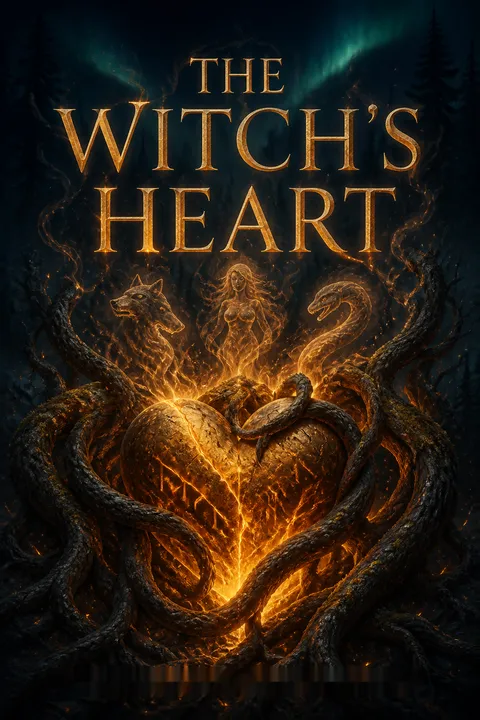


Plot Summary
Prologue
Before the story begins, the witch Gullveig teaches Odin seid, a magic that lets its practitioner leave the body and seek knowledge. When she refuses to descend into a terrifying darkness for him, Odin turns the gods against her.
They spear and burn her three times, and each time she returns. She escapes, leaving her wounded heart behind. Years later, Loki finds her in Ironwood with the heart he had taken from Odin’s hall. Her old life has ended, but the man who brings her heart back will draw her into another.
The opening makes the returned heart both a physical wound and a promise of renewed attachment. Gullveig survives the gods’ violence, but survival does not erase what they did or restore what she knew of herself. Her refusal to explore the void establishes the central conflict between knowledge and self-preservation. Loki’s recovery of her heart reverses the gods’ act without yet making him trustworthy; the gesture begins a relationship whose tenderness will be tested by the same powers and secrets that first destroyed her life.
A Heart Returned
Her skin is still healing when Loki approaches her beside the river dividing Ironwood from the rest of Jotunheim. He returns the heart he found in Odin’s hall, admitting he had considered eating it before deciding she ought to have it. She gives herself a new name, Angrboda, and recognizes Loki as a giant and Odin’s blood brother.
Though she has sworn off seid and wants a quiet life, Loki’s restless humor draws her into conversation. He declares them friends before she has agreed, and she lets him stay. Their meeting leaves her with more than her heart: for the first time since the burnings, someone has approached her without trying to use her magic.
Angrboda’s new name is a deliberate act of separation from Gullveig, but the past remains in the scar and the absent memories she cannot explain. Loki’s return of her heart offers care without demanding immediate trust. His self-appointed friendship is comic, yet it also tests whether she can accept connection without surrendering control. The scene establishes the novel’s central tension: intimacy may restore what violence has damaged, but it can also expose Angrboda to fresh injury.
A Cave Becomes Home
Angrboda settles in a cave that feels strangely familiar, but Ironwood offers little food or comfort. A near miss with an arrow brings her to Skadi, a hunter and trader who proposes exchanging plants for Angrboda’s healing and hunger potions. The arrangement supplies the witch with food, tools, furniture, and a garden; Skadi even teaches her to trap game.
Loki continues visiting, until he arrives with his mouth crudely sewn shut after a prank on Thor and a wager with dwarfs. Angrboda removes the stitches and treats his wounds, learning that his mischief has earned the gods valuable weapons and treasures. Caring for him turns their banter into a more private dependence.
Skadi gives Angrboda a form of belonging built from reciprocal labor rather than worship or fear. The witch’s knowledge becomes useful without requiring her to expose the dangerous art of prophecy. Loki’s injured mouth briefly makes his familiar performance impossible, allowing Angrboda to care for him while he cannot charm his way out of vulnerability. Their different relationships reveal two kinds of intimacy: Skadi builds dependable structures around Angrboda, while Loki unsettles the solitude she has chosen.
The Mare in Winter
When a builder nearly completes Asgard’s wall with help from a supernatural stallion, Loki admits he must prevent the gods from losing Freyja, the sun, and the moon as payment. He turns into a mare to lure the stallion away, then spends the winter in Angrboda’s cave while she cares for him.
In spring, he gives birth to Sleipnir, a gray colt with eight legs. Angrboda wants to keep the animal, but Loki takes him to Odin as a gift. Returning to her afterward, he confesses his loneliness among the gods and admits his feelings for her. They become lovers, then agree to marry, though Loki continues to move between Ironwood and Asgard.
Loki’s transformation makes parenthood literal before either character is ready to discuss its emotional demands. Angrboda’s care for the mare gives their bond a domestic shape, while Loki’s decision to give Sleipnir to Odin reveals how strongly he remains attached to the world that rejects him. Marriage answers their loneliness but not the structural problem beneath it: Loki wants freedom from control and still seeks recognition from the gods who control his life.
A Wife in Asgard
As winter approaches, Skadi notices Angrboda’s pregnancy and persuades her to leave the isolated cave for the mountains. There Angrboda learns that the gods killed Skadi’s father, Thjazi, after he abducted Idun and her golden apples; Loki had helped Thjazi and later helped the gods recover Idun. Skadi vows revenge, while Angrboda stays beside her through the winter grief.
Back in Ironwood, Loki returns and discovers the pregnancy. He also reveals that the Aesir have made him marry Sigyn, despite his claim that Angrboda is already his wife. He insists the arrangement is political, but Angrboda now understands that their private marriage exists alongside obligations he has not escaped.
The two women’s winter together exposes a conflict that will persist throughout the story: grief can demand justice, but revenge may deepen dependence on the people who caused the injury. Angrboda supports Skadi without sharing her appetite for vengeance. Loki’s second marriage makes the limits of his promises visible. He may love Angrboda, yet he remains entangled in Asgard’s institutions, and his habit of leaving her to interpret those entanglements alone begins to erode trust.
Hel’s First Breath
During pregnancy, Angrboda senses a voice drawing her out of her body, but she resists the call toward the forbidden darkness. Later, a severe bleed and the baby’s stillness convince her that her daughter is dying. She enters a trance and calls the child’s soul back; the baby kicks, though Angrboda fears the act has harmed her.
Gerd arrives as labor begins and helps deliver Hel. The newborn’s legs are cold, pale, and stiff, so Angrboda gives her a healing potion that halts the deterioration without reversing it. Two moons later Loki arrives, meets his daughter, and is captivated when Hel smiles at him. Angrboda’s fear eases, but Hel’s unusual body and the mysterious voice remain unresolved.
Hel’s birth transforms Angrboda’s private magic into a responsibility she cannot retreat from. Calling the child back is an act of love, but it also makes the witch suspect that her intervention caused the damage she is trying to repair. The newborn’s cold legs give this fear a visible form. Loki’s immediate attachment offers relief, yet the scene does not resolve the consequences of Angrboda’s choice. Motherhood begins as devotion shadowed by uncertainty rather than simple fulfillment.
A Wolf at Birth
Angrboda’s next child is born prematurely as a wolf pup, whom she names Fenrir. He develops quickly, communicates in his parents’ minds, and struggles to control his appetite and aggression. Loki treats the wolf’s ferocity as amusing, while Angrboda tries to teach him restraint. Their third child arrives as a small green snake, Jormungand, and grows rapidly after a quiet first winter.
Hel, meanwhile, speaks and thinks with an unsettling maturity, though exertion can leave her gasping and blue at the fingertips. Loki visits when he can, bringing toys and attention, but Angrboda carries most of the daily work. Their cave becomes a loving home where every child is also a reminder that the outside world may see them as a threat.
The children’s animal forms make difference visible before they can choose how to understand it. Angrboda responds by treating their needs as ordinary family matters, while Loki often turns their strangeness into a joke. That contrast matters: humor can make an unfamiliar child feel welcome, but it can also minimize the labor and risk borne by the parent who stays. Hel’s frailty and Fenrir’s hunger further complicate the idea that love alone can protect a family from material needs or public judgment.
The Future Calls
Angrboda’s disturbing dreams intensify after she saves Hel, and she begins to suspect Odin is searching for her through seid. She tells Loki that the dreams pull her toward a depth she once refused to explore, but he doubts they mean anything. In one episode she sees a great wolf, a world-encircling serpent, the sun and moon swallowed, and the dead sailing to war.
She also glimpses Loki bound in agony beside Sigyn. She withholds those details from him, afraid of what the knowledge will do. As the children grow, she strengthens a rune-based charm around their home, hoping to hide them from Odin’s sight, while the visions make safety feel increasingly temporary.
Prophecy is not presented as a gift that grants mastery, but as an invasion of attention. Angrboda’s knowledge arrives without consent and threatens to make every ordinary family moment look like evidence of impending disaster. Her silence toward Loki is protective, yet it repeats the secrecy that has already strained their marriage. The concealment spell translates fear into action, but it cannot answer whether destiny can be changed or merely delayed.
The River’s Verdict
After Loki mocks Angrboda’s fear and calls their children monsters, Sigyn follows him from Asgard and reaches Ironwood. She sees Hel, Fenrir, and Jormungand, then calls them feral and monstrous. Angrboda, already raw from Loki’s insult, enters a prophetic trance and makes Sigyn experience a vision of her sons’ suffering.
Loki tries to stop her, but she continues until Skadi arrives. The children watch Loki leave with Sigyn and hear enough to believe their father shares her judgment. Angrboda’s retaliation gives the Aesir a reason to investigate her powers, while her children’s trust in both parents is badly shaken. The protective boundary around their home can no longer keep the conflict outside.
Angrboda’s fury is understandable, but her choice turns a private defense into a public demonstration of power. By making Sigyn see the future, she repeats the coercion that Odin once used against her. The scene also collapses the safety of Ironwood: the children witness their parents’ divided loyalties and hear themselves named as monsters. The injury is relational before it becomes political, because the family’s shelter has depended on believing that its members see one another clearly.
The Children Taken
Sigyn reports Angrboda’s magic to the Aesir, and Odin consults the Norns and Mimir. They warn that Loki’s children will bring disaster, so the gods come to Ironwood with Freyja’s enchanted restraints. Loki distracts Angrboda while Thor, Tyr, and Frey take the children. Thor carries Jormungand in a sack, Tyr restrains Fenrir, and Frey holds Hel.
Angrboda begs Loki to defend them, but he refuses, choosing his place among the Aesir. Thor then strikes Angrboda down. Odin raises her in a deathlike state and forces her into the void, where she sees the complete prophecy of Ragnarok and tells him what he wants to know. Her children are gone, and her power of foresight is broken.
The gods present their violence as prevention, but their method creates the very hostility they fear. Loki’s passivity is especially devastating because Angrboda has trusted his private tenderness to outweigh his public allegiance. Odin’s forced extraction of prophecy repeats the original crime against Gullveig, now with her children used as leverage. The scene turns the family’s private difference into a state security problem, exposing how authority can call its own fear wisdom while making the feared future more likely.
Nine Days Unconscious
Skadi finds Angrboda still tied to a tree nine days after Thor’s blow and cuts through Freyja’s restraints. She carries the frozen witch home, warms her, and tells her the children’s fates: Jormungand was thrown into the sea, Fenrir is kept in Asgard, and Odin cast Hel into Niflheim.
Angrboda realizes her visions have come true, but she can no longer perform seid. A presence in her mind urges her to remember what she gained while bound to the tree. Rather than remain in grief, she packs her potions and leaves Ironwood to search for the voice and recover her identity. Skadi offers help, but Angrboda insists on making the journey alone.
Skadi’s rescue is practical love: she cuts the restraints, restores warmth, and reports the truth without pretending it can be softened. Angrboda’s damaged ability to travel out of body makes the loss both emotional and technical. Her decision to leave is not a cure for grief; it is a refusal to let grief become the only remaining action. The voice’s question shifts the story from recovering her children directly to recovering the self capable of reaching them.
Mother Witch Returns
In Ironwood’s ruins, Angrboda glimpses a ghostly girl who calls her Mother Witch and points her toward the past. A huge, battle-scarred she-wolf then recognizes her as the witch who once lived among the Jarnvidjur, the ancient giantesses of the forest. The wolf explains that Angrboda’s guiding presence is her own lost self, not another being.
On the road, Angrboda heals strangers and searches for someone who can help restore her seid. Freyja eventually finds her and offers to guide her into trance in exchange for knowledge of a human claimant’s ancestry. With Freyja’s chant, Angrboda overcomes her fear and regains access to seid, though the void still threatens to pull her too deep.
The revelation that Mother Witch is Angrboda herself reframes recovery as reintegration rather than discovery of an external savior. Her lost identity survives as instinct, visible in her healing work and her return to the old forest. Yet reclaiming magic requires assistance from Freyja, the former pupil who once helped bind her. The scene refuses a simple division between betrayal and help: a relationship marked by complicity can still provide a tool, though Angrboda must remain alert to its cost.
A Daughter’s Rejection
Angrboda uses seid to enter Hel’s realm and finds her daughter grown into a stern ruler of the dead. Hel resents her mother for failing to visit, blames her for the magic that returned her to life, and reveals that her legs have rotted to bone. She rejects Angrboda’s offer of help.
Afterward, Odin summons Angrboda through the World Tree while disguised as a wanderer, demanding details about Baldur’s death. She identifies Hod as the killer and warns Odin that his doom is approaching, then leaves before he can force more from her. The encounter confirms that her regained power can reach the dead, but it cannot undo the years of abandonment Hel believes she endured.
Angrboda’s return to Hel exposes a painful gap between intention and experience. The mother believes she has been struggling toward reunion; the daughter remembers only absence and bodily deterioration. Their conflict resists the comforting idea that love automatically cancels harm. Angrboda’s defiance of Odin shows that she can now use prophecy on her own terms, but power does not repair the relationship with Hel. The chapter makes reconciliation a task that requires listening, accountability, and time.
Baldur’s Pyre Moves
Odin’s ravens summon Angrboda to Asgard after the gods cannot move Baldur’s funeral ship. She discovers Odin has secretly enchanted it, then removes the runes and pushes the vessel into the sea. Frigg later asks every being to weep for Baldur so he can return from Hel’s realm.
Angrboda refuses to give her grief to Odin’s request, though one tear falls for her own losses. Back in Ironwood, she finds Loki hiding in her cave after Baldur’s death and rejects his plea for shelter. Skadi reports that the Aesir have captured him and bound him in a cave beneath a venomous snake. The three years of Fimbulwinter begin, bringing the prophecy closer.
Angrboda’s work at the funeral gives her a chance to act in Asgard without submitting to its authority. Removing Odin’s runes is a small but decisive refusal to let him disguise manipulation as necessity. Her response to Frigg is equally shaped by grief: she cannot spend her tears to restore a god when her own children remain lost. Turning Loki away marks a boundary she could not set earlier, even as the approaching winter begins to make every choice feel urgent.
Skadi Chooses Ironwood
Skadi leaves her mountain hall and brings her stores, reindeer, and supplies to Angrboda’s cave as Fimbulwinter deepens. She and Angrboda resume the potion trade that keeps giants and humans fed. They argue when Skadi resolves to fight with the giants at Ragnarok, despite Angrboda’s offer to protect her.
After Skadi returns from a cooling-off period, she admits she placed the serpent above Loki during his imprisonment because she wanted him to suffer for Angrboda’s pain. She also confesses that she loves Angrboda. The two women become lovers and share the remaining years of winter together. Their happiness is real, but both know Skadi still intends to join the coming battle.
Skadi’s move from the mountains is an act of chosen solidarity, not a rescue that makes Angrboda passive. Their relationship grows through conflict as well as tenderness, and the confession about Loki’s punishment forces them to confront the difference between protecting someone and avenging them. Angrboda cannot persuade Skadi to abandon her own purpose. Their love therefore offers companionship without pretending to control fate, making each shared season more precious precisely because it cannot guarantee survival.
Loki Leaves the Cave
Near the end of Fimbulwinter, Angrboda enters the cave where Loki has been bound for three years, with Sigyn holding a bowl beneath the venomous snake. Angrboda and Sigyn acknowledge how their conflict helped the gods divide their families, then part as allies. Angrboda breaks Loki’s bonds, setting Ragnarok in motion.
He reunites with Fenrir and Jormungand, who have escaped confinement and bear no love for him, but they accept Angrboda’s plea to direct their anger at the Aesir. She sends Loki to persuade Hel to come to her. The brothers head north to join the giants, while the sun and moon begin to darken. Angrboda’s choice trades the last possibility of delay for a chance to save her daughter.
Angrboda frees Loki not because their marriage is restored, but because he is the person most likely to reach Hel. Her forgiveness is selective and hard-won: she can recognize that the Aesir caused their catastrophe without erasing Loki’s betrayal. Sigyn’s presence also turns former rivalry into shared recognition of harm. Once the bonds break, private choices become cosmic consequences. The scene makes agency costly, but still meaningful, because Angrboda acts to create a chance where neither fate nor affection can promise success.
Hel Comes Home
Loki convinces Hel to leave the underworld, and Baldur escorts her across the collapsing boundary between the dead and the living. Hel arrives unable to walk, her heart failing now that her realm no longer sustains her. Baldur explains that he brought her despite having no assurance he would survive.
Skadi departs to fight beside the giants, and the she-wolf joins her. Angrboda realizes Hel’s weakness began before birth and that her daughter’s heart needs the same life she once called back. With Ragnarok beginning, she cuts open her own chest and prepares a spell using her heart and Hel’s carved wolf toy, intending to give her daughter a future in the new world.
Hel’s return transforms the long conflict between mother and daughter into a concrete medical emergency. Angrboda no longer tries to win an argument about the past; she acts on what Hel needs now. Baldur’s escort reveals that care can persist even when survival is uncertain, while Skadi’s departure honors a different form of commitment. The carved toy gathers the family’s history into one object, joining Loki’s affection, Hel’s childhood, and Angrboda’s protective magic in preparation for a sacrifice.
The Last Shield
As Ragnarok unfolds, Fenrir devours Odin before Vidar kills him; Jormungand and Thor kill each other, and Skadi and the she-wolf fall in battle. Loki dies fighting Heimdall, while Surt’s fire consumes the worlds. Before the flames reach Ironwood, Angrboda places her beating heart inside Hel and enchants the worn wolf figurine with runes cut in her own blood.
She orders Baldur not to move Hel until the spell is complete, then steps outside and raises a shield around the cave. Her practiced magic cannot withstand the inferno, so she draws on the deep power she has feared and lets it consume her. The old world burns, leaving Hel protected for what follows.
The climax pays off the story’s repeated image of the heart as both wound and source of life. Angrboda does not defeat Ragnarok; she chooses whom her magic will shelter when the larger order collapses. Her final act joins bodily sacrifice to the modest, handmade object Hel once gave her, making care more durable than the gods’ political protections. The power she once avoided becomes necessary, but it is not a triumph over vulnerability. It is a conscious use of vulnerability for another person’s survival.
Epilogue
Hel wakes in a green Ironwood with living legs and a healed heart. Angrboda is gone, but the rune-marked wolf toy remains. Baldur returns and explains that Angrboda saved them both; after mourning her, Hel lets him stay.
They build a life in the forest, raise children, and tell their descendants about the old gods, giants, and the witch who protected them. The family’s stories keep Angrboda’s name alive, while the final tradition leaves room for a more mysterious possibility: that she still walks somewhere beyond the reach of death.
The ending gives Hel what Angrboda could not provide during their first reunion: a life in which her body is no longer defined by death and her choices are not confined to ruling the dead. Her memories of Angrboda become inheritance, not merely grief. Storytelling replaces divine worship as the means of survival, carrying forward the names and failures of gods and giants alike. The final uncertainty about Angrboda resists turning sacrifice into erasure; she may be absent from the family’s daily life, but she remains present in what they remember and repeat.
Analysis
The Witch’s Heart retells mythic inevitability from the viewpoint of someone asked to bear its costs. Angrboda’s history with Odin is not simply a conflict between a prophet and a king; it is a struggle over who may demand access to another person’s knowledge and body. Odin calls his pursuit necessary, while Angrboda experiences it as repeated violation. The gods’ attempt to prevent their foretold deaths by separating her children from her does not avert the prophecy. It produces a family marked by captivity, resentment, and loss, while giving the children reasons to fight the order that feared them.
The novel’s emotional center is not the prediction of Ragnarok but Angrboda’s changing definition of protection. She first retreats to Ironwood, then builds a household through trade and friendship, and later attempts to shield her children from every danger. Those boundaries cannot keep the gods out, and they cannot prevent Hel from feeling abandoned. The story therefore distinguishes physical safety from emotional care. Angrboda’s love is powerful, but it does not automatically make her choices harmless or make her children experience them as she intended.
The relationships resist simple moral sorting. Loki is capable of tenderness and betrayal; Sigyn can be loyal and wrong; Gerd can be coerced and still cause harm; Skadi’s devotion coexists with anger and a desire for vengeance. These contradictions keep the characters human in the midst of mythic scale. Their actions matter not because they defeat fate, but because they alter what fate means to those living through it.
The final sacrifice brings the novel’s recurring images together: the returned heart, the handmade toy, the protective spell, and the fire that once destroyed Angrboda. She cannot save the old worlds or keep every loved one alive. She can choose to give Hel a future. The epilogue then makes memory a form of survival. The gods disappear as rulers, but stories preserve their complexity, and Angrboda remains more than the mother of monsters or the wife of Loki. She is remembered as a healer who chose what her power would serve.
Review Summary
The Witch's Heart reimagines Norse mythology through Angrboda, Loki's wife. Reviews are mixed, with some praising its feminist perspective and emotional depth, while others criticize pacing and character development. Many appreciate the focus on lesser-known mythological figures and the exploration of motherhood. Comparisons to Madeline Miller's "Circe" are frequent, though opinions differ on how it measures up. The book's second half is generally considered stronger than the first, with the ending particularly impactful for many readers.
People Also Read



Characters
Angrboda
The Ironwood witchAn ancient giantess with a damaged heart, missing memories, and formidable skill in healing and seid, Angrboda begins by choosing solitude after the Aesir burn her for refusing Odin’s demands. She values self-sufficiency because dependence has repeatedly exposed her to exploitation, yet she is drawn into friendship, love, and motherhood through the people who keep returning to her cave. Her instinct is to protect others, sometimes at the cost of her own safety. She can be reticent, stubborn, and slow to ask for help, but her restraint is not indifference. As she recovers her identity, she learns to use power by choice rather than as a tool forced from her by rulers.
Loki
The restless shape-shifterOdin’s blood brother and a giant by birth, Loki is a shape-shifter who uses wit, performance, and mischief to keep boredom and loneliness at bay. He moves between Asgard and Angrboda’s home, seeking both the recognition of the gods and the freedom he cannot find among them. His charm can make affection feel effortless, while his evasions leave others to absorb the consequences of his choices. With Angrboda, he shows tenderness and an unusual capacity for honesty, but he struggles to make that private self consistent with his public allegiance. His character is driven by the tension between wanting to be accepted and refusing to be controlled.
Skadi
The steadfast HuntressA giantess, skilled archer, trader, and daughter of Thjazi, Skadi first approaches Angrboda as a practical stranger and becomes her most reliable friend. She believes in action, reciprocity, and direct confrontation, making her a counterweight to Angrboda’s guardedness. Her grief over her father’s death feeds a fierce need for justice, while her loyalty often leads her to take risks on another person’s behalf. Skadi is not endlessly patient: she challenges Angrboda when she believes the witch is accepting too little from Loki or hiding behind caution. Her warmth emerges through work, shared meals, and protection rather than sentimental assurances.
Hel
The watchful daughterAngrboda and Loki’s daughter, Hel is born with cold, deadened legs and an unnerving stillness that makes her seem older than her body. She watches people closely, speaks with precision, and dislikes being treated as helpless. Her affection for her father and her mother’s care shape her early sense of family, while her physical difference makes her vulnerable to others’ judgments. Hel is both a child who wants comfort and a person determined to govern herself. Her story explores how a loved person can still feel abandoned, and how resentment can become a defense against the hope of being hurt again.
Fenrir
The hungry wolf-sonBorn in the form of a wolf, Fenrir grows faster and hungrier than a human child. He communicates in his family’s minds and struggles to restrain his animal impulses, especially when food is scarce or he feels misunderstood. Angrboda sees his effort beneath the aggression; Loki is more likely to find his ferocity entertaining. Fenrir is perceptive and deeply affected by what his parents say, even when he pretends otherwise. His bond with Hel is loving but sometimes strained by his strength and appetite.
Jormungand
The quiet serpent-sonAngrboda and Loki’s youngest son is born as a small green snake, unusually large and intelligent for his form. At first he communicates little, staying close to his mother for warmth; as he grows, he becomes powerful enough to unsettle even his siblings. His silence makes it easy for others to underestimate the depth of his awareness. Jormungand’s place in the family reflects the novel’s concern with how a person can be treated as a monster before anyone knows what he thinks or wants.
Sigyn
Loki’s loyal wifeLoki’s wife in Asgard, Sigyn is loyal and earnest, but her trust is tested by the hidden complexity of her husband’s life. She initially sees Angrboda’s family through fear and anger, then faces the consequences of acting on incomplete knowledge. Her commitment to Loki does not make her passive; she makes choices according to her own loyalties, even when those choices conflict with his wishes. Sigyn’s role complicates the idea of a simple romantic rival, showing two women caught in the same man’s divided life and in the Aesir’s political control.
Gerd
The reluctant helperSkadi’s kinswoman and a talented gardener and craftswoman, Gerd begins as a judgmental stranger to Angrboda. She later supplies useful gifts, helps deliver Hel, and teaches the child nalbinding. Her good intentions do not prevent her from making choices under pressure that hurt the people she cares about. Gerd’s position among the gods gives her both access and constraint, and her story asks how coercion complicates responsibility without erasing it.
Freyja
The powerful seid-workerA Vanir goddess and gifted practitioner of seid, Freyja was once Angrboda’s student. She becomes a prominent presence among the Aesir, where her knowledge and political influence make her valuable to Odin. Her history with Angrboda carries genuine intimacy alongside competition and complicity. Freyja can assist Angrboda’s recovery, but their shared craft does not make their interests identical. She represents the way knowledge can empower women while also being absorbed into the systems that seek to control it.
Odin
The relentless All-fatherThe ruler of the Aesir, Odin is driven by the pursuit of knowledge, especially knowledge that might help him manage danger. His skill in seid does not make him wise in an ethical sense; he is willing to injure others to reach what they know. He treats uncertainty as a threat to be controlled and often presents coercion as necessity. His relationship with Angrboda begins with a bargain and becomes a struggle over her refusal to reveal what lies in the deepest darkness. Odin’s authority rests on foresight, surveillance, and the belief that his own survival justifies his methods.
Baldur
The beloved young godOdin’s youngest and most cherished son, Baldur is remembered for his beauty and warmth. He meets Hel when she is a frightened child in Asgard and treats her with gentle curiosity. His bond with her develops through their shared time among the dead, where his care is not based on what she can offer him. Baldur’s character contrasts with the suspicion and calculation surrounding the Aesir: he is capable of compassion even when the larger divine order is failing.
Thjazi
Skadi’s formidable fatherA giant and Skadi’s father, Thjazi is associated with the mountains and with the conflict over Idun’s golden apples. His death at the hands of the Aesir shapes Skadi’s demand for justice and gives her grief a lasting political edge.
Thor
The hammer-wielding enforcerOdin’s powerful son, Thor is direct, hot-tempered, and inclined to answer threats with force. His hammer and physical strength make him the Aesir’s blunt instrument, though his actions often reveal how little the gods understand those they fear. Thor’s conflicts with Loki and the giants repeatedly turn political tensions into bodily danger.
Tyr
The gods’ hard-handed judgeAn Aesir associated with war and justice, Tyr helps restrain Fenrir. His presence links the gods’ claims of order to the sacrifices they demand from others, and his courage is inseparable from his willingness to enforce their decisions.
Frey
The uneasy Vanir princeFrey is Freyja’s brother and a Vanir god who is often uncomfortable when the Aesir turn suspicion into violence. He is involved in taking Hel from her mother but does not share the others’ certainty that the child is dangerous. His hesitation gives him moral complexity without making him powerful enough to stop the machinery around him.
Frigg
The grieving queenOdin’s wife and Baldur’s mother, Frigg is a formidable goddess whose grief becomes a public appeal to the worlds. She believes collective mourning can reverse loss, but her request confronts Angrboda with the limits of sympathy when her own children remain beyond reach.
Njord
The sea-bound godA Vanir sea god and father of Frey and Freyja, Njord becomes Skadi’s husband through the settlement after Thjazi’s death. His attachment to the sea contrasts with Skadi’s love of the mountains, and their mismatch exposes the inadequacy of treating marriage as a simple payment for grief.
The she-wolf
Angrboda’s ancient companionA huge, battle-scarred wolf who once lived with Angrboda among the Jarnvidjur, she remembers the witch’s earlier identity when Angrboda herself cannot. Blunt, proud, and weary of living, she becomes a companion on the road and a source of practical wisdom. Her loyalty is not sentimental; she challenges Angrboda when self-pity or fear keeps her from acting.
The Norns
The keepers of fateUrd, Verdandi, and Skuld are the three figures Odin consults about Angrboda’s children. They speak in judgments rather than explanations, reinforcing the uncertainty surrounding fate and the limits of divine knowledge.
Mimir
Odin’s preserved adviserA decapitated god whose head Odin has preserved for its wisdom, Mimir advises Odin on how to contain the children without killing his blood brother’s kin. His counsel helps turn divine fear into a plan of confinement.
Hod
Baldur’s blind brotherOdin’s blind son, Hod becomes central to the prophecy surrounding Baldur. His lack of sight makes him vulnerable to another person’s guidance, underscoring how blame can obscure the hand that actually directs an act.
Surt
The fire giant commanderLeader of the fire giants, Surt carries the force that ends the old world. His role makes the final destruction more than a conflict between gods and giants; the catastrophe consumes the order both sides have fought to control.
Plot Devices
Seid and Yggdrasil
Travel through hidden knowledgeSeid lets Angrboda leave her body, perceive distant realms, and glimpse possible futures by reaching through Yggdrasil, the tree connecting the worlds. The power is useful but dangerous: Odin seeks knowledge through it, and his coercion leaves Angrboda unable to practice it for a time. Her recovery depends on facing the fear associated with the void rather than treating prophecy as a neutral skill. Seid ties the novel’s supernatural plot to questions of consent, surveillance, and whether knowledge of the future can ever be used without changing the present.
Angrboda’s returned heart
A wound made into protectionOdin’s followers remove Angrboda’s heart and leave it on the pyre, but Loki returns it to her. The scar remains a physical record of the violence she survived, while the heart becomes a recurring measure of intimacy: it is something Angrboda protects, fears losing, and eventually uses to save Hel. The device links her survival to her capacity for attachment without suggesting that love simply heals trauma. Its meaning changes as Angrboda chooses what to do with the heart rather than letting gods or lovers define its value.
The Ironwood protection charm
A boundary against divine sightAngrboda places rune-marked stones around her cave to make it difficult for outsiders, including Odin, to find her family. The spell gives the household a temporary boundary where its unusual children can grow without being observed or judged. It cannot prevent betrayal from someone who knows the way in, nor can it withstand the consequences of Angrboda’s public use of prophecy. The changing rules of the charm track her shifting understanding of safety: first she excludes enemies, then she also excludes Loki, whose actions have made the family vulnerable.
Angrboda’s healing potions
Care exchanged as livelihoodAngrboda makes salves, remedies, and hunger-reducing potions from plants supplied by Skadi and Gerd. Skadi carries them through Jotunheim and beyond, bringing back food, tools, and household goods in return. The trade gives Angrboda a place in a community without requiring her to reveal her prophetic ability. Her remedies also establish her as a healer whose magic is used to sustain ordinary lives, not only to influence gods. Their limits matter: she can slow the damage to Hel’s legs, but cannot fully cure them until the final spell.
Hel’s wooden wolf
A keepsake turned into spellworkLoki carves a wooden wolf for Hel when she is an infant, and she carries, chews, and turns it over throughout childhood. The toy records her bond with her father and becomes a familiar object during the years she spends apart from her family. Angrboda later carves runes into it using her own blood, making it the focus of a spell intended to protect Hel. Its effectiveness comes from more than magic: it holds the accumulated care of the people who made it meaningful.
Download PDF
Download EPUB
.epub digital book format is ideal for reading ebooks on phones, tablets, and e-readers.








