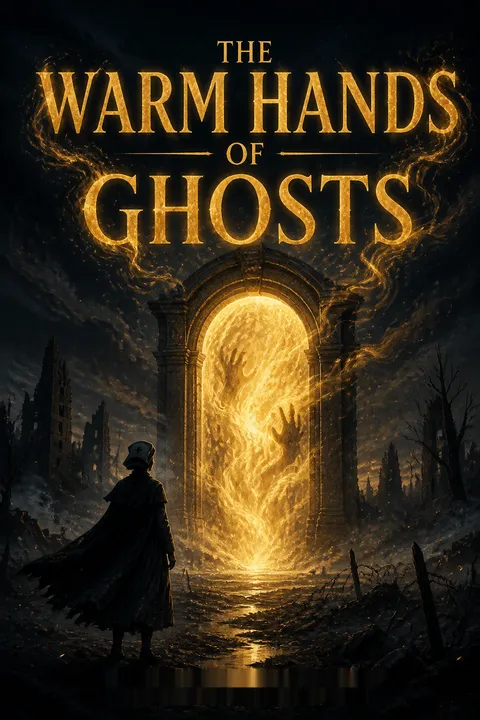


Plot Summary
Ashes and Army Effects
In January 1918, nurse Laura Iven is working in Halifax after the Mont Blanc explosion destroyed her neighborhood and may have killed her parents. Her injured leg has sent her home from the Western Front, but she keeps moving through the hospital rather than face her losses. Then a crate arrives from Flanders, addressed to her parents and containing her brother Freddie's uniform, Bible, and identity tags.
At a séance held by her employers, the Parkey sisters' Ouija board spells out that Freddie is alive. Laura opens the crate and finds a postcard hidden in his jacket, bearing a promise from an unknown person to bring him back if possible. The evidence contradicts itself, and her grief becomes a question she cannot leave alone.
Laura's first response to disaster is useful work: she dresses burns, organizes the hospital, and turns a child's pain into a story about a purple horse. That competence is both a gift and a defense against the private wreckage waiting at home. The crate punctures the distinction she has tried to maintain between the dead and the living. Its tags seem to certify Freddie's death, while the séance and postcard suggest otherwise. Neither source is trustworthy enough to settle the matter. The story begins, therefore, not with proof but with a painful mismatch between official certainty and the possibility that someone has been left behind.
Buried with an Enemy
In November 1917, a shell buries Freddie and German soldier Hans Winter beneath an overturned pillbox on Passchendaele Ridge. Freddie wakes blind, bruised, and terrified; Hans answers from the dark and initially mistakes Freddie's reaching hand for an attack. They learn each other's names and, as water seeps around them, trade scraps of home to keep panic from taking over.
Freddie dresses Hans's wounded arm, a skill his sister drilled into him, and recites a poem when the silence grows unbearable. A later bombardment opens a gap. Following the draft, the two men dig through mud and broken concrete until they claw their way outside. They have escaped the tomb, but night, shellfire, and a cratered landscape still separate them from safety.
The pillbox reduces war's grand divisions to two men who cannot see one another and need one another's breath to stay sane. Freddie's medical training, imposed by Laura before he understood its purpose, becomes a practical form of care for an enemy. Hans's restraint matters just as much: he can overpower Freddie, but chooses to keep him company instead. The darkness does not erase their national differences; it makes those differences temporarily useless. Their escape is not a victory over the battlefield. It is a small, shared refusal to let fear decide that the other man is disposable.
Laura Crosses the Atlantic
Laura writes to the Red Cross and Freddie's commanding officer, but receives only a report that he is missing and presumed killed. A former colleague hints that the dead may not always be beyond reach, strengthening Laura's suspicion that the paperwork is incomplete.
At tea with Penelope Shaw, known as Pim, and hospital organizer Mary Borden, Laura admits she wants to return to Flanders for answers. Mary agrees to take her to her privately funded hospital at Château Couthove. Pim, whose son Jimmy also vanished near Passchendaele, insists on coming too, hoping to serve as a volunteer and learn what happened to him.
Laura warns her that war nursing means blood, infection, and helpless deaths, not romantic heroism. Pim accepts the warning and prepares to go anyway, turning shared bereavement into a journey toward the front.
Laura's return is not a simple restoration of her former role. Her injured body and discharged status mean she must ask for access rather than command it, and she must admit that duty alone no longer explains her choices. Pim's decision tests Laura's protective instincts: she tries to spare her friend the costs she knows intimately, but Pim's guilt over Jimmy cannot be managed from a safe distance. Mary offers a practical route into the war zone, while her hospital depends on money and political goodwill. The women travel for different reasons, yet each is trying to make loss answerable through action.
No Man's Land
Outside the pillbox, Freddie and Hans move through flooded shell holes without knowing which army they will meet first. In a crater, a frightened Canadian soldier attacks Hans with a bayonet. Freddie tackles the man and holds him under the water until he stops moving, then reels at the fact that he has killed one of his own country's soldiers to save a German.
He and Hans continue west, rescue another man sinking in the mud with a makeshift mule harness, and reach the ruined town of Ypres. Freddie could identify Hans as a prisoner, but fears the wounded German will die before reaching medical care. He instead takes Hans away from the aid station, choosing flight over the safe return to his unit that military duty demands.
Freddie's killing is a turning point because it makes his private attachment materially dangerous. He has not merely felt compassion for Hans; he has acted against the army that claims him and cannot undo the consequence. The scene refuses to make that choice clean. The Canadian soldier is frightened, Hans is endangered, and Freddie's protective act ends in another death. His guilt is therefore not a misunderstanding to be corrected, but a real burden he must carry. The rescue that follows does not absolve him. It confirms that he will continue choosing particular people over the abstractions that sent them into the mud.
The Fiddler's Refuge
In Ypres, a strange civilian calling himself Faland finds Freddie and Hans and leads them to a wine cellar untouched by the bombardment. He supplies water, food, bandages, and a blanket, giving Freddie time to treat Hans's infected arm.
When they reach Brandhoek, Freddie sees the casualty station has been shelled and hears that Laura is gone. Believing his sister dead, he leaves Hans in the care of nurse Kate White and follows Faland into a lavish but decaying hotel.
Its mirror shows the life Freddie longs for, with Laura and Hans safe together. Faland offers wine and relief from nightmares in exchange for a true story each night. Freddie accepts. He soon discovers the price: each story disappears from his own memory after Faland hears it.
Faland's shelter answers needs the war has made brutally scarce: warmth, food, privacy, and attention. Its appeal is not simply supernatural spectacle. Freddie has been reduced to a body in uniform, and Faland appears to recognize the person beneath that uniform. The exchange of stories initially resembles care, but its asymmetry becomes clear when Faland remembers what Freddie cannot. The bargain turns memory into a consumable resource and offers relief by weakening the very self that might recover. Faland is dangerous precisely because his comfort is real. He does not need to invent suffering; he offers an escape from suffering that gradually takes away the capacity to return.
The Hotel's Tarnished Mirror
In March 1918, Laura, Pim, and Mary arrive in Flanders after a German bombing destroys their lorry and kills its driver. Seeking shelter from rain and fever, they enter a hotel that seems improbably warm and grand.
Its violinist, Faland, serves wine and points them toward a mirror said to reveal a person's deepest desire. Pim sees her missing son Jimmy; Laura sees Freddie, then glimpses him among the drinkers and calls after him, but loses him in the crowd. Mary sleeps through the strange night.
By morning, the hotel is a ruin, and none of the women can explain how its firelit rooms vanished. At Château Couthove, Laura recovers from pneumonia and returns to nursing. Pim begins questioning wounded soldiers about the elusive fiddler, while Laura tries to dismiss the episode as fever and suggestion.
The mirror does not give either woman a usable answer. It gives Pim the image she aches for and Laura a sighting that intensifies uncertainty rather than resolving it. Desire becomes evidence without becoming proof. The hotel itself performs a related deception: its warmth feels like refuge, yet the morning exposes rot and collapse. Laura's skepticism protects her from surrendering judgment too quickly, but it cannot erase what she experienced. Pim's curiosity, meanwhile, is not mere credulity; it grows from bereavement and the lack of any ordinary channel through which she can reach Jimmy. The supernatural remains plausible and suspect at once.
Stories for Forgetting
Inside the hotel, Freddie tells Faland memories from before the war and gradually loses them. The mirror keeps showing Laura and Hans in a peaceful life, while Freddie grows less able to remember the sister and friend who anchor him.
Faland reveals the exchange through his violin: he can turn a person's stories into music that makes listeners feel the buried force of that person's experience. At a Christmas dinner at General Headquarters, Freddie watches Faland play his anger into a room of officers whose comfort depends on ignoring the men at the front.
The performance shakes their composure, but changes nothing. Freddie refuses to surrender the memory of the pillbox and Hans, even as Faland warns that the world outside will call him a deserter and coward. His resistance is fragile, but it preserves one bond from being consumed.
Faland's music gives a form to feelings that ordinary military language compresses into casualty figures, but its power is not automatically liberating. Freddie's anger reaches the officers, yet the performance cannot reverse the deaths or redistribute command. Art can make suffering perceptible without guaranteeing political change. More intimately, Freddie's refusal to tell Faland about the pillbox protects the memory that matters most to him, though he cannot yet fully understand why. His resistance is not a confident moral stand; it is a stubborn boundary maintained while he is being diminished. That boundary keeps open the possibility of a self beyond pain.
A Fugitive Named Winter
Laura rides Mary Borden's motorcycle to investigate Freddie's fate. At Mendinghem, Kate White explains that a one-armed German prisoner arrived carrying Freddie's jacket and tags. The man said he and Freddie had escaped a buried pillbox together, then later insisted Freddie was alive before fleeing the hospital.
Freddie's commanding officer, Whiting, confirms that a pillbox flipped over with soldiers inside, but cannot prove Freddie died there. In Poperinghe, Laura encounters a riot stirred by Faland's violin and is pulled from the crowd by the escaped prisoner.
She recognizes him as Hans Winter, but he slips away before answering her questions. During a German offensive, Hans appears wounded at Couthove and names Faland as the place where Freddie is being held. Laura asks surgeon Stephen Jones to save him, risking the hospital's safety for the only witness who can lead her to Freddie.
Laura's investigation turns hearsay into a chain of accountable witnesses: Kate saw the effects, Whiting describes the battlefield, and Hans himself appears before her. None supplies certainty, but their converging accounts make hope rational enough to act upon. This is a crucial shift for Laura, who has treated belief as a hazard because her mother's prophecies and the séance offered no reliable control. Now she chooses trust without pretending it is proof. Jones's decision to operate despite the danger extends that trust into practice. Care becomes a wager taken with others, not an assurance that the desired outcome will occur.
Doors Through the War
During a visit by the Belgian queen, Hans struggles with Pim over a pistol and a shot narrowly misses General Gage. The disturbance exposes Hans as the escaped German prisoner, but he tells Laura that Freddie is with Faland. Laura follows the violinist into the hotel and finds her brother alive yet dulled by months of surrendered memories.
Faland's doors open onto Freddie's most terrible experiences: the trenches, a hospital death, and the shell hole where Freddie killed a Canadian soldier. Laura cannot erase those memories or persuade Freddie that nothing happened.
Instead, she stays with him as he remembers the killing and the pillbox, including Hans's presence. When Faland opens a door onto the night Laura's mother died in Halifax, Laura refuses to let them remain in the hotel. She threatens Faland's violin, and a familiar warm hand guides the siblings back to the world outside.
The hotel makes recovery an encounter with experience rather than a return to innocence. Laura cannot rescue Freddie by denying what he did, and Freddie cannot come back by recovering only comforting memories. The doors force both siblings to face incompatible forms of guilt: his responsibility for a killing and her belief that she failed their mother. Laura's decisive action is not to overpower Faland physically but to refuse his premise that pain makes the outside world uninhabitable. The warm hand remains open to supernatural interpretation, yet its function is concrete: it helps them leave together without making their losses disappear.
Pim's Last Choice
Back at Couthove, Pim and Laura travel to headquarters after Pim claims she can give Gage information about Hans. There, Pim reveals that Gage once encountered her son Jimmy after his desertion, shortly before Jimmy was executed by firing squad.
Gage told Jimmy his death would serve the war by deterring other deserters. Pim has carried that knowledge as a private wound and deliberately cultivated the attention of Gage's nephew, Lieutenant Young, to gain access to the general. She shoots Gage in the interrogation room, then declines Young's offer to protect her from the consequences.
Faland appears and offers to get Laura, Freddie, and Hans away if Pim gives him her stories and fears. Pim accepts and leaves with him. Jones helps the others escape through the confusion, while Freddie and Laura, reunited, choose to keep moving with Hans.
Pim's act grows from a specific injury, not a generalized appetite for violence: Gage made Jimmy's execution sound like a useful instrument of policy. Her revenge gives a face to a system whose authority otherwise seems too large to confront. Yet killing Gage cannot return her son or undo the meaning imposed on his death. Her refusal of Young's protection is also a refusal to let someone else narrate her choice as a mistake to be excused. Faland offers a refuge that asks for the self in exchange. Pim's decision is tragic because she sees its cost and chooses it anyway.
A Life Outside the Hotel
Laura, Freddie, Hans, and Jones leave Poperinghe under bombardment and hide in an ordinary Belgian rooming house. Back in the ordinary world, Freddie wakes from nightmares and cannot yet bear his memories. Hans, who survived because Freddie protected him, sits beside him through the darkness and helps him understand that fear does not make him worthless.
Freddie and Hans admit how deeply their survival has bound them, and begin a relationship grounded in their shared history rather than Faland's visions. Jones secures papers and passage for the three Canadians and Hans, listed as a disabled American.
On the ship, he parts from Laura and returns to his hospital. Laura and Freddie reach Halifax, where the rebuilt house is gone but the Parkey sisters have left Laura their home and money. The inheritance gives the survivors shelter, not a cure.
The return to ordinary time is difficult precisely because it removes Faland's anesthetic without removing the damage. Freddie's nightmares continue, and Laura cannot make healing happen by force of love or nursing skill. Hans offers something less grand and more durable: presence through a familiar fear, without pretending it can be cured at once. Jones's documents turn practical solidarity into a route out of military danger. The Parkeys' bequest likewise provides material conditions for recovery. The novel treats survival not as a triumphant feeling but as a set of supports that make another day, and another choice, possible.
A House Beyond the Ashes
In Halifax, Laura, Freddie, and Hans recover at Blackthorn House. Hans repairs the neglected garden, while Laura gives Freddie art supplies and watches him paint the war in jagged colors. The armistice bells startle all three into cover before they understand the fighting has ended.
Freddie cannot remain in the city, where noise and walls keep him trapped in the past, so he and Hans plan a quieter life on Cape Breton Island. Laura lets them go, asking only that Freddie keep living and try for happiness. She imagines turning Blackthorn House into a place for people damaged by war.
Months later, after Freddie and Hans have left, Stephen Jones comes to see her. His return leaves Laura with a future not defined solely by her nursing duty or her family's dead, and the story closes with the possibility of a life still being made.
The ending resists the idea that one family reunion can restore the family as it was. Freddie returns, but his needs now lead him away from Laura; her love becomes the capacity to release rather than possess him. The garden and the proposed sanatorium translate grief into forms of care without claiming to repair every wound. Even the armistice bells first sound like another attack, showing how bodily memory outlasts political endings. Jones's return offers Laura companionship, not a replacement family or a cure. The final movement is modest and consequential: the survivors stop waiting for the old world to return and begin choosing what to build.
Analysis
The novel's supernatural bargain grows from the historical conditions it depicts. In the trenches, men disappear into mud and shellfire; at headquarters, decisions are made at a distance; in hospitals, nurses and surgeons improvise while patients arrive faster than they can be treated. Faland's hotel concentrates these realities into an intimate temptation. He offers attention, music, and a pause from pain, but his refuge makes a person surrender the memories that connect him to others. The danger is not simply that Faland is a monster. It is that his offer answers a real need produced by a monstrous system.
Laura and Freddie respond to that system differently. Laura acts: she nurses, investigates, and risks bringing Hans into Couthove. Freddie survives through the loyalty he forms with Hans, but his guilt over the Canadian soldier gives Faland a route into his mind. Neither approach is presented as sufficient on its own. Laura cannot cure Freddie by finding him, and Freddie cannot return to himself by escaping the hotel. They must face memories that neither can repair, while accepting help from people whose trust they cannot fully repay.
Pim's story sharpens the novel's political question. Gage's explanation of Jimmy's execution converts an individual death into a lesson for other soldiers. Pim's revenge refuses that logic, but does not undo its damage; Faland's competing offer of oblivion takes her away from the people who might have helped her live with it. By contrast, the survivors' future is built through concrete, imperfect acts: Jones secures papers, Winter tends a garden, Laura imagines a sanatorium, and Freddie paints. The armistice ends the fighting, not its psychological afterlife. The novel's answer is neither that hope defeats trauma nor that trauma makes hope foolish. It is that memory, care, and a chosen future can coexist, even when none restores the world that was lost.
Review Summary
The Warm Hands of Ghosts is a haunting historical fiction set during World War I, blending reality with paranormal elements. Readers praise Arden's atmospheric prose and vivid depiction of war's horrors. The dual narratives of siblings Laura and Freddie are compelling, though some found Laura's chapters less engaging. The book explores themes of grief, hope, and the human cost of conflict. While different from Arden's Winternight trilogy, many reviewers found it captivating and emotionally impactful, though some felt the pacing was slow and characters underdeveloped.
People Also Read






Characters
Laura Iven
The battle-tested nurseLaura is a Canadian nurse whose competence has been forged in field hospitals, where speed and decisiveness can keep a wounded person alive. Sharp-witted and stubborn, she uses work to contain fear and prefers physical evidence to consoling speculation. The explosion in Halifax leaves her injured and bereaved, while her brother's uncertain fate gives her a reason to return to the Front. Her care is not soft or sentimental: she can be blunt, demanding, and fiercely protective, especially when others risk themselves without understanding the cost. Beneath that discipline lies a woman unsure how to live when no one needs saving. Her relationships with Freddie, Pim, and Jones reveal different sides of her loyalty, including its limits.
Wilfred Freddie Iven
The soldier who paintsFreddie, whose given name is Wilfred, is Laura's younger brother, a harbor clerk, amateur artist, and aspiring poet who enlists despite his sister's warnings. His imagination makes him attentive to color, stories, and the inner lives of others, but it cannot protect him from the brutality of combat. He wants to be brave and useful, yet the war confronts him with choices that have no clean answer. His bond with Laura gives him a history outside the army, while his capacity for unexpected tenderness becomes central to how he understands himself. Freddie is not an emblem of innocence; he is a young man trying to reconcile the person he hoped to be with what survival asks of him.
Hans Winter
The German in the darkHans Winter is a German soldier in his mid-thirties, formerly a waiter and farmer from the Bavarian mountains. Measured, observant, and sparing with words, he can appear stern even when fear or concern is driving him. His military identity does not erase his memories of family, landscape, or civilian work, and he recognizes the absurdity of a war that turns ordinary men into targets. Hans is capable of force, but his instinct is often to steady another person rather than dominate him. His relationship with Freddie develops through shared danger and promises made under pressure. He represents neither a harmless enemy nor a flawless rescuer, but a person whose loyalties are shaped by intimate responsibility.
Penelope Shaw, Pim
The grieving motherPim is a Halifax widow and mother whose polished manners and gentle chatter conceal a formidable determination. She is grieving both her husband and her missing son, Jimmy, and searches for ways to be useful after realizing that conventional charity work cannot quiet her guilt. Her beauty makes others underestimate her judgment, while her earnestness can seem naive to Laura, who has learned to distrust comforting stories. Pim's emotional life is not simple sweetness: she can be perceptive, proud, and capable of choices that unsettle people who love her. Her friendship with Laura grows through mutual care, but the two women do not share the same way of confronting loss.
Faland
The violinist in the ruinsFaland is a sharply dressed, uncanny violinist who appears in the war zone with wine, warmth, and a talent for reading what people most desire. His mismatched eyes and dry manner make him difficult to classify, even before the hotel he inhabits begins to seem impossible. He offers exhausted soldiers a temporary escape from the Front, but his attention is exacting: he wants access to what people remember and feel. Faland is neither a simple tempter nor a benevolent artist. He despises the devastation around him and is also drawn to the power it gives him. His music turns private experience into something others can hear, with consequences that are never entirely healing.
Mary Borden
The hospital's founderMary Borden is an independent American organizer who establishes and funds a hospital at Château Couthove. Practical, ambitious, and impatient with sentiment when work is pressing, she has learned to negotiate with military authorities and donors without surrendering her institution's purpose. Her confidence can come across as coldness, especially to Laura, but it is also what keeps supplies and staff moving through a chaotic system. Mary measures decisions by whether they help the hospital survive. Her friendship with Pim and working relationship with Laura expose the strain between public service and private feeling.
Stephen Jones
The exacting surgeonStephen Jones is an American surgeon working at Couthove, a disciplined clinician with a dry wit and little patience for being challenged carelessly. He is ambitious in the best sense of the word: curious about methods that could save more lives, and willing to test ideas when accepted practice falls short. His brusque manner can make compassion difficult to recognize, but he notices when patients and colleagues are at risk. Jones respects competence more readily than charm, and his relationship with Laura develops through professional disagreement, shared danger, and moments of practical trust.
Kate White
Laura's nursing mentorKate White is a seasoned head sister and Laura's friend from the Front. Cheerful, direct, and exceptionally observant, she has learned to lead exhausted staff through crises without mistaking authority for emotional invulnerability. She remembers people and details across the shifting network of casualty stations, making her an important source of information as well as a source of steadiness for Laura. Kate knows that trauma distorts memory and judgment, including her own, but does not use that uncertainty to dismiss what she has witnessed.
General Gage
The polished commanderGeneral Gage is a senior British commander whose charm and access to power make him an effective host at headquarters. He knows how to flatter visitors and manage appearances, yet his position places him among the officers whose decisions shape the dangers faced by soldiers and hospitals. To grieving families, military explanations can sound cold even when delivered with good manners. Gage embodies the distance between command and combat, and the ease with which a person's death can be explained as necessary to a larger cause.
Lieutenant Young
The earnest staff officerYoung is a junior officer on General Gage's staff and the general's nephew. He is well-bred, awkward in company, and sincerely taken with Pim. His affection makes him attentive to her wishes, though it does not mean he fully understands the grief and danger shaping her decisions. Young moves within a world of rank and access that differs sharply from the wards and trenches, but he is not merely a caricature of privilege. His willingness to help is genuine, even when his assumptions prove inadequate.
Agatha Parkey
The blind séance keeperAgatha is the eldest Parkey sister, blind from cataracts and the most commanding of the trio's séance circle. She treats spiritualism with a mixture of theatrical certainty and genuine concern for the bereaved. Her bluntness can unsettle Laura, but Agatha is also perceptive about the burdens Laura carries. She and her sisters offer Laura a home after the Halifax disaster, combining eccentric habits with practical kindness.
Lucretia Parkey
The watchful housekeeperLucretia is one of Laura's elderly employers and a member of the Parkey sisters' séance circle. Stout, warm, and more physically capable than she first appears, she helps make Blackthorn House a refuge after Laura's family home is destroyed. Her care is practical, from finding a blanket to making cocoa, and she recognizes that grief cannot always be reasoned away.
Clotilde Parkey
The sisters' gentle anchorClotilde is the gentlest of the three Parkey sisters, offering hospitality and steadiness in a household given to séances. She helps maintain the home and cares for Laura without demanding that Laura explain her grief. Her quiet presence balances Agatha's theatrical authority and Lucretia's brisk practicality.
Captain Whiting
Freddie's commanding officerWhiting commanded Freddie's unit during the Passchendaele fighting. Lean, tired, and visibly strained by combat, he tries to give Laura a factual account of what happened to her brother. His testimony reflects the limits of battlefield certainty, where men can describe the explosion but not know who survived it.
Charles Iven
Laura and Freddie's fatherCharles Iven is a Halifax harbor worker and the father of Laura and Freddie. His experience recovering bodies after the Titanic disaster has left him distrustful of technological progress and haunted by mass death. His warnings shape the siblings' childhood, even when they cannot share his outlook.
Laura and Freddie's mother
The apocalyptic motherThe siblings' mother reads religious prophecy and prepares her family for the world's end. Her certainty can frighten her children, but it also arises from fear of rapid change and a desire to make catastrophe intelligible. The biblical images she teaches Laura later color the nurse's understanding of war.
Plot Devices
The Army Effects Box
A clue against certaintyThe crate sent from Flanders contains Freddie's uniform, Bible, and identity tags, items that appear to settle his fate while leaving Laura with unresolved questions. A postcard sewn into the jacket hints that someone intended to bring him back. Together with the Red Cross report and the Parkeys' séance, the objects establish the central mystery: official records, physical evidence, and supernatural claims do not agree. The box turns Laura's grief into an investigation and gives the later search a concrete starting point.
Faland's Mirror
Desire made visibleThe tarnished mirror in Faland's hotel shows people what they most want to see, including lost loved ones. Its images are compelling but cannot be trusted as proof of the people they depict. The mirror tempts Pim and Laura with seemingly personal revelations, while its influence feeds longing and draws soldiers toward Faland's refuge. It externalizes grief without resolving it: what the viewer sees reveals a need, but not necessarily a truth.
Stories for Wine
Memory as currencyFaland asks Freddie for true stories in exchange for wine, shelter, and temporary relief from nightmares. Freddie initially accepts because he believes Laura is dead and cannot imagine a future outside the hotel. The stories gradually disappear from his memory, while Faland retains them and turns their emotional content into music. This bargain makes forgetting feel like mercy even as it erodes Freddie's identity and weakens his ties to the living. The price becomes clearest when Freddie must recover the memories he surrendered in order to leave.
The War's Ghosts
Grief without proofApparitions of the dead appear around the battlefield and in the characters' visions, but the story never makes every encounter easy to separate from trauma, fever, or supernatural intervention. Laura sees her mother, soldiers report dead companions, and the dead seem to guide the living at crucial moments. This ambiguity reflects a world where mass death has overwhelmed ordinary ways of knowing. The ghosts can offer direction or recognition, but they cannot undo a death or spare the living from making choices.
Passchendaele's Landscape
The battlefield's physical trapRain, shell holes, flooded trenches, and collapsing pillboxes make the terrain an active threat. Soldiers drown in mud, lose their bearings, and can be buried without anyone knowing where they went. The landscape creates the circumstances that trap Freddie and Hans together, makes escape slow and dangerous, and leaves official reports uncertain. It also grounds the novel's supernatural imagery in bodily reality: before anyone can argue about ghosts or devils, the mud and bombardment have already made the battlefield resemble a world beyond reason.
FAQ
Synopsis & Basic Details
What is The Warm Hands of Ghosts about?
- A World War I story: The novel follows Laura Iven, a nurse in Halifax, and her brother Freddie, a soldier in Europe, as they grapple with the aftermath of war and loss.
- Supernatural elements: The story incorporates elements of the supernatural, with a mysterious fiddler and a mirror that shows visions, blurring the lines between reality and illusion.
- A search for truth: Laura embarks on a journey to uncover the truth about her brother's fate, while Freddie struggles with his own demons and the horrors of war.
Why should I read The Warm Hands of Ghosts?
- Unique blend of genres: The book combines historical fiction with elements of fantasy and horror, creating a compelling and atmospheric narrative.
- Exploration of complex themes: It delves into the psychological impact of war, loss, and the search for identity, offering a thought-provoking and emotional experience.
- Compelling characters: The story features well-developed and relatable characters, each grappling with their own internal struggles and external challenges.
What is the background of The Warm Hands of Ghosts?
- Historical setting: The novel is set against the backdrop of World War I, specifically the Halifax explosion of 1917 and the brutal battles of the Western Front.
- Cultural context: It explores the cultural and societal impact of the war, including the changing roles of women and the psychological toll on soldiers.
- Geographical significance: The story moves between Halifax, Nova Scotia, and the battlefields of Flanders, highlighting the contrast between the home front and the war zone.
What are the most memorable quotes in The Warm Hands of Ghosts?
- "They're all gone…": This quote encapsulates Laura's grief and the overwhelming sense of loss that permeates the story, highlighting the devastating impact of war.
- "I will bring him back if I can.": This line, found on a postcard, fuels Laura's determination to find Freddie, showcasing the power of hope and the lengths she will go to for her brother.
- "You are a boy. It would be cruel, to make you hear me die.": This quote from Winter reveals his complex character and his unexpected bond with Freddie, highlighting the humanity that can exist even in the midst of war.
What writing style, narrative choices, and literary techniques does Katherine Arden use?
- Atmospheric prose: Arden employs vivid and evocative language to create a haunting and immersive atmosphere, drawing the reader into the story's world.
- Intertwined narratives: The story is told through alternating perspectives, allowing the reader to experience the events from multiple viewpoints and understand the characters' inner struggles.
- Symbolism and motifs: The novel uses recurring symbols and motifs, such as the mirror, the violin, and the color red, to enhance the story's themes and create a sense of unease and mystery.
Hidden Details & Subtle Connections
What are some minor details that add significant meaning?
- The color purple: The recurring mention of purple, from the purple horse story to the livid clouds, foreshadows the strange and otherworldly events that unfold, hinting at the blurring of reality.
- The mention of the Titanic: The reference to the Titanic graves near the new graves in Halifax highlights the cyclical nature of tragedy and the enduring impact of loss on the city.
- The identity tags: The fact that Freddie's effects include both his red and green identity tags, when only the red tag is meant to be sent home, suggests a deeper mystery surrounding his fate.
What are some subtle foreshadowing and callbacks?
- The Parkeys' séance: The séance, initially presented as a quirky pastime, foreshadows the supernatural elements of the story and the possibility of communication with the dead.
- The mention of the Lady of Shalott: Laura's recollection of the Lady of Shalott poem foreshadows the mirror's power to trap and distort reality, hinting at the dangers of seeking the truth through illusions.
- The recurring phrase "Hey waiter": The phrase, initially a casual remark about snipers, becomes a haunting echo of Winter's past and the dehumanizing nature of war.
What are some unexpected character connections?
- Laura and Mary Borden: The connection between Laura and Mary, both strong women who have served in the war, highlights the shared experiences and unique perspectives of women in a male-dominated world.
- Freddie and Hans Winter: The unlikely bond between Freddie and Hans, a Canadian and a German soldier, challenges the notion of enemy lines and reveals the shared humanity that transcends national boundaries.
- Laura and Penelope Shaw: The connection between Laura and Penelope, both women grieving for lost loved ones, highlights the shared experience of loss and the different ways people cope with grief.
Who are the most significant supporting characters?
- Kate White: As Laura's former superior and friend, Kate provides a link to Laura's past and a source of support and guidance, even when they are separated by distance.
- Doctor Jones: As a fellow medical professional, Jones challenges Laura's beliefs and pushes her to confront her own limitations, while also offering a sense of camaraderie and understanding.
- The Parkey sisters: The Parkey sisters, with their séances and eccentricities, serve as a reminder of the old world and the ways people seek solace in the face of loss and uncertainty.
Psychological, Emotional, & Relational Analysis
What are some unspoken motivations of the characters?
- Laura's need for control: Laura's relentless focus on her work and her determination to find Freddie stem from a deep-seated need to control her environment and avoid confronting her grief.
- Freddie's desire for meaning: Freddie's artistic pursuits and his search for Laura are driven by a desire to find meaning and purpose in a world that has been stripped of both.
- Winter's longing for connection: Winter's loyalty to Freddie and his willingness to risk his life for him reveal a deep longing for connection and a desire to find redemption through his actions.
What psychological complexities do the characters exhibit?
- Laura's survivor's guilt: Laura's guilt over her mother's death and her inability to save her drives her to take on more responsibility and to push herself to her limits.
- Freddie's PTSD: Freddie's trauma manifests in his nightmares, his difficulty remembering, and his struggle to reconcile his past with his present.
- Winter's internal conflict: Winter's internal conflict between his duty as a soldier and his loyalty to Freddie highlights the psychological toll of war and the struggle to reconcile opposing loyalties.
What are the major emotional turning points?
- Laura opening Freddie's box: The discovery of Freddie's belongings triggers a wave of grief and a renewed determination to find out what happened to him, setting her on her journey.
- Freddie's encounter with the dead man: Freddie's encounter with the dead man in the shell hole forces him to confront his own mortality and the dehumanizing effects of war.
- Laura's dream of the comet: Laura's nightmare about the comet and her mother reveals her deep-seated fears and her struggle to reconcile her past with her present.
How do relationship dynamics evolve?
- Laura and Freddie's sibling bond: The bond between Laura and Freddie is tested by separation and trauma, but their love for each other remains a driving force in their actions.
- Freddie and Winter's unlikely friendship: The relationship between Freddie and Winter evolves from a desperate alliance to a deep and complex friendship, highlighting the shared humanity that transcends national boundaries.
- Laura and Jones's professional respect: The relationship between Laura and Jones evolves from professional respect to a deeper understanding and connection, as they navigate the challenges of their work and their personal lives.
Interpretation & Debate
Which parts of the story remain ambiguous or open-ended?
- The nature of Faland: The true nature of Faland and his motivations remain ambiguous, leaving the reader to question whether he is a supernatural being, a figment of the characters' imaginations, or simply a manipulative human.
- The meaning of the mirror: The mirror's ability to show both desires and fears leaves its true purpose open to interpretation, raising questions about the nature of reality and the power of the human mind.
- The fate of Pim: Pim's decision to go with Faland leaves her fate ambiguous, raising questions about the nature of choice and the allure of oblivion.
What are some debatable, controversial scenes or moments in The Warm Hands of Ghosts?
- Laura's decision to leave Winter: Laura's decision to leave Winter in the hospital, despite her knowledge of his impending execution, raises questions about her priorities and the limits of her compassion.
- Pim's actions at HQ: Pim's decision to shoot General Gage, while driven by grief and anger, raises questions about the morality of violence and the consequences of seeking revenge.
- Freddie's choice to stay with Faland: Freddie's decision to stay with Faland, despite his knowledge of the danger, raises questions about his agency and the allure of oblivion.
The Warm Hands of Ghosts Ending Explained: How It Ends & What It Means
- Laura's return to Halifax: Laura's return to Halifax with Freddie and Winter represents a new beginning, but also a recognition of the enduring impact of the war and the need to rebuild their lives.
- The ambiguity of the future: The ending leaves the characters' futures open-ended, suggesting that healing is an ongoing process and that the scars of war will always be a part of their lives.
- The power of human connection: Despite the darkness and loss, the ending emphasizes the importance of human connection and the enduring power of love and loyalty in the face of adversity.
About the Author




Download PDF
Download EPUB
.epub digital book format is ideal for reading ebooks on phones, tablets, and e-readers.








