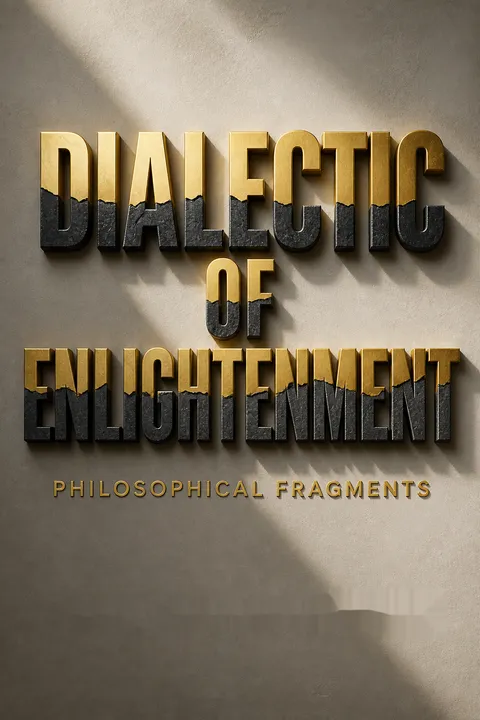


Key Takeaways
Question progress when reason turns nature and people into controllable material.
The central reversal. Horkheimer and Adorno argue that Enlightenment thought set out to free people from fear by explaining the world. But when knowledge is valued mainly for its power to predict, classify, and control, liberation starts to resemble a new kind of submission. Bacon’s ideal of knowledge as a means to act on nature becomes, in their account, a model for using people as well as the natural world. The result is not that science itself is evil, but that reason becomes narrowed to effective control.
Progress needs self-criticism. Greater productive power can improve material life while concentrating control in institutions and groups that direct it. The same machinery that supplies goods can reduce people to functions within a system. Progress, then, is not proof of freedom. It must be judged by whether people gain agency, not only by how much the system can produce.
The force of this argument lies in asking who defines progress and who bears its costs. It challenges the comforting equation of technical capacity with human betterment, without requiring a rejection of science or practical knowledge. A useful distinction is between measurement as a tool and measurement as a worldview: counting can reveal harm, but it cannot decide what matters. The argument is less persuasive if every form of expertise is treated as a route to domination. Its sharper target is expertise detached from reflection about ends, power, and human consequences.
Refuse to mistake what can be counted for all that is real.
Myth and reason overlap. Myth is not simply the opposite of rational thought: myths name, order, and explain events, while Enlightenment reason sets out to replace their stories with knowledge. Yet reason can repeat myth’s fatalism when it treats the world as a closed system of predictable events. The book traces a shift from particular meanings and qualities toward general rules, numbers, and classifications. What cannot be translated into that language risks being dismissed as irrelevant or unreal.
Equivalence has a cost. The authors connect calculation to exchange: unlike things become comparable when reduced to a common measure. This makes coordination possible, but can erase meaningful differences. If facts are accepted only as they appear, social arrangements that produced them can start to seem as inevitable as natural laws.
This is a warning about confusing a useful map with the whole landscape. Shared measures can expose patterns and support fair comparisons, yet they can also make unlike experiences look interchangeable. The distinction matters in any system that allocates resources by categories: the categories clarify some problems while hiding others. The argument does not establish that quantification is inherently oppressive. Its more compelling point is that no measure interprets itself. Judgment requires asking what has been excluded, and whether the chosen categories serve people or merely make them easier to manage.
Notice who gets to hear the Sirens, and who must keep rowing.
Odysseus survives by restraint. In Homer’s story, Odysseus wants to hear the Sirens’ irresistible song but knows it will draw sailors to their deaths. He orders his crew to block their ears with wax and row on, while he has himself tied to the mast so he can listen without acting on the temptation. Horkheimer and Adorno read this as a picture of social division: the workers are denied the experience, while the owner can enjoy it at a distance.
The bargain shapes both sides. Odysseus’s self-command helps him survive, but it is purchased through renunciation. His crew endure forced labor without access to the song’s beauty; he hears it but cannot move. The story makes discipline look less like pure freedom than a bargain in which pleasure, work, and power are unevenly distributed.
The episode makes an abstract claim about social organization memorable: access to pleasure can depend on who is free from necessary labor. It also complicates the usual celebration of self-control. Odysseus is neither simply liberated by restraint nor simply defeated by it; his survival depends on a system that confines him and his crew differently. The image invites a practical question about any institution: who performs the repetitive work, who receives the experience as a benefit, and what forms of enjoyment become possible only because someone else is prevented from participating?
Demand humane ends from reason, not just efficient means.
Efficiency cannot choose its purpose. In their discussion of Kant and the Marquis de Sade, the authors examine reason stripped down to calculation and consistency. Kant seeks a rational basis for morality, while Sade’s fictional libertines apply disciplined reasoning to cruelty. Their stark comparison suggests that logical rigor alone cannot guarantee humane conduct. If reason is treated only as a way to select effective means, it can serve either moral restraint or organized violence.
The danger is formal neutrality. A system may be orderly, precise, and consistent while pursuing destructive ends. The authors connect that possibility to political regimes that treat people as objects to be administered. Their challenge is not to abandon reason, but to ask whether reason can examine its own purposes rather than simply optimize them.
This comparison usefully separates rational consistency from moral legitimacy. An argument can be impeccably organized and still rest on a cruel premise; procedural fairness alone cannot repair a harmful end. The point applies beyond philosophy to any system that prizes performance indicators or rule-following. Still, the contrast can sound too absolute if it implies that reason has no resources for moral criticism. The more productive reading is that moral principles need interpretation and public scrutiny, not that logic is helpless or that humane outcomes are merely matters of feeling.
Treat mass entertainment as a lesson in accepting the status quo.
Formula becomes a habit of perception. The authors describe film, radio, and popular entertainment as an industry organized around standard forms and predictable effects. Stories may appear varied, but recurring plots, character types, and resolutions make their differences feel smaller than they are. In their view, entertainment often reproduces everyday life so closely that the audience is encouraged to experience the screen world as a continuation of ordinary reality.
The form matters as much as the message. Rapid scenes and dense streams of detail leave little room for reflection without risking the loss of the next event. The audience is not simply persuaded by a particular slogan; it is trained to recognize familiar patterns and accept their limits. Entertainment thus presents existing arrangements as normal, even when those arrangements are frustrating or unjust.
The chapter’s enduring insight is that media influence can reside in rhythms and conventions, not only in explicit political messages. Familiar formulas can make a narrow range of outcomes feel like the natural range. That is a stronger claim than saying audiences passively absorb whatever they watch, and it is worth preserving the distinction. Viewers also interpret, criticize, and repurpose media. The book is most useful as a prompt to inspect how a format directs attention: what it makes easy to notice, what it rushes past, and which endings it makes feel plausible.
Ask whether pleasure is offered, or only endlessly advertised.
Desire becomes a managed promise. The culture industry presents entertainment as an escape from work, but the authors argue that its patterns often resemble work’s repetition and discipline. It raises expectations through stars, images, and suggestive scenes, then withholds the satisfaction those images seem to promise. Even leisure can become another period of adjustment to the same world rather than a genuine break from it.
The return is built in. The audience is invited to imagine a different life, yet the entertainment often resolves by celebrating familiar routines or rewarding successful conformity. Pleasure is not simply absent; it is organized so that anticipation can be renewed without changing the conditions that frustrate it. The authors call this an administered form of amusement, one whose promise helps keep attention attached to the system selling it.
This analysis distinguishes pleasure from the anticipation designed to sell it. A person may enjoy a popular film or song without being deceived, so the claim should not be reduced to a diagnosis of individual taste. The more interesting question concerns the structure of the offer: does entertainment provide an experience with its own value, or keep desire circulating around a payoff that never arrives? That distinction can help readers think critically about advertising and leisure without treating enjoyment as foolish or assuming that every commercial pleasure is false.
Trace scapegoating back to the social contradictions it disguises.
Blame is displaced. In their analysis of anti-Semitism, the authors reject the idea that prejudice can be explained simply by the supposed traits of its targets. They argue that social frustrations and economic injustices are redirected toward a conspicuous, vulnerable group. In their account, the Jew becomes a scapegoat for contradictions produced by the social order itself, including exploitation that is easier to blame on intermediaries than on the system of production.
False projection makes the target fit. The book uses this term for assigning one’s own disowned impulses or fears to another person or group, then treating that imagined threat as fact. Such projection turns persecution into apparent self-defense. The account makes anti-Semitism a political and social mechanism, not merely a private prejudice, while insisting that the image imposed on victims says more about the persecutors than about those targeted.
The analysis is powerful because it refuses to let a society explain its injuries by inventing defects in the people it persecutes. It also links private psychology to institutions that can organize blame and violence. That connection can help readers recognize scapegoating without equating unlike cases or reducing every prejudice to one mechanism. The essential test is whether an accusation is supported by evidence about specific actions, or instead turns a group into a container for diffuse fears. The book’s analysis demands attention to both the story being told and the interests it protects.
Judge political packages by their machinery, not their slogans.
A ticket replaces judgment. The book describes ticket thinking as accepting a ready-made bundle of political positions rather than evaluating each claim through experience and reflection. In the anti-Semitic version, hostility toward Jews arrives packaged with other authoritarian positions, so prejudice can spread even among people with little direct experience of Jews. The individual is asked to choose a whole political identity, not to examine one argument at a time.
Stereotypes make the package portable. When people rely on prefabricated categories, perception becomes an act of sorting: friend or enemy, acceptable or dangerous. The authors connect this habit to mass politics, where institutions and slogans can guide reactions before people have considered the evidence. They argue that this weakens personal responsibility while making collective persecution easier to organize.
The idea helps explain why political identity can travel farther than firsthand knowledge. A package of positions simplifies decision-making, but it can also smuggle assumptions past scrutiny by tying them to claims a person already accepts. The analysis is especially useful when it directs attention to how a message is assembled, not only to whether its individual slogans sound persuasive. It should not imply that collective affiliation automatically erases agency. The challenge is to notice when belonging is doing the work that evidence, argument, and moral judgment ought to do.
Defend reflective thought even when it cannot promise an easy remedy.
Critique has no ready-made escape. The book resists both faith that technical progress will solve social problems and nostalgia for a simpler past. Instead, it asks Enlightenment thought to examine the domination embedded in its own habits. Determinate negation, the book’s term for criticizing a particular idea or arrangement by showing the contradiction within it, avoids dismissing the world with a vague claim that everything is false.
Thinking can preserve alternatives. The authors argue that ideas lose their critical force when turned into unquestioned slogans or tools of an existing order. Their notes also warn against confusing expertise with understanding: well-informed judgments can fail when they mistake established assumptions for reality. Critical thought may not provide a program that guarantees success, but it can identify what a system normalizes, conceals, or makes seem inevitable.
The book’s refusal to offer a simple cure is part of its intellectual discipline, not merely a weakness. It treats criticism as a way to keep contradictions visible when political language pressures people to choose between inadequate alternatives. That approach can protect independent judgment, although critique alone cannot substitute for collective action or institutional design. The useful balance is to let analysis expose hidden costs while still asking what practical change could reduce them. Otherwise, skepticism risks becoming another form of resignation, the very outcome the book is trying to resist.
Analysis
Dialectic of Enlightenment is a philosophical diagnosis of modernity built around a deliberately unsettling reversal: reason can reproduce the very fear and domination it was meant to overcome. Horkheimer and Adorno connect seemingly distant subjects, from Odysseus’s discipline to industrial entertainment and anti-Semitism, by asking how control becomes ordinary. Their method is less a linear proof than a chain of interpretations. Myth, science, markets, stories, and political habits are read as expressions of related social pressures.
The book’s strongest contribution is its refusal to separate ideas from institutions. Calculation is not condemned as such; it becomes dangerous when a society treats calculability as the sole measure of truth and makes people conform to that measure. The Sirens episode gives this claim a human shape: one person’s access to pleasure and another’s labor are structured together. The account of scapegoating likewise joins psychic projection to economic and political conditions rather than explaining prejudice as a private defect alone.
Its analysis also has limits. The culture-industry chapter can make audiences appear more passive and media more uniform than the argument needs them to be. Its sweeping account of Western history sometimes compresses different periods into one dominant trajectory, and its treatment of gender in the Sade discussion reflects assumptions readers may reasonably question. These limitations matter because the book’s own central warning applies to its method: a total explanation can flatten differences while claiming to reveal them.
The most useful reading, then, is neither as a complete history nor as a rejection of reason, science, or popular culture. It is a test for intellectual and political systems: can they examine their own purposes, acknowledge what their categories exclude, and remain answerable to the people affected by them? The book offers no assurance that such reflection will defeat domination. It insists that without it, progress can become difficult to distinguish from a more efficient form of control.
Review Summary
Dialectic of Enlightenment receives mixed reviews, with many praising its insightful critique of Western civilization and the Enlightenment. Readers appreciate its analysis of cultural industry, antisemitism, and the relationship between reason and myth. However, some find the writing style difficult and obscure. The book's central thesis, that Enlightenment reverts to mythology, resonates with many readers. Critics argue that the authors' pessimism and elitism limit their perspective. Despite its challenges, the book is considered a seminal work in critical theory.
People Also Read







Glossary
Dialectic of Enlightenment
progress reversing into dominationThe historical contradiction in which Enlightenment thought seeks freedom through knowledge and mastery, yet can turn into a new form of domination. Horkheimer and Adorno argue that myth already contains efforts to explain and control the world, while reason can revert to myth when it treats existing arrangements as inevitable and beyond criticism.
Instrumental reason
calculation serving controlA narrowed form of rationality concerned chiefly with selecting effective means to achieve given ends. In the book, it measures knowledge by usefulness, prediction, and control rather than asking whether the ends are humane or justified. Because it does not examine its purposes, instrumental reason can serve emancipatory projects or oppressive ones.
The culture industry
industrialized mass cultureThe system through which entertainment and cultural products are manufactured and distributed according to commercial priorities and standardized forms. Horkheimer and Adorno argue that recurring formulas can make audiences accept familiar social patterns as natural, while leisure resembles the discipline and repetition of work. The term criticizes the organization of culture, not simply popular taste.
Determinate negation
critique through specific contradictionA way of criticizing an idea or social arrangement by examining its particular content and exposing the contradiction within it. Rather than dismissing something with a general claim that it is false, determinate negation reads its limits and failures as evidence. In the book, it is a mode of criticism that can preserve what is true while challenging what is misleading.
False projection
disowned impulses assigned outwardA psychological process in which a person attributes impulses, fears, or intentions they cannot acknowledge in themselves to an outside person or group. Horkheimer and Adorno use the concept to explain how persecution can be experienced as self-defense: the persecutor treats an imagined threat as objective reality and attacks the people made to carry that image.
Ticket thinking
prefabricated political alignmentThe habit of accepting a bundled set of political positions instead of judging each claim through independent reflection and experience. The book argues that this encourages people to sort others into fixed categories and can attach anti-Semitism to a broader authoritarian platform. Individual judgment is displaced by allegiance to a ready-made political package.
Mimesis
adaptation through resemblanceA mode of relating to the world by resembling or participating in what is encountered, rather than standing apart from it in order to classify and control it. The book treats mimetic impulses as part of human and animal life, but says civilization represses them. That repression can return in distorted forms, including compulsive imitation and hostility toward perceived difference.
Rackets
groups securing power through protectionA term Horkheimer uses for organized groups that preserve and expand their own power while presenting themselves as providers of protection or order. The concept ranges beyond criminal gangs to describe political, economic, or institutional cliques. It highlights how relationships can become exchanges of obedience for security, with the group’s self-preservation replacing broader social purposes.
FAQ
1. What is Dialectic of Enlightenment by Max Horkheimer and Theodor W. Adorno about?
- Critique of Enlightenment: The book examines how the Enlightenment, intended to free humanity from fear and superstition, paradoxically results in new forms of domination and myth.
- Dialectic of Reason and Myth: It argues that reason and myth are not opposites but are dialectically intertwined, with Enlightenment reverting to mythology.
- Societal Analysis: The authors connect ancient and modern developments, showing how rationality leads to conformity, mass deception, and totalitarianism in modern society.
- Foundational Critical Theory Text: The work is a cornerstone of the Frankfurt School, blending philosophy, sociology, and history to critique modernity.
2. Why should I read Dialectic of Enlightenment by Horkheimer and Adorno?
- Understanding Modern Society: The book provides a deep analysis of how rationality and mass culture shape modern life, making it essential for anyone interested in philosophy, sociology, or media studies.
- Critical Theory Foundation: It is a foundational text for Critical Theory, influencing debates on culture, ideology, and authoritarianism.
- Relevance to Contemporary Issues: Its critique of mass media, conformity, and the persistence of myth in rational societies remains highly relevant today.
- Intellectual Challenge: The book’s complex arguments and interdisciplinary approach offer a rigorous intellectual challenge for advanced readers.
3. What are the key takeaways from Dialectic of Enlightenment by Horkheimer and Adorno?
- Enlightenment’s Paradox: Enlightenment, while aiming for liberation, can lead to new forms of domination and myth.
- Culture Industry Critique: Mass media and popular culture serve as tools of mass deception, standardizing thought and suppressing individuality.
- Reason’s Self-Destruction: Instrumental reason, focused on control and utility, undermines its own emancipatory potential and becomes complicit in oppression.
- Need for Critical Reflection: True freedom requires self-reflection and resistance to the regressive tendencies within Enlightenment rationality.
4. What are the best quotes from Dialectic of Enlightenment and what do they mean?
- "Enlightenment reverts to mythology": This highlights the book’s central thesis that rationality can become as dogmatic and oppressive as the myths it seeks to dispel.
- "The wholly enlightened earth is radiant with triumphant calamity": Suggests that the triumph of reason can lead to disaster if it becomes totalitarian.
- "Freedom to choose an ideology—since ideology always reflects economic coercion—everywhere proves to be freedom to be the same": Critiques the illusion of choice in mass culture, where conformity is enforced.
- "Myth is already enlightenment, and enlightenment reverts to mythology": Emphasizes the dialectical relationship between reason and myth, showing their mutual dependence.
5. How do Horkheimer and Adorno define Enlightenment in Dialectic of Enlightenment?
- Advance of Thought: Enlightenment is seen as the progress of thought aimed at liberating humans from fear and myth through knowledge.
- Mastery and Domination: It is characterized by the drive to dominate nature and society, often at the cost of individuality and self-awareness.
- Totalitarian Rationality: Enlightenment reduces all phenomena to calculability and utility, leading to a form of rationality that suppresses difference and critical thought.
- Instrumental Reason: Reason becomes a tool for control, losing its critical and emancipatory edge.
6. What is the "dialectic" between myth and Enlightenment in Dialectic of Enlightenment?
- Mutual Interdependence: The book posits that myth is already a form of enlightenment, and enlightenment inevitably reverts to mythology.
- Transformation, Not Abolition: Myths are intellectualized and transformed by reason but never fully abolished; Enlightenment itself can become a new myth.
- Historical Continuity: This dialectic is traced from ancient myths through religious and philosophical developments to modern political ideologies.
- Example of Odyssey: The Odyssey is used to illustrate how mythic and rational elements coexist and conflict in the development of human subjectivity.
7. What is the "Culture Industry" and how does it function in Dialectic of Enlightenment?
- Mass Deception: The Culture Industry refers to mass media and popular culture, which standardize and manipulate cultural products to maintain social control.
- Commodification of Culture: Art and language are stripped of their experiential content, becoming commodities that promote conformity.
- Suppression of Individuality: The Culture Industry enforces uniformity, turning individuals into passive consumers and eroding authentic selfhood.
- Tool of Social Control: It shapes desires and consciousness to reinforce the existing social order and suppress resistance.
8. How does Dialectic of Enlightenment by Horkheimer and Adorno critique reason and its self-destruction?
- Instrumentalization of Reason: Reason is reduced to a tool for domination and control, undermining its original emancipatory purpose.
- Blindness to Limits: Instrumental reason becomes blind to its own contradictions, leading to new forms of myth and domination.
- Self-Destructive Tendency: Enlightenment reason forfeits its own realization by becoming mechanized and complicit in oppression.
- Tension Between Pessimism and Hope: The authors maintain a tension between theoretical pessimism about reason’s fate and practical optimism for human emancipation.
9. How does Dialectic of Enlightenment analyze the relationship between reason and domination?
- Reason as Power: Enlightenment reason serves as an instrument of power, rationalizing and systematizing control over nature and humans.
- Loss of Critical Capacity: Reason loses its critical and reflective edge, becoming reified and mechanized.
- Dialectic of Freedom and Control: The pursuit of mastery paradoxically leads to new forms of enslavement and loss of individuality.
- Complicity in Oppression: Reason, when unreflective, becomes complicit in the very domination it sought to overcome.
10. What is the significance of the figures of Odysseus and Juliette in Dialectic of Enlightenment?
- Odysseus as Prototype: Odysseus represents the emerging bourgeois individual, navigating between mythic forces and rational mastery.
- Dialectic of Myth and Reason: His story illustrates the tension and interplay between myth and reason in the formation of subjectivity.
- Juliette and Morality: The figure of Juliette (from Marquis de Sade) is used to critique Enlightenment morality, exposing its contradictions and ties to power.
- Philosophical Context: These historical-philosophical analyses ground the book’s broader critique of Enlightenment and its self-destructive tendencies.
11. How does Dialectic of Enlightenment address anti-Semitism and its connection to Enlightenment’s limits?
- Social and Psychological Pattern: Anti-Semitism is analyzed as a complex social and psychological phenomenon, not just racial hatred.
- Projection and Scapegoating: It is explained as a projection of suppressed impulses and aggression onto Jews as scapegoats.
- Symptom of Enlightenment’s Failure: Anti-Semitism reflects the failure of Enlightenment reason to reconcile freedom and domination.
- Limits of Rationality: The persistence of anti-Semitism demonstrates the limits and contradictions within Enlightenment rationality.
12. What revisions and historical context shaped the publication of Dialectic of Enlightenment by Horkheimer and Adorno?
- Textual Revisions: The 1947 edition softened Marxist terminology and clarified distinctions between fascism and capitalism, reflecting evolving political sensitivities.
- Political Concerns: The authors initially hesitated to republish due to fears of controversy over their critiques of religion and power.
- Changing Context: Over time, shifting political climates and the enduring relevance of their critique led to republication in 1969.
- Fragmentary Nature: The book’s dense, fragmentary style reflects both the urgency and complexity of its historical moment and theoretical ambitions.
Download PDF
Download EPUB
.epub digital book format is ideal for reading ebooks on phones, tablets, and e-readers.








