


Key Takeaways
The unconscious is a factory that produces, not a theater that means
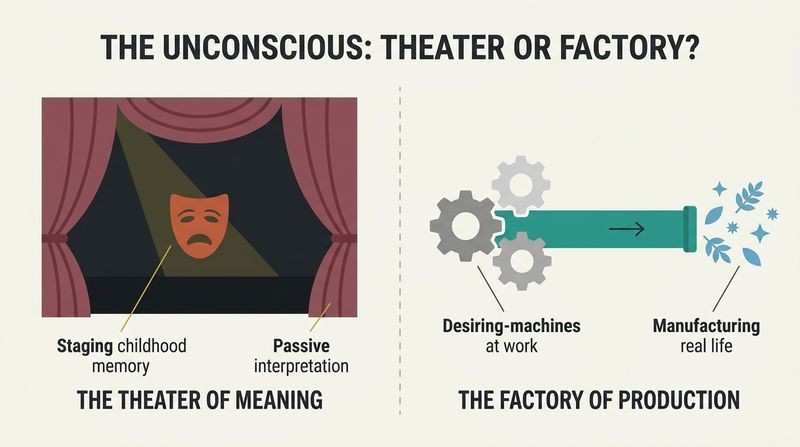
Deleuze and Guattari open with a jolt: the unconscious does not stage private dramas, it manufactures reality. They call its units desiring-machines, real couplings where one part produces a flow and another interrupts it (a breast makes milk, a mouth cuts into it). Everything connects, breaks, and flows. Their famous image is that someone wandering outdoors, feeling kinship with rocks, stars, and weather, reveals more about desire than a patient reciting childhood memories on the couch. Where Freud saw dreams and symbols to decode, they see production lines humming. The book's whole revolution is this swap of metaphors: from expression to production, from a stage where hidden meanings are performed to a workshop where desire builds the world.
The factory-versus-theater contrast is the book's cleanest provocation, and it anticipates later cognitive science that treats the mind as generative rather than representational. Predictive-processing models, for instance, cast the brain as constantly producing and revising outputs, not merely mirroring reality. What is bracing here is the refusal of depth: there is no secret beneath the symptom, only machinery running. The risk is that treating everything as a machine flattens genuine differences between neural, social, and mechanical systems. Still, as a corrective to a psychoanalysis obsessed with buried meanings, the move reframes desire as engineering rather than confession, a shift with consequences far beyond the clinic.
Desire produces reality; it is not an aching hole waiting to be filled

The dominant Western story, running from Plato through Freud and Lacan, defines desire as lack: you want what you do not have, so desire is fundamentally an absence. Deleuze and Guattari reject this. Desire, they argue, is productive and positive. It lacks nothing because it is not aimed at a missing object; it makes connections, and the real is its product. Lack, they insist, is not primary but manufactured. Scarcity is organized deliberately by market economies amid abundance, so that desire is taught to fear going without and to chase substitutes. The trick of tying desire to castration and lack, they say, is precisely how power captures it. Free desire, and it produces new arrangements rather than mourning a phantom.
This inversion is the philosophical heart of the book and its sharpest break with Lacan, for whom desire is structured around a constitutive lack marked by the phallus. Reframing scarcity as produced rather than natural echoes economic anthropology (Marshall Sahlins on the original affluent society) and critiques of manufactured demand in consumer capitalism. The strong version is liberating: stop treating wanting as pathology. The weak spot is empirical. Clinical experience of loss, grief, and yearning is real, and dismissing all lack as ideological can feel like denial. The productive account works best as a supplement to, not a total replacement of, the lack tradition.
Oedipus is an interior colony, not the buried truth of your mind

Psychoanalysis reduces every desire to the family triangle of daddy-mommy-me. Deleuze and Guattari call this a con. Oedipus, they argue, is not discovered in the unconscious; it is injected into it, a mold pressed onto desire that overflows the family in every direction. They compare it to colonization carried out from within, an intimate education that teaches us to want our own confinement. Anthropology backs them: in societies studied by ethnographers, the family is an open political and economic strategy coextensive with the whole social field, and the Oedipal mechanisms psychoanalysts expect simply are not found until colonizers arrive. The point is not that fathers and mothers do not matter, but that they function as stand-ins for a much larger world the child is already investing.
The title concept lands hardest as anti-imperialism of the psyche. The claim that Oedipus travels with the colonizer, that a shantytown Oedipus is manufactured where control over social production is stripped away, links psychoanalysis to power in a way Freud never entertained. Later scholarship on cross-cultural psychiatry partly supports the skepticism that the Oedipus complex is universal. Critics counter that the authors caricature a psychoanalysis that had already grown more flexible. The enduring value is methodological: whenever a theory finds the same structure everywhere, suspect that the theory is imposing what it claims merely to detect.
Stop asking what your desire means; ask how it works and what it does
Deleuze and Guattari replace interpretation with functionalism. The question What does it mean? keeps you trapped in the search for hidden signifiers and symbolic secrets. The question How does it work? sends you to the actual machinery: what flows are cut, what connects to what, what the output is. They borrow from anthropology, where a ritual object matters less for its meaning than for its use and its position among other things. A symbol is never in a one-to-one relation with a fixed meaning; it is multivocal and does real work. Theory, in this view, is a toolbox: keep the tools that function, discard the rest. This is why they say the unconscious does not speak or represent, it engineers.
This pragmatic turn aligns with Wittgenstein's meaning-as-use and with much of pragmatist philosophy, and it prefigures how systems thinking and cybernetics analyze behavior by tracing inputs and outputs rather than intentions. Treating theory as a toolbox is genuinely freeing for practitioners tired of interpretive dogma. The limitation is that meaning does not vanish just because you stop asking about it. Humans are relentlessly interpretive animals, and the functional question and the semantic question often illuminate each other. Still, as a discipline against premature interpretation, the shift from meaning to operation is a durable analytic habit worth adopting.
The masses were not fooled into fascism; they desired it
The book revives Wilhelm Reich's most disturbing question: how could crowds come to want their own repression? The lazy answer is that they were deceived, misled by ideology. Deleuze and Guattari refuse it. Desire, they insist, is part of the economic infrastructure itself, not a superstructural illusion. People can invest, at the level of unconscious desire, the very system that exploits them, finding a strange joy in being a cog, a passion for order, hierarchy, and even their own subjugation. Hitler sexually aroused the fascists, they write bluntly; flags, armies, and banks arouse people. This is why interest and desire diverge: you can act fervently against your own objective interests because desire has invested elsewhere.
This is the book's most politically urgent thread and the one Foucault highlighted, calling the work an introduction to the non-fascist life, a manual for hunting the fascism in our own everyday cravings for power. The insight anticipates work in political psychology on authoritarian desire and on why economic self-interest so poorly predicts voting. Framing desire as infrastructure rather than false consciousness dignifies people even as it indicts them: they are not dupes, they are invested. The uncomfortable implication is that critique and information alone cannot dissolve reactionary attachment, because the problem is libidinal, not merely cognitive.
Every society is one of three machines: coding, overcoding, or decoding
Deleuze and Guattari read all of history as three social machines that manage the flows of desire. First, the primitive territorial machine codes flows by marking bodies directly, tattooing, scarring, creating memory through cruelty, and organizing debt through alliance and filiation. Second, the barbarian despotic machine overcodes: an emperor arrives like lightning, imposes a higher unity, converts finite debts into infinite debt owed to the state, and installs writing subordinated to a ruling voice. Third, the civilized capitalist machine decodes flows and replaces codes with an axiomatic, an abstract system of money and quantities. Each machine has a full body onto which production is recorded: the earth, the despot, or capital. History is not a smooth progression but a sequence of ruptures and contingencies.
This universal history borrows Marx's mode-of-production framework but fuses it with Nietzsche's genealogy of debt, cruelty, and memory-making. The move from coding to overcoding to decoding is elegant, and the emphasis on debt as prior to exchange anticipated arguments later developed at length by anthropologist David Graeber. The reading is deliberately non-teleological: capitalism results from accidental encounters, not destiny. The obvious risk is overreach, compressing millennia of diverse societies into three archetypes. Yet as a heuristic for asking how any social order captures and channels desire, the tripartite scheme remains a powerful lens, especially its claim that the despotic state never fully disappears.
Capitalism unleashes flows with one hand and rechains them with the other
Capitalism, uniquely, runs on decoded and deterritorialized flows: it dissolves old codes, traditions, and sacred limits, converting everything into abstract quantities of money and labor. This is deterritorialization, the stripping away of fixed meanings and territories. But capitalism cannot let the flows run free, so it constantly performs reterritorialization, reviving family, nation, religion, and private property as artificial anchors. Schizophrenia, understood as the pure process of decoding flows, is capitalism's absolute limit, the wall it forever approaches and forever pushes back. The system produces schizzes the way it produces cars, then confines the actual schizophrenic as a sick person. Capitalism, they write, is defined not by a code but by an axiomatic that keeps adding new rules to absorb whatever threatens it.
The insight that capitalism is revolutionary and conservative at once, melting all that is solid while frantically rebuilding traditional anchors, extends Marx's own astonishment in the Communist Manifesto. The concept of an axiomatic that endlessly adds axioms to neutralize resistance is prescient about how markets absorb countercultures, unions, and even rebellion as new product lines. Where the argument grows contentious is its flirtation with accelerationism, the suggestion that the exit lies not in retreat but in pushing decoding further. That gambit has been read as both radically emancipatory and dangerously naive, and it seeded decades of debate about whether intensifying capitalism's own tendencies could ever be liberating.
Your desire invests race, class, and history directly, never just mommy and daddy
Deleuze and Guattari insist that delirium and desire are first of all social, political, and historical, not familial. A person raving invests continents, races, kingdoms, and economic systems long before any of it gets crushed into the family triangle. Even a small child, they argue, is already investing a whole social field: bread, money, the family's rank, its belonging to a superior or inferior group, its future. The parents are not the organizers of desire but merely stimuli and agents through whom the wider world is invested. They cite an African healing ceremony among the Ndembu, where the doctor performs what amounts to social analysis, tracing the sick man's illness through chieftainships, lineages, alliances, and colonial relations rather than reducing it to father and mother.
The Ndembu example, drawn from anthropologist Victor Turner, is one of the book's most persuasive: a healing practice that treats suffering as embedded in political and economic relations rather than in a private family drama. This anticipates community and cultural psychiatry and the social-determinants-of-health movement, which locate mental distress in poverty, racism, and displacement. The claim that a child already invests class and history is harder to prove and easy to romanticize. Yet the corrective is valuable: reducing every anxiety to parental figures can systematically erase the economic dependence and social violence that actually structure a person's life.
Every psyche swings between a fascist pole and a revolutionary pole
Beneath conscious interests lie unconscious libidinal investments, and these come in two types. The paranoiac pole is reactionary: it invests central authority, worships the strongman, loves the large gregarious mass, and whispers I belong to the superior race. The schizo pole is revolutionary: it follows lines of escape, breaks codes, and affirms I am the outsider, the deterritorialized, of an inferior race. Deleuze and Guattari distinguish subjugated groups, which reproduce authority and hierarchy even when seizing power, from subject-groups, whose desire itself is revolutionary. Crucially, a group or person constantly oscillates between the two, and a revolutionary movement can carry fascist desire inside it. The two poles do not map neatly onto left and right, because their difference is libidinal, not ideological.
The warning that revolutionaries can harbor fascist desire, that a subject-group is always in danger of hardening into a subjugated one, is the book's most sober political contribution and its answer to the failures of twentieth-century revolutions. It resonates with observations about how liberation movements reproduce the authoritarian structures they oppose. The distinction between preconscious interest and unconscious investment gives language to a real puzzle: why solidarity so often curdles into new hierarchy. The framework resists easy operationalization, and critics fairly ask how one would ever measure a group's libidinal pole. Its worth is diagnostic humility: no cause is immune to the paranoiac drift.
Schizoanalysis: dismantle your ego to free your desiring-machines
Against psychoanalysis, the authors propose schizoanalysis, which schizophrenizes rather than oedipalizes. It has a destructive task and positive tasks, undertaken at once. The destructive task is a brutal scouring: blow up Oedipus, the ego, guilt, the law, and castration, refusing to play daddy-mommy-me. The positive task is functional and mechanic: discover what a person's desiring-machines actually are, how they run, what flows they cut, what their nonhuman sexes are. Central here is the body without organs, the smooth unproductive surface onto which desire is recorded, at once the model of death and the egg of pure intensities through which the self passes. Schizoanalysis has no political program and claims to speak for no one; it simply asks how much room a given society leaves for the production of desire.
Schizoanalysis is easier to state as critique than to practice as method, and the authors concede it offers no program, which frustrates readers wanting a clinic or a party line. The romanticizing of schizophrenia has drawn justified criticism, since actual psychosis is often anguish, not liberation; the authors partly guard against this by distinguishing the schizophrenic process, a breakthrough, from the schizophrenic patient, a breakdown produced by arresting that process. The body without organs became one of the twentieth century's most generative concepts, migrating into art, architecture, and media theory. As a stance, schizoanalysis endures less as a technique than as permission to treat the self as something to be taken apart and rebuilt.
Analysis
Anti-Oedipus, the first volume of Capitalism and Schizophrenia, is less a book to be understood than an incendiary device to be deployed, as its authors and Foucault both insisted. Written in the wake of May 1968 by a philosopher and a militant psychoanalyst, it attempts an audacious fusion: not the tired Freud-plus-Marx synthesis of Reich and the Frankfurt School, but Marx crossed with Nietzsche, revolution crossed with genealogy. From Nietzsche it takes debt, cruelty, memory, and the critique of ressentiment; from Marx it takes flows, production, and the reading of history through modes of production. The wager is that political economy and libidinal economy are one and the same, that there is only desiring-production coursing through the social field. Its most lasting achievements are conceptual gifts that outgrew the book: deterritorialization, the body without organs, desiring-machines, molar and molecular, the axiomatic of capital. These have colonized geography, media studies, art theory, and organizational thought far beyond philosophy. Its central polemic, that psychoanalysis smuggles a bourgeois family drama into the unconscious and calls it a discovery, remains a bracing warning against any theory that finds its own structure everywhere it looks. The book's weaknesses are equally real. Its prose is deliberately delirious, often impenetrable, and its celebration of the schizo courts a dangerous aestheticizing of genuine suffering, a charge the authors half-anticipate by distinguishing process from breakdown. Its politics point toward acceleration without a destination, seeding an ambiguous legacy that both left and reactionary thinkers have since claimed. Read today, its deepest relevance may be Foucault's framing: an ethics for detecting the fascism lodged in our own cravings for order, leadership, and belonging. In an age of algorithmic capture of desire and resurgent authoritarianism, the claim that people can libidinally invest their own domination is not a period piece but a diagnosis. The book asks, relentlessly, not what your desire means but what it is building, and for whom.
Review Summary
Anti-Oedipus is a challenging but influential critique of psychoanalysis and capitalism. Readers find it dense, provocative, and revolutionary in its ideas about desire, social structures, and liberation. The book introduces concepts like desiring-machines, body without organs, and schizoanalysis. While some praise its insights and style, others criticize it as obscure or pseudo-philosophical. Many struggle with its complexity but appreciate its attempt to rethink fundamental ideas about society, psychology, and human nature. The book's impact on critical theory and philosophy is widely acknowledged.
People Also Read








Glossary
Desiring-machines
Productive units of the unconsciousThe elementary components of the unconscious understood as real, literal machines rather than metaphors. Each consists of a flow-producing part and a part that interrupts or draws off that flow, connecting endlessly to others. They are not fantasy or dream machines but productive: they make connections, cut flows, and produce the real. Desire, in this account, is machinic assembly, not lack or representation.
Body without organs
Unproductive recording surface of desireBorrowed from Antonin Artaud, it is the smooth, sterile, full surface onto which desiring-production is recorded and distributed, opposed not to the organs but to the organism. It repels or attracts the desiring-machines, functions as both the model of death (zero intensity) and an egg crisscrossed with intensities through which a subject passes. Each socius (earth, despot, capital) is a clothed version of it.
Oedipus
Imposed family-triangle repression of desireAs redefined here, not a universal complex but a mechanism of capture that reduces the whole social field to the daddy-mommy-me triangle. It is injected into the unconscious rather than found there, functioning as an interior colonization that teaches desire to want its own repression. The authors treat it as the displaced limit of desire internalized under capitalism.
Schizoanalysis
Deleuze-Guattari alternative to psychoanalysisThe practice proposed in place of psychoanalysis. Its destructive task demolishes Oedipus, the ego, guilt, and castration; its positive task discovers how a person's desiring-machines actually function and how desire invests the social field. It schizophrenizes rather than oedipalizes, seeks the productive unconscious rather than an expressive one, and asks how desire works rather than what it means. It claims no political program.
Deterritorialization / Reterritorialization
Freeing flows, then re-anchoring themDeterritorialization is the process of stripping flows of desire, labor, or meaning from fixed codes and territories, freeing them into abstract circulation. Reterritorialization is the counter-movement that re-anchors those freed flows onto new or revived territories such as family, nation, or property. Capitalism runs on both at once, decoding with one hand while artificially recoding with the other.
Molar / Molecular
Large aggregates versus micro-multiplicitiesTwo scales of organization. The molar refers to large statistical aggregates, structured masses, organisms, classes, and gregarious wholes governed by laws of large numbers. The molecular refers to the micro-level of singular desiring elements, partial objects, and flows that can subordinate or escape the molar. Paranoiac investment enslaves the molecular to the molar; schizoid investment reverses this.
Socius
Full body recording social productionThe social full body onto which production is recorded and from which it appears to emanate as if from a cause. It takes three historical forms: the body of the earth (primitive territorial machine), the body of the despot (barbarian machine), and the body of capital-money (capitalist machine). It codes, overcodes, or decodes the flows of desire respectively.
Surplus value of code / of flux
Precapitalist versus capitalist surplus extractionSurplus value of code is the primitive form of surplus, generated when one element captures a fragment of another's code, tied to prestige, debt, and qualitative relations. Surplus value of flux is its capitalist transformation, extracted through differential relations between decoded, quantified flows of capital and labor, no longer requiring codes but an abstract axiomatic of money.
Subject-groups / Subjugated groups
Revolutionary versus authority-reproducing collectivesA subjugated group reproduces hierarchy, authority, and the repression of desire even when it seizes power, referring itself to an external form of force. A subject-group has revolutionary libidinal investments, subordinates power to the production of desire, and generates its own analysis. The two constantly convert into each other, so revolutionary groups are always threatened by subjugation.
FAQ
What's Anti-Oedipus: Capitalism and Schizophrenia about?
- Exploration of Desire: The book examines the relationship between desire and social production, arguing that desire is a productive force rather than a lack. It critiques traditional psychoanalysis, especially the Oedipus complex.
- Critique of Psychoanalysis: Deleuze and Guattari challenge the dominance of the Oedipus complex, suggesting it limits understanding of desire by reducing it to familial relationships.
- Capitalism and Schizophrenia: The authors link capitalism to schizophrenia, suggesting that capitalism produces a form of social schizophrenia by detaching desire from its social context.
Why should I read Anti-Oedipus?
- Innovative Framework: The book offers a radical rethinking of desire, production, and social relations, making it essential for those interested in philosophy, psychology, and social theory.
- Cultural Relevance: It provides critical insights into how desire operates within capitalist societies, encouraging readers to question established norms.
- Engaging Style: The dynamic and often humorous writing style makes complex ideas accessible, challenging readers to think critically about societal structures.
What are the key takeaways of Anti-Oedipus?
- Desiring-Production: Desire is a productive force that shapes reality, operating through "desiring-machines" that connect various flows and partial objects.
- Critique of Oedipus: The book critiques the Oedipus complex as a limiting framework, calling for a broader understanding of desire.
- Connection to Capitalism: Capitalism's tendency to decode and detach desire leads to a fragmented social reality, highlighting the need for a more integrated understanding of desire.
What is schizoanalysis as defined in Anti-Oedipus?
- Alternative to Psychoanalysis: Schizoanalysis seeks to understand desire and its connections to social production without the constraints of the Oedipus complex.
- Focus on Desiring-Machines: It emphasizes the role of desiring-machines, exploring how they operate within social contexts.
- Revolutionary Potential: Schizoanalysis encourages individuals to break free from societal constraints, promoting a radical rethinking of identity and social relations.
How does Anti-Oedipus relate capitalism to schizophrenia?
- Capitalism as Decoding Machine: Capitalism functions as a machine that decodes flows of desire, detaching them from their social contexts, leading to a fragmented reality.
- Schizophrenia as a Limit: Schizophrenia represents the extreme consequences of a society that prioritizes decoding over connection.
- Desire and Social Production: Capitalism's tendency to detach desire from its social roots contributes to feelings of alienation and fragmentation.
What is the significance of the "body without organs" in Anti-Oedipus?
- Conceptual Framework: The "body without organs" (BwO) serves as a metaphor for a state of being that resists traditional structures and identities.
- Desiring-Machines: The BwO is linked to desiring-machines, emphasizing that desire is not fixed but constantly in motion.
- Rejection of Oedipal Structures: It challenges the Oedipal framework by advocating for a more fluid understanding of self.
How does Anti-Oedipus critique traditional psychoanalysis?
- Oedipus Complex as Limiting: The authors argue that the Oedipus complex restricts understanding of desire by reducing it to familial relationships.
- Focus on Representation: Traditional psychoanalysis is critiqued for prioritizing representation over production.
- Need for a New Framework: Deleuze and Guattari call for a rethinking of psychoanalysis that incorporates desiring-production and schizoanalysis.
What are desiring-machines in Anti-Oedipus?
- Definition: Desiring-machines are mechanisms through which desire operates and interacts with social and technical systems.
- Interconnectedness with Society: They are deeply embedded in social machines, highlighting how desire shapes and is shaped by societal structures.
- Fluidity of Desire: Desiring-machines illustrate the fluid and dynamic nature of desire, encouraging a rethinking of how desire is understood.
How do Deleuze and Guattari redefine the concept of the Oedipus complex?
- Rejection of Familial Focus: They argue that the Oedipus complex is too focused on familial relationships and fails to account for broader social dynamics.
- Desire as a Social Construct: Desire is shaped by societal influences rather than being an innate psychological phenomenon.
- Emphasis on Collective Desire: They highlight the importance of collective desire, which transcends individual familial ties.
What is the relationship between capitalism and schizophrenia in Anti-Oedipus?
- Capitalism as Schizophrenic System: Capitalism detaches desire from its social context, leading to a form of schizophrenia.
- Desire and Alienation: In a capitalist society, desire is often repressed and redirected, creating a conflict between individual needs and societal demands.
- Revolutionary Potential of Desire: Recognizing the schizophrenic nature of capitalism can lead to a revolutionary understanding of desire.
How does Anti-Oedipus redefine the concept of desire?
- Desire as Productive Force: Desire is a mechanism of production rather than a mere psychological phenomenon.
- Fluid and Dynamic Nature: Desire is not fixed but is fluid and capable of transformation.
- Liberation from Repression: Liberating desire from societal constraints can lead to revolutionary change.
What critiques does Anti-Oedipus offer regarding traditional psychoanalysis?
- Focus on Oedipus Complex: The book critiques the overemphasis on the Oedipus complex, arguing it limits understanding of desire.
- Repression of Desire: Psychoanalysis often represses the productive aspects of desire by confining it to familial representations.
- Need for Schizoanalysis: Schizoanalysis is proposed as a necessary alternative to better address the complexities of desire.
About the Author
Other books by Gilles Deleuze


Download PDF
Download EPUB
.epub digital book format is ideal for reading ebooks on phones, tablets, and e-readers.








