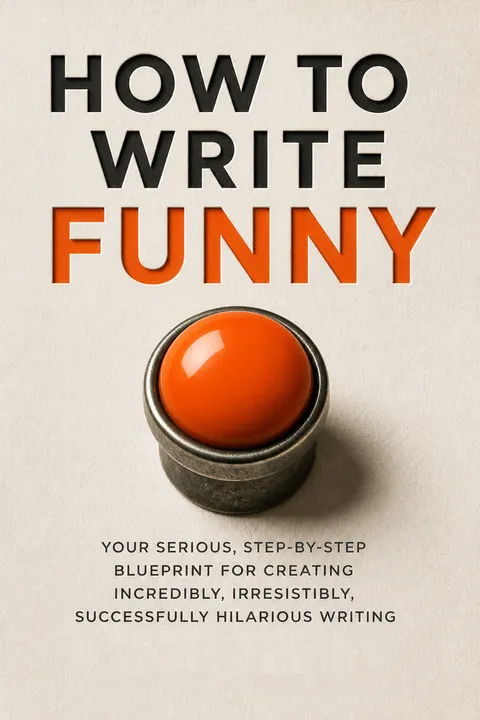


Key Takeaways
Treat comedy as a craft, not a birthright or lucky accident
Start with the comic idea. Dikkers argues that funny writing can be learned through repeatable practice, even though no technique guarantees a laugh every time. The smallest working unit is a joke: a compact, funny concept that can often stand alone as a headline, title, or premise. A strong concept matters more than ornate prose. A polished paragraph cannot rescue an idea that does not interest or amuse readers, while a strong idea can survive plain execution.
Build before you scale. The book focuses on the single joke because its mechanics also feed articles, sketches, and scripts. Dikkers describes beginning as an unconfident writer who copied material rather than generating it, then improving through study and repeated practice. The goal is not perfect batting, but a better average: creating material that works more often than chance alone would allow.
The book’s most useful promise is not that humor can be made predictable, but that its production can be made less mysterious. This distinction matters. Creative work remains exposed to audience, context, and taste, yet a writer can still improve the quality of the ideas submitted to that unpredictable test. Treating a joke as a small, inspectable unit also resembles prototyping in design: make a cheap version, learn from its reception, and refine the premise before investing in a larger work.
Draft recklessly, then let a separate editor decide what survives
Separate invention from judgment. Dikkers calls the generative mode the Clown and the evaluative mode the Editor. The Clown produces ideas without deciding whether they are clever; the Editor tests, reshapes, and rejects them. Too much Editor suppresses drafts before they exist. Too much Clown leaves weak material untouched. The balance comes from switching deliberately between the two jobs, rather than demanding that one moment of writing do both.
Make raw material daily. The book recommends writing continuously for half an hour, without correcting or stopping, and carrying a notebook to capture stray observations. Afterward, review the material and keep only promising fragments. Most will not be useful, which is precisely why volume matters. A cooling-off period before revision can also help restore distance from the writer’s own attachment to a line.
This separation resembles divergent and convergent thinking: first widen the field of possibilities, then apply constraints. The labels are memorable, though their association with right and left brain hemispheres should be taken as metaphor, not a literal map of how creativity is organized. The practical insight survives that caveat. Switching roles reduces premature self-censorship and protects revision from becoming a defense of every first draft. It also gives criticism a job, rather than letting it become a verdict on the writer’s talent.
Make every joke surprising without making readers work to understand it
Freshness earns the laugh. In Dikkers’s account, surprise is necessary for humor: a familiar phrase, overused subject, or predictable joke pattern offers little new for readers to discover. Comedy clichés can include whole topics and stock characters, not just repeated wording. A joke about tired airline food or a familiar sitcom setup may be recognizable, but recognition alone is not a fresh comic turn.
Remove needless friction. Surprise works best when readers can quickly grasp the situation. Dikkers therefore treats accessibility and brevity as partners: use clear language, familiar points of reference, and fewer unnecessary words. He points to the compactness of newspaper comics as a way to catch a reader’s eye even when that reader did not intend to stop. Cutting can sharpen both meaning and comic timing.
The useful tension here is between novelty and legibility. A joke must depart from expectation, but not so far that the audience cannot reconstruct what expectation it violated. This resembles a basic principle of information design: a signal is noticeable only against a pattern the audience already understands. Brevity helps preserve that pattern. Still, accessibility is not identical to simplicity; a joke can be intellectually layered if its surface is easy to enter and its deeper implications reward a second reading.
Hide a sharp opinion beneath the joke, never announce its point
Give the joke a buried meaning. Dikkers calls this concealed opinion Subtext: what a line communicates beyond its literal wording. It is usually a judgment about people, institutions, or life, not a lesson the writer states directly. The writer should be able to explain the idea plainly during revision, but the reader should encounter it through the joke rather than a sermon.
Let readers connect the pieces. Satire uses comic form to reveal a deeper judgment. Swift’s proposal to solve poverty by consuming poor children is a deliberately monstrous pretense that exposes the cruelty and neglect surrounding the real problem. The outrageous surface makes readers infer the argument underneath. If the writer spells out that argument inside the joke, the discovery disappears and the piece risks becoming an editorial with comic decoration.
Subtext makes laughter cognitively active: the audience completes an inference, and that act of recognition can make a joke feel more satisfying than a simple surprise. It also helps satire criticize without reducing itself to a claim-and-proof essay. The method depends on readers sharing enough context to infer the intended judgment, however. When the clues are too faint, audiences may miss the target; when they are too blunt, the work loses its double meaning. Clarity of intent and indirectness of expression must coexist.
Turn plain opinions into jokes by changing the frame around them
Use comic transformations. Dikkers groups reliable joke-making devices under the name Funny Filters. Rather than repeat the book’s full catalogue, the main moves can be understood as families: reverse an expectation, exaggerate an opinion past reason, or make a character act out a simple flaw; exploit language or shared experience; borrow a recognizable format or compare unlike things; shift attention to a trivial detail, or make humor itself the subject.
Keep the point legible. The book’s example of an agriculture official meeting with a cabbage turns official seriousness into absurdity. The comic image is silly, but it can also imply that government rituals are ridiculous or unimportant. A joke may combine several devices, yet it still needs a clear central idea. If each added twist introduces a new impossible premise, readers may lose track of what they are meant to infer.
These devices function like transformations in rhetoric: the writer does not merely state an opinion, but changes its scale, voice, setting, or apparent subject. That gives a single premise several routes to surprise. The framework is especially useful as a diagnostic tool when a draft feels flat: the writer can ask what expectation, character flaw, association, or format might make the underlying thought visible. The categories overlap, and that is a strength for practice, though not evidence that every successful joke fits a fixed taxonomy.
Aim satire at power, and make shock earn its place
Choose a deserving target. Dikkers adapts a journalistic principle for satire: ridicule should generally fall on the comfortable, such as entrenched authority or a powerful status quo, rather than people already suffering. Humor that appears to attack the vulnerable is likely to read as mean rather than daring. Edginess can come from seeming to approach an improper target while actually exposing the powerful one, but the distinction has to be clear.
Treat shock as seasoning. Sex, profanity, violence, and gross-out details can startle readers, but shock alone often narrows the audience. Dikkers argues that it works best in moderation and alongside meaningful Subtext. His example of a book showing judges naked uses the discomfort not just for surprise, but to suggest that legal authorities are human and fallible. Without that added purpose, provocation can feel empty.
The target of a joke is not a minor stylistic choice; it determines the social meaning of the laugh. A useful test is who gains permission to feel superior, and who pays for the joke. Yet punching up is not mechanically simple: power may be institutional, local, or situational, and a joke’s audience may read its target differently from its writer. Shock can expose hypocrisy or strip authority of its mystique, but the comic framing must make the object of criticism easier to identify than the object of ridicule.
Borrow familiar forms, then smuggle in an unfamiliar judgment
Let the format do comic work. Parody imitates the recognizable shape of another kind of writing or media, such as a news report, legal document, or diary. Dikkers stresses that the imitation should be convincing; weak resemblance gives readers less to recognize and less to enjoy. The content can then undermine the form’s assumptions. The Onion’s mock news style, for example, gets humor from looking like serious reporting while presenting an absurd event.
Hide one side of a comparison. Analogy links unlike things while allowing readers to discover the unstated half. Orwell’s Animal Farm presents a farmyard political conflict that also points toward the Russian Revolution, with the novel’s broader judgment about power working beneath that comparison. Misplaced focus uses a related trick: it fixates on some minor matter while the more serious issue remains conspicuously unaddressed.
Recognizable forms give readers a fast entry point. They know the conventions of a news bulletin or official document, so even small deviations become visible. Analogy adds another layer by asking the audience to map one world onto another. Together, these techniques show that humor can arise from structure as much as from punchlines. Their limitation is contextual: parody loses force when the source form is unfamiliar, while analogy can become overdetermined if every detail insists on a one-to-one interpretation.
Make prose easier to discover by borrowing other media’s strengths
Respect prose’s trade-offs. Writing can be intimate, focused, and durable, but it competes with entertainment that is easier to encounter and consume. Dikkers advises writers to make their work concise and clear, then borrow attention-grabbing features from other media: an image, a spoken presentation, a video treatment, or an unexpected public placement.
Change the doorway, not the joke. The Onion began as a free newspaper distributed in public places, where its comic headlines could surprise people who had not gone looking for humor. Dikkers also describes using words on screen in web video to bring readers toward prose. These are not instructions to copy someone else’s jokes. They are ways to place original work in a format or setting that helps an audience notice it.
The book treats distribution as part of writing, a useful corrective to the romantic idea that good work automatically finds its audience. Medium shapes attention: an image can invite a glance, audio can accompany a commute, and public placement can create surprise. Those advantages do not remove the need for a strong concept or a suitable audience. Nor does maximum reach always serve every project. Accessibility is best understood as reducing avoidable barriers, not sanding away a writer’s distinctive subject or perspective.
Use a repeatable three-pass process instead of waiting for inspiration
Choose a route into the joke. Dikkers names three methods. Filtering starts with an opinion and tries different comic devices. Finessing begins with a promising line and improves clarity, contrast, wording, and placement. Divining starts with a device or comic pattern and uses it to generate an idea when the page feels empty. Each route produces raw material; none replaces judgment or guarantees success.
Revise with a light hand. After generating options, identify what the joke is really saying, check whether the reader can follow it, and remove extra words. Put the strongest reveal near the end when that improves the effect, but do not force a formula if it makes the sentence awkward. Proofread, let drafts cool, and seek useful feedback. Keep producing new ideas rather than protecting one favorite line from revision.
The three routes address distinct creative bottlenecks: no premise, an imperfect premise, or no starting point at all. That makes the process more adaptable than a single rigid recipe. It also turns revision into a set of questions rather than a vague demand to be funnier. Audience testing matters because the writer cannot fully simulate another reader’s assumptions. At the same time, immediate reactions are noisy; a joke’s reception depends on setting, delivery, and shared references, not only its construction.
Build a joke first; dramatic plots carry humor beyond a short sketch
Know which structure you need. Comedic structure establishes one comic premise and escalates it through a sequence of related turns. Dikkers argues that this can sustain a joke, article, or short sketch, but becomes tiring when stretched across a long story. Longer work needs dramatic structure, where characters pursue goals, face changing circumstances, and give readers reasons to care beyond the next laugh.
Let the small skill travel. The book therefore starts with the one-line joke, then treats it as a foundation for larger forms rather than a complete substitute for them. A feature-length comedy can include jokes and absurdity while relying on relationships, conflict, and emotional movement to hold attention. This distinction helps writers diagnose a draft: if its comic premise has already been exhausted, more punchlines may not solve a story problem.
This distinction separates local pleasure from narrative propulsion. A joke rewards a quick inference; a story sustains curiosity through change and consequence. The two can reinforce each other, but they ask different things of an audience. A long comedy built only from repeated comic escalation risks fatigue, while a dramatic plot with no comic texture may feel inert. The practical lesson is not that comedy and drama must be kept apart, but that the writer should know which structure is carrying the reader at each scale.
Analysis
How To Write Funny is a craft manual organized around a practical puzzle: how can a writer create laughter on a page, where there is no performer to supply facial expression, timing, or charisma? Its answer is procedural. Generate material without judgment, identify the idea beneath it, transform that idea through comic devices, then edit for clarity and impact. The book’s strongest contribution is this shift from talent as mystery to writing as a cycle of production and selection. Its insistence on Subtext also gives the method an ethical and intellectual center: the joke is not only a verbal trick, but a way to deliver a judgment indirectly.
The framework is most persuasive when treated as a working vocabulary rather than a complete science of humor. Its catalogue makes revision more concrete, but comic success is shaped by culture, audience, timing, and performance context. The book’s claims about objective repeatability are therefore best read as an aspiration toward craft, not a guarantee. Likewise, its Clown and Editor metaphor is useful for distinguishing idea generation from evaluation, while the associated left-brain and right-brain language is too simple as neuroscience. The metaphor remains operational even when its biological explanation is not.
A productive tension runs through the advice. Writers should be accessible, yet avoid familiar comic material; use recognizable formats, yet create fresh judgments; offend the comfortable, yet ensure readers understand the target. These are not contradictions to eliminate but constraints to balance. The book’s process offers a way to test those balances through drafts rather than settle them abstractly. Its deepest practical lesson is that humor depends on both invention and selection: the writer needs enough ideas to discover a strong one, and enough distance to recognize when the joke is not yet working.
Review Summary
Readers praise "How to Write Funny" for its practical, step-by-step approach to comedy writing. Many found it eye-opening, dispelling myths about innate talent and providing a structured framework for generating humor. While some desired more examples, most appreciated the book's concise, information-dense content. It's widely recommended for aspiring comedians and writers looking to improve their humor skills, with many reporting increased success in their comedy endeavors after applying the book's techniques.
People Also Read
Glossary
Clown
Unjudging idea generatorDikkers’s name for the playful, prolific mode of writing that produces possibilities without evaluating them too early. The Clown records observations, drafts bad jokes, and experiments freely. Its purpose is to generate raw material, not polished work. The term is best understood as a practical metaphor for creative openness, rather than a literal account of a brain hemisphere.
Editor
Critical joke refinerDikkers’s name for the evaluative mode that tests and improves raw comic material. The Editor looks for clarity, freshness, strong contrast, concise wording, and a workable target, then revises or discards weak ideas. The method depends on balancing this role with the Clown: editing too early suppresses invention, while too little editing leaves unconvincing material in the finished work.
Subtext
The joke’s hidden judgmentThe opinion or value judgment communicated beneath a joke’s literal wording. In Dikkers’s model, a writer should know exactly what the joke is saying, but should not state that message directly within the comic text. Readers infer it from the setup, frame, or twist. Satire uses Subtext to make humor carry a view of society, human behavior, or power.
Funny Filters
Devices that reshape an opinionDikkers’s term for recurring comic devices that transform an underlying opinion into a joke. They include moves such as reversing expectations, exaggerating, building a simple comic character, playing with language, invoking shared experience, imitating familiar forms, comparing unlike subjects, misdirecting attention, and commenting on comedy itself. The devices can overlap and are intended as practical tools for generating and diagnosing humor.
Filtering
Opinion into comic premiseA method for creating a joke by starting with a clear opinion or observation, then testing how different comic devices might reshape it. The writer tries alternative frames, voices, exaggerations, or comparisons to find a version that makes the idea surprising. Filtering emphasizes experimentation: the first attempts may fail, and the resulting lines are drafts to assess rather than guaranteed jokes.
Finessing
Refining an existing jokeA revision method used when a promising joke or funny idea already exists. The writer clarifies its meaning, checks that the reader can follow it, strengthens the contrast, trims unnecessary language, and considers where the reveal lands. Finessing can improve a joke’s odds, but it can also damage the original idea if revision becomes excessive or changes what made the line work.
Divining
Generating from comic devicesA method for finding material when the writer has no useful notes or premise to develop. Instead of beginning with an opinion, the writer starts with a comic device or familiar pattern and brainstorms possible subjects, characters, contrasts, and turns. The method is intended to create momentum and raw options, which can then be evaluated and revised.
Comedic Structure
Escalation of one comic premiseA short-form structure that establishes a central joke or comic idea and develops it through related turns or escalating variations. Dikkers presents it as effective for one-liners, articles, and short sketches, but limited for sustaining long narratives. Longer works generally need dramatic structure, in which character goals and changing events maintain interest beyond the comic premise.
FAQ
What's "How To Write Funny" about?
- Blueprint for Humor Writing: "How To Write Funny" by Scott Dikkers provides a structured approach to creating humorous writing. It breaks down the process into manageable steps.
- Understanding Humor: The book explores what makes writing funny, focusing on the mechanics of humor and how to reliably generate laughs.
- Tools and Techniques: It introduces various tools and techniques that professional comedy writers use, such as the 11 Funny Filters, to craft jokes and humorous content.
- Practical Exercises: The book includes exercises and methods to help writers develop their comedic skills, making it a practical guide for aspiring humor writers.
Why should I read "How To Write Funny"?
- Learn from an Expert: Scott Dikkers, a co-founder of The Onion, shares his expertise and insights into humor writing, making it a valuable resource for anyone interested in comedy.
- Structured Approach: The book offers a clear, step-by-step blueprint for writing humor, which can help both beginners and experienced writers improve their craft.
- Comprehensive Coverage: It covers a wide range of topics, from overcoming writer's block to understanding different types of laughs, providing a thorough understanding of humor writing.
- Practical Application: With exercises and actionable advice, the book is designed to help readers apply what they learn and start writing funny content immediately.
What are the key takeaways of "How To Write Funny"?
- Importance of Subtext: Subtext is crucial in humor writing, as it adds depth and surprise, making jokes more satisfying and memorable.
- 11 Funny Filters: These are the fundamental building blocks of humor, including Irony, Character, Shock, and others, which help transform ideas into jokes.
- Balancing Clown and Editor: Successful humor writing requires balancing the creative, spontaneous side (Clown) with the critical, analytical side (Editor).
- Accessibility and Brevity: Making humor accessible and concise is essential for reaching a wide audience and maximizing comedic impact.
What are the 11 Funny Filters in "How To Write Funny"?
- Irony: Involves expressing the opposite of the intended meaning to create humor.
- Character: Uses a character's traits to generate jokes, often through archetypes like the Dummy or the Know-It-All.
- Shock: Employs elements like sex, swearing, or violence to surprise and amuse.
- Hyperbole: Exaggerates to an impossible degree to highlight absurdity and create laughs.
- Wordplay: Involves playing with words, such as puns or double meanings, to craft jokes.
- Reference: Relies on shared experiences or cultural touchstones to connect with the audience.
- Madcap: Uses slapstick, absurdity, and non-sequiturs for comedic effect.
- Parody: Mimics another work or style to create humor through imitation.
- Analogy: Compares two disparate things to highlight similarities in a humorous way.
- Misplaced Focus: Draws attention to trivial details to indirectly highlight the main issue.
- Metahumor: Makes humor itself the subject of the joke, often through self-reference or deconstruction.
How does Scott Dikkers suggest overcoming writer's block in "How To Write Funny"?
- Morning Pages Exercise: Write continuously for half an hour every day without judgment to clear mental blocks and stimulate creativity.
- Notebook Habit: Carry a notebook to jot down any amusing thoughts or observations throughout the day, capturing spontaneous ideas.
- Balance Clown and Editor: Develop both the creative (Clown) and analytical (Editor) sides of your brain to generate and refine ideas effectively.
- Regular Practice: Consistent writing practice helps build momentum and reduces the likelihood of writer's block over time.
What is the role of Subtext in humor writing according to "How To Write Funny"?
- Hidden Message: Subtext is the underlying message or opinion in a joke that adds depth and surprise, making it more engaging.
- Universal Appeal: Good Subtext often points out a universal truth or flaw, making the humor more relatable and impactful.
- Concealed Delivery: Subtext should never be stated outright; it should be discovered by the reader, enhancing the comedic effect.
- Foundation for Jokes: Subtext serves as the foundation for crafting jokes, guiding the use of Funny Filters to veil the message humorously.
What are the methods for writing jokes in "How To Write Funny"?
- Filtering Method: Start with Subtext and filter it through one or more Funny Filters to create a joke.
- Finessing Method: Begin with a joke or funny idea and refine it using an understanding of Subtext and Funny Filters.
- Divining Method: Use the Funny Filters to generate humor from scratch, even without initial ideas or notes.
- Iterative Process: Each method involves trial and error, encouraging writers to experiment and refine their jokes for maximum comedic effect.
How does "How To Write Funny" address the balance between creativity and criticism?
- Clown vs. Editor: The book emphasizes the need to balance the creative, spontaneous Clown side with the critical, analytical Editor side.
- Developing Both Sides: Exercises like Morning Pages help cultivate the Clown, while structured editing practices strengthen the Editor.
- Avoiding Over-Criticism: Writers are encouraged to embrace their ideas without immediate judgment, allowing creativity to flow before refining.
- Iterative Improvement: The process involves generating ideas freely and then critically assessing and improving them for better humor writing.
What are some practical exercises from "How To Write Funny"?
- Morning Pages: Write continuously for 30 minutes daily to stimulate creativity and overcome mental blocks.
- Notebook Habit: Keep a notebook to capture spontaneous ideas and observations that could inspire humor.
- Funny Filter Practice: Write jokes using each of the 11 Funny Filters to develop versatility and skill in humor writing.
- Regular Review: Periodically review and refine ideas from your notebook and Morning Pages to identify potential jokes and improve them.
What are the best quotes from "How To Write Funny" and what do they mean?
- "Comedy is like a frog—once you start dissecting it, it’s not funny." This highlights the complexity of humor and the challenge of analyzing it without losing its essence.
- "Quantity is the Key to Quality." Emphasizes the importance of producing a large volume of work to find and refine the best ideas.
- "Comfort the Afflicted, Afflict the Comfortable." Suggests that effective satire targets those in power or authority, rather than vulnerable groups.
- "If they laugh, it’s funny." Reminds writers that the ultimate goal of humor is to make people laugh, regardless of the method used.
How does "How To Write Funny" suggest making humor accessible?
- Brevity is Key: Keep writing concise to make it easier for readers to engage and understand the humor.
- Universal Themes: Use themes and references that are widely relatable to reach a broader audience.
- Clear Subtext: Ensure the Subtext is easily discoverable by the reader, enhancing the joke's impact.
- Avoid Clichés: Steer clear of overused jokes and topics to maintain originality and surprise in humor writing.
What is the significance of the "Clown and Editor" concept in "How To Write Funny"?
- Dual Mindset: The Clown represents creativity and spontaneity, while the Editor embodies logic and criticism.
- Balancing Act: Successful humor writing requires balancing these two mindsets to generate and refine ideas effectively.
- Cultivating Creativity: Exercises like Morning Pages help develop the Clown, encouraging free-flowing ideas without judgment.
- Structured Refinement: The Editor's role is to critically assess and improve ideas, ensuring the final product is polished and effective.
Download PDF
Download EPUB
.epub digital book format is ideal for reading ebooks on phones, tablets, and e-readers.








