

Key Takeaways
Treat eloquence as a learnable craft, not a lightning strike
Shakespeare learned the tools. Forsyth opens by challenging the idea that great writing comes from mysterious, inborn genius. Shakespeare’s early plays contain few lines that became famous; his later work is dense with memorable phrasing. The book’s explanation is practical: he studied rhetoric, the craft of persuasion, including techniques for shaping a phrase so its wording sticks.
Recipes, not miracles. Shakespeare also adapted existing material. Forsyth compares Thomas North’s account of Cleopatra’s arrival with Shakespeare’s version: the scene’s essential facts were already there, but Shakespeare reshaped the language, including its sounds and rhythms. The point is not that technique guarantees greatness. It is that deliberate practice gives writers more control than waiting for inspiration.
What's striking is the shift from worshipping a writer to studying the work. That shift makes literary skill more accessible without making the achievement smaller: a craft can be learned, yet its most accomplished uses remain surprising. The useful caution is that a technique is not a recipe for quality by itself. Knowing how a phrase is built can explain some of its force, but does not fully account for taste, purpose, or the larger work around it.
Give an ordinary thought a sound pattern people can carry
Sound leaves a handle. Alliteration repeats initial consonant sounds; polyptoton repeats a word in different grammatical forms; assonance repeats vowel sounds. Forsyth shows how Shakespeare revised an existing description of Cleopatra’s barge by adding repeated sounds and changing word choices. The scene’s subject did not become more important, but its phrasing became easier to remember.
Use the pattern selectively. Familiar sayings, political slogans, and advertising lines often rely on alliteration. Forsyth argues that its appeal can keep a phrase alive even after its original meaning has blurred or changed. Sound is not proof that a claim is true, though. A phrase can feel familiar, neat, and authoritative simply because its words fit together pleasingly. Too much repetition becomes a verbal stunt rather than a useful aid to memory.
This section separates a message from its delivery: sometimes the same idea becomes memorable because the ear can easily hold it. That is useful for a speech, a title, or a phrase meant to travel between people. It also exposes a risk. A polished sound can make weak reasoning feel stronger than it is. The practical test is whether the sound clarifies and carries the thought, rather than distracting from what the thought actually says.
Balance opposites to make an argument feel neatly complete
Structure can settle a thought. Antithesis places contrasting ideas in parallel, as in a claim that sets one kind of person against another. Isocolon gives parallel clauses a similar grammatical shape. Chiasmus reverses elements across the two halves, creating a verbal mirror. A tricolon arranges three items, often building toward an ending that sounds complete or surprising.
The shape guides expectation. Forsyth points to writers such as Oscar Wilde, whose contrasts often begin predictably and then turn in an unexpected direction. He also notes that political speeches lean on groups of three because the form sounds conclusive. These structures do not prove that a division is fair or that a list is exhaustive. They make a thought feel finished, which is a persuasive effect, not a guarantee of sound reasoning.
Parallel form helps listeners compare ideas without losing track of them. Reversal can sharpen a genuine distinction, while a three-part sequence can make a point feel like a whole rather than a fragment. But symmetry is seductive: a sentence may imply that its two sides are equally valid, or that its third item completes the field, even when neither is true. The reader can enjoy the balance and still ask whether the categories fit reality.
Repeat a phrase to turn movement into inevitability
Repetition creates direction. Anadiplosis carries the last word of one clause into the start of the next, so the thought appears to advance step by step. Anaphora repeats opening words; epistrophe repeats endings; diacope repeats a word or phrase with a short interruption. Each gives an audience a pattern to follow and a point to anticipate.
The pattern can overpower nuance. Forsyth explains how Churchill’s repeated promise to keep fighting became the remembered center of a speech, while its bleak description of a possible invasion receded. Repetition can also make a chain of claims seem logically inevitable, even when each link deserves scrutiny. Use it to create momentum, but inspect the argument underneath: a sequence that sounds like cause and effect may only be a sequence that sounds good.
Repetition works both as a memory aid and as an attention filter. It tells listeners what to retain, while backgrounding whatever does not fit the repeated frame. That makes it valuable in performance and especially important to evaluate in political language. The form itself is neutral: it can help an audience follow a real progression or narrow attention around a convenient one. The key question is not only what gets repeated, but what the repetition leaves out.
Control the reader's breath by controlling when the sentence resolves
Delay the grammatical payoff. A periodic sentence withholds its main clause until the end, making the reader carry earlier phrases forward before the thought resolves. Forsyth uses Kipling’s poem If as an example: its 294 words form one sentence, with a long run of conditional clauses before the main assertion arrives. The structure makes continuation part of the experience.
Choose a pace. Hypotaxis builds sentences through subordinate clauses nested under other clauses. Parataxis places statements beside one another in a more direct sequence. Forsyth associates the first with deliberation and the second with bluntness, and shows how writers can use either for effect. Neither is inherently better. A long sentence can signal care or become exhausting; short statements can clarify or flatten complex relationships.
Sentence structure is not just a container for meaning. It determines how much information a reader must hold before receiving the point, and therefore shapes pace, emphasis, and emotional pressure. This offers a practical editing question: should the reader encounter the conclusion early, or earn it through accumulated clauses? Forsyth's contrast between measured complexity and blunt simplicity is vivid, but style alone cannot establish a speaker's wisdom or temperament.
Make one grammatical or semantic stumble earn the reader's attention
Break a pattern on purpose. Hyperbaton moves words into an unusual order; enallage uses conspicuously unexpected grammar; catachresis makes a startling semantic mismatch that readers can still interpret. Syllepsis makes one word serve two meanings or constructions at once. Hendiadys expresses a joined idea through two linked nouns. Each creates a brief moment of friction, prompting the reader to notice the wording.
A stumble needs a landing. Forsyth shows that an unusual construction can become memorable when its meaning remains recoverable. Shakespeare’s use of a verb with an unexpected object can feel witty; an inverted sentence may sound striking when its pattern is clear. But oddness is not automatically eloquence. If readers cannot reconstruct the intended relation, the surprise becomes confusion. Make the departure from ordinary phrasing serve emphasis, humor, or ambiguity.
These figures work by making language briefly resist its usual habits. That small resistance can renew attention, much as a familiar route feels different when one landmark is changed. The writer's challenge is calibration: too little novelty passes unnoticed, while too much makes the reader stop for the wrong reason. Ambiguity can be expressive, but it should be distinguished from a sentence whose intended meaning has simply gone missing.
Show the whole through one charged fragment, not an inventory
A fragment can imply a world. Metonymy substitutes something closely associated with a subject; synecdoche uses a part to stand for a whole, or the whole for a part. Forsyth contrasts these compact images with the blazon, a long poetic catalogue of a beloved person's body parts. Lists of separate features can make a person feel dissected rather than seen. A single vivid fragment can do more: a face can evoke a person, a conflict, and the story attached to both.
Cross the senses sparingly. Synaesthesia describes one sense through another, while a transferred epithet assigns a human feeling to an object, as when a person appears to smoke a nervous cigarette. Personification gives human qualities to abstractions. Such moves animate description, but work best when the reader can still picture the underlying scene.
Fragmentary images ask the audience to complete what is missing. That participation can make a description more vivid than an exhaustive catalogue, which directs attention to every detail at once. The approach also carries a limitation: a fragment can reduce a person to a single emblem, especially when the image is used carelessly. Strong imagery invites inference without pretending that one feature contains everything worth knowing.
Use lists and deliberate excess to make an image overwhelm the ordinary
Accumulation changes scale. Congeries is a rhetorical pile-up of nouns or adjectives. Forsyth illustrates it with Dickens’s extended description of a Christmas tree, whose many objects build a scene too abundant to summarize as merely decorated. Merism names opposite or complementary parts to suggest a whole. Hyperbole exaggerates beyond the plausible; adynaton makes a point through an impossibility. Pleonasm repeats what is already present, sometimes for emphasis rather than error.
Excess must have a purpose. A catalogue can flood the reader with detail, while an impossible comparison can turn a plain refusal or promise into something vivid. Repetition can likewise make conviction audible. But abundance is not inherently powerful. If every phrase strains for emphasis, none stands out. Give the accumulation a clear target, and let the scale of the language match the effect sought.
Accumulation changes the reader's task. Instead of extracting one proposition, the audience experiences density, abundance, or scale. That can suit a comic catalogue, a vivid setting, or an emphatic claim. The danger is inflation: when a writer treats every point as enormous, proportion disappears. A useful discipline is to reserve maximal language for moments that benefit from excess, so the contrast with ordinary speech remains available.
Choose the question form for the audience, not merely the answer
Questions can direct a room. Forsyth distinguishes several jobs performed by rhetorical questions. Some invite an audience to supply an expected answer; others ask and immediately answer themselves; still others express doubt, rebuke, or grief. A politician asking supporters which party cares most is not seeking neutral information. The question makes agreement feel shared before the speaker states a conclusion.
Anticipate resistance. Hypophora is a question followed by its answer. Forsyth points to Churchill using this form to state both policy and aim during the crisis of 1940. Prolepsis can introduce a pronoun before naming what it refers to, briefly creating curiosity before resolving it. These techniques can focus attention and manage objections, but their effect depends on context. A question that sounds inclusive to supporters may feel manipulative to outsiders.
A question is a social action as much as a request for information. It can invite participation, establish authority, or make disagreement seem unreasonable. That makes audience awareness essential: the same wording can open inquiry in one setting and close it in another. Strong question-based rhetoric does more than sound engaging. It makes clear whether a genuine answer is welcome or whether the question is being used to lead listeners toward one.
Treat rhetorical labels as recipes, not rigid laws
The names are untidy. Forsyth notes that rhetorical terminology accumulated across Greek, Roman, medieval, and Renaissance writers, who did not always use the same labels or definitions. Even modern reference works disagree about some figures. A device may also overlap with several others: repetition, for instance, can involve sound, emphasis, and structural symmetry at once.
Keep the effect in view. The book chooses workable definitions and demonstrates what particular patterns can do in English. Its aim is not to settle every scholarly dispute, but to help writers notice and use phrasing that might otherwise happen by accident. That practical approach is useful as long as labels remain tools for analysis. A name can point to a pattern; it cannot replace attention to what the words actually do.
The book's loose taxonomy is a deliberate trade: accessibility and examples take priority over terminological precision. That choice suits a practical guide, since writers need to recognize effects more than win disputes over labels. It also suggests a broader habit of reading: classify a phrase provisionally, then test whether the label explains its impact. A framework is most useful when it sharpens perception rather than pretending language has perfectly clean borders.
Analysis
The book's strongest idea is not that rhetoric can manufacture genius, but that memorable writing has discoverable mechanics. Forsyth makes the mechanics entertaining by moving among Shakespeare, pop songs, political speeches, advertising, and everyday sayings. This range supports a valuable reversal: famous lines need not be treated as mysterious gifts from exceptional minds. They can be examined as crafted arrangements of sound, syntax, repetition, contrast, and expectation.
That approach also makes the book's examples do double duty. A phrase is presented both as a specimen of a figure and as evidence that phrasing can outlast content. This is persuasive, but it creates a tension. Once a memorable line is classified, it can seem as if the label explains its success completely. In reality, a rhetorical pattern may help account for rhythm or recall without explaining why a particular idea matters in its historical or emotional setting. The technique is part of the cause, not the whole cause.
The book is especially useful when read as a writer's field guide rather than a scientific account of persuasion. Its terminology is acknowledged as unstable, and some interpretations of authorial intention are necessarily speculative. Forsyth's energetic confidence is part of the pleasure, but can make a plausible reading sound more certain than the evidence warrants. Readers can keep the practical insight while treating individual explanations as hypotheses.
The ethical implication is central: eloquence makes language more effective, not more truthful. A repeated phrase can focus attention while hiding an uncomfortable detail; a balanced contrast can make a false choice feel exhaustive. Learning rhetorical devices should therefore improve both composition and skepticism. Writers gain options for shaping attention, while readers gain ways to notice how attention is being shaped. The book's best legacy is this double literacy: learn how memorable language is built, then ask what the memorable form is helping its speaker accomplish.
Review Summary
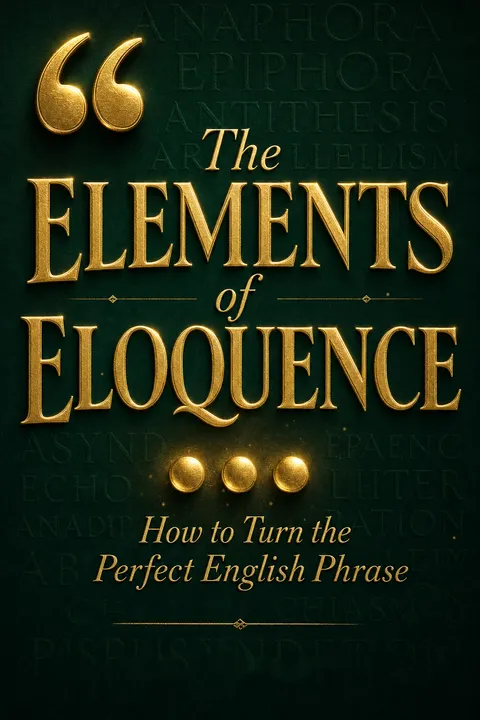
The Elements of Eloquence is praised for its witty and entertaining exploration of rhetorical devices in writing. Readers appreciate Forsyth's clear explanations, engaging examples, and humor. Many find the book informative and useful for improving their own writing. Some criticize the author's occasional overreaching or lack of primary research. The book's structure, with linked chapters covering various rhetorical techniques, is both clever and potentially tiresome. Overall, it's recommended for writers, language enthusiasts, and those interested in the mechanics of memorable phrases.
People Also Read

Glossary
Alliteration
Repeated initial soundsAlliteration repeats the same initial consonant sound in nearby words. It can give a phrase rhythm, emphasis, and a memorable sonic shape. Forsyth stresses that alliteration appears in proverbs, poetry, slogans, and advertising, sometimes helping a saying endure even as its meaning shifts.
Polyptoton
One word, changed formPolyptoton repeats a word or closely related word in different grammatical forms, such as using a verb and then its corresponding noun. The repetition connects the ideas while the grammatical change adds emphasis or play. It can occur even when the speaker does not know the technical name.
Antithesis
Balanced opposing ideasAntithesis places contrasting ideas in a balanced structure. The contrast may be simple or may turn against the audience's expectation. Its crisp form can make a distinction feel settled and memorable, even when the ideas are not genuinely exhaustive opposites.
Merism
Parts naming a wholeMerism refers to a whole by naming its parts, often through paired opposites or complementary categories. A phrase can imply totality without listing every possible element. The device appears in formal vows, songs, poetry, and legal language.
Hyperbaton
Unusual word orderHyperbaton places words in an unusual order, disrupting the expected sequence of a sentence. In English, where word order carries much of the grammatical information, a successful inversion can be striking and memorable. If the reader cannot recover the intended relation, it may simply seem confusing.
Anadiplosis
Clause-ending word repeatedAnadiplosis repeats the final word or phrase of one clause at the start of the next. The link creates a sense of progression, connection, or inevitability. It can make a chain of ideas sound logically compelling even when the reasoning between its steps is weak.
Periodic sentence
Main clause delayedA periodic sentence delays its grammatical completion, often placing the main clause near the end. Earlier phrases create expectation and require the reader to carry information forward. The structure can build suspense or grandeur, but excessive delay may make a sentence difficult to follow.
Hypotaxis
Nested subordinate clausesHypotaxis arranges clauses in a hierarchy, with subordinate clauses depending on or embedded within other clauses. It allows detailed qualifications and relationships to accumulate inside a sentence. Forsyth contrasts its deliberate complexity with the more direct sequence of parataxis.
Parataxis
Statements placed side by sideParataxis places clauses or sentences beside one another without making their grammatical dependence explicit. Its direct, sequential form can sound plain, brisk, or forceful. Forsyth contrasts it with hypotaxis, while noting that the effect depends on how a writer uses it.
Diacope
Repetition with interruptionDiacope repeats a word or phrase after a brief interruption. The inserted word may identify someone, add a description, or intensify the repeated expression. The pattern can give a line emphasis and finality, even when the repeated words themselves are ordinary.
Tricolon
Three-part sequenceA tricolon presents three parallel words, phrases, or clauses. The third element may complete a pattern, extend it, or overturn the expectation created by the first two. Forsyth argues that three-part structures often sound finished, which makes them especially useful in public rhetoric.
Chiasmus
Reversed parallel structureChiasmus reverses elements across two related clauses, creating a mirrored structure. The reversal can express reciprocity, contrast, or a reversal of roles. Because the form appears balanced, it can make a claim feel logical, although structural symmetry alone does not establish that the claim is true.
Syllepsis
One word, mismatched usesSyllepsis uses one word with two or more meanings or grammatical relationships that do not quite match. Often witty, it makes the reader reconsider how the shared word connects to each part of the sentence. Its comic surprise can become distracting if used too often.
Synecdoche
A part stands for a wholeSynecdoche uses a part to refer to a whole, or sometimes a whole to refer to a part. The selected fragment can condense a larger person, object, or event into a vivid image. It is a specific form of metonymy, which relies on association rather than similarity.
Anaphora
Repeated opening wordsAnaphora repeats a word or phrase at the beginning of successive clauses or sentences. It directs attention to the recurring opening and gives a passage rhythm and unity. In speeches, it can make the repeated idea dominate listeners' memories over the details that follow.
Congeries
A pile-up of detailsCongeries is a rhetorical accumulation of nouns, adjectives, or other elements into a list. Rather than offering a concise summary, it creates force through abundance. A long catalogue can build a vivid scene, comic excess, or a barrage of praise or insults.
FAQ
1. What is "The Elements of Eloquence" by Mark Forsyth about?
- Focus on Rhetorical Techniques: The book explores the classical figures of rhetoric—specific techniques and patterns used to craft memorable, persuasive, and beautiful English phrases.
- Demystifying Great Writing: Forsyth argues that great writing, from Shakespeare to pop songs, is not just about inspiration or genius, but about mastering and applying these rhetorical tricks.
- Structure and Approach: Each chapter is devoted to a different rhetorical figure, explaining its definition, history, and use, with examples from literature, music, and popular culture.
- Accessible and Entertaining: The book is written in a witty, conversational style, making complex linguistic concepts approachable and enjoyable for general readers.
2. Why should I read "The Elements of Eloquence" by Mark Forsyth?
- Unlocks the Secrets of Style: The book reveals the hidden formulas behind the most memorable lines in English, helping readers understand why certain phrases stick in the mind.
- Practical Writing Advice: By learning these rhetorical figures, readers can improve their own writing, making it more striking, persuasive, and memorable.
- Entertaining and Insightful: Forsyth’s humor and wide-ranging examples—from Shakespeare to advertising slogans—make the book both fun and enlightening.
- Appreciation of Language: It deepens readers’ appreciation for the artistry of language, showing that beauty in writing is often a matter of technique, not just inspiration.
3. What are the key takeaways from "The Elements of Eloquence"?
- Rhetoric is Learnable: Great writing is not just innate genius; it’s often the result of learned techniques and deliberate practice.
- Figures of Rhetoric Matter: Specific rhetorical devices—like alliteration, anaphora, and chiasmus—are the building blocks of memorable phrases.
- Form Over Content: The way something is said can be as important, or more so, than what is being said.
- Historical and Modern Relevance: These techniques are timeless, used by everyone from Shakespeare to modern songwriters and politicians.
4. How does Mark Forsyth define and explain rhetorical figures in "The Elements of Eloquence"?
- One Chapter per Figure: Each rhetorical device gets its own chapter, with a clear definition and explanation of how it works.
- Examples from Literature and Pop Culture: Forsyth illustrates each figure with famous lines from Shakespeare, the Bible, pop songs, movies, and more.
- Practical Demonstrations: He often rewrites ordinary sentences using the figure to show the dramatic difference in memorability and impact.
- Humorous Commentary: Forsyth’s explanations are laced with wit, making the learning process engaging and memorable.
5. What are some of the most important rhetorical figures covered in "The Elements of Eloquence"?
- Alliteration: The repetition of initial consonant sounds, making phrases catchy and memorable (e.g., "Full fathom five thy father lies").
- Polyptoton: Repeating a word in different grammatical forms (e.g., "Please Please Me").
- Antithesis: Juxtaposing contrasting ideas in balanced phrases (e.g., "It was the best of times, it was the worst of times").
- Anaphora and Epistrophe: Repeating words at the beginning or end of successive clauses for emphasis.
- Chiasmus: Mirroring words or structures for symmetry (e.g., "Ask not what your country can do for you...").
- Many More: The book covers dozens of figures, including merism, diacope, hendiadys, hyperbole, litotes, and more.
6. How does "The Elements of Eloquence" by Mark Forsyth show that great writing can be learned?
- Shakespeare as Example: Forsyth demonstrates that even Shakespeare started out poorly and improved by learning and practicing rhetorical figures.
- Historical Education: He explains that Elizabethan education focused on teaching these figures, and that writers like Shakespeare used them deliberately.
- Recipes for Memorable Lines: The book presents rhetorical figures as "recipes" that anyone can follow to craft striking phrases.
- Practice Over Inspiration: Forsyth debunks the myth of the "natural genius," emphasizing the role of technique and repetition.
7. What are some practical ways to use the advice from "The Elements of Eloquence" in my own writing?
- Identify and Apply Figures: Learn to recognize rhetorical figures and consciously use them to enhance your writing’s style and memorability.
- Experiment with Structure: Try rewriting ordinary sentences using different figures (e.g., alliteration, tricolon, anadiplosis) to see their effect.
- Focus on Form: Pay attention not just to what you say, but how you say it—structure, rhythm, and repetition can make your writing more persuasive.
- Avoid Overuse: Forsyth cautions that overusing any figure can be distracting or ridiculous; the key is to use them judiciously for maximum impact.
8. How does Mark Forsyth use humor and examples in "The Elements of Eloquence" to teach rhetorical concepts?
- Witty Commentary: Forsyth’s explanations are filled with jokes, playful asides, and tongue-in-cheek observations about language and literature.
- Pop Culture References: He draws on examples from pop songs, movies, and advertising, making the material relatable and lively.
- Parodies and Rewrites: Forsyth often rewrites famous lines or creates exaggerated examples to illustrate both the power and the pitfalls of each figure.
- Self-Deprecating Tone: The author pokes fun at himself and at the sometimes arcane world of rhetorical terminology, keeping the tone light.
9. What are some of the best quotes from "The Elements of Eloquence" and what do they mean?
- "Shakespeare was not a genius. He was, without the distant shadow of a doubt, the most wonderful writer who ever breathed. But not a genius." — Forsyth argues that Shakespeare’s greatness was due to learned technique, not innate genius.
- "Any phrase, so long as it alliterates, is memorable and will be believed even if it’s a bunch of nonsense." — Emphasizes the power of form over content.
- "A poet is not somebody who has great thoughts. That is the menial duty of the philosopher. A poet is somebody who expresses his thoughts, however commonplace they may be, exquisitely." — Highlights the importance of expression and style in poetry.
- "The figures are, to some extent, alive and well. We still use them. It’s just that we use them haphazardly." — Suggests that rhetorical figures are still present in everyday language, even if we’re not conscious of them.
10. How does "The Elements of Eloquence" by Mark Forsyth address the history and evolution of rhetorical figures?
- Ancient Origins: Forsyth traces many figures back to Ancient Greek and Roman rhetoric, showing their long-standing importance.
- Renaissance Revival: He explains how the Renaissance, especially in Elizabethan England, saw a renewed interest in rhetorical technique.
- Decline and Survival: The book discusses how the Romantic movement and modern education led to a decline in formal rhetoric, but the figures survived in popular culture.
- Ongoing Relevance: Forsyth demonstrates that these figures are still used today, often unconsciously, in everything from political speeches to advertising.
11. What are some advanced or lesser-known rhetorical figures explained in "The Elements of Eloquence"?
- Hendiadys: Using two nouns joined by "and" instead of an adjective and a noun (e.g., "sound and fury" instead of "furious sound").
- Diacope: Repetition of a word or phrase with a small intervening word or phrase (e.g., "Bond. James Bond.").
- Scesis Onomaton: A series of phrases or sentences without a main verb, often for dramatic effect.
- Prolepsis: Using a pronoun before introducing the noun it refers to, creating a sense of mystery or emphasis.
- Catachresis: Deliberate misuse or stretching of words, creating striking or jarring effects (e.g., "I will speak daggers to her, but use none").
12. How does "The Elements of Eloquence" by Mark Forsyth suggest readers approach the use of rhetorical figures in modern writing?
- Learn the Rules, Then Break Them: Forsyth encourages readers to master the figures, then use them creatively and flexibly.
- Blend Tradition and Innovation: He shows that while the figures are ancient, they can be adapted to modern contexts and styles.
- Use for Effect, Not Obscurity: The goal is to make writing more memorable and persuasive, not to show off or confuse the reader.
- Enjoy the Playfulness: Forsyth’s overall message is to take pleasure in the artistry of language, using rhetorical figures as tools for beauty and impact.
Download PDF
Download EPUB
.epub digital book format is ideal for reading ebooks on phones, tablets, and e-readers.








