

Key Takeaways
Treat self-control as managing inherited urges, not proving moral superiority.
Old instincts, new world. Burnham and Phelan argue that many frustrating impulses make sense in the conditions that shaped human evolution. An appetite for rich food helped when meals were uncertain; spending a windfall made more sense when stored food spoiled. In modern life, the same tendencies meet supermarkets, credit cards, and constant entertainment. The result is a mismatch between ancient motivations and new surroundings, not simply a shortage of character.
Genes are not the whole story. The authors stress that biology interacts with upbringing and circumstances. Their practical starting point is to recognize predictable vulnerabilities, then find ways to manage them. Knowing that a craving is likely to win at midnight, for instance, changes the useful question from “Why am I weak?” to “What can I arrange before then?”
The book's most useful shift is from moral blame to behavioral diagnosis. That does not excuse harmful choices; it makes responsibility more concrete by asking what conditions repeatedly produce them. Evolutionary explanations are strongest as hypotheses about broad pressures, not as proof that any specific modern behavior has a genetic cause. The distinction matters: a person can inherit tendencies without inheriting a fixed fate. The model invites readers to respect human limits while still taking responsibility for the systems, habits, and relationships they build around those limits.
Change the terrain before temptation arrives; willpower is a late defense.
Prepare while clear-headed. The authors repeatedly favor advance arrangements over last-minute resistance. One example is the person who removes tempting snacks after dinner, before the late-night craving begins. Another is Jay's decision to make savings difficult to reach, rather than trusting himself not to spend money sitting in his checking account. These strategies use a moment of relative strength to protect against a later moment of weakness.
Make good actions easier. Exercise becomes more appealing when attached to a commitment, such as a walking partner who expects you to show up. A paid membership can also make skipping feel costly. The principle is to structure the choice so that the desired action has less friction and the unwanted one has more. It is not a guarantee, but it can reduce how often self-control must carry the entire burden.
This is a practical theory of agency: freedom is not only the ability to choose in the moment, but also the ability to shape which choices will be easy to make. That makes planning a form of self-respect rather than a confession of weakness. The approach has limits, because not everyone controls their home, work schedule, or access to supportive people. Still, even small changes can matter when they target a recurring point of failure rather than relying on a fresh resolution every day.
Make saving automatic because modern money does not feel like food.
An ancient savings account. The book suggests that humans evolved to store energy in their bodies, not in bank accounts. In the authors' example, squirrels hide thousands of nuts for winter, while human ancestors often faced surplus food that could spoil or be taken. Eating extra could be a sensible way to preserve it. Money, by contrast, is an abstract, recent invention, and spending it can feel more natural than preserving it.
Hide money from impulse. In February 2000, the authors cite an American savings rate of just 0.8 percent. Their proposed fix is to save before spending: arrange payroll deductions, keep savings in a separate account without easy ATM access, and increase contributions when income rises. Jay used an automatic investment deducted from his credit-card bill. The common thread is making saving happen without requiring a monthly act of restraint.
The animal comparisons make an abstract financial problem memorable: the difficulty is not that people cannot understand saving, but that modern money does not activate an old, intuitive sense of stored food. Automatic transfers exploit that gap in a useful way. The book's numbers describe its period, not current conditions, and its evolutionary explanation should not obscure wages, debt costs, or unequal access to financial security. Still, the behavioral lesson is durable: a plan that happens before spending is more reliable than hoping there will be money left afterward.
Plan for appetite as a defended biological setting, not a character flaw.
The body resists scarcity. Chantek, an orangutan raised in captivity, reached about 500 pounds, while the book says wild orangutans commonly weigh around 160. The contrast illustrates how abundant food and little movement can amplify an appetite suited to harder conditions. The authors also describe a “set point,” a proposed range of body weight that the body defends by changing hunger and energy use. In their cited research, people who lost weight showed a lower metabolic rate, while weight loss increased production of neuropeptide Y, a chemical linked to carbohydrate cravings.
Plan instead of starving. The authors argue that severe restriction can intensify hunger and make weight loss difficult to sustain. They recommend deciding in advance what kinds of foods to eat, tracking intake, and changing the environment around tempting foods. They also suggest making movement serve a goal, such as walking with a partner or earning access to food through activity.
This account makes weight regulation more complex than a simple instruction to eat less. It helps explain why extreme restriction can feel punishing and why a plan for food and activity may be more sustainable than a cycle of deprivation. The “set point” is a model, not a precise personal target, and biological influence does not make weight change impossible. The book's useful contribution is to treat hunger as information about a body defending itself, while still recognizing that food choices and surroundings can be changed.
Treat addiction as a hijacked reward system, not a simple choice.
Chemical signals shape desire. The book describes the brain's reward pathways as systems that encourage useful behaviors by making them pleasurable. Drugs can imitate or alter the chemical signals involved. Cocaine, for example, blocks the recycling of dopamine, prolonging its effects in the brain. Repeated use can produce tolerance, so the same dose has less effect, while stopping can bring withdrawal. The authors compare this to a body adjusting to an outside chemical by changing its own internal machinery.
Willpower has company. The authors argue that “just say no” is often inadequate for people with addiction. They discuss approaches that reduce harm or change the experience of a drug, including nicotine patches and methadone, and describe Antabuse as making alcohol unpleasant to consume. These are historical examples from the book, not current treatment advice. The underlying lesson is to seek tools and support that alter the cycle, rather than treating relapse as proof of bad character.
The reward-pathway account helps explain why a person can sincerely want to stop and still feel pulled toward the drug. It also shifts the focus from moral condemnation toward treatment and practical support. At the same time, a chemical explanation cannot capture every cause of addiction or determine which intervention will work for a particular person. The strongest reading is neither “choice explains everything” nor “biology removes responsibility.” It is that powerful cravings change the conditions under which choices are made, so support should address those conditions.
Price modern risks with math, not instincts tuned to ancestral dangers.
Intuition misreads odds. The authors contrast vivid ancestral dangers with risks that dominate modern life. They report that Americans feared natural disasters more than diabetes, although diabetes killed many more people in the year they examined. A lottery example makes the same point: the California drawing described in the book required matching six numbers and had odds of about one in eighteen million. People often feel that a possible prize is more attainable than it is.
Use base rates. In the book's HIV-test example, one person in a thousand is infected and the test is described as 95 percent accurate. A positive result among this low-risk group means many false alarms can outnumber true positives; the authors calculate that the chance the person is infected is under 2 percent. For financial bets, insurance, and medical tests, the practical advice is to calculate probabilities rather than trust the strength of a feeling.
The examples expose a gap between emotional vividness and statistical frequency. A rare, dramatic event can feel more dangerous than a common, less visible one, while a jackpot can feel close simply because it is easy to imagine winning. The remedy is not to ignore intuition, but to ask what information it leaves out, especially the base rate and the cost of being wrong. Probability alone does not settle every decision: severity, uncertainty, and personal circumstances matter too. But it is a better starting point than vividness.
Stop expecting possessions to deliver lasting happiness; design for progress and surprise.
Good fortune fades into normal. The authors describe research in which lottery winners and people who suffered severe accidents moved back toward their earlier levels of reported happiness. They also note that, across the decades they examine, rising average income in the United States did not bring a corresponding rise in average life satisfaction. Their point is not that money never helps, but that people adapt quickly to changed circumstances and shift their expectations.
Build satisfaction into the process. The book uses “flow” for an experience of being absorbed in a challenging activity with a clear goal and a sense of control. It recommends breaking large tasks into smaller steps so progress is visible, and offering small, unexpected gifts rather than concentrating all generosity on expected occasions. These choices create more moments of progress and positive surprise than simply waiting for a major purchase to transform daily life.
The distinction between a brief lift and lasting satisfaction helps explain why upgrades often disappoint: the new condition becomes ordinary, while the desire for the next improvement remains. The book's emphasis on progress also gives ambition a more workable target than permanent contentment. Its broad claims about income and happiness should not be read as saying that material security is irrelevant; the examples concern average long-term satisfaction, not every individual's needs. The practical question is whether a purchase improves daily life after the novelty wears off.
Read attraction and infidelity through biology, but never mistake tendencies for destiny.
Some preferences recur. The book argues that attraction is not purely a fashion imposed by culture. It points to studies in which people from different cultures favored similar faces, and to research on symmetry, a rough indicator of how evenly a body developed. It also describes a waist-to-hip ratio near 0.7 among Miss America winners across several decades. The authors interpret such patterns as clues to health or fertility, while acknowledging that cultural standards also change.
Commitments face competing pulls. The authors interpret differences in jealousy through reproductive risks: men in their surveys were more distressed by a partner's sexual affair, while women were more distressed by emotional attachment elsewhere. Their account also links marriage to exchanged commitments, care, and resources. These are population-level claims from a book published in 2000, not rules for every couple. Its practical counsel is to make commitments explicit, give partners attention, and avoid secrecy that breeds suspicion.
Evolutionary explanations can make recurring preferences feel less mysterious, but the distance from a population pattern to an individual prediction is large. Cultural rules, personal history, and the terms partners negotiate all shape intimate life. The book is most useful when its account of biology broadens awareness of possible pressures, not when it is used to excuse betrayal or prescribe gender roles. Its strongest relationship advice is less controversial than its explanations: trust requires attention, candor, and commitments that both people understand.
Build trust through reciprocal favors, clear expectations, and proportionate accountability.
Cooperation needs balance. The authors describe reciprocal help as a way to manage uncertainty: one person contributes now with the expectation that help may return in the future. They compare this with vampire bats sharing food after an unsuccessful hunt. Human cooperation is more complex, but the same concern about being exploited appears in the book's account of the ultimatum game. When one person offers an unfair split, people sometimes reject even a small payment, choosing to punish the unfairness.
Keep relationships from tipping. A $10,000 loan from Patricia to a struggling friend, Katherine, ended in resentment when it was never repaid and the friendship collapsed. The authors argue that large, unspoken obligations can strain a relationship. Clear terms, manageable favors, and fair exchanges help keep trust intact. Their argument also applies to gifts: a thoughtful gesture can strengthen a relationship, but gifts can carry expectations even when nobody states them aloud.
Reciprocity is a useful lens for understanding why trust depends on memory, fairness, and credible expectations rather than goodwill alone. It also explains why a gesture can feel warm to one person and burdensome to another. Yet relationships are not merely ledgers, and generosity can matter even when repayment is unlikely. The book's practical insight is to make obligations legible before they become resentments. Fairness is easier to sustain when people can discuss what a favor means instead of silently keeping score.
Keep pleasure, but replace its dangerous delivery system.
Desire need not be erased. In the Odyssey, Odysseus wants to hear the Sirens' song but knows it could lead his ship to destruction. He has himself tied to the mast and orders his crew not to release him. The story illustrates the book's central tactic: anticipate how a desire can overpower judgment, then arrange a safer way to experience it. The authors point to roller coasters as a way to enjoy an artificial rush of danger without facing the risks of a real crisis.
Find safer substitutes. The same logic appears in the book's discussion of nicotine patches and methadone, which aim to satisfy a craving while reducing some of its costs. Substitutes are imperfect, but they can make pleasure less destructive. The aim is not to become desireless or to rely only on heroic discipline. It is to preserve enjoyable parts of life while changing the route by which an impulse is satisfied.
This closing idea avoids a false choice between indulging every urge and suppressing every pleasure. It treats self-control as a design problem: keep what is rewarding, but alter the conditions or substitute the behavior that makes it dangerous. The approach can be humane because it does not require people to pretend they have no cravings. It also requires care, since a substitute can carry its own costs and may not address the source of distress. The central skill is choosing pleasure with its consequences in view.
Analysis
Mean Genes offers a memorable organizing idea: many modern self-control problems emerge when motivations shaped under scarcity meet abundance, convenience, and technologies designed to capture attention. Its best practical contribution is not a claim that genes dictate behavior, but a method for anticipating weak points and changing the conditions around them. Automatic savings, planned meals, and limits on access all convert biological insight into a manageable choice.
The evolutionary lens is illuminating but uneven. It can generate plausible explanations for appetite, risk, attraction, and cooperation, yet a plausible story about ancestral advantage is not direct evidence that a present-day behavior evolved for that reason. This is the familiar risk of adaptationist reasoning: several different histories may explain the same pattern, while culture and institutions can reshape behavior quickly. The book often acknowledges environmental influence, but its confident, gendered explanations sometimes outrun what its examples establish.
Its publication in 2000 also matters. The statistics and medical examples are period-specific, and claims about weight regulation, addiction, sex differences, and particular genes should not be used as current clinical guidance. Those details do not erase the book's central insight, but they call for separating its durable behavioral strategies from historical scientific claims. A modern reading connects the book's strongest advice with behavioral economics and public health: decisions are shaped by defaults, friction, incentives, and access, not only by stated intentions. This widens the responsibility frame. Individuals can redesign parts of their lives, but employers, financial firms, food companies, and governments also shape the available terrain. The book is most valuable when it turns self-knowledge into practical design, and least reliable when a broad evolutionary story is treated as a complete explanation of an individual life.
Review Summary
Mean Genes explores how evolutionary biology influences human behavior, offering insights into why we struggle with self-control, overeating, and other impulses. Readers appreciate its accessible style and scientific approach to self-help, though some find the content repetitive or outdated. The book explains how behaviors that were once advantageous for survival may now be detrimental, providing strategies to overcome genetic predispositions. While some praise its entertaining and informative nature, others critique its simplistic solutions and lack of depth in certain areas.
People Also Read









Glossary
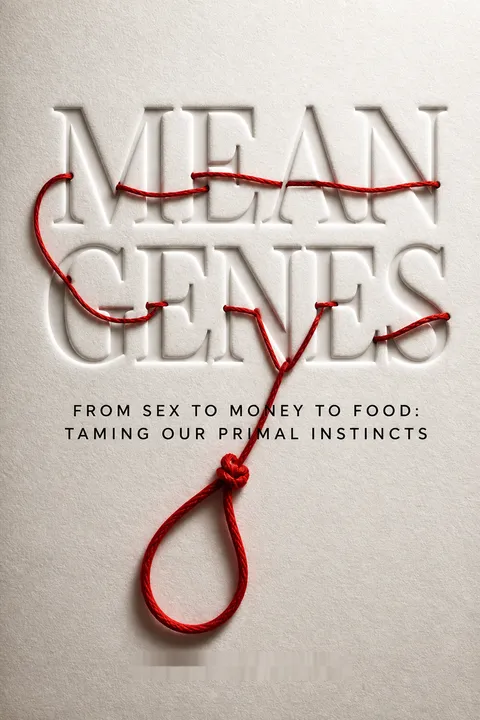
Mean Genes
Inherited impulses that challenge controlThe authors' name for inherited tendencies that can work against a person's considered goals in modern settings. The phrase is metaphorical: genes do not consciously scheme. It describes the tension between biological motivations shaped over evolutionary time and environments that can make those motivations costly, such as abundant food, easy credit, or highly rewarding drugs.
pet path
Following immediate urgesThe authors' label for living mainly by immediate feelings of pleasure and pain, much as they describe other animals doing. On this path, a person eats when hungry, repeats what feels good, and avoids discomfort without deliberately considering long-term goals. The alternative is conscious regulation of impulses, rather than assuming instinct will serve modern interests.
set point
A defended weight rangeA model of body-weight regulation in which the body and mind respond when weight shifts from a defended range. In the book's account, weight loss can prompt greater hunger and a slower metabolic rate, while weight gain can prompt changes in the opposite direction. The model helps explain why weight loss can be difficult to maintain, but it should not be treated as a fixed, exact number for every person.
do-it-again centers
Brain reward pathwaysThe authors' informal term for brain systems that make certain experiences pleasurable and increase the likelihood that the behavior associated with them will be repeated. They describe natural rewards, such as food and sex, as activating these pathways. Drugs can imitate or alter chemical signals in the same systems, producing powerful rewards without the original behavior.
flow
Absorption in a challenging taskA term used in the book for an enjoyable state of focused engagement. The person feels able to act, is using relevant skills, and is working toward a clear, challenging goal. Attention becomes absorbed in the activity and self-consciousness recedes. The authors use the idea to explain why purposeful work or practice can feel more satisfying than passive leisure.
mate guarding
Actions limiting partner accessBehavior intended to reduce the chance that a romantic or sexual partner will form another mating relationship. The book uses examples ranging from publicly signaling a relationship to spending more time near a partner. It interprets these actions as responses to reproductive uncertainty, but the term describes behavior, not a justification for controlling or coercive conduct.
MHC or HLA
Immune-system gene markersMHC, or HLA in humans, refers to genes involved in immune-system function. The book discusses research suggesting that people may prefer partners with different versions of these markers, potentially combining immune-system variants in offspring. This is presented as one possible biological influence on attraction, not a complete explanation of partner choice or a reliable way to predict an individual's preferences.
FAQ
What's "Mean Genes: From Sex to Money to Food Taming Our Primal Instincts" about?
- Overview: "Mean Genes" by Terry Burnham and Jay Phelan explores how our genetic makeup influences our behaviors and desires, often leading us to make choices that are not in our best interest.
- Focus Areas: The book covers a range of topics including sex, money, food, drugs, risk-taking, and relationships, examining how our primal instincts drive these behaviors.
- Purpose: It aims to provide readers with insights into why we struggle with self-control and offers strategies to manage these instincts effectively.
- Approach: The authors use a combination of scientific research, evolutionary biology, and personal anecdotes to explain complex concepts in an accessible manner.
Why should I read "Mean Genes"?
- Self-Understanding: The book offers a deep dive into understanding why we behave the way we do, providing a "manual" for our brains.
- Practical Advice: It provides actionable strategies to help manage and tame our primal instincts, making it a practical guide for improving self-control.
- Scientific Insight: The book is grounded in evolutionary biology, offering scientific explanations for everyday behaviors and challenges.
- Engaging Style: With a mix of humor, personal stories, and scientific data, the book is both informative and entertaining.
What are the key takeaways of "Mean Genes"?
- Genetic Influence: Our genes play a significant role in shaping our desires and behaviors, often leading us to make irrational choices.
- Self-Control Strategies: Understanding our genetic predispositions can help us develop strategies to manage our instincts and improve self-control.
- Evolutionary Perspective: Many of our modern struggles, such as overeating and addiction, can be traced back to survival mechanisms from our evolutionary past.
- Behavioral Change: Small, incremental changes in behavior can lead to significant improvements in managing our primal instincts.
How do Burnham and Phelan suggest we manage our primal instincts?
- Awareness: The first step is understanding that our instincts are deeply rooted in our genes and recognizing when they are influencing our behavior.
- Incremental Change: The authors advocate for making small, manageable changes rather than attempting drastic overhauls.
- Environmental Control: Altering our environment to reduce temptation can be more effective than relying solely on willpower.
- Technological Aids: Utilizing modern technology, such as food substitutes or financial tools, can help mitigate the effects of our instincts.
What are the best quotes from "Mean Genes" and what do they mean?
- "Our toughest battles are with ourselves." This quote encapsulates the book's central theme that self-control is a constant struggle against our genetic programming.
- "Like it or not, we are each engaged in a battle against our own set of mean genes." This highlights the idea that our genes are not always aligned with our best interests.
- "The twig of human nature is indeed bent from the start." This suggests that our natural inclinations are often at odds with societal expectations and personal goals.
- "We are not lumbering robots doomed to carry out our genetic programming." This emphasizes the potential for change and self-improvement despite our genetic predispositions.
How does "Mean Genes" explain the role of genetics in financial behavior?
- Evolutionary Background: The book explains that our ancestors lived in environments where immediate consumption was necessary for survival, influencing our modern spending habits.
- Instinctual Spending: Our genetic predisposition to consume rather than save is a survival mechanism that is maladaptive in today's financial world.
- Practical Solutions: The authors suggest strategies like hiding money from ourselves and using automatic savings plans to counteract our instinctual spending habits.
- Cultural Comparisons: The book contrasts different cultural approaches to saving and spending, highlighting the flexibility of these behaviors.
What insights does "Mean Genes" offer about dieting and weight control?
- Thrifty Genes: Our genes are programmed to store fat as a survival mechanism, making weight loss challenging in a world of abundance.
- Set Point Theory: The book discusses the concept of a "set point" for weight, where the body resists changes to its established weight.
- Behavioral Strategies: The authors recommend focusing on the type of calories consumed and keeping detailed records of eating habits to manage weight effectively.
- Technological Interventions: They also explore the potential of food substitutes and pharmaceuticals to aid in weight control.
How does "Mean Genes" address addiction and substance abuse?
- Pleasure Pathways: The book explains how drugs hijack the brain's natural reward systems, making them highly addictive.
- Genetic Predisposition: Some individuals have genetic variations that make them more susceptible to addiction.
- Willpower Limitations: The authors argue that willpower alone is often insufficient to overcome addiction, advocating for technological and medical interventions.
- Preventive Measures: They suggest that understanding one's genetic risk can help in making informed choices about substance use.
What does "Mean Genes" say about risk-taking behavior?
- Genetic Thrill-Seeking: The book posits that some people have a genetic predisposition to seek out risky activities for the dopamine rush they provide.
- Evolutionary Advantage: Risk-taking may have been advantageous for our ancestors in exploring new territories and securing resources.
- Modern Implications: In today's world, this can manifest in gambling, extreme sports, and other high-risk behaviors.
- Managing Risks: The authors suggest finding safer outlets for thrill-seeking, such as roller-coasters or video games, to satisfy these instincts.
How does "Mean Genes" explore the concept of beauty and attraction?
- Biological Basis: The book argues that beauty standards are rooted in biological signals of health and fertility, such as symmetry and clear skin.
- Cultural Universality: Despite cultural variations, certain aspects of beauty are universally recognized, indicating a genetic basis.
- Mate Selection: The authors discuss how these standards influence mate selection and reproductive success.
- Practical Implications: Understanding these instincts can help individuals navigate relationships and societal expectations.
What does "Mean Genes" reveal about gender roles and relationships?
- Biological Differences: The book explores how genetic and hormonal differences influence traditional gender roles and behaviors.
- Evolutionary Context: Many gender-specific behaviors have evolutionary roots, such as male risk-taking and female mate selection criteria.
- Cultural Influences: While acknowledging cultural impacts, the authors emphasize the underlying biological factors that shape gender dynamics.
- Relationship Strategies: They offer insights into how understanding these differences can improve communication and satisfaction in relationships.
How can "Mean Genes" help improve personal relationships?
- Understanding Instincts: Recognizing the genetic basis for certain behaviors can lead to more empathy and better communication.
- Managing Expectations: The book suggests setting realistic expectations based on an understanding of human nature.
- Strengthening Bonds: It offers practical advice for maintaining strong relationships, such as regular gift-giving and shared activities.
- Conflict Resolution: By understanding the genetic roots of conflict, individuals can develop more effective strategies for resolving disputes.
Download PDF
Download EPUB
.epub digital book format is ideal for reading ebooks on phones, tablets, and e-readers.








