

Key Takeaways
Make sex education a series of small conversations, not one awkward speech
Start before a crisis. The book opens with Zaloom’s shock when her twelve-year-old daughter receives a sexualized message from a longtime friend, then brushes off her mother’s concern. The episode shows how early teens encounter sexual scripts, often before adults expect them to. A single lecture cannot prepare a young person for changing relationships, online pressure, and new questions as they arise.
Build a habit of dialogue. Talk during ordinary moments, such as a car ride or kitchen cleanup. Ask what a teen thinks before offering conclusions, listen more than you speak, and admit when you need to find an answer. Short conversations, repeated over time, make sensitive topics less like a family emergency and more like something a teen can bring to a trusted adult.
The book treats communication as prevention infrastructure, not merely a parenting style. Repeated, low-pressure exchanges give teens practice naming discomfort before they need to act under stress. This resembles learning in other domains: people handle unfamiliar situations better when they have rehearsed concepts and language in advance. The approach also respects adolescent autonomy by letting a young person shape the pace. One limitation is that not every parent is safe or informed; the larger principle is access to at least one reliable adult, whether at home, school, or in health care.
Treat consent as active, reversible agreement, not silence or assumed permission
Permission requires agency. Zaloom uses the familiar problem of friends taking fries without asking to make consent concrete: sharing might be welcome, but taking without checking denies the owner a choice. Sexual consent is an agreement that both people want what is happening. Affirmative consent means clear agreement, freely given by someone able to decide, and maintained as the interaction continues. It can be withdrawn at any time.
Each step needs attention. A yes to kissing does not authorize another activity. A relationship, earlier sexual experience, silence, or a body’s involuntary response is not permission. Pressure, threats, and impaired capacity undermine consent. In the book’s example, Phil asks to pause until a condom is available, then asks to stop when sex feels wrong. His partner’s refusal to stop violates the agreement. Laws and age rules vary by jurisdiction.
Consent is best understood here as real-time coordination, not a one-time contract or a magic phrase. That framing connects sexual ethics to human factors: systems are safer when people can detect changing conditions and correct course without penalty. It also highlights a hard truth about power. Someone may say yes while fearing social, emotional, or physical consequences, so the words alone cannot settle whether agreement is freely given. Clear verbal check-ins help, while attention to hesitation and context prevents the practice from becoming a mechanical checkbox.
Aim beyond legal consent toward safety, reciprocity, and pleasure for both
Legality is a floor. The book distinguishes legal sex from ethical sex and from good sex. Ethical sex considers both partners’ well-being and the effects of the choice; good sex is also wanted, safe, and satisfying for both. Two people can agree to an activity and still leave one feeling pressured, ignored, or unhappy. That difference matters: a minimum legal standard is not the same as a healthy encounter.
Readiness belongs to each person. Before intimacy, teens can consider their boundaries, motives, safety, and ability to communicate. The book’s couple Sophie and Jackson discuss readiness and protection, check in with each other, and make room for awkwardness rather than treating it as failure. The author also notes that committed relationships are not a requirement for good sex; casual intimacy can be positive when both people are clear, capable, considerate, and mutually engaged.
This distinction is valuable because law tends to define prohibited conduct, while relationships require a richer account of care. The framework makes room for pleasure as a legitimate part of sexual health, rather than treating education as a catalogue of dangers. It also guards against implying that commitment automatically makes sex safe or ethical. The book’s preference for connection reflects what many teens say they want, but the stronger test is alignment: partners should understand one another’s expectations and have equal room to choose, whether the relationship is casual or serious.
Teach teens to question the scripts porn and gender stereotypes hand them
Scripts shape expectations. Zaloom calls culturally normalized expectations about sex and sexuality “sexpectations.” Media and peer talk can present boys as dominant and emotionally detached, while girls are expected to be accommodating, attractive, and responsible for a partner’s pleasure. These rules can leave everyone less able to speak honestly. The author’s classroom exercise finds students readily naming contrasting expectations for masculinity and femininity, including pressure on boys to hide vulnerability and on girls to avoid both prude-shaming and slut-shaming.
Porn is entertainment, not instruction. The book describes mainstream online pornography as staged, edited, and often one-sided, with little modeling of negotiation, protection, or mutual pleasure. A 2008 survey cited in the book found online pornography exposure during adolescence among 93 percent of male and 62 percent of female college respondents. The author also cautions that research cannot establish a simple cause-and-effect link between viewing porn and risky behavior.
The useful move is not to treat curiosity as wrongdoing, but to ask who made a sexual image, what it leaves out, and whose pleasure it centers. That is media literacy applied to intimacy. It can help young people distinguish a performance designed for an audience from the negotiation required between actual partners. The book’s attention to gender scripts is especially strong because it shows how restrictive norms harm boys as well as girls. Its broader claims about porn’s effects deserve restraint: exposure, selection, and behavior can influence one another, and correlation is not proof of cause.
Replace the hookup myth with skills for building trust and real connection
The supposed norm is exaggerated. A 2015 CDC survey cited in the book found nearly 60 percent of U.S. high school students had not had sex. A 2017 Harvard Graduate School of Education report found that 85 percent of the young people surveyed wanted sex within a serious romantic relationship. These figures challenge the idea that everyone is constantly hooking up, a myth that can make teens feel behind or push them toward experiences they do not want.
Connection is learned. Zaloom encourages teens to practice asking someone out directly, accepting a no without gossip or retaliation, and building trust through shared time. She describes a student who knew how to arrange a hookup but did not know how to ask someone on a date. That gap reveals how a culture rich in sexual imagery can still leave young people without basic relationship skills. Relationships can teach communication, care, and self-knowledge, even when they do not last.
The statistics matter less as a universal portrait than as a correction to a powerful social illusion. When people believe a behavior is common, they may conform even when their private preference differs. Naming that gap can reduce pressure and make room for deliberate choice. Still, the book’s contrast between hookup culture and committed love should not become a new hierarchy. Some people genuinely prefer casual sex, and some committed relationships are unhealthy. Trust, honesty, mutuality, and freely chosen expectations are more useful measures than the relationship label.
Give bystanders simple ways to interrupt harm without playing hero
Intervene in proportion to risk. Bystander intervention means taking action as someone who is neither the target nor the person causing harm. It can be direct, indirect, or delegated: challenge a degrading comment, create a distraction, recruit friends, or alert an adult or authority. The book’s party example shows Jenny noticing that Maya is intoxicated and being isolated. With a friend’s help, she invents a reason to bring Maya away, avoiding a confrontation that could escalate.
Practice the words beforehand. Teens may stay quiet because they fear losing status, being mocked, or becoming a target themselves. Scenario discussions let them rehearse brief responses and consider safer alternatives. Online, bystanders can refuse to share intimate images, tell peers that forwarding them can cause serious harm, and support the person whose privacy was violated. The goal is not to prove bravery; it is to reduce danger and connect someone to help.
The book turns bystander action from a moral slogan into a menu of behaviors, which matters because high-pressure moments narrow people’s options. Rehearsed scripts lower the effort required to act, and recruiting others distributes both risk and responsibility. This fits a broader prevention principle: norms shift when ordinary participants stop rewarding harmful conduct with silence or laughter. Individual intervention is not a substitute for accountable schools or safer institutions, however. Bystanders should assess danger and use authority or emergency support when direct involvement could increase the threat.
Plan for risk without making survivors responsible for someone else’s choice
Safety advice is not blame. The author stresses that assault is never a consequence a person deserves for drinking, trusting someone, or making an imperfect decision. Practical planning can still reduce exposure: go with a trusted friend, agree to check on each other, plan transportation, avoid being isolated with someone unfamiliar, and leave when a situation feels wrong. In one story, a student at a college concert becomes dangerously intoxicated and is groped; bystanders intervene and get her medical attention.
Digital space has real stakes. Private images can be copied and circulated, and an online stranger may use familiarity or threats to extract more material. The book calls threats to expose intimate images in exchange for further sexual content sextortion. It advises preserving threatening messages and seeking trusted adult or professional help. Laws around explicit images involving minors differ, and the book’s legal discussion should not replace current local advice.
This section handles a delicate tension: people deserve agency, yet prevention advice can sound like a burden placed on those most at risk. The distinction depends on where responsibility is located. Precautions are tools for navigating an unsafe environment, not conditions a survivor must satisfy to be believed. The same logic applies online: privacy habits may limit exposure, but coercion remains the responsibility of the person using threats. Practical plans work best when friends and institutions share the protective role instead of asking one teen to anticipate every danger.
After disclosure, believe the teen and return control of next steps
The response can shape recovery. Survivor accounts show how assault may be followed by isolation, online harassment, disbelief, and threats. One contributor describes a long delay before reporting, then severe bullying and a suicide attempt. Others describe freezing or struggling to name what happened. A frozen response does not mean agreement. The book urges the first person told to listen, affirm that the assault was not the survivor’s fault, avoid interrogation, and let the survivor choose among support options.
Offer choices, not commands. A teen may seek medical care, counseling, a forensic interview, school support, or law enforcement involvement; the appropriate options depend on circumstances and location. Title IX is the federal education law discussed in the book in relation to sex discrimination at federally funded schools. If a teen is accused, the book advises parents to obtain local legal counsel and therapeutic support, since school discipline and criminal processes are different and consequential.
Restoring choice is not a soft extra; it directly addresses the loss of control that often defines an assault. A supportive adult can make the next step manageable by offering options, practical company, and continued attention without demanding a particular account or outcome. The same care for process applies when someone is accused: support should not become a presumption of innocence or guilt, and legal advice should come from qualified counsel. The book’s survivor narratives make clear that institutional response can either reduce isolation or compound harm, so procedure and compassion belong together.
Analysis
This is both a practical guide and a teaching method. Its governing idea is that sexual health is learned through repeated conversations about agency, attention, care, and consequences, not delivered in a single “talk.” Zaloom moves across several levels: a young person’s bodily autonomy, the conduct of partners, peer-group norms, digital spaces, and the responsibilities of families and schools. The classroom scenarios are central to that structure. They turn abstract rules into recognizable decisions, such as whether to notice hesitation, interrupt a friend’s pressure, or help someone leave an unsafe room.
The book’s strongest contribution is its insistence that consent and pleasure are connected to communication. That framing makes consent more than a legal threshold and makes good sex more than performance. It also broadens the discussion beyond heterosexual couples, including queer and transgender teens, and recognizes that boys can be harassed or assaulted. Its practical advice is unusually attentive to the social costs of speaking up, especially fear of rejection, ridicule, and loss of status.
A tension remains between empowering young people and asking them to manage hazards created by others. The author explicitly rejects victim-blaming, but long safety checklists can still be heard as a burden unless adults also emphasize prevention, accountability, and institutional responsibility. The book’s emphasis on relationships reflects the reported preferences of many teens, yet relationship status cannot serve as a proxy for ethical conduct. The better standard is mutual clarity and respect, in any form of relationship.
The evidence and legal material require particular care. The text was published in 2019, its statistics come from studies with specific dates and populations, and legal definitions vary by jurisdiction. Some scientific claims about sexual bonding or pornography are less settled than the practical recommendations around communication and capacity. Read as an educational framework rather than a current legal manual, the book’s lasting value lies in teaching readers how to think through changing situations, seek support, and preserve each person’s dignity.
Review Summary
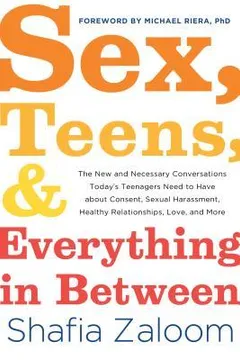
Sex, Teens, and Everything in Between receives high praise for its comprehensive, inclusive approach to teen sexuality education. Readers appreciate its focus on consent, safety, and fostering meaningful conversations. The book is lauded for its engaging writing style, real-life scenarios, and discussion questions. Many reviewers recommend it for parents, educators, and teens themselves. Some critiques mention repetitiveness and heavy reliance on alcohol-related examples. Overall, the book is considered an invaluable resource for navigating difficult but essential topics surrounding teen sexuality and relationships.
People Also Read









Glossary
Affirmative consent
Clear, freely given agreementAn agreement to a specific sexual activity, expressed clearly by someone with the capacity to choose and free from pressure or coercion. In the book’s account, consent must remain active as intimacy changes, and it can be withdrawn at any time. Silence, prior sexual activity, or agreement to one act does not establish consent to another.
Incapacitated
Unable to decide or communicateA state in which a person cannot think clearly or make or communicate a meaningful choice, often because of alcohol or another substance. The book emphasizes that intoxication affects people differently and that someone who is incapacitated cannot give valid consent. Specific legal standards and determinations depend on jurisdiction and circumstances.
Sexpectations
Cultural expectations about sexZaloom’s term for normalized cultural expectations that shape how people think sex should look and how partners should behave. These expectations can come from pornography, popular media, gender stereotypes, and peer talk. They may prioritize performance, conquest, or appearance over communication, personal readiness, emotional safety, and mutual pleasure.
Gender paradigm
Interlocking gender rulesThe mutually reinforcing cultural expectations attached to binary ideas of masculinity and femininity. In the book’s examples, boys may be expected to dominate and conceal vulnerability, while girls may be expected to accommodate others and manage their own desirability. These roles can constrain people’s self-expression and make reciprocal communication harder.
Bystander intervention
Action to interrupt potential harmAction taken by someone who is neither the person causing harm nor the person targeted, with the aim of preventing or interrupting harassment or assault. It may involve speaking directly, creating a distraction, recruiting others, or contacting an adult or authority. The appropriate response depends on the situation and the bystander’s safety.
Title IX
Federal education sex-discrimination lawTitle IX of the Education Amendments of 1972 is the federal civil rights law described in the book as prohibiting sex discrimination in education programs or activities receiving federal financial assistance. The book discusses it in connection with schools’ responses to sex-based harassment and violence. How it applies to a particular situation depends on current rules and specific facts.
Forensic interview
Trauma-informed fact-gathering interviewAn interview conducted by a trained professional using an approach intended to support a person reporting abuse and reduce unnecessary repeated questioning. The book presents it as a way to gather information while limiting the risk of retraumatization. Availability, procedures, and the role of an interview vary across jurisdictions and cases.
Sextortion
Threats used to obtain sexual materialThe use of threats involving intimate images to pressure someone into providing additional sexual images, videos, or activity. In the book’s example, an online adult uses attention and apparent familiarity to obtain images from a teenager, then threatens to distribute them unless the teen complies. The term describes coercion, not freely given agreement.
FAQ
What's Sex, Teens, and Everything in Between about?
- Focus on Teen Issues: The book addresses essential conversations that teenagers need to have about consent, sexual harassment, healthy relationships, and love.
- Educational Approach: Shafia Zaloom uses her experience as a health educator to present real-life scenarios and practical advice, facilitating dialogues between parents and teens.
- Empowerment Through Knowledge: It aims to empower teens to make informed decisions about their bodies and relationships, promoting a culture of respect and understanding.
Why should I read Sex, Teens, and Everything in Between?
- Essential Conversations: It is crucial for parents and teens who want to engage in meaningful discussions about sexuality and relationships.
- Real-Life Scenarios: The book includes relatable stories and examples that resonate with both teens and parents, making complex topics accessible.
- Promotes Healthy Relationships: Readers gain insights into fostering healthy, respectful relationships, vital for emotional and physical well-being.
What are the key takeaways of Sex, Teens, and Everything in Between?
- Consent is Key: Consent must be affirmative, conscious, voluntary, and ongoing, with silence not equating to consent.
- Understanding Sexual Dynamics: It explores societal pressures and media portrayals affecting teens' perceptions of relationships.
- Empathy and Communication: The book stresses the importance of empathy and effective communication in relationships.
How does Sex, Teens, and Everything in Between define consent?
- Affirmative Consent: Consent is an agreement where both individuals actively want and accept what is happening, communicated verbally or through affirmative actions.
- Ongoing Process: Consent must be sought and confirmed throughout any sexual encounter, ensuring comfort and willingness.
- Legal and Ethical Dimensions: Consent cannot be given if someone is incapacitated by drugs or alcohol, highlighting legal implications.
How does Sex, Teens, and Everything in Between address the issue of sexual harassment?
- Real-World Examples: The book provides narratives of individuals who have experienced sexual harassment, illustrating its emotional and psychological impact.
- Legal Rights: It outlines the rights of teens and the legal consequences of sexual harassment and assault, empowering readers to seek help.
- Bystander Intervention: Zaloom discusses the role of bystanders in preventing harassment and supporting victims, encouraging action against inappropriate behavior.
What practical tips does Sex, Teens, and Everything in Between offer for parents?
- Start the Conversation Early: Parents are encouraged to initiate discussions about sex and relationships early and make them ongoing.
- Use Everyday Contexts: The book suggests using everyday situations, like watching a movie, to discuss themes of consent and relationships.
- Be Open and Honest: Creating a safe space for teens to ask questions and express feelings without judgment fosters trust and communication.
What are the best quotes from Sex, Teens, and Everything in Between and what do they mean?
- “Consent is about educating others on how to treat you and listening for how others want to be treated.”: This quote encapsulates consent as mutual understanding and respect for boundaries.
- “Sexual well-being is about feeling respected and safe so you can be vulnerable and intimate with another person.”: It highlights the importance of emotional safety in sexual relationships.
- “The discovery of sexuality with a dedicated partner with whom you can explore, experiment, share, and grow is a gift.”: This reflects the positive aspects of healthy relationships and mutual exploration.
How does Sex, Teens, and Everything in Between discuss the impact of media on teen sexuality?
- Media Influence: The book discusses how media portrayals shape teens' expectations and behaviors regarding sex and relationships.
- Sexpectations: It introduces "sexpectations," societal norms influencing teens' perceptions and engagement in sexual relationships.
- Critical Thinking: Zaloom encourages teens to critically analyze media messages about gender roles and sexuality for informed choices.
What advice does Sex, Teens, and Everything in Between offer for navigating relationships?
- Communicate Openly: The book stresses the importance of expressing feelings, desires, and boundaries clearly in relationships.
- Practice Empathy: Teens are advised to consider their partner's feelings and experiences, promoting empathy as a relationship cornerstone.
- Be Prepared for Challenges: Relationships can be complicated, and teens are encouraged to approach challenges with patience and a willingness to learn.
How can teens ensure they are making safe choices in their relationships according to Sex, Teens, and Everything in Between?
- Know Your Rights: Understanding legal rights regarding consent and sexual activity is emphasized.
- Trust Your Instincts: Teens are encouraged to listen to their gut feelings about a situation or relationship.
- Seek Support: Talking to trusted adults or friends if feeling uncomfortable or unsafe is advised for guidance and support.
How does Sex, Teens, and Everything in Between address the topic of sexual assault?
- Defining Sexual Assault: The book describes it as any nonconsensual sexual behavior, including unwanted touching and penetration.
- Survivor Stories: Personal accounts from survivors illustrate the impact of sexual assault and the importance of support.
- Empowerment and Healing: Emphasizes the need for survivors to reclaim their narratives and find healing through support and advocacy.
What strategies does Sex, Teens, and Everything in Between suggest for healthy sexual relationships?
- Communication is Key: Open and honest communication about desires, boundaries, and consent is essential.
- Respecting Boundaries: The necessity of respecting each other's boundaries and the right to say no is highlighted.
- Building Trust: Trust is built through shared experiences and mutual respect, essential for a healthy relationship.
Download PDF
Download EPUB
.epub digital book format is ideal for reading ebooks on phones, tablets, and e-readers.








