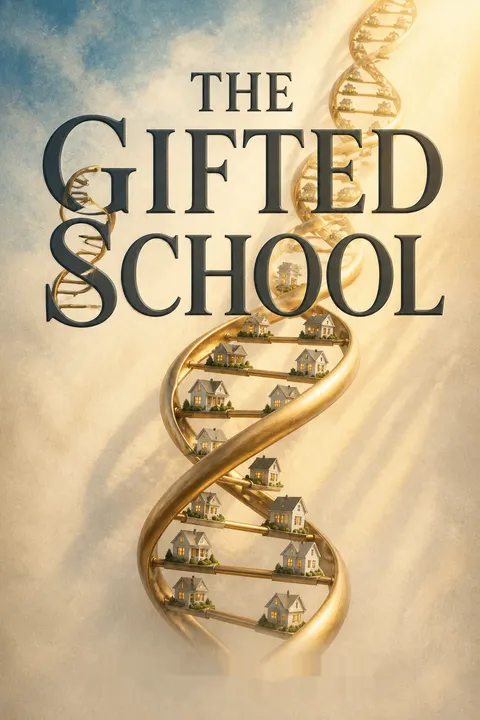


Plot Summary
Prologue
During the CogPro, fifth-grader Emma Zellar freezes over a pattern question. She finds the answer by noticing shapes in the cafeteria windows, but her pencil rolls off the desk before she can fill in the bubble.
When the proctor calls time, Emma Z has to choose between leaving the answer blank and breaking the rules. She sets down her pencil. Beyond the mirrored glass, her mother waits with the other parents, unable to see the small failure that will later acquire enormous weight.
The opening turns a standardized test into a miniature drama of knowledge and performance. Emma Z can solve the problem, yet the test records only whether she marks the answer in time. The watching parents make a private act of concentration feel like a public verdict. That distinction becomes central to the novel: children possess abilities that a score, a portfolio, or a parent's story about them can only imperfectly represent. The unfilled bubble also quietly anticipates the gap between what Emma Z can do and what adults will insist her results mean.
Crystal Academy Arrives
Rose Holland, a pediatric neurologist, meets her three longtime friends for birthday drinks while privately worrying about her marriage to Gareth and their daughter, Emma Q. Lauren Frye is preoccupied with her gifted son, Xander, and Samantha Zellar hints that her daughter, Emma Z, may leave the public schools.
At Thanksgiving, Samantha and her husband, Kev, reveal the plan for Crystal Academy, a new public school for exceptional students drawn from five districts. Its entrance test and scarce places immediately reshape the conversation.
Rose sees a chance for Emma Q to be recognized by ability rather than money, while her husband doubts the value of another competitive school. The friends leave the table with different hopes, though none yet admits how much is at stake.
The academy arrives as an institution but functions first as a mirror. Rose sees a chance to correct the educational neglect she remembers from childhood; Samantha sees another arena in which her family might excel; Lauren sees a fitting home for Xander. Their stated commitment to friendship does not prevent comparison. Instead, the school's promise gives old insecurities a new, measurable object. The novel's social pressure begins not with a villain but with a plausible public opportunity whose scarcity encourages parents to treat one another's children as competitors.
Paper Birds in Beulah
Far from Crystal's manicured streets, Ch’ayña and her daughter, Silea, clean wealthy families' homes to support Silea's son, Atik. He is a self-taught origami maker who fills their trailer with folded animals, vehicles, and a detailed paper model of their mobile-home park. After the Academy is announced, Atik learns that the school may admit students from Beulah County and decides to take its test.
Ch’ayña worries that a place among Crystal's affluent children could make him ashamed of home. When Silea breaks her elbow, Atik helps with the cleaning jobs, missing school to keep the family afloat. His talent and labor are both visible to adults, but neither guarantees that the school will recognize him fairly.
Atik's storyline makes the novel's argument about giftedness concrete without reducing it to a test score. His origami depends on spatial reasoning, patience, and an intimate knowledge of how forms hold together. Yet his family must weigh that ability against immediate needs, including lost wages and transportation. Ch’ayña's fear is not simply resistance to change: she understands that admission can carry a demand to assimilate. The same opportunity Rose welcomes as meritocratic rescue may feel, to Atik's grandmother, like an invitation to leave his community behind.
The Twins Divide
Beck Unsworth-Chaudhury, father to twins Charlie and Aidan, measures family life partly through their competitive soccer. Aidan notices that Charlie's form is slipping, then watches him lose his starting place while Aidan excels at midfield.
Their mother, Azra, also tells Beck that Aidan qualified for St. Bridget's gifted program and scored well above Charlie, a difference Beck resists because he remembers being excluded from his own school's gifted room. Later, Beck pushes the boys onto another difficult ski run after Aidan asks to stop.
Aidan crashes and injures his ankle, jeopardizing his hoped-for soccer tryout. He blames Charlie, and Beck accepts the accusation without understanding how badly the twins' competition has begun to distort what each tells him.
Beck's nostalgia for exclusion gives his resistance to gifted education a personal charge, but it does not make him immune to achievement culture. He rejects academic ranking while investing heavily in soccer, where his sons' status is easier for him to celebrate. The ski accident shows how parental ambition can disguise itself as shared fun: Beck wants one more run, while Aidan's hesitation goes unheard. The brothers' different temperaments are also becoming harder to flatten into twinship. Their rivalry will matter less as a contest of ability than as a test of whether adults notice the costs of comparison.
The First Cut
When the CogPro sessions begin, Rose watches Emma Q struggle with the pressure, while Emma Z appears composed. Beck initially misses the boys' test because he takes them skiing, then returns Aidan for the makeup session; Charlie refuses to participate.
Atik takes the test after his grandmother drives him from their home in Beulah County. The results advance Emma Q, Emma Z, Aidan, Tessa, and Atik to the next stage. Emma Q earns 135, and Emma Z's parents tell her she earned 145, though that account is false.
Xander fails because his verbal score drags down his stronger nonverbal results. Lauren appeals, and the review later lets him proceed. For the adults, the scores seem to confirm or threaten stories they have long told about their children.
The first round converts a broad, uncertain idea of ability into a narrow administrative threshold. The same process produces pride, embarrassment, and strategic concealment, depending on which family is watching. Xander's uneven result exposes a basic weakness in the test, yet his mother's distress centers partly on how other people will interpret it. The false report of Emma Z's score shows how quickly measurement becomes family mythology. Atik's participation, meanwhile, depends on labor and transportation as much as aptitude, reminding the reader that access to assessment is itself unequal.
The Gifted Club
As the next admissions stage approaches, Emma Q and Emma Z begin judging classmates by their prospects. They form an exclusive Gifted Club with other children who passed the first cut, then create a chart sorting students by imagined college destinations.
Emma Q insults a teacher who questions the club, and the principal summons Rose and Gareth. Rose is shaken further when she overhears the girls mocking peers in the car, including Xander. At Samantha's house, she and Samantha make the Emmas write apologies to the students and staff they have hurt.
Samantha still defends the girls' opinions as partly accurate, revealing how readily adult assumptions have entered their friendship. The Emmas' private rivalry has become a public act of exclusion.
The club is not merely childish imitation of adult status seeking. The girls turn the admissions process into a social hierarchy before the school has even selected its students. Their spreadsheet makes class-coded judgments look like prediction, while the title Gifted converts a provisional test result into an identity. Rose's shock at Q's cruelty marks a break between maternal knowledge and actual behavior: she cannot assume her daughter is kind because she loves her. Samantha's partial defense shows that the children have learned more than ambition from adults; they have inherited rationalizations for exclusion.
Every Child Needs a Spike
Crystal Academy asks families to submit portfolios focused on a child's strongest talent. Tessa, Lauren's troubled teenage daughter, begins altering donated clothes at Azra's consignment shop. When Azra recognizes the designs as genuine work, she gives Tessa a rack for her own line, TessaRacks.
Xander abandons a science project he finds dull and develops a chess study instead. Rose, fearing Emma Q's horse-riding record is too entangled with Emma Z's shared History Day project, replaces the girls' joint credit with Q's name alone.
She also lies to founding director Bitsy Leighton about a proposed brain-development study to gain access to the admissions process. Atik assembles photographs of his origami, while his family tries to meet the submission deadline around Silea's injury and their cleaning work.
The portfolio stage claims to value the whole child, yet it intensifies parental management of childhood. A real talent like Tessa's emerges through practice and recognition, while Rose's fear turns a shared school project into a tool for advantage. Her lie to Bitsy is particularly revealing: Rose's scientific identity, built on evidence and integrity, becomes a credential she improvises for her daughter. Atik's family faces a different burden. They are not polishing an application in spare time; they are trying to make a child's work legible while labor and injury constrain their choices.
The Protest Takes Shape
Criticism of Crystal Academy grows into ALPACA, a parents' group opposing the school and its admissions system. At a public meeting, Bitsy Leighton challenges the mostly white audience to consider multilingual children like Atik, who speaks Quechua, Spanish, and English.
Beck, meanwhile, hides mounting debt, misses employee pay, and pushes the twins toward elite soccer even as Charlie struggles and Aidan advances. At a tournament, Charlie injures an opponent with a reckless tackle, and Beck shoves a parent who insults him.
Rose's lie about the research project reaches her university supervisors; they withdraw support for her major NIH grant. Across these households, the academy's pressure no longer stays confined to applications. It is feeding professional, financial, and emotional failures.
The public dispute gives the parents a language of equity, but their private conduct reveals how difficult it is to separate principle from self-interest. Beck can understand the value of inclusion while still treating elite soccer as a family imperative. Rose's deception has consequences precisely because it crosses a boundary between her professional authority and her daughter's application. Bitsy's example of Atik complicates the academy's idealism: inclusion is not a slogan when a child's languages, labor, and location challenge the expectations of a privileged audience. The novel keeps structural critique and individual hypocrisy in the same frame.
Tessa's Camera Opens
Tessa has been recording video diaries for friends from rehabilitation, assuming the channel is private. Her posts reveal family gossip, private homes, and adult secrets; one shows her getting high with Beck while they sit in a hot tub, both inadequately clothed.
The number of viewers climbs, and children begin sharing clips. Tessa's disclosures expose Beck's poor judgment and leave his sons alarmed, while her comments about their families reopen old wounds. At the same time, Xander secretly gathers biological samples from the people around him for his science project, including hair, toothbrushes, and other material.
He orders inexpensive DNA kits and turns years of chess-game records into a theory about inherited behavior. Both teenagers believe they control what their experiments and recordings will reveal.
The camera and the DNA kits are parallel instruments of observation. Tessa records what adults prefer to keep private; Xander gathers evidence without consent, believing that classification will make people understandable. Each teenager mistakes access for control. The video diary begins as a tool for connection after rehabilitation, but its audience expands beyond the circle Tessa imagined. Xander's project similarly transforms intimacy into data. Their different methods converge on the same ethical problem: other people's lives become material before those people have agreed to be seen.
The Wall of Hidden Kin
At Crystal Academy's open house, Rose discovers that her altered horse project is displayed under Emma Q's name alone, while Atik's origami portfolio is safely on the wall because Tiago recreated and delivered it.
Then Xander unveils his chess-and-DNA study: its family chart identifies Gareth and Samantha, not Kev, as Emma Z's biological parents, making the two Emmas half-sisters. Xander's samples also expose other family relationships. The revelation lands before students, parents, and administrators.
Rose turns on Gareth and Samantha, then admits that she stole Emma Z's share of the project. Emma Z publicly confirms the theft. The school display, intended to celebrate individual gifts, becomes the place where the adults' private stories collapse into view.
The open house joins two forms of exposure: Rose's small but deliberate theft of a child's work and Xander's enormous, nonconsensual disclosure of family biology. His findings are scientifically crude in method and emotionally exact in consequence. The display does not simply reveal who is related to whom; it reveals how adults have shaped identities through omission, ambition, and convenient stories. Rose's outburst recognizes the admissions system's role but cannot erase her own choices. The public setting matters: private damage becomes spectacle at the very institution that promised to evaluate children fairly.
After the Display Falls
The open house also exposes Tessa's videos, and Beck watches his own hot-tub encounter circulate among people who question his judgment. At the school, Aidan mocks Charlie's place on the bench during a soccer highlight reel, and Beck finally sees how his attention to Aidan has humiliated his other son.
After returning home, Beck cleans the neglected house, shows Sonja the family's debts, and begins a plan to pay employees and cut spending. Aidan then admits that he lied about Charlie causing the ski crash and had also blamed him for other damage.
He says he does not want Crystal Academy or the expensive soccer academy. Beck agrees to reconsider both choices. Tessa, ashamed by her videos, considers leaving for New York but remains with her family.
The consequences force a change in scale. Beck's public embarrassment is painful, but the more consequential recognition is that his sons have been living inside the rivalry he helped intensify. Aidan's confession shows how one false accusation can become a family structure when adults prefer a simple villain to uncomfortable uncertainty. Beck's cleaning and financial disclosure are modest acts, not instant redemption; they matter because they replace concealment with visible responsibility. Tessa's wish to flee expresses the familiar adolescent fantasy of escaping judgment, while her continued presence leaves repair possible but unfinished.
The Marriage Comes Apart
After the open house, Rose confronts Gareth at home. He explains that he and Samantha had a brief sexual relationship years earlier, before Rose and Samantha became friends, and that neither of them faced the possibility that Emma Z might be his child.
The DNA results make their chosen silence impossible to maintain. Rose asks Gareth to leave, recognizing that the affair is only one part of their estrangement: his stalled writing career and resentment of her ambition have shaped their marriage for years.
Samantha later admits that fear, fertility struggles, and the timing of her pregnancy helped her accept Kev's paternity without question. She and Rose eventually speak again, but neither the truth nor the friendship can be restored by a single apology.
Paternity is the plot's sharpest revelation, but the emotional wound has a longer history. Gareth's account reveals a marriage organized around unspoken resentment, while Samantha's explanation shows how desire and fear can make a convenient interpretation feel true. The novel does not equate biological truth with the whole of parenthood: Kev has raised Emma Z as his daughter, and Gareth's genetic connection does not erase years of absence. Rose's decision to separate from Gareth is not presented as a clean moral victory. It is an overdue refusal to keep living inside a story she no longer believes.
The Letters Arrive
On May 8, Rose receives a rejection from Crystal Academy, as does Samantha; both families had remained in the admissions system despite the open-house chaos. Lauren tells the friends that Xander and Tessa have been accepted. The text does not disclose the final decisions for Aidan or Atik, or the result of Tessa's envelope in her last video diary.
Rose and Samantha meet for a walk and speak more honestly about the affair, Emma Z, and the fantasies they built around their children's gifts. Samantha asks to repair their friendship for the girls' sake. They do not settle everything, but they walk together again, looking west across the valley as an eagle's attempted hunt ends with the rabbit falling free.
The results refuse the neat equation between talent and admission: the family that has suffered most receives two acceptances, while Rose and Samantha do not. The unreported outcomes preserve the uncertainty that the parents tried to eliminate through scores, portfolios, and predictions. Rose and Samantha's walk offers reconciliation as a practice, not a verdict. The final image of the rabbit escaping may be wishful interpretation rather than fact, which suits the novel's skepticism about certainty. Parents can make plans and stories, but they cannot know in advance what their children will survive or become.
Analysis
The Gifted School treats giftedness less as a stable possession than as a story families tell about children under pressure. A test score, a soccer highlight reel, a fashion rack, and a portfolio each make some abilities visible while concealing the labor and circumstance that produced them. The novel's sharpest critique is not that parents care about achievement, but that they confuse advocacy with authorship. Rose, Samantha, Beck, and Lauren each try to protect a child by controlling how that child is understood. Their efforts range from coaching and secrecy to outright deception, and the children inherit not only ambition but the adults' habits of ranking, withholding, and self-justification.
The book also resists a simple opposition between elite schooling and public equity. Crystal Academy is genuinely designed to widen access, and Bitsy's defense of multilingual students challenges a narrow account of intelligence. Yet the admissions process still turns scarcity into competition, encouraging affluent parents to treat merit as something they can document, polish, or purchase. Atik's family reveals the material dimensions of access: time, transport, physical health, and the stability to assemble a portfolio. His talents are no less real because his family cannot devote the same resources to displaying them.
The children, meanwhile, are not passive casualties. Tessa finds a vocation through design, Xander constructs a disturbing experiment from his desire for certainty, and the Emmas reproduce adult hierarchies in their own club. Their actions are consequential, but the novel does not pretend that children invented the systems they imitate. Its most humane insight is that repair begins when adults stop treating a child's success as evidence about themselves. The ending offers no universal verdict on who is gifted or who belongs. It leaves the characters with less control than they wanted, and with the more demanding work of seeing one another without the protective stories they once preferred.
Review Summary
The Gifted School centers on four affluent Colorado families competing for spots at a selective magnet school for gifted children. Reviews are mixed (3.71/5), with readers praising the timely social commentary on competitive parenting and privilege, comparing it to Big Little Lies. Many found characters unlikable but compulsively readable, though some felt the 450-page length excessive. Several noted the book's prescience given the college admissions scandal. Common criticisms included too many characters, predictable twists, and endings that felt either too neat or unsatisfying. Educators particularly appreciated its realistic portrayal of gifted school dynamics.
Characters
Rose Holland
Ambitious neurologist motherRose is a pediatric neurologist and researcher whose professional discipline gives her confidence that careful work can shape outcomes. She loves Emma Q fiercely, but her own childhood experience of being overlooked makes her sensitive to any chance her daughter might be underestimated. Rose's marriage to Gareth has grown distant, and her friendships with Samantha, Lauren, and Azra provide the intimacy she lacks at home. Her strongest quality, focused determination, can become an appetite for control: she monitors her daughter's progress, compares families, and is tempted to bend rules when she fears Q will lose an opportunity.
Gareth Quinn
Stalled novelist and fatherGareth is a former novelist who now teaches intermittently and manages much of the household while Rose's medical career flourishes. His wit and attentiveness once drew Rose to him, but professional disappointment has hardened into passivity and resentment. He values a less directed childhood for Emma Q, partly from principle and partly because he feels diminished by Rose's success. Gareth often avoids confrontation until silence itself becomes a weapon. His perspective complicates the portrait of the disengaged husband: he is caring and perceptive, yet his quietness can conceal deep grievances.
Emma Q
Bookish, watchful daughterEmma Q is Rose and Gareth's daughter, an avid reader whose verbal intelligence and close friendship with Emma Z shape much of her childhood. She often apologizes and hesitates, especially when a more confident person takes the lead, but she is not merely meek. Her parents' attention to achievement makes her sensitive to comparison, while her own reading gives her a language for noticing people and patterns. Q's bond with Z is affectionate and competitive at once. She is still forming her moral judgment, and her actions show how readily a child can absorb the status assumptions circulating among adults.
Samantha Zellar
Polished social strategistSamantha is Emma Z's mother, a socially skilled former trainer and the center of her long friendship with Rose, Lauren, and Azra. She knows how to host, redirect a conversation, and make people feel included, but her confidence can turn into entitlement when she believes her family deserves an advantage. Samantha is deeply invested in her daughter and in the Zellar family's public image. Beneath her composure lie insecurities about fertility, status, and the expectations of Kev's powerful family. Her instinct to manage appearances protects her from shame, but it also makes honesty harder.
Emma Zellar
Confident young achieverEmma Z is Samantha and Kev's daughter, Emma Q's closest friend, and a socially assured child who likes leading games, projects, and conversations. She is quick to read other people's reactions and often imitates the confident adults around her. Her ease can shade into impatience with children she sees as less capable, especially as the Academy's admissions contest gives her a new way to rank classmates. Emma Z is not defined by schoolwork alone: she enjoys travel, social attention, and the feeling of competence. Her self-image is closely tied to being admired, making uncertainty particularly difficult for her.
Azra Chaudhury
Steady friend and shopkeeperAzra is a Crystal native, owner of the consignment shop BloomAgain, mother of twins, and the calmest member of her close circle. After divorcing Beck, she maintains an unusually warm co-parenting relationship with him while building a life beyond the marriage. Her ease is not indifference: she notices who feels excluded and often mediates conflict before it hardens. Azra's patience can make others mistake her for someone without strong needs. She is particularly sensitive to how the mothers value their daughters' manners and academic promise while overlooking her sons' abilities. Her generosity helps Tessa discover a practical path into design.
Beck Unsworth
Restless, distracted fatherBeck is a graphic designer, father of Charlie and Aidan, husband to Sonja, and Azra's ex-husband. He prefers improvisation to schedules and dismisses many forms of adult supervision as pretentious, even as he pours energy into his sons' soccer. His inherited wealth has allowed him to avoid confronting financial limits until the debts become impossible to hide. Beck is affectionate and funny, but his self-absorption can make him miss what his children are trying to tell him. His relationship with Azra remains close enough for her to see his weaknesses clearly, which he both resents and needs.
Lauren Frye
Grieving, vigilant motherLauren is a social worker and the mother of Tessa and Xander. Since her husband Julian's death, she has directed much of her energy toward her children's education and well-being. Her focus on Xander's intelligence gives her a sense of purpose, but it can crowd out curiosity about other children and make Tessa feel unseen. Lauren is practical and loyal, often caring for friends through concrete acts rather than easy conversation. Grief has made her protective, and protection sometimes becomes control. Her bluntness can wound, though it also reflects a refusal to disguise how frightened she is for her family.
Tessa Frye
Recovering teenage designerTessa is Lauren's teenage daughter and Xander's older sister. After years of dangerous behavior, substance use, and treatment, she is trying to rebuild trust and find a direction that belongs to her. She has a vivid eye for clothing, fabric, and how garments change the way a person appears, but adults have often noticed her beauty or her crises before her creative ability. Tessa's video diaries give her a place to speak freely to absent friends, although she underestimates how widely private material can travel. Her humor is sharp, her confidence unstable, and her need to be taken seriously palpable.
Xander Frye
Chess-minded outlierXander is Lauren's son, Tessa's younger brother, and a formidable chess player who records games with unusual precision. He understands patterns more easily than social cues and often studies people as if they were sets of predictable moves. His independence delights his mother when it produces academic distinction, but it can also make adults overlook his emotional uncertainty. Xander is curious, literal, and capable of unsettling ingenuity. His interest in science is genuine, although his confidence in his own reasoning can outrun his understanding of consent and consequence.
Charlie Unsworth-Chaudhury
Competitive twin strikerCharlie is Beck and Azra's twin son, a soccer striker accustomed to being the team's captain and standout player. He is expressive, quick to joke, and often more comfortable displaying anger than admitting hurt. As Aidan begins to excel in ways that draw attention, Charlie has to confront a changed place in the family and on the field. His loyalty to his brother is real, though it can take the form of silence or provocation rather than tenderness.
Aidan Unsworth-Chaudhury
Quiet, gifted midfielderAidan is Charlie's twin and Beck and Azra's son. More reserved than his brother, he sees details others miss and plays soccer with a strategic calm that becomes increasingly visible to coaches and parents. He is caught between wanting recognition for his own abilities and protecting the bond that defines his relationship with Charlie. Aidan's quiet manner can make adults mistake him for uncomplicated, even when he is carrying resentment, guilt, or fear.
Atik Yupanqui
Quechua-speaking origamistAtik is Silea's son and Ch’ayña's grandson, a student from Beulah County who speaks Quechua, Spanish, and English. He teaches himself origami and creates elaborate birds, animals, vehicles, and architectural models from paper. Atik is observant and technically minded, but he is also a child whose family depends on his help with cleaning work when his mother is injured. His talent is not separate from his circumstances: the places he lives and the materials he can find become part of what he makes. He wants access to a larger world without ceasing to belong to his own.
Ch’ayña
Protective grandmotherCh’ayña is Atik's grandmother and Silea's mother. She is blunt, resourceful, and proud of the work that keeps her family fed. Her skepticism toward Crystal's affluent culture comes from lived observation, not abstract hostility; she worries that opportunity may teach Atik to look down on his own community. She understands craft, care, and practical survival, even when she cannot read the institutions evaluating her grandson.
Silea
Working mother and cleanerSilea is Atik's mother and Ch’ayña's daughter. She cleans homes in Crystal while raising her son in Beulah County, balancing physical work with the hope that he will have choices she did not. Her injury makes the family's dependence on Atik's labor more visible. Silea is warmer toward help than her mother is, especially from Tiago, but she does not mistake kindness for security.
Sonja
Beck's Austrian second wifeSonja is Beck's second wife and the mother of their young son, Roy. She has also taken on substantial care of Charlie and Aidan, despite not being their mother. Direct and capable, she increasingly expects Beck to share domestic work and face their finances honestly. Her frustration grows from the difference between the relaxed life Beck imagines and the labor required to sustain their household.
Bitsy Leighton
Academy founding directorBitsy is the founding head of Crystal Academy, an educator charged with designing an admissions process for students from several districts. She argues for a broad definition of ability and presses affluent families to consider applicants whose talents may not be captured by a single test. Bitsy is confident under public scrutiny, but the institution she represents is vulnerable to both political pressure and the compromises of individual parents.
Tiago
Practical family allyTiago is Silea's companion, a resourceful man who offers practical help to her and Atik. Ch’ayña distrusts his place in the family at first, but he respects Atik's abilities and finds concrete ways to support them.
Kev Zellar
Affluent political fatherKev is Samantha's husband, Emma Z's father as she understands it, a City Council member and finance professional. He is charming in public, comfortable with money and influence, and invested in giving his daughter opportunities. His instinct to solve problems through connections reflects both confidence and anxiety about how his family is judged.
Julian Frye
Beloved absent fatherJulian was Lauren's husband and the father of Tessa and Xander. His memory remains important to both children, though in different ways. His friendships and generous presence helped bind the four families together before his absence altered their lives.
Plot Devices
The CogPro
A score becomes a gateThe fictional CogPro is the first admissions filter for Crystal Academy. It tests several kinds of reasoning but compresses a child's performance into a threshold that determines who receives further consideration. Its results drive the parents' hope and shame, expose Xander's uneven profile, and invite disputes about test preparation, district differences, and bias. The exam is not simply a neutral prop: it gives the families a common measure, then demonstrates how much that measure leaves out.
The Portfolios
Parents package childhood as proofThe Academy's second stage asks applicants to present evidence of a concentrated strength. The portfolios allow children like Tessa and Atik to show abilities not easily represented by a standardized score, but they also invite parents to curate, coach, and claim the work. A joint horse project becomes a point of competition between the Emmas, while Xander's independent project grows beyond adult supervision. The device exposes the difference between helping a child communicate a talent and turning that talent into an adult's sales pitch.
Xander's Chess Study
Patterns become a dangerous testXander uses years of recorded chess games to build an algorithm that assigns behavioral traits to players, then compares the patterns with DNA evidence. His project gives him a way to make human motives feel legible and predictable. He treats the families around him as both opponents and research subjects, gathering samples without permission. The display's conclusions carry consequences far beyond the science fair because Xander applies his method to the hidden biological relationships within his community.
Tessa's Video Diaries
Private confession becomes public evidenceTessa records informal videos for friends from rehabilitation, using the camera to speak about family life, recovery, resentment, and uncertainty. She assumes the audience is limited, but the view counts rise and schoolchildren circulate the clips. The videos reveal truths the adults have concealed, yet they also expose private homes and relationships without consent. The device makes Tessa both a witness to adult hypocrisy and a participant in a new breach of trust.
Atik's Origami
Paper makes ability visibleAtik's folded figures and models turn abstract spatial intelligence into objects that anyone can inspect. His paper version of the mobile-home park joins technical precision with close attention to his own community. Origami also links generations: Ch’ayña taught him his first fold, while Atik develops the craft far beyond what she knows. The portfolio nearly misses the deadline, but Tiago's practical intervention brings both photographs and physical examples to the school, giving the work a visible place in the exhibition.
About the Author
Other books by Bruce Holsinger

Download PDF
Download EPUB
.epub digital book format is ideal for reading ebooks on phones, tablets, and e-readers.








