

Key Takeaways
Ask about what customers did, not what they might someday do.
Look for lived evidence. The Mom Test is a way to learn about a business idea without inviting people to flatter its founder. Rather than asking whether an idea sounds good, ask about the person’s own routines, problems, and past decisions. Seek a recent example, and listen more than you speak. Specific memories are harder to tailor to what the founder hopes to hear than broad opinions or predictions.
A cookbook gets tested. In the book’s example, a mother likes her iPad, but her actual use is searching for travel information, not cooking. Her cookbooks were mostly gifts and remained unopened, while she had bought a specialized vegan cookbook herself. Those details suggest distinct customer groups and a discovery challenge, neither of which the original idea revealed.
The shift from stated preference to remembered behavior resembles a basic principle in behavioral research: what people report wanting and what they actually do can diverge. Asking about a recent episode also gives the conversation a timeline, making follow-up questions more precise. Still, memory is not a perfect record, and past behavior may not predict adoption of a genuinely new product. The strongest learning comes from combining concrete stories with observation, when possible, and treating each account as evidence to investigate rather than a final verdict.
Treat praise and promises as noise until behavior backs them up.
Separate warmth from evidence. Compliments feel encouraging, but they cost the speaker nothing. The same is true of what the book calls fluff: vague claims about usual behavior, imagined future actions, or hypothetical willingness to buy. When someone says a problem happens constantly, ask when it last happened and what they did. If they say they would buy a solution, find out whether they have searched for one, paid for a workaround, or made any concrete effort.
A costly mistake. The author recounts an early startup that lost about $10 million after treating enthusiastic future promises as proof of demand. By contrast, someone complaining about loyalty cards who has never tried an available loyalty app may not care enough to become a customer. A disappointing answer can be more useful than enthusiastic approval.
This is a practical defense against social desirability bias, the tendency to give answers that seem polite or acceptable. It also separates intention from action, a distinction familiar in behavioral science and consumer research. However, absence of past action is not always proof of low demand: people may not know a solution exists, or existing options may be inaccessible. The useful question is not simply whether someone has acted, but what prevented action and whether that obstacle is one a new business can realistically remove.
Follow the request to the motive before building the feature.
Requests are clues. A customer’s suggested feature is a description of one possible solution, not a reliable specification. Ask what the feature would help them accomplish, how they manage without it, and what happens when the task goes wrong. Explore strong emotions, too. Frustration, embarrassment, or excitement can point toward a consequential problem, but only follow-up questions reveal why it matters.
The dashboard detour. MTV asked the author’s company for analytics. The team built an elaborate dashboard, then added spreadsheet and PDF exports, yet MTV kept asking for reports by email. The real goal was to give MTV’s clients a polished weekly update, not to explore campaign data. A scheduled, simple report might have met the need better than months of dashboard work.
This approach connects to the jobs-to-be-done perspective: customers often request a feature because they are trying to make progress in a particular situation. Understanding that situation can reveal a simpler solution and reduce the risk of feature creep. The caution is that one articulate customer’s motive is not automatically representative of a whole market. Treat a revealed motive as a hypothesis, then check whether other people in the intended segment share it and whether it affects their choices.
Ask the question that could make you abandon the business.
Find the business’s weak link. A useful question can change a decision, not merely fill a page of notes. Before a conversation, identify the assumptions most likely to break the business and ask about them directly. The author recommends preparing three key learning goals for each customer type, including at least one uncomfortable question. If the answer would not affect the plan, the question may be too minor.
The elephant is often practical. A tool might genuinely save overworked teachers time, but schools may lack the budget to buy it. In another example, the author avoided speaking with lawyers about uncertain content ownership, a risk he says cost his company at least half a million dollars. A real problem is not enough if a major constraint blocks the business.
This resembles a pre-mortem: a team imagines failure, then identifies assumptions that could have caused it. The method helps counter confirmation bias by putting threatening explanations on the agenda before a founder becomes attached to a preferred answer. It also makes customer conversations more efficient because each question is tied to a decision. The limitation is that a single alarming answer may reflect one person’s circumstances, not a general constraint. High-stakes risks deserve follow-up with relevant experts and additional evidence.
Separate customer demand from your ability to deliver the solution.
Know which risk is real. Market risk asks whether enough customers want a solution and will pay for it. Product risk asks whether the company can build, distribute, and sustain a solution that works. A conversation can reveal that farmers want a better way to monitor animal fertility, but it cannot prove that a startup can build the device. Likewise, bars may pay for more customers on quiet nights, but that promise does not show a startup can attract enough consumers to send them.
Match evidence to uncertainty. Conversations are especially useful for understanding needs, budgets, current alternatives, and buying processes. When success depends chiefly on technical execution, audience growth, or continued use, customer discussion alone cannot settle the question. The author’s point is not to ignore demand, but to avoid mistaking willingness to benefit from success for evidence that the business can produce it.
This distinction is a reminder that evidence has to fit the claim being tested. Interviews can illuminate motives and purchasing constraints; prototypes, technical trials, and observed usage are better suited to questions about feasibility and behavior. In research terms, the test must have construct validity: it should measure the uncertainty at issue, not a nearby but easier question. A founder may face both kinds of risk at once, so the practical task is to identify which uncertainty is currently most capable of killing the venture.
Require a real next step before calling someone a customer.
Look for a cost. Commitment means giving up something valuable, such as time, reputation, or money. Advancement means moving to a defined next stage toward a purchase. A compliment, or a promise to buy someday, is neither. A scheduled trial with a team, an introduction to the budget owner, a deposit, or permission to use a prototype can carry meaningful cost and provide stronger evidence.
End the polite limbo. The author describes “zombie leads”: people who keep meeting, offer kind words, and never move toward a decision. A clear request for a next step gives them a chance to accept or decline. Either answer teaches the founder something. The value of a commitment depends on what it costs: a quick, consequence-free trial says less than a paid test that requires a team to change its routine.
Commitments function like costly signals: when a person risks time, money, or credibility, the signal is harder to produce casually. This makes them more informative than verbal enthusiasm. But costly action is not a guarantee of product-market fit. A pilot may be driven by curiosity, a personal relationship, or a temporary budget, and a deposit does not prove repeat demand. The strongest interpretation comes from asking what the commitment means to the customer and whether it reflects a recurring need.
Choose one reachable customer slice before interpreting mixed feedback.
Narrow the audience. A broad label such as “students” can include people with completely different goals, tools, and constraints. The book calls the process of narrowing a group by its needs and circumstances Customer Slicing. Ask who wants the solution most, what they are already doing about the problem, and where those people can be found. A useful segment is not just a type of person; it is a group with a shared reason to care and a practical way to reach them.
Mixed signals have a cause. The author once treated “advertisers” as one customer group, from tiny shops to major brands. Their budgets and needs varied so widely that nearly every feature pleased someone, making it hard to learn what truly worked. Start with a focused segment that is reachable, promising as a business, and a group the team can serve well.
Segmentation improves learning because it reduces the number of explanations behind conflicting feedback. It also creates a more coherent first market for product decisions and messaging. The danger is choosing a slice so narrow that it reflects a few unusually enthusiastic people rather than a viable market. A segment should be specific enough to produce consistent patterns, but large and accessible enough to support a business. In complex organizations, the end user, budget holder, buyer, and partner may each require separate conversations.
Make customer learning a conversation, not a calendar ritual.
Keep the exchange human. Early learning does not always require a formal interview. A brief chat at an industry gathering can reveal how someone handles a task, what they have tried, and what frustrates them. The author estimates that a one-hour meeting can absorb roughly four hours once scheduling, travel, and preparation are included. Casual conversations reduce that overhead and can make it easier for people to describe ordinary details of their work.
Create a reason to talk. If a formal meeting is needed, explain the problem area, the stage of the work, and what help is needed. Show why this particular person can offer useful insight, and make clear when there is nothing to sell. Meetups, teaching, industry writing, and warm introductions can bring relevant people into reach. Informality should lower the social barrier, not remove the purpose of the conversation.
A conversational setting can reduce the performance pressure that makes an interview feel like a test, while also making it easier to notice unexpected details. The book’s emphasis on lightweight exchanges is especially useful when founders have limited time. Yet casual settings can create their own biases: people may be distracted, social ties may soften criticism, and notes can be lost. A clear learning goal and a quick written record help preserve rigor without turning every encounter into a boardroom exercise.
Find first buyers among people already hacking around the pain.
Look for active effort. The book uses the term earlyvangelists for unusually committed first customers. In business settings, they have a serious problem, recognize it, have a budget, and have cobbled together a workaround. Consumer versions may search for fixes, recruit friends, or pay in advance for an unfinished product. Their actions show more than general interest: the problem has already claimed time, money, or attention.
Emotion helps locate urgency. A mild complaint may be real but not important enough to drive a purchase. Strong frustration can signal a deeper need, especially when it comes with evidence of effort to solve the problem. Keep such people close and learn from them, but do not assume their enthusiasm describes everyone. They are valuable guides to an early product, not proof that a broad market will adopt it.
Early adopters can help a young company learn because their need is intense enough to overcome the risks of trying something unfinished. Their workarounds also reveal what a new product must replace, rather than merely what people say they dislike. There is a tradeoff: unusually motivated users can pull a product toward edge cases or specialized features. Their feedback is most useful when founders distinguish the core problem from the unusual intensity of the person experiencing it.
Share evidence across the founding team before changing direction.
Prevent a learning bottleneck. When one founder conducts every conversation and relays a personal interpretation, that person can become the team’s sole authority on what customers want. The author calls this a learning bottleneck. Founders making major product and business decisions should hear customers directly, at least sometimes, and review notes together. Two people can be especially useful: one guides the conversation while the other captures details.
Make evidence retrievable. Prepare the most important questions as a team, write down specific examples and exact wording where useful, then review the notes promptly. Update assumptions and choose the next questions. The book recommends moving quickly: spend days, not months, learning the basics, then give customers something concrete to try or buy. Conversations remain useful afterward, but they should accelerate building, not become a substitute for it.
Shared evidence protects a team from the distortion that occurs when observations pass through one person’s memory and judgment. It also makes disagreement productive: colleagues can inspect what was actually said instead of arguing over a founder’s summary. This fits a broader principle of organizational learning: information only improves decisions when it can travel to the people making them. Notes still require interpretation, however. Teams should preserve context and uncertainty rather than turning an anecdote into a rigid instruction.
Analysis
The book’s central contribution is a practical theory of evidence. A founder’s job is not to collect approval for an idea, but to reduce uncertainty about a business. That requires distinguishing what people say from what their histories, workarounds, budgets, and commitments reveal. The distinction sounds simple, yet it changes the purpose of a customer conversation: the founder is not there to win an argument or recruit a product committee, but to discover facts that may force a change in direction.
Its strongest move is matching questions to decisions. Asking about past behavior tests whether a problem has mattered in real life. Asking about budgets and stakeholders tests whether a buyer can act. Asking for a costly next step tests whether interest survives contact with effort. The separation of market risk from product risk adds an important safeguard: customer enthusiasm cannot prove technical feasibility, distribution, or retention. The method is therefore not merely about better interviewing. It is about choosing the right evidence for each uncertainty.
The approach also has limits. Retrospective accounts are vulnerable to memory errors, and people who have already built workarounds may not represent less engaged customers. A handful of conversations can reveal mechanisms and hypotheses, but cannot establish how common a need is. Narrow segmentation sharpens learning, yet must not be confused with proof of market size. Interviews are strongest when paired with observation, prototypes, purchasing behavior, and broader measurement appropriate to the question.
The book’s operational advice matters because insight is organizational, not private. Shared notes, team participation, and prompt review prevent a founder’s interpretation from hardening into unchallengeable “customer truth.” Its urgency is equally important: discovery should reduce wasted building, not become an elaborate reason to postpone it. The method succeeds when it produces a more specific bet, a clearer test, or a decision to stop. The deepest discipline is emotional: treating a negative answer as progress rather than an injury to the idea.
Review Summary
The Mom Test receives high praise for its practical advice on customer conversations for entrepreneurs. Readers appreciate its concise, example-filled approach to avoiding common pitfalls in customer interviews. The book emphasizes focusing on customers' lives and problems rather than pitching ideas. Many find it valuable for product development, startups, and general communication skills. Some criticize the simplistic premise and potentially reinforcing stereotypes. Overall, it's widely recommended as an essential read for anyone in product development or entrepreneurship, offering actionable insights for effective customer interactions.
People Also Read










Glossary
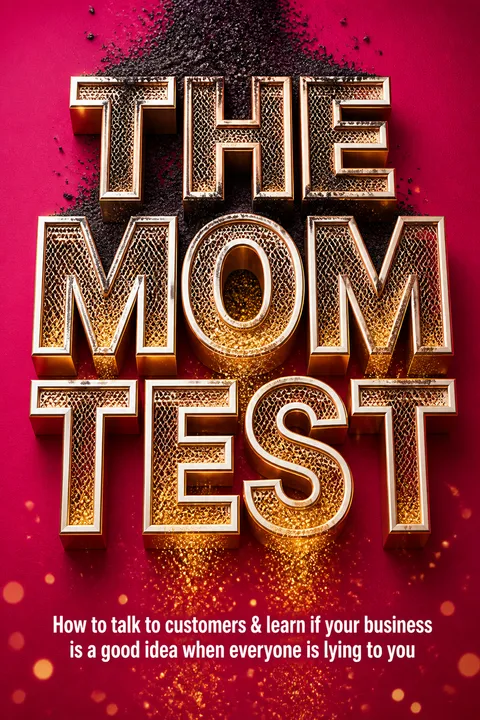
The Mom Test
Non-leading customer questionsA method for discussing customer needs without prompting people to praise a founder’s idea. It focuses on the customer’s life, past behavior, and specific experiences, while encouraging the founder to listen more than they speak. Its purpose is to produce useful facts rather than flattering opinions or unsupported predictions.
fluff
Unverified claims and promisesVague statements about what someone usually does, hypothetical possibilities, or actions they say they may take in the future. Examples include broad claims that a problem happens all the time or promises to buy a product that does not yet exist. The term signals that a response needs to be anchored in concrete past events or present commitments.
The Pathos Problem
Praise prompted by exposed investmentThe tendency for people to soften criticism when they can see that a founder is emotionally or financially invested in an idea. Mentioning a project that a founder has quit a job to pursue can make listeners feel responsible for protecting the founder’s feelings. The result is supportive but unreliable feedback, even when the listener is not intentionally misleading anyone.
Commitment and advancement
Costly steps toward a saleCommitment is a customer’s willingness to give up something valuable, such as time, reputation, or money. Advancement is movement to the next stage of a real purchasing process. A substantial trial, a deposit, or an introduction to a decision maker can provide evidence of both. Compliments and vague future promises provide neither.
Customer Slicing
Narrowing a customer groupA way to turn a broad audience into a specific, findable group with shared motivations and circumstances. It asks who within a segment wants the solution most, what those people already do about the problem, and where they can be reached. The goal is to make conversations and product decisions less vulnerable to mixed feedback from unrelated customer types.
Meeting Anti-Pattern
Over-formalizing customer conversationsThe habit of turning every chance to learn from a customer into a scheduled, formal meeting. This adds time and social overhead, can imply that a product pitch is coming, and may cause founders to miss useful informal conversations. The alternative is to keep early learning focused and conversational, while reserving formal meetings for situations that genuinely require them.
earlyvangelists
Highly committed first customersA term for early customers whose need is strong enough to make them try an unproven product. In business markets, they recognize a significant problem, have the means to address it, and often use a makeshift workaround. Consumer earlyvangelists may actively seek solutions or pay in advance. Their behavior helps a startup learn, though their enthusiasm does not prove broad demand.
learning bottleneck
Customer insight held by one personA team problem in which customer conversations, notes, and interpretations remain concentrated in one founder’s head. Other team members must accept that founder’s account as the basis for decisions, even though observations can be misremembered or misinterpreted. Shared conversations, written evidence, and team reviews distribute learning and make assumptions easier to question.
product risk
Uncertainty about delivering a solutionThe risk that a company cannot build, grow, or sustain a product that fulfills its promise. Customer interest may be real while technical feasibility, distribution, or continued use remains uncertain. Interviews can help establish whether customers might value a successful solution, but product risk usually requires evidence from building, testing, and observing the product.
market risk
Uncertainty about customer demandThe risk that a sufficiently large group of customers does not have the problem, value the proposed solution, or have the ability and willingness to pay. Conversations can help examine needs, current alternatives, budgets, and buying processes. Market risk differs from product risk, which concerns whether the company can deliver the solution customers may want.
FAQ
What's "The Mom Test" about?
- Purpose of the book: "The Mom Test" by Rob Fitzpatrick is about how to have effective conversations with customers to validate business ideas without getting misleading feedback.
- Core concept: It introduces a method to ask questions that even your mom can't lie about, focusing on gathering truthful insights rather than compliments.
- Avoiding bias: The book emphasizes avoiding biased questions that lead to false positives, which can mislead entrepreneurs into thinking their idea is validated.
- Practical guide: It provides practical advice and tools from various methodologies like Customer Development and Lean Startup to improve customer conversations.
Why should I read "The Mom Test"?
- Improve customer conversations: It helps entrepreneurs learn how to talk to customers effectively to validate their business ideas.
- Avoid common pitfalls: The book addresses common mistakes in customer conversations that lead to misleading data.
- Practical advice: Offers actionable steps and real-world examples to improve the quality of feedback from customer interactions.
- Broad applicability: Useful for entrepreneurs, salespeople, mentors, and investors who want to understand customer needs better.
What are the key takeaways of "The Mom Test"?
- Ask about their life: Focus on the customer's life and past experiences rather than your idea.
- Avoid hypothetical questions: Steer clear of questions about the future or opinions, as they often lead to false positives.
- Seek commitment: Look for signs of commitment from customers, such as time, reputation, or money, to validate interest.
- Iterative learning: Continuously refine your questions and approach based on the feedback and insights gathered.
How does "The Mom Test" suggest avoiding bad data?
- Deflect compliments: Compliments are often misleading and should be deflected to focus on gathering facts.
- Anchor fluff: Avoid generic claims and future promises by anchoring questions in specific past behaviors.
- Dig beneath ideas: Understand the motivations behind feature requests or ideas rather than taking them at face value.
- Seek specifics: Always aim for concrete, specific examples from the customer's past experiences.
What is the "Mom Test" method?
- Life over idea: Talk about the customer's life instead of your idea to avoid bias.
- Specifics over generics: Ask about specific past events rather than hypothetical future scenarios.
- Listen more: Focus on listening rather than talking to gather genuine insights.
- Non-biasing questions: Craft questions that don't lead the customer to give you the answer you want to hear.
How can I apply "The Mom Test" in customer conversations?
- Prepare questions: Before conversations, prepare questions that focus on the customer's past experiences and problems.
- Keep it casual: Approach conversations informally to avoid setting expectations and biases.
- Seek advancement: Look for signs of commitment or advancement in the customer's interest.
- Review and iterate: After conversations, review notes with your team and refine your approach based on what you learn.
What are some examples of good and bad questions according to "The Mom Test"?
- Bad question: "Do you think it's a good idea?" This invites opinions and compliments rather than facts.
- Good question: "Talk me through the last time that happened." This asks for specific past experiences.
- Bad question: "Would you buy a product which did X?" This is hypothetical and often leads to false positives.
- Good question: "How are you dealing with it now?" This seeks to understand current solutions and pain points.
What are the signs of a successful meeting in "The Mom Test"?
- Facts gathered: You leave with concrete, specific facts about the customer's life and problems.
- Commitment shown: The customer shows commitment by giving up something of value, like time or money.
- Advancement achieved: The meeting ends with clear next steps or advancement in the sales process.
- Avoidance of fluff: The conversation avoids generic compliments and focuses on actionable insights.
How does "The Mom Test" suggest handling compliments and fluff?
- Deflect compliments: Politely deflect compliments to refocus the conversation on gathering useful data.
- Anchor generic claims: Ask for specific examples to anchor generic claims in reality.
- Challenge future promises: Question future promises by asking about past behaviors and current solutions.
- Focus on facts: Always steer the conversation back to concrete facts and past experiences.
What is the importance of customer segmentation in "The Mom Test"?
- Avoid drowning: Proper segmentation helps avoid being overwhelmed by too many options and mixed signals.
- Serve specific needs: Focus on a specific customer segment to tailor your product and marketing effectively.
- Consistent feedback: A well-defined segment provides consistent feedback, making it easier to validate ideas.
- Findable segments: Ensure your customer segments are specific enough to be easily found and engaged with.
How does "The Mom Test" recommend preparing for customer conversations?
- Identify big questions: Decide on the three most important questions you need answers to before the meeting.
- Research beforehand: Conduct desk research to avoid asking obvious questions and focus on deeper insights.
- Team involvement: Involve your team in preparation to ensure all perspectives are considered.
- Plan for commitment: Know what kind of commitment or advancement you want to achieve from the meeting.
What are the best quotes from "The Mom Test" and what do they mean?
- "Opinions are worthless." This highlights the importance of focusing on facts rather than opinions in customer conversations.
- "Talk about their life instead of your idea." Emphasizes the need to avoid bias by focusing on the customer's experiences.
- "The more they’re giving up, the more seriously you can take their kind words." Suggests that real commitment is shown through what customers are willing to sacrifice.
- "You aren’t allowed to tell them what their problem is, and in return, they aren’t allowed to tell you what to build." Stresses the division of responsibility between understanding the problem and creating the solution.
About the Author
Other books by Rob Fitzpatrick
Download PDF
Download EPUB
.epub digital book format is ideal for reading ebooks on phones, tablets, and e-readers.








