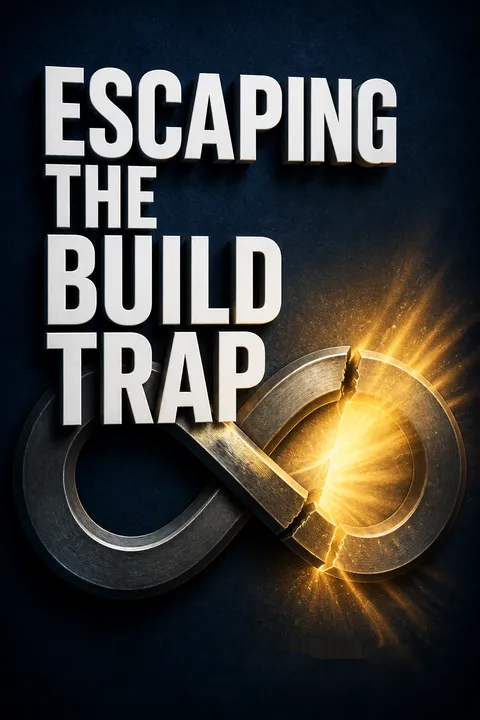


Key Takeaways
Measure customer and business outcomes, not the features your teams ship
Output is not value. The build trap is the habit of treating shipped features, completed projects, or development speed as proof of success. Real value appears when a product solves a customer problem and produces a useful result for the business. Marquetly celebrated releasing 10 features in one month, only to find that students ignored them and teachers were frustrated by the clutter.
Follow the exchange. Customers provide money, data, or referrals when a product reliably meets a need. One data platform had 30 features, with 40 more planned, yet customers regularly used only 2% of what already existed. More development would not fix a weak understanding of what customers valued.
What's striking is how easily a visible activity becomes a substitute for an invisible result. Feature counts are legible in meetings, while customer value can take months to emerge. This resembles Goodhart's law: once a measure becomes a target, people optimize the measure itself. The remedy is not to discard delivery measures, which help teams understand flow, but to keep them subordinate to evidence of customer behavior and business impact. Outcomes also need careful interpretation: revenue can rise for reasons unrelated to a feature, so teams should triangulate usage, customer feedback, and business results.
Make product managers accountable for the why, not just the backlog
Connect the disciplines. A product manager joins customer understanding, business goals, and technical and design expertise to identify valuable problems. The role is not to dictate every solution or merely collect requests. Perri distinguishes this work from project management, which concentrates on when delivery happens, and from a Scrum product owner’s narrower backlog responsibilities.
Influence, do not command. At Marquetly, Nick acted like a miniature CEO and alienated his colleagues. He improved when he listened to the team, tested his assumptions, and focused on customer problems. In another example, product manager Meghan investigated why 60% of mortgage applicants abandoned an application. Testing online document verification increased completion among trial users by 90%, guiding a more useful product direction.
The role is best understood as a boundary-spanning function, not as a miniature executive. Its value comes from translating between groups that hold different kinds of knowledge, then making trade-offs without pretending to possess every answer. That requires influence and intellectual humility. The distinction between product management and product ownership is useful, though titles vary widely across organizations. A job title cannot guarantee strategic authority; leaders must also give product managers access to customers, relevant data, and room to challenge a proposed solution.
Set a strategic direction that guides choices without prescribing every feature
Strategy is a decision aid. A strategy should connect a lasting company vision to a small number of current business priorities, then give product teams latitude to find ways forward. Perri calls those priorities strategic intents. They describe what the company needs to achieve, not a list of features to build. Teams translate them into product initiatives, meaning customer problems worth solving, and then consider possible solutions.
Netflix chose focus. The company wanted to make entertainment more convenient. It explored a streaming device, Project Griffin, but stopped the effort just before launch when it conflicted with the company’s direction. The project became Roku, while Netflix pursued partnerships that put its service on existing devices. A clear direction made stopping an expensive, nearly finished project a strategic choice, not a defeat.
A useful strategy limits the field of choice without eliminating judgment. That balance matters because detailed plans create false certainty in markets where customer behavior and technology shift. The Netflix example shows strategic consistency can require abandoning work that is attractive on its own. Yet a small number of priorities is not automatically wise: leaders still need credible evidence that those priorities matter, and a stable vision should not become an excuse to ignore disruptive changes. Direction is a hypothesis about where value can be created, not a permanent map.
Organize teams around customer value, not permanent ownership of components
Own a result, not a widget. Teams assigned to technical components can keep producing work even when those components are stable and unrelated to current goals. Marquetly had 20 teams organized around product pieces, creating backlogs without anyone accountable for a whole customer outcome. Perri recommends organizing around value streams, the activities and interactions through which a customer receives value.
Design for the full journey. An insurance app is only one part of the value delivered by car insurance. Its product team should connect to the broader insurance experience and goals. TransferWise, by contrast, organized a relatively small set of teams around outcomes such as retention, new currencies, and user acquisition. The structure gave teams scope to act across product components instead of protecting a narrow patch of technology.
This argument shifts organizational design from the architecture of the software to the flow of value through the business. That can reduce handoffs and discourage teams from preserving work simply because it belongs to them. It also asks leaders to define outcomes that teams can meaningfully influence. Outcome-based teams can create coordination costs when several teams touch the same journey, as the TransferWise example acknowledges. The practical design problem is therefore not choosing components or outcomes in the abstract, but balancing end-to-end responsibility with enough shared expertise and coordination.
Use a repeatable learning loop to move from goals to solvable problems
Start with the gap. The Product Kata is Perri’s repeatable method for guiding product work through uncertainty. A team clarifies its direction and current position, identifies the largest obstacle between them, chooses a next step to investigate it, and compares what it expected with what it learned. The loop keeps the team focused on progress toward a goal instead of filling a backlog for its own sake.
Marquetly found the real obstacle. A team initially suspected teachers needed an easier way to upload course material. Interviews and observation revealed a more serious problem: teachers lacked the skill and time to create and edit course videos. That finding changed the problem worth solving. The team’s first understanding was plausible, but evidence revealed it was incomplete.
The method translates scientific reasoning into an operating rhythm: state what is known, identify uncertainty, take a bounded action, and update the explanation. Its strength is not a magic sequence but the discipline of making assumptions visible. This is especially useful when people mistake confidence for evidence. Still, a loop cannot decide which goal deserves attention or whether available data represent customers well. Those judgments require domain expertise, ethical consideration, and leadership alignment. The process improves inquiry; it does not replace the quality of the questions.
Test uncertain solutions cheaply before committing to production-scale builds
Learn before scaling. Experiments should answer a specific uncertainty, not serve as a shortcut to shipping a rough version. In a concierge experiment, a team manually provides the service to a small group. In a Wizard of Oz experiment, the customer sees what looks like a finished product while people perform the work behind the scenes. Concept tests use simple demonstrations, such as a sketch or video, to see how a solution idea lands.
Marquetly tested the service first. Staff helped teachers edit videos, then tested whether teachers could use video-editing software themselves. Twelve of 14 teachers in the manual trial published courses, and 30 of 40 in the software trial did so within a month. This evidence supported a scalable solution more directly than a speculative year-long build would have.
Cheap tests are valuable because they buy information before an organization makes a costly commitment. The strongest experiments observe behavior or ask for a meaningful commitment, rather than relying only on hypothetical enthusiasm. They also require clear limits and honest communication, especially when a service is being simulated manually. Not every uncertainty deserves a formal test: a well-understood, low-risk fix can simply be built and monitored. The useful question is proportionality: how much evidence is warranted by the cost, reversibility, and potential harm of getting the decision wrong?
Keep iterating until user behavior proves the feature achieved its goal
Choose measures that guide action. Counts of page views, releases, or features can look impressive without explaining whether a product works. Product metrics should connect team activity to customer behavior and business results. Perri describes funnel measures that track a user’s progress toward value, alongside measures of satisfaction, engagement, retention, and task success. Teams should combine early signals with slower outcomes, since retention may take months to observe.
Launch is a hypothesis. Marquetly’s video tool initially reached only 60% of teachers, below its adoption goal, even though users who adopted it published courses at a 75% rate. The team investigated non-adoption rather than declaring victory. A feature is not done merely because code shipped; the team must assess whether it reached its intended outcome and adjust accordingly.
The distinction between leading and lagging measures is crucial: early behaviors can guide action, while longer-term indicators confirm whether value endured. But a dashboard can create a new build trap if teams chase whatever is easiest to count. Measures need context, guardrails, and qualitative explanation. A feature can improve one metric while worsening another, such as acquisition rising while retention falls. The book’s emphasis on continued iteration is strongest when success criteria are defined before launch and when teams remain willing to revise the product, the target, or their assumptions.
Align incentives, budgets, and psychological safety with learning and outcomes
Policies shape behavior. Product teams cannot sustain good practices if bonuses depend on shipping features or if budgets punish them for stopping weak projects. One company’s employees rushed out whatever they could in December to satisfy a scorecard, then spent January repairing the damage. Sales incentives can create a parallel problem when commissions reward promises that the product cannot support.
Fund learning in stages. Perri recommends treating product investment more like staged venture funding: allocate enough to investigate an opportunity, then provide more resources as evidence strengthens. Leaders should also set limits for experiments and make small failures safe to discuss. This gives teams a reason to surface bad news early, rather than conceal uncertainty until a large commitment has failed.
Incentives are a form of organizational design, not an administrative afterthought. When rewards favor output, asking individuals to behave experimentally creates a conflict between professional judgment and personal security. Staged funding can make uncertainty manageable, but it can also favor projects whose early signals are easiest to measure over slower, foundational work. Psychological safety does not mean the absence of accountability. It means people can report disconfirming evidence without being punished for the honesty that helps the organization avoid larger losses.
Keep leaders and teams close to customers through visible outcome reviews
Customer contact is operating work. Product teams need direct exposure to customers, not just a stream of requests filtered through sales or leadership. John Deere encouraged software staff to visit a working farm because developers unfamiliar with farming needed to see how customers used equipment. That contact gives teams context that a requirements document cannot provide.
Make progress legible. Marquetly’s CEO initially felt uneasy when teams spent time researching instead of shipping. Regular reviews of outcomes helped him see the connection between learning and business progress. Perri describes separate reviews for company priorities, product initiatives, and releases, each aimed at a different audience and time horizon. Transparent roadmaps can explain what is being explored without turning tentative ideas into promises.
Customer proximity improves the organization’s ability to notice needs that formal requests may conceal. It also counters the cognitive distance created when executives encounter customers only through reports. Yet customer contact is not automatically customer understanding: a handful of vivid interviews can mislead, and customers may describe solutions rather than underlying needs. Good practice combines observation, behavioral data, and broader market evidence. Outcome reviews then create a feedback channel inside the company, helping leaders see why a team is learning and where its decisions remain uncertain.
Analysis
The book’s central argument is organizational, not merely procedural. A team can learn interview techniques and run experiments, yet still ship low-value work if sales promises, executive mandates, annual budgets, and bonus plans all reward volume. The build trap is therefore a coordination failure: different functions optimize locally, while no shared mechanism connects their activity to customer and business outcomes. Product management is presented as the connective discipline, but it cannot compensate for a company whose incentives contradict its stated priorities.
The strongest conceptual move is the distinction between strategy and a delivery plan. A plan says what leaders expect to happen. A strategic framework specifies the intended direction and gives teams enough authority to learn how to reach it. This is a practical response to uncertainty, not a claim that planning is useless. Forecasts, budgets, and deadlines remain necessary; their danger arises when they are treated as evidence that a solution is valuable or as commitments that cannot be revisited.
The approach also carries tensions. Outcome measures can be noisy, delayed, and influenced by forces beyond a team’s control. Local autonomy can fragment a portfolio, while intense customer focus can overfit current users and neglect people who have not yet adopted the product. Experiments can privilege easily testable improvements over infrastructure or long-horizon innovation. These are not reasons to retreat to output counting. They are reasons to pair outcome ownership with shared strategy, multiple measures, qualitative inquiry, and explicit governance of risk.
Ultimately, becoming product-led means changing who can make decisions, what evidence counts, and how the organization responds when evidence contradicts a plan. Its defining test is not whether a company uses agile rituals or calls teams autonomous. It is whether teams can stop, redirect, and explain their work in terms of value created for customers and the business.
Review Summary
Escaping the Build Trap receives high praise from readers, with an average rating of 4.3/5. Many reviewers commend its practical advice on product management and building product-led organizations. The book is praised for its clear explanations, relatable examples, and focus on outcomes rather than outputs. Some readers found the strategy section less engaging, but overall, it's considered a valuable resource for product managers, executives, and anyone interested in product-focused organizations. Several reviewers recommend it as a must-read for those in product-related roles.
People Also Read






Glossary
Build trap
Output mistaken for valueThe build trap is an organizational pattern in which success is measured by producing features, releases, or projects rather than by the value those outputs create. Teams become busy shipping work without checking whether customers use it or whether it advances business goals. Escaping it requires changing strategy, roles, processes, incentives, and measures.
Value Exchange System
Value exchanged with customersThe Value Exchange System describes how a business creates products or services to solve customer problems and, when customers receive value, gains something in return, such as revenue, data, knowledge, or promotion. The exchange depends on understanding customer needs and on organizational conditions that allow the company to respond effectively.
Product-led organization
Organization managed for product valueA product-led organization aligns its strategy, teams, processes, and policies around products as sustained sources of customer and business value. It gives product teams goals and room to investigate how to reach them, measures outcomes rather than treating shipping as success, and supports learning through its culture, incentives, and funding.
Product Kata
Iterative product learning methodThe Product Kata is Melissa Perri’s method for guiding product work through uncertainty. Teams connect their direction to their current position, identify the main obstacle to progress, choose a step that can reduce uncertainty, and compare expected results with what happened. Repeating the cycle helps teams focus on learning and outcomes rather than simply maintaining a backlog.
Strategic intent
Current company-level priorityA strategic intent is a concise, outcome-oriented company priority that describes an important area of focus for realizing the company vision. It guides decisions across the organization without prescribing every feature or project. Perri argues that companies should keep the number small enough to concentrate people and resources rather than spreading effort across too many priorities.
Product initiative
Customer problem tied to strategyA product initiative translates a company priority into a problem or opportunity that product work can address. It connects business goals with customer value and provides direction for teams to investigate possible solutions. Unlike a feature list, an initiative describes the intended progress and can be pursued through more than one solution.
Option
Possible solution to investigateAn option is a possible solution a team explores to address a product initiative. It represents a bet about how to create progress, not a commitment that the solution is already correct. Teams may test one or several options, define near-term evidence of success, and change direction as they learn.
Product death cycle
Unvalidated feature-request loopThe product death cycle, a term attributed in the book to David Bland, describes a pattern in which companies implement ideas without validating the underlying problem. Features are added in response to requests, customers do not gain enough value, and the company seeks more features to fix the disappointment. The cycle substitutes solutions for customer understanding.
Concierge experiment
Manual service testA concierge experiment tests a proposed value by having people provide the service manually to a small group of customers. Customers know the work is being done by hand rather than by a finished automated product. Close interaction helps a team learn what matters before investing in software, although the approach is labor-intensive and does not scale.
Wizard of Oz
Manual process behind product appearanceA Wizard of Oz experiment presents customers with what appears to be a functioning product while people perform some or all of the work behind the scenes. It lets a team test demand or the experience without building the full technical system. Because manual operations remain hidden, the experiment should be temporary and monitored carefully.
Cost of Delay
Value lost through waitingCost of Delay is a way to assess how postponing work affects the outcomes a company hopes to achieve. It combines the urgency of acting with the value of the problem being addressed, helping teams compare what to do first. The book also describes a qualitative assessment when precise financial estimates are unavailable.
Pirate Metrics
User lifecycle funnel measuresPirate Metrics is Dave McClure’s framework for tracking how users move through a product lifecycle. Its stages cover finding a product, beginning to use it, continuing to return, recommending it, and generating revenue. The framework helps teams identify where users drop out, though its sequence may need adjustment for different business models.
HEART metrics
User experience measurement frameworkHEART is a framework associated with Google’s Kerry Rodden for measuring dimensions of user experience: happiness, engagement, adoption, retention, and task success. It helps teams look beyond whether a feature was released or visited and assess how people experience and use it. The relevant measures depend on the product and the user task.
North Star
Shared product direction documentA North Star document explains a product’s customer problem, proposed solution, important success factors, and intended outcomes in a form the team can visualize and discuss. It provides context and alignment, rather than prescribing an implementation plan. Teams should revise it as they learn more about the product and the people it serves.
FAQ
What's "Escaping the Build Trap" about?
- Focus on Value Creation: "Escaping the Build Trap" by Melissa Perri is about shifting organizations from a feature-focused mindset to one that prioritizes value creation for both the business and its customers.
- Product Management Role: The book defines the role of product management in creating a product-led organization that consistently delivers real value.
- Strategic Framework: It provides a strategic framework for aligning product development with business goals and customer needs.
- Organizational Change: The book emphasizes the need for organizational change to support effective product management practices.
Why should I read "Escaping the Build Trap"?
- Understand Product Management: It offers a comprehensive understanding of what effective product management entails and how it can drive business success.
- Avoid Common Pitfalls: The book helps identify and avoid common pitfalls in product development, such as focusing on outputs rather than outcomes.
- Practical Advice: Melissa Perri provides actionable advice and frameworks that can be applied to real-world product management challenges.
- Organizational Alignment: It guides readers on how to align their organization’s strategy, processes, and culture to support product-led growth.
What are the key takeaways of "Escaping the Build Trap"?
- Value Over Features: Focus on delivering value rather than just shipping features.
- Strategic Alignment: Align product strategy with business goals and customer needs.
- Role of Product Managers: Product managers should be empowered to make decisions that drive value creation.
- Organizational Support: Successful product management requires organizational support, including the right culture, processes, and incentives.
What is the "build trap" according to Melissa Perri?
- Definition: The build trap is when organizations measure success by outputs (features shipped) rather than outcomes (value delivered).
- Symptoms: It often results in a reactive approach to product development, where teams are busy building features without understanding their impact.
- Consequences: Companies in the build trap risk losing market share and failing to meet customer needs effectively.
- Solution: Escaping the build trap involves shifting to a product-led approach that focuses on strategic value creation.
How does Melissa Perri define a product-led organization?
- Value-Driven: A product-led organization prioritizes product success as the primary driver of business growth and value.
- Strategic Alignment: It aligns product strategy with business objectives and customer needs.
- Empowered Teams: Product teams are empowered to make decisions and are held accountable for delivering outcomes.
- Cultural Shift: The organization supports a culture of learning, experimentation, and customer-centricity.
What is the Product Kata, and how is it used?
- Definition: The Product Kata is a systematic approach to uncovering the right solutions to build, focusing on problem-solving and experimentation.
- Steps: It involves setting a goal, understanding the current state, identifying obstacles, experimenting with solutions, and learning from outcomes.
- Iterative Process: The process is iterative, encouraging continuous learning and adaptation based on feedback and results.
- Application: It helps product teams focus on delivering value by systematically tackling problems and validating solutions.
What are the roles and responsibilities of a product manager according to "Escaping the Build Trap"?
- Value Creation: Product managers are responsible for creating value by aligning product development with business goals and customer needs.
- Strategic Decision-Making: They make strategic decisions based on data, customer insights, and market research.
- Cross-Functional Collaboration: Product managers work closely with design, development, and business teams to ensure cohesive product development.
- Outcome Focused: They focus on achieving outcomes rather than just delivering outputs.
How does "Escaping the Build Trap" suggest organizations should handle strategy?
- Framework Over Plan: Strategy should be a decision-making framework, not a detailed plan, allowing for flexibility and adaptation.
- Alignment: Align strategy with company vision and strategic intents to ensure cohesive direction across the organization.
- Deployment: Deploy strategy through clear communication and alignment at all levels, from vision to product initiatives.
- Continuous Evaluation: Regularly evaluate and adjust strategy based on outcomes and market changes.
What are some of the best quotes from "Escaping the Build Trap" and what do they mean?
- "The build trap is when organizations become stuck measuring their success by outputs rather than outcomes." This quote highlights the core issue of focusing on feature delivery rather than value creation.
- "A good strategy should transcend the iterations of features, focusing more on the higher-level goals and vision." It emphasizes the importance of aligning product development with strategic goals.
- "Product managers are the ones who fit right in the middle and translate needs into a product that will satisfy the customer while sustaining and growing the business." This quote defines the critical role of product managers in bridging business and customer needs.
How does "Escaping the Build Trap" address the issue of organizational culture?
- Customer-Centric Culture: The book advocates for a culture that prioritizes understanding and meeting customer needs.
- Learning and Experimentation: It encourages a culture of learning and experimentation to drive innovation and value creation.
- Outcome-Oriented: Organizations should focus on achieving outcomes rather than just delivering outputs.
- Supportive Environment: A supportive environment is necessary for product managers to succeed, including the right incentives and safety to experiment.
What is the role of metrics in "Escaping the Build Trap"?
- Actionable Metrics: Metrics should be actionable and tied to business outcomes, not just vanity metrics that look impressive but offer little insight.
- System of Metrics: Use a system of metrics to provide a comprehensive view of product health and progress toward goals.
- Leading and Lagging Indicators: Balance leading indicators (predictive) with lagging indicators (outcome-based) to guide decision-making.
- Continuous Measurement: Regularly measure and evaluate metrics to ensure alignment with strategic goals and customer needs.
How does "Escaping the Build Trap" suggest handling product roadmaps?
- Living Roadmaps: Roadmaps should be dynamic and continuously updated to reflect current strategy and progress.
- Strategic Communication: Use roadmaps to communicate strategy and development stages to different audiences, including sales and leadership.
- Stages of Development: Clearly define stages of development (Experiment, Alpha, Beta, GA) to manage expectations and align teams.
- Alignment with Goals: Ensure roadmaps align with strategic goals and are not just a list of features to be delivered.
About the Author
Other books by Melissa Perri
Download PDF
Download EPUB
.epub digital book format is ideal for reading ebooks on phones, tablets, and e-readers.








