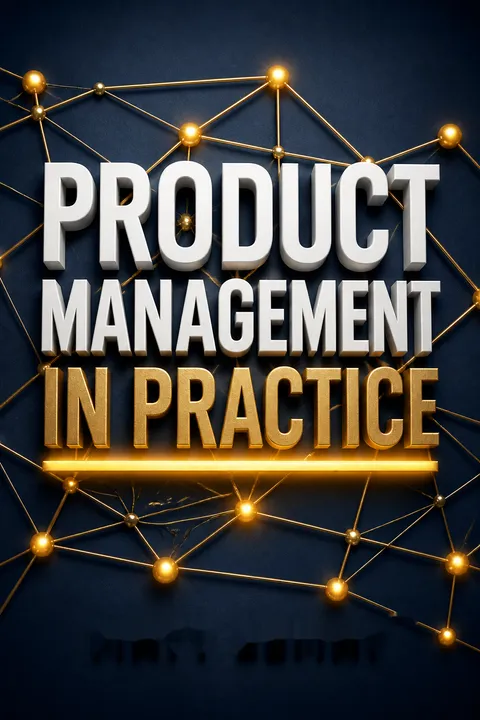


Key Takeaways
Treat product management as connective leadership, not miniature CEOhood
The real job is connection. On his first day as a product manager, Matt LeMay expected roadmaps, goals, and user research plans. His boss offered no guide, only the expectation that he would work it out. The surprise was not unique to startups: the role varies across organizations, but almost always means linking users, business priorities, and specialists who do not report to the PM.
Influence replaces authority. Product managers are often held responsible for results they cannot produce alone. They must clarify goals, resolve misunderstandings, and help others do their best work. The title does not make someone a boss or the sole visionary. The value is visible in what a team can accomplish together, including the unglamorous work that keeps it moving.
The role resembles boundary-spanning work in organizational sociology: a person connects groups whose knowledge, incentives, and vocabulary differ. That position can improve coordination, but it can also become invisible labor. If a PM is expected to fix every gap without decision rights or executive support, the organization has turned a connective role into a convenient shock absorber. The practical implication is to make dependencies and decisions visible, not to romanticize endless personal availability. Influence is essential, but authority and accountability still need to be designed coherently.
Build the CORE skills that help specialists work as one
A different skill map. A familiar model pictures product managers between user experience, technology, and business. LeMay argues that knowing those disciplines is not the same as connecting the people who practice them. His alternative is CORE: Communication, Organization, Research, and Execution. Communication seeks clarity; organization creates a team that can work without constant PM intervention; research gathers perspectives; execution means doing what the work requires.
Learn enough, then collaborate. A technically complex product may require technical literacy, but not every PM needs to code or master data science. Curiosity and contextual learning are often more useful than pretending to be an expert. The execution principle includes both routine support and high-stakes conversations. Neither is beneath the PM, and neither should be pursued as a status performance.
CORE usefully shifts hiring and development away from credential proxies toward observable behavior: Can someone surface ambiguity, coordinate work, investigate a claim, and help deliver? Those capacities can be practiced and assessed. Yet a framework cannot erase the need for domain expertise. In safety-critical or highly regulated products, a PM who cannot recognize material technical or legal risks may slow the team or make poor trade-offs. The stronger interpretation is not that hard skills are irrelevant, but that their required depth should follow the work rather than a universal stereotype.
Use curiosity to earn trust before you need help
Ask before you need a favor. LeMay describes avoiding the data science team because he assumed its members would not want to explain their work. A simple invitation to talk revealed that a data scientist felt similarly distant from product. The gap had been maintained by mutual assumptions, not actual hostility. Learning directly from colleagues also teaches which expertise matters in this organization and builds a relationship before a deadline makes it transactional.
Make being wrong useful. A growth mindset treats unfamiliar work and setbacks as opportunities to learn rather than verdicts on ability. One product was nearly blocked by compliance, but its PM asked for the reasoning, uncovered a specific user interaction that triggered the rejection, and worked out an alternative. Curiosity also means asking other departments what goals and constraints they are serving.
This approach echoes psychological safety, the shared sense that questions and uncertainty can be expressed without humiliation. Curiosity is not merely pleasant; it is an information-gathering behavior that can expose hidden dependencies before they become costly. Still, openness alone does not guarantee trust. In workplaces where candor is punished, people may reasonably withhold information. The PM has to show that questions lead to fair treatment and useful action, rather than extracting knowledge from colleagues while leaving their concerns unchanged.
Treat best practices as hypotheses, not imported operating systems
Fit the practice to the problem. A successful process at one company may fail elsewhere because teams, incentives, and constraints differ. LeMay recounts a product leader who arrived ready to transplant a full set of routines from a previous job. The team was skeptical. A slower approach, introducing one change at a time and checking whether it helped, built a process that fit the new organization.
Start with the goal. An offsite may seem like a solution to poor communication, but the underlying issue could be conflicting incentives or damaged relationships. First describe the challenge, its effect on users, and the beliefs or habits contributing to it. Then test a modest intervention. A famous company’s method can help win permission to experiment, but its reputation is not evidence that the method will work here.
This is an argument for local experimentation over management fashion. A practice is a causal claim: under these conditions, this routine should produce this result. Changing one element at a time makes it easier to learn whether the claim holds. There is a limit, however. Small pilots can preserve an organization’s comfortable assumptions if the problem requires structural change, such as changing incentives or reallocating authority. Iteration should therefore test not only rituals, but also whether the diagnosis itself is adequate.
Make uncomfortable communication cheaper than expensive surprises
Name the apparent obvious. A minor mismatch between what an executive expects and what a developer is building can grow into a public launch dispute if nobody asks about it. LeMay recommends stating assumptions, requests, and concerns plainly, even when doing so feels awkward. Overcommunication is not a demand for more messages; it is a way to make expectations explicit before work hardens around different interpretations.
Seek commitment, not quiet. The technique called disagree and commit asks participants to voice objections, then affirm responsibility for a chosen path. Silence is not automatically agreement. In one team discussion about after-hours client emails, requiring clear commitment surfaced a better policy: answer the next morning instead of rewarding late-night messages. The method needs care. Used as an order to comply, it destroys the candor it is meant to invite.
This is closely related to the difference between psychological safety and decision accountability. A team needs room to dissent, but endless discussion can also conceal avoidance. A useful meeting makes both stages explicit: disagreement is welcome before the decision, and responsibility is shared afterward. The book's emphasis on directness also corrects a common social trap: a vaguely phrased request can feel polite to its author while forcing recipients to guess its urgency. Clarity reduces that hidden emotional work.
Manage up for clarity, and keep users inside the strategy
Help leaders make the trade-offs. Senior stakeholders can shift priorities, but a PM should not respond by turning the team against them. In one example, an executive-selected workflow tool could not meet basic needs. The team created increasingly elaborate workarounds, then learned from users that the finished product was not useful. Earlier, direct questions about the technology choice and its costs could have prevented the sunk-cost spiral.
No big reveals. Build executive understanding in smaller conversations before presenting a major change in a high-stakes meeting. Explain options and consequences, and let leaders own the decisions. At the same time, connect business outcomes to real user needs. A redesign that pleased internal department heads but buried the site's search function illustrates how stakeholder harmony can crowd out usability. The PM's job is to connect these interests, not quietly conceal one from another.
Managing up is most effective when it gives decision-makers better information rather than staging a contest over who is right. This fits the logic of procedural justice: people are more likely to support difficult outcomes when they understand the options and believe their concerns were heard. Still, not every business goal can be reconciled with every user preference. The PM should make conflicts and costs legible, rather than promise a perfect alignment that does not exist. User evidence strengthens the conversation, but does not replace judgment.
Watch users in context instead of collecting feature wish lists
Observe what people do. In LeMay's poker example, a researcher who admits limited knowledge learns that a group has developed its own informal rules. That discovery could matter more than a list of requested app features. Users are often better at describing an episode than predicting what product should be built. Ask about a particular recent experience, and invite them to walk through it, rather than asking for broad preferences.
Notice the workarounds. Researchers studying measuring cups saw people crouch to read markings at eye level. That behavior suggested a design opportunity that users had not articulated as a feature request. The book also warns against over-relying on prominent power users: a publishing startup listened to successful authors while discounting target users who said they lacked the time and capacity for the proposed tool. User research is a skill, not a validation ritual.
Contextual observation helps distinguish stated preference from situated behavior. People may lack the vocabulary to propose a solution, while their workarounds reveal friction directly. This does not make interviews or self-reports useless; each method answers different questions. Observation can also mislead when a researcher overinterprets a small sample or treats unusual behavior as representative. Strong discovery triangulates what users say, what they do, and the conditions shaping both, with particular attention to whose voices are missing.
Make data answer a decision, with assumptions exposed
Numbers do not choose goals. A PM should state what information was collected, how it was gathered, and what assumptions connect it to a decision. A company considering European expansion might rank countries by car ownership, but that metric only helps if driver supply matters more than demand, regulation, or competition. Make those assumptions discussable before presenting the result as objective.
Metrics need context. LeMay invokes the One Metric That Matters as a focusing exercise, not a universal magic number. A fall in page views could be good for a search tool designed to deliver answers quickly, or bad for an ad-funded site. He also calls broad scores such as Net Promoter Score Obfuscating Quantitative Proxies: compressed numbers that hide how data was collected and what distinctions are lost. Pair metrics with qualitative evidence, and be accountable for understanding causes and actions, not only hitting a number.
The central caution connects to Goodhart's law: once a measure becomes a target, people may optimize the measure instead of the underlying value. The author's emphasis on assumptions is a practical defense, because it reveals the choices buried between observation and conclusion. Yet rejecting summary measures entirely would be a mistake. Aggregation can help detect trends that no anecdote reveals. The right question is whether a metric is suitable for a particular decision, population, and time horizon, not whether it captures reality perfectly.
Make roadmaps and prioritization serve shared goals, not status
Define what a roadmap promises. Organizations often disagree about whether a roadmap is a fixed commitment, a strategic sketch, or a changing set of ideas. State its audience, time horizon, review rhythm, and rules for changes. Treat it as a shared conversation about what to build and why, rather than property the PM must guard. Specifications should likewise prompt collaboration, not substitute for user learning or become elaborate documents mistaken for the product.
Prioritize against usable goals. A backlog cannot resolve unclear strategy. Test goals against real choices: if one option might grow revenue and another might attract users, can the stated goals tell the team which matters now? Include research, prototypes, and experiments as work, not just coding. An impact-versus-effort discussion can also bring developers into the decision, since they know the cost of implementation while product colleagues explain user value.
Roadmaps are coordination devices, so their value depends on shared interpretation. A document that different departments treat as a promise, forecast, and wish list is not merely imperfect; it creates incompatible expectations. Explicit uncertainty can be more useful than false precision. Goals also make prioritization more accountable, but only if they include meaningful user outcomes and do not reward easily counted proxies alone. Treating discovery as legitimate work protects the option to learn before committing substantial engineering capacity.
Use Agile values to improve work, not to worship ceremonies
Values before rituals. The Agile Manifesto values people and interaction, working software, customer collaboration, and response to change over rigid reliance on tools, documents, contracts, and plans. LeMay points to the Heart of Agile, a plain-language set of actions: collaborate, deliver, reflect, and improve. Teams can begin with a known method such as Scrum, then adjust practices against their goals instead of treating a manual as law.
Inspect what the ritual does. One team discovered that its daily standup had become a place to report blockers rather than resolve them. A developer had stayed blocked since Friday because he expected the Monday meeting to handle it. The team removed the ritual and agreed to raise blockers immediately in chat. Agile cannot supply product purpose by itself, and user-focused paperwork cannot replace actual conversations with users.
The book's critique distinguishes a method from its implementation. A ceremony can provide useful cadence, shared visibility, and a prompt for reflection, but repeating it does not guarantee those outcomes. This is a familiar problem in institutional life: compliance with procedure can become a substitute for achieving the procedure's purpose. The counterweight is not improvisation for its own sake. Teams need enough stability to coordinate, plus scheduled opportunities to assess whether their routines still serve delivery, learning, and collaboration.
Challenge product autopilot without becoming the team's lone rescuer
Success is uncommon, and comfort can hide drift. The book cites 2.2 million apps in Apple's store and 2.8 million in Google Play in 2017, alongside a Forrester finding that most smartphone users spent most of their time in only five non-preinstalled apps. The point is not to discourage product work, but to reject the fantasy that frameworks guarantee a breakout. Teams doing well can still become insular, stop questioning assumptions, and miss changing user needs.
Build a resilient team. Talk with people who left, examine competing products, and use time-boxed prototypes to challenge core assumptions. A healthy organization does not avoid conflict; it handles disagreements without personal attacks and treats new information as useful. When the PM feels solely responsible for holding everything together, delegate important work and protect ordinary team routines. A connector can shape a culture, but should not become its only functioning connection.
This ending makes a valuable distinction between performance and organizational health. Favorable metrics can coexist with weak learning, brittle relationships, and dependence on a single coordinator. Resilience comes from distributing context and responsibility, so the team can respond when assumptions fail or key people are absent. There is also a tension worth keeping visible: continuous challenge can become exhausting if every routine is treated as suspect. A sustainable practice alternates focused execution with deliberate reflection, rather than demanding permanent urgency or permanent reinvention.
Analysis
LeMay's central argument is that product management is not a miniature version of a CEO, designer, engineer, or analyst. It is work at the seams between people who have different information, incentives, and authority. The book's examples repeatedly show that failures often arise not from a lack of a framework but from unspoken assumptions: an executive believes a design was approved, a developer believes a request is impossible, a user researcher mistakes a confident power user for the target market, or a team interprets a roadmap in incompatible ways.
The CORE model translates that diagnosis into daily practice. Communication makes ambiguity visible. Organization reduces dependence on the PM as a human routing system. Research tests internal assumptions against users and colleagues. Execution turns shared intent into real work, including tasks with little prestige. Curiosity binds these skills together because it makes expertise, disagreement, and correction approachable rather than threatening.
The book is strongest when it treats process as a social agreement rather than a neutral machine. A standup, roadmap, metric, or Agile framework has effects only through how people understand and use it. This is a useful corrective to management cultures that equate visible artifacts with progress. Its limitation is that connective labor can be celebrated without asking whether an organization has provided enough authority, staffing, or executive clarity for the PM to succeed. Individual skill cannot indefinitely compensate for structural dysfunction.
The adaptation's practical test is therefore twofold: does a practice improve the team's ability to learn and deliver value for users, and does responsibility for that practice belong to more than one person? When both answers are yes, product management becomes a capability shared across the organization rather than a role expected to absorb every contradiction.
Review Summary
Product Management in Practice receives high praise for its practical, real-world approach to product management. Readers appreciate its focus on communication, soft skills, and dealing with ambiguity. The book offers valuable insights for both new and experienced product managers, with many highlighting its down-to-earth style and relatable scenarios. Reviewers consistently mention the book's emphasis on clarity, stakeholder management, and adaptability. Many consider it a must-read for aspiring product managers, noting its effectiveness in demystifying the role and providing actionable advice for common challenges.
People Also Read








Glossary
CORE skills
Four connective capabilitiesA product management skill model consisting of Communication, Organization, Research, and Execution. It describes the work of aligning people and moving product decisions forward, rather than presenting the PM as a partial designer, engineer, and business leader. The model is intended to apply across company sizes and product roles.
disagree and commit
Dissent, then shared responsibilityA meeting practice that aims for explicit commitment to a decision rather than apparent consensus. Participants are prompted to express concerns before choosing a path, then take responsibility for carrying it out. Silence should not automatically count as agreement. The technique is meant to encourage useful dissent, not compel obedience or punish disagreement.
Heart of Agile
Four actions for agile workAlistair Cockburn's concise description of Agile practice: Collaborate, Deliver, Reflect, and Improve. In the book, these actions connect the Agile Manifesto's values to everyday work and provide a simple test for evaluating specific ceremonies or methods. They emphasize ongoing learning rather than strict adherence to a single prescriptive framework.
Obfuscating Quantitative Proxies (OQPs)
Numbers that conceal complexityLeMay's term for single numerical scores that claim to represent complex behaviors or product health while concealing important context, data collection choices, or assumptions. Such a score may still reveal a trend, but its usefulness depends on the question being asked. It should not be treated as universally comparable or as a complete account of user experience.
Objectives and Key Results (OKRs)
Objectives paired with measuresA goal-setting approach that combines a qualitative objective with measurable key results indicating progress. The book favors the framework as a way to connect an inspiring direction with evidence of movement. It recommends beginning on a manageable scale and adapting the practice, rather than assuming organization-wide adoption will work automatically.
One Metric That Matters
A focus-setting metric exerciseA concept from Lean Analytics that asks a team to identify the most important metric for its current product and goals. LeMay presents choosing one metric as a focusing exercise, not a universal rule that every product has only one relevant measure. Its meaning depends on the organization's strategy and the decision at hand.
Product Martyr
Self-sacrifice as proof of valueOne of LeMay's recurring caricatures of an insecure product manager. The Product Martyr accepts excessive responsibility, emphasizes personal sacrifice, and signals resentment while appearing to serve the team. The pattern can arise when connective contributions are hard to measure, but it damages trust by making ordinary collaboration feel like a debt owed to the PM.
FAQ
What's "Product Management in Practice" about?
- Real-world guide: "Product Management in Practice" by Matt LeMay is a practical guide that explores the day-to-day responsibilities of a product manager.
- Connective role: It emphasizes the connective role of product management, bridging user needs with business goals and technical viability.
- Case studies and frameworks: The book includes case studies and frameworks to help new and experienced product managers navigate their roles effectively.
- Focus on relationships: It highlights the importance of building great relationships as a foundation for building great products.
Why should I read "Product Management in Practice"?
- Practical insights: The book offers actionable insights and advice for both aspiring and experienced product managers.
- Beyond theory: It goes beyond theoretical concepts to address the real-world challenges and nuances of product management.
- Empathy and collaboration: Emphasizes core values like empathy, curiosity, and collaboration, which are crucial for success in product management.
- Real-world stories: Includes stories from working product managers, providing relatable and practical examples.
What are the key takeaways of "Product Management in Practice"?
- CORE skills: Focus on Communication, Organization, Research, and Execution as the key skills for product managers.
- Clarity over comfort: Prioritize clarity in communication, even when it's uncomfortable, to avoid misunderstandings.
- Change the rules: Adapt processes to fit the team's needs rather than rigidly following established rules.
- User-centric approach: Always align product decisions with user needs and business goals.
What are the best quotes from "Product Management in Practice" and what do they mean?
- "Clarity over comfort": This quote emphasizes the importance of clear communication, even when it might be uncomfortable, to ensure alignment and avoid misunderstandings.
- "Change the rules, don’t break the rules": Encourages adapting processes to better fit the team's needs rather than blindly following established practices.
- "Live in your user’s reality": Highlights the importance of understanding and prioritizing user needs in product management decisions.
- "No work beneath, no work above": Suggests that product managers should be willing to take on any task necessary to support their team and product.
How does Matt LeMay define the role of a product manager in "Product Management in Practice"?
- Connective role: A product manager connects user needs with business goals, technical viability with user experience, and vision with execution.
- Varied responsibilities: The role involves a wide range of tasks, from strategic planning to day-to-day execution.
- Influence without authority: Product managers often have responsibility without direct authority, requiring them to lead through influence.
- Focus on relationships: Building strong relationships is crucial for successful product management.
What is the CORE skill model in "Product Management in Practice"?
- Communication: Effective communication between stakeholders, users, and team members is essential.
- Organization: Organizing the team for successful collaboration and ensuring everyone knows their priorities.
- Research: Continuously seeking new ideas and perspectives to inform product decisions.
- Execution: Ensuring that tasks are completed efficiently and effectively, with a willingness to take on any necessary work.
How does "Product Management in Practice" address the challenges of working with senior stakeholders?
- Managing up for clarity: Push for clarity in company strategy and vision, as a lack of clarity can hinder success.
- Empower decision-making: Help senior stakeholders make informed decisions by providing clear information and options.
- Avoid surprises: Ensure that senior stakeholders are not surprised by new ideas in important meetings by socializing them in advance.
- User-centric focus: Keep user needs at the forefront of discussions with senior stakeholders to align business goals with user value.
What advice does Matt LeMay give for communicating with users in "Product Management in Practice"?
- Play dumb: Create space for users to communicate their reality by not assuming you know everything.
- Ask about specifics: Focus on specific instances rather than generalizations to get more accurate insights.
- Avoid leading questions: Don’t ask users to design the product for you; instead, understand their needs and design solutions accordingly.
- Level up questions: Use questions that help uncover core goals and motivations without making users defensive.
How does "Product Management in Practice" suggest handling data-driven decision-making?
- Avoid the "D" word: Be specific about the data you’re using and the assumptions you’re making.
- Document assumptions: Clearly document assumptions to allow for informed discussions and testing.
- Focus on key metrics: Identify and focus on the metrics that truly matter for your product and business goals.
- Qualitative and quantitative: Supplement quantitative data with qualitative insights to understand the "why" behind the numbers.
What is the approach to roadmaps and prioritization in "Product Management in Practice"?
- Strategic communication tool: Treat roadmaps as a tool for strategic communication, not a fixed plan.
- Facilitate collaboration: Use roadmaps to encourage collaboration and alignment around high-level goals.
- Structured idea evaluation: Provide templates to structure and evaluate ideas for the roadmap based on user needs and business goals.
- Prioritize against goals: Ensure that prioritization decisions are guided by clear and actionable organizational goals.
How does "Product Management in Practice" view Agile methodologies?
- Values over processes: Emphasizes the core values of Agile, such as collaboration and responding to change, over rigid processes.
- Reflect and improve: Encourage regular reflection and improvement of Agile practices to ensure they meet team goals.
- Adaptation: Be willing to adapt Agile practices to fit the specific needs of the team and organization.
- Beyond software: Agile principles can be applied beyond software development to improve collaboration and efficiency across the organization.
What are the common pitfalls for product managers according to "Product Management in Practice"?
- Insecurity-driven behaviors: Avoid falling into archetypes like the Jargon Jockey or Product Martyr, which are often driven by insecurity.
- Over-reliance on best practices: Don’t blindly follow best practices without considering the unique needs of your organization.
- Avoiding user interaction: Ensure that user-centric rituals don’t replace actual user interaction and feedback.
- Neglecting team dynamics: Pay attention to team dynamics and ensure that processes and communication styles are adapted to fit the team’s needs.
Download PDF
Download EPUB
.epub digital book format is ideal for reading ebooks on phones, tablets, and e-readers.








