

Key Takeaways
Treat product management as outcome ownership, not authority or document production.
The job is the result. A product manager connects customer needs, technology, design, and business goals, then helps a team deliver a product that works for real users. The role spans research and planning, design, implementation and testing, and release. The balance shifts by company and product: one PM may write detailed specifications, another may work through quick sketches with engineers, and another may coordinate complex hardware launches.
Influence replaces command. PMs generally do not manage the engineers and designers building the product. They earn cooperation through clear goals, research, sound judgment, and follow-through. A specification, meeting, or roadmap is only useful if it helps the team make decisions and ship. If a critical task has no obvious owner, the PM is expected to find a way to cover the gap.
This role resembles systems engineering more than miniature executive leadership. The PM coordinates people with distinct expertise while preserving their ownership of implementation and design. That arrangement can produce better decisions because technical and creative knowledge stays close to its source. It also creates a real accountability tension: responsibility may be broad while formal authority is narrow. Clear decision rights and explicit success measures help prevent influence from becoming endless negotiation, especially when strong stakeholders disagree.
Choose companies by how their PMs actually work, not by brand.
The title hides different jobs. The book contrasts companies where PMs shape strategy from the bottom up with companies where senior leaders set direction and PMs execute it. It also describes teams with many PMs sharing detailed work and teams where one PM owns a broad area. Microsoft’s program manager role, for example, can include hands-on feature definition, while Apple’s engineering program managers often coordinate tightly controlled launches. At Amazon, proposals rely heavily on written business cases, while Facebook favors a technical, entrepreneurial style.
Investigate the local reality. Culture, decision-making, technical expectations, team size, product maturity, and release cadence all shape the work. A startup may offer wide influence but little mentorship; a large company may offer experienced colleagues but narrower ownership. Ask who decides what to build, how designers and engineers participate, and what a typical week actually involves.
This is a useful corrective to prestige-based job searches. Organizational behavior research often distinguishes formal structure from work as actually practiced, and product management is particularly sensitive to that gap. Two people with the same title can have radically different authority, customer access, and pace. A candidate should evaluate the manager and team, not just the company’s public reputation. The tradeoff is that interview answers describe a team at a moment in time; rapid reorganizations can make even accurate answers temporary.
Prove you can ship by creating evidence, not collecting credentials.
Experience means decisions plus consequences. Strong candidates show that they can understand a customer, choose what matters, work through constraints, and explain the result. For students, the book recommends technical study, team projects, leadership, and side projects. A side project can be an app, a prototype, or even a tested product concept. Its value lies in the decisions and learning it reveals, not just download totals.
Build the missing part of your profile. Engineers can practice customer research and strategic thinking; designers can strengthen prioritization and analysis; support staff can turn repeated complaints into broader product insights. A computer science background can help build credibility with engineers, but it is a proxy for technical fluency, not a guarantee of PM ability. An MBA can help with business skills and networks, but it is neither a universal requirement nor a shortcut to product experience.
The emphasis on evidence aligns with experiential learning: people develop judgment by acting, observing outcomes, and revising their approach. A modest project with clear user learning can therefore be more persuasive than a polished credential with no applied work. The caution is that shipped products are not pure measures of individual skill. Team resources, timing, and market conditions shape outcomes. Candidates should describe their own decisions honestly, while employers should distinguish personal contribution from the team’s broader success.
Make your resume a 15-second proof of measurable product impact.
Design for the skim. The book argues that resume screeners may spend only about 15 seconds on an application. Keep the strongest evidence easy to find: use concise bullets, make company and role information clear, and generally keep the resume to one page with less than ten years of experience. Replace lists of duties with accomplishments. “Owned feature planning” says little; what changed for users, revenue, reliability, or team speed is more persuasive.
Quantify, then explain. Numbers help a reader judge scale, but they need context and must be defensible. A resume example turns a vague claim about improving productivity into a description of specific process changes. Include meaningful side projects, even if unfinished or unsuccessful, and explain unfamiliar employers briefly. A short cover letter can connect experience to a particular role, especially when the candidate’s background does not look conventional.
A resume is an interface under severe time constraints. Information architecture matters: prominent, specific evidence reduces the effort required to infer relevance. This is similar to designing a product for a hurried user, a useful irony for PM candidates. Metrics add credibility, but a single percentage can mislead if the baseline, attribution, or measurement method is unclear. A strong application makes the claim easy to notice and the underlying work easy to interrogate.
Research the company, then tell a coherent story about your fit.
Study the product as a user. Before interviewing, use the company’s products and learn who they serve, how they make money, what alternatives customers have, and what users praise or complain about. Then connect those observations to the company’s strategy, culture, and the specific PM role. Research is not trivia for impressing interviewers; it helps a candidate offer relevant answers and decide whether the job is a good match.
Make the pitch a story. For “Tell me about yourself,” select a few experiences that explain how the candidate arrived at product management and why the role fits. For “Why this company?” cite a specific product, customer, or challenge, then link it to credible experience or motivation. Keep the answer focused. A list of praise for a famous company does not show why this particular candidate would contribute.
Good preparation is a form of perspective-taking: it asks the candidate to model the company’s users and the interviewer’s decision problem. That makes answers more specific without requiring theatrical enthusiasm. The same discipline can expose poor fit before an offer is accepted. There is a limit, however: public product analysis cannot reveal all internal constraints, and confident criticism based on shallow research can backfire. The strongest preparation combines informed opinions with curiosity about what remains unknown.
Prepare five flexible stories that reveal your actions and their effects.
Build a story bank. Behavioral questions test both what a candidate has done and how clearly they communicate it. Prepare examples of leadership, teamwork, success, challenge, and failure, then choose five substantial stories that can answer several kinds of questions. A useful structure is Situation, Action, Result: explain only enough context, emphasize personal actions, and show what changed. Starting with the story’s central point helps the listener follow the details.
Own the contribution. A team’s success matters, but an interviewer needs to understand what the candidate did. “We fixed the problem” hides whether the candidate found the cause, aligned stakeholders, or simply watched. Choose genuine failures, explain how they were handled, and say what was learned. Avoid blaming colleagues. Prepare for follow-ups about reactions, consequences, and what would be done differently.
A prepared story bank reduces the mental load of answering under pressure, much as a well-organized case file helps a decision-maker find relevant evidence. The structure also makes attribution clearer, which is essential when work is collaborative. Yet interview stories are edited narratives, not complete records. A candidate can make an ordinary event sound heroic through selective framing. Follow-up questions are valuable because they test whether the account remains coherent when the interviewer probes its mechanics.
Design from user goals before pitching features.
Start with the person and the problem. Product questions are not invitations to list favorite features. Clarify the situation, identify users and buyers, and understand what they are trying to accomplish. A calculator for children may also need to work for parents and teachers; a home stove must account for novice cooks, experienced cooks, and household safety. Use cases reveal the gaps between a product’s current design and people’s actual needs.
Connect each idea to a need. After identifying the most important use cases, propose a small number of improvements and explain their tradeoffs. An alarm clock for a blind user, for instance, cannot rely on visual indicators alone, but spoken feedback may disturb a sleeping partner. Alternative signals, such as vibration or tactile controls, address the access problem differently. Close by explaining how success could be tested and what the proposal sacrifices.
This approach reflects human-centered design: observation of people’s goals is a better starting point than a designer’s assumptions about desirable features. It also guards against a common product failure, solving the stated request while missing the underlying need. Accessibility examples sharpen the method because they expose assumptions built into ordinary interfaces. Still, interviews rarely provide enough evidence to settle every user tradeoff. A good candidate states assumptions and proposes ways to learn, rather than treating an elegant idea as proof.
In cases and estimates, make your reasoning visible before naming an answer.
Structure beats lucky guesses. Estimation questions test how candidates reason with incomplete information, not whether they know the exact number of pizzas sold in a city. Clarify what is being counted, list known facts, create an equation, break it into manageable parts, state assumptions, calculate, and sanity-check the result. Label units and consider overlooked sources. For example, estimating annual product revenue may require users, frequency of use, and revenue per action rather than one unsupported guess.
Cases need a decision path. Diagnose a business problem by tracing its components: a sales decline might come from fewer visitors, weaker conversion, lower prices, or poorer retention. Product cases also ask candidates to weigh customer value, business goals, competitors, launch risks, and success metrics. Familiar frameworks can help organize thought, but forcing a memorized template onto the problem is less useful than a clear structure built for the question.
The method resembles scientific modeling: make the assumptions explicit, derive an estimate, then look for evidence that the model is implausible. That is more informative than false precision, particularly when data is unavailable. In real product work, however, a coherent estimate is only a starting point. Inputs can be correlated, customer behavior can change, and aggregate averages can conceal important segments. The habit of checking the model’s weak points is as important as the arithmetic itself.
Treat coding questions as problem-solving conversations, not typing tests.
Think aloud before coding. Some PM interviews include technical questions, especially for technically oriented roles or candidates with recent coding experience. The book advises clarifying the problem, drawing an example, discussing a simple solution, considering efficiency and edge cases, and only then writing code or pseudocode. Test the result with normal and boundary cases. Interviewers also notice whether a candidate responds constructively to hints and keeps working when the solution is difficult.
Expect different hiring rituals. Company processes vary. Google and Facebook use hiring committees in the described processes; Amazon interviewers assess leadership principles and include a bar raiser; Apple puts particular weight on product passion and team fit; Microsoft teams can emphasize different skills. These descriptions are guides, not guarantees. Candidates should prepare for the actual role and team, rather than assuming every company with the same title asks the same questions.
The conversational approach makes reasoning observable, which is useful when a perfect answer is less important than the ability to learn and adapt. It also resembles collaborative debugging, where explaining assumptions often reveals the bug before code does. Interview formats are imperfect measurements of job performance, though. A timed algorithm puzzle may reward recent practice more than product judgment. Candidates should prepare for the stated process while remembering that interview performance is evidence, not a complete portrait of capability.
Advance by shipping meaningful work and earning trust across teams.
Results build a PM career. The book treats launched products as the strongest proof of a PM’s contribution. Early in a role, become the expert on customers and the product area, help the team with useful work, and define how success will be measured. Completing several release cycles develops skills that a roadmap or specification alone cannot demonstrate. Seek assignments that build missing strengths, such as moving from a mature product to a new one or from consumer work to business customers.
Choose environments that teach. New PMs may benefit from experienced peers; more seasoned PMs may value broader ownership. A supportive manager, a growing organization, and meaningful cross-team projects can create room to expand responsibility. Promotion depends not just on meeting current expectations, but on showing consistent work at the next level. The book’s career stories also stress learning the team’s history before trying to change everything.
The focus on shipped outcomes keeps career growth tied to value delivered rather than visible busyness. It also highlights a less obvious source of influence: reliability across team boundaries. However, product success is shared and sometimes shaped by market luck, so career systems should not reward only headline launches. Maintenance, accessibility, infrastructure, and avoided failures can matter greatly despite being less visible. A durable career combines demonstrable results with judgment about which results are worth pursuing.
Analysis
This book is both a practical interview manual and an introduction to a profession whose boundaries change from company to company. Its central argument is that product management is not a credentialed specialty with a single route in. It is a set of observable behaviors: understand customers, make choices amid uncertainty, align people who do not report to you, and carry decisions through to launch. The interview is presented as a rehearsal of the job, not a test of memorized definitions.
The strongest thread is the insistence on evidence. Candidates should show consequences in their resumes, personal actions in behavioral stories, explicit assumptions in estimates, and user goals in product designs. This produces a coherent standard across the book’s many formats. A resume bullet, an interview answer, and a launch plan all need to make the reasoning and impact legible to someone with limited context.
The company comparisons add an important qualification: competence is contextual. A technically deep role, a strategy-heavy role, and an execution-centered program role do not demand identical profiles. The book’s historical company descriptions should be treated as snapshots, not timeless facts, but its method of asking about decision rights, team composition, and work cadence remains useful.
The main limitation is inherent in interview preparation. A person can learn to narrate sound judgment more easily than to exercise it under real organizational constraints. Polished stories and frameworks can become performance theater if they are detached from genuine customer contact and honest measurement. The book partly counters this risk by valuing launches, follow-through, and concrete outcomes over documents alone. Its most durable lesson is therefore not how to sound like a PM, but how to make one’s thinking inspectable while doing product work.
Review Summary
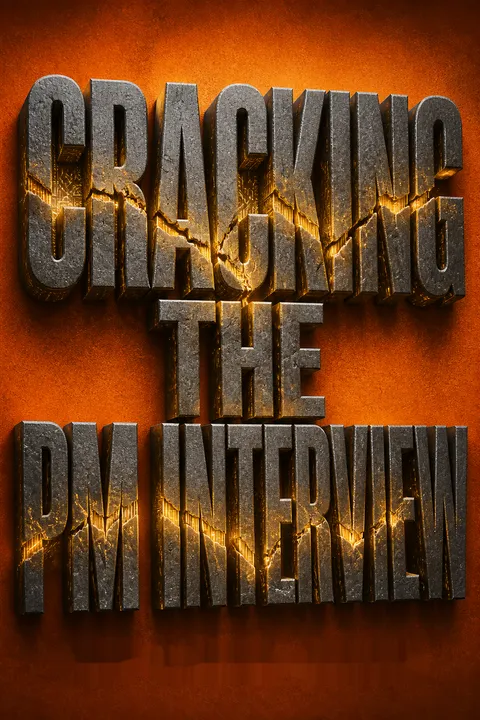
Cracking the PM Interview receives mostly positive reviews for its comprehensive coverage of product management roles and interview preparation. Readers praise its detailed insights, practical advice, and real-world examples. Many find it helpful for understanding PM responsibilities and company-specific interview processes. Some criticize its length and occasional dryness. While most recommend it for aspiring PMs, a few suggest it may not be sufficient on its own. Overall, reviewers consider it a valuable resource for those seeking PM positions or looking to improve their skills.
People Also Read







Glossary
Product sense
Recognizing promising product choicesProduct sense is the judgment to distinguish useful product decisions from weak ones. It involves noticing customer problems, identifying what matters most, and forming plausible solutions without relying only on explicit requests or exhaustive data. The book treats it as important to PM work and as something candidates can demonstrate through thoughtful product analysis.
Dogfooding
Using your own productDogfooding means employees use their own product, often while it is still being developed. Internal use can reveal defects and confusing experiences before a wider release. The book gives examples of software teams using early builds and describes it as one source of qualitative feedback, alongside usability studies and experiments.
Minimum viable product (MVP)
Smallest test of core valueA minimum viable product is an early, deliberately limited version of a product designed to test whether its core value matters to customers. It leaves out nonessential features so a team can launch sooner and learn from real use. It is not simply a lower-quality version of the full product; its scope should serve a learning goal.
Objectives and Key Results (OKRs)
Goals linked to measurable resultsObjectives and Key Results are a way for a team to express what it wants to accomplish and how it will judge progress. In the book’s account, PMs work with teams to define measurable results that make success concrete. The approach helps align work and prioritize features against outcomes rather than activity alone.
Situation, Action, Result (S.A.R.)
Structure for experience storiesS.A.R. is a structure for answering behavioral interview questions. The candidate briefly describes the situation, explains the actions they personally took, and ends with the result. The book emphasizes that the action section should be substantial and that results should be specific, ideally with measurable impact. Some versions add a task step and are called S.T.A.R.
Associate Product Manager (APM)
Entry-level PM development roleAn Associate Product Manager is an entry-level product role, often offered through a structured rotational program for new graduates. The programs described in the book combine real product responsibilities with training, mentorship, and movement between teams. Program length and design differ by company, so the title does not imply one universal experience.
A/B testing
Comparing product variants experimentallyA/B testing compares user behavior across groups exposed to different product experiences. One group sees a proposed change, while a control group continues with the existing version. Teams compare selected measures, such as engagement, retention, or revenue, to estimate the change’s effect. The book cautions that experiments need appropriate measures and interpretation.
Big O notation
How resource use scalesBig O notation describes how an algorithm’s time or memory requirements grow as its input grows. It expresses a scaling pattern, such as linear or quadratic growth, rather than an exact running time. The book introduces it as useful technical fluency for PM candidates who may need to discuss implementation tradeoffs with engineers.
Bar raiser
Independent hiring standards interviewerAt Amazon, a bar raiser is an interviewer from outside the hiring team who helps assess whether a candidate meets the company’s hiring standard. The role is intended to add an independent perspective, and the book notes that the bar raiser can challenge answers and has veto power in the described process.
FAQ
What's Cracking the PM Interview about?
- Focus on Product Management: The book is a comprehensive guide for aspiring product managers, detailing the necessary skills and experiences to land a PM role in technology.
- Interview Preparation: It covers various aspects of the interview process, including types of questions, preparation strategies, and what companies seek in candidates.
- Real-World Insights: Authors Gayle Laakmann McDowell and Jackie Bavaro share insights from their experiences at top tech companies, making the content practical and relatable.
Why should I read Cracking the PM Interview?
- Expert Guidance: Authored by industry experts with firsthand experience in hiring and coaching PM candidates, offering valuable insights.
- Structured Approach: Provides a clear roadmap for breaking into product management, simplifying career navigation for readers.
- Comprehensive Resources: Includes real resumes, cover letters, and interview questions, serving as a practical toolkit for job seekers.
What are the key takeaways of Cracking the PM Interview?
- Understanding the PM Role: Emphasizes the importance of understanding what a product manager does and how the role varies across companies.
- Interview Strategies: Offers strategies for tackling different types of interview questions, including behavioral, estimation, and product design questions.
- Career Advancement Tips: Shares tips on advancing in a PM career, highlighting the importance of networking and continuous learning.
What types of interview questions are covered in Cracking the PM Interview?
- Behavioral Questions: Discusses preparation for questions assessing past experiences and their relevance to the PM role.
- Estimation Questions: Explains approaches to estimation questions, testing analytical thinking and problem-solving skills.
- Product Questions: Details handling product design and improvement questions, focusing on user needs and market fit.
How does Cracking the PM Interview define a successful product manager?
- Customer Advocate: A successful PM advocates for the customer, understanding their needs and translating them into product features.
- Cross-Functional Leader: PMs must lead without authority, influencing engineers, designers, and other stakeholders to achieve product goals.
- Data-Driven Decision Maker: Highlights the importance of using data to inform decisions, ensuring product strategies are backed by solid metrics.
What specific methods does Cracking the PM Interview recommend for preparing for interviews?
- Research the Company: Stresses understanding the company’s products, culture, and market position before the interview.
- Practice Mock Interviews: Recommends conducting mock interviews to practice responses to common PM questions and receive feedback.
- Develop a Personal Pitch: Advises crafting a concise personal pitch that highlights your background, skills, and fit for the role.
What are some common myths about product management addressed in Cracking the PM Interview?
- PMs are Project Managers: Clarifies that while some PMs may have project management responsibilities, their primary role is to define product vision and strategy.
- Technical Skills are Optional: Emphasizes that a technical background is beneficial for PMs, aiding in effective communication with engineering teams.
- You Need an MBA: Argues that an MBA is not a requirement for becoming a PM, as many successful PMs come from diverse backgrounds.
What advice does Cracking the PM Interview give for writing a strong resume?
- Be Concise and Impactful: Advises keeping resumes to one page and focusing on accomplishments rather than responsibilities.
- Use Metrics to Showcase Success: Encourages candidates to quantify achievements, such as “increased user engagement by 30%,” to demonstrate impact.
- Tailor Your Resume: Suggests customizing your resume for each application, highlighting relevant experiences that align with the job description.
What are the best quotes from Cracking the PM Interview and what do they mean?
- “Product management is a strange role.”: Highlights the unique nature of product management, where there is no clear path or formal training.
- “You need to learn to lead your team without authority.”: Emphasizes the importance of influence and collaboration in product management.
- “Taking the guesswork and randomness out of interviews is a good thing for everyone.”: Underscores the goal of demystifying the interview process.
How can I leverage Cracking the PM Interview for career advancement?
- Networking Strategies: Provides insights on building and leveraging a professional network, crucial for career growth in product management.
- Continuous Learning: Emphasizes ongoing education and skill development, encouraging PMs to stay updated on industry trends.
- Seeking Mentorship: Suggests finding mentors who can provide guidance and support, helping navigate your career path effectively.
What frameworks are recommended in Cracking the PM Interview?
- SWOT Analysis: Helps assess a product's strengths, weaknesses, opportunities, and threats, providing a structured way to evaluate strategic decisions.
- 4 Ps of Marketing: Focuses on Product, Price, Promotion, and Place, guiding PMs in developing effective marketing strategies.
- Customer Purchase Decision Making Process: Understanding this process helps PMs design products that align with customer needs and behaviors.
How can I effectively communicate my product vision during an interview?
- Articulate Goals Clearly: Define the product's goals and how it addresses user needs, ensuring alignment with the company's mission.
- Use Data to Support Ideas: Back up your vision with data or examples from successful products, demonstrating grounded ideas.
- Engage the Interviewer: Encourage dialogue by asking for the interviewer's thoughts, showing value for collaboration and feedback.
About the Author
Other books by Gayle Laakmann McDowell


Download PDF
Download EPUB
.epub digital book format is ideal for reading ebooks on phones, tablets, and e-readers.








