

Key Takeaways
Treat a history as a memory test, then ask what its omissions conceal
Memory sets the syllabus. The book opens by arguing, in comic form, that history is whatever readers can retain. Its editors claim to have reduced England’s past to the handful of names and dates that survive the schoolroom, even boasting that two of the four dates they planned to include were cut as forgettable. The result is not a reliable account but a parody of how education turns a vast past into a small stock of examinable facts.
Forgetting is the joke. The mock test papers ask students to recall muddled names, invent connections, and admit how little they remember. Their absurd questions make the reader’s gaps feel less like personal failure than part of the system.
What's striking is that the joke targets not only bad recall but the authority granted to whatever survives it. Memory is selective: vivid names and dramatic battles crowd out slow changes in law, work, and daily life. That makes the book's comic compression a useful prompt to ask who chose the syllabus and what the selection makes seem important. The limitation is that a parody of simplification can itself flatten the past. Its best use is as a guide to skepticism, not as a substitute for historical study.
Watch each invasion become a new national identity
Identity keeps changing hands. The book turns early English history into a procession of arrivals. Romans appear, leave, and are followed by Picts, Scots, Angles, Saxons, Jutes, Danes, and Normans. The names and origins are deliberately scrambled for comic effect, while each new group seems to rename the country and redefine who counts as English. Britons pushed west become Welsh, and the once foreign Saxons become the people whose history is being told.
Conquest changes the label. In this account, the Norman invasion of 1066 is declared the final conquest, after which England can supposedly become a leading nation. The joke exposes how a national story can treat earlier arrivals as formative and later arrivals as interruption.
The sequence makes national identity look less like an ancient possession than a story assembled after successive migrations and conflicts. That aligns with modern historical approaches that study nations as institutions and shared narratives, rather than timeless biological units. The humor also reveals how a victor's arrival can be recast as the beginning of normality. Yet the book's wave metaphor risks treating diverse peoples as interchangeable forces and overlooking the uneven, gradual ways cultures mix. It works best as a challenge to simple origin stories, not as a complete account of migration.
Use the Good, Bad, and Weak King labels as a warning about easy history
Monarchs become schoolroom types. Kings are sorted into simple moral categories, with Alfred presented as good, Ethelred as weak, John as awful, and Canute as an experimental ruler who changes course. The jokes twist familiar stories: Alfred's cake burning is assigned to the wrong king, while Ethelred's indecision invites repeated Danish demands for payment. Canute's encounter with the sea becomes a lesson in abandoning a mistaken belief.
Labels replace explanation. Once a ruler has been tagged, complex events are made to look like predictable results of a single personality. A weak king brings another invasion; a strong king restores order. The comic pattern is easy to remember precisely because it leaves out political pressures and competing interests.
The caricatures expose a durable habit of political storytelling: explaining institutional crises through the temperament of one leader. This is memorable and sometimes useful, since individual choices matter. But it can disguise the constraints that shape those choices, including rival elites, resources, and inherited systems. The book's blunt categories parody textbook shorthand while also demonstrating its appeal. Readers can keep the mnemonic value of a vivid character, provided they ask what structures the character cannot explain.
Check who is excluded whenever a charter promises freedom
Rights arrive with exceptions. The book presents Magna Carta as a major step toward democracy, then undercuts the claim by repeatedly excluding ordinary people from its promised protections. In the parody, the barons secure limits on royal power for themselves, while the common people remain outside the bargain. The document's significance is thus made funny by the distance between its grand reputation and its restricted beneficiaries.
Representation is also mocked. Under Henry III, Simon de Montfort improves Parliament by inviting parish representatives, but the explanation is intentionally absurd and small in scale. The joke suggests that political participation is not a gift bestowed on everyone at once. It is negotiated, uneven, and often shaped by those who already possess power.
This section's central tension remains useful: a legal principle can be historically important while its original reach is narrow. Political rights often expand through reinterpretation, pressure, and conflicts over who qualifies as a full member of the community. The satire encourages readers to inspect the gap between universal language and actual access. Its limitation is that the joke can make legal development seem merely hypocritical. Restricted beginnings do not erase later consequences, and a partial safeguard can still create tools that future groups use to demand broader protection.
See royal legitimacy as a contest over stories, not just bloodlines
The throne stays disputed. From the Wars of the Roses to the Tudor accession, the book depicts kingship as a muddle of competing claims, convenient deaths, and political improvisation. Barons choose colored roses to mark opposing sides, while would-be monarchs appear in waves and confuse the royal succession. Henry VII's victory is made memorable by the crown supposedly found hanging in a hawthorn tree after battle.
A claim needs an audience. The comic pretenders Lambert Simnel and Perkin Warbeck become so interchangeable that even their identities seem negotiable. The episodes turn succession into a performance: claimants need supporters, proof, and a story that people will accept. Birth matters, but it never settles the argument on its own.
Legitimacy is not simply a family tree. It depends on institutions, force, recognition, and persuasive accounts of who should rule. The book's pretenders make that social dimension visible by turning identity itself into an unstable political claim. This also connects to modern questions about authority: a title has power only when relevant audiences treat it as valid. The comic emphasis on confusion, however, can obscure real differences between dynastic claims and the practical governance that follows. The useful lesson is not that all claims are equally arbitrary, but that legitimacy must be maintained and recognized.
Notice how religious and civil conflicts become costume dramas
Belief becomes a uniform. Henry VIII's break with Rome is recast as a domestic quarrel over marriage, while the dissolution of monasteries is treated as a royal measure for ending the Middle Ages. Later, Protestant and Catholic identities become labels that determine who may be punished. The book's distorted account makes religious change seem at once personal, administrative, and brutally consequential.
Politics wears its colors. During the Civil War, Cavaliers and Roundheads are identified by hats, hair, and clothing as much as by their arguments over royal power. Their visual contrast makes a complicated struggle easy to picture, while the satire exposes how political opponents can be reduced to uniforms and slogans.
Costume is not merely decoration in political life. Visible symbols help groups recognize allies, coordinate action, and signal loyalty, which helps explain why the book's clothing jokes land so well. At the same time, treating conflict as a clash of outfits can conceal material stakes, institutional disputes, and sincere religious commitments. The satire is strongest when it shows how labels simplify opponents; it is less useful if readers conclude that underlying differences were only theatrical. The memorable image should open inquiry into the arguments, not close it.
Interrogate every imperial victory called necessary, moral, or inevitable
Expansion gets a flattering story. Across its account of overseas conflict, the book repeatedly frames British victories as proper, fortunate, or required. It jokes that the American colonies rebel after a forced tea gathering, that British activity in India begins with a company clerk's victories, and that wars in Asia and Africa are launched for moral reasons that conveniently serve imperial aims.
The joke turns the lens around. By treating conquest as a sequence of self-evident benefits, the narrative exposes the language that makes expansion appear benevolent. Its recurring ranking of nations also turns empire into a school competition, with Britain repeatedly insisting that it must remain on top. The comic confidence is the point, not a neutral report of events.
Imperial narratives often present coercion as order, commerce, or protection, while centering the intentions of the power doing the conquering. The book's mock certainty helps readers hear that self-justification as rhetoric rather than fact. This is especially valuable because official histories can make domination sound administrative and inevitable. A caution is necessary: satire can expose British self-importance while still giving less space to the perspectives of colonized people. A fuller analysis must ask not only how empire justified itself, but whose experiences and political choices its story leaves out.
Ask who pays for every story of progress
Invention has a human cost. The Industrial Revolution is rendered as a discovery that women and children can work exhausting factory hours, while machinery and railways are presented as a stream of clever inventions. Factory laws arrive as soothing measures, including one that supposedly allows very young workers a meal after work. The gap between progress and working conditions supplies the satire's bite.
Reform can preserve the system. The book also mocks enclosure, which converts common land into controlled property, and legislation that treats workers' collective action as both permitted and forbidden. Its invented labels turn policy into nonsense, but the underlying pattern is clear: changes celebrated as national advancement can distribute costs and benefits very unevenly.
Technological change is not a synonym for social improvement. A machine can raise output while worsening control over workers, and new property rules can increase productivity while restricting access to land. The section anticipates a central question in political economy: who captures the gains of innovation, and who absorbs its disruption? Its comedy makes exploitation legible without requiring technical detail. Still, it risks making reform look uniformly cynical. Factory regulation and organized labor can also alter power relations, even when reforms begin imperfectly.
Treat the declared end of history as the joke's final warning
The finale refuses certainty. The book carries its comic survey through Queen Victoria, the empire, and the Great War, which it describes as a conflict to end war. Its causes are assembled from confused national rivalries, an assassination, imperial anxieties, and other alleged triggers. The peace settlement is then presented as more terrible than the battles, with its proposed remapping of the world creating yet more geography.
A neat ending is suspect. The editors announce that America has become the leading nation and that history is over, only to stop the account at that moment. This conclusion turns the promise of finality into one last joke. The reader has just watched every period declare itself decisive, so the ending's certainty is plainly unstable.
The book's ending punctures a familiar temptation: to treat the present as the final, settled result of everything that came before. Historical narratives often impose closure because readers want causes, lessons, and a destination. Yet political orders remain contingent, and a peace agreement can carry conflicts into new forms rather than erase them. The satire captures this instability through deliberate absurdity. Its own cutoff is also a limit: events beyond its 1930 publication are outside its view. That boundary makes the claim of finality a comic device, not a forecast.
Analysis
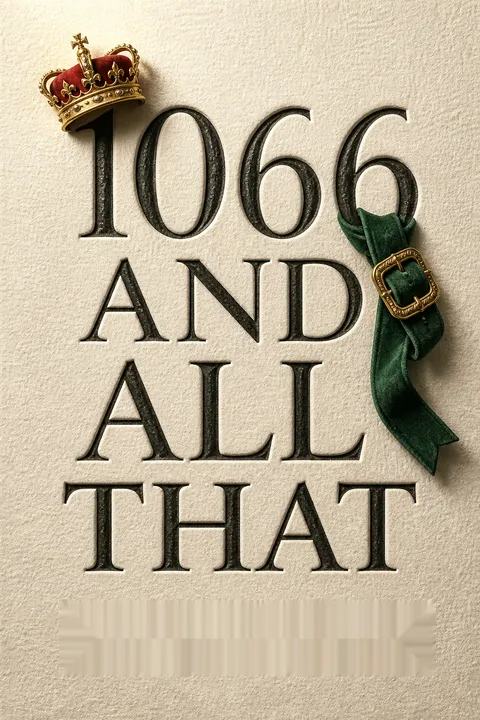
1066 and All That is a comic history book whose method is deliberate distortion. Its authors compress a long national story into a few dates, famous names, stock character types, and absurd causal explanations, imitating the confident shortcuts of school history. The result is more than a string of puns: the same jokes recur across centuries, making invasion, succession, law, religion, empire, and industrial change look like variations on a narrow set of stories about who is good, who is in charge, and whether Britain remains on top.
That pattern gives the book its analytical force. The recurring praise of events as beneficial, the habit of explaining crises through a king's character, and the assumption that imperial expansion is both natural and virtuous expose how historical narratives can smuggle political judgments into apparently simple facts. The mock examination papers deepen the point by making ignorance part of the reading experience. Students are asked to perform certainty about material that has been rendered impossible to remember coherently.
The satire also has limits. Its method relies on shared familiarity with British schoolroom conventions and imperial self-image, and its comic compression can repeat the exclusions it ridicules. Ordinary people, colonized subjects, and women often appear as punchlines or background figures rather than as agents with their own accounts of events. The book is therefore best read in two ways at once: as an enduring attack on rote, self-congratulatory history, and as a period piece whose own blind spots deserve scrutiny. Its central invitation is not to discard memorable stories, but to notice when a memorable story is doing the work of an explanation.
Review Summary
1066 and All That is a 1930 satirical parody of English history textbooks, presenting history as a series of memorable (and deliberately garbled) facts. Reviewers praise its dry British humor and clever wordplay, comparing it to Monty Python. The book works best for readers familiar with traditional English history education, as many jokes rely on historical knowledge. Common themes include jokes about "Top Nation" status, Good vs. Bad kings, and mock exam questions. While some find it brilliantly funny, others note it hasn't aged well, particularly regarding colonial attitudes. Most agree it's a quick, entertaining read requiring historical background for full appreciation.
People Also Read
Glossary
memorable history
History reduced to recallThe book's comic description of history narrowed to the names, dates, and incidents a reader can remember. It parodies school learning that rewards a small set of familiar facts while neglecting complexity. The phrase also explains the book's method: a deliberately selective and distorted account designed to make the limits of historical memory visible.
Good Thing
Satirical label for benefitA recurring judgment applied to events, rulers, invasions, and policies throughout the book. The label is often attached to outcomes that are absurd, harmful, or beneficial only to a particular group. Its repeated use mocks histories that turn complicated changes into confident moral verdicts, especially when the supposed benefits conveniently support national pride.
Weak King
A monarch blamed for failureOne of the book's recurring comic types for an ineffective ruler. A Weak King is treated as the simple cause of political disorder, invasion, or royal decline. The category parodies textbook accounts that explain major events through a monarch's personality while overlooking institutions, rival powers, and broader social conditions.
Top nation
Claimed national supremacyThe book's satirical shorthand for the supposed ranking of countries, especially Britain's recurring claim to superiority. Military victories, naval power, and imperial expansion are presented as proof of national standing. The term exposes the competitive, self-congratulatory logic behind a national history that treats dominance as both the goal and the measure of success.
Wave
A succession of arrivalsA recurring narrative device that presents invasions, migrations, or political movements as successive waves washing over Britain. The compressed image makes the chronology easy to follow and repeatedly comic, as one group replaces another. It also risks making distinct peoples and political changes seem interchangeable, a simplification consistent with the book's parody of abbreviated history.
Download PDF
Download EPUB
.epub digital book format is ideal for reading ebooks on phones, tablets, and e-readers.








