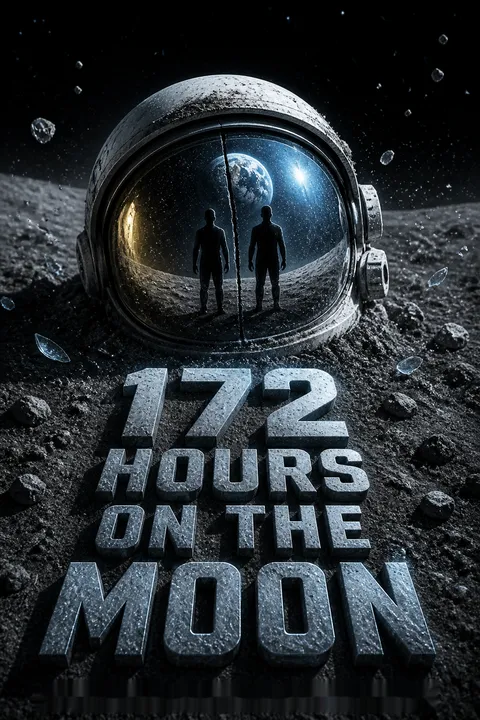


Plot Summary
Prologue
In 2010, NASA’s leaders debate reviving lunar travel after a mysterious signal returns. They disclose that a hidden research base, DARLAH 2, has stood on the moon since the 1970s, and that an Apollo photograph shows an unexplained figure near an astronaut.
Publicly, NASA will promise a search for valuable minerals and sell the mission as a celebration. Privately, officials want to investigate the signal and address the danger that ended earlier moon missions. To attract money and global attention, they decide to add three teenagers to the crew, chosen by lottery.
The plan turns public enthusiasm into cover for an experiment whose risks its organizers cannot explain. NASA’s leaders do not simply conceal information from the public; they recruit teenagers precisely because their novelty can make a dangerous mission irresistible. The lottery lends this manipulation the appearance of fairness, while the mineral prospect and anniversary celebration make secrecy look like ordinary public relations. The unexplained figure in the photograph supplies an image the meeting cannot interpret, but the decision proceeds anyway. From the beginning, the story’s central danger is institutional certainty without knowledge: the officials can design a launch and a publicity campaign, yet cannot establish what waits on the moon.
Three Seats for the Moon
Years after the secret meeting, NASA blankets the world with advertisements for a return to the moon and opens a lottery to teenagers. Mia Nomeland, a Norwegian guitarist and singer, rejects the idea because she wants to build her band, Rogue Squadron. Her parents have secretly entered her anyway, convinced she may regret missing the chance.
In Tokyo, Midori Yoshida sees the mission as a way out of the future her family expects her to accept, and enters willingly. In Paris, Antoine Devereux signs up after his girlfriend, Simone, leaves him for someone else. Each teenager approaches the same offer differently: as an intrusion, an escape route, or a means of outrunning heartbreak. None knows NASA has concealed the mission’s real purpose.
The lottery gives the story three distinct versions of wanting to leave. Mia’s resistance is not fear of adventure so much as loyalty to a life she has chosen: music, friends, and control over her own future. Midori converts the mission into a practical route beyond social expectations, while Antoine uses distance as anesthesia for rejection. Their different motives matter because the same journey will later strip away their imagined destinations. NASA’s lottery also echoes these private desires with a public promise of choice, although Mia’s parents have already chosen for her. The opening therefore makes consent, not curiosity, the first fault line.
Tickets Out of Ordinary Lives
NASA’s letters confirm that all three teenagers have won. Mia first rejects hers, crumpling the notice at rehearsal, but her bandmates argue that her fame could give Rogue Squadron the career she wants. She agrees to go.
Midori accepts immediately, imagining that the publicity will help her persuade her parents to move to the United States. Antoine keeps his news private until his parents discover the letter. Before leaving Paris, he watches Simone with her new boyfriend through a coin-operated telescope at the Eiffel Tower, then abandons the instrument and his last hope of winning her back.
His selection feels like escape, but a sighting of a passenger plane crashing into the Channel, unnoticed by everyone else, leaves him wondering whether the sky is safe.
Selection converts a private fantasy into a binding public identity. Mia’s decision is the most ambivalent: her friends make the mission seem useful to her own ambition, but the argument also pressures her to accept a risk she never sought. Midori’s confidence is similarly instrumental. She sees fame as leverage over her parents, not as a destination in itself. Antoine, by contrast, turns NASA’s offer into a deliberate act of disappearance. The inexplicable crash interrupts that fantasy with a warning he cannot verify. Each teen thus boards with an unresolved bargain: Mia hopes to reclaim authorship, Midori expects mobility, and Antoine wants pain to become irrelevant through distance.
Warnings Before Houston
On the night before the families travel, Mia slips out in New York and meets Murray, a homeless former hotel doorman who warns her against the moon. She notices the characters 6E on his coat, though neither can explain how they appeared. Midori encounters a silent woman in an airport restroom who warns her away from gate J5; Midori’s father finds the gate, and they board anyway.
At Houston’s Johnson Space Center, the three teenagers begin months of demanding technical and survival training. Mia learns that her parents have left for Los Angeles with her younger brother, Sander, giving her space but sharpening her homesickness. She also discovers that her band is rehearsing without her, with Kari taking the lead vocals.
The warnings arrive in forms the teenagers can dismiss: a cryptic mark, a voice in a restroom, a crash no one else saw. Their ambiguity is crucial. Each warning can be treated as stress, coincidence, or an invitation to fear, so none can stop the mission before its machinery is already moving. At the same time, training shifts the young people from lottery winners into performers of competence. Mia’s band troubles make the cost of departure tangible, while her parents’ absence gives her the independence she once demanded in an unexpectedly painful form. The adults have granted her autonomy only after committing her to a journey she did not choose.
The Saturn V Returns
As the launch approaches, Mia, Midori, and Antoine grow closer, and Mia falls for Antoine during the countdown. Their families watch from Kennedy Space Center, including Mia’s parents and Sander, who quietly wave as the rocket carries her away. After several days in the cramped command capsule, the crew transfers to the lunar lander Demeter and descends toward the Sea of Tranquility.
The teenagers see Earthrise before landing, then step onto the moon in bulky suits. NASA’s live broadcast turns their arrival into spectacle, but the surface feels stark and silent. Midori finds Buzz Aldrin’s abandoned boots and claims them as a souvenir. The crew then approaches DARLAH 2, the long-hidden base where they are supposed to spend 172 hours.
The launch briefly fulfills each teenager’s imagined departure, but the experience quickly changes scale. Earth becomes a visible home rather than an abstract origin, and the moon’s silence interrupts the mission’s televised cheer. Mia’s affection for Antoine gives her a personal reason to be glad she came, yet the romance begins inside a setting where ordinary futures have been suspended. The abandoned boots are a particularly sharp souvenir: Midori treats history as something she can carry into her self-made life, while the crew’s destination is itself a relic concealed from history. The spectacle of arrival masks a question the teenagers cannot yet answer: why this base was built and left unused.
Inside the Museum Base
Inside DARLAH 2, the crew finds 1970s computers, stale air, and equipment that has waited decades for its first occupants. Base manager Aldrich Coleman explains the modules and restricts access to the computer room, greenhouse, and other systems. Mia and Midori share a bedroom, and Antoine joins them rather than sleep alone; Mia and Antoine kiss while Midori is away.
At the crew’s first press conference, the communications link fails, the lights go dark, and an alarm reports a local generator failure. Engineers Sam Wilson and Peter Stanton volunteer to repair it outside. The teenagers are left in emergency lighting as their commander orders everyone to wait, while the malfunction makes the base’s age feel less like history than a threat.
The base is presented as a habitat and a museum at once: built to sustain life, yet untouched long enough for its systems and food to feel abandoned. The restrictions suggest knowledge withheld even within the crew, establishing that secrecy is not confined to NASA’s public face. Mia’s kiss with Antoine offers a sudden pocket of intimacy, but the power failure arrives before that new relationship can settle into ordinary life. The emergency lights also invert the celebratory broadcast. The public can no longer see the astronauts, and the crew loses contact with the authority that has promised their safety. Their enclosure is now both physical shelter and a sealed information system.
Two Astronauts Belowground
Wilson and Stanton descend through a hatch to reach the power generator, where they find its control panel smashed. While they search for a repair, the hatch closes and locks from above. Their oxygen runs low as Caitlin and the others try to help, but no one can open the sealed entrance in time. The two engineers remove their helmets and die.
Back inside, the crew learns that the emergency supply will soon fail and that the lunar lander’s hatch has also been damaged, making immediate departure impossible. In a Florida nursing home, former NASA custodian Oleg Himmelfarb recognizes images of the base on television. His memories begin returning, but his attempt to warn the space center fails because he can barely speak.
The first deaths transform malfunction into evidence of design, even before anyone can prove deliberate sabotage. The generator is damaged, the exit is locked from the wrong side, and the crew’s technical competence cannot overcome a door they cannot reach. Himmelfarb’s parallel awakening widens the danger beyond the moon: the past contains information that the present needs, but age and institutional secrecy have made it nearly inaccessible. His failing voice mirrors the crew’s broken radio link. Both groups possess a warning, and both are trapped by systems that prevent it from reaching its destination. The tragedy is not merely that technology fails, but that the mission has no trustworthy route to knowledge.
The Custodian’s Last Warning
A space documentary shows Himmelfarb a photograph from the old lunar program, including his younger self and Aldrich Coleman. The image restores his memory of an astronaut seeing a figure that looked exactly like himself on the moon. Himmelfarb understands that NASA is sending people back into the same danger.
He reaches a phone and tries to warn officials, but dementia has damaged his speech. Unable to make himself understood, he later scratches 6EQUJ5 into his mashed potatoes before dying. The sequence is the signal recorded by the Big Ear radio telescope in 1977, the same code that will appear inside DARLAH 2. His final message preserves the one clue he can still deliver.
Himmelfarb’s memory returns not as a cure but as a brief, painful restoration of responsibility. The former custodian has spent years protecting classified information, and now the silence he once maintained becomes intolerable. Yet his body cannot carry his recovered knowledge into the world: speech fails, the phone cannot connect him to the right person, and only a mark in food survives. The code links a seemingly abstract astronomical event to a human failure of warning. His death makes the mission’s history literal inheritance: the teenagers are endangered by decisions made before they were born, while the one witness able to explain them is almost erased by time.
Tracks That Belong to No One
Commander Lloyd Nadolski takes Antoine to DARLAH 1 to restore power and communications, leaving Caitlin, Coleman, Mia, and Midori at the base. The rovers travel farther than expected, and Antoine breaks a wheel against a rock.
Nadolski then notices a second set of tracks that cannot belong to any earlier mission. Two figures without spacesuits approach, one resembling Nadolski and the other Antoine. Both men disappear, and Coleman later returns to DARLAH 2 alone. Meanwhile Mia and Midori activate the supposedly powerless base computer.
It reports that someone shut down the main generator, rejects their request to restore power, and identifies itself as 6EQUJ5. It also warns that oxygen support will fail and displays messages in the girls’ languages.
The doubles first become undeniable through traces and substitutions: tracks with no known maker, then familiar bodies where no living person should be. This attacks the astronauts’ basic method of survival, which depends on recognizing teammates and trusting procedures. The computer’s strange independence makes the base itself seem implicated, but its warnings provide the first usable evidence that a mind, or system, is acting against them. The code connects the crew’s immediate crisis to Himmelfarb’s recovered memory, though the girls do not yet understand the full history. Coleman’s return brings experience back into the room, but his inability to explain the threat leaves authority present without offering certainty.
Copies in the Corridors
With the emergency supply nearly exhausted, Caitlin tries to numb her fear with medicine from the infirmary. Mia sees what looks like Antoine outside, and Caitlin rushes out to reach him. The figure attacks and kills her. Mia then encounters an exact copy of herself in the corridor. The double admits that it cut the power, trapped Wilson and Stanton, and intercepted Antoine and Nadolski.
Mia wounds it with a knife, but the attack has no effect; she escapes only by crawling beneath a security hatch and sealing herself into the kitchen with Midori. The apparent reunion with Antoine has become bait, and Mia understands that the doubles can imitate the people she most wants to trust.
The doubles exploit grief rather than simply disguising themselves. Caitlin’s longing for a familiar crewmate overrules the practical knowledge that no one can safely stand outside without a suit. Mia’s own copy then turns self-recognition into a threat: the face she uses to establish identity is no longer proof of who she is. Her knife fails, forcing her to survive by noticing the structure of the base and using a hatch as a barrier. This is a first shift from panic to tactical attention. Trust remains emotionally necessary, especially between Mia and Midori, but it must now be tested against behavior and physical evidence.
The Moon’s Old Secret
Mia and Midori find Coleman hiding in the greenhouse with a pistol. He admits that NASA concealed earlier encounters with duplicates, including an incident during the Apollo 13 mission that the agency publicly disguised as an explosion.
On the moon, astronaut Fred Haise saw a copy of himself; other Apollo crews had similar encounters. A severed arm recovered from a later incident contained no living tissue. Coleman describes the beings as doppelgängers that mimic people and attack them, then explains that NASA built the two DARLAH bases partly to study and contain the phenomenon.
He has no proof of what the entities are or what they want. The moon may be a place of origin, a prison, or simply the ground where the danger was first encountered.
Coleman’s account enlarges the crisis from a broken mission into a policy built on concealment. NASA did not merely fail to anticipate the doubles; it hid prior victims and sent a new crew into a site it had already deemed dangerous. The most disturbing detail is the severed arm without organic material, which frustrates any easy explanation based on illness, hallucination, or ordinary human violence. Coleman’s speculation about the moon’s spiritual meaning does not resolve the mystery. It reveals how institutions reach for certainty when evidence fails, and how that certainty can become another instrument of risk. The teenagers inherit both the threat and the adults’ compromised record.
Coleman’s Final Instructions
Coleman explains that DARLAH 1 contains a three-person evacuation capsule, the only remaining route to Earth. Mia and Midori must reach it, while he stays behind because there is no room for him and he believes he must contain the danger. Before they leave, he teaches them how to recognize a double: its shadow may fall the wrong way, and the lower part of its eyes may be black.
The girls run through the dark base and escape through the decompression chamber as its remaining air rushes out. Coleman remains in the greenhouse. After they are gone, he ends his life with a pistol, accepting the death he believes will keep him from becoming another threat to them.
Coleman’s choice combines care with an old burden of guilt. He has spent decades serving an institution that concealed the danger, and his final act cannot undo that history; it can only create a narrow chance for the teenagers to escape. His instructions offer practical criteria rather than a grand theory, a useful distinction in a story where explanation repeatedly exceeds evidence. Mia must now carry both the map and the judgment once reserved for adults. The three-person limit turns rescue into a painful arithmetic, while Coleman’s refusal to board rejects the assumption that leadership means survival. He gives up control so the young women can act for themselves.
Midori’s Wrong Shadow
Mia and Midori cross the barren surface toward DARLAH 1 and find Antoine and Nadolski dead, their helmets removed. Mia covers Antoine’s face with lunar dust and forces herself onward. Near the hidden entrance, her double pursues them. They climb down into the underground base, where a figure appearing to be Midori helps Mia restart the power.
Its shadow falls the wrong way, exposing the deception. The copy reveals that the real Midori was killed before the pair reached the station. As it advances, the double mutilates its own mouth, invoking Midori’s story of the slit-mouth woman. Mia retreats into the decompression chamber, opens the outer hatch, and uses the vacuum to blast the creature out before sealing the door.
The journey makes survival inseparable from mourning. Mia gives Antoine a small human gesture in a landscape that cannot preserve the dead, then keeps moving because stopping would make his death final in another way. At DARLAH 1, the trusted companion is revealed as an imitation, so Mia’s remaining emotional bond becomes another weapon used against her. The wrong shadow turns Coleman’s advice into a test she can apply under pressure. The creature’s use of Midori’s folklore is especially cruel: it converts a story shared for companionship into a personalized threat. Mia survives not by overpowering the double, but by understanding the station’s physics and acting decisively.
DARLAH One Comes Home
Alone in DARLAH 1, Mia runs through a dark corridor and finds the evacuation capsule. A double attacks her beside it, but she reaches the controls and launches. The capsule lands in the Atlantic, where a fishing boat rescues her. She gives the crew only a brief account, then slips away from their Newfoundland home before NASA can reach her.
The vessel is not the command craft Ceres, as officials expect, but a capsule marked DARLAH 1. Mia takes buses and rides toward New York, calls her father, and promises to wait at the Four Seasons. From the outside, the mission appears to have produced one impossible survivor. The officials hurry to prepare welcome speeches, unaware that the girl returning to them may not be Mia.
The apparent escape is staged as a return to ordinary sensation: ocean, wind, sunlight, and salt replace the moon’s dust and sealed air. Yet the capsule’s unfamiliar label and Mia’s disappearance from Newfoundland destabilize that relief before it can become secure. She has survived the physical route home, but no one has verified her identity or asked what happened to the others. NASA’s instinct is immediately to convert the event into a public narrative of heroism, repeating the mission’s original mistake: managing the image before establishing the facts. The ocean offers a boundary crossing, not proof that the danger has been left behind.
A Face at the Four Seasons
In Central Park, Murray recognizes the returned girl and guides her to Coney Island, where she lets him sleep on the beach he remembers from childhood. At sunrise, he notices that her eyes are black at the bottom. She attacks and leaves him on the sand. The girl then returns to the Four Seasons, where Mia’s parents and Sander arrive to embrace her.
Sander senses something wrong, but the adults mistake the copy for their daughter. After isolating him, she kills him and reappears with another identical girl. The two doubles leave the suite and multiply through the hotel, attacking guests and slipping out unnoticed. Mia’s escape has delivered a replica to Earth, while the real girl’s fate remains unknown.
The ending makes recognition the last fragile defense. Murray has learned to distrust a comforting story when the person before him carries a visible discrepancy; Sander registers the same wrongness, but his parents’ relief overrules his unease. The family reunion becomes the doubles’ easiest point of entry because love encourages them to accept the face they have been waiting to see. The multiplication from one intruder to many turns private horror into an urban contagion. Most devastatingly, the book refuses to confirm what happened to the real Mia. The public may celebrate a return, but the person welcomed home is already using that welcome to spread the danger.
Analysis
The novel turns exploration into a problem of consent and recognition. NASA makes the moon mission appear voluntary through a lottery, but Mia’s parents have entered her without permission, while the agency itself hides why the base exists. This pattern continues after launch: officials present the teenagers as honored pioneers even though they lack the information needed to judge the danger. The story’s institutional critique is precise. The adults are not uniformly cruel or incompetent; many are protective, skilled, or frightened. Their failure is that they preserve secrecy and reputation even when transparency might save lives.
The moon then makes recognition unreliable. A familiar face ordinarily confirms relationship and safety, but the doubles reproduce faces, voices, clothing, and memories well enough to make affection dangerous. Mia’s survival depends on learning to distrust appearance without becoming incapable of trust altogether. That tension gives her bond with Midori and Antoine real stakes: intimacy is both the reason to keep going and the vulnerability an imitation can exploit. The clues that distinguish a double are physical, but attention to them demands composure precisely when grief and panic make composure difficult.
Music, letters, footprints, and the signal are all attempts to preserve connection across distance. Mia’s band continues without her; Sander writes a letter she cannot find; Himmelfarb leaves a code in food; the astronauts’ prints remain in lunar dust. Each trace can outlast its maker, but survival of a message does not guarantee that it will be understood in time. The book’s bleakest turn follows from that gap. Mia appears to return to Earth, yet the face her family welcomes may belong to the threat. The ending denies the comfort of arrival: physical distance has been crossed, but identity, trust, and safety have not been restored.
Review Summary
172 Hours on the Moon received mixed reviews. Many readers found it creepy and suspenseful, praising the unique premise and intense second half. However, critics noted poor character development, pacing issues, and plot holes. Some felt the writing was dry and the dialogue unnatural, possibly due to translation. The ending was divisive, with some appreciating its boldness while others found it confusing or unsatisfying. Overall, opinions ranged from considering it a thrilling horror novel to a disappointing execution of an intriguing concept.
People Also Read


Characters
Mia Nomeland
Stubborn Norwegian musicianMia is a fifteen-year-old Norwegian guitarist and vocalist who cares more about Rogue Squadron than NASA’s lunar lottery. Her defiance comes from a hard-won sense of authorship: she wants to decide what her life is for, rather than accept the ambitions her parents project onto her. She can be sarcastic and impatient, especially when adults treat her opinions as a phase, but her loyalty to her band and younger brother is genuine. Once she commits to a course of action, she turns practical, observant, and resourceful. Music is not merely her dream of fame; it is the language through which she measures belonging, confidence, and the future she hopes to claim.
Midori Yoshida
Harajuku escape plannerMidori is a fifteen-year-old from Yokohama who has found self-expression and friendship in Tokyo’s Harajuku scene. She imagines leaving Japan and resists the narrow future she believes her family and society have mapped out for her. Fashion gives her a way to make identity visible, while her plans for New York reveal both ambition and the romantic certainty of someone still young enough to believe escape can solve everything. She is curious, socially perceptive, and often more willing than Mia to speak about fear and loneliness. Her Japanese ghost stories are part of her cultural imagination and a way of testing how the others respond to the things they cannot explain.
Antoine Devereux
Heartbroken Parisian dreamerAntoine is a sixteen-year-old Parisian whose decision to enter NASA’s lottery follows the collapse of his relationship with Simone. Romantic and self-conscious, he feels intensely and tends to turn pain into grand gestures, making the moon seem like the farthest possible refuge from rejection. His interest in space and careful preparation give him a more serious side than his impulsive choice first suggests. Among the three teenagers, he often tries to appear composed, yet he is also capable of admitting fear. His developing connection with Mia gives him a new attachment to Earth even as his original reason for leaving begins to recede.
Aldrich Coleman
Keeper of DARLAHColeman is the experienced base manager responsible for DARLAH 2 and the crew’s daily life inside it. His gentle, measured manner makes him a reassuring presence, though his careful omissions suggest that he carries knowledge he is reluctant to share. He believes in procedure and duty, but his history with NASA has taught him that official explanations can conceal serious dangers. His concern for the teenagers is sincere, and he treats their questions as more than childish interruptions. Beneath his professional restraint lies a man shaped by an old trauma and by the costs of protecting a secret.
Caitlin Hall
Fearless mission pilotCaitlin is a young astronaut and the pilot of the lunar lander. Her worn clothes, fast driving, and love of music make her less formal than the rest of the crew, which helps Mia feel she might be understood by an adult. She is technically capable and accustomed to taking action, but her confidence does not mean she is immune to fear. A formative night watching the stars helped shape her interest in space, giving the profession personal meaning beyond status or career. Her warmth with the teenagers coexists with the discipline required to operate in a dangerous environment.
Lloyd Nadolski
Veteran mission commanderNadolski is a forty-two-year-old astronaut with extensive experience and formal responsibility for the expedition. He distrusts the decision to bring teenagers into space and worries about the mission’s equipment, especially the lander’s dated design. He values control, preparation, and clear chains of command, traits that make him effective when systems behave as expected. When the mission departs from its training, however, his professional confidence must contend with evidence that cannot be explained by ordinary engineering failures. His relationship with the younger crew begins as guarded supervision rather than easy companionship.
Oleg Himmelfarb
Forgotten NASA custodianHimmelfarb is an elderly former custodian at NASA’s Goldstone facility, once trusted with an unusually high security clearance. Now living with advanced dementia, he has lost much of his memory and independence. His former life as a private, conscientious worker is visible in the silence he maintained about his work, even with his family. A glimpse of the lunar base can briefly restore a buried memory, revealing how knowledge may survive in fragments even when the person carrying it is almost gone. His story places the mission’s hidden past beside the teenagers’ immediate danger.
Sander Nomeland
Mia’s devoted younger brotherSander is Mia’s nine-year-old brother, a quiet child who wears a protective helmet outside and takes pride in caring for his stuffed lion. His way of understanding the world is concrete and affectionate: he offers to write Mia a letter because he wants to remain connected while she is far away. Mia’s protectiveness toward him is one of the few subjects that softens her impatience with her family. Sander’s directness gives their relationship a tenderness that does not depend on him fully understanding the mission or the scale of the danger.
Simone
Antoine’s former girlfriendSimone is Antoine’s former girlfriend, whose decision to end their relationship leaves him searching for an explanation and a way to escape Paris. She has since built a life with Noël, but her feelings about Antoine are less settled than she initially admits. Watching news of the lunar crisis forces her to recognize that she still cares about what happens to him. Her perspective shows how a breakup can continue to shape two people differently: Antoine acts on his pain by leaving, while Simone discovers its persistence only when distance makes the loss real.
Murray
Coney Island’s lost guideMurray is a homeless older man Mia meets in Central Park. Once employed as a doorman at the Four Seasons, he remembers an earlier Coney Island as a place of wonder and communal freedom. His stories are sometimes repetitive, but his practical kindness is clear when he walks Mia back toward her hotel. Murray sees the lunar mission as another costly human ambition and warns that distance does not make danger disappear. His memories of a vanished playground echo Mia’s fears that the world she loves may not be waiting unchanged when she returns.
Mia’s parents
Well-meaning boundary crossersMia’s parents believe the lottery could give their daughter a life-changing opportunity, so they enter her without her permission. Their decision grows from concern that she will regret refusing, but it also shows how easily parental love can become a way of overruling a child’s stated wishes. They are proud of Mia and genuinely frightened by the risks once the launch becomes real. Her mother eventually recognizes that Mia needs more independence, while her father tries to repair their distance through small gestures. They love her, but do not always know how to listen.
Wilson
Mission systems engineerWilson is one of the NASA engineers responsible for the mission’s equipment. When the base loses power, he volunteers to help locate the fault rather than wait for someone else to take the risk. He approaches emergencies with technical focus and works alongside Stanton under severe time pressure. His role represents the competence and courage of the mission’s professional crew, even as their training cannot prepare them for every failure.
Peter Stanton
Engineer and family manStanton is an astronaut with an engineering background who has spent years at NASA without having flown a mission. He values his life with his wife, Yvonne, and their three young daughters, and had come to accept that space might remain an unrealized ambition. When NASA asks him to join the lunar expedition, he must weigh that old dream against the family life he has built. In a crisis, he is methodical and determined, though he understands that courage cannot make damaged machinery obey.
Yvonne Stanton
Stanton’s cautious partnerYvonne is Stanton’s wife and the mother of their three daughters. She understands immediately what NASA’s unexpected offer means to her husband and tries to protect the family life they have built. Her caution is rooted in intimacy rather than a lack of faith in Stanton: she knows the cost of his old ambition and does not want him pulled away from the life that now makes him happy.
Leonora, Silje, and Kari
Mia’s bandmatesLeonora, Silje, and Kari form Rogue Squadron with Mia. Their friendship gives Mia a sense of belonging and a concrete ambition beyond school. When Mia is selected, they see the publicity as a possible route to gigs and a recording contract, and their encouragement helps change her mind. They also continue rehearsing while she is away, forcing Mia to confront the possibility that the band can develop without her. Their relationship with her blends affection, shared dreams, and the self-interest that can emerge when opportunity suddenly arrives.
Takumi Watanabe
Midori’s kind mailmanTakumi is Midori’s neighborhood mailman, often accompanied by his black Labrador, Bob. He shares the moment she opens NASA’s letter and celebrates her selection with uncomplicated warmth. His small kindness gives Midori a sense of being seen by someone outside her immediate family, and his farewell recognizes that leaving home does not have to mean severing every attachment.
Noël
Simone’s new partnerNoël is the man Simone chooses after her relationship with Antoine ends. His growing presence in Simone’s room and daily life makes Antoine feel replaced, though Noël is not initially presented as a villain. He represents the new life Antoine cannot stop measuring against his memories of Simone.
Dr. Paul Lewis
NASA’s public administratorLewis is a NASA administrator who welcomes the teenagers to Houston and presents the expedition as both an extraordinary privilege and a historic responsibility. His polished assurances help the agency frame the young participants as fortunate pioneers. He is one of the public faces of an organization whose private knowledge is far more troubling than its official presentation suggests.
Plot Devices
The 6EQUJ5 signal
A warning across decadesThe code comes from a brief, unexplained radio signal recorded by the Big Ear telescope in 1977. NASA secretly traces it to the moon, where the signal’s return helps prompt the new expedition. Himmelfarb remembers the code as part of the buried history, and DARLAH 2’s computer later identifies itself with the same sequence. The device binds scientific mystery to the crew’s immediate danger, while its numerical form allows a warning to survive when ordinary communication fails. Its significance changes from an astronomical curiosity into evidence that the moon’s threat has been active for decades.
The DARLAH installations
A refuge with buried purposeDARLAH 2 is a secret lunar research base built in the 1970s and presented publicly as a dormant facility for future science. Its partner, DARLAH 1, lies underground nearby and contains a power station and a small evacuation capsule. The two installations give the crew a concrete sequence of objectives when their first base and lander fail. They also embody NASA’s history of secrecy: the structures were built not merely for exploration, but in response to a phenomenon the agency could not explain. Their design supplies both the path toward escape and the institutional history that makes the mission so dangerous.
The teenage lottery
Publicity disguised as choiceNASA offers three places on the moon mission to teenagers selected through a global lottery. The promotion is designed to attract young audiences, corporate sponsorship, and public support for a return to space. For Mia, the lottery becomes a conflict over consent because her parents enter her against her wishes. Midori treats it as a vehicle for escape, while Antoine sees it as a way to leave heartbreak behind. The same mechanism therefore drives the three protagonists toward the moon for sharply different reasons, while disguising the agency’s private motives beneath the language of opportunity.
The doppelgängers
Identity turned into a weaponThe doubles imitate living people with exact faces, clothing, and voices, allowing them to exploit recognition and trust. A wrong-facing shadow and black lower irises can expose them, but these clues are difficult to notice under fear, darkness, or exhaustion. Their behavior is not explained by ordinary biology, and a severed portion examined after an earlier encounter contained no organic material. The doubles can lure people through familiar appearances, interfere with equipment, and create uncertainty about who has survived. They convert the crew’s strongest emotional attachments into points of vulnerability.
The evacuation capsule
A narrow route homeDARLAH 1’s capsule is preprogrammed to leave the moon and return to Earth, but it can carry only three people. This limit turns escape into a moral choice and makes Coleman’s decision to remain behind consequential. The device also appears to fulfill the mission’s basic promise: a way back for those who reach it. Its arrival in the Atlantic seems to confirm a successful return, but the capsule’s marking and its passenger’s later behavior complicate that assumption. A vehicle can carry someone across the distance without proving that the person inside is who they claim to be.
Download PDF
Download EPUB
.epub digital book format is ideal for reading ebooks on phones, tablets, and e-readers.








