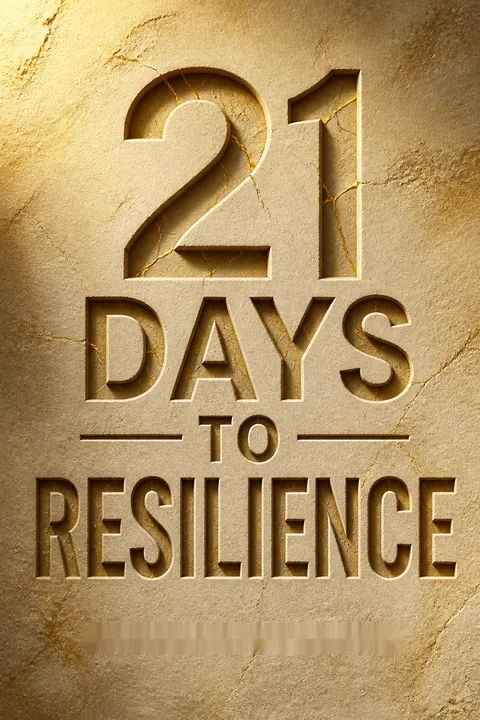


Key Takeaways
Train yourself to meet hardship without letting it define your life
Resilience is a practice. Montminy’s central claim is that resilience is more than recovering your old footing. It means responding to adversity in ways that can create new strength and meaning. Problems still hurt; resilient people are not immune to fear, grief, or setbacks. They learn not to treat a painful moment as the whole story of who they are.
Her examples range from Olympic runner and wartime survivor Louis Zamperini to her own year of relentless school bullying. A study that measured students before and after the September 11 attacks found that those who had scored higher in resilience reported positive emotions alongside fear and sadness, and later increases in optimism and well-being. The book turns this idea into a three-week training program, not a promise of instant change.
The useful distinction here is between resilience and invulnerability. Allowing fear or sadness to coexist with hope is more psychologically credible than insisting on positivity. The September 11 study is especially memorable because resilience appears as emotional range, not emotional cleanliness. Still, growth should not be treated as the expected reward for suffering. Trauma can damage, and recovery depends partly on safety, resources, and support beyond individual attitude. The strongest reading of the book is that people can develop responses that help them recover, not that every hardship is secretly beneficial.
Make ordinary routines carry the load when adversity drains your attention
Automate the helpful. The book estimates that about 40 percent of daily activity is habitual. Repeated behaviors can provide steadiness and conserve attention, leaving more capacity for difficult decisions. Habits also meet needs, even when their costs outweigh their benefits. Late-night television, for instance, may offer comfort or distraction while undermining sleep.
Montminy recommends noticing a habit’s cue and reward, then altering the surroundings and choosing a replacement. She moved her phone away from the bedroom to interrupt morning email-checking and make family time easier. Health supports this foundation too: movement can help the body recover from stress, while play and humor can loosen the grip of distress. A study of mice in the book links exercise with recovery from social stress, though animal findings do not establish the same effect in people.
This is a practical argument for designing defaults rather than relying on repeated acts of willpower. Behavioral science often distinguishes deliberate choices from actions triggered by familiar settings, so changing the setting can be more effective than scolding oneself. The phone example works because it removes a prompt and makes a different morning more likely. The same principle needs care: routines can stabilize life, but too much dependence on them can make disruption harder. Resilience requires useful structure that can bend when circumstances change.
Pair belief in your ability with a concrete route forward
Hope needs a plan. Montminy distinguishes hope from optimism. Optimism is an expectation that good things can happen; hope also includes a sense of personal agency and a way to move toward a desired outcome. Belief without steps can become wishful thinking, while steps without belief can feel pointless. Each can reinforce the other.
Surfer Bethany Hamilton returned to the water three weeks after a shark attack severed her left arm. She learned to surf again and won a national title the following year. Montminy presents her faith and hope as sources of motivation, not as a guarantee that adversity will end well. For everyday challenges, the book suggests naming what is wanted, identifying obstacles, and creating manageable next steps. If the original route fails, hopeful problem solving looks for another one.
Hope becomes most actionable when it connects motivation to pathways. This resembles a broader goal-setting principle: people are more likely to persist when they can picture both a valued destination and plausible routes toward it. The distinction also protects hope from becoming mere prediction. A person can remain hopeful while admitting that an outcome is uncertain. The cancer examples in the book should be read cautiously, since a hopeful outlook does not control disease or replace treatment. Its clearest benefit is helping people stay engaged with choices they can make.
Name the feeling before it chooses your next move
Attention creates a pause. Self-awareness means noticing thoughts, emotions, bodily sensations, and actions without immediately condemning them. Emotional intelligence adds the ability to recognize feelings in oneself and others and use that information when responding. Montminy emphasizes precise emotional vocabulary: distinguishing frustration from anger, or anxiety from irritation, rather than calling everything simply bad.
A client noticed that her husband’s late work dinners made her tense, pace, and eat more ice cream. Instead of confronting him in the heat of the moment, she waited until morning, explained that she felt lonely, and they made time for dates. The book recommends brief mindfulness breaks, breathing, and naming emotions. It cites research in which putting feelings into words reduced activity in brain systems involved in emotional response.
The pause between feeling and action is a small but consequential form of agency. Naming an emotion can make a diffuse reaction more understandable, while bodily signals may reveal what a person has not yet articulated. This is also a communication tool: saying that a person feels excluded is more informative than announcing that someone is impossible. The method is not a demand to analyze every feeling. In intense or unsafe situations, immediate protection matters more than introspection. But for recurring everyday conflict, a clearer emotional label can prevent a temporary reaction from becoming a lasting pattern.
Act on what you can influence, then stop wrestling reality
Control has boundaries. The book calls learned helplessness the passivity that can develop when people believe their actions have no effect. Feeling some influence over a situation can encourage initiative, but excessive control can become rigid or controlling toward others. Resilience means acting where action is possible while adapting when circumstances shift.
Montminy recounts psychologist Ellen Langer’s 1979 retreat study, in which older male nursing-home residents spent a week in an environment modeled on 1959. Researchers reported changes in measures such as posture and flexibility. The example illustrates how expectations and behavior may affect experience, but it does not prove that attitude can reverse aging. Acceptance, in the book’s sense, means acknowledging what is already true, not approving of it or giving up. From there, a person can choose a next step.
This section’s strongest idea is the distinction between influence and control. Treating every outcome as controllable invites self-blame; treating none as influenceable invites passivity. Acceptance can help locate the boundary by separating the fact of a situation from the response still available. The retreat story is evocative, but its small, unusual design cannot support broad claims about aging. Its lasting value is better understood as a prompt to examine how expectations, social context, and behavior shape the experience of later life.
Break hard problems into small steps, and change route when facts change
Persistence needs ingenuity. Perseverance supplies the effort to stay with a meaningful goal; problem solving supplies ways to move toward it. Innovation matters because unfamiliar difficulties rarely yield to a familiar script. Montminy describes crows dropping pebbles into a water-filled tube until the rising water brought food within reach. The birds did not overpower the obstacle; they changed the conditions around it.
J. K. Rowling’s first Harry Potter manuscript was rejected by twelve publishers before it found a home. The lesson is not that every rejected project deserves endless pursuit. The book recommends breaking goals into small, schedulable tasks, asking trusted people for accountability, and reviewing whether the goal still matters. Persistence keeps commitment alive; flexibility allows the method to change when evidence or circumstances change.
This combination avoids two common traps: quitting at the first setback and persisting simply because effort has already been spent. A useful distinction is between commitment to an underlying value and attachment to one particular strategy. The crow story makes the point vivid: the goal stayed fixed while the means changed. Breaking work into smaller actions also reduces the cognitive burden of a large, vague challenge. Yet persistence is not proof of eventual success. Sometimes new information should lead to stopping, redirecting effort, or redefining the goal.
Let values give effort direction when outcomes stay uncertain
Character steadies the self. Montminy links self-respect to behavior, not mere self-praise: keeping commitments, treating others with dignity, and making choices one can stand behind. Integrity means acting honestly toward oneself and others, while purpose gives those actions a direction. Spirituality, as she uses the term, can be religious or secular; it is a felt connection to something larger than personal gain.
Her cousin quietly paid for birthday balloons for neighborhood children and helped families in need without seeking recognition. Candace Lightner responded to her daughter’s death in a drunk-driving crash by founding Mothers Against Drunk Driving. These stories show purpose becoming action. The book’s exercises ask readers to identify what matters, then make daily choices that reflect those priorities, even when the outcome cannot be guaranteed.
Values can act as an internal compass when external rewards are unreliable. They also give purpose a practical test: not only what a person says matters, but what behavior follows. The cousin’s generosity is compelling precisely because it is concrete and repeated. Still, integrity should not be confused with never changing one’s mind. Honest reflection can require revising a commitment when it becomes harmful or impossible. A durable sense of self comes less from rigid consistency than from making choices that remain accountable to one’s core principles.
Build a small dependable circle, and contribute to it
Support is a shared resource. Social connectivity is not the same as popularity. Montminy argues that a few reliable relationships can provide more security than a large number of casual contacts. Support can mean listening, encouragement, practical assistance, or help thinking through a decision. Resilience includes knowing when to ask for it, not only managing alone.
The book also connects empathy to altruism. Empathy recognizes what another person may need; altruism acts on that recognition without demanding a reward. In one experiment described by Montminy, toddlers helped adults retrieve dropped objects without being asked. The book suggests that helpful behavior can be encouraged by its environment. Its practical advice is reciprocal: reach out to people who matter, ask clearly for the kind of support needed, and offer useful help in return.
A dependable network is not simply emotional comfort. It can provide information, practical assistance, and a second perspective when stress narrows attention. The emphasis on asking for help is valuable because independence can become a socially approved form of isolation. Altruism also builds belonging through action rather than sentiment alone. Its limits matter, however: giving should not mean neglecting personal capacity, and mutual support does not require equal contributions at every moment. Healthy connection makes room for both care and boundaries.
Practice gratitude as attention and action, not forced cheerfulness
Notice what remains good. Gratitude, in Montminy’s account, directs attention toward what is valuable without denying what hurts. It can remind people that life contains relationships, abilities, and experiences worth protecting, giving them reasons to keep moving through a hard period. The book cites a survey of more than 160 university students in which gratitude was the strongest of the measured predictors of resilience, followed by forgiveness and acceptance. That association is suggestive, not proof that gratitude alone causes resilience.
The practice is more specific than listing generic blessings. Montminy recommends recording fresh details, such as a child helping after dinner, and expressing appreciation through a note, a conversation, or practical help. She also warns against punishing oneself for failing to feel grateful. Gratitude is a practice of noticing and responding, not an obligation to feel cheerful.
Gratitude can interrupt attentional bias toward threat and lack, especially when it is tied to specific people and events. Turning appreciation into an action also strengthens relationships, making the practice social rather than purely private. The caution against forced positivity is essential: gratitude does not make injustice acceptable or grief inappropriate. Its value lies in widening attention so difficulty is not the only thing a person can see. That wider view can support perseverance while leaving room to name what still needs to change.
Analysis
The book’s organizing insight is that resilience is not one heroic trait. It is a repertoire of responses, practiced across three domains: the self, the sources of meaning that sustain the self, and relationships with other people. Its sequence moves from daily habits and self-awareness toward acceptance, purpose, problem solving, and social contribution. That design makes an abstract psychological concept usable: each chapter asks readers to assess current behavior and try a small exercise.
The book is strongest when it connects a specific action to a specific mechanism. Moving a phone can interrupt a cue; naming an emotion can create distance from it; breaking a goal into smaller tasks can make action more imaginable. The stories make those mechanisms memorable, from a crow using stones to reach food to a woman whose improved self-awareness changes a marital conversation. The central model is therefore less about adopting a relentlessly positive personality than about building options for responding.
There is a tension between this practical message and some of the book’s more sweeping claims. Resilience is trainable, but the text can sometimes imply that a person’s response is the decisive factor in outcomes shaped by illness, poverty, discrimination, unsafe relationships, or access to care. Such conditions are not solved by reframing. The author’s own bullying story shows that institutional failure can force a change of environment, not simply a change of attitude. Similarly, research examples vary in strength: a study of animals, a small retreat, and a survey association cannot all establish the same kind of cause and effect.
The 21-day structure is best treated as an invitation to begin practicing, not as a scientific deadline for transformation. The book itself notes that lasting behavior change commonly takes longer. Its most durable contribution is the breadth of its toolkit and the insistence that negative feelings belong within a resilient life. Readers can use the exercises as experiments, retaining what helps and seeking professional or material support when a challenge exceeds self-guided practice.
Review Summary
21 days to resilience receives mixed reviews, with an average rating of 3.55/5. Readers appreciate its practical tips, organization, and concise format. Some find it helpful for daily life improvement and building resilience. However, critics argue it lacks depth, contains basic information, and can be repetitive. The audiobook version receives praise for engagement but criticism for difficulty in accessing exercises. Some readers find the book inspiring and worth revisiting, while others consider it superficial and redundant compared to other self-help books.
People Also Read







Glossary
Resilience
Adaptive response to adversityThe capacity to withstand stressful or adverse conditions, respond effectively, and learn or find meaning through the experience. In this book, resilience is not a fixed personality trait or freedom from painful emotions. It is a skill that can be strengthened through habits, self-awareness, flexibility, perseverance, supportive relationships, and other practiced capacities.
Realistic optimism
Hope grounded in realityAn orientation that allows a person to expect possible good outcomes without pretending that life is always pleasant or predictable. Realistic optimism includes acknowledging pain and uncertainty while remaining active and resourceful. It differs from forced cheerfulness because it does not require denying negative emotions or assuming that every challenge will resolve favorably.
Learned helplessness
Belief that actions cannot helpA pattern of passivity that can arise when someone believes their actions have little or no effect on their circumstances. Montminy uses the term to explain why perceived lack of control can discourage efforts to change a situation. The concept does not mean that every circumstance is controllable; it concerns the expectation that action is futile.
Emotional intelligence
Using emotional information wiselyThe ability to notice and interpret emotions in oneself and other people, distinguish among feelings, and use that information when deciding how to act. In the book, emotional intelligence supports resilience by helping people understand reactions, communicate more clearly, empathize with others, and avoid responding automatically in stressful situations.
Emotional granularity
Precise distinctions among emotionsThe ability to identify emotions with specificity rather than using broad labels such as good, bad, or mad. A person with greater emotional granularity can distinguish, for example, anxiety from irritation or disappointment from rejection. Montminy argues that such precision can make feelings easier to understand and reduce impulsive reactions.
Posttraumatic growth
Positive change after traumaPositive psychological changes that some people report after struggling with a traumatic or highly stressful experience. In this book, the idea represents a deeper form of resilience than simply returning to a previous state. Growth may include new meaning, priorities, or strengths, but it is not guaranteed by trauma and does not erase the harm.
Hope
Agency paired with pathwaysA motivating belief that a desired future is possible, supported both by confidence in one’s capacity to act and by a plan for reaching the goal. Montminy distinguishes hope from general optimism: hope requires a sense of agency and workable steps. When either is missing, motivation may fade or a goal may remain only a wish.
FAQ
1. What is "21 Days to Resilience" by Zelana Montminy about?
- Practical Resilience Training: The book is a 21-day, step-by-step guide designed to help readers build resilience through daily exercises, self-reflection, and actionable advice.
- Three-Week Structure: It divides resilience-building into three themed weeks: Self, Spirit, and Social, each focusing on different aspects of personal growth and coping.
- Science-Backed Approach: Montminy draws on psychological research, personal stories, and real-life examples to explain how resilience can be developed, not just inherited.
- Focus on Action: Unlike many books that only discuss the importance of resilience, this book provides concrete tools and daily practices to help readers actively strengthen their resilience muscle.
2. Why should I read "21 Days to Resilience" by Zelana Montminy?
- Resilience Over Happiness: The book argues that chasing happiness directly can be counterproductive, and that building resilience is the true path to lasting well-being and success.
- Accessible and Actionable: It offers a clear, manageable program that fits into daily life, making it easier to implement real change.
- Addresses Modern Challenges: Montminy addresses issues like instant gratification, avoidance of discomfort, and the need for personal responsibility in today’s fast-paced world.
- Personal and Universal: The author shares her own struggles and triumphs, making the advice relatable, while also providing universal strategies applicable to anyone.
3. What are the key takeaways from "21 Days to Resilience" by Zelana Montminy?
- Resilience is Learnable: Resilience is not a fixed trait; anyone can develop it through intentional practice and self-awareness.
- 21 Core Traits: The book identifies 21 traits (like habit, hope, health, control, playfulness, self-respect, etc.) that contribute to resilience, each with its own chapter and exercises.
- Daily and Lifelong Practice: Building resilience requires consistent, daily effort, but also a long-term commitment to self-improvement and adaptability.
- Growth Through Adversity: Negative emotions and challenges are not to be avoided but embraced as opportunities for growth and learning.
4. How is the 21-day program in "21 Days to Resilience" by Zelana Montminy structured?
- Three Thematic Weeks: Week 1 focuses on the self, Week 2 on the spirit, and Week 3 on social aspects, each with seven daily topics.
- Daily Format: Each day introduces a new trait, explains its role in resilience, and provides a "Take Stock" self-assessment, "Daily Dos" (morning, day, night), and a "Lifelong" exercise.
- Progressive Learning: The program is designed to build foundational skills first (self), then deepen meaning (spirit), and finally expand to relationships (social).
- Habit Formation Science: The 21-day length is based on research suggesting it takes at least 21 days to start forming new habits, with the goal of jumpstarting lifelong change.
5. What is Zelana Montminy’s definition of resilience in "21 Days to Resilience"?
- More Than Bouncing Back: Resilience is not just about recovering from setbacks, but about growing stronger and finding positive meaning through adversity.
- Active Adaptation: It involves shifting perceptions, changing responses, and learning from challenges rather than being defined by them.
- Skill, Not Trait: Resilience is a dynamic skill that can be developed and strengthened, not a static personality trait or genetic gift.
- Integration of Emotions: Resilient people experience the full range of emotions, including negative ones, and use them as tools for growth.
6. What are the 21 core traits or factors of resilience according to "21 Days to Resilience"?
- Week 1 (Self): Habit, Hope, Health, Control, Playfulness, Self-Respect, Self-Awareness.
- Week 2 (Spirit): Realistic Optimism, Mindfulness, Integrity, Spirituality, Flexibility, Perseverance, Acceptance.
- Week 3 (Social): Innovation, Emotional Intelligence, Purpose, Problem Solving, Social Connectivity, Altruism, Gratitude.
- Holistic Approach: These traits cover personal habits, mindset, emotional skills, and social connections, reflecting a comprehensive view of resilience.
- Daily Focus: Each trait is explored with practical exercises to help readers assess and strengthen that specific area.
7. What are some of the most actionable daily practices recommended in "21 Days to Resilience"?
- Morning Intentions: Start each day with a specific intention or cue to reinforce a new habit or mindset (e.g., gratitude, optimism, self-respect).
- Self-Assessment: Use daily "Take Stock" exercises to reflect on current strengths and areas for growth.
- Behavioral Tweaks: Implement small environmental or behavioral changes, like changing routines, visualizing goals, or practicing mindfulness for a few minutes.
- Evening Reflection: End each day with reflection, gratitude, or journaling to reinforce learning and track progress.
8. How does "21 Days to Resilience" by Zelana Montminy differentiate between happiness and resilience?
- Happiness as Byproduct: The book argues that happiness is more easily attained when it is not the direct goal, but a byproduct of building resilience.
- Pitfalls of Chasing Happiness: Pursuing happiness for its own sake can lead to disappointment, isolation, and a focus on shortcomings.
- Resilience as Foundation: Resilience provides the strength to handle adversity, learn from negative emotions, and ultimately experience deeper, more lasting happiness.
- Balanced Emotional Life: True well-being comes from embracing both positive and negative experiences, not from avoiding discomfort.
9. What are some of the most powerful quotes from "21 Days to Resilience" and what do they mean?
- "We are what we repeatedly do. Excellence, then, is not an act, but a habit." (Aristotle): Emphasizes the importance of daily habits in building resilience and excellence.
- "Hope is important because it can make the present moment less difficult to bear." (Thich Nhat Hanh): Highlights hope as a driving force for enduring hardship and moving forward.
- "It’s not the strongest of the species that survive, not the most intelligent but the one most responsive to change." (Charles Darwin): Underlines flexibility and adaptability as key to resilience.
- "Do not spoil what you have by desiring what you have not..." (Epicurus): Encourages gratitude and contentment as foundations for resilience.
10. How does "21 Days to Resilience" by Zelana Montminy address breaking bad habits and forming good ones?
- Cue and Reward System: The book explains how habits are formed through cues and rewards, and how understanding this can help replace bad habits with positive ones.
- Environmental Change: Suggests altering your environment to disrupt negative cues and make positive behaviors easier to adopt.
- Replacement Strategy: Encourages identifying bad habits, removing their triggers, and substituting them with healthier alternatives.
- Tracking and Reflection: Recommends keeping a log or journal to notice patterns, track progress, and reinforce new habits.
11. How does "21 Days to Resilience" by Zelana Montminy integrate emotional intelligence and self-awareness into resilience?
- Emotional Vocabulary: The book stresses the importance of developing a nuanced emotional vocabulary (emotional granularity) to better understand and manage feelings.
- Self-Reflection Exercises: Daily practices encourage readers to notice their emotions, physical sensations, and reactions without judgment.
- Empathy and Communication: Building emotional intelligence helps in understanding others, improving relationships, and responding thoughtfully rather than reactively.
- Resilience Link: High emotional intelligence enables more effective coping, problem-solving, and adaptability in the face of stress.
12. What long-term strategies does "21 Days to Resilience" by Zelana Montminy recommend for sustaining resilience beyond the 21 days?
- Consistent Practice: Emphasizes the need for ongoing, regular practice of the skills and habits developed during the 21 days.
- Weekly and Lifelong Reflection: Suggests setting aside time for weekly check-ins and lifelong journaling to maintain self-awareness and track growth.
- Building on Successes: Encourages celebrating small wins and building upon them to reinforce self-respect and motivation.
- Adaptability and Acceptance: Recommends embracing change, accepting impermanence, and being kind to oneself as essential for lifelong resilience.
Download PDF
Download EPUB
.epub digital book format is ideal for reading ebooks on phones, tablets, and e-readers.








