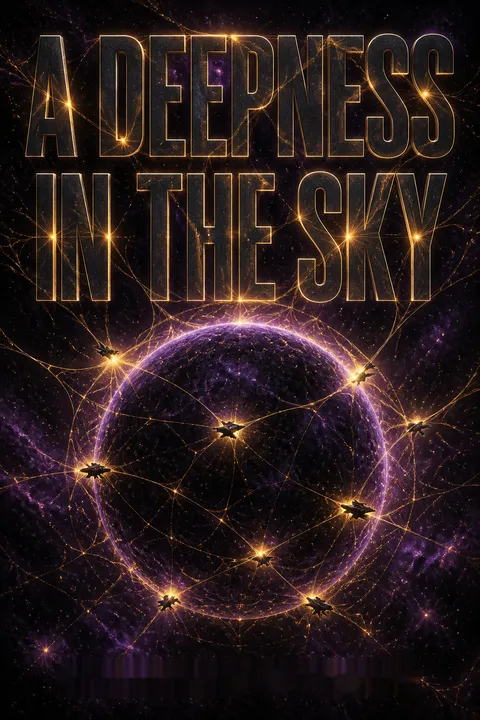


Plot Summary
Prologue
For eight centuries, the Qeng Ho quietly search for Pham Nuwen, a vanished founder whose trail narrows at last to Triland. Fleet Captain Sammy Park goes groundside and discovers that Pham has lived for years under the name Bidwel Ducanh, hiding in a poorhouse cemetery.
Pham is old, ill, and still bitter toward the Traders who once failed him. Sammy tells him that the nearby OnOff star has sent radio signals unlike any human transmission, and that a fleet is ready to investigate. Pham refuses until Sammy shows him the ships waiting overhead. The search ends; a far more dangerous journey begins.
The prologue makes historical memory an active force rather than a record of settled facts. Sammy’s eight-century pursuit turns a famous founder into a vulnerable old man, while Pham’s resentment shows how a culture can preserve its institutions and still fail the person who imagined them. His decision to join the expedition is not a simple homecoming: the OnOff signals offer a second chance to pursue the wonder that his earlier life could not reach. The fleet overhead also makes the novel’s scale intimate. Civilizations may span centuries, but they still depend on one person deciding to trust again.
Two Fleets, One Sleeping World
A century and a half after Pham joins Sammy Park’s fleet, the Qeng Ho reach OnOff ahead of the slower Emergents. Both expeditions discover the same prize: Arachna, a planet whose native Spider civilization lies frozen through its sun’s long dark phase.
Emergent leader Tomas Nau proposes shared mining and cultural surveys, but linguist Trixia Bonsol hears ownership, not trade, in the visitors’ language. Their lavish habitat’s paintings seem to preserve pain rather than beauty.
Ezr Vinh, a young Qeng Ho apprentice close to Trixia, is less certain than she is, yet her warning unsettles him. The parties agree to work together because neither can safely exploit Arachna alone. Their treaty creates the appearance of cooperation before either side knows what the other truly intends.
The first encounter makes interpretation itself a strategic resource. Trixia reads the Emergents’ everyday phrasing and art as evidence of a social order that treats people as property, while Ezr sees only a reasonable business proposal. Neither observation is complete, but the mismatch matters: the Qeng Ho trust explicit bargains, whereas Nau’s culture can disguise domination as management. The alien Spiders are not yet active participants, so both human groups can project their own ambitions onto them. The joint agreement therefore rests on a moral absence. They negotiate over a civilization that cannot consent.
Ezr Chooses the Risk
When the Qeng Ho Trading Committee deadlocks, Ezr is summoned because his family owns part of the expedition. The choices are stark: share control with Nau, attack the Emergents first, or abandon the mission.
Ezr rejects joint command because he believes Nau would exploit it, but also opposes a surprise attack, which would turn the Traders into aggressors and could destroy both fleets. He urges the expedition to stay, cooperate only as needed, and prepare for danger. Captain Park accepts the advice.
On Arachna, Ezr’s landing team surveys a frozen settlement and finds a self-powered mechanical recorder that has operated for centuries. Ezr spots a nearby building’s flat objects as books, revealing a library and giving the expedition its first substantial record of Spider knowledge.
Ezr’s decision is a first act of responsibility, not confidence. He has little authority and knows less than the officers around him, yet he refuses the false comfort of a clean answer. His caution is ethical as well as tactical: he will not endorse murder simply because it might be profitable. The library discovery then gives his curiosity practical value. In both moments, he notices what others overlook, but he has not yet learned how easily good intentions can be used by stronger players. His apprenticeship begins as a struggle to distinguish principled restraint from dangerous naivety.
Sherkaner Enters the Dark
On Arachna, the crew’s discovery of a library is a small victory. Far earlier, on another world governed by a sun that repeatedly dies, Sherkaner Underhill has been chasing a much larger one. The eccentric young scientist drives an automobile to Lands Command to sell a plan for attacking the enemy during the Deepest Dark.
In Nigh’t’Deepness, an ambush by neglected out-of-phase children shows him a society that abandons people who do not fit its seasonal rules. Retired teacher Lady Enclearre explains that poverty and the coming cold make such children especially vulnerable.
At Lands Command, wounded sergeant Hrunkner Unnerby dismisses Sherkaner’s scheme as impossible. Lieutenant Victory Smith recognizes its potential, examines his prototypes, and brings him into military research.
Sherkaner’s invention begins in a collision between curiosity and social neglect. The children in the dell are not simply comic danger; they embody what happens when a culture’s survival rules become moral excuses for abandonment. Lady Enclearre turns that encounter into a concrete lesson about the coming Dark. At Lands Command, Unnerby embodies practical skepticism, while Victory can recognize possibility without surrendering judgment. Sherkaner’s genius is not that every idea works. It is his ability to generate enough possibilities that others can select, test, and build the rare ones that do.
Four Walk Through Darkness
Sherkaner’s team enters the Deepest Dark in a sealed craft, then uses engineered bacteria that oxidize buried organic matter to make heat and breathable conditions. Sergeant Unnerby, chemist Amberdon Nizhnimor, and engineer Gil Haven accompany him across frozen terrain toward a Tiefer supply depot.
Their exotherms find fuel beneath the snow, but the journey is painful and their supplies are limited. Gil develops Wanderdeep, a panic that drives him toward false shelter, and falls to his death during the final climb.
Unnerby and Nizhnimor continue, reach the depot, and cover its equipment with dark powder. When sunlight returns, the blackened machinery will overheat and fail, forcing the enemy to negotiate or retreat. Sherkaner’s once-fanciful idea has become a weapon.
The expedition turns curiosity into an instrument of war, but it refuses to make that transformation clean. The exotherms are a brilliant technical solution, yet their limited lifespan puts the team on a clock and Gil’s death makes the cost irreversible. Sherkaner’s wonder at the stars coexists with the duty to keep walking. That tension anticipates the novel’s central problem: exceptional capabilities can rescue communities or magnify coercion, depending on who directs them. The powder that disables the depot is a modest material with immense consequence, much like the small choices that later determine whether technology serves people or owns them.
The Ambush at OnOff
While the crews work on Arachna, the Emergents’ apparent cooperation gives way to a prepared attack. Their engineered mindrot strikes the Qeng Ho during the joint operation, causing severe headaches, collapse, and confusion just as missiles target Captain Park’s flagship.
Ezr’s lander loses secure communications and is diverted into a lower orbit. He tends to sick crewmates while the Qeng Ho defenses fight the incoming weapons. Park’s ship disappears in a cluster of nuclear flashes.
The disease and the attack leave the Traders crippled before they can understand what has happened. Ezr’s last clear comfort is that Trixia was not aboard the flagship. Nau’s people recover the surviving crews and begin sorting captives, casualties, and valuable specialists.
The ambush succeeds because it attacks trust, bodies, and communications at once. A battlefield response would be difficult enough; the mindrot makes the Qeng Ho doubt their own senses and coordination at the exact moment they need both. Park’s loss strips away institutional authority, leaving the survivors vulnerable to Nau’s account of events. Ezr’s care for his crewmates matters because it keeps him human inside a disaster designed to reduce people to assets. The attack also exposes the danger of technological asymmetry: the Emergents’ most powerful weapon is not a missile but a method for controlling when their opponents can think.
A Manager in Captivity
Ezr wakes aboard an Emergent habitat after eight days. Anne Reynolt, the director of human resources, reports that fourteen hundred Qeng Ho died, four ships were destroyed, and most senior officers are held in coldsleep. Nau appoints Ezr fleet manager, emphasizing that his family owns surviving ships.
The appointment looks like respect but makes Ezr responsible for administering his own people under their conquerors. Nau confines most survivors to a damaged temporary habitat and replaces their trusted interfaces with monitored keyboards.
Ezr finds familiar faces, including Benny Wen and Jimmy Diem, but they treat him formally because Nau is watching. Qiwi Lisolet, still a teenager, hopes her parents will recover. Ezr’s new office is a wedge driven between loyalty to his people and the authority he must perform.
Nau’s appointment is a refined form of coercion: he gives Ezr enough authority to make collaboration look voluntary, while removing the tools that would make independent action possible. The role also traps Ezr in a moral double bind. If he resists openly, the survivors may suffer; if he obeys, they may read his obedience as betrayal. Qiwi’s hope gives the policy an emotional face, while the keyboards and surveillance make its structure visible. The scene shows how power can recruit a victim into maintaining the system that victimizes him, especially when every available alternative appears worse.
Diem’s Failed Counterstroke
Jimmy Diem organizes a secret attempt to seize the Qeng Ho starship Far Treasure during OnOff’s relighting. The plan exploits the chaos around the unstable diamond rubble, but Pham Trinli discovers that Nau’s surveillance has exposed the conspiracy.
Jimmy continues anyway. Aboard the ship, he finds the supposed Qeng Ho hostages already dead, including Qiwi’s mother. He broadcasts the discovery, then detonates explosives that destroy the Far Treasure and kill people on both sides.
Nau blames the massacre on Diem and calls the survivors to cooperate for the sake of survival. Ezr, who knew Diem, later doubts the broadcast and suspects it was staged. The failed revolt leaves the Qeng Ho more isolated and gives Nau a story that turns his own crimes into a plea for unity.
Diem’s failure is not simply the cost of poor planning. It reveals how completely Nau controls the conditions under which resistance can be understood. The discovery of the dead hostages should expose the regime, but the explosion that follows lets Nau recast the evidence as proof of Qeng Ho recklessness. Ezr’s doubt becomes crucial because he refuses to accept a tidy moral narrative, even when it would relieve him of responsibility. The episode also punishes haste: courage without trustworthy information can serve the very power it means to overthrow. Yet Diem’s attempt leaves a record of resistance that later characters can interpret.
The Lost Prince’s Long Game
As the Exile settles into Watches, Ezr studies the Qeng Ho library and notices that Pham Trinli knows secrets the official records do not contain. He traces the clues to Pham Nuwen, the legendary founder searched for in the prologue.
Pham had been taken from medieval Canberra as a boy, learned the Traders’ systems aboard a starship, and helped build a far-reaching commercial culture with Sura Vinh. At Brisgo Gap, he tried to turn that network into a durable human order.
Sura and their allies stopped him, sending Pham and his followers away in scattered ships. Now Pham secretly uses the Qeng Ho localizers, tiny network devices he helped shape, to evade Nau’s surveillance and recruit Ezr. His old dream is empire; his new opportunity is Focus.
Pham’s hidden identity converts the novel’s present struggle into a return of history, but not a return to innocence. His childhood betrayal and later political defeat explain both his ambition and his suspicion of restraint. The localizers are more than clever hardware: they let an individual recover agency inside a system designed to observe him. Yet Pham’s secret advantage tempts him toward the same centralization that once divided him from Sura. Ezr’s discovery makes him an heir to two legacies, the Qeng Ho’s ideal of exchange and Pham’s conviction that only stronger organization can prevent civilizational collapse.
Children’s Hour, Two Worlds
The years pass as the sun relights and Spider radio broadcasts resume. Trixia becomes the best human interpreter of their language, translating a science program called the Children’s Hour. Her choices make its young speakers sound like particular children rather than specimens, and the listeners at Benny’s parlor begin to care about them.
On Arachna, Sherkaner Underhill’s children grow up in a society that condemns out-of-phase births, while his wife, Victory Smith, tries to defend them without exposing them to every political danger.
The show’s human audience reacts with affection, but Spider traditionalists object when they learn that the children violate the generation cycle. Trixia’s translations have turned an academic project into a bridge between two societies, and a new source of danger.
Translation here is not a neutral transfer of information. Trixia’s humanizing names and phrasing make the Spiders legible as people, but they also shape what the Qeng Ho and Emergents think they know. The Children’s Hour creates intimacy across species before either side can meet face to face. Meanwhile, Sherkaner’s family tests the same question from within Spider society: whether tradition protects life or merely preserves familiar power. The show becomes politically potent precisely because it is emotionally persuasive. Once listeners care about individual children, the debate can no longer be kept safely inside linguistic theory.
A Banner Above Princeton
After the Church of the Dark challenges Sherkaner’s out-of-phase family, the children sneak away to see firstsnow and visit the Royal Museum. They meet another family raising out-of-phase children, then Kindred agents seize them, mistaking the strangers for part of the Underhill household.
Brent brings down a display rack to stop the kidnappers, and Viki, Gokna, Jirlib, and Brent are carried to a high-rise holding room. They use play twine and Brent’s jacket lining to hang a bright signal outside.
During the rescue, the children fight back, but a kidnapper’s gunfire kills Gokna and wounds Brent and Viki. Victory Smith’s forces recover the survivors. Gokna’s death turns the family’s public argument about birth and tradition into an intimate loss no political victory can undo.
The children’s escape depends on the very qualities adults often dismiss: play, improvisation, and trust in one another’s odd skills. Brent’s structural thinking and the sisters’ nerve become practical survival tools. But the rescue does not reward ingenuity with a clean happy ending. Gokna dies, exposing the cost of treating children as symbols in a political argument. Sherkaner’s optimism cannot protect his family from consequences, and Victory’s command cannot reverse them. The aftermath changes the family from a private experiment into a team preparing for a dangerous future, while leaving grief as a permanent part of its foundation.
Qiwi’s Stolen Years
Qiwi builds an underground economy at L1, trading favors, food, and park technology while helping Nau keep the damaged settlement functioning. Her loyalty seems firm until Floria Peres reports that her sister Luan, a Focused carver, has vanished under suspicious circumstances.
Qiwi searches the records and finds a false death report aboard the Invisible Hand. There she discovers an immersive record of Tomas Nau torturing her mother, Kira, and realizes that her own memories have been repeatedly scrubbed after she learned too much.
The discovery reframes her devotion to Nau as something engineered through trauma and forgetting. She has power, skill, and a possible way to expose him, but the revelation threatens the fragile identity she built to survive.
Qiwi’s competence has always been real, but her apparent allegiance rests on a history Nau repeatedly rewrites. Her trading is both a practical contribution and a form of selfhood: she creates reciprocity in a society built on ownership. Discovering the record of her mother’s torture does not instantly restore a stable past. Instead, it makes memory itself suspect, including the tenderness she feels toward Nau. The scene complicates victimhood without diminishing it. Qiwi is neither a puppet nor fully free; she must assemble agency from fragments that her captor has deliberately scattered.
Cavorite Breaks the Schedule
At the edge of the next Dark, the Qeng Ho engineer Hrunkner Unnerby carries mineral samples from the Kindred’s Southland mines to Sherkaner. The powder loses apparent weight under light, confirming that the supposed gravity anomalies were real.
At the same time, Jau Xin retrieves a Kindred satellite whose cavorite cladding lets it hold an impossible low orbit. The material suggests that Arachna’s diamond deposits may be remnants of ancient technology, not mere geology.
The discovery makes the Spiders’ progress dangerous to hide: their rivals can soon detect the humans, while their military powers are developing faster than expected. Nau abandons the leisurely Lurk and orders the operation advanced to a year. The resource that promises a vast future also compresses every decision into a crisis.
Cavorite changes the novel’s scale from political survival to technological history. It is both a practical military advantage and evidence that the planet may be littered with the remains of a civilization far older than anyone imagined. The same discovery offers hope and removes time. Nau responds as a strategist: he accelerates control before the Spiders can become independent. The contrast with Unnerby’s careful engineering matters. He follows an anomaly because the evidence warrants it; Nau sees the same evidence as a reason to seize a world. Knowledge does not dictate its use, but it changes the urgency of every moral choice.
Pham Gives Up Empire
Pham’s localizer conspiracy grows more dangerous as Anne Reynolt closes in. He attacks her with the clinic’s Focus equipment, intending to remove the greatest threat to his plans, but changes the procedure so she loses recent memory rather than her life.
At the same time, Ezr confronts him: Focus could give Pham the power to govern across the stars, but it would make human beings into instruments. Pham nearly kills Ezr, then destroys nearby localizers in despair.
He finally recognizes that a civilization built by enslaving people would betray the justice he wanted to protect. Instead of pursuing empire, he helps Ezr stabilize the resistance and protects Anne. His renunciation is not a victory over danger; it is the choice to accept a harder, less controllable future.
Pham’s crisis is not that he discovers Focus is evil; he has understood its costs for years. The decisive change is that he can no longer treat those costs as an acceptable payment for an abstract future. Ezr’s challenge makes the contradiction personal: Pham’s plan would save humanity by denying human agency. His near-violence toward Ezr shows how thoroughly ambition has colonized his emotional life. Choosing restraint does not erase the harm he has caused Anne or the Focused. It does, however, redirect his expertise from ownership toward repair.
Southmost on the Brink
With the Exile ending, Nau’s faction prepares a staged war that will let it seize the Spider world after destroying the strongest opposition. Victory Smith travels to Southmost and offers herself, the King, or another Accord leader as a hostage to reassure the Parliament.
Honored Pedure appears in person, but the Kindred launch missiles while Smith is still speaking. At Lands Command, Victory Lighthill and her team seize the Command and Control Center before officials can shut down the corrupted networks.
Rachner Thract, disgraced but vindicated by his warning about a hidden force, helps Sherkaner reach the defense system. Lighthill turns the network against the attack, and the Accord intercepts most of the warheads. A catastrophe is reduced to a survivable strike, but the conflict has become open war.
The Southmost sequence tests two kinds of authority. Smith stakes her own freedom on a public offer, while Lighthill uses a family-built intelligence team to seize control when formal systems become unreliable. Thract’s earlier paranoia proves less important than his willingness to act on evidence others dismissed. The defense succeeds not because technology is inherently trustworthy, but because people recognize that their networks have been compromised and improvise around them. The attack also reveals the danger of trying to preserve peace through appearances. Nau’s staged conflict and the Kindred’s real missiles converge until only decisive action can separate rescue from massacre.
The Lake and the Last Lie
At North Paw, Pham’s sabotage makes the park’s lake surge through Nau’s lodge, destroying his refuge and scattering the people inside. Ezr survives with a shattered arm and reaches Nau in L1-A, where a nuclear torpedo is aimed at the Qeng Ho temp.
Qiwi arrives, carrying her injured father, and Nau tries to revive the lie that Ezr murdered her mother. This time Qiwi remembers the truth. She shoots Nau with a wire gun, ending his control of the crisis.
Elsewhere, Jau Xin uses the Invisible Hand’s damaged systems to crash it onto Arachna rather than carry out Brughel’s orders. The ship’s occupants survive the landing, and the Spiders gain the human prisoners they need to understand the invasion. Nau’s planned extermination collapses from several directions at once.
The climax resolves conflicts through acts of recognition as much as force. Qiwi’s memory returns at the precise moment Nau tries to use her manufactured loyalty against Ezr. Her shot is an act of self-defense and a refusal to let him narrate her past again. Jau’s crash sacrifices the last usable starship rather than allow it to become a weapon of mass murder. Pham’s sabotage of the park reveals how fragile Nau’s authority is when its systems are interrupted. The survivors do not win by mastering every technology; they win because several people stop obeying the roles their captors assigned them.
No Longer Exile
After the fighting, the surviving Qeng Ho and Emergents must negotiate with the Spiders they came to exploit. Most of Nau’s plan has failed, but the damaged human settlements and broken ships leave everyone dependent on cooperation. The Focused are gradually deFocused, with mixed results; Anne Reynolt leads the work, and Trixia returns to herself while retaining the knowledge that made her a bridge between species.
Qiwi reunites with Floria and helps her father rebuild the park. Ezr accepts that Trixia’s future may not include the life he once imagined, and he begins to understand how much Qiwi has built beside him. The Exile ends not with a clean victory, but with a partnership that must be earned daily.
The resolution refuses to make liberation synonymous with restoration. Some people recover, some carry irreversible damage, and the lost years cannot be returned. The new human-Spider partnership is therefore a practice, not a treaty that erases history. Ezr’s emotional growth lies in releasing the future he had scripted for Trixia; Qiwi’s lies in claiming agency after repeated memory theft. The Spiders are no longer silent objects of study, while humans lose the presumption that technological superiority entitles them to rule. Survival is shared, and so is responsibility for what follows.
Epilogue
Seven years later, the Spiders have built a growing presence in orbit, and their shipyards are beginning to assemble starships. At a farewell banquet, Pham Nuwen and Anne Reynolt prepare to leave with a small fleet for the Emergent worlds, where Focus still sustains an empire. Ezr and Qiwi, now parents, help build the human-Spider partnership they once could barely imagine.
Pham’s destination is more than a rescue mission: he hopes the discoveries around Arachna will eventually make a voyage toward the hidden galactic core possible. As the guests discuss meeting again after the next Brightness, Sherkaner’s daughter wonders whether her father might still be alive somewhere in the Dark.
The epilogue converts the novel’s endings into beginnings without pretending that history has been repaired. The Spiders enter space as partners rather than customers, while Pham carries the unfinished struggle against Focus back toward its source. His ambition survives, but its method has changed: he now seeks allies rather than a population of managed subjects. The promised reunion two centuries later acknowledges the cost of interstellar distance, while the possibility that Sherkaner still lives preserves the novel’s governing appetite for uncertainty. Hope here is not a guarantee. It is a direction people choose together.
Analysis
A Deepness in the Sky is built around a collision between two ways of surviving time. The Qeng Ho preserve knowledge by moving between worlds; the Spiders rebuild beneath a sun whose cycle repeatedly destroys surface life. The Emergents offer a third method: Focus, which makes specialized human minds reliable enough to function as infrastructure. Each method solves a real problem, but none is morally neutral. Trade can preserve freedom while leaving societies exposed to collapse. Seasonal tradition can protect children while condemning those born at the wrong time. Focus can produce miracles while converting people into property.
The novel’s central argument emerges through contrasting characters rather than a single thesis. Pham Nuwen believes a large enough system can end the recurring disasters of history, and his experience gives that belief genuine force. Ezr Vinh and Qiwi Lisolet show that a system’s success cannot be separated from the lives it spends. Their resistance is not always clean: Ezr acts from guilt as much as principle, Qiwi survives by cooperating with the person who manipulates her, and Pham’s own idealism nearly becomes another excuse for domination. The book treats moral growth as a correction made under pressure, not as purity preserved from the start.
Its structure makes that argument temporal. Sherkaner’s ancient war, Pham’s centuries of travel, and the forty-year Exile are not decorative histories; each demonstrates that innovation changes the conditions of responsibility. The recurring sun is a literal clock, but the deeper deadline is the moment when knowledge becomes power over others. The Spiders’ eventual partnership offers no promise that history has been conquered. Instead, the ending suggests that durable civilization depends on institutions that can be challenged, relationships that survive disagreement, and knowledge shared without pretending its owners are entitled to rule.
Review Summary
A Deepness in the Sky is a prequel to Vinge's "A Fire Upon the Deep", set in the same universe but thousands of years earlier. It follows two human factions, the Qeng Ho and the Emergents, as they make first contact with an alien spider-like species. The novel explores themes of interstellar trade, technological advancement, and tyranny. Readers praise Vinge's world-building, character development, and ability to create suspense. While some find the pacing slow and the aliens too human-like, many consider it a masterpiece of hard science fiction, highlighting its complex plot and thought-provoking ideas.
People Also Read



Characters
Ezr Vinh
The reluctant heirEzr is a young Qeng Ho apprentice whose family owns ships but whose own authority is limited. He specializes in the Dawn Age of human history, an interest his practical elders regard as charming but unprofitable. His closeness to Trixia draws him toward questions of culture and interpretation, while his sense of responsibility makes him vulnerable to guilt when he cannot protect others. Ezr is neither a natural commander nor a simple idealist; he studies people, remembers details, and slowly learns that hesitation can be a moral choice or a form of surrender. His central tension is between the inherited power of his family and the person he wants to become.
Trixia Bonsol
The language bridgeTrixia is a Trilander linguist whose ear for speech lets her detect social assumptions that more technical observers miss. She has earned her place on the expedition through scholarship rather than family power, and her work makes her indispensable to the humans’ understanding of the Spiders. With Ezr, she shares an attraction built partly on intellectual respect and partly on his willingness to listen. Trixia wants to know minds unlike her own, not simply decode their words. Her translations reveal both her precision and her capacity for imaginative empathy, though her fierce concentration can narrow her attention to everything outside the problem she is trying to solve.
Pham Trinli
The boastful armsmanPham Trinli is an aging Qeng Ho programmer-at-arms whose loud stories and apparent incompetence make him easy to underestimate. He drifts through the expedition’s social spaces, trades gossip, and seems more interested in boasting than in responsibility. Beneath that performance, he is observant about systems, security, and the habits of people who believe themselves in control. His relationship with younger crew members is deliberately difficult to read: he can be irritating, oddly protective, and unexpectedly alert to danger. He embodies the Qeng Ho’s long memory, but also the cost of living too long with an unresolved purpose.
Qiwi Lin Lisolet
The bristling prodigyQiwi is the daughter of Deputy Fleet Captain Kira Lisolet and ecologist Ali Lin. Raised for much of her childhood aboard a starship, she combines unusual technical training with a child’s appetite for attention and a trader’s instinct for opportunity. Her friendship with Ezr is complicated by her crush on him and his tendency to treat her as an irritating younger sibling. She is also a formidable engineer, a devoted daughter, and a natural broker of favors. Qiwi wants the people around her to survive, but she often pursues that goal through work and bargains rather than direct confession. Her independence is real, even when others try to steer it.
Tomas Nau
The gracious tyrantTomas Nau is the Emergent expedition’s Podmaster, practiced in presenting control as calm stewardship. He is intelligent, patient, and deeply interested in the strategies by which societies survive or collapse. Nau believes that order is worth imposing when he thinks the alternative is disaster, and he is skilled at making people accept that argument as their own. His dealings with Ezr, Qiwi, and the Qeng Ho reveal a talent for emotional manipulation as well as political calculation. He can recognize practical wisdom even in people whose values he does not share, but his capacity to learn does not erase the violence built into his assumptions about ownership.
Anne Reynolt
The exacting directorAnne Reynolt directs Emergent human resources and oversees the Focused specialists whose minds support the expedition. She is pale, severe, and usually more interested in outcomes than social comfort. Her technical precision and unusual ability to manage people make her one of Nau’s most valuable officers. Reynolt does not display ordinary warmth, but she is not simply indifferent: she maintains the specialists’ health and recognizes the system’s dependence on them. Her calmness can make her seem less dangerous than she is, while her competence gives her unusual power inside an authoritarian culture.
Sherkaner Underhill
The restless inventorSherkaner is a Spider scientist and inexhaustible generator of ideas. He moves easily between mathematics, biology, engineering, and whatever new problem catches his attention, often drawing more disciplined collaborators into his schemes. His marriage to Victory Smith joins speculative imagination with strategic judgment. Sherkaner’s willingness to question traditions, including the rules governing children’s birth, makes him both a creator and a public target. He is curious about people as well as machines, though his delight in possibility can leave him slow to recognize fear or practical limits. He wants a civilization that can remain awake and inventive even when its sun disappears.
Victory Smith
The hard-eyed strategistVictory Smith is an unusually young officer who rises through military intelligence despite being born outside the accepted generation cycle. Her discipline and ability to assess risk complement Sherkaner’s improvisational genius. As his partner, she shares his appetite for change but knows that new technology can create new wars as readily as it solves old problems. She is protective of her family without treating affection as a substitute for preparation. Victory’s manner is controlled, sometimes severe, because she has learned that other people’s mistakes can become her responsibility. She is driven by service to the Accord and by a private loyalty to those who stand beside her.
Hrunkner Unnerby
The engineer in uniformUnnerby is a practical engineer and former soldier who first dismisses Sherkaner’s impossible plans, then helps make them work. He values discipline, preparation, and the social rules that have kept people alive through earlier Darks. His friendship with Victory and Sherkaner is deep but strained by his discomfort with their family choices. Unnerby is willing to change his mind when experience demands it, though he cannot shed inherited instincts as quickly as he can revise an engineering plan.
Ritser Brughel
The brutal vice-podmasterBrughel is Nau’s vice-podmaster and security chief, a bully whose emotions are more visible than his strategy. He enjoys dominance and treats people as resources, yet he can perform discipline when the mission requires it. His personal frustrations make him volatile, and his hatred of Qiwi is sharpened by her ability to defy him. Brughel represents the Emergency’s appetite for coercion without Nau’s talent for disguising it as benevolence.
Sura Vinh
The patient founderSura is a Qeng Ho captain and planner who helps shape the trading culture that carries knowledge between worlds. Practical and far-sighted, she thinks in generations and institutions rather than in personal triumphs. Her relationship with Pham is intimate, collaborative, and intellectually contentious. Sura believes that a durable network of trade can improve civilizations without ruling them directly, while Pham reaches for a more unified order. She is difficult to impress because she has watched too many confident plans collide with political reality.
Sammy Park
The searching captainSammy is a Qeng Ho fleet captain who carries the long search for Pham into the present. He is disciplined, loyal, and capable of recognizing when a mission’s stated purpose is not its only purpose. His connection to Pham reaches back farther than most crew members can imagine. Sammy is a practical leader, but the decisions he makes are shaped by an unusual respect for history and for promises that span generations.
Jimmy Diem
The embattled crewleaderDiem is a hard-working Qeng Ho crewleader who wants a steady career, a partner, and a place in fleet management. His ambitions are modest compared with the forces that seize control of the expedition. He is not a master strategist, but he has enough courage to organize resistance when the survivors are threatened. His loyalty to his crew and to Tsufe Do gives his actions emotional weight beyond their tactical success.
Jau Xin
The careful pilotJau is an Emergent pilot manager who is technically capable, academically inclined, and more reflective than the system that raised him. His relationship with programmer Rita Liao gives him a private life beyond his role in Nau’s operation. He is drawn toward the Spiders as people, even when his duties push him to treat them as a strategic problem. Jau’s caution can look like compliance, but it also gives him room to recognize the consequences of his orders.
Rita Liao
The determined programmerRita is a programmer and Jau Xin’s partner. She works within the Emergent system while questioning what it asks of its people. Her enthusiasm for the Spider world grows from genuine curiosity, and she is particularly moved by the children Trixia brings to life through translation. Rita is direct about her feelings and less skilled than Ezr at hiding moral discomfort. Her loyalty to Jau makes political danger personal.
Gokna Lighthill
The daring sisterGokna is one of Sherkaner and Victory’s out-of-phase children. Clever, competitive, and quick to improvise, she is especially close to her sister Victory Junior, though they quarrel constantly. Gokna takes risks because she is curious and dislikes being treated as fragile. Her courage is inseparable from her youth: she can devise a plan before fully understanding what it may cost.
Victory Junior
The watchful daughterKnown as Viki within her family, Victory Junior is observant, inventive, and more socially perceptive than she first appears. Growing up under security restrictions makes her eager for unsupervised experience, while her parents’ public argument over out-of-phase births makes her keenly aware of how others judge her. She shares a playful rivalry with Gokna and looks to both parents for different kinds of guidance.
Ali Lin
The ecological artistAli is Qiwi’s father and a gifted builder of parks, bonsai, and miniature ecosystems. He is gentle and absorbed by living systems, often so deeply focused that he seems distant from the people around him. His work turns ecological maintenance into an art and gives the cramped human settlement small pieces of beauty. Qiwi shares his wonder for biology, even when she must find ways to draw him back toward family life.
Rachner Thract
The doubted intelligence officerThract is a young officer responsible for countering the Kindred’s operations. Bookish and earnest, he sees threats before he can always prove them. His conclusions are repeatedly dismissed because they sound too extreme or lack evidence that fits established procedures. Thract’s loyalty is to the Accord, but his deeper problem is that he cannot make others see the pattern he sees.
Lady Enclearre
The teacher in the hillsA retired parish teacher and former sailor, Lady Enclearre lives in a poor rural community and prepares for each coming Dark. She is blunt about the harm caused by families who ignore the seasonal rules and abandon their children to hardship. Her stories give Sherkaner an early view of how social customs can protect people and punish them at once.
Floria Peres
The grieving traderFloria is a Qeng Ho chemical engineer who helps run the volatile distillery and cultivates a small sense of home inside the Exile. She is skilled at bargaining but carries private grief over her sister Luan’s fate. Her willingness to speak with Qiwi about that grief helps reveal how the Emergent system hides its costs behind routine work.
Zinmin Broute
The translating performerBroute is an Emergent Focused translator who gives voice to Spider radio programs and public broadcasts. His performances can sound patient, comic, or authoritative according to the role he is interpreting. Outside that work, he is a specialist shaped by a narrow focus, illustrating how much of the human personality the translation process can set aside.
Plot Devices
OnOff’s sun cycle
A planetary deadlineOnOff dims for roughly two centuries, then relights with extraordinary force. Arachna’s inhabitants freeze underground during the dark phase and must rebuild much of their surface civilization after each new sun. The cycle shapes the Spider calendar, their taboos around birth, the timing of human arrival, and the strategic calculations of both fleets. Its return gives the expedition a brief window to study the Spiders, while its eventual fading threatens to end their chance to influence events. The sun is therefore both a physical environment and the clock that makes delay dangerous.
Mindrot and Focus
A mind made governableThe Emergent mindrot virus began as a devastating disease, then was adapted to infect brain support cells and release controlled psychoactive chemicals. Focus uses that system to intensify a specialist’s attention, turning human expertise into a persistent layer of computation and decision-making. The process can produce extraordinary results, but it narrows the person’s life around a task and makes the Focused dependent on managers. Its military form disables opponents; its civilian form supplies the machinery of Emergent society. The device forces the characters to confront a central question: whether capability justifies turning a person into an instrument.
Qeng Ho localizers
A hidden network everywhereLocalizers are tiny devices that locate one another and exchange data. The Qeng Ho versions can be powered wirelessly and contain small sensors and processors, allowing them to form a distributed network without ordinary interfaces. Pham uses them to see and communicate through spaces the Emergents believe are secure. Nau later adopts them for surveillance, unaware that Pham knows hidden ways to access their systems. Their versatility makes them a plot engine and a moral problem: the same infrastructure can enable a captive’s resistance or give an authority near-total knowledge of its people.
Cavorite
A new law of motionA mineral composite refined by the Kindred appears to reduce gravitational mass under illumination, allowing satellites to remain in impossible low orbits and promising a new form of antigravity. Unnerby first identifies the effect in rock flour from Southland, while the Kindred’s satellite gives the discovery practical military significance. Cavorite changes the balance between the Spider powers and makes human secrecy harder to sustain. It also hints that Arachna’s diamond deposits may be remnants of a much older technology. The substance turns a scientific mystery into a deadline for political action.
The Children’s Hour
A bridge through translationTrixia’s interpretation of a Spider science broadcast gives human listeners an accessible view of Spider children, family life, and public debate. The program begins as a source of language data, then becomes a popular story whose translated personalities feel intimate to people at L1. Its influence also runs back toward Arachna: Sherkaner’s real children appear on the program, turning the show into a public argument over the old ban on out-of-phase births. The broadcast shows that translation is never merely technical. The translator’s choices can create empathy, distort reality, and reshape political loyalties.
FAQ
Synopsis & Basic Details
What is A Deepness in the Sky about?
- Human factions clash near alien world: Two human expeditions, the established Qeng Ho traders and the authoritarian Emergents, converge on the OnOff star system, home to the awakening Spider civilization. Their initial encounter devolves into a devastating ambush by the Emergents, leaving both sides stranded and reliant on the alien world's future technology for survival.
- Survival hinges on alien progress: Stranded in the OnOff system, the surviving humans must navigate deep mistrust and limited resources. Their only hope of returning home or rebuilding their capabilities lies in the Spider civilization on Arachna developing advanced technology during the star's brief "Bright" cycle.
- Moral compromises in exile: The narrative follows key individuals, primarily young Qeng Ho apprentice Ezr Vinh and Emergent leader Tomas Nau, as they grapple with the ethical costs of survival, including the use of mind-altering technology ('Focus') and the potential exploitation of the developing Spider society.
Why should I read A Deepness in the Sky?
- Epic scope and intricate worldbuilding: The novel presents a vast future history of humanity across millennia and light-years, featuring diverse cultures, advanced technologies, and unique alien life, all centered around the fascinating mystery of the OnOff star and its inhabitants.
- Deep character and thematic exploration: Beyond the hard science fiction elements, the story delves into complex human motivations, the nature of intelligence, the ethics of power and control, and the cyclical patterns of history and civilization, offering rich material for reflection.
- Masterful blend of plot and ideas: Vinge weaves together thrilling plotlines of conspiracy, survival, and first contact with profound philosophical and technological concepts, creating a narrative that is both intellectually stimulating and emotionally engaging.
What is the background of A Deepness in the Sky?
- Far future human diaspora: The story is set thousands of years after humanity has spread across the galaxy, resulting in diverse, often isolated, civilizations with varying levels of technology and social structures, connected loosely by the ancient trading culture of the Qeng Ho.
- Unique stellar phenomenon: The OnOff star is a central mystery, cycling between periods of intense brightness and near-total darkness over centuries, a phenomenon that shapes the environment and the life cycle of the planet Arachna and its inhabitants.
- Advanced and dangerous technology: Key technological elements include interstellar ramscoop drives, sophisticated automation, coldsleep for interstellar travel, and the Emergents' controversial 'Focus' technology, a mind-altering virus used for enhancing specific skills at the cost of autonomy.
What are the most memorable quotes in A Deepness in the Sky?
- "So high, so low, so many things to know.": This recurring phrase, initially a children's song or poem among the Spiders, becomes a motif representing the vastness of the universe, the limits of knowledge, and the endless possibilities for discovery, echoing Sherkaner Underhill's scientific curiosity and Pham Nuwen's grand ambitions.
- "You must choose your own monsters.": Spoken by Trixia Bonsol (via translator) to Pham Nuwen, this line encapsulates the difficult moral choices characters face, particularly regarding the use of 'Focus' and the nature of their enemies, suggesting that perception and choice define who the 'monsters' truly are.
- "There is a deepness in the sky, and it extends forever.": Sherkaner Underhill's assertion to Honored Pedure, initially about the vastness of space as a new frontier for the Spiders, takes on broader symbolic meaning about the enduring mysteries of the universe and the potential for exploration beyond planetary limits, even in the face of perceived 'Darkness'.
What writing style, narrative choices, and literary techniques does Vernor Vinge use?
- Multiple perspectives and shifting focus: Vinge employs a third-person narrative that frequently shifts between characters (Ezr, Nau, Trixia, Qiwi, Sherkaner, Victory, Hrunkner, Pham, Anne, Ritser, Jau, Rita, Gonle, Belga, Rachner), offering a panoramic view of events and highlighting the subjective nature of truth and perception in a complex situation.
- Integration of technical detail and jargon: The narrative is rich with plausible scientific and technological concepts, often explained through character dialogue or internal thought, immersing the reader in the world's advanced setting and treating technology as a natural, sometimes problematic, part of life.
- Subtle foreshadowing and thematic layering: Vinge weaves in subtle hints and recurring motifs (like the 'deepness' or the 'Lazy Woodsfairies' story) that gain significance as the plot unfolds, connecting individual character arcs and plot points to larger themes of history, evolution, and the nature of intelligence.
Hidden Details & Subtle Connections
What are some minor details that add significant meaning?
- Spider mechanical recorder's longevity: The discovery of a simple, spring-driven mechanical recorder on the Spider world, still functioning after 200 years of cold, subtly foreshadows the Spiders' ingenuity and resilience, suggesting their technology, while different, is robust and capable of enduring extreme conditions.
- Emergent banquet art's hidden message: Trixia Bonsol's observation that the intricate, surreal landscape paintings in the Emergent habitat were likely created by unhappy or controlled individuals hints at the darker side of Emergent society and the potential psychological cost of their 'Focus' technology, which is later revealed to be a form of enslavement.
- The significance of diamond formations: The presence of large diamond asteroids at L1 and diamond foraminifera on Arachna, initially presented as scientific curiosities, later becomes a key clue to the planet's ancient history and its connection to a vastly older, supercivilization that may have used nanotechnology on a cosmic scale.
What are some subtle foreshadowing and callbacks?
- Sherkaner's "Lazy Woodsfairies" story: Lady Enclearre's tale of woodsfairies who fail to prepare for the Dark, and the "vermin" who prey on others, subtly foreshadows the human factions' struggle for survival in the OnOff system and the moral choices they face, particularly the temptation towards exploitation and short-sightedness.
- Pham Trinli's "accidental" competence: Pham Trinli's seemingly bumbling actions, such as his "accidental" hand-to-hand skill or his "lucky" discovery of the localizer secret, are subtle callbacks to Pham Nuwen's historical reputation for unexpected competence and strategic brilliance, hinting at Trinli's true identity and deliberate actions.
- The "Deepness in the Sky" as a literal destination: Sherkaner Underhill's metaphorical phrase about space as a new frontier is echoed in Pham Nuwen's final plan to journey towards the galactic core, the presumed origin of the ancient supercivilization, turning a philosophical concept into a concrete, albeit incredibly ambitious, mission.
What are some unexpected character connections?
- Pham Nuwen's familial ties to the Vinhs: The revelation that Pham Trinli is Pham Nuwen, and that the Vinh Family (including Ezr) are direct descendants of Pham and Sura Vinh, creates a deep, personal connection between the legendary founder of the Qeng Ho and the young apprentice, explaining Ezr's inherited traits and his unwitting role in Pham's plans.
- Anne Reynolt as the "Frenkisch Orc": Anne Reynolt, the cold and calculating Emergent director, is revealed to be the legendary leader of the Frenkisch resistance against the Emergent invasion, a figure demonized in Emergent history. This unexpected past adds layers to her character, explaining her unique skills and her complex relationship with her own 'Focused' state.
- Sherkaner Underhill's children as key players: Sherkaner's out-of-phase children, initially presented as a controversial social experiment, become crucial figures in the Accord's defense against the Kindred and later in the alliance with the humans from L1, demonstrating that their unique upbringing and talents are vital in a changing world.
Who are the most significant supporting characters?
- Anne Reynolt: As the director overseeing 'Focus' and later a key figure in the deFocusing process and the alliance with the Spiders, Anne's unique history and capabilities are central to understanding the nature of Emergent control and the potential for redemption.
- Qiwi Lin Lisolet: From a lonely child to a resourceful engineer and key figure in the L1 underground economy and later the human-Spider alliance, Qiwi's resilience, adaptability, and complex relationship with Tomas Nau make her a vital character whose actions significantly impact the plot.
- Sherkaner Underhill: The Spider scientist whose controversial ideas and personal life challenge traditional norms, and whose final, desperate act inadvertently saves the world from nuclear war and reveals the presence of the humans from L1, serving as a catalyst for the final act of the story.
Psychological, Emotional, & Relational Analysis
What are some unspoken motivations of the characters?
- Tomas Nau's need for control and legacy: Beyond mere survival, Nau is driven by a deep-seated desire to prove the superiority of the Emergent system and establish a lasting empire, a motivation rooted in his own political struggles and the legacy of his uncle, Alan Nau. His actions are less about immediate profit and more about long-term dominance and historical significance.
- Pham Nuwen's quest for redemption and a perfect empire: Pham's actions as Trinli are fueled by a desire to correct the failures of his past, particularly the betrayal at Brisgo Gap and the perceived limitations of the Qeng Ho trading culture. He seeks not just survival, but the creation of a truly unified and enduring human civilization, believing 'Focus' might be the necessary tool.
- Ezr Vinh's struggle for agency and moral clarity: Ezr's initial motivations are driven by loyalty and love (Trixia, his Family, the Qeng Ho), but his experiences under Nau force him to confront his own perceived inadequacy and moral compromises. His quiet resistance and later alliance with Pham are driven by a deep need to reclaim agency and fight against perceived evil, even when unsure of his own capacity.
What psychological complexities do the characters exhibit?
- The psychological toll of 'Focus': The novel explores the profound psychological impact of 'Focus', showing how it creates savants but often at the cost of emotional range, social connection, and personal autonomy, turning individuals into highly specialized tools whose inner lives are often inaccessible or fragmented.
- Resilience and adaptation in extreme conditions: Characters like Qiwi Lisolet, who spent years of her childhood in coldsleep and later adapted to life under Emergent rule, and the Spider characters who endure cycles of near-extinction, demonstrate remarkable psychological resilience and the capacity for adaptation in the face of trauma and existential threats.
- The burden of leadership and moral compromise: Leaders like Tomas Nau, Victory Smith, and later Ezr Vinh and Pham Nuwen grapple with the psychological weight of making decisions that result in death and suffering, often rationalizing their actions as necessary for the greater good or survival, highlighting the difficult moral landscape of command.
What are the major emotional turning points?
- The Ambush and its immediate aftermath: The sudden, brutal attack and the subsequent realization of being stranded and captured fundamentally shifts the emotional state of the Qeng Ho survivors, replacing confidence with fear, grief, and a desperate need to adapt.
- Ezr's discovery of Trixia's 'Focus': Seeing the woman he loves transformed into a 'Focused' tool is a deeply traumatic emotional turning point for Ezr, fueling his hatred for Nau and driving his initial, often desperate, attempts at resistance.
- The death of Gokna and the attack on Hill House: The kidnapping and subsequent death of Sherkaner's daughter Gokna is a devastating emotional blow to the Lighthill family, transforming their focus from scientific counterlurk to direct action and revenge, and profoundly impacting Victory Lighthill's leadership and relationships.
How do relationship dynamics evolve?
- Ezr and Trixia's fractured connection: Their relationship transforms from a budding romance into a symbol of the damage wrought by the Emergents, with Ezr struggling to connect with the 'Focused' Trixia and later fighting for her freedom, highlighting the dehumanizing aspect of 'Focus'.
- The complex bond between Tomas Nau and Qiwi Lisolet: What begins as a manipulative relationship, with Nau exploiting Qiwi's trauma and need for connection, evolves into a strange form of mutual dependence and even affection, though underpinned by Nau's continued deception and Qiwi's unwitting role in his plans.
- The partnership of Sherkaner Underhill and Victory Smith: Their relationship is a blend of intellectual collaboration, deep personal affection, and shared purpose, evolving through wartime challenges and personal tragedies, demonstrating a powerful bond forged in shared vision and mutual support.
Interpretation & Debate
Which parts of the story remain ambiguous or open-ended?
- The ultimate fate of Sherkaner Underhill: Despite evidence of his survival after the nuclear strike and hints of his continued activity, Sherkaner's final location and state remain unknown, leaving open the possibility of his return or his continued, unseen influence on the world.
- The true nature and limits of 'Focus' reversal: While Anne Reynolt successfully deFocuses many individuals, the process is described as imperfect, with potential loss of memory or skills. Trixia's case, where she retains her Spider-centric 'Focus' by choice, leaves ambiguous the extent to which deFocusing truly restores the original personality or if some changes are permanent.
- The origins and intentions of the ancient supercivilization: The novel provides tantalizing clues about the beings who created 'cavorite' and the diamond formations, suggesting they were incredibly advanced and possibly visited Arachna millions of years ago, but their ultimate nature, motivations, and current existence remain a profound mystery.
What are some debatable, controversial scenes or moments in A Deepness in the Sky?
- Tomas Nau's use of 'Focus' and manipulation: Nau's systematic use of 'Focus' to control individuals, including the Qeng Ho survivors, and his elaborate deceptions to maintain power are highly controversial, raising questions about the ethics of using technology to strip away autonomy, even for perceived survival or order.
- The Lighthill team's actions during the Spider War: Victory Lighthill and her siblings' intervention in the Spider War, including taking control of military systems and orchestrating attacks, can be debated as either necessary actions to prevent a larger catastrophe or as a form of unauthorized, potentially reckless, interference in an alien civilization's affairs.
- Pham Nuwen's decision to pursue the coreward mission: Pham's final choice to embark on a centuries-long journey to the galactic core, potentially abandoning the newly formed human-Spider alliance, can be seen as either the ultimate pursuit of a grand, unifying vision or as a selfish act driven by his own lifelong obsession, leaving others to manage the complex situation he helped create.
A Deepness in the Sky Ending Explained: How It Ends & What It Means
- The End of Exile and Tyranny: The novel concludes with the successful overthrow of Tomas Nau's tyrannical rule at L1, orchestrated by Pham Nuwen and his allies using the very technologies Nau sought to control. Nau is killed, and the surviving humans, including many deFocused individuals, form a new alliance with the Spider civilization on Arachna.
- A New Beginning for Humanity and Spiders: The human survivors integrate with the Spiders, sharing technology and knowledge. The Spiders, now aware of the wider universe and possessing advanced human technology (including cavorite and potentially improved ramdrives), begin their own expansion into space. A new, hybrid civilization emerges, characterized by cooperation and a shared pursuit of knowledge.
- Pham Nuwen's Final Quest: Pham Nuwen, having achieved his goal of freeing the humans from Nau and establishing a new, cooperative civilization, embarks on a new, even more ambitious mission: leading a fleet towards the galactic core, seeking the origins of the ancient supercivilization that left behind the cavorite and diamond artifacts, symbolizing the enduring human drive for exploration and understanding the deepest mysteries of the universe. The ending signifies the triumph of cooperation and resilience over tyranny and despair, while acknowledging that the universe still holds profound, perhaps unattainable, secrets.
Zones of Thought Series
Download PDF
Download EPUB
.epub digital book format is ideal for reading ebooks on phones, tablets, and e-readers.








