

Key Takeaways
Gibney argues Boomer self-interest turned national inheritance into inherited debt
The central charge. Bruce Cannon Gibney argues that the Baby Boom generation, defined in his analysis as people born from 1940 to 1964, inherited a prosperous, well-maintained country and used its political power to favor its own immediate interests. In his account, tax cuts, borrowing, and generous retirement promises helped preserve present consumption while shifting costs to younger people.
A provocative diagnosis. Gibney uses "sociopathy" to describe a pattern of selfishness, impulsivity, deceit, and disregard for consequences, drawing on clinical criteria for antisocial personality disorder. He points to surveys and social statistics, including one major mental-health study that found higher rates of antisocial personality disorder in Boomer-age groups. The claim is a generational indictment, not a clinical diagnosis of every Boomer.
What's powerful is the book's insistence that public policy has beneficiaries, and that a generation's aggregate choices can matter even when no single voter intends the full result. The clinical label, however, risks turning a political argument into a psychological verdict. Group-level behavior cannot establish that individuals share a disorder, and population averages conceal dissenters and unequal power within the cohort. The book is most useful when its charge is read as a moral metaphor for short-term policy, not as a diagnosis.
Abundance can train entitlement when its costs stay invisible
A sheltered starting point. Gibney contrasts Boomers' childhood with the hardship experienced by many of their parents. Postwar America had avoided the devastation suffered by Europe and Asia, while public investment expanded housing, roads, schools, universities, scientific research, and social insurance. The generation grew up amid rising prosperity and broad optimism, often without seeing the taxes and sacrifices that had built that foundation.
New influences. The book also points to permissive parenting, infant formula, and television as distinctive parts of Boomer childhood. Benjamin Spock's widely read child-care guide urged parents to understand children's needs and rely on loving example; Gibney argues that this approach could be read as permission for indulgence. Television reached most households rapidly and consumed large amounts of leisure time. These factors form his explanation of a generation shaped by comfort, not a proven recipe for later conduct.
The book's strongest developmental insight is about visibility: people may mistake inherited institutions for natural conditions when they never witness the work that created them. That idea applies beyond generations, to organizations and public goods whose upkeep disappears from view until something breaks. The account of parenting and television is less secure as causal explanation. Similar childhood conditions can produce very different adults, and media effects depend on content, family life, and context. The background helps explain the author's thesis, but cannot by itself prove it.
Vietnam exposed how private escape could shift public burdens downward
A revealing draft. Gibney challenges the later memory of Vietnam as a war uniformly opposed by the young. He cites polling in which young Americans were initially among the war's strongest supporters, while opposition grew as combat intensified and draft risks increased. College deferments protected many students, and research cited in the book links the draft period to increased college enrollment among men.
Unequal costs. Deferments were legal, but access to college, medical exemptions, and other routes out of service favored people with more resources and knowledge. The military therefore drew disproportionately on working-class and minority communities. About 175,000 people received conscientious-objector status, far fewer than those using other deferments. Gibney's point is not that opposing the war was wrong, but that some forms of avoidance kept personal risk low by transferring it to others.
This episode gives the book a concrete test of its broader moral claim: a policy can be formally lawful and still distribute risk unfairly. The distinction between protest and private exemption is important, because noble language does not automatically make an action solidaristic. At the same time, draft decisions occurred under coercive conditions, and the state itself designed the unequal system. The sharpest reading therefore assigns responsibility both to privileged avoidance and to institutions that made class advantage part of military policy.
Follow the voters who benefit when market rhetoric meets public bailouts
Power by numbers. Gibney argues that the Boomers' political force came less from a secret cabal than from their size and longevity. By the early 1980s, they represented roughly 42 to 51 percent of eligible voters, depending on the birth-year definition. They later occupied a large share of Congress and other institutions. The book's key question is therefore practical: whose interests do policies serve?
A flexible doctrine. Gibney calls the governing approach "Boomer neoliberalism": a preference for deregulation, lower taxes, and private consumption, paired with government support when markets or major institutions falter. Both parties participated. Financial rules loosened before crises, then public funds helped contain the damage. Tax cuts often coexisted with spending commitments, so the promised smaller state did not arrive. Instead, the costs were increasingly borrowed and passed forward.
The focus on age adds a useful dimension to familiar accounts centered on party, class, or corporate influence. People at similar life stages can share material interests across party lines, making bipartisan outcomes less mysterious. Yet the argument sometimes treats a large cohort as if it voted with one mind. Generational power operates through coalitions, institutions, and turnout, not merely shared birthdays. The most persuasive version asks which policies repeatedly favored older voters, while leaving room for competing motives and political divisions within the generation.
Debt turns today's comfort into tomorrow's tax bill
A widening gap. The book describes a country that remained wealthy overall while middle incomes lagged and public debt grew. In 2015, median family income was about $70,697. Gibney estimates that it might have reached roughly $106,000 to $122,000 if earlier growth patterns had continued. That comparison is a counterfactual, a model of what could have happened, not a directly observed loss or proof of a single cause.
Who pays later. Gibney argues that lower taxes and continued spending were reconciled through borrowing rather than a smaller government. Household debt also rose sharply. The result, in his account, is that younger taxpayers inherit obligations as well as aging infrastructure and underfunded programs. His central warning is about the difference between financing something that builds future capacity and borrowing to maintain consumption without a plan to repay.
The counterfactual is useful as a question, not a verdict: it makes lost possibilities visible, but its result depends on which historical trend is extended and what other changes are held constant. The stronger point is institutional. Debt can conceal the timing and distribution of costs, allowing current beneficiaries to enjoy services while future taxpayers inherit the bill. This is why budget debates need to distinguish borrowing for durable assets from borrowing for recurring commitments. The accounting may be technical, but the choice is also ethical.
Treat deferred maintenance as borrowing against infrastructure, science, and climate
Neglect compounds. Gibney uses "deferred maintenance" for the postponement of repairs that makes future repairs more expensive and failure more likely. The American Society of Civil Engineers graded U.S. infrastructure D+ in 2013 and estimated $3.6 trillion was needed by 2020 to bring it to an adequate level. He argues that roads, water systems, schools, and military readiness all suffered from weak investment, even as the country continued to rely on assets built by earlier generations.
The future has other bills. The same short horizon, he argues, shaped cuts to public research and weak action on climate change. He also warns that artificial intelligence could transform employment, yet policy has barely considered how displaced workers would fare. In each case, immediate spending is politically visible, while benefits arrive over years and may go to people not yet influential.
The investment lens clarifies why maintenance belongs in fiscal debates: a neglected bridge or research pipeline can be a liability even when it does not appear as conventional debt. It also connects physical infrastructure to less visible capacities, such as scientific knowledge and institutional readiness. The book's financial analogy should not flatten distinct problems, though. Climate action, education, and defense have different evidence, trade-offs, and decision makers. Calling each an investment is a starting point for evaluation, not a substitute for asking which projects work and who bears their costs.
Retirement promises are transfers, not personal accounts
How the money moves. Social Security is largely pay-as-you-go: current payroll taxes fund current benefits. The Trust Fund's special Treasury securities are accounting claims on the government, not a vault of cash set aside for each retiree. Gibney cites an estimate that a typical two-earner couple born in 1955 could receive about $1.15 million in combined Social Security and Medicare benefits against $728,000 in payroll taxes, a ratio of about 1.53 to 1.
The pressure point. Longer retirements, rising medical costs, inadequate private savings, and underfunded pensions make the promises harder to sustain. The author argues that younger workers face a less favorable deal as benefits and taxes adjust. The exact balance varies with income, lifespan, policy changes, and health costs, but the broad point remains: these programs redistribute resources across people and generations, rather than simply returning each worker's deposits.
This section usefully replaces the image of a personal savings account with a clearer picture of social insurance and intergenerational transfers. That change in language matters because it makes distributional choices discussable. It also invites a fairness question: a transfer is not automatically unjust, since pooled systems protect people from risks they cannot individually manage. The relevant test is whether contributions, benefits, and risks are allocated transparently and sustainably. The author's cited payout ratio illustrates one case, but it should not stand in for every worker's experience.
When schools fail and prisons swell, punishment substitutes for opportunity
A weak pipeline. Gibney links declining school performance and punitive criminal policy. Average SAT scores fell from 478 in 1964 to 424 in 1980, a period when Boomers made up much of the test-taking population. Later, national education initiatives promised universal proficiency without delivering it; the book points to weak curricula, grade inflation, cheating scandals, and a rapid rise in for-profit colleges and student debt.
A growing carceral system. Meanwhile, stricter sentencing, drug enforcement, and reduced judicial discretion expanded the population under correctional supervision to nearly seven million people. Gibney argues that mass incarceration continued after crime had stopped rising, with limited additional deterrent effect and high financial costs. The school-to-prison connection is presented as a policy failure, not as proof that every incarcerated person would have succeeded under a different education system.
The pairing of education and incarceration shifts attention from isolated institutions to the paths people encounter across a lifetime. It also highlights a striking mismatch: systems that underinvest in learning can spend heavily on containment. But the causal chain is complex. Test-score trends, crime rates, sentencing laws, economic conditions, and individual circumstances do not collapse into one explanation. The book's argument is strongest as a critique of policy priorities: before treating punishment as the default response, governments should test whether prevention, education, and reentry produce better outcomes.
Build reform around shared costs, honest numbers, and durable investment
A costly repair. Gibney's proposed recovery plan estimates $8.65 trillion in near-term investment and about $1.17 trillion in additional annual costs. The categories include infrastructure, pensions, defense, health care, climate, education, and research. He argues that the United States can borrow at relatively low rates for productive investment, then use broader taxes and benefit reforms to meet ongoing costs. His distinction is simple: borrow to build lasting capacity, not to postpone a recurring bill.
A democratic remedy. The book calls for clearer public accounting, more expert input, and a coalition of younger voters capable of challenging policies designed around older voters. It also argues that democratic protections have weakened through barriers to voting and the growth of money in politics. The goal is not to punish every member of a generation, but to change the policies and incentives that reward short-term extraction.
The proposed shift from blame to repair gives the book a constructive destination, and its insistence on transparent numbers is essential when public costs are dispersed across decades. The scale of the plan, however, makes priorities and sequencing unavoidable. A long list of worthwhile investments is not yet a budget, and borrowing is sensible only when expected social returns justify the risk. The book's most durable proposal may be procedural: show citizens who pays, who benefits, and what evidence supports a policy before demanding their consent.
Analysis
The book's organizing achievement is to connect scattered frustrations into a single political economy of deferred costs. Decaying bridges, weak wage growth, student debt, underfunded retirement systems, financial rescues, and climate delay become variations on one pattern: benefits are immediate and concentrated, while obligations are distant and dispersed. This framing asks readers to follow incidence, not rhetoric. The relevant question is not simply whether government grew or shrank, but which groups received value, which risks were socialized, and which future capacities were neglected.
Its most compelling evidence concerns policy mechanisms that can be traced directly: tax provisions, age-linked benefits, changes to financial regulation, and legislative choices. Its more vulnerable move is to infer a generational psychological character from aggregate behaviors, then use that character to explain policy. Cohort statistics cannot tell us that every member acted alike, and correlation between a group's political dominance and national trends does not alone establish causation. Other factors, including globalization, technological change, changing household structure, and party coalitions, complicate the causal story. The clinical language of sociopathy makes the argument memorable but can obscure those distinctions.
The remedy also exposes a tension. The book condemns intergenerational extraction, yet many proposed investments and transfers impose costs on people who did not create the problem, while some older people have limited means. Fair repair therefore requires more than assigning guilt by birth year. It needs transparent accounting, attention to ability to pay, and evaluation of whether investments deliver public value.
Read as a polemic, the book overstates its case. Read as an audit prompt, it is potent: every policy should disclose who gains now, who pays later, what future capacity is created, and what evidence could prove the policy wrong. That discipline survives even when the generational indictment does not.
Review Summary
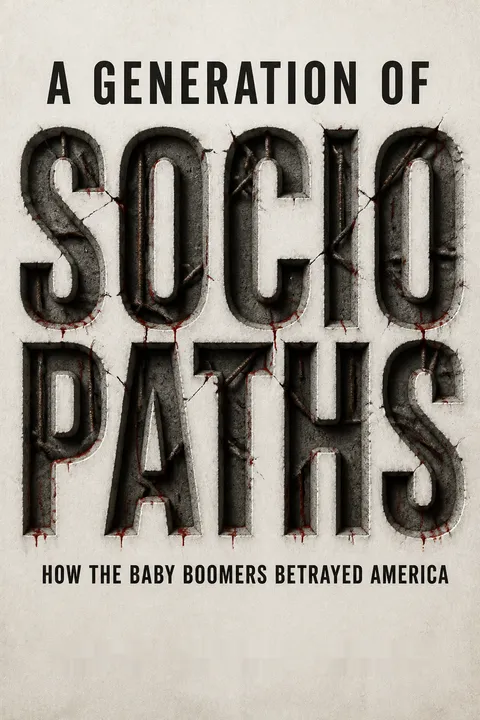
A Generation of Sociopaths receives mixed reviews, with some praising its well-researched critique of Baby Boomers' policies and their impact on future generations, while others criticize it as an oversimplification or unfair generalization. Positive reviews highlight the book's data-driven approach and thought-provoking arguments about generational selfishness. Critics argue that the author's thesis is too broad and ignores nuances within the Boomer generation. Many readers found the book engaging but controversial, sparking debates about generational responsibility and the long-term consequences of economic and social policies.
People Also Read









Glossary
Boomer sociopathy
Generational self-interest thesisGibney's term for the claim that a large share of Baby Boomers displayed a recurring pattern of self-interest, impulsivity, deceit, and disregard for consequences, both personally and through public policy. He borrows traits associated with antisocial personality disorder, but applies them as a political and moral thesis about aggregate behavior, not as a valid clinical diagnosis of every member of a generation.
Boomer neoliberalism
Market rhetoric, public backstopsGibney's label for the policy approach he associates with Boomer political dominance: deregulation, lower taxes, consumption, and reduced public investment, combined with government support when financial institutions or markets face collapse. He distinguishes this politically useful mixture from a consistent free-market doctrine, arguing that private gains were often protected while losses were shifted to the public.
deferred maintenance
Postponed upkeep and growing liabilitiesA phrase Gibney treats as a euphemism for failing to maintain public assets. Roads, bridges, water systems, schools, and other infrastructure continue to be used while repairs are postponed. The delay can raise future repair costs, reduce capacity, and increase the risk of failure. In the book's argument, the label hides a real liability even when the cost is absent from ordinary debt figures.
off balance sheet (OBS) accounting
Liabilities kept outside main statementsAccounting practices that keep certain assets, liabilities, or exposures outside an organization's primary balance sheet, often in subsidiaries, special entities, or footnotes. Such treatment can be legitimate when items belong to clients or have a distinct accounting status. Gibney emphasizes how opaque or aggressive uses can make risk difficult for investors, regulators, and the public to see, as in financial firms and government entitlement accounting.
ECA study
U.S. psychiatric prevalence surveyThe Epidemiologic Catchment Area study was a large U.S. mental-health research project conducted in the 1980s across several sites, coordinated with the National Institute of Mental Health. Gibney cites its finding that antisocial personality disorder appeared more prevalent in Boomer-age populations than in other age groups. The study measured individuals within its methods and period; its results do not by themselves establish a clinical diagnosis for an entire generation.
FAQ
What is A Generation of Sociopaths by Bruce Cannon Gibney about?
- Central Thesis: The book argues that the Baby Boomer generation, born between 1940 and 1964, has acted sociopathically, prioritizing self-interest and short-term gain over the long-term health of American society.
- Scope of Analysis: Gibney examines how Boomers shaped U.S. politics, economics, and culture, leading to national stagnation, rising inequality, and weakened democratic institutions.
- Generational Impact: The book details how Boomers used their political and economic power to lower their own tax burdens, increase debt, and preserve entitlements, shifting costs to younger generations.
- Moral and Economic Critique: Gibney frames these actions as a betrayal of intergenerational justice, using data and historical analysis to support his claims.
Why should I read A Generation of Sociopaths by Bruce Cannon Gibney?
- Unique Generational Lens: The book offers a fresh perspective on America’s decline, focusing on generational behavior rather than traditional partisan or class analysis.
- Data-Driven Critique: Gibney supports his arguments with comprehensive evidence, including economic data, policy analysis, and social behavior studies.
- Challenges Popular Narratives: The book debunks myths of Boomer moral superiority and progressive achievements, encouraging readers to question received wisdom.
- Actionable Insights: It provides concrete policy recommendations and equips readers to engage in informed civic debate and advocacy.
What are the key takeaways from A Generation of Sociopaths by Bruce Cannon Gibney?
- Boomer Self-Interest: Boomers inherited a prosperous America but chose policies that enriched themselves, increased debt, and undermined future growth and fairness.
- Erosion of Democracy: The generation weakened voting rights, allowed money to dominate politics, and contributed to disenfranchisement of minorities and youth.
- Massive Fiscal Challenges: The book estimates trillions in remediation costs for infrastructure, pensions, climate, and more, requiring urgent reform.
- Limited Moral Progress: Advances in civil rights and social justice were often delayed, uneven, or motivated by self-interest rather than altruism.
How does Bruce Cannon Gibney define "Boomer sociopathy" in A Generation of Sociopaths?
- Clinical Framework Applied: Gibney uses the DSM-V criteria for antisocial personality disorder (sociopathy) to analyze Boomer behaviors at a generational level.
- Key Traits Identified: These include disregard for others’ rights, deceitfulness, impulsivity, irresponsibility, lack of remorse, and failure to conform to social norms.
- Policy Manifestation: Boomer sociopathy is reflected in economic exploitation, political manipulation, and social neglect, as seen in their policy choices.
- Evidence-Based Argument: The book presents extensive data and historical examples to support the claim of generational sociopathy.
How did Boomer upbringing and culture contribute to sociopathic tendencies, according to A Generation of Sociopaths?
- Permissive Parenting: Influenced by Dr. Spock and other trends, Boomers were raised with less discipline, fostering entitlement and impulsivity.
- Media Influence: The rise of television and bottle-feeding are cited as factors that negatively affected cognitive development and socialization.
- Cultural Shifts: These upbringing factors produced a generation less disciplined, more self-focused, and less prepared for adult responsibilities.
- Long-Term Effects: Gibney argues these early influences set the stage for the sociopathic behaviors seen in Boomer-dominated policy and culture.
What is "Boomer neoliberalism" and how does it function in A Generation of Sociopaths by Bruce Cannon Gibney?
- Definition and Origins: Boomer neoliberalism is described as a political-economic doctrine emphasizing deregulation, consumption over production, and permanent deficits.
- Alignment with Sociopathy: This ideology fits Boomer sociopathy by prioritizing immediate gratification and shifting costs to others, especially younger generations.
- Policy Outcomes: Since the 1980s, this approach has shaped American policy across both major parties, leading to underinvestment and increased inequality.
- Long-Term Consequences: The book argues that Boomer neoliberalism has undermined economic growth, public investment, and social cohesion.
How did Baby Boomers reshape U.S. tax policy, debt, and public investment according to A Generation of Sociopaths?
- Tax Cuts Favoring Boomers: Boomers lowered marginal, capital gains, and estate taxes during their peak earning years, while increasing payroll taxes to fund their own benefits.
- Debt Accumulation: National debt ballooned as Boomers embraced deficits to fund consumption and entitlements, passing the burden to future generations.
- Deferred Maintenance: Infrastructure spending declined, leading to deteriorating public assets and missed opportunities for long-term investment.
- Tax Burden Shifts: The complexity of the tax code and enforcement reductions allowed Boomers to pay relatively less, with younger and poorer Americans shouldering more.
What are the economic and social consequences of Boomer policies in A Generation of Sociopaths by Bruce Cannon Gibney?
- Slowing Economic Growth: U.S. growth has decelerated since the 1970s, with periods of stagnation and fragile recovery.
- Rising Inequality: Wealth and income gaps have widened, with gains concentrated among older, richer households—primarily Boomers.
- Intergenerational Transfers: Boomers extracted wealth from younger generations through tax, debt, and entitlement policies, reducing social mobility.
- Social Fabric Erosion: Underfunded education, mass incarceration, and declining public investment have weakened the foundations of American society.
How does A Generation of Sociopaths by Bruce Cannon Gibney address Boomer influence on democracy and voting rights?
- Return of Voting Restrictions: Boomer-led legislatures and courts reintroduced barriers like voter ID laws and reduced polling places, disproportionately affecting minorities and youth.
- Supreme Court Decisions: Boomer appointees played key roles in gutting the Voting Rights Act, enabling restrictive state laws.
- Felony Disenfranchisement: Mass incarceration policies led to millions losing voting rights, skewing political power toward older, whiter populations.
- Party Control: Boomer dominance in party structures has made it difficult for younger and independent voters to influence candidate selection.
What does A Generation of Sociopaths by Bruce Cannon Gibney say about Boomer approaches to retirement, entitlements, and fiscal sustainability?
- Retirement Unpreparedness: Many Boomers saved inadequately, relying on Social Security, Medicare, and underfunded pensions.
- Entitlement Inequities: Social Security and Medicare benefits favor Boomers, with younger generations expected to pay more and receive less.
- Pension Crises: Both public and private pensions face insolvency, risking taxpayer bailouts and further fiscal strain.
- Sustainability Risks: The book warns that current entitlement structures are unsustainable without significant reform.
How does A Generation of Sociopaths by Bruce Cannon Gibney critique Boomer environmental and scientific policies?
- Climate Change Denial: Many Boomers have resisted acknowledging or addressing anthropogenic climate change, delaying necessary reforms.
- Underinvestment in R&D: Funding for scientific research and technological innovation has declined, limiting solutions to environmental and health challenges.
- Environmental Neglect: Boomer policies prioritized cheap consumption and offshored labor, leaving a legacy of environmental damage.
- Anti-Empiricism: The rise of anti-scientific sentiment has undermined rational debate and slowed progress on critical issues.
What solutions and reforms does Bruce Cannon Gibney propose in A Generation of Sociopaths?
- Massive Remediation Costs: The book estimates trillions needed to fix infrastructure, pensions, climate, education, and healthcare, with ongoing annual costs exceeding $1 trillion.
- Borrowing and Investment: Gibney advocates for increased government borrowing at low interest rates to fund productive investments, especially in infrastructure and education.
- Tax and Entitlement Reform: He calls for raising taxes on Boomers, increasing retirement ages, and eliminating property tax caps that favor seniors.
- Healthcare and Fiscal Reforms: Proposals include cost-benefit analyses for Medicare, rationing expensive end-of-life care, and negotiating drug prices to control spending.
Download PDF
Download EPUB
.epub digital book format is ideal for reading ebooks on phones, tablets, and e-readers.








