

Key Takeaways
Make dissent a democratic safeguard, not a test of loyalty
Debate is the book’s starting point. Kennedy writes to liberals who, in his view, accepted pandemic policies without adequately examining the evidence. He invokes Galileo, whose scientific colleagues reportedly declined to examine his telescope, as a warning about how professional consensus can become resistant to challenge. A 2021 Pew survey cited in the book found that 65 percent of Democrats supported government restrictions on some online information.
Criticism is not proof. The book argues that disagreement should invite scrutiny, not social punishment. Its central appeal is political as much as scientific: a democracy depends on citizens being able to question officials, especially when policies affect work, education, and bodily autonomy.
The strongest version of this argument is not that every dissenter is right, but that institutions need ways to discover when they are wrong. Open challenge can expose weak assumptions and conflicts of interest. Yet Galileo is an imperfect analogy: a dissident’s willingness to question authority does not establish the truth of the alternative claim. Healthy debate needs both permission to speak and standards for checking evidence, including the possibility that a claim fails scrutiny.
Judge vaccine promises by outcomes, not by slogans that keep moving
The goalposts shifted. Kennedy recalls early public claims that COVID-19 vaccines would prevent infection and transmission, then points to later admissions that vaccinated people could still become infected and spread the virus. He argues that these changes undermined public trust and weakened the case for mandates that treated vaccination status as a measure of contagiousness.
Different outcomes matter. Preventing infection, reducing transmission, and lowering the risk of severe illness are distinct claims. The book cites outbreaks among vaccinated people, including cases after a Washington, D.C., dinner and on a cruise, to challenge promises of stopping spread. It also questions claims that vaccines reduced hospitalization and death, relying heavily on comparisons of vaccinated and unvaccinated groups in several countries.
The book is right to insist that public claims be judged against the outcome they actually promise. A vaccine can fail to block infection completely yet still reduce severe outcomes, so evidence about transmission cannot settle every question about medical benefit. Clear communication should state the outcome, timeframe, population, and uncertainty being discussed. When those terms change, officials owe the public an explanation, not merely a new slogan. The same discipline applies to critics who use one kind of failure to dismiss every possible benefit.
Compare treatment and country data as clues, not causal verdicts
Kennedy offers country comparisons. He points to Haiti and Nigeria, where vaccination levels were low and reported COVID death rates were also low, and to India’s Uttar Pradesh state, which promoted ivermectin and other treatments. He contrasts these examples with the United States and argues that authorities dismissed potentially useful early treatments while favoring vaccination.
The policy dispute matters. Kennedy links the push for vaccines to emergency-use rules that, as he describes them, limited authorization when an effective existing treatment was available. But national death rates and treatment policies are comparisons across whole populations, not controlled tests. The book presents them as evidence for its case; they do not by themselves show that ivermectin or hydroxychloroquine caused better outcomes.
Cross-country differences can generate valuable questions, but they are particularly vulnerable to confounding. Age distribution, prior infection, health-care access, testing, death reporting, and timing of outbreaks can all affect apparent outcomes. This is an ecological comparison: population-level patterns do not establish what happened to individuals who received a particular treatment. The book’s most productive challenge is its demand that early-treatment evidence be examined openly. A fair assessment also compares study quality, dosage, timing, and results across the full body of evidence, rather than treating a striking national contrast as a decisive experiment.
Separate adverse-event signals from proof that a vaccine caused harm
Safety data deserve examination. Kennedy highlights reports in the Vaccine Adverse Event Reporting System, or VAERS, a voluntary US system for reporting possible vaccine-related problems. He cites 1,329,135 reports of adverse events and 241,910 reports classified as serious through July 2022. He also discusses published trial reanalyses and claims that vaccine injuries were undercounted.
A report is not a verdict. The book applies a large underreporting multiplier to estimate much higher injury and death totals. Those estimates are interpretations, not counts of confirmed vaccine-caused events. VAERS collects reports after vaccination, but a report alone cannot establish that vaccination caused the event. Kennedy argues that the number and severity of reports should have prompted stronger investigation and more transparency.
Passive reporting systems are useful for spotting unexpected patterns, especially when a new product reaches millions of people. Their weakness is that they cannot, on their own, tell investigators how often an event occurs in the general population or whether vaccination caused it. Both underreporting and reports unrelated to vaccination are possible. The responsible response is neither to treat every report as proof nor to wave the system away. Signals call for follow-up through stronger surveillance, transparent methods, and careful comparison of risks and benefits across age and health groups.
Reassess emergency rules when evidence changes and costs accumulate
Kennedy revisits early policies. He argues that masks, six-foot distancing rules, school closures, and PCR testing were treated as settled science before they had adequate support. He cites a former FDA commissioner’s description of the distancing rule as arbitrary, research on learning losses after school closures, and Anthony Fauci’s statement that PCR tests do not determine whether someone is carrying transmissible virus.
He also revisits contested claims. Kennedy says that natural immunity was stronger than vaccine-derived immunity and that a laboratory origin for the virus was plausible, positions he says had been dismissed too quickly. He further raises concern about whether mRNA could affect human DNA, citing a laboratory study of liver cells. These claims differ in evidentiary status; the book often presents them as more settled than the cited evidence warrants.
Emergency decisions are made under uncertainty, but uncertainty is not a reason to stop updating. Policies need explicit goals, measures of success, and review points, particularly when they restrict ordinary life. The book’s useful demand is that officials explain why a rule remains justified as evidence changes. Its catalogue of supposedly vindicated predictions needs more careful sorting: a policy later judged ineffective, a plausible origin hypothesis, and a laboratory result do not carry the same evidentiary weight. A sound audit preserves those distinctions instead of turning every reversal into proof of a single hidden plan.
Count children and workers among the people public-health policy must protect
The book centers indirect harm. Kennedy argues that lockdowns and school closures protected some people from infection while imposing costs on children, low-income families, and workers who could not work remotely. He cites estimates that students might return with about 70 percent of typical reading gains and less than 50 percent of typical mathematics gains. He also describes reports of increased distress among children and wider disruption to schooling and health services.
Economic consequences are part of the ledger. The book points to small-business losses, increased hardship, and the concentration of wealth among large companies and billionaires during the pandemic. These are claims about the costs of the response, not proof that every restriction caused every cited outcome. Kennedy’s broader point is that public-health success cannot be assessed by counting infections alone.
This is a crucial corrective to policy analysis that treats a single measurable outcome as the whole public good. A school closure can reduce one exposure while damaging learning, social development, and access to meals or support. Those effects are not evenly distributed, so averages can conceal who pays the price. Still, evaluating them requires careful comparisons with what would have happened without the policy, not just noting that harm followed it. The book makes a strong case for tracking collateral effects alongside disease outcomes and for directing protection toward groups with the fewest alternatives.
Demand open data before institutions ask the public for trust
Transparency is a central charge. Kennedy argues that federal agencies did not publish some COVID data that could help test their public claims. He also points to Pfizer and the FDA seeking lengthy delays in releasing vaccine trial documents, and to the Trusted News Initiative, a partnership among media organizations and technology companies that aimed to counter harmful COVID misinformation. He views these efforts as a coordinated narrowing of public debate.
Conflicts can corrode confidence. The book highlights pharmaceutical advertising, government payments to media outlets, and funding from wealthy donors as reasons to examine possible incentives. Its case is that institutions should disclose relevant data and relationships, especially when public policy and commercial interests overlap. The evidence cited varies, and the existence of funding does not by itself prove that coverage or agency decisions were controlled.
Transparency is not a public-relations gesture. It lets independent researchers test claims and helps the public distinguish a genuine evidentiary dispute from a manufactured one. The same standard should apply to agencies, companies, news organizations, and advocacy groups. Funding relationships merit disclosure, but they do not settle whether a specific claim is true. Likewise, efforts to limit demonstrably false information may have legitimate aims, yet opaque or overbroad censorship can suppress correction along with error. Trust is more durable when the rules, evidence, and decision-making process are visible.
Protect constitutional rights even when emergency policy feels urgent
Kennedy frames restrictions as a civil-liberties crisis. He argues that mandates, business closures, limits on assembly and worship, and censorship infringed constitutional protections, including speech, religious exercise, and due process. He also warns that digital tracking and the freezing of protesters’ bank accounts could normalize new forms of state power. The book connects these concerns to the growth of a security state that may use emergency powers beyond the original crisis.
Rights impose a burden of justification. In Kennedy’s view, public officials should not expect citizens to accept sweeping rules merely because they are presented as necessary. Restrictions should be examined for legal authority, proportionality, and the availability of less intrusive alternatives. The book describes many actions as constitutional violations, though legal disputes over particular rules require case-by-case analysis.
Constitutional protections matter most when fear makes exceptional powers attractive. That does not make every emergency restriction automatically unlawful; it means government should justify restrictions through lawful authority, evidence, narrow scope, and review. A useful safeguard is to ask what power is being used, who oversees it, and when it expires. Kennedy’s warning about precedents is stronger than a claim that all measures are equivalent: temporary health rules and permanent surveillance systems differ, but each deserves scrutiny before temporary arrangements become routine.
Refuse to let partisan identity choose which experts deserve scrutiny
Kennedy sees tribal politics distorting judgment. He argues that some Democrats rejected criticism of pandemic policies because it was associated with Donald Trump, while treating officials such as Anthony Fauci as beyond challenge. He says the reverse can also happen: a claim should not be accepted simply because it comes from a political opponent. The book urges liberals to apply their skepticism toward pharmaceutical companies and government agencies consistently.
The political consequence is alienation. Kennedy argues that workers and small-business owners who bore the costs of restrictions felt abandoned by a party they once saw as their advocate. When policy criticism is dismissed as partisan identity, legitimate grievances become harder to address and easier for political opportunists to exploit.
Political identity acts like a filter: it can make identical evidence seem credible or absurd depending on who presents it. The remedy is not false balance, which would give weak claims equal standing with strong ones. It is consistent standards: ask what evidence supports a claim, whether it can be checked, and what would change a proponent’s mind. The book’s appeal to liberal skepticism is most persuasive when it applies equally to government officials, pharmaceutical companies, and critics of both. No political camp owns either science or error.
Build cross-party dialogue before economic anger becomes political fuel
The closing appeal is political. Kennedy describes a growing opposition to mandates and economic inequality that he sees as racially and ideologically diverse, rather than simply a movement of one party. He warns that if mainstream liberals dismiss those concerns as right-wing grievance, the movement may be shaped by demagogues and corporate interests instead of democratic debate.
Conversation is his proposed response. He argues that people with opposing views should meet, debate evidence, and look for shared concerns about rights, livelihoods, and concentrated power. In his account, polarization distracts from the ways that political, media, technology, and pharmaceutical institutions can benefit from policies ordinary people are left to absorb.
Dialogue can reveal shared material concerns beneath partisan labels, especially when people feel that decisions were imposed without their input. It is not a substitute for evaluating claims or resolving disagreement, and an emerging protest movement is not automatically representative of everyone harmed by policy. But refusing contact leaves public grievances to the most skillful political entrepreneurs. The book’s strongest closing insight is procedural: democratic coalitions are built by listening and arguing in public, not by assuming that opponents are too irrational to deserve a hearing.
Analysis
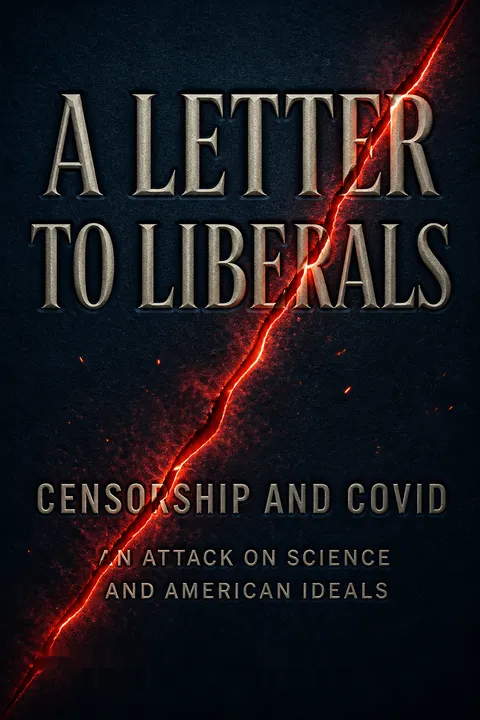
A Letter to Liberals is a 2022 political polemic organized as a challenge: Kennedy asks readers on the political left to reconsider pandemic policies, institutional authority, and the willingness to censor dissent. The letter format gives the argument a clear audience and a recurring story. Its Galileo analogy casts official consensus as a possible obstacle to discovery, while the later sections move from disputes about vaccines and treatments to children’s welfare, economic inequality, constitutional rights, and party identity.
The book’s most durable contribution is a democratic norm: emergency decisions should remain open to scrutiny, and institutions should disclose evidence, uncertainty, and conflicts of interest. Its account of policy costs also usefully widens the frame beyond infection and death to include education, work, mental health, and unequal burdens. These questions merit investigation even when a reader rejects Kennedy’s conclusions.
The main difficulty is that the text often treats unlike evidence as though it had equal force. It cites peer-reviewed studies, preprints, government statistics, media reports, advocacy sources, and population-level comparisons, then sometimes presents disputed interpretations as established facts. Country-level outcomes cannot identify the effects of a particular treatment on individuals. VAERS reports are signals for investigation, not confirmed causal totals. A laboratory finding about cells does not by itself demonstrate a change to people’s genomes. Claims about vaccine effectiveness also require separation by outcome, age, time since vaccination, and variant. The book’s extensive citations therefore do not remove the need to assess each source and method.
Its Galileo and censorship comparisons are rhetorically effective, but can blur the difference between silencing a speaker and testing a claim. A rigorous public conversation needs both protections: freedom to challenge authority and transparent standards for weighing evidence. The book is best read as an argument about distrust and democratic accountability, not as a reliable stand-alone guide to COVID medicine. Its invitation to debate is strongest when extended to its own claims as well as to the institutions it criticizes.
Review Summary
A Letter to Liberals receives mostly positive reviews, with readers praising Kennedy's well-researched arguments and dedication to truth. Many appreciate his critique of the Democratic Party's response to COVID-19 and his call for open dialogue. Reviewers highlight the book's focus on liberal values, free speech, and questioning authority. Some note its controversial nature but recommend reading it for a different perspective. Critics mention its one-sided approach and that it's more of an essay than a book. Overall, readers find it thought-provoking and relevant.
People Also Read






Glossary
Lockdown Liberalism
Liberalism tied to pandemic controlsKennedy’s critical label for liberals who supported lockdowns and other COVID-19 countermeasures, and whom he says abandoned traditional commitments to open debate, civil liberties, and skepticism toward pharmaceutical companies and government agencies. It is a rhetorical term used in the book, not a neutral or generally established name for a political movement.
Pathogenic priming
A feared harmful immune responseIn the book, pathogenic priming describes the possibility that vaccination could prompt an immune response that worsens illness after later exposure to a pathogen. Kennedy uses it in discussing concerns about COVID-19 vaccines and coronavirus research. The text also connects it with antibody-dependent enhancement, though these terms describe related concerns rather than automatically proving that such harm occurred.
Antibody-Dependent Enhancement (ADE)
Antibodies may worsen infectionAntibody-dependent enhancement is a proposed process in which antibodies from prior infection or vaccination could, under certain conditions, facilitate infection or intensify disease rather than protect against it. Kennedy cites ADE as a historical concern raised during early discussion of coronavirus vaccines. The term describes a possible biological mechanism, not evidence that a particular vaccine causes enhanced disease.
original antigenic sin (OAS)
Immune memory favors an earlier variantOriginal antigenic sin is a term used in immunology for the influence of a person’s first exposure to a pathogen on later immune responses to related variants. The book applies it to the concern that immune responses shaped by the original SARS-CoV-2 strain might be less well matched to later variants. The concept does not, by itself, establish that vaccination increases infection risk.
Vaccine Adverse Event Reporting System
US vaccine safety reporting systemVAERS is a US system that collects reports of health events occurring after vaccination. Health professionals, manufacturers, and members of the public can submit reports. It can help identify patterns that warrant investigation, but reports alone do not prove that a vaccine caused an event, establish the event’s frequency, or provide a confirmed count of vaccine injuries.
Trusted News Initiative
Media partnership against misinformationThe Trusted News Initiative is a partnership of news organizations and technology companies described in the book as working to counter harmful COVID-19 misinformation. Kennedy portrays its coordination as a mechanism for suppressing criticism of official pandemic policies. The initiative’s stated purpose and Kennedy’s criticism should be distinguished from evidence that every participating organization coordinated to censor all dissent.
Great Barrington Declaration
Statement opposing broad lockdownsThe Great Barrington Declaration is a 2020 statement by researchers who opposed broad lockdowns and proposed focusing protection on people considered most vulnerable, while allowing others to resume more normal activity. Kennedy cites it as support for targeted protection rather than restrictions on the general population. It represents a policy position in a contested public-health debate, not a settled scientific consensus.
About the Author
Other books by Robert F. Kennedy Jr.
Download PDF
Download EPUB
.epub digital book format is ideal for reading ebooks on phones, tablets, and e-readers.








