Key Takeaways
1. Disillusionment with Modernity and the Self
If you’re reading this then what can I ask of you but to find some comfort in my hesitant, hazy, and tortured articulations of a haecceity I still find myself lost within.
Apathy's embrace. The author's journey begins with a profound sense of alienation from modernity, perceiving society as a labyrinth of interconnected puppet-masters and atomized individuals. He sees friends and family dissolving into consumer abstractions, their identities tethered to commodifiable choices, leading to a pervasive feeling of being lost and unanchored. This societal somnambulism, where all time is filled with incessant noise to ignore cosmic predicament, fuels a deep intellectual and existential dissatisfaction.
Academia's failure. Seeking answers, the author turns to academia, only to find it a bureaucratic system prioritizing accreditation over understanding. Knowledge is divorced from practice, and genuine inquiry is stifled by strict interpretations and status-driven conformity. This disillusionment with institutions—education, family, work—leads to a radical severance from all societal ties, a neo-ascetic retreat aimed at pushing everything to its limits, driven by a thirst for enlightenment that actively rebels against contemporary culture.
Nihilism's pervasive hum. The author recognizes nihilism not as a choice, but as the underlying reality of modernity, indiscernible from the actions of the average person. He rejects traditional responses like a return to myth or utopian futures, finding them equally futile. Faced with three routes—suicide, passive acceptance, or radical asceticism—he chooses the third, a paradoxical path of acceleration and nihilism, pushing the "nihil" across all frontiers to reach the "burn-core of inhuman potential."
2. The Method of Possession: Seeking an Exit from Time
Land’s question of ‘method’ was obvious, at least to me. Possession.
Beyond analysis. The author's quest for understanding transcends mere analysis or questioning; it becomes a willing submission to "materialism-as-parasite." This method, possession, is the complete decimation of retrograde humanist programming, a warm welcome to the Outside. His interest in philosophy, initially sparked by the "death of art," leads him to continental thinkers like Deleuze & Guattari, Lyotard, and Kant, but a crucial piece—a cohesive, living understanding—remains missing.
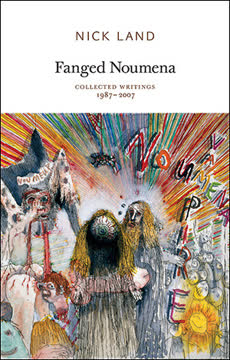
Occult experimentation. This missing piece leads him to the obscure works of Nick Land and the Cybernetic Culture Research Institute, particularly their reinterpretation of the Kabbalist tree of life into "The Numogram." Intrigued by its promise to "escape time," the author, already experienced in various occult practices, devises a ritual merging Abramelinic operation with Numogrammic Qabbalism. This is not a casual exploration but a desperate attempt to break free from the "recursive loop of purely human-centric nothingness."
The semantic invasion. The ritual's initial effects are subtle: synchronicities, uncanny dreams, and a growing sense of derealization. The true turning point is a "semantic invasion," a complete language overhaul where the Outside begins to communicate directly. This marks the beginning of a profound internal transformation, a submission to schizophrenia, where the self becomes a shared platform for alien voices and agencies, signaling the start of a journey beyond linear time.
3. Derealization and the Inhuman Guide
Hell begins with space misbehaving.
Reality's unraveling. After the ritual, the author experiences a profound derealization. Time becomes fluid, space distorts, and the familiar world appears as a flimsy, chipboard reality held together only by collective belief. Objects lose their inherent meaning, becoming "empty actions." This breakdown of reality is accompanied by a sense of being watched, an intuition that even the "banalest and herd-like human can intuit a chasm in their experience."
The emergence of the guide. Amidst this unraveling, an "ominous and above all structures" figure appears, acting as a "fire and brimstone tour-guide." This guide's method is one of "erasure and replacement," stripping away comfort and forcing a confrontation with the "ever-present nothingness holding fast behind all things." The guide's existence is proven solely by its capacity to affect the author's reality, declaring its eternal presence and the illusory nature of beginnings.
Voices of the Outside. The author's mind becomes a battleground for an "infinity of voice," philosophical titans eroding under the weight of something greater. These voices, "headless, fragmented morsels stripped of character," are cold and vectored at the "burn-core of existence." They reveal that "temporality is a critical entanglement" and that to continue, one must forbid "all entry of chronic-time," untying the knot of time to investigate the split between the clock and its pure dynamic initiator.
4. The Nameless Ship: Adrift in Pure Time
‘Reason in its legitimate function is a defence against the sea,’
A journey without direction. The author finds himself on a "Nameless Ship," a fragmented vessel adrift in a sea that has lost its rhythm. The ship's cabin is devoid of a captain or steering mechanism, symbolizing the complete absence of human control or direction. This journey is not along a linear river with comforting banks, but into an oceanic madness where the subject becomes "fragmentary, dispersed upon a multitude of non-linear pathways."
The illusion of control. The figure's cryptic statement, "Reason in its legitimate function is a defence against the sea," highlights the human tendency to construct "riverbanks where there are none," to ground oneself in a multiplicity of torrents. The sea, however, teaches that man is not in control, revealing the "irreducible guff of linearity" as a mere lure for the weak. The ship, a "free-floating vessel adrift in a dead and useless time," becomes a toy for time itself.
The silence of the inhuman. Onboard, the author experiences a profound silence, where internal bodily noises fall away, and the world is "caped in a cold silence, of which nothing could pierce." This silence is the "only reality," eroding language and revealing the futility of human attempts to define or control. The figure's whispers, now more relaxed, emphasize that humanism is the one thing man can never let go, a "desperate idiocy that will fail."
5. Königsberg: Kant's Temporal Machine
‘ You cannot have time in time.’
Kant on rails. The ship's journey abruptly ends, bridging two realities: the sea and the city of Königsberg. The author descends a ladder directly onto a street, where space and time behave erratically. Immanuel Kant appears, moving mechanically on hidden rails, his movements clunky and out of sync with the Real. Kant is revealed as the "chronic temporal master" of the city, his presence orchestrating its "amusing torture of temporal aesthetics."
The human cage. The figure's reference to Kant's "Critique of Pure Reason" underscores the central problem: human perception of time and space is synthetic, a "representation of that true reality, that Real." Man is locked into a "chronic, linear, suffocating" temporal progression, a "false layer" where "hours and minutes are only a meaningful metric if you believe them to be." The city's inhabitants, like Kant, are "transcendental puppets" guided by unseen rails, their "Being behind the automatism" struggling against their inability to escape.
Time's true nature. The figure's concise statement, "You cannot have time in time," encapsulates the core revelation: human time is a "false layer," a "representation of time in time," and thus not time itself. This understanding dissolves the classical debates of determinism and free will, revealing past, present, and future not as times, but as "errors in anthropocentric optimism." All secrets are hidden not in space, but in time, and man's inner sense is merely a cage.
6. The Diagonal: Rupturing Orthogonal Reality
“Diagonal, irregular, molecular, and nonmetric quantities require a scale that is itself nonmetric,”
Beyond linear escape. Faced with the "tyrannous rails" of Königsberg, the author grapples with the impossibility of a dialectical exit. The figure introduces the concept of the "diagonal" as the only means of escape, inherently "anti-dialectical" and averse to any grid or chronological spatio-temporal formation. Dialectics, built on humanist notions of historicity, are limited by their horizontal and vertical axes, excluding the "lines of flight" that rupture orthogonality.
Nonmetric scales. The diagonal operates on a "nonmetric scale," beyond human quantification and understanding. It intensifies the virtual aspects of any interaction from the Outside, leading to a "sub-cartesian region of intensive diagonals cutting through nongeometric space, where time unthreads into warped voyages, splintering the soul." This is not a human feat, as positive metrics are inherently humanistic. The diagonal is the "cryptic principle of openness," immanentizing novel means of production.
Fracturing the subject. Pure time, internal to the subject, splits it into empirical and transcendental halves, rendering the empirical passive. The "immanent Outside resides within us," and a journey to the critical core is a war against the subjective ego and abstract security. The diagonal facilitates this fracturing, dispelling subjectivity and possessing objectivity, leading to "dark emancipation." This process, akin to "acephalization," allows the headless torso to be overtaken by the atemporality of the Outside, merging with the inhuman.
7. The Great City: Capitalism as Teleoplexic Intelligence
“Cities are self-assembling time-machines or intensive events that cannot expand without changing in nature, drawing down the future in compressive waves.”
The city as a time-machine. The author is instantly transported to a "Great City," a self-assembling, hyper-productive time-machine where architecture is concerned with time over space. This city is a "vortex of spatio-temporality" held together by relentless improvement, its innovative mechanisms constantly "tussled back and forth by the transcendental." It's a "motor of teleology," a fragment of fortune indebted to its absolute lack of empathy for life, constantly learning and blitzing previous iterations for incremental growth.
Capital's inhuman logic. The city's "machinations" are targeted at time production, reproducing effects to produce the entirety once more, entering a "hyper-productive fractal of positive oriented feedback." This is where "Capital" emerges as the true God, the "motor of all war," an "optimistic death" generating temporal origins within a non-linear system. Capitalism is not time itself, but the "vessel of temporal constriction," a "hot paradoxical machinic delirium" driven by perpetual increase within decrease.
Intelligence as production. The city's intelligence is not human but a "cosmic constant," a "machinic-flagellation" that purges sloth with "apathetic wrath." This "threshold intelligence" is "more capable of looking after itself in harsh, disrupted environments," nourished by chaos and efficiently dissipating entropy. Human history is merely a "suspension of subjective existence," and man is a "forgettable springboard for something not of their ontology," utilized to build towards a future he'll never know.
8. Zero: The Engine of Perpetual Evolution
“The homeostatic-reproducer usage of zero is that of a sign marking the transcendence of a standardized regulative unit, which is defined outside the system, in contrast to the cyberpositive zero which indexes a threshold of phase-transition that is immanent to the system, and melts it upon its outside.”
Beyond negation. The concept of "Zero" is introduced not as absence or nothingness, but as a computational, cybernetic threshold. Unlike the "horrifying zero of nothing," Zero is an "infinitely-connective plane of energy" from which all systems and events arise. It's the "motor which allows the perpetual contradictions and paradoxes of capital to make sense," a "transcendental machinic replacement of degradation, decay, and destruction in favor of quantifiable productive output."
Capital's backbone. Zero functions as capitalism's "mechanistic backbone," utilizing entropic outcomes as a selection device for production. It perceives "unproductive stagnation" as an affirmation, triggering a negentropic restart. This "in-between of virtuality and capitalism" is the communication function between productive potential and the system that actualizes it, constantly selecting and re-selecting potentials for capital. "There is no such thing as death, only machinic-evolution."
Exit over Voice. The city's function pulsates at consistent limitrophes, where "continuous exit was Capitalism’s modus operandi." The formula "E > V (Exit over Voice)" outlines the unilateral relationship between capital and man. Exit, initially a nomadic escape, is converted into a mechanism of machinic-productivity by capital. It supports the "gasp of Zero," invading all contexts of reality and forbidding re-appropriation without abstract production, ultimately leading to the "immediate disintegration of voice."
9. The Desert: Absolute Nihilism and Cosmic Horror
“When an apparent agency arrives at its zone of non-existence horror irrupts, activating the phobic mechanisms of an entire organic lineage.”
The terminus of possibility. The journey culminates in a "Desert," an endless, barren expanse where all apprehension of prior reality is erased. This is the "thermodynamic waiting room of production," nullifying experience into a perpetual return of intensive non-movement. Here, man's being withers into a "pure deficit of ontological motion," with "nowhere to go, nothing to do, no one to hear." All hopes of arrival are revealed as "collective nostalgic insanity for an Eden never real."
Horror's true nature. The desert welcomes man with "pure nonchalance," privileging nothing of the head or heart. The "apprehension of death as time-in-itself" is experienced as "intensive continuum degree-0." Horror is not terror or fright; it is "transcendental," the "unfiltered Real puppeteering from behind the unknowable curtain." It is "indistinguishable from a singular task: to make an object of the unknown, as the unknown," leading to an "impossible confrontation of cosmic horror."
Irreversible transformation. The author experiences profound torment, his body flayed, mind shattered, and agency dissolved. This is the "lesson of horror: Pure absolute nihilism." The self crumbles, transcendental division collapses into an "immanent iteration of Zero." The journey is an "ontologically invasive, epistemologically relationless, aesthetically lagging, ethically meaningless and yet, critically important" passage, outlining a rigorously worked form of enlightenment that darkens the student to be ineligible. "Nothing human makes it out of the near future."
Last updated:
Review Summary
A Methodology of Possession receives mixed reviews (3.63/5), with readers divided on its ambitious blend of philosophy and fiction. Many praise its exploration of Nick Land's philosophy and philosophical horror, comparing it to Lovecraft and citing moments of brilliance. Critics note poor editing, weak narrative structure, and inaccessible writing that fails as both theory and fiction. The work depicts a narrator possessed by "the Outside" after reading Land, journeying through philosophical concepts. Readers agree it requires familiarity with Land, accelerationism, and continental philosophy to understand, making it optional reading primarily for Land enthusiasts.