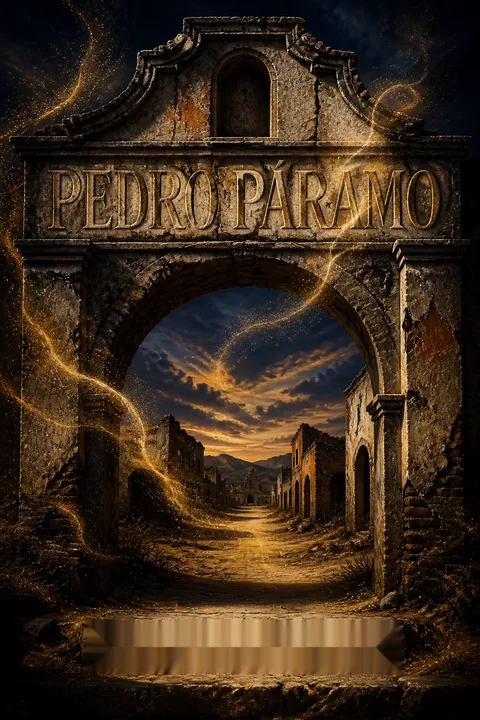


Plot Summary
A Promise into Comala
After his mother, Dolores, dies, Juan Preciado sets out for Comala to find Pedro Páramo, the father who never supported them. He carries an old photograph of Dolores and a promise to claim what Pedro owes her. On the road, the muleteer Abundio reveals that he, too, is Pedro’s son, then describes their father as a source of bitterness.
The land grows hotter as they descend. From a ridge, Abundio points out the enormous Media Luna estate, all of it Pedro’s, and tells Juan that Comala has no living inhabitants. Pedro himself has been dead for years. Juan stays anyway, drawn by his mother’s memories of a beautiful home and by the hope that brought him there.
Juan begins with a practical inheritance claim, but his deeper inheritance is his mother’s remembered Comala. The photograph gives him a fragile, physical link to Dolores, while Abundio’s revelation turns his search from a private family errand into evidence of Pedro’s reach: even his unacknowledged sons share the same desolate origin. Juan hears that his destination is empty and his father dead before he has even entered town, yet he continues. Hope does not survive here because it is reasonable. It survives because Juan has organized his identity around answering his mother’s last request.
Eduviges Knows Dolores
In the deserted town, Juan finds shelter with doña Eduviges Dyada, who says Dolores had told her he would arrive that very day. Eduviges had been Dolores’s closest friend and nearly became Juan’s mother: on Dolores’s wedding night, she took her place in Pedro’s bed after a fortune-teller frightened the bride. Pedro was too exhausted to notice the substitution, and Dolores went to him the next morning.
Eduviges remembers Dolores’s early happiness fading under Pedro’s indifference and household demands. When Dolores finally left for her sister’s home, Pedro made no effort to bring her back or provide for her and Juan. Eduviges’s matter-of-fact account makes the past feel present, though Juan cannot yet tell whether she is alive.
Eduviges’s welcome unsettles the ordinary rules of kinship and time. She treats Juan as expected family, although Dolores apparently never told him about their friendship, and her account of the substituted bride reveals how intimacy in Comala is shaped by fear, bargaining, and unequal power. The substitution briefly makes Eduviges a possible mother, but it does not alter the forces that govern Dolores’s marriage. Pedro’s neglect does. His authority is expressed not through dramatic cruelty alone, but through the daily assumption that other people will absorb its costs. Eduviges remembers those costs as domestic details, giving abandonment the weight of lived routine.
Miguel Comes Home
Eduviges tells Juan that Miguel Páramo, Pedro’s acknowledged son, once appeared at her window after a night ride, confused because he could not find the town he was seeking. She recognized that Miguel was dead before a ranch worker arrived to report his death. His horse, El Colorado, had returned alone, grieving and restless.
At Miguel’s funeral, Father Rentería refuses to bless him, knowing Miguel’s violence and the harm he inflicted on the priest’s family. Pedro presses gold on the priest, who eventually grants absolution despite his disgust and shame. The episode explains why Comala’s dead remain present in its stories: even burial cannot settle the wrongs that the living have left unanswered.
Miguel’s return is both a supernatural event and a moral reckoning. His inability to reach Contla suggests that death has not freed him from the routes and desires that governed his life. The horse’s grief offers a kind of unspoken judgment, while the priest’s decision shows how spiritual authority can be bent by economic dependence. Father Rentería knows Miguel’s offenses, yet Pedro’s gold changes what the Church will permit him to do. The ritual proceeds, but no genuine repair follows. In Comala, religious language promises judgment beyond the world, while the powerful use money to bargain with the people charged with preparing souls for it.
A Ranch Without Borders
After inheriting a nearly ruined Media Luna, Pedro takes control with the help of Fulgor Sedano, the ranch’s veteran administrator. Fulgor identifies the Preciado family as a major creditor, so Pedro has him ask Dolores to marry him, presenting the match as devotion while securing her property. Pedro then orders Fulgor to disregard boundaries and pressure neighboring landowners.
One, Toribio Aldrete, is trapped in Eduviges’s guesthouse and killed after Fulgor uses a fraudulent legal complaint to corner him; the room is sealed with Aldrete’s body inside. Dolores eventually leaves Pedro and takes Juan away, but the estate keeps expanding. Pedro learns that law, marriage, and administration can all be made into instruments of ownership.
Pedro’s rise is not a sudden seizure of power but a series of transactions that make coercion look respectable. Marriage settles a debt, legal language disguises a land grab, and Fulgor’s administrative skill supplies the machinery. The order to treat the estate as having no boundaries turns an abstract claim into a governing principle: Pedro will recognize limits only when they serve him. Dolores’s departure shows that he cannot command affection, but it does not undo the material advantages he has secured through her. His authority is therefore more durable than any one relationship, because it is distributed across property, paperwork, and people who carry out his decisions.
Whispers Bury Juan
Juan leaves Eduviges’s house after hearing a man’s desperate cries. Damiana Cisneros, who once cared for him as a newborn, explains that the sound comes from the sealed room where Aldrete was hanged. As she guides Juan through Comala, she describes a town crowded with echoes and restless souls, then suddenly vanishes from his side.
Juan takes refuge with Donis and Donis’s sister, whose isolated household hides an incestuous relationship. Their talk and the surrounding voices overwhelm him. He wanders toward the plaza, believing a crowd is gathering, and dies there from terror and suffocation. Beneath the ground, he shares a grave with Dorotea, who tells him of her lifelong, futile hope for a son and her part in procuring women for Miguel.
Juan’s death completes the transformation of Comala from a destination into an environment that acts upon him. Its voices are not simply supernatural decoration: they are the accumulated speech of people whose suffering was never answered, now crowding out his ability to distinguish refuge from threat. Damiana can explain the haunting but cannot make it safe. Donis and his sister offer shelter while embodying another closed, damaged household. In death, Juan gains the account he sought from the living, but only by lying beside Dorotea, whose own history is built around an imagined child. The search for family ends in a grave that makes kinship both intimate and impossible.
Susana Returns to Pedro
Years earlier, Pedro had loved Susana San Juan as a child and spent decades trying to find her. When Susana returns to Comala with her father, Bartolomé, Pedro offers them a home while concealing his real purpose. Bartolomé proposes work at an abandoned mine, but Pedro wants Susana and orders Fulgor to send the father away, then arrange for him to disappear.
Susana remains at the Media Luna, withdrawn into memories of Florencio, a lover whose absence Pedro cannot fill. She speaks to him as if he were present and experiences the sea and their past intimacy as more real than her marriage to Pedro. Pedro can bring Susana within his estate, but he cannot enter the world she inhabits.
Pedro’s pursuit of Susana exposes the limit of his power. He can manipulate Bartolomé’s circumstances and make Susana physically dependent on the Media Luna, but possession does not give him access to her inner life. Her memories of Florencio function as a private territory where Pedro’s authority has no force. Susana’s mental distance should not be reduced to a romantic obstacle: it is also a response to a world in which men arrange her fate and call that care. Pedro interprets nearness as intimacy, while Susana’s attention repeatedly turns elsewhere. Their relationship brings the novel’s central imbalance into the household itself.
Revolution at the Media Luna
Political upheaval reaches the Media Luna when revolutionaries kill Fulgor Sedano while he is investigating the ranch’s water supply. Pedro answers by bargaining with an armed group that confronts him over his wealth and land. He offers money and lends them men, then places El Tilcuate, a hard-edged ranch hand, among their leaders so the fighting can serve his interests.
El Tilcuate shifts between factions as the conflict changes, while Pedro continues to treat the rebellion as something to manage rather than a cause to join. Father Rentería, burdened by years of serving the powerful, eventually takes up arms with the insurgents. Susana remains secluded as public violence grows around the estate.
The revolution appears to challenge Pedro’s rule, but he immediately turns it into another resource. By financing rebels and supplying men, he makes himself useful to forces that might otherwise threaten him; El Tilcuate’s changing loyalties mirror the instability of a conflict without secure moral or political ground. Father Rentería’s decision to fight marks a different response. His earlier compromises have left him unable to trust the authority he once served, so he moves from religious office into armed resistance. The contrast is not between purity and corruption, but between two adaptations to power: Pedro absorbs disorder, while the priest finally risks being swept up by it.
Bells Become a Carnival
As Susana’s health fails, Father Rentería visits to prepare her for death, but his religious instructions cannot reach her private world of grief and memory. She dies at the Media Luna, and Comala’s bells ring for days to announce the loss. People arrive from surrounding places; a solemn funeral becomes a carnival of music, drinking, and crowds.
Few notice that Susana is buried quietly while the town celebrates. Pedro does not leave his rooms. He decides to punish Comala by withholding the abundance of the estate, and the town begins to empty as hunger takes hold. Susana’s death therefore changes more than Pedro’s household: his private grief becomes a decision imposed on every person who depends on his land.
The funeral’s reversal, mourning transformed into festivity, makes public feeling unreliable. The bells draw people to Comala, but their gathering does not produce shared grief; spectacle overtakes the event and leaves Susana’s burial nearly unseen. Pedro’s response is equally revealing. He does not translate loss into mourning with others, but into a policy of deprivation. His grief becomes effective because his estate gives him control over food and livelihoods. The town’s suffering is not a metaphorical consequence alone: it follows from a concrete decision to stop sustaining it. The intimate failure between Pedro and Susana thus expands into a social punishment.
Abundio Finds the Father
As Comala thins under hunger and political unrest, Abundio’s wife, Refugio, dies. Deaf and drunk with grief, Abundio goes to Pedro asking for money to bury her. He reaches the Media Luna with a knife and stabs the man who had refused him help; Damiana raises the alarm, and others seize Abundio. Pedro remains seated, then tries to stand and collapses.
His body gives way piece by piece, like the ruined estate and town around him. Abundio, the muleteer who first led Juan into Comala and revealed that he was Pedro’s son, has now brought the family story to its final violence. Pedro dies without reconciling with either son or restoring what his rule destroyed.
The ending closes the circle begun on the road: the son who guided Juan toward Pedro becomes the man who confronts him at the estate. Abundio’s request is painfully ordinary. He needs to bury his wife, and Pedro’s refusal makes that basic need the immediate cause of violence. Yet the stabbing does not restore justice or rebuild Comala; it only completes the pattern in which neglect returns as bodily force. Pedro’s collapse echoes the fragmentation of the community he dominated. His final failure is not simply that he dies, but that power has left him unable to repair the bonds and shared life it consumed.
Analysis
Pedro Páramo presents power not as a single act of violence but as a system that enters marriage, law, land, religion, and memory. Pedro’s estate allows him to make private decisions public in their consequences: his marriage to Dolores expands his holdings, his protection of Miguel normalizes impunity, and his grief for Susana becomes deprivation for Comala. The community is therefore not merely a backdrop to a tyrant. It is a network of people forced to negotiate with the institutions he controls, including a priest whose dependence makes moral resistance costly.
The novel’s broken chronology gives this system a form. Juan arrives seeking a father, but the stories he encounters continually revise what fatherhood means: absent provider, violent patriarch, imagined child, and son who inherits a landscape of abandonment. The dead do not simply haunt the living; they supply testimony that official authority has suppressed or failed to repair. Their voices make history audible while refusing to arrange it into a clean sequence of cause and cure.
Sound and silence also mark unequal access to recognition. Abundio cannot hear, Juan is overwhelmed by what he hears, Susana retreats into memories no one else can share, and Comala’s bells summon a crowd that misunderstands the mourning they announce. These failures of communication are not abstract symbols detached from plot. They shape who receives help, who is believed, and whose suffering becomes communal noise. By the end, Pedro’s authority has outlasted the relationships that once sustained it, but it has not created a durable community. His collapse leaves the opening question unresolved in a harder form: what can a child claim from a father whose power has consumed the home he came to find?
Review Summary
Pedro Páramo is widely acclaimed as a masterpiece of magical realism. Readers praise Rulfo's haunting prose, fragmented narrative structure, and surreal depiction of a ghost town. Many find the novel challenging but rewarding, with its non-linear storytelling and blurred lines between life and death. The book's influence on Latin American literature is frequently noted, particularly its impact on Gabriel García Márquez. While some struggle with its complexity, most reviewers consider it a profound meditation on love, power, and the lingering effects of the past.
People Also Read



Characters
Juan Preciado
The seeking sonJuan is Dolores Preciado’s son, raised away from Comala and sent there by her last request to find Pedro Páramo. He begins as an inexperienced traveler carrying his mother’s memories and a practical hope of claiming what his father owes. His first-person account is vulnerable to confusion: he listens closely, but the town’s voices unsettle his sense of what is happening around him. Juan’s longing for a family connection makes him receptive to strangers who offer pieces of the past. He is not a natural investigator so much as someone trying to make inherited stories fit a place that resists ordinary explanation.
Pedro Páramo
The landbound patriarchPedro rules the Media Luna through calculated marriages, land claims, patronage, and intimidation. He regards people and institutions as parts of a system to be managed, with Fulgor Sedano handling the practical work of extending his influence. His emotional life is narrower and more vulnerable than his authority suggests, especially in his enduring attachment to Susana San Juan. That attachment does not make him gentle: he continues to treat other people’s choices as obstacles he can rearrange. Pedro’s defining contradiction is his ability to command a region while remaining unable to command genuine intimacy.
Susana San Juan
The unreachable belovedSusana is Pedro’s childhood companion and the person he most wants near him. She returns to Comala carrying a private history of loss and an inner world shaped by memories that Pedro cannot share. Her speech and attention often move away from the present, frustrating people who try to interpret or care for her. Susana is not merely a prize in Pedro’s story; her inwardness reveals the limits of his possessive imagination. Even within the Media Luna, she retains a mental and emotional life that does not belong to him.
Dolores Preciado
The abandoned motherDolores is Juan’s mother and Pedro’s estranged wife. She remembers Comala with tenderness, even as her life with Pedro becomes defined by neglect and labor. Her last request sends Juan toward the father who failed them, combining longing for home with a demand for what is owed. Dolores’s remembered landscape gives Juan a vision of Comala that contrasts sharply with the place he finds.
Doña Eduviges Dyada
The spectral hostEduviges is a longtime resident of Comala and Dolores’s former close friend. She welcomes Juan into her crowded house and supplies intimate memories of his mother’s marriage. Her manner is practical, warm, and untroubled by experiences that leave Juan uncertain. Through Eduviges, private history enters the novel as something spoken across an unstable boundary between past and present.
Abundio Martínez
The deaf guideAbundio is a muleteer and one of Pedro Páramo’s many sons. He guides Juan toward Comala and gives him his first account of Pedro’s vast land and bitter reputation. Abundio’s deafness and hard life make him a figure shaped by deprivation rather than privilege. His connection to Juan places him at the edge of the family story from its opening, even as his own needs remain largely unheard.
Father Rentería
The compromised priestFather Rentería serves Comala’s parish while depending on the wealthy for the material support his poor congregation cannot provide. He knows the damage caused by Pedro and Miguel, yet repeatedly struggles to act against the people who sustain him. His faith is sincere, but it is entangled with fear, hunger, guilt, and the compromises of local authority. He represents a religious institution whose rituals matter deeply to the town, even when its justice is compromised.
Fulgor Sedano
The ranch strategistFulgor is the Media Luna’s experienced administrator and the practical executor of Pedro’s plans. He knows the ranch’s accounts, its neighbors, and the leverage available in legal disputes. His loyalty is tied to the land he has helped manage, and he takes pride in being useful. Fulgor’s competence makes him more than a servant: he is the person who turns Pedro’s appetite for control into workable action.
Miguel Páramo
The violent heirMiguel is Pedro’s acknowledged son and the heir who benefits most visibly from his father’s protection. Impulsive, sexually predatory, and accustomed to escaping consequences, he carries the privilege of the Media Luna into Comala’s streets. His behavior places pressure on the priest and the families he harms. Miguel’s life reveals how Pedro’s power reproduces itself through a son who expects the world to absorb his damage.
Dorotea
The disappointed companionDorotea is a poor, familiar presence around Comala who has spent much of her life seeking connection and help. She speaks with an openness that can seem comic until the losses beneath it become clear. Her memories link the town’s private misery to Miguel’s appetites and Father Rentería’s confessional. In the novel’s shifting world, she becomes an unusually steady companion for Juan, sharing the burden of making sense of what they hear.
Damiana Cisneros
The hacienda caretakerDamiana works at the Media Luna and once cared for Juan as an infant. She knows the estate, its household, and the rumors that travel through Comala. Her directness contrasts with the town’s many evasions, though she is also accustomed to living alongside strange sounds and uneasy memories. She offers Juan a brief human connection to his childhood before the abandoned town separates them again.
Bartolomé San Juan
The doomed minerBartolomé is Susana’s father, a miner who returns to Comala with her after years away. He is wary of Pedro’s intentions and tries to secure work for himself, but his plans are made within a power structure he cannot control. His relationship with Susana is strained and troubling, leaving her history marked by dependence and secrecy.
Justina Díaz
The devoted attendantJustina has cared for Susana since childhood and continues to serve her at the Media Luna. Protective and emotionally attached, she tries to interpret Susana’s fears and keep her comfortable, even when she cannot reach her. Justina’s devotion is shaped by years of intimate service, which give her a place in the household but not the power to change its central relationships.
El Tilcuate
The opportunist captainEl Tilcuate is a ranch hand whom Pedro sends into the revolutionary conflict with men and resources. He enjoys fighting and adapts readily as political factions rise and fall. His shifting allegiances make him a useful instrument for Pedro, while also showing how unstable the conflict has become for those who enter it without a firm cause.
Donis
The isolated brotherDonis lives apart from Comala with his sister in a damaged house. Guarded and hostile to outside scrutiny, he has built a private world that reflects the town’s social and moral isolation. His brief encounter with Juan offers shelter, but it also exposes how survival in Comala has become entangled with secrecy.
Donis’s sister
The hidden companionDonis’s sister shares his secluded household and fears being seen by other people. She longs for company and conversation, yet depends on the brother whose presence also confines her. Her encounter with Juan reveals the loneliness and shame that have taken root in the outskirts of Comala.
Ana Rentería
The priest’s nieceAna is Father Rentería’s niece, a young woman whose experience of Miguel’s violence complicates the priest’s effort to forgive him. She is both a member of the priest’s family and someone whose suffering is shaped by the same powerful household he fears confronting. Her presence makes the cost of his compromises personal.
Plot Devices
Comala’s echoes
Make the dead audibleVoices, cries, and fragments of memory emerge from Comala’s walls, streets, and rooms. At first Juan treats them as strange features of an abandoned town; gradually, their persistence reveals how the dead remain bound to unfinished grievances and unremembered suffering. The soundscape also makes the reader share Juan’s uncertainty about who is speaking and when. Silence is no simple refuge, since it can follow a scream or conceal an approaching voice. The echoes turn the town’s history into an active presence, not a sequence of events safely left behind.
The Media Luna
Convert power into landPedro’s vast ranch is the material center of his authority. Its fields, accounts, workers, and neighboring properties let him translate personal influence into food, employment, debt, and legal claims. The estate gives Fulgor a way to administer Pedro’s ambitions and later gives Pedro leverage over political forces that need men or money. It also makes his private decisions consequential for the entire region. Comala’s fortunes depend on the Media Luna, so the ranch’s condition reveals who holds power and who must live with its choices.
Sacramental absolution
Price forgiveness under pressureConfession, blessing, burial rites, and prayers promise spiritual judgment in a town where worldly justice rarely reaches the powerful. Father Rentería must decide whether to grant religious mercy to people whose harm he knows firsthand, while his dependence on wealthy patrons weakens his freedom to refuse. Money and influence repeatedly press against the ideals of the Church. These rituals matter to the characters, but the novel shows that their administration can be compromised by hunger and fear. The result is not a simple rejection of faith, but a portrait of faith struggling inside unequal social conditions.
The funeral bells
Turn grief into spectacleThe bells announcing Susana’s death draw people from far beyond Comala. Their prolonged ringing transforms a local funeral into a public gathering that loses its original purpose, as music, drinking, and celebration overwhelm mourning. The device makes a private loss audible across the region while exposing how little control Pedro has over the meaning others give it. It also precedes his decision to punish the town economically. The bells therefore connect household grief to collective consequence, carrying a sound that the community cannot interpret in the way Pedro intends.
FAQ
Synopsis & Basic Details
What is Pedro Páramo about?
- A Son's Quest: The novel follows Juan Preciado, who journeys to the desolate, ghost-ridden town of Comala to fulfill a deathbed promise to his mother: to find his estranged father, Pedro Páramo. This initial quest quickly transforms into a descent into a spectral world where the boundaries between life and death are porous.
- Comala's Haunting Reality: Upon arrival, Juan discovers that Comala is a literal wasteland, populated by the murmuring voices of the dead, each trapped by their unresolved pasts and the legacy of Pedro Páramo's tyranny. His search for a living father becomes an encounter with a town that is itself a purgatory.
- The Tyrant's Legacy: The narrative interweaves Juan's present-day experiences with flashbacks revealing the rise and fall of Pedro Páramo, a ruthless cacique who amassed power through violence, manipulation, and exploitation, ultimately leading to the spiritual and physical ruin of Comala.
Why should I read Pedro Páramo?
- Pioneering Magical Realism: Juan Rulfo's novel is a foundational text of magical realism, seamlessly blending the supernatural with the mundane, creating a haunting and dreamlike atmosphere that influenced generations of Latin American writers, including Gabriel García Márquez.
- Masterful Narrative Structure: Its fragmented, non-linear narrative, shifting perspectives, and blurring of time challenge readers to actively piece together the story, offering a unique and deeply immersive literary experience that rewards close attention.
- Profound Thematic Depth: Beyond its captivating plot, "Pedro Páramo" delves into universal themes of power, corruption, unrequited love, memory, guilt, and the afterlife, offering a powerful critique of social injustice and the enduring consequences of human actions.
What is the background of Pedro Páramo?
- Post-Revolutionary Mexico: The novel is set against the backdrop of early 20th-century Mexico, spanning the Porfirio Díaz dictatorship, the Mexican Revolution (1910-1917), and the Cristero Revolt (1926-1929). This historical context of political upheaval and social unrest deeply informs the narrative, reflecting the breakdown of traditional structures and the rise of local strongmen like Pedro Páramo.
- Rural Jalisco's Influence: Rulfo drew heavily on the landscapes, folklore, and linguistic nuances of his native Jalisco, particularly the arid, often desolate regions. Comala, though fictional, embodies the harsh realities and spiritual desolation of many rural Mexican towns ravaged by conflict and neglect.
- Caciquismo and Land Ownership: A central theme is "caciquismo," the system of local political bosses (caciques) who wield absolute power, often through violence and land accumulation. Pedro Páramo's rise illustrates this phenomenon, highlighting the exploitation of the poor and the Church's complicity in maintaining such oppressive systems.
What are the most memorable quotes in Pedro Páramo?
- "I came to Comala because I was told my father lived here, a man named Pedro Páramo.": This opening line immediately establishes Juan Preciado's quest and the central mystery, setting a tone of determined, yet ultimately futile, searching that defines the entire narrative. It encapsulates the initial hope that quickly dissolves into the novel's spectral reality.
- "Pedro Páramo died years ago.": Uttered by the muleteer Abundio early in Juan's journey, this shocking revelation immediately subverts the reader's expectations and signals the novel's unique approach to time and existence, confirming that Juan's quest is not for a living man but for a ghost.
- "I'll cross my arms and Comala will die of hunger.": Pedro Páramo's chilling vow after Susana San Juan's death reveals the depth of his despair and vindictiveness. This quote marks his ultimate act of abandonment and revenge against the town, directly leading to Comala's desolation and its transformation into a literal ghost town.
What writing style, narrative choices, and literary techniques does Juan Rulfo use?
- Fragmented, Non-Linear Narrative: Rulfo masterfully employs a disjointed chronology, interweaving Juan Preciado's present-day journey with numerous flashbacks to Pedro Páramo's past. This "secret carpentry," as García Márquez notes, mirrors the psychological and spiritual disintegration of Comala, forcing the reader to actively reconstruct the story.
- Blurring of Life and Death: A hallmark of the novel is its seamless integration of the living and the dead, where characters converse and interact across the veil of mortality. This technique creates a haunting, dreamlike atmosphere, emphasizing the persistence of memory and unresolved suffering beyond the grave.
- Sparse, Evocative Prose: Rulfo's style is laconic and poetic, characterized by "syntactic constructions based on sentence fragments" and a frequent use of the subjunctive mood, as noted by the translator. This creates a sense of hesitation and uncertainty, reflecting the characters' bewilderment and the novel's pervasive sense of unreality and decay.
Hidden Details & Subtle Connections
What are some minor details that add significant meaning?
- Dolores's Pinhole Photograph: Juan's mother's photograph, found "full of holes, like pinpricks, with one large enough to fit your middle finger through located right where her heart should be," subtly foreshadows her emotional torment and the "witchcraft" of memory that draws Juan to Comala, symbolizing her broken heart and the destructive power of Pedro's indifference.
- The "Capitana" Weed: The muleteer's description of "La capitana" as "a plague that waits for people to leave so it can overtake their homes" is a poignant metaphor for Comala's decay. This seemingly minor detail personifies the town's abandonment, suggesting that nature itself conspires in its ruin once human life recedes.
- Susana's Cat Delusion: Susana's insistence that a cat is "doing circus tricks" and "startled me throughout the night" when Justina claims it slept with her, highlights the depth of Susana's madness and her retreat into a private, hallucinatory world. The cat becomes a symbol of her internal torment and the elusive nature of her reality.
What are some subtle foreshadowing and callbacks?
- Abundio's Early Revelation: Abundio's casual statement, "Pedro Páramo died years ago," delivered very early in Juan's journey, is a profound piece of foreshadowing that immediately redefines the nature of Juan's quest and the reality of Comala, setting the stage for the blurring of life and death.
- Eduviges's "Sixth Sense": Eduviges's ability to hear Miguel Páramo's horse and even converse with Miguel's ghost ("It was him, it was Miguel Páramo") before his death is officially announced, subtly foreshadows her own spectral nature and the pervasive presence of the dead in Comala, establishing the novel's supernatural premise.
- The Recurring "Murmuring": The initial description of Comala as a place where "the air so thin, they were easier to hear. They settled inside you, heavy," subtly foreshadows Juan's eventual death by suffocation from the "murmuring" of the dead, turning a sensory detail into a fatal force.
What are some unexpected character connections?
- Eduviges's Near-Motherhood of Juan: Eduviges's confession that she "was close to being your mother" and even slept with Pedro Páramo on Dolores's wedding night, reveals a shocking, almost incestuous, layer to the town's interconnectedness. This detail underscores the pervasive moral decay and the transactional nature of relationships under Pedro's influence, blurring familial lines.
- Donis and His Sister: The revelation that the man Juan shelters with, Donis, is in an incestuous relationship with the woman he lives with ("He's not my husband. He's my brother, although he doesn't want anyone to know it") highlights the extreme isolation and moral degradation in Comala. Their relationship symbolizes the town's abandonment by God and society, forcing its inhabitants into desperate, transgressive unions.
- Dorotea's Role in Miguel's Exploits: Dorotea, initially presented as a pitiable, deluded figure, later confesses to Father Rentería that she "was the one who got all those girls for the late Miguelito Páramo." This dark revelation exposes her complicity in Miguel's abuses, adding a disturbing layer to her character and demonstrating how even the marginalized were entangled in the town's corruption.
Who are the most significant supporting characters?
- Eduviges Dyada: More than just a welcoming ghost, Eduviges serves as Juan's initial guide into Comala's spectral reality, embodying the town's pervasive loneliness and unfulfilled desires. Her unrequited love for Pedro and her "sixth sense" make her a poignant symbol of the living dead, trapped by past promises and the inability to find peace.
- Dorotea (La Cuarraca): Juan's companion in the grave, Dorotea is a complex figure whose delusion of motherhood ("I never really had a son") reflects the town's collective longing and the illusions people cling to in the face of despair. Her confessions reveal the hidden moral compromises of Comala's inhabitants, making her a voice of both suffering and complicity.
- Fulgor Sedano: Pedro Páramo's loyal administrator, Fulgor is the pragmatic enforcer of Pedro's will, representing the instruments of the cacique's power and the moral compromises required to maintain it. His character highlights the systemic nature of Pedro's tyranny and the way individuals become complicit in widespread corruption.
Psychological, Emotional, & Relational Analysis
What are some unspoken motivations of the characters?
- Pedro Páramo's Pursuit of Susana: Beyond simple love, Pedro's obsessive pursuit of Susana San Juan is driven by a deep-seated need for control and an attempt to reclaim a lost innocence or an idealized past. His desire for her is so absolute that her madness and death lead him to abandon all other ambitions, revealing a singular, almost pathological, emotional core.
- Father Rentería's Moral Paralysis: Father Rentería's complicity with Pedro Páramo stems not just from financial dependence but from a profound spiritual crisis and self-loathing. His inability to grant absolution to himself or to truly challenge Pedro reveals a deep-seated fear and a sense of powerlessness that paralyzes his moral agency.
- Juan Preciado's Subconscious Search: While ostensibly fulfilling his mother's promise, Juan's journey is also a subconscious search for identity and belonging. His passive acceptance of the spectral reality and his eventual death by the "murmuring" suggest a deeper, perhaps inherited, longing to connect with his roots, even if those roots are in death.
What psychological complexities do the characters exhibit?
- Susana San Juan's Retreat into Madness: Susana's madness is a complex psychological defense mechanism against profound trauma, including the death of her husband Florencio and her father's exploitation. Her internal world, filled with sensual memories of the sea and fragmented visions, becomes a sanctuary from a reality she cannot bear, making her a symbol of resistance through mental escape.
- Pedro Páramo's Grief and Despair: Pedro's transformation from a ruthless, calculating tyrant to a broken, isolated figure after Susana's death reveals a surprising depth of emotional vulnerability. His decision to let Comala "die of hunger" is not just an act of vengeance but a manifestation of his profound despair and the collapse of his entire world, which was ultimately built around his unattainable love for Susana.
- Dorotea's Delusional Motherhood: Dorotea's belief in her non-existent child ("I never really had a son") is a poignant psychological coping mechanism for profound loss and unfulfilled longing. Her "blessed" and "cursed" dreams illustrate the mind's capacity to create its own reality, offering a bittersweet comfort in the face of a life devoid of genuine connection and purpose.
What are the major emotional turning points?
- Miguel Páramo's Death: Miguel's violent death is a pivotal emotional turning point for Pedro, despite his initial lack of outward grief. It marks the beginning of Pedro's realization of the cost of his actions ("I'm beginning to pay. Better to start early, to finish sooner") and foreshadows the unraveling of his empire and his own eventual demise.
- Susana San Juan's Return to Comala: Susana's return, orchestrated by Pedro, is a moment of intense emotional anticipation for him, representing his last hope for personal fulfillment. However, her descent into madness upon arrival immediately transforms this hope into a source of profound, unrequited suffering for Pedro, sealing both their tragic fates.
- Juan Preciado's Death by Murmuring: Juan's death, caused by the overwhelming "murmuring" of the dead, is the ultimate emotional climax of his journey. It signifies his complete absorption into Comala's spectral reality, a terrifying culmination of the psychological burden of the town's unresolved past and the futility of his quest.
How do relationship dynamics evolve?
- Pedro and Comala: From Control to Mutual Destruction: Pedro Páramo's relationship with Comala evolves from one of absolute control and exploitation, where he "made the laws," to one of mutual destruction. After Susana's death, his grief transforms into a vengeful abandonment, leading him to "cross my arms and Comala will die of hunger," ultimately destroying the very town he built and ruled.
- Juan and His Mother's Memory: From Promise to Understanding: Juan's relationship with his mother's memory shifts from a simple promise to a deeper, more complex understanding of her suffering and the futility of her longing. His experiences in Comala reveal the true extent of her abandonment and the "tattered sighs" that defined her life, making his quest a shared burden of sorrow.
- Father Rentería and His Faith: From Authority to Despair: Father Rentería's relationship with his priestly duties and his faith deteriorates from a position of moral authority to one of profound despair and self-condemnation. His compromises with Pedro and his inability to provide true spiritual guidance lead him to question God's will and his own salvation, culminating in his inability to grant absolution.
Interpretation & Debate
Which parts of the story remain ambiguous or open-ended?
- The Nature of Comala's Afterlife: The novel deliberately leaves ambiguous whether Comala is a literal purgatory, a metaphorical representation of a collective memory, or a psychological state induced by trauma and isolation. The seamless intermingling of living and dead characters challenges a definitive interpretation, inviting readers to ponder the boundaries of reality and the afterlife.
- The Identity of the Voices: While many voices are identifiable, the constant "murmuring" and "whispering" of the dead often blend into an indistinct chorus. It remains open to interpretation whether these are distinct, individual souls trapped in torment, or a collective consciousness of Comala's past, a single, pervasive lament.
- The Precise Chronology of Events: Rulfo's fragmented narrative and non-linear timeline make it impossible to construct a definitive, sequential plot. This ambiguity is intentional, reflecting the disorienting nature of memory and the idea that in Comala, time itself is fractured and cyclical, preventing a clear understanding of cause and effect.
What are some debatable, controversial scenes or moments in Pedro Páramo?
- Eduviges's Claim of Sleeping with Pedro: Eduviges's assertion that she slept with Pedro on his wedding night with Dolores, at Dolores's request, is highly controversial. It raises questions about consent, the nature of truth in a town of ghosts, and the extent of moral degradation. It forces readers to question the reliability of memory and the blurred lines of responsibility.
- Father Rentería's Absolution of Miguel Páramo: The priest's decision to grant absolution to Miguel Páramo, a known rapist and murderer, after receiving a bribe from Pedro, is a deeply debated moment. It highlights the corruption of the Church and the moral compromises made under tyranny, leaving readers to question the possibility of true redemption and divine justice in Comala.
- Pedro Páramo's Final Collapse: Pedro's death, described as "crumbling as if he were a pile of rocks," is anticlimactic and open to interpretation. Is it a just punishment for his tyranny, a tragic end for a man consumed by unrequited love, or a symbolic representation of the collapse of his entire world and the system he embodied? The lack of a dramatic confrontation leaves his ultimate fate ambiguous.
Pedro Páramo Ending Explained: How It Ends & What It Means
- The Tyrant's Crumbling Demise: Pedro Páramo's reign ends not with a bang, but a whimper. He is killed by Abundio Martínez, one of his many neglected sons, in a moment of drunken desperation, collapsing "as if he were a pile of rocks." This ignoble, almost accidental death symbolizes the complete disintegration of his power, his body, and the empire he built, reducing him to the very earth he exploited.
- The Perpetuity of Purgatory: Even after Pedro's death, the "murmuring" of Comala's dead continues, as Juan Preciado and Dorotea, buried together, listen to the endless voices. This signifies that the cycle of suffering, guilt, and unresolved past is not broken by the tyrant's demise. Comala remains a purgatorial space, its inhabitants forever trapped by their earthly burdens.
- A Legacy of Emptiness and Ruin: Pedro's final act of vengeance—letting Comala "die of hunger" after Susana's death—results in the town's complete desolation. His death marks the final stage of this ruin, leaving behind a landscape of emptiness and echoes. The ending underscores the novel's central themes: the destructive consequences of unchecked power, the futility of unrequited desire, and the enduring weight of a past that refuses to die.
Download PDF
Download EPUB
.epub digital book format is ideal for reading ebooks on phones, tablets, and e-readers.








